
the Creative Commons Attribution 4.0 License.
the Creative Commons Attribution 4.0 License.
 | 17 Feb 2026
Brief communication: A century of landslide records in Calabria, southern Italy, looking for changes and trends through a dynamic analysis
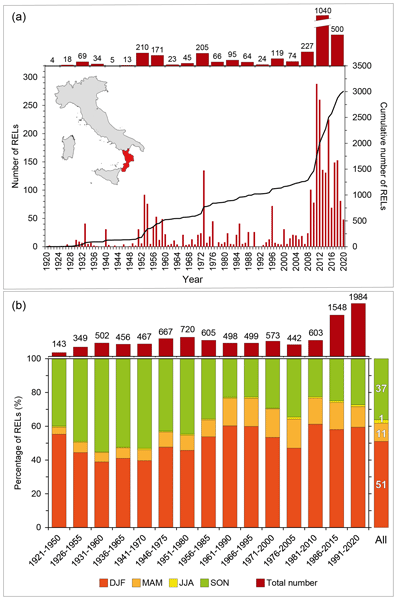
Abstract. This study updates an article published in NHESS journal in 2015 and investigates long-term changes in landslide-triggering rainfall conditions in Calabria (southern Italy) over 1921–2020. A catalogue of 3,006 rainfall events associated with landslides (RELs) was reconstructed using 9,530 landslide records and daily rainfall measurements from 318 gauges. Rainfall thresholds were calculated for 15 30-year moving windows to investigate the triggering conditions of the RELs. Results show a marked increase in the number of RELs after 2009, shifts in seasonal occurrence, and decreasing rainfall duration and cumulative amounts. Triggering rainfall shows an overall decreasing trend over the years.
Competing interests: One of the (co-)authors is a member of the editorial board of Natural Hazards and Earth System Sciences.
Publisher's note: Copernicus Publications remains neutral with regard to jurisdictional claims made in the text, published maps, institutional affiliations, or any other geographical representation in this paper. While Copernicus Publications makes every effort to include appropriate place names, the final responsibility lies with the authors. Views expressed in the text are those of the authors and do not necessarily reflect the views of the publisher.-
Notice on discussion status
The requested preprint has a corresponding peer-reviewed final revised paper. You are encouraged to refer to the final revised version.
-
Preprint
(914 KB)
-
The requested preprint has a corresponding peer-reviewed final revised paper. You are encouraged to refer to the final revised version.
- Preprint
(914 KB) - Metadata XML
- BibTeX
- EndNote
- Final revised paper


Journal article(s) based on this preprint
Interactive discussion
Status: closed
-
RC1: 'Comment on egusphere-2026-621', Francisco Dourado, 23 Feb 2026
-
AC1: 'Reply on RC1', Stefano Luigi Gariano, 20 May 2026
Reply to Reviewer #1, Francisco Dourado
Below is our reply to the comments from the reviewer #1, Francisco Dourado. We report the comments from the reviewer, followed by our replies.
We sincerely thank the reviewer for his careful review of our paper and his insightful comments.RC1: 'Comment on egusphere-2026-621', Francisco Dourado, 23 Feb 2026
The manuscript is an update of the data window (+10 years) of the paper presented by Gariano (2015). Gariano's (2015) work was an important milestone for understanding the spatial distribution of landslides and the relationship between rainfall intensity and landslides. This manuscript is an important update of this relationship between rainfall intensity and landslides.
The author points out his main doubts about the representativeness of the results (regarding the spatial and temporal distribution of the data).
R: We thank the reviewer for his positive comment on our work, and on the previous one too. Indeed, we wanted to clearly highlight the pros and cons of the data used and the results obtained.
In addition to what was indicated by the author, the following doubts remained:
The Calabria region has a very large topographic variation, and I believe that the behavior of the rainfall distribution in the western (coastal) portion of the region is different from the distribution in the eastern (coastal) region. Thus, if there was a distribution of new gauges in a given region, the climatological analysis may present an artificially forced trend. It would be important for the author to present a map showing the distribution of the gauges, highlighting the new equipment added in this study, as well as a map of average annual rainfall recalculated with the new gauges. If possible, a comparative map showing the difference between the current map and the previous map (2015) should also be presented.
R: We thank the reviewer for this comment. Indeed, the rainfall distribution along the two sides of the region is different. Regarding the rain gauge number and distribution in the region, we have checked it and we haven’t found any significant increase in the last 10-year period (2011-2020) compared to the preceding ones. Overall, only 13 new stations were installed in the region after 2011, out of a total number of 120 gauges currently operational. Of these, 8 gauges were operational only in 2016, 2017, and 2018. Figure R1 shows the number of operating rain gauges per year in Calabria between 1920 and 2020 (updating Figure 1c from Gariano et al. 2015). It can be seen that overall the number of operating rain gauges in the region has not significantly changed after the year 2000, when the network was transferred from national to regional management and when automatic stations were installed and old stations were dismissed.
Moreover, we have prepared an updated map of average annual rainfall recalculated with the new data and compared it to the previous one. Figure R2 shows the map of mean annual rainfall (MAR) in Calabria, in five classes, as published in Gariano et al. (2015) and updated with the new data. It can be noted that no significant changes can be found.
However, we are afraid that we can’t add this map into the manuscript due to the limited number of figures/tables allowed for Brief Communications in NHESS journal (https://www.natural-hazards-and-earth-system-sciences.net/about/manuscript_types.html).
(See supplement for the figures)
The question remains whether the increase in recorded landslide events is actually related to an increase in the frequency of extreme events, or whether this increase in recorded events is related to increased human occupation of the region and, consequently, an increase in the number of observers of these events
R: The reviewer points out a relevant issue in historic data collection from chronicle and technical sources over large areas, such as a whole administrative region as in our case. Indeed, our dataset is composed of landslides that have somehow caused some damage to the population, structures, and infrastructure, as to be reported in a chronicle or mentioned in technical reports. Thus, all landslides in our catalogue had some relations with (increased or decreased) human occupation of the region.
However, this limitation is widely acknowledged in literature and is intrinsic to documentary data sources, which nonetheless remain the only available source of information for reconstructing dated historical landslide events over long periods, in our case. On the other hand, geomorphological landslide inventories derived from aerial photographs or field mapping represent only a static snapshot of slope conditions at the time of the survey or image acquisition and generally do not provide an accurate date (year-month and day) for landslide initiation.
Historical documentary sources, despite their well-known limitations, make it possible to temporally constrain landslide occurrences and therefore to carry on temporal analyses and identify the potentially triggering rainfall events. This represents a key prerequisite for investigations such as the one presented in this paper, which aims to analyze the changes in rainfall conditions associated with landslide triggering.
Moreover, please note that the interpretations of changing landslide activity made in the work were mostly focused on the variations in triggering conditions rather than on the total number of landslides.References:
Gariano, S. L., Petrucci, O., and Guzzetti, F.: Changes in the occurrence of rainfall-induced landslides in Calabria, southern Italy, in the 20th century, Nat. Hazards Earth Syst. Sci., 15, 2313–2330, https://doi.org/10.5194/nhess-15-2313-2015, 2015.
-
AC1: 'Reply on RC1', Stefano Luigi Gariano, 20 May 2026
-
RC2: 'Comment on egusphere-2026-621', Bei Zhang, 29 Apr 2026
Taking the Calabria region in southern Italy as the study area, this paper systematically analyzes the spatiotemporal distribution patterns of rainfall-induced landslide events and the long-term evolutionary trends of their triggering conditions, based on a century-scale (1921–2020) landslide inventory and rainfall observation data. Overall, the study is supported by solid data, rigorous methodology, sound logic, and reliable conclusions. A few suggestions for revision are provided below for your reference:
Line 23: The opening sentence states that historical documentary data represent the principal source of information on landslide occurrences for implementing empirical models. As this is a broad statement, it would be helpful to support it with relevant references. Suitable examples include documentary/event catalogues such as FraneItalia and ITALICA e.g., Calvello and Pecoraro (2018), Peruccacci et al. (2023). In addition, recent studies that used documented landslide occurrences to define empirical rainfall thresholds for landslides in southern Italy may also be relevant, e.g., Zhang et al. (2025, 2026).
Line 110–112: The manuscript reports a considerable increase in the number of RELs starting in 2009 and notes that the last two 30-year moving windows contain more than twice as many events as the previous ones. However, the authors also acknowledge that the recent increase may be partly related to the greater availability of online information sources. I suggest discussing more explicitly how much of this increase may reflect improved reporting and data collection rather than a real increase in landslide occurrence. This distinction is important because the observed increase in RELs is later used to support broader interpretations of changing landslide activity.
Line 43–47 and Line 77–79: The use of 30-year moving windows with a 5-year step is an interesting methodological improvement compared with the previous static-period analysis. However, adjacent windows strongly overlap and therefore are not statistically independent. The authors should briefly acknowledge this dependence when interpreting temporal trends in threshold parameters and triggering rainfall conditions. This would help avoid overinterpreting small fluctuations between consecutive windows as independent temporal changes.
Line 59–62 and Line 182–193: The manuscript clearly explains that daily rainfall data were used because this is the only temporal resolution available over the full century. However, the use of daily rather than hourly rainfall data may strongly affect threshold estimation (Gariano, 2020). Although this limitation is discussed later, I suggest mentioning it earlier in the Methods or briefly in the Abstract/Conclusions. This would make clearer from the beginning that the thresholds are mainly intended for long-term comparative analysis rather than operational early warning.
Line 138–140 and Line 210–212: The conclusion that less rainfall was progressively needed to initiate landslides, and that the territory has become more prone to landslides, is interesting but should be expressed with caution. Because the landslide catalogue is based on documentary sources, changes in reporting practices, urban exposure, information availability, and source completeness may also influence the apparent triggering conditions. I suggest slightly qualifying this statement, for example by stating that the results “may indicate” or “are consistent with” an increased territorial propensity, rather than presenting it as a definitive outcome.
Figure 2 caption and Line 137–150: Please check the consistency between the text and the caption of Figure 2. The main text discusses threshold values for durations of two and four days, and Table 1 reports E at 2 days and E at 4 days. However, the caption of Figure 2 refers to “durations of one and two days.” This appears to be an inconsistency and should be corrected.
Citation: https://doi.org/10.5194/egusphere-2026-621-RC2 -
AC2: 'Reply on RC2', Stefano Luigi Gariano, 20 May 2026
Reply to Reviewer #2, Bei Zhang
Below is our reply to the comments from reviewer #2, Bei Zhang. We report the comments from the reviewer followed by our replies.
We sincerely thank the reviewer for careful review of our paper and insightful comments.
Taking the Calabria region in southern Italy as the study area, this paper systematically analyzes the spatiotemporal distribution patterns of rainfall-induced landslide events and the long-term evolutionary trends of their triggering conditions, based on a century-scale (1921–2020) landslide inventory and rainfall observation data. Overall, the study is supported by solid data, rigorous methodology, sound logic, and reliable conclusions. A few suggestions for revision are provided below for your reference:
R: We thank the reviewer for this positive comment and his careful review of our work.
Line 23: The opening sentence states that historical documentary data represent the principal source of information on landslide occurrences for implementing empirical models. As this is a broad statement, it would be helpful to support it with relevant references. Suitable examples include documentary/event catalogues such as FraneItalia and ITALICA e.g., Calvello and Pecoraro (2018), Peruccacci et al. (2023). In addition, recent studies that used documented landslide occurrences to define empirical rainfall thresholds for landslides in southern Italy may also be relevant, e.g., Zhang et al. (2025, 2026).
R: Since both of us have been working for years on historical documentary data, mostly on landslides and floods (the first author is also co-author of ITALICA), we sincerely thank the reviewer for this comment. Due to the restrictions on the number of references allowed for Brief Communication in NHESS journal, we can’t add other references – we have already reached the maximum number of 20 (https://www.natural-hazards-and-earth-system-sciences.net/about/manuscript_types.html).
If the Editor agrees, we could add the two references strictly related to landslide catalogues (FraneItalia and ITALICA) and leave out the two references on the application of documented data for the definition of prediction tools. Otherwise, if the number of references can’t be exceeded, we will leave out the four suggested references.Line 110–112: The manuscript reports a considerable increase in the number of RELs starting in 2009 and notes that the last two 30-year moving windows contain more than twice as many events as the previous ones. However, the authors also acknowledge that the recent increase may be partly related to the greater availability of online information sources. I suggest discussing more explicitly how much of this increase may reflect improved reporting and data collection rather than a real increase in landslide occurrence. This distinction is important because the observed increase in RELs is later used to support broader interpretations of changing landslide activity.
R: We agree with the reviewer; indeed, we have explicitly mentioned in several places in the text that the increase in records in recent years is certainly also linked to the greater availability of information, particularly online. On the other hand, however, there can be no increase in information about landslides unless there are landslides. Indeed, we would like to emphasize that in the decade from 2011 to 2020, the Calabria region was hit by numerous intense weather events that have caused widespread landslides in the regional territory, as we have mentioned by citing various studies (again, the number of citations has been limited to fit within the maximum allowed for Brief Communications). Therefore, it is certainly both factors that have contributed to the increase in records.
As regards the interpretations of changing landslide activity, we remark that we focused more on variations in triggering conditions than on the total number of landslides, precisely because if we had claimed that the huge number of landslides in recent years was only linked to climate change (or to any other factor without mentioning the source of information), our findings would not have been credible. Analyses of triggering conditions, using 30-year moving windows, have enabled us to obtain robust results even in the face of such variations in the amount of data.Line 43–47 and Line 77–79: The use of 30-year moving windows with a 5-year step is an interesting methodological improvement compared with the previous static-period analysis. However, adjacent windows strongly overlap and therefore are not statistically independent. The authors should briefly acknowledge this dependence when interpreting temporal trends in threshold parameters and triggering rainfall conditions. This would help avoid overinterpreting small fluctuations between consecutive windows as independent temporal changes.
R: We thank the reviewer for this insightful and constructive comment. We agree that the presented approach introduces an overlap, with around 80% of shared data between consecutive windows. Our primary goal with this dynamic analysis was to capture the long-term changing trajectory of the triggering conditions over the century, rather than interpreting minor fluctuations between consecutive windows as distinct temporal changes. To address this concern and prevent any overinterpretation of minor variations, we have added a brief clarification in the revised manuscript (Section 4, Discussion) explicitly acknowledging this statistical dependence. The new text reads: “However, it must be acknowledged that the use of 30-year windows with a 5-year step results in adjacent periods that share 25 years of overlapping data and therefore are not statistically independent. Consequently, minor fluctuations between consecutive windows should not be overinterpreted as independent temporal changes; rather, the focus of this analysis is strictly on the broad, long-term evolutionary trends observed across the entire century.”
Line 59–62 and Line 182–193: The manuscript clearly explains that daily rainfall data were used because this is the only temporal resolution available over the full century. However, the use of daily rather than hourly rainfall data may strongly affect threshold estimation (Gariano, 2020). Although this limitation is discussed later, I suggest mentioning it earlier in the Methods or briefly in the Abstract/Conclusions. This would make clearer from the beginning that the thresholds are mainly intended for long-term comparative analysis rather than operational early warning.
R: We accept this suggestion and modify the text by adding in the introduction and in the conclusions the following sentences:
“..., with the sole purpose of long-term comparative analysis and without aiming to operational landslide prediction.” (in the introduction)
“However, rainfall thresholds derived from low-resolution rainfall data (i.e., daily measurements) can be used for long-term comparative analysis but suffer from uncertainty and underestimation, which hinders their practical application in operational landslide prediction.” (in the conclusions)Line 138–140 and Line 210–212: The conclusion that less rainfall was progressively needed to initiate landslides, and that the territory has become more prone to landslides, is interesting but should be expressed with caution. Because the landslide catalogue is based on documentary sources, changes in reporting practices, urban exposure, information availability, and source completeness may also influence the apparent triggering conditions. I suggest slightly qualifying this statement, for example by stating that the results “may indicate” or “are consistent with” an increased territorial propensity, rather than presenting it as a definitive outcome.
R: We thank the reviewer for this comment - we agree with him on the caution needed in this statement. We revised the sentences accordingly.
Figure 2 caption and Line 137–150: Please check the consistency between the text and the caption of Figure 2. The main text discusses threshold values for durations of two and four days, and Table 1 reports E at 2 days and E at 4 days. However, the caption of Figure 2 refers to “durations of one and two days.” This appears to be an inconsistency and should be corrected.
R: Thank you for pointing out this issue. There was an error in the caption of Figure 2 – the correct durations are two and four days, as indicated in the main text and in Table 1. We have now corrected the error in the caption.
Citation: https://doi.org/10.5194/egusphere-2026-621-AC2
-
AC2: 'Reply on RC2', Stefano Luigi Gariano, 20 May 2026
Peer review completion


Post-review adjustments


Interactive discussion
Status: closed
-
RC1: 'Comment on egusphere-2026-621', Francisco Dourado, 23 Feb 2026
The manuscript is an update of the data window (+10 years) of the paper presented by Gariano (2015).
Gariano's (2015) work was an important milestone for understanding the spatial distribution of landslides and the relationship between rainfall intensity and landslides.
This manuscript is an important update of this relationship between rainfall intensity and landslides.The author points out his main doubts about the representativeness of the results (regarding the spatial and temporal distribution of the data).
In addition to what was indicated by the author, the following doubts remained:
The Calabria region has a very large topographic variation, and I believe that the behavior of the rainfall distribution in the western (coastal) portion of the region is different from the distribution in the eastern (coastal) region. Thus, if there was a distribution of new gauges in a given region, the climatological analysis may present an artificially forced trend. It would be important for the author to present a map showing the distribution of the gauges, highlighting the new equipment added in this study, as well as a map of average annual rainfall recalculated with the new gauges. If possible, a comparative map showing the difference between the current map and the previous map (2015) should also be presented.
The question remains whether the increase in recorded landslide events is actually related to an increase in the frequency of extreme events, or whether this increase in recorded events is related to increased human occupation of the region and, consequently, an increase in the number of observers of these events.
Citation: https://doi.org/10.5194/egusphere-2026-621-RC1 -
AC1: 'Reply on RC1', Stefano Luigi Gariano, 20 May 2026
Reply to Reviewer #1, Francisco Dourado
Below is our reply to the comments from the reviewer #1, Francisco Dourado. We report the comments from the reviewer, followed by our replies.
We sincerely thank the reviewer for his careful review of our paper and his insightful comments.RC1: 'Comment on egusphere-2026-621', Francisco Dourado, 23 Feb 2026
The manuscript is an update of the data window (+10 years) of the paper presented by Gariano (2015). Gariano's (2015) work was an important milestone for understanding the spatial distribution of landslides and the relationship between rainfall intensity and landslides. This manuscript is an important update of this relationship between rainfall intensity and landslides.
The author points out his main doubts about the representativeness of the results (regarding the spatial and temporal distribution of the data).
R: We thank the reviewer for his positive comment on our work, and on the previous one too. Indeed, we wanted to clearly highlight the pros and cons of the data used and the results obtained.
In addition to what was indicated by the author, the following doubts remained:
The Calabria region has a very large topographic variation, and I believe that the behavior of the rainfall distribution in the western (coastal) portion of the region is different from the distribution in the eastern (coastal) region. Thus, if there was a distribution of new gauges in a given region, the climatological analysis may present an artificially forced trend. It would be important for the author to present a map showing the distribution of the gauges, highlighting the new equipment added in this study, as well as a map of average annual rainfall recalculated with the new gauges. If possible, a comparative map showing the difference between the current map and the previous map (2015) should also be presented.
R: We thank the reviewer for this comment. Indeed, the rainfall distribution along the two sides of the region is different. Regarding the rain gauge number and distribution in the region, we have checked it and we haven’t found any significant increase in the last 10-year period (2011-2020) compared to the preceding ones. Overall, only 13 new stations were installed in the region after 2011, out of a total number of 120 gauges currently operational. Of these, 8 gauges were operational only in 2016, 2017, and 2018. Figure R1 shows the number of operating rain gauges per year in Calabria between 1920 and 2020 (updating Figure 1c from Gariano et al. 2015). It can be seen that overall the number of operating rain gauges in the region has not significantly changed after the year 2000, when the network was transferred from national to regional management and when automatic stations were installed and old stations were dismissed.
Moreover, we have prepared an updated map of average annual rainfall recalculated with the new data and compared it to the previous one. Figure R2 shows the map of mean annual rainfall (MAR) in Calabria, in five classes, as published in Gariano et al. (2015) and updated with the new data. It can be noted that no significant changes can be found.
However, we are afraid that we can’t add this map into the manuscript due to the limited number of figures/tables allowed for Brief Communications in NHESS journal (https://www.natural-hazards-and-earth-system-sciences.net/about/manuscript_types.html).
(See supplement for the figures)
The question remains whether the increase in recorded landslide events is actually related to an increase in the frequency of extreme events, or whether this increase in recorded events is related to increased human occupation of the region and, consequently, an increase in the number of observers of these events
R: The reviewer points out a relevant issue in historic data collection from chronicle and technical sources over large areas, such as a whole administrative region as in our case. Indeed, our dataset is composed of landslides that have somehow caused some damage to the population, structures, and infrastructure, as to be reported in a chronicle or mentioned in technical reports. Thus, all landslides in our catalogue had some relations with (increased or decreased) human occupation of the region.
However, this limitation is widely acknowledged in literature and is intrinsic to documentary data sources, which nonetheless remain the only available source of information for reconstructing dated historical landslide events over long periods, in our case. On the other hand, geomorphological landslide inventories derived from aerial photographs or field mapping represent only a static snapshot of slope conditions at the time of the survey or image acquisition and generally do not provide an accurate date (year-month and day) for landslide initiation.
Historical documentary sources, despite their well-known limitations, make it possible to temporally constrain landslide occurrences and therefore to carry on temporal analyses and identify the potentially triggering rainfall events. This represents a key prerequisite for investigations such as the one presented in this paper, which aims to analyze the changes in rainfall conditions associated with landslide triggering.
Moreover, please note that the interpretations of changing landslide activity made in the work were mostly focused on the variations in triggering conditions rather than on the total number of landslides.References:
Gariano, S. L., Petrucci, O., and Guzzetti, F.: Changes in the occurrence of rainfall-induced landslides in Calabria, southern Italy, in the 20th century, Nat. Hazards Earth Syst. Sci., 15, 2313–2330, https://doi.org/10.5194/nhess-15-2313-2015, 2015.
-
AC1: 'Reply on RC1', Stefano Luigi Gariano, 20 May 2026
-
RC2: 'Comment on egusphere-2026-621', Bei Zhang, 29 Apr 2026
Taking the Calabria region in southern Italy as the study area, this paper systematically analyzes the spatiotemporal distribution patterns of rainfall-induced landslide events and the long-term evolutionary trends of their triggering conditions, based on a century-scale (1921–2020) landslide inventory and rainfall observation data. Overall, the study is supported by solid data, rigorous methodology, sound logic, and reliable conclusions. A few suggestions for revision are provided below for your reference:
Line 23: The opening sentence states that historical documentary data represent the principal source of information on landslide occurrences for implementing empirical models. As this is a broad statement, it would be helpful to support it with relevant references. Suitable examples include documentary/event catalogues such as FraneItalia and ITALICA e.g., Calvello and Pecoraro (2018), Peruccacci et al. (2023). In addition, recent studies that used documented landslide occurrences to define empirical rainfall thresholds for landslides in southern Italy may also be relevant, e.g., Zhang et al. (2025, 2026).
Line 110–112: The manuscript reports a considerable increase in the number of RELs starting in 2009 and notes that the last two 30-year moving windows contain more than twice as many events as the previous ones. However, the authors also acknowledge that the recent increase may be partly related to the greater availability of online information sources. I suggest discussing more explicitly how much of this increase may reflect improved reporting and data collection rather than a real increase in landslide occurrence. This distinction is important because the observed increase in RELs is later used to support broader interpretations of changing landslide activity.
Line 43–47 and Line 77–79: The use of 30-year moving windows with a 5-year step is an interesting methodological improvement compared with the previous static-period analysis. However, adjacent windows strongly overlap and therefore are not statistically independent. The authors should briefly acknowledge this dependence when interpreting temporal trends in threshold parameters and triggering rainfall conditions. This would help avoid overinterpreting small fluctuations between consecutive windows as independent temporal changes.
Line 59–62 and Line 182–193: The manuscript clearly explains that daily rainfall data were used because this is the only temporal resolution available over the full century. However, the use of daily rather than hourly rainfall data may strongly affect threshold estimation (Gariano, 2020). Although this limitation is discussed later, I suggest mentioning it earlier in the Methods or briefly in the Abstract/Conclusions. This would make clearer from the beginning that the thresholds are mainly intended for long-term comparative analysis rather than operational early warning.
Line 138–140 and Line 210–212: The conclusion that less rainfall was progressively needed to initiate landslides, and that the territory has become more prone to landslides, is interesting but should be expressed with caution. Because the landslide catalogue is based on documentary sources, changes in reporting practices, urban exposure, information availability, and source completeness may also influence the apparent triggering conditions. I suggest slightly qualifying this statement, for example by stating that the results “may indicate” or “are consistent with” an increased territorial propensity, rather than presenting it as a definitive outcome.
Figure 2 caption and Line 137–150: Please check the consistency between the text and the caption of Figure 2. The main text discusses threshold values for durations of two and four days, and Table 1 reports E at 2 days and E at 4 days. However, the caption of Figure 2 refers to “durations of one and two days.” This appears to be an inconsistency and should be corrected.
Citation: https://doi.org/10.5194/egusphere-2026-621-RC2 -
AC2: 'Reply on RC2', Stefano Luigi Gariano, 20 May 2026
Reply to Reviewer #2, Bei Zhang
Below is our reply to the comments from reviewer #2, Bei Zhang. We report the comments from the reviewer followed by our replies.
We sincerely thank the reviewer for careful review of our paper and insightful comments.
Taking the Calabria region in southern Italy as the study area, this paper systematically analyzes the spatiotemporal distribution patterns of rainfall-induced landslide events and the long-term evolutionary trends of their triggering conditions, based on a century-scale (1921–2020) landslide inventory and rainfall observation data. Overall, the study is supported by solid data, rigorous methodology, sound logic, and reliable conclusions. A few suggestions for revision are provided below for your reference:
R: We thank the reviewer for this positive comment and his careful review of our work.
Line 23: The opening sentence states that historical documentary data represent the principal source of information on landslide occurrences for implementing empirical models. As this is a broad statement, it would be helpful to support it with relevant references. Suitable examples include documentary/event catalogues such as FraneItalia and ITALICA e.g., Calvello and Pecoraro (2018), Peruccacci et al. (2023). In addition, recent studies that used documented landslide occurrences to define empirical rainfall thresholds for landslides in southern Italy may also be relevant, e.g., Zhang et al. (2025, 2026).
R: Since both of us have been working for years on historical documentary data, mostly on landslides and floods (the first author is also co-author of ITALICA), we sincerely thank the reviewer for this comment. Due to the restrictions on the number of references allowed for Brief Communication in NHESS journal, we can’t add other references – we have already reached the maximum number of 20 (https://www.natural-hazards-and-earth-system-sciences.net/about/manuscript_types.html).
If the Editor agrees, we could add the two references strictly related to landslide catalogues (FraneItalia and ITALICA) and leave out the two references on the application of documented data for the definition of prediction tools. Otherwise, if the number of references can’t be exceeded, we will leave out the four suggested references.Line 110–112: The manuscript reports a considerable increase in the number of RELs starting in 2009 and notes that the last two 30-year moving windows contain more than twice as many events as the previous ones. However, the authors also acknowledge that the recent increase may be partly related to the greater availability of online information sources. I suggest discussing more explicitly how much of this increase may reflect improved reporting and data collection rather than a real increase in landslide occurrence. This distinction is important because the observed increase in RELs is later used to support broader interpretations of changing landslide activity.
R: We agree with the reviewer; indeed, we have explicitly mentioned in several places in the text that the increase in records in recent years is certainly also linked to the greater availability of information, particularly online. On the other hand, however, there can be no increase in information about landslides unless there are landslides. Indeed, we would like to emphasize that in the decade from 2011 to 2020, the Calabria region was hit by numerous intense weather events that have caused widespread landslides in the regional territory, as we have mentioned by citing various studies (again, the number of citations has been limited to fit within the maximum allowed for Brief Communications). Therefore, it is certainly both factors that have contributed to the increase in records.
As regards the interpretations of changing landslide activity, we remark that we focused more on variations in triggering conditions than on the total number of landslides, precisely because if we had claimed that the huge number of landslides in recent years was only linked to climate change (or to any other factor without mentioning the source of information), our findings would not have been credible. Analyses of triggering conditions, using 30-year moving windows, have enabled us to obtain robust results even in the face of such variations in the amount of data.Line 43–47 and Line 77–79: The use of 30-year moving windows with a 5-year step is an interesting methodological improvement compared with the previous static-period analysis. However, adjacent windows strongly overlap and therefore are not statistically independent. The authors should briefly acknowledge this dependence when interpreting temporal trends in threshold parameters and triggering rainfall conditions. This would help avoid overinterpreting small fluctuations between consecutive windows as independent temporal changes.
R: We thank the reviewer for this insightful and constructive comment. We agree that the presented approach introduces an overlap, with around 80% of shared data between consecutive windows. Our primary goal with this dynamic analysis was to capture the long-term changing trajectory of the triggering conditions over the century, rather than interpreting minor fluctuations between consecutive windows as distinct temporal changes. To address this concern and prevent any overinterpretation of minor variations, we have added a brief clarification in the revised manuscript (Section 4, Discussion) explicitly acknowledging this statistical dependence. The new text reads: “However, it must be acknowledged that the use of 30-year windows with a 5-year step results in adjacent periods that share 25 years of overlapping data and therefore are not statistically independent. Consequently, minor fluctuations between consecutive windows should not be overinterpreted as independent temporal changes; rather, the focus of this analysis is strictly on the broad, long-term evolutionary trends observed across the entire century.”
Line 59–62 and Line 182–193: The manuscript clearly explains that daily rainfall data were used because this is the only temporal resolution available over the full century. However, the use of daily rather than hourly rainfall data may strongly affect threshold estimation (Gariano, 2020). Although this limitation is discussed later, I suggest mentioning it earlier in the Methods or briefly in the Abstract/Conclusions. This would make clearer from the beginning that the thresholds are mainly intended for long-term comparative analysis rather than operational early warning.
R: We accept this suggestion and modify the text by adding in the introduction and in the conclusions the following sentences:
“..., with the sole purpose of long-term comparative analysis and without aiming to operational landslide prediction.” (in the introduction)
“However, rainfall thresholds derived from low-resolution rainfall data (i.e., daily measurements) can be used for long-term comparative analysis but suffer from uncertainty and underestimation, which hinders their practical application in operational landslide prediction.” (in the conclusions)Line 138–140 and Line 210–212: The conclusion that less rainfall was progressively needed to initiate landslides, and that the territory has become more prone to landslides, is interesting but should be expressed with caution. Because the landslide catalogue is based on documentary sources, changes in reporting practices, urban exposure, information availability, and source completeness may also influence the apparent triggering conditions. I suggest slightly qualifying this statement, for example by stating that the results “may indicate” or “are consistent with” an increased territorial propensity, rather than presenting it as a definitive outcome.
R: We thank the reviewer for this comment - we agree with him on the caution needed in this statement. We revised the sentences accordingly.
Figure 2 caption and Line 137–150: Please check the consistency between the text and the caption of Figure 2. The main text discusses threshold values for durations of two and four days, and Table 1 reports E at 2 days and E at 4 days. However, the caption of Figure 2 refers to “durations of one and two days.” This appears to be an inconsistency and should be corrected.
R: Thank you for pointing out this issue. There was an error in the caption of Figure 2 – the correct durations are two and four days, as indicated in the main text and in Table 1. We have now corrected the error in the caption.
Citation: https://doi.org/10.5194/egusphere-2026-621-AC2
-
AC2: 'Reply on RC2', Stefano Luigi Gariano, 20 May 2026
Peer review completion
Post-review adjustments
Journal article(s) based on this preprint
Viewed
| HTML | XML | Total | BibTeX | EndNote | |
|---|---|---|---|---|---|
| 875 | 386 | 92 | 1,353 | 85 | 170 |
- HTML: 875
- PDF: 386
- XML: 92
- Total: 1,353
- BibTeX: 85
- EndNote: 170
Viewed (geographical distribution)
| Country | # | Views | % |
|---|
| Total: | 0 |
| HTML: | 0 |
| PDF: | 0 |
| XML: | 0 |
- 1
Stefano Luigi Gariano

Olga Petrucci
The requested preprint has a corresponding peer-reviewed final revised paper. You are encouraged to refer to the final revised version.
- Preprint
(914 KB) - Metadata XML
The manuscript is an update of the data window (+10 years) of the paper presented by Gariano (2015).
Gariano's (2015) work was an important milestone for understanding the spatial distribution of landslides and the relationship between rainfall intensity and landslides.
This manuscript is an important update of this relationship between rainfall intensity and landslides.
The author points out his main doubts about the representativeness of the results (regarding the spatial and temporal distribution of the data).
In addition to what was indicated by the author, the following doubts remained:
The Calabria region has a very large topographic variation, and I believe that the behavior of the rainfall distribution in the western (coastal) portion of the region is different from the distribution in the eastern (coastal) region. Thus, if there was a distribution of new gauges in a given region, the climatological analysis may present an artificially forced trend. It would be important for the author to present a map showing the distribution of the gauges, highlighting the new equipment added in this study, as well as a map of average annual rainfall recalculated with the new gauges. If possible, a comparative map showing the difference between the current map and the previous map (2015) should also be presented.
The question remains whether the increase in recorded landslide events is actually related to an increase in the frequency of extreme events, or whether this increase in recorded events is related to increased human occupation of the region and, consequently, an increase in the number of observers of these events.