
the Creative Commons Attribution 4.0 License.
the Creative Commons Attribution 4.0 License.
 | 03 Mar 2026
Measured methane emissions from a metropolitan wastewater treatment lagoon in Victoria Australia are substantially higher than report emissions based on emission factors
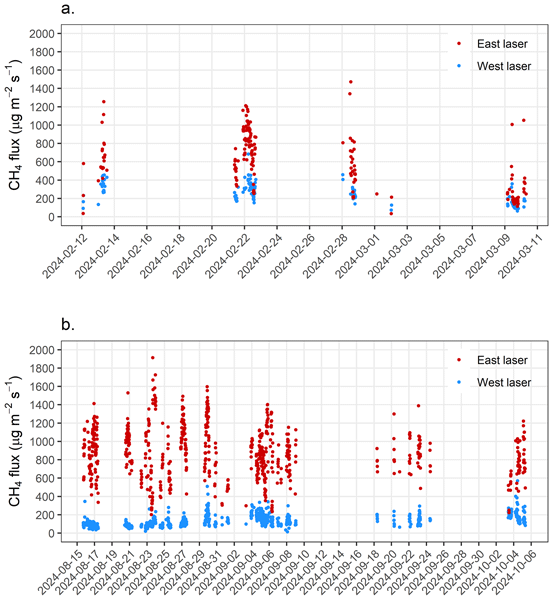
Abstract. Wastewater treatment facilities contribute ~8 % of global anthropogenic methane (CH4) emissions. Accurate measurements of CH4 emissions not only improve greenhouse gas (GHG) emission estimates from the facilities but also expand our understanding of operational impact on emissions, thus enabling the development of effective mitigation strategies. In this study, CH4 emissions were measured during summer and winter seasons at an aerobic lagoon at a large sewage treatment plant in Australia. Line-averaged CH4 concentrations were measured by open-path lasers and CH4 fluxes were calculated using inverse-dispersion modelling. Methane fluxes showed temporal and spatial variations over the measurement periods, and correlated with wastewater dissolved methane, flow rate, and aerator operation. The annual GHG emission of 79,593 tCO2-e yr-1, represents ~25 % of CH4 production captured by the anaerobic digestion pot, and is approximately 2‒3 times higher than the National Greenhouse and Energy Reporting Scheme (NGERS) reported emissions of the aerobic lagoon.
-
Notice on discussion status
The requested preprint has a corresponding peer-reviewed final revised paper. You are encouraged to refer to the final revised version.
-
Preprint
(1445 KB)
-
Supplement
(534 KB)
-
The requested preprint has a corresponding peer-reviewed final revised paper. You are encouraged to refer to the final revised version.
- Preprint
(1445 KB) - Metadata XML
-
Supplement
(534 KB) - BibTeX
- EndNote
- Final revised paper


Journal article(s) based on this preprint
Interactive discussion
Status: closed
-
RC1: 'Comment on egusphere-2026-6', Anonymous Referee #2, 24 Mar 2026
-
AC2: 'Reply on RC1', Mei Bai, 09 Jun 2026
General Comments:
The manuscript presents an interesting comparison between measured methane concentrations and reported emission factors at a large metropolitan wastewater treatment lagoon. The use of Inverse-Dispersion Modelling (IDM) with open-path lasers (OPL) is a robust approach for non-intrusive monitoring; however, the current manuscript has significant gaps regarding spatial weighting, micrometeorological artifacts, and the representativeness of the upscaled annual data. Without addressing these potential biases, the conclusion that emissions are 2–3 times higher than NGERS reports may be premature.
We thank the Reviewer for their thorough and constructive review of our manuscript. Below, we address each of the reviewer’s comments.
Specific comments:
- How does the "touchdown" coverage (mentioned as >20% in Section 2.5) vary across the pond surface? Does the weighting reflect the actual spatial concentration gradient?
It depends on the wind direction, but the source area can be seen when the wind’s direction is within a range of >330° to < 40°. This is when the measurements can be considered for representing the source emission and not contaminated by nearby sources (e.g., eastern side and western side).
As the pond is particularly large and that the downwind open-path laser parallel to the pond, that is set with a typical pathlength of about ~200 m to maintain its stability and performance, we can only sample a portion of the pond emission, in addition to limited resources, we deployed two open-path lasers downwind the pond, by dividing the pond into two half, one laser can be focused on the pond area close to the anaerobic pod and the other one in contrast to the western side of the pond.
The touchdown coverage varies with wind direction and atmospheric conditions. We also analysed its spatial distribution. The footprints showing its spatial distribution indicate which parts of the lagoon contributed to the OPL-IDM estimate for each laser path.
However, the footprint does not provide spatially resolved concentrations within the sampled area. For each laser path and time step, we obtain one aggregated estimate for the area sampled by that footprint. Therefore, the footprint tells us where the measurement is coming from, but not how methane concentration varies within that area.
The weighting does not represent a measured spatial concentration gradient. Instead, it is used to scale the two aggregated estimates, one from the west footprint and one from the east footprint to the full lagoon area. We clarified this in the revised text and assessed the sensitivity of the full lagoon estimate to alternative weights.
- Is the 8:00 AM peak a result of a biological process, or is it a micrometeorological artifact caused by the breakup of the nocturnal boundary layer? At 8:00 AM, the atmosphere often transitions from stable to unstable, which can "dump" accumulated methane toward the sensors. In the early morning, the "surface layer" might not be fully developed. Are you seeing a real biological emission peak, or is it just the "fumigation" of methane trapped near the water surface overnight being released as the sun hits the pond?
This diurnal pattern on the eastern pond area, with peak emission at ~8:00, was associated with operation activities (aerator on/off and influent flow rate high/low) rather than micrometeorological artifact. A similar diurnal pattern has also been reported in the literature (Mannina et al., 2018; Bühler et al., 2022; Guisasola et al., 2008). Ebullition (bubbling) and diffusion (dissolved methane in the effluent) are the dominant pathways of methane emissions and can be influenced by a range of locations-specific, biotic and abiotic factors.
As sewage from the anaerobic digestion pod enter the Pond 1, the influent is saturated with dissolved methane. When the aerators are switched on, they not only rapidly strip dissolved methane from the water surface to the atmosphere but also generate turbulence in the sediment-water system in the pond, contributing to diffuse emission from the lower to the up layers of the pond and ultimately to the atmosphere. The influent flow rate plays an important role in regulating methane emissions: it exhibits a similar 24-hr diurnal variation as CH4 emissions but with a time lag of 1-2 hrs. Furthermore, other studies suggest the peak emission in the morning could be due to the sewage system, where higher methane production with longer retention time in the effluent, and methane could also accumulate in sediments (Guisasola et al., 2008). If aerators are turned off in the afternoon, methane could build up overnight and then be released the following morning when aeration resumes (Bühler et al., 2022).
- I am wondering why a simple linear weighting (0.67/0.33) is superior to a more robust spatial interpolation. If the wind direction shifts even slightly, the "footprint" of what those lasers "see" changes drastically. Did you perform a sensitivity analysis on those weights?
We agree that wind direction affects the area represented by each laser path. This is why we used the IDM footprints to interpret the two OPL measurements. However, a full spatial interpolation of methane concentrations across the lagoon is not possible with these data.
The method gives a single aggregated estimate for the area sampled by each laser path, that is, the laser footprint. We do not have spatially resolved concentrations within the footprints. At each time step, we therefore have two aggregated estimates for two different parts of the lagoon, not many point measurements that could be used to build a concentration map.
Applying a spatial interpolation method in this setting would require assumptions about the spatial autocorrelation structure, which cannot be estimated from only two aggregated observations per time step, and about emissions in unsampled portions of the lagoon. This would mostly be extrapolation rather than interpolation. For this reason, we used a simple weighting approach to scale the two estimates to the full lagoon. This method is transparent and does not imply more spatial detail than the data can support.
We also tested how sensitive the results were to the chosen weights. The main estimate used the 0.67/0.33 weighting, but we also recalculated emissions using 0.75/0.25 and 0.5/0.5. We report the results as a range, with 0.67/0.33 used as the most representative case based on the relative areas represented by the west and east laser footprints.
- Was the background laser (OPLC34) moved to account for different northerly wind angles (e.g., NNE vs. NNW)? If not, the (C/Q)sim could be biased by "dirty" upwind air that wasn't properly subtracted.
The background laser position was not moved during the summer and winter measurements. To the north of the pond (NNE-NNW) there was short grass adjacent to the pond, and a corn field a few hundred meters away; because the land cover was similar, the background condition remained stable during our measurements, and methane emissions from the corn field can be considered negligible compared with the large source of aerated pond.
Furthermore, downwind CH4 concentrations on the western and eastern side of Pond 1 varied with time, while the background concentration on northern side of the pond remained constant at ~1.9 ppm under northerly winds. During the summer campaign, enhancement in CH4 concentrations under northerly wind conditions were 3.6 ppm (western area) and 10.8 ppm (eastern area). During the winter campaign the averaged enhancements measured by laser 33 (western laser) and laser 1013 (eastern laser) was 2.3 ppm and 13.5 ppm, respectively. These enhanced downwind concentrations measured by both lasers were much higher than the change in background concentration.
Importantly, we applied filtering criteria to ensure that the periods with unreasonable (and high) values from the upwind, which do not represent the true background of the pond, are not included in the flux calculations: the difference in background concentration between the simulated background level and the measured one (upwind) is < 20 ppb, and wind directions >330° or < 40°.
- Did the cross-calibration (Section 2.2) account for the difference in lower-detection limits between the two brands? If the "East" laser is less precise, the uncertainty in the "high emission" zone is actually higher than in the "low emission" West zone.
Yes, this is an important point. We deliberately matched each instrument to the expected concentration range at its location. The higher-precision Unisearch laser (< 1 ppb at 100 m) was used in the western low-emission zone and the Boreal laser (~20 ppb at 100 m) in the eastern high-emission zone.
In practice, concentrations at both sites were well above detection limits throughout the campaign.
At the western site, the Unisearch laser measured enhancements of 0.12‒10.8 ppm in winter and 0.96‒14 ppm in summer, at least >100 time above its detection limit of <1 ppb. At the eastern site, enhanced concentrations ranged at 2.1‒34 ppm in winter and 1.2‒57 ppm in summer, or at least >50 times the Boreal laser's detection limit of 20 ppb.
Ultimately, instrument precision contributed negligibly to the total uncertainty in our flux estimates. Because flux is derived from a large number of measurements, random instrument noise averages out (SE = SD/sqrt(n), where n is the number of measurements), contributing only 0.02% of total flux uncertainty, which, as reported in the manuscript, is dominated by uncertainty in the wind dispersion model (~20%).
- You calculated an annual emission based on a 5-week summer campaign and a 7-week winter campaign. But wastewater chemistry (BOD/COD) and microbial activity aren't just seasonal; they are operational. Was the "flow rate" or "aerator schedule" during these 12 weeks truly representative of the other 40 weeks of the year? If the facility had a "high load" period during their measurement window, the "2–3 times higher than NGERS" claim might be an overestimation of the annual total.
The flow rate of wastewater and aerator schedule had significant variations on a diurnal timeframe as discussed in the paper.
While there are some minor seasonal changes between summer and winter in the flow of COD through Pond1, these variations are not very significant to the overall results of the paper.
There were not changes to normal operations or unusually high loads during the 5 week and 7 week campaigns and results indicated that a longer campaign would be of little benefit. Furthermore, due to budget constraints a longer campaign period was not possible.References
Bühler, M., Häni, C., Ammann, C., Brönnimann, S., and Kupper, T.: Using the inverse dispersion method to determine methane emissions from biogas plants and wastewater treatment plants with complex source configurations, Atmospheric Environment: X, 13, 100161, https://doi.org/10.1016/j.aeaoa.2022.100161, 2022.
Guisasola, A., de Haas, D., Keller, J., and Yuan, Z.: Methane formation in sewer systems, Water Research, 42, 1421-1430, https://doi.org/10.1016/j.watres.2007.10.014, 2008.
Mannina, G., Butler, D., Benedetti, L., Deletic, A., Fowdar, H., Fu, G., Kleidorfer, M., McCarthy, D., Steen Mikkelsen, P., Rauch, W., Sweetapple, C., Vezzaro, L., Yuan, Z., and Willems, P.: Greenhouse gas emissions from integrated urban drainage systems: Where do we stand?, Journal of Hydrology, 559, 307-314, https://doi.org/10.1016/j.jhydrol.2018.02.058, 2018.
-
AC2: 'Reply on RC1', Mei Bai, 09 Jun 2026
-
RC2: 'Comment on egusphere-2026-6', Anonymous Referee #1, 28 Apr 2026
This manuscript presents direct methane flux measurements from an aerobic wastewater treatment lagoon and compares the observed fluxes with inventory-based estimates. The topic is important because wastewater lagoons remain poorly constrained sources of methane, and field measurements are still limited in the literature. The dataset has potential value, and the paper addresses a relevant gap for greenhouse gas accounting. However, in its current form, I think the manuscript requires major revision before publication. The main conclusions are potentially important, but several aspects of the analysis and interpretation need stronger justification. In particular, the representativeness of the measurements, uncertainty treatment, site characterization, and extrapolation to broader inventory implications require more detailed discussion.
My Specific comments are as follows:
- What motivated the authors to study an aerobic pond instead of an anaerobic pond, given that the latter could be a larger concern for methane production? Is it possible to provide any comparison between these two types of ponds?
- The atmospheric transport model is 3-dimensional. However, the authors’ measurements only happened at ground level. How could this fact be addressed in uncertainty analysis? Could drone-based vertical measurement of methane concentrations improve the credibility of the emission rate estimation?
- The measurement only happened in Summer and Winter, which was not representative enough for the annual case. Also, the manuscript would benefit from a clearer justification of whether the monitoring period is representative of longer-term methane emissions.
- In L151-L154, could you elaborate more on how the WindTrax model works, instead of treating it like a black box? What assumptions does the model use? What uncertainties does it bring? And does it work equally well on point source and areal source?
- In L151-L154, did the authors treat the entire pond as a homogeneous areal source? If so, what uncertainty can that bring?
- In L182, what does “stratified sampling” mean?
Citation: https://doi.org/10.5194/egusphere-2026-6-RC2 -
AC1: 'Reply on RC2', Mei Bai, 09 Jun 2026
This manuscript presents direct methane flux measurements from an aerobic wastewater treatment lagoon and compares the observed fluxes with inventory-based estimates. The topic is important because wastewater lagoons remain poorly constrained sources of methane, and field measurements are still limited in the literature. The dataset has potential value, and the paper addresses a relevant gap for greenhouse gas accounting. However, in its current form, I think the manuscript requires major revision before publication. The main conclusions are potentially important, but several aspects of the analysis and interpretation need stronger justification. In particular, the representativeness of the measurements, uncertainty treatment, site characterization, and extrapolation to broader inventory implications require more detailed discussion.
We thank the Reviewer for the thorough and constructive review of our manuscript. Below, we address each of the reviewer’s comments.
My Specific comments are as follows:
- What motivated the authors to study an aerobic pond instead of an anaerobic pond, given that the latter could be a larger concern for methane production? Is it possible to provide any comparison between these two types of ponds?
Pond 1 is largely an anaerobic pond and to some degree there are aerobic processes as well due to the surface aerators. However, the surface aerators only cover a small percentage of the entire pond area and do not deliver a satisfactory dissolved oxygen level that enables the categorising the Pond 1 as an aerobic pond. Other research using hoods and a mobile CH4 sensor have shown that the Pond 1s have by far the highest CH4 emissions at the WTP and therefore are the largest concern with respect to CH4 emissions. This is because they are the first ponds after the covered anaerobic pots where anaerobic digestion of raw sewage takes place. Effluent from the anaerobic pots is saturated with dissolved methane, once agitated and/or under different atmospheric pressure (in Pond 1), releases CH4 emissions to the environment. Wastewater in the downstream facultative ponds such as Pond 2 has a much lower COD than in Pond 1, and Pond 2 typically emits less than 1/10 of the CH4 emissions compared to Pond 1.
- The atmospheric transport model is 3-dimensional. However, the authors’ measurements only happened at ground level. How could this fact be addressed in uncertainty analysis? Could drone-based vertical measurement of methane concentrations improve the credibility of the emission rate estimation?
The IDM is an inverse-dispersion, surface-layer model. In our study the pond-to-sensor distance was within 300 m, which is appropriate for a surface-layer model: emission plume emitted from the pond can be sampled by the ground-level sensor before it rises above the surface layer and escapes detection from the sensor.
In the previous section we described flux footprint. For each 15-minute period we used WindTrax to generate 150,000 Monte Carlo replicates to simulate the origin points of discrete particles (i.e., touchdowns) that might have contributed to the flux (in practice these particles are generated from the measurement to the source, hence WindTrax is said to be an inverse dispersion model). To determine the source area for each 15-minute measurement, we first filter the touchdowns that fall outside the pond (as they correspond to background concentrations). We aggregate the touchdowns into 10 by 10 m raster cells. We count the number of touchdowns per cell. As is customary in footprint analysis, we then estimate the footprint area as the area contributing to 80% of the touchdowns that fall within the pond (Kljun et al., 2015).
The anaerobic pond was treated as an area source, and the inverse-dispersion model was used to measure gas emissions from the pond. IDM has been well reported in the literature, it requires the horizontal concentration difference between the upwind and downwind of the pond, coupled with three-dimensional wind variables to characterize the atmospheric turbulence. Each measurement technique has advantages and limitations, and emission estimates could be substantial differences using different measurement approaches, due to their spatial footprint and capability of long-term measurement. Using drone technique is a top-down measurement approach. It may be well suitable for targeting emission hotspots within a complex source configuration, but footprint is usually limited by the flying height due to nationwide regulations of flying zone. It is usually used for mobile survey and data quality assessment but spatial interpretability of concentration changes relies on wind regime and atmospheric stability (Dash et al., 2026). Therefore, interfering emission sources, shorter period on site, and requirement of consistent weather conditions limit the use of this method (Gong et al., 2023; De Jong et al., 2026). Recently Flesch et al. (2023) used IDM technique coupled with concentrations measured by uncrewed aerial vehicle (UAV) to quantify CH4 flux from waste pond.
- The measurement only happened in Summer and Winter, which was not representative enough for the annual case. Also, the manuscript would benefit from a clearer justification of whether the monitoring period is representative of longer-term methane emissions.
I agree with the reviewer’s comment. A longer-term measurement would be ideal; however, the funding was short and resources are limited, importantly the snapshot measurement can indicate seasonal emissions variability. Our measurements in each season obtained over 25% valid data over the measurement period, which is sufficient to represent the emissions status.
- In L151-L154, could you elaborate more on how the WindTrax model works, instead of treating it like a black box? What assumptions does the model use? What uncertainties does it bring? And does it work equally well on point source and areal source?
Sure, WindTrax is a software (www.thunderbeachscientific.com) based on the backward Lagrangian stochastic dispersion (bLs) model for calculating gas emission rate from a source area (Flesch et al., 1995). It is described in a few scientific publications (e.g., (Usepa); Wilson et al. (2012); Bai et al. (2025)), and has a substantial record of use with IDM(Bai et al., 2023).It includes a graphical interface that creates a map showing the target source and sensor locations, including sensor heights. By default, WindTrax releases 50,000 trajectories from 30 points- particles distributed along the measurement path. Trajectories travel in the dispersion plume upwind, starting at the senor position backwards towards the source surface; some trajectories intersect with the source surface, while others avoid the source surface. When trajectories touch the ground, surface information including the particle’s touchdown position and vertical velocity (x,y,w) is recorded.
WindTrax uses the bLs method, which is based on Monin-Obukhov Similarity Theory (MOST), and simulates the relationship between concentration and emission rate, (C/Q)sim, based on the vertical velocity of the trajectories (w0) that infers the pond surface (“touchdown”).
(C/Q)sim = 1/N Σ|2/w0|
Where (C/Q)sim is the simulated relationship ratio, N is the total number of particles released, w0 is the vertical ‘touchdown’ velocity, which is the function of u* (friction velocity, m s-1), L (Obukhov stability length, m), z0 (surface roughness length, m) and β (average wind direction). These parameters can be derived from a 3-D sonic anemometer. The summation includes all ‘touchdown’ trajectories within the source area from each release point.
Assuming a horizontally homogenous surface layer (Flesch et al., 2004), and given the downwind concentration increase above the background level (Cdownwind-Cupwind), the unknown source emission rate (e.g., the effluent pond) QIDM is determined using:
QIDM = ΔC/ (C/Q)sim
Where QIDM is the pond emission rate,ΔC is the concentration enhancement between upwind (background) Cupwind and downwind Cdownwind, ΔC = Cdownwind-Cupwind,(C/Q)sim is the simulated concentration and emission rate relationship ratio, it is associated with source geometry, wind variables, surface layer meteorology, and the sensor coordinates.
Wind variables, including ambient temperature and pressure, and the standard deviations of the velocity fluctuations in the three directional components (σu,v,w), can be derived from a 3-D sonic anemometer.
As the IDM is based on the Monin–Obukhov similarity theory (MOST), which assumes a horizontally homogenous terrain with no tree lines, tall buildings, or other nearby sources, it also requires a well-defined, spatially uniform source area. As a result, the accuracy of the IDM can be sensitive to the conditions that are not ideal (for example, wind complexity or a non-uniform source area) (Gao et al., 2010). Bai (2010) discussed several factors that contribute to the Windtrax uncertainty, such as the number of trajectories releases, the number of particles distributed along the measurement path, the averaging interval for flux estimates, the distance of the sensors to the source, and boundary layer stability. Flesch et al. (2007) noted that in many situations MOST may not be well adapted, accurate IDM calculation can be obtained with assumptions of winds under ideal conditions. Harper et al. (2010) and Laubach and Kelliher (2005) reported uncertainties of approximately 10% and 20% in IDM flux estimates, respectively. Wilson et al. (2001) tested IDM accuracy by introducing disturbed winds around a lagoon to create wind complexity and found good agreement between IDM and a mass-balance method, and the IDM measurements were within 15% of the true emission rate. Bühler et al. (2021) reported an uncertainty range of 14-21% when using IDM coupled with line-average concentrations in a dairy cow study but rising to as much as 36% when external sources were included. However, in this study we applied filtering criteria so that external sources are not included in the flux calculation. An average of 20% uncertainty from IDM simulation is applied in our uncertainty estimation.
The IDM technique has been shown to offer the efficiency (over survey approach), simplicity (single gas concentration sensor and basic wind information) and flexibility (any location at any arbitrary shape). IDM techniques are suitable for well-defined surface source; however, for some point sources, such as flares, leaky pipes, biodigesters, or a barn, small animal pen, it can be challenging because they create wind complexity. Flesch et al. (2011) approved to overcome these complications by adjusting the distance between sensor and point source until concentration is measured far enough so that the IMD is insensitive to the complications. As a rule of thumb for a single source, the distance from the point source should be ten times the height of the largest wind obstacle, and roughly two times the maximum distance between potential sources. The IDM method has also been widely used in intensive feedlots and grazing dairy cows where individual cattle is treated as a point source, but a group of cattle can be treated as a source area.
- In L151-L154, did the authors treat the entire pond as a homogeneous areal source? If so, what uncertainty can that bring?
No. We did not treat the entire pond as one homogeneous source. The two OPL paths sampled two different footprint areas, one associated with the west laser and one with the east laser. At each time step, each footprint gives one aggregated estimate for the area it samples. This does not mean that emissions within the footprint are homogeneous, only that the method measures an average response over that footprint.
To scale these estimates to the full lagoon, we used a weighted average of the west and east estimates, where the weights represent the relative lagoon areas associated with each laser footprint. The uncertainty from this scaling was assessed using a sensitivity analysis with different weights. We report the resulting range in the manuscript.
- In L182, what does “stratified sampling” mean?
Stratified sampling means that the lagoon was divided into different sampling groups, or strata, before calculating the overall estimate. In our case, the strata correspond to the west and east footprint areas sampled by the two laser paths. Each stratum was represented by its own OPL-IDM estimate, and the full-lagoon estimate was then calculated by weighting these estimates according to the relative area represented by each footprint. This is a common approach in survey sampling when different parts of a study area are sampled separately and then combined using weights.
References
Bai, M.: Methane emissions from livestock measured by novel spectroscopic techniques, PhD School of Chemistry, University of Wollongong, University of Wollongong, NSW, Australia, 303 pp., 2010.
Bai, M., Wang, Z., Lloyd, J., Seneviratne, D., Flesch, T., Yuan, Z., and Chen, D.: Long-term onsite monitoring of a sewage sludge drying pan finds methane emissions consistent with IPCC default emission factor, Water research X, 19, 100184, https://doi.org/10.1016/j.wroa.2023.100184, 2023.
Bai, M., Wang, Z., Seneviratne, D., Lloyd, J., De Jong, P., Ye, L., and Chen, D.: Substantial ammonia emissions from sludge drying pans in wastewater treatment plants, Nature Water, 10.1038/s44221-025-00479-8, 2025.
Bühler, M., Häni, C., Ammann, C., Mohn, J., Neftel, A., Schrade, S., Zähner, M., Zeyer, K., Brönnimann, S., and Kupper, T.: Assessment of the inverse dispersion method for the determination of methane emissions from a dairy housing, Agricultural and Forest Meteorology, 307, 108501, https://doi.org/10.1016/j.agrformet.2021.108501, 2021.
Dash, S. S., Coates, T. W., and Madramootoo, C. A.: UAV-Based Measurements of Methane Enhancements Reveal Hotspot Structure and Wind Effects, Environmental Science & Technology, 60, 13980-13996, 10.1021/acs.est.5c18173, 2026.
de Jong, P., Srinamasivayam, B., Harrison, A., Wardrop, P., Rebsdorf, M., Thorgaard, S., and Vale, P.: Methane emissions monitoring at wastewater treatment plants in Europe and Australia, Water research X, 30, 100480, https://doi.org/10.1016/j.wroa.2025.100480, 2026.
Flesch, T. K., Desjardins, R. L., and Worth, D.: Fugitive methane emissions from an agricultural biodigester, Biomass and Bioenergy, 35, 3927-3935, https://doi.org/10.1016/j.biombioe.2011.06.009, 2011.
Flesch, T. K., Wilson, J. D., and Yee, E.: Backward-time Lagrangian stochastic dispersion models and their application to estimate gaseous emissions, J. Appl. Meteorol., 34, 1320-1332, 10.1175/1520-0450(1995)034<1320:BTLSDM>2.0.CO;2, 1995.
Flesch, T. K., Harper, L. A., Coates, T. W., and Carlson, P. J.: Estimation of gas emissions from a waste pond using micrometeorological approaches: Footprint sensitivities and complications, Atmospheric Environment: X, 19, 100219, https://doi.org/10.1016/j.aeaoa.2023.100219, 2023.
Flesch, T. K., Wilson, J. D., Harper, L. A., Crenna, B. P., and Sharpe, R. R.: Deducing ground-to-air emissions from observed trace gas concentrations: A field trial, J. Appl. Meteorol., 43, 487-502, 10.1175/1520-0450(2004)043<0487:DGEFOT>2.0.CO;2, 2004.
Flesch, T. K., Wilson, J. D., Harper, L. A., Todd, R. W., and Cole, N. A.: Determining ammonia emissions from a cattle feedlot with an inverse dispersion technique, Agr. Forest Meteorol., 144, 139-155, 2007.
Gao, Z., Desjardins, R. L., and Flesch, T. K.: Assessment of the uncertainty of using an inverse-dispersion technique to measure methane emissions from animals in a barn and in a small pen, Atmospheric Environment, 44, 3128-3134, https://doi.org/10.1016/j.atmosenv.2010.05.032, 2010.
Gong, S., Schinteie, R., Crooke, E., and Midgley, D. J.: Methane contributions from holding ponds– a desktop study to dentify emissions potential and controls in CSG holding ponds and aquatic systems in Queensland, CSIRO, AustraliaEP2023‐2256, 2023.
Harper, L. A., Flesch, T. K., Weaver, K. H., and Wilson, J. D.: The Effect of Biofuel Production on Swine Farm Methane and Ammonia Emissions, J. Environ. Qual., 39, 1984-1992, https://doi.org/10.2134/jeq2010.0172, 2010.
Kljun, N., Calanca, P., Rotach, M. W., and Schmid, H. P.: A simple two-dimensional parameterisation for Flux Footprint Prediction (FFP), Geosci. Model Dev., 8, 3695-3713, 10.5194/gmd-8-3695-2015, 2015.
Laubach, J. and Kelliher, F. M.: Methane emissions from dairy cows: Comparing open-path laser measurements to profile-based techniques, Agri. Forest Meteorol. , 135, 340-345, 2005.
USEPA: EPA Handbook: Optical Remote Sensing for Measurement and Monitoring of Emissions Flux, 2011.
Wilson, J. D., Flesch, T. K., and Crenna, B. P.: Estimating Surface-Air Gas Fluxes by Inverse Dispersion Using a Backward Lagrangian Stochastic Trajectory Model, in: Lagrangian Modeling of the Atmosphere, 149-162, https://doi.org/10.1029/2012GM001269, 2012.
Wilson, J. D., Flesch, T. K., and Harper, L. A.: Micro-meteorological methods for estimating surface exchange with a disturbed windflow, Agricultural and Forest Meteorology, 107, 207-225, https://doi.org/10.1016/S0168-1923(00)00238-0, 2001.
Peer review completion


Interactive discussion
Status: closed
-
RC1: 'Comment on egusphere-2026-6', Anonymous Referee #2, 24 Mar 2026
General Comments:
The manuscript presents an interesting comparison between measured methane concentrations and reported emission factors at a large metropolitan wastewater treatment lagoon. The use of Inverse-Dispersion Modelling (IDM) with open-path lasers (OPL) is a robust approach for non-intrusive monitoring; however, the current manuscript has significant gaps regarding spatial weighting, micrometeorological artifacts, and the representativeness of the upscaled annual data. Without addressing these potential biases, the conclusion that emissions are 2–3 times higher than NGERS reports may be premature.
Specific comments:
1. How does the "touchdown" coverage (mentioned as >20% in Section 2.5) vary across the pond surface? Does the weighting reflect the actual spatial concentration gradient?
2. Is the 8:00 AM peak a result of a biological process, or is it a micrometeorological artifact caused by the breakup of the nocturnal boundary layer? At 8:00 AM, the atmosphere often transitions from stable to unstable, which can "dump" accumulated methane toward the sensors. In the early morning, the "surface layer" might not be fully developed. Are you seeing a real biological emission peak, or is it just the "fumigation" of methane trapped near the water surface overnight being released as the sun hits the pond?
3. I am wondering why a simple linear weighting (0.67/0.33) is superior to a more robust spatial interpolation. If the wind direction shifts even slightly, the "footprint" of what those lasers "see" changes drastically. Did you perform a sensitivity analysis on those weights?
4. Was the background laser (OPLC34) moved to account for different northerly wind angles (e.g., NNE vs. NNW)? If not, the (C/Q)sim could be biased by "dirty" upwind air that wasn't properly subtracted.
5. Did the cross-calibration (Section 2.2) account for the difference in lower-detection limits between the two brands? If the "East" laser is less precise, the uncertainty in the "high emission" zone is actually higher than in the "low emission" West zone.
6. You calculated an annual emission based on a 5-week summer campaign and a 7-week winter campaign. But wastewater chemistry (BOD/COD) and microbial activity aren't just seasonal; they are operational. Was the "flow rate" or "aerator schedule" during these 12 weeks truly representative of the other 40 weeks of the year? If the facility had a "high load" period during their measurement window, the "2–3 times higher than NGERS" claim might be an overestimation of the annual total.
Citation: https://doi.org/10.5194/egusphere-2026-6-RC1 -
AC2: 'Reply on RC1', Mei Bai, 09 Jun 2026
General Comments:
The manuscript presents an interesting comparison between measured methane concentrations and reported emission factors at a large metropolitan wastewater treatment lagoon. The use of Inverse-Dispersion Modelling (IDM) with open-path lasers (OPL) is a robust approach for non-intrusive monitoring; however, the current manuscript has significant gaps regarding spatial weighting, micrometeorological artifacts, and the representativeness of the upscaled annual data. Without addressing these potential biases, the conclusion that emissions are 2–3 times higher than NGERS reports may be premature.
We thank the Reviewer for their thorough and constructive review of our manuscript. Below, we address each of the reviewer’s comments.
Specific comments:
- How does the "touchdown" coverage (mentioned as >20% in Section 2.5) vary across the pond surface? Does the weighting reflect the actual spatial concentration gradient?
It depends on the wind direction, but the source area can be seen when the wind’s direction is within a range of >330° to < 40°. This is when the measurements can be considered for representing the source emission and not contaminated by nearby sources (e.g., eastern side and western side).
As the pond is particularly large and that the downwind open-path laser parallel to the pond, that is set with a typical pathlength of about ~200 m to maintain its stability and performance, we can only sample a portion of the pond emission, in addition to limited resources, we deployed two open-path lasers downwind the pond, by dividing the pond into two half, one laser can be focused on the pond area close to the anaerobic pod and the other one in contrast to the western side of the pond.
The touchdown coverage varies with wind direction and atmospheric conditions. We also analysed its spatial distribution. The footprints showing its spatial distribution indicate which parts of the lagoon contributed to the OPL-IDM estimate for each laser path.
However, the footprint does not provide spatially resolved concentrations within the sampled area. For each laser path and time step, we obtain one aggregated estimate for the area sampled by that footprint. Therefore, the footprint tells us where the measurement is coming from, but not how methane concentration varies within that area.
The weighting does not represent a measured spatial concentration gradient. Instead, it is used to scale the two aggregated estimates, one from the west footprint and one from the east footprint to the full lagoon area. We clarified this in the revised text and assessed the sensitivity of the full lagoon estimate to alternative weights.
- Is the 8:00 AM peak a result of a biological process, or is it a micrometeorological artifact caused by the breakup of the nocturnal boundary layer? At 8:00 AM, the atmosphere often transitions from stable to unstable, which can "dump" accumulated methane toward the sensors. In the early morning, the "surface layer" might not be fully developed. Are you seeing a real biological emission peak, or is it just the "fumigation" of methane trapped near the water surface overnight being released as the sun hits the pond?
This diurnal pattern on the eastern pond area, with peak emission at ~8:00, was associated with operation activities (aerator on/off and influent flow rate high/low) rather than micrometeorological artifact. A similar diurnal pattern has also been reported in the literature (Mannina et al., 2018; Bühler et al., 2022; Guisasola et al., 2008). Ebullition (bubbling) and diffusion (dissolved methane in the effluent) are the dominant pathways of methane emissions and can be influenced by a range of locations-specific, biotic and abiotic factors.
As sewage from the anaerobic digestion pod enter the Pond 1, the influent is saturated with dissolved methane. When the aerators are switched on, they not only rapidly strip dissolved methane from the water surface to the atmosphere but also generate turbulence in the sediment-water system in the pond, contributing to diffuse emission from the lower to the up layers of the pond and ultimately to the atmosphere. The influent flow rate plays an important role in regulating methane emissions: it exhibits a similar 24-hr diurnal variation as CH4 emissions but with a time lag of 1-2 hrs. Furthermore, other studies suggest the peak emission in the morning could be due to the sewage system, where higher methane production with longer retention time in the effluent, and methane could also accumulate in sediments (Guisasola et al., 2008). If aerators are turned off in the afternoon, methane could build up overnight and then be released the following morning when aeration resumes (Bühler et al., 2022).
- I am wondering why a simple linear weighting (0.67/0.33) is superior to a more robust spatial interpolation. If the wind direction shifts even slightly, the "footprint" of what those lasers "see" changes drastically. Did you perform a sensitivity analysis on those weights?
We agree that wind direction affects the area represented by each laser path. This is why we used the IDM footprints to interpret the two OPL measurements. However, a full spatial interpolation of methane concentrations across the lagoon is not possible with these data.
The method gives a single aggregated estimate for the area sampled by each laser path, that is, the laser footprint. We do not have spatially resolved concentrations within the footprints. At each time step, we therefore have two aggregated estimates for two different parts of the lagoon, not many point measurements that could be used to build a concentration map.
Applying a spatial interpolation method in this setting would require assumptions about the spatial autocorrelation structure, which cannot be estimated from only two aggregated observations per time step, and about emissions in unsampled portions of the lagoon. This would mostly be extrapolation rather than interpolation. For this reason, we used a simple weighting approach to scale the two estimates to the full lagoon. This method is transparent and does not imply more spatial detail than the data can support.
We also tested how sensitive the results were to the chosen weights. The main estimate used the 0.67/0.33 weighting, but we also recalculated emissions using 0.75/0.25 and 0.5/0.5. We report the results as a range, with 0.67/0.33 used as the most representative case based on the relative areas represented by the west and east laser footprints.
- Was the background laser (OPLC34) moved to account for different northerly wind angles (e.g., NNE vs. NNW)? If not, the (C/Q)sim could be biased by "dirty" upwind air that wasn't properly subtracted.
The background laser position was not moved during the summer and winter measurements. To the north of the pond (NNE-NNW) there was short grass adjacent to the pond, and a corn field a few hundred meters away; because the land cover was similar, the background condition remained stable during our measurements, and methane emissions from the corn field can be considered negligible compared with the large source of aerated pond.
Furthermore, downwind CH4 concentrations on the western and eastern side of Pond 1 varied with time, while the background concentration on northern side of the pond remained constant at ~1.9 ppm under northerly winds. During the summer campaign, enhancement in CH4 concentrations under northerly wind conditions were 3.6 ppm (western area) and 10.8 ppm (eastern area). During the winter campaign the averaged enhancements measured by laser 33 (western laser) and laser 1013 (eastern laser) was 2.3 ppm and 13.5 ppm, respectively. These enhanced downwind concentrations measured by both lasers were much higher than the change in background concentration.
Importantly, we applied filtering criteria to ensure that the periods with unreasonable (and high) values from the upwind, which do not represent the true background of the pond, are not included in the flux calculations: the difference in background concentration between the simulated background level and the measured one (upwind) is < 20 ppb, and wind directions >330° or < 40°.
- Did the cross-calibration (Section 2.2) account for the difference in lower-detection limits between the two brands? If the "East" laser is less precise, the uncertainty in the "high emission" zone is actually higher than in the "low emission" West zone.
Yes, this is an important point. We deliberately matched each instrument to the expected concentration range at its location. The higher-precision Unisearch laser (< 1 ppb at 100 m) was used in the western low-emission zone and the Boreal laser (~20 ppb at 100 m) in the eastern high-emission zone.
In practice, concentrations at both sites were well above detection limits throughout the campaign.
At the western site, the Unisearch laser measured enhancements of 0.12‒10.8 ppm in winter and 0.96‒14 ppm in summer, at least >100 time above its detection limit of <1 ppb. At the eastern site, enhanced concentrations ranged at 2.1‒34 ppm in winter and 1.2‒57 ppm in summer, or at least >50 times the Boreal laser's detection limit of 20 ppb.
Ultimately, instrument precision contributed negligibly to the total uncertainty in our flux estimates. Because flux is derived from a large number of measurements, random instrument noise averages out (SE = SD/sqrt(n), where n is the number of measurements), contributing only 0.02% of total flux uncertainty, which, as reported in the manuscript, is dominated by uncertainty in the wind dispersion model (~20%).
- You calculated an annual emission based on a 5-week summer campaign and a 7-week winter campaign. But wastewater chemistry (BOD/COD) and microbial activity aren't just seasonal; they are operational. Was the "flow rate" or "aerator schedule" during these 12 weeks truly representative of the other 40 weeks of the year? If the facility had a "high load" period during their measurement window, the "2–3 times higher than NGERS" claim might be an overestimation of the annual total.
The flow rate of wastewater and aerator schedule had significant variations on a diurnal timeframe as discussed in the paper.
While there are some minor seasonal changes between summer and winter in the flow of COD through Pond1, these variations are not very significant to the overall results of the paper.
There were not changes to normal operations or unusually high loads during the 5 week and 7 week campaigns and results indicated that a longer campaign would be of little benefit. Furthermore, due to budget constraints a longer campaign period was not possible.References
Bühler, M., Häni, C., Ammann, C., Brönnimann, S., and Kupper, T.: Using the inverse dispersion method to determine methane emissions from biogas plants and wastewater treatment plants with complex source configurations, Atmospheric Environment: X, 13, 100161, https://doi.org/10.1016/j.aeaoa.2022.100161, 2022.
Guisasola, A., de Haas, D., Keller, J., and Yuan, Z.: Methane formation in sewer systems, Water Research, 42, 1421-1430, https://doi.org/10.1016/j.watres.2007.10.014, 2008.
Mannina, G., Butler, D., Benedetti, L., Deletic, A., Fowdar, H., Fu, G., Kleidorfer, M., McCarthy, D., Steen Mikkelsen, P., Rauch, W., Sweetapple, C., Vezzaro, L., Yuan, Z., and Willems, P.: Greenhouse gas emissions from integrated urban drainage systems: Where do we stand?, Journal of Hydrology, 559, 307-314, https://doi.org/10.1016/j.jhydrol.2018.02.058, 2018.
-
AC2: 'Reply on RC1', Mei Bai, 09 Jun 2026
-
RC2: 'Comment on egusphere-2026-6', Anonymous Referee #1, 28 Apr 2026
This manuscript presents direct methane flux measurements from an aerobic wastewater treatment lagoon and compares the observed fluxes with inventory-based estimates. The topic is important because wastewater lagoons remain poorly constrained sources of methane, and field measurements are still limited in the literature. The dataset has potential value, and the paper addresses a relevant gap for greenhouse gas accounting. However, in its current form, I think the manuscript requires major revision before publication. The main conclusions are potentially important, but several aspects of the analysis and interpretation need stronger justification. In particular, the representativeness of the measurements, uncertainty treatment, site characterization, and extrapolation to broader inventory implications require more detailed discussion.
My Specific comments are as follows:
- What motivated the authors to study an aerobic pond instead of an anaerobic pond, given that the latter could be a larger concern for methane production? Is it possible to provide any comparison between these two types of ponds?
- The atmospheric transport model is 3-dimensional. However, the authors’ measurements only happened at ground level. How could this fact be addressed in uncertainty analysis? Could drone-based vertical measurement of methane concentrations improve the credibility of the emission rate estimation?
- The measurement only happened in Summer and Winter, which was not representative enough for the annual case. Also, the manuscript would benefit from a clearer justification of whether the monitoring period is representative of longer-term methane emissions.
- In L151-L154, could you elaborate more on how the WindTrax model works, instead of treating it like a black box? What assumptions does the model use? What uncertainties does it bring? And does it work equally well on point source and areal source?
- In L151-L154, did the authors treat the entire pond as a homogeneous areal source? If so, what uncertainty can that bring?
- In L182, what does “stratified sampling” mean?
Citation: https://doi.org/10.5194/egusphere-2026-6-RC2 -
AC1: 'Reply on RC2', Mei Bai, 09 Jun 2026
This manuscript presents direct methane flux measurements from an aerobic wastewater treatment lagoon and compares the observed fluxes with inventory-based estimates. The topic is important because wastewater lagoons remain poorly constrained sources of methane, and field measurements are still limited in the literature. The dataset has potential value, and the paper addresses a relevant gap for greenhouse gas accounting. However, in its current form, I think the manuscript requires major revision before publication. The main conclusions are potentially important, but several aspects of the analysis and interpretation need stronger justification. In particular, the representativeness of the measurements, uncertainty treatment, site characterization, and extrapolation to broader inventory implications require more detailed discussion.
We thank the Reviewer for the thorough and constructive review of our manuscript. Below, we address each of the reviewer’s comments.
My Specific comments are as follows:
- What motivated the authors to study an aerobic pond instead of an anaerobic pond, given that the latter could be a larger concern for methane production? Is it possible to provide any comparison between these two types of ponds?
Pond 1 is largely an anaerobic pond and to some degree there are aerobic processes as well due to the surface aerators. However, the surface aerators only cover a small percentage of the entire pond area and do not deliver a satisfactory dissolved oxygen level that enables the categorising the Pond 1 as an aerobic pond. Other research using hoods and a mobile CH4 sensor have shown that the Pond 1s have by far the highest CH4 emissions at the WTP and therefore are the largest concern with respect to CH4 emissions. This is because they are the first ponds after the covered anaerobic pots where anaerobic digestion of raw sewage takes place. Effluent from the anaerobic pots is saturated with dissolved methane, once agitated and/or under different atmospheric pressure (in Pond 1), releases CH4 emissions to the environment. Wastewater in the downstream facultative ponds such as Pond 2 has a much lower COD than in Pond 1, and Pond 2 typically emits less than 1/10 of the CH4 emissions compared to Pond 1.
- The atmospheric transport model is 3-dimensional. However, the authors’ measurements only happened at ground level. How could this fact be addressed in uncertainty analysis? Could drone-based vertical measurement of methane concentrations improve the credibility of the emission rate estimation?
The IDM is an inverse-dispersion, surface-layer model. In our study the pond-to-sensor distance was within 300 m, which is appropriate for a surface-layer model: emission plume emitted from the pond can be sampled by the ground-level sensor before it rises above the surface layer and escapes detection from the sensor.
In the previous section we described flux footprint. For each 15-minute period we used WindTrax to generate 150,000 Monte Carlo replicates to simulate the origin points of discrete particles (i.e., touchdowns) that might have contributed to the flux (in practice these particles are generated from the measurement to the source, hence WindTrax is said to be an inverse dispersion model). To determine the source area for each 15-minute measurement, we first filter the touchdowns that fall outside the pond (as they correspond to background concentrations). We aggregate the touchdowns into 10 by 10 m raster cells. We count the number of touchdowns per cell. As is customary in footprint analysis, we then estimate the footprint area as the area contributing to 80% of the touchdowns that fall within the pond (Kljun et al., 2015).
The anaerobic pond was treated as an area source, and the inverse-dispersion model was used to measure gas emissions from the pond. IDM has been well reported in the literature, it requires the horizontal concentration difference between the upwind and downwind of the pond, coupled with three-dimensional wind variables to characterize the atmospheric turbulence. Each measurement technique has advantages and limitations, and emission estimates could be substantial differences using different measurement approaches, due to their spatial footprint and capability of long-term measurement. Using drone technique is a top-down measurement approach. It may be well suitable for targeting emission hotspots within a complex source configuration, but footprint is usually limited by the flying height due to nationwide regulations of flying zone. It is usually used for mobile survey and data quality assessment but spatial interpretability of concentration changes relies on wind regime and atmospheric stability (Dash et al., 2026). Therefore, interfering emission sources, shorter period on site, and requirement of consistent weather conditions limit the use of this method (Gong et al., 2023; De Jong et al., 2026). Recently Flesch et al. (2023) used IDM technique coupled with concentrations measured by uncrewed aerial vehicle (UAV) to quantify CH4 flux from waste pond.
- The measurement only happened in Summer and Winter, which was not representative enough for the annual case. Also, the manuscript would benefit from a clearer justification of whether the monitoring period is representative of longer-term methane emissions.
I agree with the reviewer’s comment. A longer-term measurement would be ideal; however, the funding was short and resources are limited, importantly the snapshot measurement can indicate seasonal emissions variability. Our measurements in each season obtained over 25% valid data over the measurement period, which is sufficient to represent the emissions status.
- In L151-L154, could you elaborate more on how the WindTrax model works, instead of treating it like a black box? What assumptions does the model use? What uncertainties does it bring? And does it work equally well on point source and areal source?
Sure, WindTrax is a software (www.thunderbeachscientific.com) based on the backward Lagrangian stochastic dispersion (bLs) model for calculating gas emission rate from a source area (Flesch et al., 1995). It is described in a few scientific publications (e.g., (Usepa); Wilson et al. (2012); Bai et al. (2025)), and has a substantial record of use with IDM(Bai et al., 2023).It includes a graphical interface that creates a map showing the target source and sensor locations, including sensor heights. By default, WindTrax releases 50,000 trajectories from 30 points- particles distributed along the measurement path. Trajectories travel in the dispersion plume upwind, starting at the senor position backwards towards the source surface; some trajectories intersect with the source surface, while others avoid the source surface. When trajectories touch the ground, surface information including the particle’s touchdown position and vertical velocity (x,y,w) is recorded.
WindTrax uses the bLs method, which is based on Monin-Obukhov Similarity Theory (MOST), and simulates the relationship between concentration and emission rate, (C/Q)sim, based on the vertical velocity of the trajectories (w0) that infers the pond surface (“touchdown”).
(C/Q)sim = 1/N Σ|2/w0|
Where (C/Q)sim is the simulated relationship ratio, N is the total number of particles released, w0 is the vertical ‘touchdown’ velocity, which is the function of u* (friction velocity, m s-1), L (Obukhov stability length, m), z0 (surface roughness length, m) and β (average wind direction). These parameters can be derived from a 3-D sonic anemometer. The summation includes all ‘touchdown’ trajectories within the source area from each release point.
Assuming a horizontally homogenous surface layer (Flesch et al., 2004), and given the downwind concentration increase above the background level (Cdownwind-Cupwind), the unknown source emission rate (e.g., the effluent pond) QIDM is determined using:
QIDM = ΔC/ (C/Q)sim
Where QIDM is the pond emission rate,ΔC is the concentration enhancement between upwind (background) Cupwind and downwind Cdownwind, ΔC = Cdownwind-Cupwind,(C/Q)sim is the simulated concentration and emission rate relationship ratio, it is associated with source geometry, wind variables, surface layer meteorology, and the sensor coordinates.
Wind variables, including ambient temperature and pressure, and the standard deviations of the velocity fluctuations in the three directional components (σu,v,w), can be derived from a 3-D sonic anemometer.
As the IDM is based on the Monin–Obukhov similarity theory (MOST), which assumes a horizontally homogenous terrain with no tree lines, tall buildings, or other nearby sources, it also requires a well-defined, spatially uniform source area. As a result, the accuracy of the IDM can be sensitive to the conditions that are not ideal (for example, wind complexity or a non-uniform source area) (Gao et al., 2010). Bai (2010) discussed several factors that contribute to the Windtrax uncertainty, such as the number of trajectories releases, the number of particles distributed along the measurement path, the averaging interval for flux estimates, the distance of the sensors to the source, and boundary layer stability. Flesch et al. (2007) noted that in many situations MOST may not be well adapted, accurate IDM calculation can be obtained with assumptions of winds under ideal conditions. Harper et al. (2010) and Laubach and Kelliher (2005) reported uncertainties of approximately 10% and 20% in IDM flux estimates, respectively. Wilson et al. (2001) tested IDM accuracy by introducing disturbed winds around a lagoon to create wind complexity and found good agreement between IDM and a mass-balance method, and the IDM measurements were within 15% of the true emission rate. Bühler et al. (2021) reported an uncertainty range of 14-21% when using IDM coupled with line-average concentrations in a dairy cow study but rising to as much as 36% when external sources were included. However, in this study we applied filtering criteria so that external sources are not included in the flux calculation. An average of 20% uncertainty from IDM simulation is applied in our uncertainty estimation.
The IDM technique has been shown to offer the efficiency (over survey approach), simplicity (single gas concentration sensor and basic wind information) and flexibility (any location at any arbitrary shape). IDM techniques are suitable for well-defined surface source; however, for some point sources, such as flares, leaky pipes, biodigesters, or a barn, small animal pen, it can be challenging because they create wind complexity. Flesch et al. (2011) approved to overcome these complications by adjusting the distance between sensor and point source until concentration is measured far enough so that the IMD is insensitive to the complications. As a rule of thumb for a single source, the distance from the point source should be ten times the height of the largest wind obstacle, and roughly two times the maximum distance between potential sources. The IDM method has also been widely used in intensive feedlots and grazing dairy cows where individual cattle is treated as a point source, but a group of cattle can be treated as a source area.
- In L151-L154, did the authors treat the entire pond as a homogeneous areal source? If so, what uncertainty can that bring?
No. We did not treat the entire pond as one homogeneous source. The two OPL paths sampled two different footprint areas, one associated with the west laser and one with the east laser. At each time step, each footprint gives one aggregated estimate for the area it samples. This does not mean that emissions within the footprint are homogeneous, only that the method measures an average response over that footprint.
To scale these estimates to the full lagoon, we used a weighted average of the west and east estimates, where the weights represent the relative lagoon areas associated with each laser footprint. The uncertainty from this scaling was assessed using a sensitivity analysis with different weights. We report the resulting range in the manuscript.
- In L182, what does “stratified sampling” mean?
Stratified sampling means that the lagoon was divided into different sampling groups, or strata, before calculating the overall estimate. In our case, the strata correspond to the west and east footprint areas sampled by the two laser paths. Each stratum was represented by its own OPL-IDM estimate, and the full-lagoon estimate was then calculated by weighting these estimates according to the relative area represented by each footprint. This is a common approach in survey sampling when different parts of a study area are sampled separately and then combined using weights.
References
Bai, M.: Methane emissions from livestock measured by novel spectroscopic techniques, PhD School of Chemistry, University of Wollongong, University of Wollongong, NSW, Australia, 303 pp., 2010.
Bai, M., Wang, Z., Lloyd, J., Seneviratne, D., Flesch, T., Yuan, Z., and Chen, D.: Long-term onsite monitoring of a sewage sludge drying pan finds methane emissions consistent with IPCC default emission factor, Water research X, 19, 100184, https://doi.org/10.1016/j.wroa.2023.100184, 2023.
Bai, M., Wang, Z., Seneviratne, D., Lloyd, J., De Jong, P., Ye, L., and Chen, D.: Substantial ammonia emissions from sludge drying pans in wastewater treatment plants, Nature Water, 10.1038/s44221-025-00479-8, 2025.
Bühler, M., Häni, C., Ammann, C., Mohn, J., Neftel, A., Schrade, S., Zähner, M., Zeyer, K., Brönnimann, S., and Kupper, T.: Assessment of the inverse dispersion method for the determination of methane emissions from a dairy housing, Agricultural and Forest Meteorology, 307, 108501, https://doi.org/10.1016/j.agrformet.2021.108501, 2021.
Dash, S. S., Coates, T. W., and Madramootoo, C. A.: UAV-Based Measurements of Methane Enhancements Reveal Hotspot Structure and Wind Effects, Environmental Science & Technology, 60, 13980-13996, 10.1021/acs.est.5c18173, 2026.
de Jong, P., Srinamasivayam, B., Harrison, A., Wardrop, P., Rebsdorf, M., Thorgaard, S., and Vale, P.: Methane emissions monitoring at wastewater treatment plants in Europe and Australia, Water research X, 30, 100480, https://doi.org/10.1016/j.wroa.2025.100480, 2026.
Flesch, T. K., Desjardins, R. L., and Worth, D.: Fugitive methane emissions from an agricultural biodigester, Biomass and Bioenergy, 35, 3927-3935, https://doi.org/10.1016/j.biombioe.2011.06.009, 2011.
Flesch, T. K., Wilson, J. D., and Yee, E.: Backward-time Lagrangian stochastic dispersion models and their application to estimate gaseous emissions, J. Appl. Meteorol., 34, 1320-1332, 10.1175/1520-0450(1995)034<1320:BTLSDM>2.0.CO;2, 1995.
Flesch, T. K., Harper, L. A., Coates, T. W., and Carlson, P. J.: Estimation of gas emissions from a waste pond using micrometeorological approaches: Footprint sensitivities and complications, Atmospheric Environment: X, 19, 100219, https://doi.org/10.1016/j.aeaoa.2023.100219, 2023.
Flesch, T. K., Wilson, J. D., Harper, L. A., Crenna, B. P., and Sharpe, R. R.: Deducing ground-to-air emissions from observed trace gas concentrations: A field trial, J. Appl. Meteorol., 43, 487-502, 10.1175/1520-0450(2004)043<0487:DGEFOT>2.0.CO;2, 2004.
Flesch, T. K., Wilson, J. D., Harper, L. A., Todd, R. W., and Cole, N. A.: Determining ammonia emissions from a cattle feedlot with an inverse dispersion technique, Agr. Forest Meteorol., 144, 139-155, 2007.
Gao, Z., Desjardins, R. L., and Flesch, T. K.: Assessment of the uncertainty of using an inverse-dispersion technique to measure methane emissions from animals in a barn and in a small pen, Atmospheric Environment, 44, 3128-3134, https://doi.org/10.1016/j.atmosenv.2010.05.032, 2010.
Gong, S., Schinteie, R., Crooke, E., and Midgley, D. J.: Methane contributions from holding ponds– a desktop study to dentify emissions potential and controls in CSG holding ponds and aquatic systems in Queensland, CSIRO, AustraliaEP2023‐2256, 2023.
Harper, L. A., Flesch, T. K., Weaver, K. H., and Wilson, J. D.: The Effect of Biofuel Production on Swine Farm Methane and Ammonia Emissions, J. Environ. Qual., 39, 1984-1992, https://doi.org/10.2134/jeq2010.0172, 2010.
Kljun, N., Calanca, P., Rotach, M. W., and Schmid, H. P.: A simple two-dimensional parameterisation for Flux Footprint Prediction (FFP), Geosci. Model Dev., 8, 3695-3713, 10.5194/gmd-8-3695-2015, 2015.
Laubach, J. and Kelliher, F. M.: Methane emissions from dairy cows: Comparing open-path laser measurements to profile-based techniques, Agri. Forest Meteorol. , 135, 340-345, 2005.
USEPA: EPA Handbook: Optical Remote Sensing for Measurement and Monitoring of Emissions Flux, 2011.
Wilson, J. D., Flesch, T. K., and Crenna, B. P.: Estimating Surface-Air Gas Fluxes by Inverse Dispersion Using a Backward Lagrangian Stochastic Trajectory Model, in: Lagrangian Modeling of the Atmosphere, 149-162, https://doi.org/10.1029/2012GM001269, 2012.
Wilson, J. D., Flesch, T. K., and Harper, L. A.: Micro-meteorological methods for estimating surface exchange with a disturbed windflow, Agricultural and Forest Meteorology, 107, 207-225, https://doi.org/10.1016/S0168-1923(00)00238-0, 2001.
Peer review completion
Journal article(s) based on this preprint
Viewed
| HTML | XML | Total | Supplement | BibTeX | EndNote | |
|---|---|---|---|---|---|---|
| 1,066 | 355 | 83 | 1,504 | 219 | 102 | 136 |
- HTML: 1,066
- PDF: 355
- XML: 83
- Total: 1,504
- Supplement: 219
- BibTeX: 102
- EndNote: 136
Viewed (geographical distribution)
| Country | # | Views | % |
|---|
| Total: | 0 |
| HTML: | 0 |
| PDF: | 0 |
| XML: | 0 |
- 1

Pieter De Jong
Ellen Tao
Deli Chen
The requested preprint has a corresponding peer-reviewed final revised paper. You are encouraged to refer to the final revised version.
- Preprint
(1445 KB) - Metadata XML
-
Supplement
(534 KB) - BibTeX
- EndNote
- Final revised paper
General Comments:
The manuscript presents an interesting comparison between measured methane concentrations and reported emission factors at a large metropolitan wastewater treatment lagoon. The use of Inverse-Dispersion Modelling (IDM) with open-path lasers (OPL) is a robust approach for non-intrusive monitoring; however, the current manuscript has significant gaps regarding spatial weighting, micrometeorological artifacts, and the representativeness of the upscaled annual data. Without addressing these potential biases, the conclusion that emissions are 2–3 times higher than NGERS reports may be premature.
Specific comments:
1. How does the "touchdown" coverage (mentioned as >20% in Section 2.5) vary across the pond surface? Does the weighting reflect the actual spatial concentration gradient?
2. Is the 8:00 AM peak a result of a biological process, or is it a micrometeorological artifact caused by the breakup of the nocturnal boundary layer? At 8:00 AM, the atmosphere often transitions from stable to unstable, which can "dump" accumulated methane toward the sensors. In the early morning, the "surface layer" might not be fully developed. Are you seeing a real biological emission peak, or is it just the "fumigation" of methane trapped near the water surface overnight being released as the sun hits the pond?
3. I am wondering why a simple linear weighting (0.67/0.33) is superior to a more robust spatial interpolation. If the wind direction shifts even slightly, the "footprint" of what those lasers "see" changes drastically. Did you perform a sensitivity analysis on those weights?
4. Was the background laser (OPLC34) moved to account for different northerly wind angles (e.g., NNE vs. NNW)? If not, the (C/Q)sim could be biased by "dirty" upwind air that wasn't properly subtracted.
5. Did the cross-calibration (Section 2.2) account for the difference in lower-detection limits between the two brands? If the "East" laser is less precise, the uncertainty in the "high emission" zone is actually higher than in the "low emission" West zone.
6. You calculated an annual emission based on a 5-week summer campaign and a 7-week winter campaign. But wastewater chemistry (BOD/COD) and microbial activity aren't just seasonal; they are operational. Was the "flow rate" or "aerator schedule" during these 12 weeks truly representative of the other 40 weeks of the year? If the facility had a "high load" period during their measurement window, the "2–3 times higher than NGERS" claim might be an overestimation of the annual total.