
the Creative Commons Attribution 4.0 License.
the Creative Commons Attribution 4.0 License.
 | 13 Mar 2026
Global fully coupled climate-aerosol CMA-CPSv4: aerosol simulation performance
Abstract. This study provides a comprehensive description of the China Meteorological Administration Climate Prediction System version 4 (CMA-CPSv4), which is developed based on the fully coupled global climate-aerosol Beijing Climate Center Earth System Model (BCC-ESM1). It is updated from its previous version, CMA-CPSv3, which was based on the high-resolution Beijing Climate Center Climate System Model version 2 (BCC-CSM2-HR). In contrast to CMA-CPSv3, CMA-CPSv4 is capable of simulating the dynamic evolution of aerosols and their feedback on the climate system. This study aims to evaluate the reproducibility of atmospheric aerosols in CMA-CPSv4 under the forcing of observed atmospheric circulation. The 20-year simulations for the period 2001–2020 are conducted. The results show that CMA-CPSv4 reasonably captures the global spatial distribution and temporal variations in mass concentrations for five categories of dust, sea salt, sulfates, organic carbon, and black carbon, as well as aerosol optical depth (AOD). In East Asia, simulated fine-mode particulate matter PM2.5 concentrations are in good agreement with the CMIP6 multi-model ensemble mean (MME), although dust concentrations over the Taklamakan–Mongolia–North China regions are slightly underestimated, and sulfate concentrations are overestimated over the oceans. In addition, several severe dust pollution events in northern China are successfully reproduced, demonstrating the capability of CMA-CPSv4 to simulate aerosol concentrations and extreme events. The reasonable simulation of aerosol distribution is fundamental for studying aerosol-climate interactions and the impact of aerosols on numerical weather and climate prediction in our future work.
-
Notice on discussion status
The requested preprint has a corresponding peer-reviewed final revised paper. You are encouraged to refer to the final revised version.
-
Preprint
(5373 KB)
-
The requested preprint has a corresponding peer-reviewed final revised paper. You are encouraged to refer to the final revised version.
- Preprint
(5373 KB) - Metadata XML
- BibTeX
- EndNote
- Final revised paper


Journal article(s) based on this preprint
Interactive discussion
Status: closed
-
RC1: 'Comment on egusphere-2026-599', Anonymous Referee #1, 11 May 2026
- AC1: 'Reply on RC1', Mengzhe Zheng, 30 May 2026
-
RC2: 'Comment on egusphere-2026-599', Anonymous Referee #2, 19 May 2026
This manuscript presents a comprehensive evaluation of the aerosol simulation performance of the newly developed China Meteorological Administration Climate Prediction System version 4, CMA-CPSv4. The authors assess 20-year simulations for 2001–2020, focusing on five major aerosol species, surface PM2.5, aerosol optical depth, and selected severe dust events over China. The model results are compared with a broad range of observational and reference datasets, including MERRA-2, CMIP6 multi-model ensemble results, AERONET, MODIS, MISR, EANET, and CNEMC observations.
Overall, I find this manuscript to be a useful and timely contribution to the development of coupled climate–aerosol prediction systems. The work is well organized, the evaluation is reasonably comprehensive, and the figures clearly demonstrate both the strengths and remaining deficiencies of CMA-CPSv4. In particular, the manuscript shows that the model can reproduce the broad global distributions of major aerosol species and AOD, the seasonal and interannual variations over many regions, and the temporal evolution of a severe dust event in China. The authors also acknowledge several important model biases, such as the underestimation of PM2.5 over East Asia, the underestimation of dust, the overestimation of oceanic sulfate, and the overly strong upward transport of aerosols in the tropics.
I support the publication of this manuscript after minor to moderate revision. My comments below are intended mainly to improve the clarity of the model description, the interpretation of several biases, and the presentation of the scientific advances of CMA-CPSv4 relative to the previous system. Several clarifications and additional discussions would strengthen the manuscript.
General Comments
1) Clarification of nitrate and ammonium treatment in the aerosol scheme
Line 95-113: The authors provide a detailed description of the interactive calculations and chemical reactions for various prognostic aerosol species, including dust, sea salt, OC, BC, and sulfate. However, nitrate and ammonium aerosols are noticeably absent from the prognostic chemistry scheme. Given that nitrate is a major and increasingly dominant component of anthropogenic aerosols. Furthermore, Equation (1) on Line 111 includes ammonium nitrate (wrong NH4NO2? please check), yet it is not treated as a prognostic variable in the chemistry module. The author should explicitly explain the rationale behind excluding nitrate from the interactive calculations in this section. Is this omission due to the heavy computational cost, the complexity of gas-aerosol thermodynamic partitioning (e.g., lack of modules like ISORROPIA), or is it planned for a future update? Please clarify this in the manuscript.
2) Interpretation of the strong vertical transport and upper-tropospheric BC
Figure 3: The vertical distributions show stronger upward transport in CMA-CPSv4 compared to MERRA-2. The authors mention this may be related to "stronger convective activity". Since the wind and temperature are nudged to ERA5, is the convection scheme still generating stronger updrafts than the reanalysis? Please briefly explain how nudging interacts with parameterized convection in this model.
Also, in Figure 3 (specifically panels m, n, and o), the CMA-CPSv4 simulation exhibits anomalously high concentrations of Black Carbon reaching the upper troposphere and nearing the lower stratosphere over the tropics. In Lines 225–227, the authors attribute this to "stronger convective activity and vertical transport in the model." Since BC is subject to aging, wet scavenging, and convective removal processes, such strong vertical extension may indicate not only enhanced convective transport but also possible biases in wet scavenging, convective detrainment, or the aging/removal treatment of BC. I suggest that the authors add a short discussion acknowledging this as a potential source of model bias or uncertainty, rather than attributing it solely to stronger vertical transport. It would also be useful to mention whether similar features have been reported in BCC-ESM1 or related model versions.
3) Added value of CMA-CPSv4 relative to CMA-CPSv3
The manuscript introduces CMA-CPSv4 as an upgraded version of CMA-CPSv3 (Lines 14–17; 75–77), noting that the primary difference is the simulation of the dynamic evolution of aerosols and their feedback on the climate system. However, the evaluation focuses almost entirely on CMA-CPSv4 alone. The manuscript would be stronger if the authors more clearly summarized the scientific and operational advances of CMA-CPSv4 relative to CMA-CPSv3.
I suggest adding at least a short paragraph or a concise table describing the main differences between CMA-CPSv3 and CMA-CPSv4. This could include the treatment of prognostic aerosols, aerosol–radiation interactions, aerosol–cloud interactions, and aerosol emissions. This would help readers better appreciate why CMA-CPSv4 represents a meaningful step forward.
Specific Comments:
4) Line 105: Two “hydrophobic” in the sentence.
5) Line 111: “NH4NO2”, please check
6) Line 146: The equation uses “OA”, while the model description mainly refers to “OC”. Please check.
7) Page 7, Figure 1: MERRA-2 and the CMIP6 MME differ substantially for sea salt aerosols. Since the manuscript uses both as reference datasets, please briefly discuss possible reasons for these differences
Citation: https://doi.org/10.5194/egusphere-2026-599-RC2 - AC2: 'Reply on RC2', Mengzhe Zheng, 30 May 2026
Peer review completion


Interactive discussion
Status: closed
-
RC1: 'Comment on egusphere-2026-599', Anonymous Referee #1, 11 May 2026
Overview:
The paper presents a description and evaluation of the aerosol simulation performance of the coupled climate-aerosol CMA-CPSv4 climate modelling system for a 20 year period (2001-2020). The meteorology is nudged to ERA5 and CMIP forcing and emissions data were used. The model simulation is evaluated with ADO (Aeronet) and surface PM25 observations (East Asia networks) and compared against the MERRA-2 reanalysis and the CMIP MME. The authors find overall a good simulation of global aerosols with some issues related regional desert dust and sulphate over the oceans.
General remarks
The paper is a solid evaluation of 20-year aerosol simulation with chemistry-climate model.
The study's conclusions for climate applications are limited since CMA-CPSv4 is nudged to ERA5 analysis. It is also unclear how prognostic aerosols are used in both the radiation scheme (direct effects) and cloud microphysics (indirect effects). While CMA-CPSv4 appears to function similarly to the CTM, the title implies that aerosol feedback is included. The authors should clarify which aspects of aerosol-climate coupling are examined and evaluated.
The paper does not provide evidence that CMA-CPSv4 represents an improvement over v3. If the inclusion of aerosol weather and climate feedback is considered a significant innovation in v4, the authors should demonstrate this by illustrating how these feedbacks enhance specific aspects of the climate simulation. Despite nudging to ERA5, differences in cloud and precipitation simulations are expected and should be addressed. If v3 simulation data are unavailable, it would be appropriate to compare v4 simulations with and without aerosol interactions.
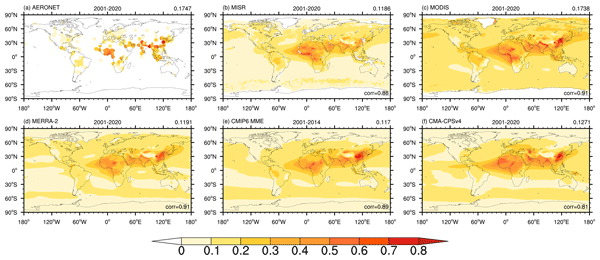
Utilizing MERRA-2 and the CMIP multi-model ensemble as reference is problematic due to well-documented limitations in these data sets. Specifically, for the scatter plots shown in Figure 7 (PM observations) and Figure 9 (Aeronet AOD), it is advisable to always display observations on the x-axis and model outputs on the y-axis. Additionally, Aeronet analyses should include relevant CMIP data for comprehensive comparison.
While the case study of two dust events in May 2011 is interesting, it raises the question of the representativeness of these events for the 20-year study period. A more scientifically valid analysis would have involved evaluating the model's ability to forecast the frequency, timing, and intensity of dust events across China or other regions worldwide.
The frequent use of subjective terms like "good agreement" or "reasonable agreement" is a weakness; quantitative assessments should be used instead.
Citation: https://doi.org/10.5194/egusphere-2026-599-RC1 - AC1: 'Reply on RC1', Mengzhe Zheng, 30 May 2026
-
RC2: 'Comment on egusphere-2026-599', Anonymous Referee #2, 19 May 2026
This manuscript presents a comprehensive evaluation of the aerosol simulation performance of the newly developed China Meteorological Administration Climate Prediction System version 4, CMA-CPSv4. The authors assess 20-year simulations for 2001–2020, focusing on five major aerosol species, surface PM2.5, aerosol optical depth, and selected severe dust events over China. The model results are compared with a broad range of observational and reference datasets, including MERRA-2, CMIP6 multi-model ensemble results, AERONET, MODIS, MISR, EANET, and CNEMC observations.
Overall, I find this manuscript to be a useful and timely contribution to the development of coupled climate–aerosol prediction systems. The work is well organized, the evaluation is reasonably comprehensive, and the figures clearly demonstrate both the strengths and remaining deficiencies of CMA-CPSv4. In particular, the manuscript shows that the model can reproduce the broad global distributions of major aerosol species and AOD, the seasonal and interannual variations over many regions, and the temporal evolution of a severe dust event in China. The authors also acknowledge several important model biases, such as the underestimation of PM2.5 over East Asia, the underestimation of dust, the overestimation of oceanic sulfate, and the overly strong upward transport of aerosols in the tropics.
I support the publication of this manuscript after minor to moderate revision. My comments below are intended mainly to improve the clarity of the model description, the interpretation of several biases, and the presentation of the scientific advances of CMA-CPSv4 relative to the previous system. Several clarifications and additional discussions would strengthen the manuscript.
General Comments
1) Clarification of nitrate and ammonium treatment in the aerosol scheme
Line 95-113: The authors provide a detailed description of the interactive calculations and chemical reactions for various prognostic aerosol species, including dust, sea salt, OC, BC, and sulfate. However, nitrate and ammonium aerosols are noticeably absent from the prognostic chemistry scheme. Given that nitrate is a major and increasingly dominant component of anthropogenic aerosols. Furthermore, Equation (1) on Line 111 includes ammonium nitrate (wrong NH4NO2? please check), yet it is not treated as a prognostic variable in the chemistry module. The author should explicitly explain the rationale behind excluding nitrate from the interactive calculations in this section. Is this omission due to the heavy computational cost, the complexity of gas-aerosol thermodynamic partitioning (e.g., lack of modules like ISORROPIA), or is it planned for a future update? Please clarify this in the manuscript.
2) Interpretation of the strong vertical transport and upper-tropospheric BC
Figure 3: The vertical distributions show stronger upward transport in CMA-CPSv4 compared to MERRA-2. The authors mention this may be related to "stronger convective activity". Since the wind and temperature are nudged to ERA5, is the convection scheme still generating stronger updrafts than the reanalysis? Please briefly explain how nudging interacts with parameterized convection in this model.
Also, in Figure 3 (specifically panels m, n, and o), the CMA-CPSv4 simulation exhibits anomalously high concentrations of Black Carbon reaching the upper troposphere and nearing the lower stratosphere over the tropics. In Lines 225–227, the authors attribute this to "stronger convective activity and vertical transport in the model." Since BC is subject to aging, wet scavenging, and convective removal processes, such strong vertical extension may indicate not only enhanced convective transport but also possible biases in wet scavenging, convective detrainment, or the aging/removal treatment of BC. I suggest that the authors add a short discussion acknowledging this as a potential source of model bias or uncertainty, rather than attributing it solely to stronger vertical transport. It would also be useful to mention whether similar features have been reported in BCC-ESM1 or related model versions.
3) Added value of CMA-CPSv4 relative to CMA-CPSv3
The manuscript introduces CMA-CPSv4 as an upgraded version of CMA-CPSv3 (Lines 14–17; 75–77), noting that the primary difference is the simulation of the dynamic evolution of aerosols and their feedback on the climate system. However, the evaluation focuses almost entirely on CMA-CPSv4 alone. The manuscript would be stronger if the authors more clearly summarized the scientific and operational advances of CMA-CPSv4 relative to CMA-CPSv3.
I suggest adding at least a short paragraph or a concise table describing the main differences between CMA-CPSv3 and CMA-CPSv4. This could include the treatment of prognostic aerosols, aerosol–radiation interactions, aerosol–cloud interactions, and aerosol emissions. This would help readers better appreciate why CMA-CPSv4 represents a meaningful step forward.
Specific Comments:
4) Line 105: Two “hydrophobic” in the sentence.
5) Line 111: “NH4NO2”, please check
6) Line 146: The equation uses “OA”, while the model description mainly refers to “OC”. Please check.
7) Page 7, Figure 1: MERRA-2 and the CMIP6 MME differ substantially for sea salt aerosols. Since the manuscript uses both as reference datasets, please briefly discuss possible reasons for these differences
Citation: https://doi.org/10.5194/egusphere-2026-599-RC2 - AC2: 'Reply on RC2', Mengzhe Zheng, 30 May 2026
Peer review completion
Journal article(s) based on this preprint
Viewed
| HTML | XML | Total | BibTeX | EndNote | |
|---|---|---|---|---|---|
| 868 | 574 | 81 | 1,523 | 87 | 101 |
- HTML: 868
- PDF: 574
- XML: 81
- Total: 1,523
- BibTeX: 87
- EndNote: 101
Viewed (geographical distribution)
| Country | # | Views | % |
|---|
| Total: | 0 |
| HTML: | 0 |
| PDF: | 0 |
| XML: | 0 |
- 1
Mengzhe Zheng

Yixiong Lu
Weihua Jie
Yiming Liu
Xiaoge Xin
Jie Zhang
Xindan Zhang
Jiajie Yang
The requested preprint has a corresponding peer-reviewed final revised paper. You are encouraged to refer to the final revised version.
- Preprint
(5373 KB) - Metadata XML
Overview:
The paper presents a description and evaluation of the aerosol simulation performance of the coupled climate-aerosol CMA-CPSv4 climate modelling system for a 20 year period (2001-2020). The meteorology is nudged to ERA5 and CMIP forcing and emissions data were used. The model simulation is evaluated with ADO (Aeronet) and surface PM25 observations (East Asia networks) and compared against the MERRA-2 reanalysis and the CMIP MME. The authors find overall a good simulation of global aerosols with some issues related regional desert dust and sulphate over the oceans.
General remarks
The paper is a solid evaluation of 20-year aerosol simulation with chemistry-climate model.
The study's conclusions for climate applications are limited since CMA-CPSv4 is nudged to ERA5 analysis. It is also unclear how prognostic aerosols are used in both the radiation scheme (direct effects) and cloud microphysics (indirect effects). While CMA-CPSv4 appears to function similarly to the CTM, the title implies that aerosol feedback is included. The authors should clarify which aspects of aerosol-climate coupling are examined and evaluated.
The paper does not provide evidence that CMA-CPSv4 represents an improvement over v3. If the inclusion of aerosol weather and climate feedback is considered a significant innovation in v4, the authors should demonstrate this by illustrating how these feedbacks enhance specific aspects of the climate simulation. Despite nudging to ERA5, differences in cloud and precipitation simulations are expected and should be addressed. If v3 simulation data are unavailable, it would be appropriate to compare v4 simulations with and without aerosol interactions.
Utilizing MERRA-2 and the CMIP multi-model ensemble as reference is problematic due to well-documented limitations in these data sets. Specifically, for the scatter plots shown in Figure 7 (PM observations) and Figure 9 (Aeronet AOD), it is advisable to always display observations on the x-axis and model outputs on the y-axis. Additionally, Aeronet analyses should include relevant CMIP data for comprehensive comparison.
While the case study of two dust events in May 2011 is interesting, it raises the question of the representativeness of these events for the 20-year study period. A more scientifically valid analysis would have involved evaluating the model's ability to forecast the frequency, timing, and intensity of dust events across China or other regions worldwide.
The frequent use of subjective terms like "good agreement" or "reasonable agreement" is a weakness; quantitative assessments should be used instead.