
the Creative Commons Attribution 4.0 License.
the Creative Commons Attribution 4.0 License.
 | 04 Feb 2026
Convective controls on anvil cloud evolution in the ICON km-scale global climate model
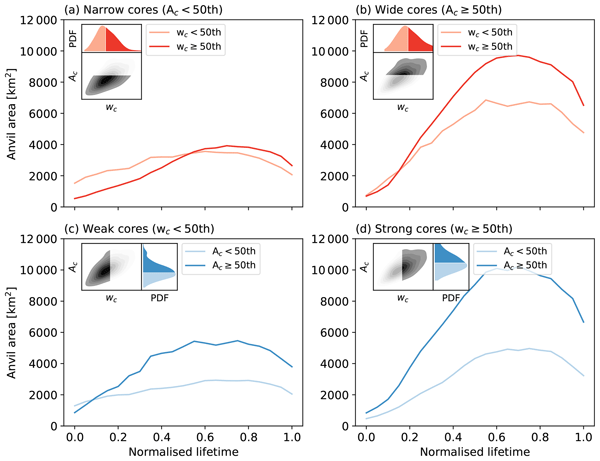
Abstract. Deep convective clouds substantially modify the balance of shortwave and longwave radiative energy at the top of the atmosphere. Although in the present-day these effects approximately balance out, projected changes in deep convective clouds could alter the future top-of-atmosphere energy balance. Past studies have found relationships between convection and anvil clouds, but our understanding of how convection typically controls the properties and evolution of anvil clouds that determine anvil radiative effects remains incomplete, limiting our ability to explain or justify projected changes in cloud optical properties. This manuscript presents a new method to track the lifecycle of deep convective clouds and their convective cores in three-dimensional space in km-scale global climate models. An analysis of how convective organisation, intensity and area relate to anvil properties in the ICOsahedral Non-hydrostatic (ICON) model is then presented. Approximately 1,000 deep convective clouds are tracked over one simulation week in the tropical Amazon region. We find that while both convective intensity and area correspond to larger anvils, the correlation between convective area and anvil size is stronger than that between anvil size and convective intensity. Convective intensity was associated with a 4-fold increase in anvil extent when convective cores were larger, compared to when they were in the bottom 50th percentile. This result could not be explained by associated changes in peak convective mass flux or organisation. These results indicate how changes in the frequency or typical size of convective updrafts may link to changes in anvil development, extent and, ultimately, radiative effects.
Competing interests: At least one of the (co-)authors is a member of the editorial board of Atmospheric Chemistry and Physics.
Publisher's note: Copernicus Publications remains neutral with regard to jurisdictional claims made in the text, published maps, institutional affiliations, or any other geographical representation in this paper. While Copernicus Publications makes every effort to include appropriate place names, the final responsibility lies with the authors. Views expressed in the text are those of the authors and do not necessarily reflect the views of the publisher.-
Notice on discussion status
The requested preprint has a corresponding peer-reviewed final revised paper. You are encouraged to refer to the final revised version.
-
Preprint
(20345 KB)
-
The requested preprint has a corresponding peer-reviewed final revised paper. You are encouraged to refer to the final revised version.
- Preprint
(20345 KB) - Metadata XML
- BibTeX
- EndNote
- Final revised paper


Journal article(s) based on this preprint
Interactive discussion
Status: closed
-
RC1: 'Comment on egusphere-2026-580', Anonymous Referee #1, 03 Mar 2026
The comment was uploaded in the form of a supplement: https://egusphere.copernicus.org/preprints/2026/egusphere-2026-580/egusphere-2026-580-RC1-supplement.pdfCitation: https://doi.org/
10.5194/egusphere-2026-580-RC1 - RC2: 'Comment on egusphere-2026-580', Anonymous Referee #2, 18 Mar 2026
-
AC1: 'Comment on egusphere-2026-580', Mathilde Ritman, 28 Apr 2026
The comment was uploaded in the form of a supplement: https://egusphere.copernicus.org/preprints/2026/egusphere-2026-580/egusphere-2026-580-AC1-supplement.pdf
Peer review completion


Interactive discussion
Status: closed
-
RC1: 'Comment on egusphere-2026-580', Anonymous Referee #1, 03 Mar 2026
The comment was uploaded in the form of a supplement: https://egusphere.copernicus.org/preprints/2026/egusphere-2026-580/egusphere-2026-580-RC1-supplement.pdf
- RC2: 'Comment on egusphere-2026-580', Anonymous Referee #2, 18 Mar 2026
-
AC1: 'Comment on egusphere-2026-580', Mathilde Ritman, 28 Apr 2026
The comment was uploaded in the form of a supplement: https://egusphere.copernicus.org/preprints/2026/egusphere-2026-580/egusphere-2026-580-AC1-supplement.pdf
Peer review completion
Journal article(s) based on this preprint
Data sets
ICON tracked deep convective cloud statistics and data accompanying the manuscript "Convective controls on anvil cloud evolution in the ICON km-scale global climate model" Mathilde Ritman https://doi.org/10.5281/zenodo.18413874
Model code and software
Scripts to produces results presented in "Convective controls on anvil cloud evolution in the ICON km-scale global climate model" Mathilde Ritman https://doi.org/10.5281/zenodo.18414234
Interactive computing environment
Scripts to produces results presented in "Convective controls on anvil cloud evolution in the ICON km-scale global climate model" Mathilde Ritman https://doi.org/10.5281/zenodo.18414234
Viewed
| HTML | XML | Total | BibTeX | EndNote | |
|---|---|---|---|---|---|
| 1,349 | 1,235 | 128 | 2,712 | 417 | 273 |
- HTML: 1,349
- PDF: 1,235
- XML: 128
- Total: 2,712
- BibTeX: 417
- EndNote: 273
Viewed (geographical distribution)
| Country | # | Views | % |
|---|
| Total: | 0 |
| HTML: | 0 |
| PDF: | 0 |
| XML: | 0 |
- 1
Mathilde Ritman

William Jones
Philip Stier
The requested preprint has a corresponding peer-reviewed final revised paper. You are encouraged to refer to the final revised version.
- Preprint
(20345 KB) - Metadata XML