
the Creative Commons Attribution 4.0 License.
the Creative Commons Attribution 4.0 License.
 | 12 Feb 2026
The Role of Rossby Wave Breaking in the Formation and Maintenance of Tropical-Extratropical Cloud Bands over the South Pacific
Abstract. Tropical-extratropical cloud bands are elongated cloud structures bridging tropical and midlatitude regions that act as a primary source of regional precipitation. While the role of Rossby wave breaking in the formation of cloud bands is established, the extent to which this dynamic forcing governs cloud band characteristics, their entire lifecycle, their spatial distribution and seasonality has not yet been systematically quantified. In this study, we apply an object-based approach to reanalysis data to investigate how stratospheric potential vorticity (PV) structures, as indicators of Rossby wave breaking, influence cloud band formation and persistence over the South Pacific region. Our climatological analysis confirms a robust statistical link in which cyclonic PV structures steer tropical moisture poleward and eastward, shaping the diagonal orientation of the cloud bands. We also find that cloud band duration is modulated by the properties of PV structures: long-lived cloud bands are distinguished by a systematically higher frequency of upstream PV structures and are sustained by persistent PV structures throughout their lifecycle, which favour a more zonal orientation of the cloud systems. Categorizing by cloud band duration reveals distinct seasonal regimes: while short-lived events occur year-round, persistent cloud bands are strictly confined to the austral warm season. Furthermore, long-lived cloud bands are associated with PV structures that reside significantly farther equatorward prior to genesis compared to those of short-lived events. These findings highlight that equatorward-breaking Rossby waves create a tropospheric environment favouring not only the formation but also the maintenance of these cloud bands. Consequently, accurately representing Rossby wave dynamics in weather and climate models is critical for simulating cloud band characteristics and their influence on climate variability.
Competing interests: At least one of the (co-)authors is a member of the editorial board of Weather and Climate Dynamics.
Publisher's note: Copernicus Publications remains neutral with regard to jurisdictional claims made in the text, published maps, institutional affiliations, or any other geographical representation in this paper. While Copernicus Publications makes every effort to include appropriate place names, the final responsibility lies with the authors. Views expressed in the text are those of the authors and do not necessarily reflect the views of the publisher.-
Notice on discussion status
The requested preprint has a corresponding peer-reviewed final revised paper. You are encouraged to refer to the final revised version.
-
Preprint
(5732 KB)
-
The requested preprint has a corresponding peer-reviewed final revised paper. You are encouraged to refer to the final revised version.
- Preprint
(5732 KB) - Metadata XML
- BibTeX
- EndNote
- Final revised paper


Journal article(s) based on this preprint
Interactive discussion
Status: closed
- RC1: 'Comment on egusphere-2026-571', Anonymous Referee #1, 31 Mar 2026
-
RC2: 'Comment on egusphere-2026-571', Anonymous Referee #2, 08 Apr 2026
Review of “ The role of Rossby wave breaking in the formation and maintence of tropical-extratropocal cloud bands over the South Pacific” By Pilon et al
Summary
This study studies the relationship between TE cloud bands and RWB and shows that there exists as robust link between PV structures and TE events, which was established by means of composite analysis and statistical significance. As reviewer I believe that this paper warrants publication; there are however matters of significant concern that should be addressed by the authors before it can be accepted
Major comments
- This manuscript is too brief and the analysis could be expanded and many sections for example 3.5 require more expansion and discussion. There is a lot of room for that in the paper, so that the analysis is at the level of papers we see in this journal.
- Figure 3 appears to be incomplete which makes it very difficult for readers to assess the discussion in Section 3.3, please look into this. Information about the vertical motion is completely missing because it should be showing in panels (j) to (i) which are not presented.
- In Line 340 claims that “-extending Rossby wave breaking events facilitate the cloud band genesis”. Evidence of the fact that the RWB presented in the composites has this morphology is missing, as far as one can tell. It the opinion of this reviewer that the authors should demonstrate why they are saying this. If anything, the green contours representing the 500 hPa anomalies in Figure 3 suggest that the RWB is poleward (Peters and Waugh 1996, Barnes et al. 2025). This is major issue that needs to be addressed. The RWB need to be characterised properly before compositing to determine whether they are anticyclonic and poleward or anticyclonic and equatorward, because this has profound implications on the jet streaks that materialise for these categories, and therefore the transverse circulations that these jet streaks induce.
Minor comments
- Lines 41 – 44: Several studies have considered the morphologies of RWB in idealised models and reanalyses and should be referenced here. As the issue of morphology appears to be a critical issues as suggested above, the authors should be a bit more explicit about this.
- Lines 74 – 75: The ERA 5 data should be described properly please, including the pressure levels used in the study, the variables etc. A very critical issue: this is a SH study yet the authors consider the pre-satellite era, please justify this and consider the pitfalls of doing this (Tennent 2004, GRL). This needs to be properly justified.
- Lines 130 – 139: This, of course is a good way to extract the most robust signal. However, the authors should also consider what happens when the streamers occur downstream of the CBs. Surely there would be such cases. If there are none, please be explicit about the fact this was tested and none such cases were found. To illustrate the importance of this point, if a RWB is downstream and cyclonic, the vertically upward motion it would induce would be the strongest of all four categories of RWB because of the jet streak orientation that would materialise. Again, this why it is important to consider the issue of morphology before composting.
- Lines 178 – 180: These cases are very carefully chosen, again is there no possible of downstream occurrence (as questioned above)
- Lines 187 – 188: This statement needs clarification (ie. Extratropical frequencies vs tropical and isentropic surfaces on which RWB are identified on. I thinks this is a bit misleading)
- Lines 201 – 231: This section is difficult to assess because the accompanying figure is incomplete as mentioned above. When addressing these issues, please clarify how exactly RWB drives moisture fluxes, please show the low-level qV fields etc or backward trajectories could be employed
- Lines 250 – 251: The authors need to establish first from previous studies that have considered the CBs in this region that they actually occur right through the year, before making this statement. We know in other areas for instance that they are summer phenomena.
- Lines 340 – 341: As noted above, the issue of morphology needs to be carefully considered in this study.
Citation: https://doi.org/10.5194/egusphere-2026-571-RC2 -
AC1: 'Comment on egusphere-2026-571 - Response to reviewers', Romain Pilon, 30 Apr 2026
The comment was uploaded in the form of a supplement: https://egusphere.copernicus.org/preprints/2026/egusphere-2026-571/egusphere-2026-571-AC1-supplement.pdf
Peer review completion


Interactive discussion
Status: closed
-
RC1: 'Comment on egusphere-2026-571', Anonymous Referee #1, 31 Mar 2026
In this manuscript, the authors demonstrate the importance of extratropical disturbances in the development and persistence of South Pacific Convergence Zone events. The innovative methodology combines the objective identification of cloud band events and PV structures, providing a robust link between the extratropical forcing and the organized convective activity in the subtropics. The results also advance the understanding of the dynamic environment necessary to form and sustain persistent cloud bands and could be extended to other regions. However, the manuscript could benefit from a more in-depth discussion of the main findings in light of previous research. I also have some minor questions related to details in the methodology, with clarification of these points facilitating the future reproducibility of the results. Thus, I would recommend the manuscript undergo minor revisions before acceptance and publications.
Major Comments
- Section 3.3. In this section, the authors propose a mechanism for the formation of the cloud bands based on the presence of PV structures. On the poleward side of the CB centre, cyclonic PV anomalies destabilise the lower troposphere and induces convection and ascending motion. On the other hand, the diabatic heat released by the enhanced convection contributes to the anticyclonic PV anomalies ahead of the cloud band axis. The mechanism is similar to that proposed by Van der Wiel et al (2015). According to those authors, the propagation of the Rossby wave trains forming the SPCZ is subjected by two main forcings: horizontal advection of cyclonic vorticity anomalies, dictating the propagation of the RW into the tropics, counteracted by anticyclonic vorticity tendencies from vortex stretching due to the enhanced convection and ascent at the SPCZ axis. Similar mechanisms were also observed in the SACZ region. Thus, it would be informative to discuss the results obtained by the authors with those from previous literature. This discussion could also be included in the conclusions.
- Zilli and Hart (2021) demonstrated that transient cloud bands over South America occur poleward of the persistent ones. They also showed that the relationship between the vorticity tendencies and the local environment are different for these events when compared to the more tropical persistent cloud bands. In the manuscript, the authors also mentioned this in section 3.6.2. However, the main analysis in sections 3.3 and 3.4 does not take this into account. Results in Fig 5 also suggest a clear seasonality in the transient cloud bands, with austral spring and summer events occurring at similar latitude as persistent events, but austral fall and winter transient events located primarily south of 20oS. To what extent does the local environment of the cloud bands could increase the variability and affect the composite results in Figs 3 and 4?
- One of the findings of the manuscript is that “... long-lived cloud bands are distinguished [from transient events] by a higher frequency of upstream PV structures persisting throughout the cloud band lifecycle.” (lines 323-333). The frequency of upstream PV structures depends on the upstream area of the cloud band, as illustrated in Figure A1. However, this area can vary massively among cloud band days, with the events in Figure 1 serving as a great example to that. Thus, what is the relationship between the persistence of the cloud band and the upstream area, and to which extend this can affect the frequency of PV structures associated with the events.
Minor Comments
- The analysis considers ERA5 data since 1959. How reliable are ERA5 data, and in particular OLR, for the years before 1979? Would the same results be obtained if considering only data after 1979?
- The caption suggests that the contours in Fig 2a represent the number of days with cloud bands. However, a maximum of ~50 days per year is below what would be expected for the region. Previous papers (Haffke & Magnusdottir, 2013) estimated that the SPCZ is present in 30-40% of the NDJFMA months, with would be equivalent to ~70 days per year. From Figure 6a, the detection algorithm identified ~3000 cloud band events which, considering 63 years (1959-2021), results in 48 events per year, on average. This number is close to the numbers represented by the contours in Fig 2a. Thus, I would like to double-check if the information in Figs 2a and 2b are cloud band days or cloud band events? Reference: Haffke, C., & Magnusdottir, G. (2013). The South Pacific Convergence Zone in three decades of satellite images. Journal of Geophysical Research: Atmospheres, 118(19), 10,839-10,849. https://doi.org/10.1002/jgrd.50838
- A suggestion for figure 2c: repeat the contours from Fig 2a here, for reference.
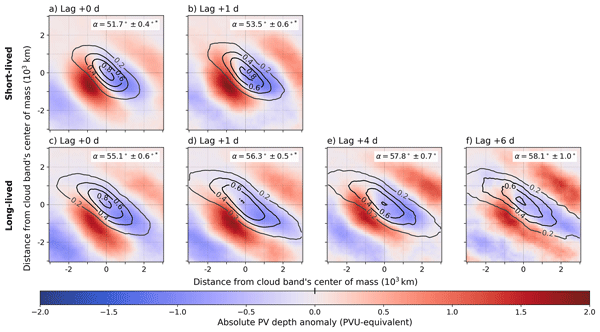
- The caption in Fig 3 refers to more panels than included. Also, the sentence “The white contour represents the 210 Wm−2 cloud band detection threshold.” refers only to panels a-c, so it would be better to place it with the description of these panels.
- In Figures 3 and 4, the composites for day +2 are centred in the centroid of the cloud bands objects detected in day +2? If so, I would expect to have some OLR values below 210 W.m-2 in Fig 4f. Furthermore, what is the centroid considered for those events persisting only one day? If not, what is the reference considered? Please, clarify this in Session 2.3.2.
- In section 2.1.3, cloud band events lasting less than 3 days are called “transient” while those persisting 4 or more days are called “persistent”. However, in some parts of the manuscript, “transient”, “short” or “short-lived” events are used interchangeably. See, for example, the caption of figs 3 and 4, as well as the label of the first row in Fig 4. Similarly, “persistent” events are also referred to as “long” or “long-lived” (as in line 332). Consider using only one of the terms.
- Figure 6: please, include a description of the significance tests used here (Wilson score and the bootstrap confidence interval) to the methodology section.
Citation: https://doi.org/10.5194/egusphere-2026-571-RC1 -
RC2: 'Comment on egusphere-2026-571', Anonymous Referee #2, 08 Apr 2026
Review of “ The role of Rossby wave breaking in the formation and maintence of tropical-extratropocal cloud bands over the South Pacific” By Pilon et al
Summary
This study studies the relationship between TE cloud bands and RWB and shows that there exists as robust link between PV structures and TE events, which was established by means of composite analysis and statistical significance. As reviewer I believe that this paper warrants publication; there are however matters of significant concern that should be addressed by the authors before it can be accepted
Major comments
- This manuscript is too brief and the analysis could be expanded and many sections for example 3.5 require more expansion and discussion. There is a lot of room for that in the paper, so that the analysis is at the level of papers we see in this journal.
- Figure 3 appears to be incomplete which makes it very difficult for readers to assess the discussion in Section 3.3, please look into this. Information about the vertical motion is completely missing because it should be showing in panels (j) to (i) which are not presented.
- In Line 340 claims that “-extending Rossby wave breaking events facilitate the cloud band genesis”. Evidence of the fact that the RWB presented in the composites has this morphology is missing, as far as one can tell. It the opinion of this reviewer that the authors should demonstrate why they are saying this. If anything, the green contours representing the 500 hPa anomalies in Figure 3 suggest that the RWB is poleward (Peters and Waugh 1996, Barnes et al. 2025). This is major issue that needs to be addressed. The RWB need to be characterised properly before compositing to determine whether they are anticyclonic and poleward or anticyclonic and equatorward, because this has profound implications on the jet streaks that materialise for these categories, and therefore the transverse circulations that these jet streaks induce.
Minor comments
- Lines 41 – 44: Several studies have considered the morphologies of RWB in idealised models and reanalyses and should be referenced here. As the issue of morphology appears to be a critical issues as suggested above, the authors should be a bit more explicit about this.
- Lines 74 – 75: The ERA 5 data should be described properly please, including the pressure levels used in the study, the variables etc. A very critical issue: this is a SH study yet the authors consider the pre-satellite era, please justify this and consider the pitfalls of doing this (Tennent 2004, GRL). This needs to be properly justified.
- Lines 130 – 139: This, of course is a good way to extract the most robust signal. However, the authors should also consider what happens when the streamers occur downstream of the CBs. Surely there would be such cases. If there are none, please be explicit about the fact this was tested and none such cases were found. To illustrate the importance of this point, if a RWB is downstream and cyclonic, the vertically upward motion it would induce would be the strongest of all four categories of RWB because of the jet streak orientation that would materialise. Again, this why it is important to consider the issue of morphology before composting.
- Lines 178 – 180: These cases are very carefully chosen, again is there no possible of downstream occurrence (as questioned above)
- Lines 187 – 188: This statement needs clarification (ie. Extratropical frequencies vs tropical and isentropic surfaces on which RWB are identified on. I thinks this is a bit misleading)
- Lines 201 – 231: This section is difficult to assess because the accompanying figure is incomplete as mentioned above. When addressing these issues, please clarify how exactly RWB drives moisture fluxes, please show the low-level qV fields etc or backward trajectories could be employed
- Lines 250 – 251: The authors need to establish first from previous studies that have considered the CBs in this region that they actually occur right through the year, before making this statement. We know in other areas for instance that they are summer phenomena.
- Lines 340 – 341: As noted above, the issue of morphology needs to be carefully considered in this study.
Citation: https://doi.org/10.5194/egusphere-2026-571-RC2 -
AC1: 'Comment on egusphere-2026-571 - Response to reviewers', Romain Pilon, 30 Apr 2026
The comment was uploaded in the form of a supplement: https://egusphere.copernicus.org/preprints/2026/egusphere-2026-571/egusphere-2026-571-AC1-supplement.pdf
Peer review completion
Journal article(s) based on this preprint
Viewed
| HTML | XML | Total | BibTeX | EndNote | |
|---|---|---|---|---|---|
| 1,103 | 669 | 94 | 1,866 | 238 | 227 |
- HTML: 1,103
- PDF: 669
- XML: 94
- Total: 1,866
- BibTeX: 238
- EndNote: 227
Viewed (geographical distribution)
| Country | # | Views | % |
|---|
| Total: | 0 |
| HTML: | 0 |
| PDF: | 0 |
| XML: | 0 |
- 1

Andries Jan De Vries
Daniela I. V. Domeisen
The requested preprint has a corresponding peer-reviewed final revised paper. You are encouraged to refer to the final revised version.
- Preprint
(5732 KB) - Metadata XML
In this manuscript, the authors demonstrate the importance of extratropical disturbances in the development and persistence of South Pacific Convergence Zone events. The innovative methodology combines the objective identification of cloud band events and PV structures, providing a robust link between the extratropical forcing and the organized convective activity in the subtropics. The results also advance the understanding of the dynamic environment necessary to form and sustain persistent cloud bands and could be extended to other regions. However, the manuscript could benefit from a more in-depth discussion of the main findings in light of previous research. I also have some minor questions related to details in the methodology, with clarification of these points facilitating the future reproducibility of the results. Thus, I would recommend the manuscript undergo minor revisions before acceptance and publications.
Major Comments
Minor Comments