
the Creative Commons Attribution 4.0 License.
the Creative Commons Attribution 4.0 License.
 | 10 Feb 2026
Analysis of Antarctic ozone trends from 1979 to 2023
Abstract. Antarctic ozone has shown a sustained recovery since 2000, but levels were distinctly low during 2020–2023, potentially affecting estimates of ozone recovery and long-term trends. To assess the impact of recent low ozone on long-term variability, we analyze total column ozone (TCO) data from World Ozone and Ultraviolet Radiation Centre, multi-sensor reanalysis, and Total Ozone Mapping Spectrometer/Ozone Monitoring Instrument. Ozone fields from TOMCAT, a 3-D chemical transport model, are also used to gain better insight ozone changes. Multiple linear regression (MLR) is applied to estimate ozone trends over Antarctica from 1979 to 2023, incorporating proxies representing key chemical and dynamical processes such as the El Niño-Southern Oscillation and the Brewer-Dobson circulation (BDC).
Our analysis suggests that before 2000, all datasets show significant declines in annual TCO of about 2 and 6 Dobson Units per year (DU/yr) for September and October, respectively. For the 2001–2023 period, the magnitude of the October trend shifted to −1.5 DU/yr. The MLR effectively captures long-term ozone changes as well as unusual dynamical events such as the sudden stratospheric warmings in 2002 and 2019. As dynamical proxies show the largest influence, we use TOMCAT simulations to illustrate the impact of the BDC on the Antarctic ozone. Two sensitivity simulations further demonstrate that the strengthening (weakening) of the circulation leads to high (low) ozone values in spring. These findings suggest that after ozone-depleting substances were strictly controlled, dynamical processes have played an increasingly important role in controlling the ozone recovery patterns in Antarctica.
-
Notice on discussion status
The requested preprint has a corresponding peer-reviewed final revised paper. You are encouraged to refer to the final revised version.
-
Preprint
(1649 KB)
-
The requested preprint has a corresponding peer-reviewed final revised paper. You are encouraged to refer to the final revised version.
- Preprint
(1649 KB) - Metadata XML
- BibTeX
- EndNote
- Final revised paper


Journal article(s) based on this preprint
Interactive discussion
Status: closed
-
RC1: 'Comment on egusphere-2026-560', Anonymous Referee #1, 11 Mar 2026
-
AC1: 'Reply on RC1', Haotian He, 04 May 2026
The manuscript “Analysis of Antarctic ozone trends from 1979 to 2023” by He et al. provides an analysis of the long-term evolution of total column ozone over Antarctica from 1979 through 2023 based on four data sets: WOUDC ground-based measurements, the Multisensor Reanalysis (MSR-2),the Total Ozone Mapping Spectrometer/Ozone Monitoring Instrument (TOMS/OMI) record, and Chemical Transport Model (CTM) simulations from TOMCAT. The authors apply a standard multiple linear regression (MLR) approach taking into account various atmospheric key processes which affect ozone variability. They focus on the investigation of the role of the Brewer-Dobson Circulation (BDC) on ozone changes, and they perform two sensitivity experiments with TOMCAT also focused on the role of the BDC. The latter is limited to the period 2000-2009. On top of that, the authors investigate the divergence of the September and October trends. The topic of the manuscript fits into the scope of ACP. However, I think that the novelty of the investigation is somewhat limited, but I would recommend publication after revision.
Thanks for your suggestion and detailed remark. This manuscript has addressed and answered each of the relevant questions and suggestions. We focused on changes in BDC to ozone, extended the time period of sensitivity experiments (2001-2023), and reanalyzed ozone changes in recent years (2020-2023). The modified words, expressions and sentences have been highlighted.
Thank you.
Major comments
In the abstract, you mention the distinctly low ozone values during 2020-2023 and the intention to assess the impact on long-term trends. Unfortunately, this assessment is limited to a short paragraph in Sec. 4. I recommend to elaborate on this in more detail, in particular with respect to the possible reasons for the reduced values, e.g. the exceptional atmospheric conditions during these years. Related to the previous point: Why did you limit the model sensitivity experiments to the period 2000-2009? The correlation between BDC and polar ozone for 1995-2010 was already investigated in detail in Weber et al. (2011). I think, analysing the behavior in the last years (2020-2023) would be interesting. Is there any possibility to extend the model analysis?
Thank for your suggestion.
- We have added the Figure 6 and content about the connection between ozone changes in recent years(2020-2023) and BDC.
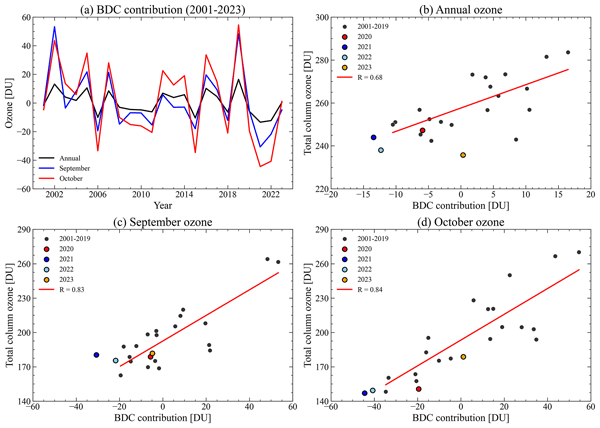
“Figure 6 shows the contribution of BDC to TCO changes from 2001 to 2023. BDC has a significant impact on the recent ozone variability, contributing up to -45 DU in October during 2020-2023. ... Although TCO remained relatively low in 2023, the corresponding BDC contribution was small.” (L271-276)
- We have extended the sensitivity experiment time and focused on the analysis of low ozone levelsfrom 2020 to 2023 (see Figure 7-9 and Section 5).
“Despite Antarctic ozone trends showing a decline during 2001-2023 in the annual mean and October, both EXP1 and EXP2 exhibited positive trends after controlling for BDC intensity, with notable consistency between the two experiments.” (L304-306)
“TCO values dropped to approximately 150 DU in October-November during 2020-2022, significantly lower than in most years of the 2001-2019 period. ... Nevertheless, ozone levels in recent years (2020-2023) are significantly elevated compared with most of the past two decades.” (L318-323)
“Figure 9a shows the monthly mean temperature at 50 hPa from 2001 to 2023. The cooler temperatures in the spring and winter from 2020 to 2022 were associated with the persistently low ozone values. ... The higher springtime temperature and EHF in 2023, compared with the springs of 2020-2022, contributed to the elevated ozone concentrations (Fig. 8a). ” (L329-334)
Thank you.
Minor comments
- 3, l. 89:consistancy -> consistency
Yes, we agree with you. “consistancy” has been modified to “consistency”. (L92)
Thank you.
- 4, Sec. 2.1:How many ground-based stations are located in the latitude band 60°S-90°S?
Thank for your suggestion. We have added this as follows.
“Antarctic ozone observations have drawn upon over 20 ground-based stations since monitoring was initiated.” (L102-103)
Thank you.
- 4, l. 100: Please use “MSR-2” consistently throughout the manuscript.
Thank for your suggestion. “MSR” has been modified to “MSR-2”. And the corresponding expressions in the whole manuscript have been modified. (L104, L105, L131, L193, L200, L217)
Thank you.
- 4, ll. 102-103:MSR-2 also includes SBUV/NOAA-17, -18, -19.
Thank for your suggestion. We have revised this as follows.
“These include the TOMS series (Nimbus-7 and Earth Probe), SBUV (Nimbus-7 and NOAA-9, -14, -11, -16, -17, -18, -19), BUV-Nimbus 4, GOME (ERS-2), SCIAMACHY (Envisat), OMI (EOS-Aura), and GOME-2 (Metop-A).” (L106-107)
Thank you.
- 4, l. 107:For MSR-2, use “van der A et al., 2015”.van der A, R. J., Allaart, M. A. F., and Eskes, H. J.: Extended and refined multi sensor reanalysis of totalozone for the period1970–2012, Atmos. Meas. Tech., 8, 3021–3035, https://doi.org/10.5194/amt-83021-2015, 2015.
Thank for your suggestion. The corresponding reference has been added.
“The final global ozone dataset is generated using data assimilation techniques based on a chemical transport model driven by meteorological fields from the European Centre for Medium-Range Weather Forecasts (ECMWF) (Van Der A et al., 2015).” (L110-111)
“Van der A, R. J., Allaart, M. A. F., and Eskes, H. J.: Extended and refined multi sensor reanalysis of total ozone for the period 1970–2012, Atmos. Meas. Tech., 8, 3021-3035, https://doi.org/10.5194/amt-8-3021-2015, 2015.” (L528-529)
Thank you.
- 4, Sec. 2.3 TOMS/OMI: I suggest to delete the first sentence since EP TOMS was decommissioned in 2007. The datasets forTOMS and OMI are two separate data records with different spatial resolutions. Please describe, howyou merge them for the analysis. Did you compare them during their overlap period? Did you apply any adjustment to one of the records in order to avoid artificial jumps? Please provide some more details here.
Thank for your suggestion. We have revised and supplemented this as follows.
“The TOMS and OMI data were processed using the Version 8 algorithm developed by the NASA Goddard's Ozone Processing Team (Wellemeyer et al., 2004). The TOMS program began in 1978, total column ozone measurements from TOMS onboard Nimbus-7, Meteor-3, and Earth probes were used.” (L113-115)
“Despite the overlap of time periods measured by different TOMS platforms, the bias of ozone data between them is 1-2% (Kroon et al., 2008).” (L118-119)
Thank you.
- 5, Table 1:The link https://woudc.org/archive/Projects-Campaigns/ZonalMeans provides only zonal means forthe period until 2021 (file gb_1964-2021_za.txt). What is the source for the extended (until 2023)record? 3rd column (spatio-temporal resolution): Please (i) provide the resolution in degree [°] for MSR-2, TOMS/OMI, and TOMCAT, (ii) remove “lat*lon=….” in the second and third row, and (iii) explain T42 L32 for TOMCAT. 4th column, last row: “EAR 5” -> “ERA5”
Yes, you are right.
- What is the source for the extended (until 2023)record?
At present, there is a lot of missing data in 2025, so WOUDC does not provide the latest link. Our WOUDC data was provided by Dr. Vitali E. Fioletov, and we acknowledge his suuport in the acknowledgements. And we have added it to the data availability.
“Updated ozone data from WOUDC will be made available on request.” (L363)
- About “spatio-temporal resolution”, We have revised it(see Table 1).
Table 1. Sources and temporal coverage of ozone datasets.
Dataset
Spatio-temporal resolution
Source
WOUDC
Monthly,
5° zonal mean of TCO
http://woudc.org/archive/Projects-Campaigns/ZonalMeans (1970-2021), the dataset is continuously updated.
MSR-2
Monthly,
0.5° × 0.5° with TCO
https://www.temis.nl/protocols/O3global.php
TOMS/OMI
Monthly,
TOMS: 1° × 1.25° with TCO,
OMI: 1° × 1° with TCO
https://disc.gsfc.nasa.gov/datasets?keywords=TOMS&page=1&measurement=Atmospheric%20Ozone,
https://www.earthdata.nasa.gov/learn/find-data/near-real-time/omi
TOMCAT
Daily,
2.8° × 2.8° and 32 vertical levels (about 0-60 km)
Simulation of global ozone data based on ERA5 (Chipperfield, 2006).
Thank you.
- 5, 133-134:“These trend terms represent the only non-periodic terms of MLR…” -> Not sure, if this statement iscorrect. For example, AOD is non-periodic as well. Please explain what you mean here.
Yes, you are right. We have revised this as follows.
“The trend term is the only non-periodic term in the MLR, whereas other terms generally exhibit some form of periodic or peak. Changes in stratospheric ozone levels are driven by the combined influences of climate variability and ODS. Consequently, the net ozone trend need not strictly track EESC variations before and after the ODS peak, and ILT will better represent the ozone changes caused by other non-periodic forcings.” (L140-143)Thank you.
p. 6, Eq. (1) and following text: Please explain all terms, e.g. QBO_10(t), QBO_30(t), S(t), E(t), …. Does “t” represent the month or the year?Thank for your suggestion. We have added this as follows.
“t is the year (month) during period 1979-2023.” (L149)
Thank you.
- 6, l. 160:“…while other proxies use the monthly mean time series” -> In line 143, you indicate that “t”represents the year and not the month. Please clarify. Maybe “t” represents the month (see my previous comment).
Yes, you are right. We have revised this as follows.
“In the MLR, AAO and BDC are represented by the mean of the autumn-to-spring accumulation, while other proxies use the monthly mean time series for monthly analyses and annual mean time series for annual analyses with no time lags.” (L175-177)
Thank you.
- 6, Table 2:Please check URL for QBO indices and BDC.
Thank for your suggestion. We have revised it (see Table 2).
Table 2. Sources of impact proxies.
Proxy
Explanatory proxy
url / file
QBO 10 hPa, QBO 30 hPa
Singapore wind speed at 30 hPa and 10 hPa
https://www.iup.uni-bremen.de/OREGANO/proxy
SAOD(t)
Stratospheric aerosol optical depth at 550 nm
https://asdc.larc.nasa.gov/project/GloSSAC
S(t)
Bremen composite Mg II index
https://www.iup.uni-bremen.de/UVSAT/data/
BDC(t)
Eddy heat flux (100 hPa, 45°S-75°S)
https://www.iup.uni-bremen.de/OREGANO/proxy
E(t)
Multivariate ENSO Index (MEI V2)
https://psl.noaa.gov/data/climateindices/list/
AAO(t)
Antarctic Oscillation (AAO)
https://www.cpc.ncep.noaa.gov/products/precip/CWlink/daily_ao_index/aao/aao.shtml
Thank you.
- 8, l. 172:“Antarctic ozone recovery exhibits strong seasonal dependence, particularly the contrasting behaviorin September and October” -> Please provide some more explanation for this statement and a reference.
Yes, we agree with you. We have revised it and added references as follows.
“Antarctic ozone recovery exhibits strong seasonal dependence, especially in the spring. While chemical processes dominate in September, dynamical factors exert greater control in October (Strahan et al., 2014; Solomon et al., 2016; Stone et al., 2021).” (L189-190)
“Strahan, S., Douglass, A., Newman, P., and Steenrod, S.: Inorganic chlorine variability in the Antarctic vortex and implications for ozone recovery, J. Geophys. Res.: Atmos., 119, 14,098-014,109, https://doi.org/10.1002/2014JD022295, 2014.” (L521-523)
“Solomon, S., Ivy, D. J., Kinnison, D., Mills, M. J., Neely III, R. R., and Schmidt, A.: Emergence of healing in the Antarctic ozone layer, Science, 353, 269-274, https://doi.org/10.1126/science.aae0061, 2016.” (L511-512)
“Stone, K., Solomon, S., Kinnison, D., and Mills, M. J.: On recent large Antarctic ozone holes and ozone recovery metrics, Geophys. Res. Lett., 48, e2021GL095232, https://doi.org/10.1029/2021GL095232, 2021.” (L519-520)
Thank you.
- 8, l. 177: “September shows signs of recovery” -> According to table 3, all trends are very close to zero andstatistically not significant. I suggest to mention this here. The same holds for October; the negativetrends are statistically not significant.
Yes, we agree with you. We have revised it.
“To ensure consistency across datasets with different temporal coverage, trends were analyzed for 2001-2023. During this period, the trends are not statistically significant, with September closer to zero and October exhibits a decline of approximately -1 DU/yr.” (L194-196)
Thank you.
- 9, ll. 190-194: September trends are positive for both periods (2001-2019 and 2001-2023), but for 2001-2023, thetrends are very close to zero and reduced by a similar value as the October trends. Dynamicalprocesses do not only affect October values (see also your Fig. 7).
Thank for your suggestion. We have revised this as follows.
“After 2000, September consistently exhibits positive trends. However, anomalously low ozone levels persistently observed during 2020-2023 attenuated the trend from 2001 to 2023, bringing it closer to zero. October trends shift from weakly positive (0.3 ± 3.2 DU/yr for 2001-2019) to negative (-1.5 ± 2.4 DU/yr for 2001-2023). This shift suggests that EESC might not accurately reflect the ozone changes in October. Furthermore, the decline in the trend over the past two months has been similar, indicating that other factors (e.g. BDC) have become more important for spring ozone depletion under ODS controls.” (L208-213)
Thank you.
- 11, l. 206:“September shows a weak positive trend of 0.1” -> I suggest to rephrase. This is rather “close to zero”than positive. And it has a large 2-sigma uncertainty (1.8DU/year).
Yes, we agree with you. We have revised this as follows.
“In September, the trend of TOMCAT was close to zero, while the trend estimated by the TOMCAT-based MLR showed a negative trend (-0.7 DU/yr).” (L226-227)
Thank you.
- 11, l. 207:“can explaining” -> I suggest to rephrase, e.g.: “The independent variables in the MLR can explainabout 85%...”
Thank for your suggestion.
“The long-term ozone changes in the MLR can explaining about 85 % of the variance in the interannual time series.” has been modified to “The independent variables in the MLR can explain about 85 % of the variance in the interannual time series. ” (L229)
Thank you.
- 12, ll. 208-209:Can this be also related to the possibility that models do not entirely capture the complete variabilityof the atmosphere?
Yes, you are right. We can't guarantee that MLR models can entirely capture the complete variability of the atmosphere, but it can effectively reproduce the ozone time series. We have added this as follows.
“Table 3 indicates that the independent variables in the MLR models effectively reproduce the ozone time series for each dataset. ... Among these datasets, the MLR of TOMCAT accurately reproduced long-term ozone changes ,explaining 91% of the variance in the September time series.” (L228-231)
Thank you.
Line 209: Replace “observed” with “simulated”.Sorry for my carelessness. We have modified it as follows.
“observed” has been modified to “simulated”. (L230)
Thank you.
- 12, l. 220: “However, positive trends dominate the middle and lower stratosphere” -> replace “middle” by“upper”; positive trends are found around 2-3 hPa.
Sorry for my carelessness. We have modified it as follows.
“middle” has been modified to “upper”. (L243)
Thank you.
- 14, l. 238:“, with BDC being the main driver of long-term ozone changes” -> I would suggest to rephrase: “, withBDC being the main driver of interannual ozone variation and an important contributor to long-term ozone changes.”
Thank for your suggestion. We have modified it as follows.
“with BDC being the main driver of long-term ozone changes” has been modified to “with BDC being the main driver of interannual ozone variation and an important contributor to long-term ozone changes ” (L272)
Thank you.
- 14, Fig. 6:Do I understand correctly, that these peak contributions shown in Fig. 6 were obtained from thecurves in Figure 5? If so, I do not see peak contributions of the BDC of 80-100DU (Fig. 6) in the curves of Fig. 5 (b) and (c). Please explain, what you mean with “rate of ozone change [in percent]”?
Thank you for pointing this out. We have deleted Figure 5 and added explanations about peak contributions (see Eq. (2)).
“To quantitatively describe the contribution of different factors on the ozone, we calculated the peak contribution of the proxies to ozone and its rate of change. The contribution equation is shown in Eq. (2):
(2)
where represents the peak contribution, is the contribution of different factors to ozone during the period 1979-2023, and is the TCO time series.” (L155-161)
“The rate of peak contribution in percent is labelled above each bar.” (L251)
“Based on Eq. (2), we evaluated the peak contribution of each proxy to TCO (Fig.5).” (L254)
Thank you.
- 17, Figure 7:Title: the period shown here is 2000-2009.
Sorry for my carelessness. We have revised it (see Figure 7).
Thank you.
- 18, Fig. 8(b) and p. 19, Fig. 9(b):The year 2000 is quite different in EXP1; lower ozone values compared to the subsequent years, butEHF (Fig. 9b) is also quite low in October (green curve). Do you have an explanation?
Thank for your suggestion. We have redrawn the Figure 7-9 and mainly analyzed the changes from 2020 to 2023.
“TCO values dropped to approximately 150 DU in October-November during 2020-2022, significantly lower than in most years of the 2001-2019 period. ... Nevertheless, ozone levels in recent years (2020-2023) are significantly elevated compared with most of the past two decades.” (L318-323)
“Figure 9a shows the monthly mean temperature at 50 hPa from 2001 to 2023. The cooler temperatures in the spring and winter from 2020 to 2022 were associated with the persistently low ozone values. ... The higher springtime temperature and EHF in 2023, compared with the springs of 2020-2022, contributed to the elevated ozone concentrations (Fig. 8a). ” (L329-334)
Thank you.
- 19, Figure 9:
(i) Title of top panel: “Tempetature” -> “Temperature”
(ii) I would suggest to highlight the exceptional years 2002 and 2006 in both panels a bit more forbetter visibility.
Thank you for pointing this out. We have revised it (see Figure 9) and mainly analyzed the changes from 2020 to 2023.
“Figure 9a shows the monthly mean temperature at 50 hPa from 2001 to 2023. The cooler temperatures in the spring and winter from 2020 to 2022 were associated with the persistently low ozone values. ... The higher springtime temperature and EHF in 2023, compared with the springs of 2020-2022, contributed to the elevated ozone concentrations (Fig. 8a). ” (L329-334)
Thank you.
- 19, l.306:“(Fig. 8 and Fig. 9a)” -> Do you mean Fig. 7 and Fig. 8a?
Yes, you are right. We have modified the expression.
“Figure 9a shows the monthly mean temperature at 50 hPa from 2001 to 2023.” (L329)
“As shown in Fig. 9b, EHF was high in the spring during 2020-2022, indicating the weakened circulation and reduced ozone transport from the tropics to the polar regions.” (L331-332)
Thank you.
- 20, ll. 331-332:I suggest to rephrase this sentence. Please explain the impact of the BDC. The start a new sentencefor volcanic aerosols.
Thank for your suggestion. We have revised and supplemented this as follows.
“Proxy analysis highlights the dominant role of BDC in the Antarctic spring, and BDC contributions to ozone changes exhibited a positive correlation with TCO during 2001-2023. Despite SAOD contributes about 25 DU to long-term ozone interannual variability, this signal was largely driven by the elevated aerosol loading following the Pinatubo (1991) volcanic eruptions.” (L350-353)
Thank you.
- 23, ll. 395-397: Reference refers to article in ACPD. Replace with reference to final revised version in ACP.
Dhomse, S. S., Kinnison, D., Chipperfield, M. P., Salawitch, R. J., Cionni, I., Hegglin, M. I., Abraham, N.L., Akiyoshi, H., Archibald, A. T., Bednarz, E. M., Bekki, S., Braesicke, P., Butchart, N., Dameris, M.,Deushi, M., Frith, S., Hardiman, S. C., Hassler, B., Horowitz, L. W., Hu, R.-M., Jöckel, P., Josse, B., Kirner,O., Kremser, S., Langematz, U., Lewis, J., Marchand, M., Lin, M., Mancini, E., Marécal, V., Michou, M.,Morgenstern, O., O'Connor, F. M., Oman, L., Pitari, G., Plummer, D. A., Pyle, J. A., Revell, L. E., Rozanov,E., Schofield, R., Stenke, A., Stone, K., Sudo, K., Tilmes, S., Visioni, D., Yamashita, Y., and Zeng, G.:Estimates of ozone return dates from Chemistry-Climate Model Initiative simulations, Atmos. Chem.Phys., 18, 8409–8438, https://doi.org/10.5194/acp-18-8409-2018, 2018.
Thank you for pointing this out. The corresponding reference has been revised.
“Dhomse, S. S., Kinnison, D., Chipperfield, M. P., Salawitch, R. J., Cionni, I., Hegglin, M. I., Abraham, N. L., Akiyoshi, H., Archibald, A. T., Bednarz, E. M., Bekki, S., Braesicke, P., Butchart, N., Dameris, M., Deushi, M., Frith, S., Hardiman, S. C., Hassler, B., Horowitz, L. W., Hu, R. M., Jöckel, P., Josse, B., Kirner, O., Kremser, S., Langematz, U., Lewis, J., Marchand, M., Lin, M., Mancini, E., Marécal, V., Michou, M., Morgenstern, O., O'Connor, F. M., Oman, L., Pitari, G., Plummer, D. A., Pyle, J. A., Revell, L. E., Rozanov, E., Schofield, R., Stenke, A., Stone, K., Sudo, K., Tilmes, S., Visioni, D., Yamashita, Y., and Zeng, G.: Estimates of ozone return dates from Chemistry-Climate Model Initiative simulations, Atmos. Chem. Phys., 18, 8409-8438, https://doi.org/10.5194/acp-18-8409-2018, 2018.” (L432-438)
Thank you.
- 23-24, ll. 427-430: Something seems to be wrong with initials, please check.
Sorry for my carelessness. The corresponding reference has been revised.
“Harris, N. R. P., Kyrö, E., Staehelin, J., Brunner, D., Andersen, S. B., Godin-Beekmann, S., Dhomse, S., Hadjinicolaou, P., Hansen, G., Isaksen, I., Jrrar, A., Karpetchko, A., Kivi, R., Knudsen, B., Krizan, P., Lastovicka, J., Maeder, J., Orsolini, Y., Pyle, J. A., Rex, M., Vanicek, K., Weber, M., Wohltmann, I., Zanis, P., and Zerefos, C.: Ozone trends at northern mid- and high latitudes - a European perspective, Ann. Geophys., 26, 1207-1220, https://doi.org/10.5194/angeo-26-1207-2008, 2008.” (L460-463)
Thank you.
- 26, ll. 504-505: Year is missing.
Sorry for my carelessness. The corresponding reference has been revised.
“Wellemeyer, C., Bhartia, P., Taylor, S., Qin, W., and Ahn, C.: Version 8 Total Ozone Mapping Spectrometer (TOMS) Algorithm, paper presented at Quadrennial Ozone Symposium, Eur. Comm., Kos, Greece, 2004.” (L545-546)
Thank you.
-
AC1: 'Reply on RC1', Haotian He, 04 May 2026
-
RC2: 'Comment on egusphere-2026-560', Anonymous Referee #2, 16 Mar 2026
Review of “Analysis of Antarctic ozone trends from 1979 to 2023”.
This paper investigates Antarctic total column ozone trends over 1979–2023 with a focus on recent unusually low ozone years and on the contributions of the BDC on Antarctic TCO variability. The paper is well written and mostly clear. Some of the figures do need to be reworked in some fashion to be able to be readable, especially by colorblind people. Justification for some of methodology needs to be included and I would like to see discussion of some of the results expanded to increase the novel aspects of the paper (see specific comments below). Overall, I think the paper will expand our understanding and knowledge of the Antarctic ozone hole recovery and will be a good fit for publication after the authors address the comments listed below.
Major comments
What is your justification for the time-period of your proxies used? Do your results show a difference if you use a 45 or 30 day lagged proxy instead of the Autumn-Spring accumulation for the eddy heat flux? Also, why is ENSO an instantaneous proxy? ENSO will affect tropospheric wave propagation which will likely take time to propagate down from the upper stratosphere. Does your ENSO proxy change the outcome if it is lagged?
Line 178, Table 3 and throughout. How much does this change if you just use 2000–2023 instead of 2001–2023? Other recent studies I have seen (including references cited in the paper) use 2000 as the starting point of ozone recovery (Steinbrech et al., 2017 Godin-Beekmann, etc.). What you have done is not necessarily wrong and it might not really change things, but some discussion on this somewhere in the paper is warranted. How important is end-point noise here?
In regards to modelling sections on the influence of the BDC. Have you looked into other potential conclusions here? Are there differences in the trends between the 2002 and 2006 years (EXP1 and EXP2)? If so what is causing them? Why is this analysis limited to only 10 years when the rest of the paper ends in 2023?
Please check the colorblind friendliness of your figures. There are a lot of separate lines, many of which are hard to distinguish (especially figure 5). I suggest reworking Figures 5, 8, and 9 to be more readable and to focus more on the conclusions you are trying to make. For example, using filled ranges with some key years overplotted to highlight specific conclusions could be one option.
Specific comments
Line 18-21. Please add in conclusions of the recent 2020-2023 years impact on ozone variability here too?
Line 53. Wang et al., (2025) may be an important reference missing here.
Line 64. The references on wildfire don’t talk about ozone depletion? There are other references that are likely more relevant here: Santee et al., (2022); Bernath et al., (2022); Solomon et at., (2023); Stone et al., (2025); Bruhl et al. (2025), etc.
Line 115-116. I suggest rewording this sentence as it is a little confusing as it stands: “TOMCAT is a three-dimensional chemical transport model (CTM) that simulates global data for stratospheric chemical elements and substances such as ozone based on consistent chemical equations”. By substances, do you mean aerosols, or VSLS, or just stratospheric trace gases in general? What do you mean by consistent chemical equations? You could just mention the source of the equation constants. I.e. JPL-xx.
Line 129. I understand what you mean here in a general sense but in the case of ozone the long-term trend isn’t really due to an unknown process?
Line 131. What does independent linear trend mean? From your equation 1 I assume you mean that you have two separate linear trends, but you may want to explain how this is different from PLT or why this technique is important to use here (or the benefits and flaws).
Line 134-135. I am confused by this sentence: “Not all aperiodic changes can be assumed to follow EESC, hence we employ ILT as the trend term of the MLR and ILT and all proxies match the entire period”. It sounds like you employ ILT as the trend term of ILT. I think you can split this into two sentences to avoid confusion.
Line 149. “To account for the effect of QBO phases and strength on ozone”. Do you mean: To account for the effect of the QBO phase on ozone variability?
Line 150-153. I think you should change to “stratospheric aerosol optical depth” like you have in Table 2 and change the acronym to SAOD to make sure you are clear that you are considering stratospheric aerosols only.
Line 159. “Are you really using AAO and ENSO as proxies for long term ozone change? You mention in the previous sentence that ENSO is related to early or late breakup of the polar vortex which isn’t really long term ozone change.
Line 173. I assume these are linear trends from the MLR and not standalone linear trends? I think you mention it is from MLR in Table 3 but might be best to say this here too.
Line 174. “In recent years”. I suggest giving the actual year range here.
Line 209. “Among them, the MLR of TOMCAT is the largest, explaining 91 % of the variance in the time series, indicating strong reproduction of observed long-term ozone variability.” This sentence is confusing. Among what? All panels of Figure 3 show TOMCAT only, and 91% of the variance is only for September. Also, I understand it is specified dynamics, but TOMCAT is a model, not observations. Please reword.
Line 249-250. I don’t think you can conclude that AOD dominates interannual variability here considering there is really only one event (Pinatubo) that is larger than any other proxies interannual variability.
Line 250. Is the 5.5% term referring to the maximum change in a given year or the explained variance?
Line 250-253: “The dominant role of BDC can be explained by its transport of ozone from the tropics to high latitudes, with ozone accumulation reaching a maximum at mid to high latitudes from May to September. During winter, ozone is transported from mid latitudes to the polar regions in spring, and the efficiency of this transport depends on the strength of BDC” These sentences seem to be explaining the same thing? Please refine.
Line 267. “Typical years”. I suggest removing typical as it may seem you are referring to normal years instead of more extreme BDC years.
Line 280-284. I don’t understand the reasoning here. I think this can be expanded a little. Where are the numbers 15% and 52% coming from? Also, the extremes in Figure 7 (blue and red lines) now show the linear trends predominantly dominated by ODS recovery similar to what was done by Solomon et al., (2016). Have you looked into other results here? Are there differences in the trends between the 2002 and 2006 years? If so what is causing them?
Line 325. Maybe self-evident, but I suggest mentioning that this change in trend sign is due to large ozone holes later in the period (after 2019).
Line 326. “explaining about 67-91 %”. Is the large range due different months? 65% in September and 91% in October?
Figure 1 title. Correlation between proxy -> correlation between proxies
Figure 2. I think you can keep the same x-axis limits for panel d to make it easier to compare with the other datasets. Also, y-axis limits should be the same here.
Figure 4. Is there any particular reason for the dates shown on the x-axis? I like the vertical dashed line separating the months but the 20-day tick mark is unusual?
Figure 3. What does OLS mean in the legend? Ordinary Least Squares maybe? I can’t find this acronym throughout the text and am confused why ordinary least squares would be used here (it that is indeed the case).
Figure 5. Please restructure this figure. It is very hard to distinguish between lines here. It will be virtually impossible for a colorblind person. If there is a supplement, this figure could be a good fit considering that most information is captured in Figure 6.
Figure 7-9. It looks like these figures have stretched aspect ratios? I assume it will be fixed later. Please check.
Figures 8 and 9 are going are also going to be hard for colorblind readers. I suggest reworking. Maybe using a filled range with only extremes and notable years overplotted. (I understand that it is not an easy ask).
Figure 9. I am confused why this analysis only goes to 2009 in contrast to the rest of the paper which extends to 2023?
Technical corrections
Line 109. Total ozone column – TCO for consistency.
Line 133. “changes in the ODS” -> “changes in ODS”
Line 154. “use Bremen” to “use the Bremen”
Line 177. “2001- 2023”. Remove space and use endash.
Line 207. “Explaining” -> “Explain”
Line 254. “of BDC” -> “of the BDC”
Line 255 “peak rate” -> “the peak rate”
Table 1. EAR5 -> ERA5 (I assume).
Line 260-261. “To investigate the role of BDC on Antarctic ozone” suggest changing to “To investigate this further”.
Line 295. “The EXP1” -> “EXP1”
References
Wang, P., Solomon, S., Santer, B. D., Kinnison, D. E., Fu, Q., Stone, K. A., Zhang, J., Manney, G. L., and Millán, L. F.: Fingerprinting the recovery of Antarctic ozone, Nature, 639, 646–651, https://doi.org/10.1038/s41586-025-08640-9, 2025.
Santee, M. L., Lambert, A., Manney, G. L., Livesey, N. J., Froidevaux, L., Neu, J. L., Schwartz, M. J., Millán, L. F., Werner, F., Read, W. G., Park, M., Fuller, R. A., and Ward, B. M.: Prolonged and Pervasive Perturbations in the Composition of the Southern Hemisphere Midlatitude Lower Stratosphere From the Australian New Year’s Fires, Geophysical Research Letters, 49, 1–11, https://doi.org/10.1029/2021gl096270, 2022.
Bernath, P., Boone, C., and Crouse, J.: Wildfire smoke destroys stratospheric ozone, Science, 375, 1292–1295, https://doi.org/10.1126/science.abm5611, 2022.
Solomon, S., Stone, K., Yu, P., Murphy, D. M., Kinnison, D., Ravishankara, A. R., and Wang, P.: Chlorine activation and enhanced ozone depletion induced by wildfire aerosol, Nature, 615, 259–264, https://doi.org/10.1038/s41586-022-05683-0, 2023.
Stone, K., Solomon, S., Yu, P., Murphy, D. M., Kinnison, D., and Guan, J.: Two-years of stratospheric chemistry perturbations from the 2019/2020 Australian wildfire smoke, Atmos. Chem. Phys., 25, 7683–7697, https://doi.org/10.5194/acp-25-7683-2025, 2025.
Brühl, C., Kohl, M., Lelieveld, J., Rieger, L., and Santee, M.: Radiative forcing and stratospheric ozone changes due to major forest fires and recent volcanic eruptions including Hunga Tonga, , https://doi.org/10.5194/egusphere-egu25-3642, 2025.
Solomon, S., Ivy, D. J., Kinnison, D., Mills, M. J., Neely, R. R., and Schmidt, A.: Emergence of healing in the Antarctic ozone layer, Science, 310, 307–310, https://doi.org/10.1126/science.aae0061, 2016.
Citation: https://doi.org/10.5194/egusphere-2026-560-RC2 -
AC2: 'Reply on RC2', Haotian He, 04 May 2026
Review of “Analysis of Antarctic ozone trends from 1979 to 2023”.
This paper investigates Antarctic total column ozone trends over 1979–2023 with a focus on recent unusually low ozone years and on the contributions of the BDC on Antarctic TCO variability. The paper is well written and mostly clear. Some of the figures do need to be reworked in some fashion to be able to be readable, especially by colorblind people. Justification for some of methodology needs to be included and I would like to see discussion of some of the results expanded to increase the novel aspects of the paper (see specific comments below). Overall, I think the paper will expand our understanding and knowledge of the Antarctic ozone hole recovery and will be a good fit for publication after the authors address the comments listed below.
Thanks for your suggestion and detailed remark. This manuscript has addressed and answered each of the relevant questions and suggestions. We focused on changes in BDC to ozone, extended the time period of sensitivity experiments (2001-2023), and reanalyzed ozone changes in recent years (2020-2023). The modified words, expressions and sentences have been highlighted.
Thank you.
Major comments
What is your justification for the time-period of your proxies used? Do your results show a difference if you use a 45 or 30 day lagged proxy instead of the Autumn-Spring accumulation for the eddy heat flux? Also, why is ENSO an instantaneous proxy? ENSO will affect tropospheric wave propagation which will likely take time to propagate down from the upper stratosphere. Does your ENSO proxy change the outcome if it is lagged?
Thank for your suggestion.
- What is your justification for the time-period of your proxies used?
Our proxies is based on the descriptions of weber (2018,2022) and Toro et al. (2017) and has been verified.
“Other terms used include QBO, 11-year solar cycle, ENSO, Antarctic Oscillation (AAO), BDC, stratospheric aerosol optical depth (SAOD) (Weber et al., 2018, 2022; Toro A et al., 2017)” (L143-144)
“Toro A, R., Araya, C., Labra O, F., Morales, L., Morales, R. G., and Leiva G, M. A.: Trend and recovery of the total ozone column in South America and Antarctica, Clim. Dyn., 49, 3735-3752, https://doi.org/10.1007/s00382-017-3540-1, 2017.” (L525-526)
- Do your results show a difference if you use a 45 or 30 day lagged proxy instead of the Autumn-Spring accumulation for the eddy heat flux?
The MLR that includes the Autumn-Spring accumulation of eddy heat flux will better reproduce the long-term ozone changes over Antarctic.
“The dominant role of BDC can be explained by its transport of ozone from the tropics to high latitudes, with ozone accumulation reaching a maximum at mid to high latitudes from May to September and the efficiency of transport depends on the strength of BDC (Weber et al., 2011; Fioletov et al., 2023).” (L256-258)
So we think that the Autumn-Spring accumulation of eddy heat flux would provide a better description of the BDC changes.
- Also, why is ENSO an instantaneous proxy? Does your ENSO proxy change the outcome if it is lagged?
Thank for your suggestion. We have found that different lag times of ENSO have little impact on the results of the MLR. So we keep our MLR the same as the ENSO proxy described by weber (2018,2022) and Toro et al. (2017).
“Other terms used include QBO, 11-year solar cycle, ENSO, Antarctic Oscillation (AAO), BDC, stratospheric aerosol optical depth (SAOD) (Weber et al., 2018, 2022; Toro A et al., 2017)” (L143-144)
“In the MLR, AAO and BDC are represented by the mean of the autumn-to-spring accumulation, while other proxies use the monthly mean time series for monthly analyses and annual mean time series for annual analyses with no time lags.” (L175-177)
Thank you.
Line 178, Table 3 and throughout. How much does this change if you just use 2000–2023 instead of 2001–2023? Other recent studies I have seen (including references cited in the paper) use 2000 as the starting point of ozone recovery (Steinbrech et al., 2017 Godin-Beekmann, etc.). What you have done is not necessarily wrong and it might not really change things, but some discussion on this somewhere in the paper is warranted. How important is end-point noise here?
Thank for your suggestion. We have added this as follows.
“We also found that choosing the turnaround year for the overall ozone trend (e.g., 2000 vs 2001) has little impact on the trajectory (Zambri et al., 2021; Kessenich et al., 2023).” (L153-154)
“Zambri, B., Solomon, S., Thompson, D. W., and Fu, Q.: Emergence of Southern Hemisphere stratospheric circulation changes in response to ozone recovery, Nat. Geosci., 14, 638-644, https://doi.org/10.1038/s41561-021-00803-3, 2021.” (L553-554)
Thank you.
In regards to modelling sections on the influence of the BDC. Have you looked into other potential conclusions here? Are there differences in the trends between the 2002 and 2006 years (EXP1 and EXP2)? If so what is causing them? Why is this analysis limited to only 10 years when the rest of the paper ends in 2023?
Thank for your suggestion.
- Are there differences in the trends between the 2002 and 2006 years (EXP1 and EXP2)?
We have added this as follows.
“Despite Antarctic ozone trends showing a decline during 2001-2023 in the annual mean and October, both EXP1 and EXP2 exhibited positive trends after controlling for BDC intensity, with notable consistency between the two experiments.” (L304-306)
- Why is this analysis limited to only 10 years when the rest of the paper ends in 2023?
Thank you for pointing this out. We have extended the sensitivity experiment time and mainly analyzed the changes from 2020 to 2023 (see Figure 7-9 and Section 5).
“TCO values dropped to approximately 150 DU in October-November during 2020-2022, significantly lower than in most years of the 2001-2019 period. ... Nevertheless, ozone levels in recent years (2020-2023) are significantly elevated compared with most of the past two decades.” (L318-323)
“Figure 9a shows the monthly mean temperature at 50 hPa from 2001 to 2023. The cooler temperatures in the spring and winter from 2020 to 2022 were associated with the persistently low ozone values. ... The higher springtime temperature and EHF in 2023, compared with the springs of 2020-2022, contributed to the elevated ozone concentrations (Fig. 8a). ” (L329-334)
Thank you.
Please check the colorblind friendliness of your figures. There are a lot of separate lines, many of which are hard to distinguish (especially figure 5). I suggest reworking Figures 5, 8, and 9 to be more readable and to focus more on the conclusions you are trying to make. For example, using filled ranges with some key years overplotted to highlight specific conclusions could be one option.
Thank you for pointing this out. We have deleted the Figure 5 and revised the Figure 7-9. We have adjusted the line colors of the Figure 8-9.
Thank you.
Specific comments
Line 18-21. Please add in conclusions of the recent 2020-2023 years impact on ozone variability here too?
Thank for your suggestion. We have added this as follows.
“For the 2001-2019 period, TCO showed signs of recovery, while the magnitude of the October trend shifted to -1.5 DU/yr over the extended 2001-2023 period. ... TCO exhibited a positive correlation with the estimated BDC contribution throughout the 2001-2023 period.” (L27-30)
Thank you.
Line 53. Wang et al., (2025) may be an important reference missing here.
Yes, you are right. The corresponding reference has been added.
“... long-lasting ozone holes (Kessenich et al., 2023; Wang et al., 2025).” (L56)
“Wang, P., Solomon, S., Santer, B. D., Kinnison, D. E., Fu, Q., Stone, K. A., Zhang, J., Manney, G. L., and Millán, L. F.: Fingerprinting the recovery of Antarctic ozone, Nature, 639, 646-651, https://doi.org/10.1038/s41586-025-08640-9, 2025.” (L532-533)
Thank you.
Line 64. The references on wildfire don’t talk about ozone depletion? There are other references that are likely more relevant here: Santee et al., (2022); Bernath et al., (2022); Solomon et at., (2023); Stone et al., (2025); Bruhl et al. (2025), etc.
Yes, you are right. The corresponding reference has been added.
“such as the 2019-2020 Australian fires, (Santee et al., 2022; Bernath et al., 2022; Solomon et al., 2023; Brühl et al., 2025).” (L67)
“Santee, M. L., Lambert, A., Manney, G. L., Livesey, N. J., Froidevaux, L., Neu, J. L., Schwartz, M., Millán, L., Werner, F., and Read, W. G.: Prolonged and pervasive perturbations in the composition of the Southern Hemisphere midlatitude lower stratosphere from the Australian New Year's fires, Geophys. Res. Lett., 49, e2021GL096270, https://doi.org/10.1029/2021gl096270, 2022.” (L49-500)
“Solomon, S., Stone, K., Yu, P., Murphy, D., Kinnison, D., Ravishankara, A., and Wang, P.: Chlorine activation and enhanced ozone depletion induced by wildfire aerosol, Nature, 615, 259-264, https://doi.org/10.1038/s41586-022-05683-0, 2023.” (L512-514)
“Bernath, P., Boone, C., and Crouse, J.: Wildfire smoke destroys stratospheric ozone, Science, 375, 1292-1295, https://doi.org/10.1126/science.abm5611, 2022.” (L396-397)
“Brühl, C., Kohl, M., and Lelieveld, J.: Radiative forcing and stratospheric ozone changes due to major forest fires and recent volcanic eruptions including Hunga Tonga, Atmos. Chem. Phys., 25, 18697-18718, https://doi.org/10.5194/acp-25-18697-2025, 2025.” (L398-400)
Thank you.
Line 115-116. I suggest rewording this sentence as it is a little confusing as it stands: “TOMCAT is a three-dimensional chemical transport model (CTM) that simulates global data for stratospheric chemical elements and substances such as ozone based on consistent chemical equations”. By substances, do you mean aerosols, or VSLS, or just stratospheric trace gases in general? What do you mean by consistent chemical equations? You could just mention the source of the equation constants. I.e. JPL-xx.
Thank for your suggestion. We have revised and supplemented this as follows.
“TOMCAT is a three-dimensional chemical transport model (CTM) and is driven by the ERA5 reanalysis meteorological field provided by the ECMWF (Chipperfield, 2006). The model uses a detailed gas-phase stratospheric chemistry scheme, providing a detailed description of stratospheric chemistry including the reactions of the oxygen, nitrogen, hydrogen, chlorine and bromine elements.” (L121-124)
Thank you.
Line 129. I understand what you mean here in a general sense but in the case of ozone the long-term trend isn’t really due to an unknown process?
Yes, we agree with you. We have revised it as follows.
“Ozone trends are generally estimated using MLR, which incorporates trend terms and also includes proxies for the known dynamical and chemical processes.” (L136-137)
Thank you.
Line 131. What does independent linear trend mean? From your equation 1 I assume you mean that you have two separate linear trends, but you may want to explain how this is different from PLT or why this technique is important to use here (or the benefits and flaws).
Thank for your suggestion. We have revised it as follows.
“The trend term is the only non-periodic term in the MLR, whereas other terms generally exhibit some form of periodic or peak. Changes in stratospheric ozone levels are driven by the combined influences of climate variability and ODS. Consequently, the net ozone trend need not strictly track EESC variations before and after the ODS peak, and ILT will better represent the ozone changes caused by other non-periodic forcings.” (L140-143)
Thank you.
Line 134-135. I am confused by this sentence: “Not all aperiodic changes can be assumed to follow EESC, hence we employ ILT as the trend term of the MLR and ILT and all proxies match the entire period”. It sounds like you employ ILT as the trend term of ILT. I think you can split this into two sentences to avoid confusion.
Thank for your suggestion. We have revised it as follows.
“Consequently, the net ozone trend need not strictly track EESC variations before and after the ODS peak, and ILT will better represent the ozone changes caused by other non-periodic forcings.” (L142-143)
Thank you.
Line 149. “To account for the effect of QBO phases and strength on ozone”. Do you mean: To account for the effect of the QBO phase on ozone variability?
Yes, you are right. We have modified it as follows.
“To account for the effect of QBO phases and strength on ozone” has been modified to “To account for the effect of the QBO phase on ozone variability” (L163)
Thank you.
Line 150-153. I think you should change to “stratospheric aerosol optical depth” like you have in Table 2 and change the acronym to SAOD to make sure you are clear that you are considering stratospheric aerosols only.
Thank for your suggestion. “AOD” has been modified to “SAOD”. And the corresponding expressions in the whole manuscript have been modified. (L144, L147, L164, L169, L260, L351)
Thank you.
Line 159. “Are you really using AAO and ENSO as proxies for long term ozone change? You mention in the previous sentence that ENSO is related to early or late breakup of the polar vortex which isn’t really long term ozone change.
Thank for your suggestion. We have revised and added it as follows.
“Sea surface temperature (SST) trends modulate Antarctic stratospheric ozone recovery (Hu et al., 2025).” (L172)
“Hu, Y., Tian, W., Zhang, J., Wang, Z., Li, D., and Yang, Q.: Recent sea surface temperature trends hinder Antarctic stratospheric ozone recovery, Commun. Earth Environ., https://doi.org/10.1038/s43247-025-03042-1, 2025.” (L464-465)
Thank you.
Line 173. I assume these are linear trends from the MLR and not standalone linear trends? I think you mention it is from MLR in Table 3 but might be best to say this here too.
Thank you for pointing this out. We have revised the title of Table 3.
“Linear trends (DU/yr) of TCO” has been modified to “Table 3. Independent linear trends (DU/yr) of TCO” (L196)
Thank you.
Line 174. “In recent years”. I suggest giving the actual year range here.
Thank for your suggestion. “In recent years” has been modified to “during 2020-2023”. And the corresponding expressions in the whole manuscript have been modified. (L192, L195, L351)
Thank you.
Line 209. “Among them, the MLR of TOMCAT is the largest, explaining 91 % of the variance in the time series, indicating strong reproduction of observed long-term ozone variability.” This sentence is confusing. Among what? All panels of Figure 3 show TOMCAT only, and 91% of the variance is only for September. Also, I understand it is specified dynamics, but TOMCAT is a model, not observations. Please reword.
Thank you for pointing this out. We have modified and added it as follows.
“observed” has been modified to “simulated”. (L230)
“Table 3 indicates that the independent variables in the MLR models effectively reproduce the ozone time series for each dataset. The independent variables in the MLR can explain about 85 % of the variance in the interannual time series. Among these datasets, the MLR of TOMCAT accurately reproduced of simulated long-term ozone variability,explaining 91% of the variance in the September time series.” (L228-231)
Thank you.
Line 249-250. I don’t think you can conclude that AOD dominates interannual variability here considering there is really only one event (Pinatubo) that is larger than any other proxies interannual variability.
Yes, you are right. We have revised it as follows.
“After a volcanic eruption, SAOD will remain high in the stratosphere for a limited period. SAOD exerted a significant influence on Antarctic ozone following the El Chichón (1982) and Pinatubo (1991) volcanic eruptions.” (L260-262)
Thank you.
Line 250. Is the 5.5% term referring to the maximum change in a given year or the explained variance?
Thank you for pointing this out. We have added explanations about peak contributions (see Eq. (2)).
“To quantitatively describe the contribution of different factors on the ozone, we calculated the peak contribution of the proxies to ozone and its rate of change. The contribution equation is shown in Eq. (2):
where represents the peak contribution, is the contribution of different factors to ozone during the period 1979-2023, and is the TCO time series.” (L155-161)
Thank you.
Line 250-253: “The dominant role of BDC can be explained by its transport of ozone from the tropics to high latitudes, with ozone accumulation reaching a maximum at mid to high latitudes from May to September. During winter, ozone is transported from mid latitudes to the polar regions in spring, and the efficiency of this transport depends on the strength of BDC” These sentences seem to be explaining the same thing? Please refine.
Yes, we agree with you. We have revised it as follows.
“The dominant role of BDC can be explained by its transport of ozone from the tropics to high latitudes, with ozone accumulation reaching a maximum at mid to high latitudes from May to September and the efficiency of transport depends on the strength of BDC (Weber et al., 2011; Fioletov et al., 2023).” (L257-258)
Thank you.
Line 267. “Typical years”. I suggest removing typical as it may seem you are referring to normal years instead of more extreme BDC years.
Yes, we agree with you. We have deleted it (Typical years).
“The selection of 2002 and 2006 was guided by interannual variation of ozone” (L288)
Thank you.
Line 280-284. I don’t understand the reasoning here. I think this can be expanded a little. Where are the numbers 15% and 52% coming from? Also, the extremes in Figure 7 (blue and red lines) now show the linear trends predominantly dominated by ODS recovery similar to what was done by Solomon et al., (2016). Have you looked into other results here? Are there differences in the trends between the 2002 and 2006 years? If so what is causing them?
- Where are the numbers 15% and 52% coming from?
Thank you for pointing this out. We have added explanations about peak contributions (see Eq. (2)).
“To quantitatively describe the contribution of different factors on the ozone, we calculated the peak contribution of the proxies to ozone and its rate of change. The contribution equation is shown in Eq. (2):
where represents the peak contribution, is the contribution of different factors to ozone during the period 1979-2023, and is the TCO time series.” (L155-161)
- Are there differences in the trends between the 2002 and 2006 years? If so what is causing them?
Thank for your suggestion. We have extended the sensitivity experiment time and redrawn the Figure 7.
“Despite Antarctic ozone trends showing a decline during 2001-2023 in the annual mean and October, both EXP1 and EXP2 exhibited positive trends after controlling for BDC intensity, with notable consistency between the two experiments.” (L304-306)
Thank you.
Line 325. Maybe self-evident, but I suggest mentioning that this change in trend sign is due to large ozone holes later in the period (after 2019).
Yes, we agree with you. We have revised it as follows.
“In 2001-2019, annual ozone showed signs of recovery, while the persistent low ozone values from 2020 to 2023 resulting in the annual ozone change shifted downward at -0.4 (1.1) DU/yr during 2001-2023.” (L341-343)
Thank you.
Line 326. “explaining about 67-91 %”. Is the large range due different months? 65% in September and 91% in October?
Thank you for pointing this out. We have revised it as follows.
“The MLR reproduces using multiple datasets effectively capturing the long-term ozone change over Antarctic. Among these, the MLR based on the TOMCAT model performed better, explaining 91% of the variance in the time series in September.” (L344-346)
Thank you.
Figure 1 title. Correlation between proxy -> correlation between proxies
Thank for your suggestion. We have revised the Figure 1.
Thank you.
Figure 2. I think you can keep the same x-axis limits for panel d to make it easier to compare with the other datasets. Also, y-axis limits should be the same here.
Thank for your suggestion. We have revised the Figure 2.
Thank you.
Figure 4. Is there any particular reason for the dates shown on the x-axis? I like the vertical dashed line separating the months but the 20-day tick mark is unusual?
Thank you for pointing this out. We have revised the Figure 4.
Thank you.
Figure 3. What does OLS mean in the legend? Ordinary Least Squares maybe? I can’t find this acronym throughout the text and am confused why ordinary least squares would be used here (it that is indeed the case).
Sorry for my carelessness. We have revised the Figure 3.
Thank you.
Figure 5. Please restructure this figure. It is very hard to distinguish between lines here. It will be virtually impossible for a colorblind person. If there is a supplement, this figure could be a good fit considering that most information is captured in Figure 6.
Yes, you are right. We have deleted Figure 5 and adjusted the line colors of the subsequent figures (Figure 8-9).
Thank you.
Figure 7-9. It looks like these figures have stretched aspect ratios? I assume it will be fixed later. Please check.
Thank you for pointing this out. We have revised the Figure 7-9.
Thank you.
Figures 8 and 9 are going are also going to be hard for colorblind readers. I suggest reworking. Maybe using a filled range with only extremes and notable years overplotted. (I understand that it is not an easy ask).
Thank you for pointing this out. We have revised the Figure 8-9 and mainly analyzed the changes from 2020 to 2023.
“TCO values dropped to approximately 150 DU in October-November during 2020-2022, significantly lower than in most years of the 2001-2019 period. ... Nevertheless, ozone levels in recent years (2020-2023) are significantly elevated compared with most of the past two decades.” (L318-323)
“Figure 9a shows the monthly mean temperature at 50 hPa from 2001 to 2023. The cooler temperatures in the spring and winter from 2020 to 2022 were associated with the persistently low ozone values. ... The higher springtime temperature and EHF in 2023, compared with the springs of 2020-2022, contributed to the elevated ozone concentrations (Fig. 8a). ” (L329-334)
Thank you.
Figure 9. I am confused why this analysis only goes to 2009 in contrast to the rest of the paper which extends to 2023?
Thank you for pointing this out. We have extended the sensitivity experiment time (2001-2023) and revised the Figure 9.
Thank you.
Technical corrections
Line 109. Total ozone column – TCO for consistency.
Thank for your suggestion. “Total ozone column” has been modified to “TCO” (L114)
Thank you.
Line 133. “changes in the ODS” -> “changes in ODS”
Thank for your suggestion. “the ODS” has been modified to “ODS” (L141)
Thank you.
Line 154. “use Bremen” to “use the Bremen”
Thank you for pointing this out. “use Bremen” has been modified to “use the Bremen” (L168)
Thank you.
Line 177. “2001- 2023”. Remove space and use endash.
Sorry for my carelessness. We have removed space.
Thank you.
Line 207. “Explaining” -> “Explain”
Thank you for pointing this out. “Explaining” has been modified to “Explain” (L229)
Thank you.
Line 254. “of BDC” -> “of the BDC”
Thank you for pointing this out. “of BDC” has been modified to “of the BDC” (L259)
Thank you.
Line 255 “peak rate” -> “the peak rate”
Thank you for pointing this out. “peak rate” has been modified to “the peak rate” (L259)
Thank you.
Table 1. EAR5 -> ERA5 (I assume).
Sorry for my carelessness. “EAR5” has been modified to “ERA5” (Table 1)
Thank you.
Line 260-261. “To investigate the role of BDC on Antarctic ozone” suggest changing to “To investigate this further”.
Thank for your suggestion. “To investigate the role of BDC on Antarctic ozone” has been modified to “To investigate this further” (L281)
Thank you.
Line 295. “The EXP1” -> “EXP1”
Thank for your suggestion. “The EXP1” has been modified to “EXP1” (L320)
Thank you.
References
Wang, P., Solomon, S., Santer, B. D., Kinnison, D. E., Fu, Q., Stone, K. A., Zhang, J., Manney, G. L., and Millán, L. F.: Fingerprinting the recovery of Antarctic ozone, Nature, 639, 646–651, https://doi.org/10.1038/s41586-025-08640-9, 2025.
Santee, M. L., Lambert, A., Manney, G. L., Livesey, N. J., Froidevaux, L., Neu, J. L., Schwartz, M. J., Millán, L. F., Werner, F., Read, W. G., Park, M., Fuller, R. A., and Ward, B. M.: Prolonged and Pervasive Perturbations in the Composition of the Southern Hemisphere Midlatitude Lower Stratosphere From the Australian New Year’s Fires, Geophysical Research Letters, 49, 1–11, https://doi.org/10.1029/2021gl096270, 2022.
Bernath, P., Boone, C., and Crouse, J.: Wildfire smoke destroys stratospheric ozone, Science, 375, 1292–1295, https://doi.org/10.1126/science.abm5611, 2022.
Solomon, S., Stone, K., Yu, P., Murphy, D. M., Kinnison, D., Ravishankara, A. R., and Wang, P.: Chlorine activation and enhanced ozone depletion induced by wildfire aerosol, Nature, 615, 259–264, https://doi.org/10.1038/s41586-022-05683-0, 2023.
Stone, K., Solomon, S., Yu, P., Murphy, D. M., Kinnison, D., and Guan, J.: Two-years of stratospheric chemistry perturbations from the 2019/2020 Australian wildfire smoke, Atmos. Chem. Phys., 25, 7683–7697, https://doi.org/10.5194/acp-25-7683-2025, 2025.
Brühl, C., Kohl, M., Lelieveld, J., Rieger, L., and Santee, M.: Radiative forcing and stratospheric ozone changes due to major forest fires and recent volcanic eruptions including Hunga Tonga, , https://doi.org/10.5194/egusphere-egu25-3642, 2025.
Solomon, S., Ivy, D. J., Kinnison, D., Mills, M. J., Neely, R. R., and Schmidt, A.: Emergence of healing in the Antarctic ozone layer, Science, 310, 307–310, https://doi.org/10.1126/science.aae0061, 2016.
Thank for your suggestion. The corresponding reference has been added.
Thank you.
-
AC2: 'Reply on RC2', Haotian He, 04 May 2026
-
CC1: 'Comment on egusphere-2026-560', Hannah Kessenich, 17 Mar 2026
Kessenich et al., 2023 is cited in the context of the large and long-lasting ozone holes during 2020-2023. However, in the context of the work presented in the manuscript, this publication should be cited for its finding of negative daily ozone trends in October.
Figure 4 in this manuscript, for example, appears to replicate Figure 3 from Kessenich et al., but now with TOMCAT data rather than MLS/Aura observations. The TOMCAT results appear to closely agree with the MLS results presented in Kessenich et al, but this is not mentioned.
Good scientific practise requires that appropriate credit should be given when an analysis is adapted or extended. As such, please add appropriate citation to the work of Kessenich et al. 2023.
Citation: https://doi.org/10.5194/egusphere-2026-560-CC1 -
AC3: 'Reply on CC1', Haotian He, 04 May 2026
Kessenich et al., 2023 is cited in the context of the large and long-lasting ozone holes during 2020-2023. However, in the context of the work presented in the manuscript, this publication should be cited for its finding of negative daily ozone trends in October.
Figure 4 in this manuscript, for example, appears to replicate Figure 3 from Kessenich et al., but now with TOMCAT data rather than MLS/Aura observations. The TOMCAT results appear to closely agree with the MLS results presented in Kessenich et al, but this is not mentioned.
Good scientific practise requires that appropriate credit should be given when an analysis is adapted or extended. As such, please add appropriate citation to the work of Kessenich et al. 2023.
Thank for your suggestion. We think that Kessenich et al. (2023) will be helpful for us to analyze the ozone trend. The corresponding reference has been added.
“In the Antarctic region specifically, while a sustained recovery has been observed since 2000, the period between 2020 and 2023 was characterized by exceptionally large and long-lasting ozone holes (Kessenich et al., 2023; Wang et al., 2025).” (L55-56)
“Kessenich et al. (2023) effectively analyzed the daily variations of ozone concentration in the polar regions during spring and winter based on MLS/Aura data.” (L238-239)
“Kessenich, H. E., Seppala, A., and Rodger, C. J.: Potential drivers of the recent large Antarctic ozone holes, Nat. Commun., 14, 7259, https://doi.org/10.1038/s41467-023-42637-0, 2023.” (L466-467)
Thank you.
-
AC3: 'Reply on CC1', Haotian He, 04 May 2026
Peer review completion


Interactive discussion
Status: closed
-
RC1: 'Comment on egusphere-2026-560', Anonymous Referee #1, 11 Mar 2026
The manuscript “Analysis of Antarctic ozone trends from 1979 to 2023” by He et al. provides an
analysis of the long-term evolution of total column ozone over Antarctica from 1979 through 2023
based on four data sets: WOUDC ground-based measurements, the Multisensor Reanalysis (MSR-2),
the Total Ozone Mapping Spectrometer/Ozone Monitoring Instrument (TOMS/OMI) record, and
Chemical Transport Model (CTM) simulations from TOMCAT. The authors apply a standard multiple
linear regression (MLR) approach taking into account various atmospheric key processes which affect
ozone variability. They focus on the investigation of the role of the Brewer-Dobson Circulation (BDC)
on ozone changes, and they perform two sensitivity experiments with TOMCAT also focused on the
role of the BDC. The latter is limited to the period 2000-2009. On top of that, the authors investigate
the divergence of the September and October trends.
The topic of the manuscript fits into the scope of ACP. However, I think that the novelty of the
investigation is somewhat limited, but I would recommend publication after revision.Major comments
In the abstract, you mention the distinctly low ozone values during 2020-2023 and the intention to
assess the impact on long-term trends. Unfortunately, this assessment is limited to a short paragraph
in Sec. 4. I recommend to elaborate on this in more detail, in particular with respect to the possible
reasons for the reduced values, e.g. the exceptional atmospheric conditions during these years.Related to the previous point: Why did you limit the model sensitivity experiments to the period
2000-2009? The correlation between BDC and polar ozone for 1995-2010 was already investigated in
detail in Weber et al. (2011). I think, analysing the behavior in the last years (2020-2023) would be
interesting. Is there any possibility to extend the model analysis?Minor comments
p. 3, l. 89:
consistancy -> consistencyp. 4, Sec. 2.1:
How many ground-based stations are located in the latitude band 60°S-90°S?p. 4, l. 100:
Please use “MSR-2” consistently throughout the manuscript.p. 4, ll. 102-103:
MSR-2 also includes SBUV/NOAA-17, -18, -19.p. 4, l. 107:
For MSR-2, use “van der A et al., 2015”.
van der A, R. J., Allaart, M. A. F., and Eskes, H. J.: Extended and refined multi sensor reanalysis of total
ozone for the period 1970–2012, Atmos. Meas. Tech., 8, 3021–3035, https://doi.org/10.5194/amt-8
3021-2015, 2015.p. 4, Sec. 2.3 TOMS/OMI:
I suggest to delete the first sentence since EP TOMS was decommissioned in 2007. The datasets for
TOMS and OMI are two separate data records with different spatial resolutions. Please describe, how
you merge them for the analysis. Did you compare them during their overlap period? Did you apply
any adjustment to one of the records in order to avoid artificial jumps? Please provide some more
details here.p. 5, Table 1:
The link https://woudc.org/archive/Projects-Campaigns/ZonalMeans provides only zonal means for
the period until 2021 (file gb_1964-2021_za.txt). What is the source for the extended (until 2023)
record?
3rd column (spatio-temporal resolution): Please (i) provide the resolution in degree [°] for MSR-2,
TOMS/OMI, and TOMCAT, (ii) remove “lat*lon=….” in the second and third row, and (iii) explain T42
L32 for TOMCAT.
4th column, last row: “EAR 5” -> “ERA5”p. 5, 133-134:
“These trend terms represent the only non-periodic terms of MLR…” -> Not sure, if this statement is
correct. For example, AOD is non-periodic as well. Please explain what you mean here.
p. 6, Eq. (1) and following text:
Please explain all terms, e.g. QBO_10(t), QBO_30(t), S(t), E(t), ….
Does “t” represent the month or the year?p. 6, l. 160:
“…while other proxies use the monthly mean time series” -> In line 143, you indicate that “t”
represents the year and not the month. Please clarify. Maybe “t” represents the month (see my
previous comment).p. 6, Table 2:
Please check URL for QBO indices and BDC.p. 8, l. 172:
“Antarctic ozone recovery exhibits strong seasonal dependence, particularly the contrasting behavior
in September and October” -> Please provide some more explanation for this statement and a
reference.p. 8, l. 177:
“September shows signs of recovery” -> According to table 3, all trends are very close to zero and
statistically not significant. I suggest to mention this here. The same holds for October; the negative
trends are statistically not significant.p. 9, ll. 190-194:
September trends are positive for both periods (2001-2019 and 2001-2023), but for 2001-2023, the
trends are very close to zero and reduced by a similar value as the October trends. Dynamical
processes do not only affect October values (see also your Fig. 7).p. 11, l. 206:
“September shows a weak positive trend of 0.1” -> I suggest to rephrase. This is rather “close to zero”
than positive. And it has a large 2-sigma uncertainty (1.8DU/year).p. 11, l. 207:
“can explaining” -> I suggest to rephrase, e.g.: “The independent variables in the MLR can explain
about 85%...”p. 12, ll. 208-209:
Can this be also related to the possibility that models do not entirely capture the complete variability
of the atmosphere?
Line 209: Replace “observed” with “simulated”.p. 12, l. 220:
“However, positive trends dominate the middle and lower stratosphere” -> replace “middle” by
“upper”; positive trends are found around 2-3 hPa.p. 14, l. 238:
“, with BDC being the main driver of long-term ozone changes” -> I would suggest to rephrase: “, with
BDC being the main driver of interannual ozone variation and an important contributor to long-term
ozone changes.”p. 14, Fig. 6:
Do I understand correctly, that these peak contributions shown in Fig. 6 were obtained from the
curves in Figure 5? If so, I do not see peak contributions of the BDC of 80-100DU (Fig. 6) in the curves
of Fig. 5 (b) and (c).
Please explain, what you mean with “rate of ozone change [in percent]”?p. 17, Figure 7:
Title: the period shown here is 2000-2009.p. 18, Fig. 8(b) and p. 19, Fig. 9(b):
The year 2000 is quite different in EXP1; lower ozone values compared to the subsequent years, but
EHF (Fig. 9b) is also quite low in October (green curve). Do you have an explanation?p. 19, Figure 9:
(i) Title of top panel: “Tempetature” -> “Temperature”
(ii) I would suggest to highlight the exceptional years 2002 and 2006 in both panels a bit more for
better visibility.p. 19, l.306:
“(Fig. 8 and Fig. 9a)” -> Do you mean Fig. 7 and Fig. 8a?p. 20, ll. 331-332:
I suggest to rephrase this sentence. Please explain the impact of the BDC. The start a new sentence
for volcanic aerosols.p. 23, ll. 395-397:
Reference refers to article in ACPD. Replace with reference to final revised version in ACP.
Dhomse, S. S., Kinnison, D., Chipperfield, M. P., Salawitch, R. J., Cionni, I., Hegglin, M. I., Abraham, N.
L., Akiyoshi, H., Archibald, A. T., Bednarz, E. M., Bekki, S., Braesicke, P., Butchart, N., Dameris, M.,
Deushi, M., Frith, S., Hardiman, S. C., Hassler, B., Horowitz, L. W., Hu, R.-M., Jöckel, P., Josse, B., Kirner,
O., Kremser, S., Langematz, U., Lewis, J., Marchand, M., Lin, M., Mancini, E., Marécal, V., Michou, M.,
Morgenstern, O., O'Connor, F. M., Oman, L., Pitari, G., Plummer, D. A., Pyle, J. A., Revell, L. E., Rozanov,
E., Schofield, R., Stenke, A., Stone, K., Sudo, K., Tilmes, S., Visioni, D., Yamashita, Y., and Zeng, G.:
Estimates of ozone return dates from Chemistry-Climate Model Initiative simulations, Atmos. Chem.
Phys., 18, 8409–8438, https://doi.org/10.5194/acp-18-8409-2018, 2018.p. 23-24, ll. 427-430:
Something seems to be wrong with initials, please check.p. 26, ll. 504-505:
Year is missing.Citation: https://doi.org/10.5194/egusphere-2026-560-RC1 -
AC1: 'Reply on RC1', Haotian He, 04 May 2026
The manuscript “Analysis of Antarctic ozone trends from 1979 to 2023” by He et al. provides an analysis of the long-term evolution of total column ozone over Antarctica from 1979 through 2023 based on four data sets: WOUDC ground-based measurements, the Multisensor Reanalysis (MSR-2),the Total Ozone Mapping Spectrometer/Ozone Monitoring Instrument (TOMS/OMI) record, and Chemical Transport Model (CTM) simulations from TOMCAT. The authors apply a standard multiple linear regression (MLR) approach taking into account various atmospheric key processes which affect ozone variability. They focus on the investigation of the role of the Brewer-Dobson Circulation (BDC) on ozone changes, and they perform two sensitivity experiments with TOMCAT also focused on the role of the BDC. The latter is limited to the period 2000-2009. On top of that, the authors investigate the divergence of the September and October trends. The topic of the manuscript fits into the scope of ACP. However, I think that the novelty of the investigation is somewhat limited, but I would recommend publication after revision.
Thanks for your suggestion and detailed remark. This manuscript has addressed and answered each of the relevant questions and suggestions. We focused on changes in BDC to ozone, extended the time period of sensitivity experiments (2001-2023), and reanalyzed ozone changes in recent years (2020-2023). The modified words, expressions and sentences have been highlighted.
Thank you.
Major comments
In the abstract, you mention the distinctly low ozone values during 2020-2023 and the intention to assess the impact on long-term trends. Unfortunately, this assessment is limited to a short paragraph in Sec. 4. I recommend to elaborate on this in more detail, in particular with respect to the possible reasons for the reduced values, e.g. the exceptional atmospheric conditions during these years. Related to the previous point: Why did you limit the model sensitivity experiments to the period 2000-2009? The correlation between BDC and polar ozone for 1995-2010 was already investigated in detail in Weber et al. (2011). I think, analysing the behavior in the last years (2020-2023) would be interesting. Is there any possibility to extend the model analysis?
Thank for your suggestion.
- We have added the Figure 6 and content about the connection between ozone changes in recent years(2020-2023) and BDC.
“Figure 6 shows the contribution of BDC to TCO changes from 2001 to 2023. BDC has a significant impact on the recent ozone variability, contributing up to -45 DU in October during 2020-2023. ... Although TCO remained relatively low in 2023, the corresponding BDC contribution was small.” (L271-276)
- We have extended the sensitivity experiment time and focused on the analysis of low ozone levelsfrom 2020 to 2023 (see Figure 7-9 and Section 5).
“Despite Antarctic ozone trends showing a decline during 2001-2023 in the annual mean and October, both EXP1 and EXP2 exhibited positive trends after controlling for BDC intensity, with notable consistency between the two experiments.” (L304-306)
“TCO values dropped to approximately 150 DU in October-November during 2020-2022, significantly lower than in most years of the 2001-2019 period. ... Nevertheless, ozone levels in recent years (2020-2023) are significantly elevated compared with most of the past two decades.” (L318-323)
“Figure 9a shows the monthly mean temperature at 50 hPa from 2001 to 2023. The cooler temperatures in the spring and winter from 2020 to 2022 were associated with the persistently low ozone values. ... The higher springtime temperature and EHF in 2023, compared with the springs of 2020-2022, contributed to the elevated ozone concentrations (Fig. 8a). ” (L329-334)
Thank you.
Minor comments
- 3, l. 89:consistancy -> consistency
Yes, we agree with you. “consistancy” has been modified to “consistency”. (L92)
Thank you.
- 4, Sec. 2.1:How many ground-based stations are located in the latitude band 60°S-90°S?
Thank for your suggestion. We have added this as follows.
“Antarctic ozone observations have drawn upon over 20 ground-based stations since monitoring was initiated.” (L102-103)
Thank you.
- 4, l. 100: Please use “MSR-2” consistently throughout the manuscript.
Thank for your suggestion. “MSR” has been modified to “MSR-2”. And the corresponding expressions in the whole manuscript have been modified. (L104, L105, L131, L193, L200, L217)
Thank you.
- 4, ll. 102-103:MSR-2 also includes SBUV/NOAA-17, -18, -19.
Thank for your suggestion. We have revised this as follows.
“These include the TOMS series (Nimbus-7 and Earth Probe), SBUV (Nimbus-7 and NOAA-9, -14, -11, -16, -17, -18, -19), BUV-Nimbus 4, GOME (ERS-2), SCIAMACHY (Envisat), OMI (EOS-Aura), and GOME-2 (Metop-A).” (L106-107)
Thank you.
- 4, l. 107:For MSR-2, use “van der A et al., 2015”.van der A, R. J., Allaart, M. A. F., and Eskes, H. J.: Extended and refined multi sensor reanalysis of totalozone for the period1970–2012, Atmos. Meas. Tech., 8, 3021–3035, https://doi.org/10.5194/amt-83021-2015, 2015.
Thank for your suggestion. The corresponding reference has been added.
“The final global ozone dataset is generated using data assimilation techniques based on a chemical transport model driven by meteorological fields from the European Centre for Medium-Range Weather Forecasts (ECMWF) (Van Der A et al., 2015).” (L110-111)
“Van der A, R. J., Allaart, M. A. F., and Eskes, H. J.: Extended and refined multi sensor reanalysis of total ozone for the period 1970–2012, Atmos. Meas. Tech., 8, 3021-3035, https://doi.org/10.5194/amt-8-3021-2015, 2015.” (L528-529)
Thank you.
- 4, Sec. 2.3 TOMS/OMI: I suggest to delete the first sentence since EP TOMS was decommissioned in 2007. The datasets forTOMS and OMI are two separate data records with different spatial resolutions. Please describe, howyou merge them for the analysis. Did you compare them during their overlap period? Did you apply any adjustment to one of the records in order to avoid artificial jumps? Please provide some more details here.
Thank for your suggestion. We have revised and supplemented this as follows.
“The TOMS and OMI data were processed using the Version 8 algorithm developed by the NASA Goddard's Ozone Processing Team (Wellemeyer et al., 2004). The TOMS program began in 1978, total column ozone measurements from TOMS onboard Nimbus-7, Meteor-3, and Earth probes were used.” (L113-115)
“Despite the overlap of time periods measured by different TOMS platforms, the bias of ozone data between them is 1-2% (Kroon et al., 2008).” (L118-119)
Thank you.
- 5, Table 1:The link https://woudc.org/archive/Projects-Campaigns/ZonalMeans provides only zonal means forthe period until 2021 (file gb_1964-2021_za.txt). What is the source for the extended (until 2023)record? 3rd column (spatio-temporal resolution): Please (i) provide the resolution in degree [°] for MSR-2, TOMS/OMI, and TOMCAT, (ii) remove “lat*lon=….” in the second and third row, and (iii) explain T42 L32 for TOMCAT. 4th column, last row: “EAR 5” -> “ERA5”
Yes, you are right.
- What is the source for the extended (until 2023)record?
At present, there is a lot of missing data in 2025, so WOUDC does not provide the latest link. Our WOUDC data was provided by Dr. Vitali E. Fioletov, and we acknowledge his suuport in the acknowledgements. And we have added it to the data availability.
“Updated ozone data from WOUDC will be made available on request.” (L363)
- About “spatio-temporal resolution”, We have revised it(see Table 1).
Table 1. Sources and temporal coverage of ozone datasets.
Dataset
Spatio-temporal resolution
Source
WOUDC
Monthly,
5° zonal mean of TCO
http://woudc.org/archive/Projects-Campaigns/ZonalMeans (1970-2021), the dataset is continuously updated.
MSR-2
Monthly,
0.5° × 0.5° with TCO
https://www.temis.nl/protocols/O3global.php
TOMS/OMI
Monthly,
TOMS: 1° × 1.25° with TCO,
OMI: 1° × 1° with TCO
https://disc.gsfc.nasa.gov/datasets?keywords=TOMS&page=1&measurement=Atmospheric%20Ozone,
https://www.earthdata.nasa.gov/learn/find-data/near-real-time/omi
TOMCAT
Daily,
2.8° × 2.8° and 32 vertical levels (about 0-60 km)
Simulation of global ozone data based on ERA5 (Chipperfield, 2006).
Thank you.
- 5, 133-134:“These trend terms represent the only non-periodic terms of MLR…” -> Not sure, if this statement iscorrect. For example, AOD is non-periodic as well. Please explain what you mean here.
Yes, you are right. We have revised this as follows.
“The trend term is the only non-periodic term in the MLR, whereas other terms generally exhibit some form of periodic or peak. Changes in stratospheric ozone levels are driven by the combined influences of climate variability and ODS. Consequently, the net ozone trend need not strictly track EESC variations before and after the ODS peak, and ILT will better represent the ozone changes caused by other non-periodic forcings.” (L140-143)Thank you.
p. 6, Eq. (1) and following text: Please explain all terms, e.g. QBO_10(t), QBO_30(t), S(t), E(t), …. Does “t” represent the month or the year?Thank for your suggestion. We have added this as follows.
“t is the year (month) during period 1979-2023.” (L149)
Thank you.
- 6, l. 160:“…while other proxies use the monthly mean time series” -> In line 143, you indicate that “t”represents the year and not the month. Please clarify. Maybe “t” represents the month (see my previous comment).
Yes, you are right. We have revised this as follows.
“In the MLR, AAO and BDC are represented by the mean of the autumn-to-spring accumulation, while other proxies use the monthly mean time series for monthly analyses and annual mean time series for annual analyses with no time lags.” (L175-177)
Thank you.
- 6, Table 2:Please check URL for QBO indices and BDC.
Thank for your suggestion. We have revised it (see Table 2).
Table 2. Sources of impact proxies.
Proxy
Explanatory proxy
url / file
QBO 10 hPa, QBO 30 hPa
Singapore wind speed at 30 hPa and 10 hPa
https://www.iup.uni-bremen.de/OREGANO/proxy
SAOD(t)
Stratospheric aerosol optical depth at 550 nm
https://asdc.larc.nasa.gov/project/GloSSAC
S(t)
Bremen composite Mg II index
https://www.iup.uni-bremen.de/UVSAT/data/
BDC(t)
Eddy heat flux (100 hPa, 45°S-75°S)
https://www.iup.uni-bremen.de/OREGANO/proxy
E(t)
Multivariate ENSO Index (MEI V2)
https://psl.noaa.gov/data/climateindices/list/
AAO(t)
Antarctic Oscillation (AAO)
https://www.cpc.ncep.noaa.gov/products/precip/CWlink/daily_ao_index/aao/aao.shtml
Thank you.
- 8, l. 172:“Antarctic ozone recovery exhibits strong seasonal dependence, particularly the contrasting behaviorin September and October” -> Please provide some more explanation for this statement and a reference.
Yes, we agree with you. We have revised it and added references as follows.
“Antarctic ozone recovery exhibits strong seasonal dependence, especially in the spring. While chemical processes dominate in September, dynamical factors exert greater control in October (Strahan et al., 2014; Solomon et al., 2016; Stone et al., 2021).” (L189-190)
“Strahan, S., Douglass, A., Newman, P., and Steenrod, S.: Inorganic chlorine variability in the Antarctic vortex and implications for ozone recovery, J. Geophys. Res.: Atmos., 119, 14,098-014,109, https://doi.org/10.1002/2014JD022295, 2014.” (L521-523)
“Solomon, S., Ivy, D. J., Kinnison, D., Mills, M. J., Neely III, R. R., and Schmidt, A.: Emergence of healing in the Antarctic ozone layer, Science, 353, 269-274, https://doi.org/10.1126/science.aae0061, 2016.” (L511-512)
“Stone, K., Solomon, S., Kinnison, D., and Mills, M. J.: On recent large Antarctic ozone holes and ozone recovery metrics, Geophys. Res. Lett., 48, e2021GL095232, https://doi.org/10.1029/2021GL095232, 2021.” (L519-520)
Thank you.
- 8, l. 177: “September shows signs of recovery” -> According to table 3, all trends are very close to zero andstatistically not significant. I suggest to mention this here. The same holds for October; the negativetrends are statistically not significant.
Yes, we agree with you. We have revised it.
“To ensure consistency across datasets with different temporal coverage, trends were analyzed for 2001-2023. During this period, the trends are not statistically significant, with September closer to zero and October exhibits a decline of approximately -1 DU/yr.” (L194-196)
Thank you.
- 9, ll. 190-194: September trends are positive for both periods (2001-2019 and 2001-2023), but for 2001-2023, thetrends are very close to zero and reduced by a similar value as the October trends. Dynamicalprocesses do not only affect October values (see also your Fig. 7).
Thank for your suggestion. We have revised this as follows.
“After 2000, September consistently exhibits positive trends. However, anomalously low ozone levels persistently observed during 2020-2023 attenuated the trend from 2001 to 2023, bringing it closer to zero. October trends shift from weakly positive (0.3 ± 3.2 DU/yr for 2001-2019) to negative (-1.5 ± 2.4 DU/yr for 2001-2023). This shift suggests that EESC might not accurately reflect the ozone changes in October. Furthermore, the decline in the trend over the past two months has been similar, indicating that other factors (e.g. BDC) have become more important for spring ozone depletion under ODS controls.” (L208-213)
Thank you.
- 11, l. 206:“September shows a weak positive trend of 0.1” -> I suggest to rephrase. This is rather “close to zero”than positive. And it has a large 2-sigma uncertainty (1.8DU/year).
Yes, we agree with you. We have revised this as follows.
“In September, the trend of TOMCAT was close to zero, while the trend estimated by the TOMCAT-based MLR showed a negative trend (-0.7 DU/yr).” (L226-227)
Thank you.
- 11, l. 207:“can explaining” -> I suggest to rephrase, e.g.: “The independent variables in the MLR can explainabout 85%...”
Thank for your suggestion.
“The long-term ozone changes in the MLR can explaining about 85 % of the variance in the interannual time series.” has been modified to “The independent variables in the MLR can explain about 85 % of the variance in the interannual time series. ” (L229)
Thank you.
- 12, ll. 208-209:Can this be also related to the possibility that models do not entirely capture the complete variabilityof the atmosphere?
Yes, you are right. We can't guarantee that MLR models can entirely capture the complete variability of the atmosphere, but it can effectively reproduce the ozone time series. We have added this as follows.
“Table 3 indicates that the independent variables in the MLR models effectively reproduce the ozone time series for each dataset. ... Among these datasets, the MLR of TOMCAT accurately reproduced long-term ozone changes ,explaining 91% of the variance in the September time series.” (L228-231)
Thank you.
Line 209: Replace “observed” with “simulated”.Sorry for my carelessness. We have modified it as follows.
“observed” has been modified to “simulated”. (L230)
Thank you.
- 12, l. 220: “However, positive trends dominate the middle and lower stratosphere” -> replace “middle” by“upper”; positive trends are found around 2-3 hPa.
Sorry for my carelessness. We have modified it as follows.
“middle” has been modified to “upper”. (L243)
Thank you.
- 14, l. 238:“, with BDC being the main driver of long-term ozone changes” -> I would suggest to rephrase: “, withBDC being the main driver of interannual ozone variation and an important contributor to long-term ozone changes.”
Thank for your suggestion. We have modified it as follows.
“with BDC being the main driver of long-term ozone changes” has been modified to “with BDC being the main driver of interannual ozone variation and an important contributor to long-term ozone changes ” (L272)
Thank you.
- 14, Fig. 6:Do I understand correctly, that these peak contributions shown in Fig. 6 were obtained from thecurves in Figure 5? If so, I do not see peak contributions of the BDC of 80-100DU (Fig. 6) in the curves of Fig. 5 (b) and (c). Please explain, what you mean with “rate of ozone change [in percent]”?
Thank you for pointing this out. We have deleted Figure 5 and added explanations about peak contributions (see Eq. (2)).
“To quantitatively describe the contribution of different factors on the ozone, we calculated the peak contribution of the proxies to ozone and its rate of change. The contribution equation is shown in Eq. (2):
(2)
where represents the peak contribution, is the contribution of different factors to ozone during the period 1979-2023, and is the TCO time series.” (L155-161)
“The rate of peak contribution in percent is labelled above each bar.” (L251)
“Based on Eq. (2), we evaluated the peak contribution of each proxy to TCO (Fig.5).” (L254)
Thank you.
- 17, Figure 7:Title: the period shown here is 2000-2009.
Sorry for my carelessness. We have revised it (see Figure 7).
Thank you.
- 18, Fig. 8(b) and p. 19, Fig. 9(b):The year 2000 is quite different in EXP1; lower ozone values compared to the subsequent years, butEHF (Fig. 9b) is also quite low in October (green curve). Do you have an explanation?
Thank for your suggestion. We have redrawn the Figure 7-9 and mainly analyzed the changes from 2020 to 2023.
“TCO values dropped to approximately 150 DU in October-November during 2020-2022, significantly lower than in most years of the 2001-2019 period. ... Nevertheless, ozone levels in recent years (2020-2023) are significantly elevated compared with most of the past two decades.” (L318-323)
“Figure 9a shows the monthly mean temperature at 50 hPa from 2001 to 2023. The cooler temperatures in the spring and winter from 2020 to 2022 were associated with the persistently low ozone values. ... The higher springtime temperature and EHF in 2023, compared with the springs of 2020-2022, contributed to the elevated ozone concentrations (Fig. 8a). ” (L329-334)
Thank you.
- 19, Figure 9:
(i) Title of top panel: “Tempetature” -> “Temperature”
(ii) I would suggest to highlight the exceptional years 2002 and 2006 in both panels a bit more forbetter visibility.
Thank you for pointing this out. We have revised it (see Figure 9) and mainly analyzed the changes from 2020 to 2023.
“Figure 9a shows the monthly mean temperature at 50 hPa from 2001 to 2023. The cooler temperatures in the spring and winter from 2020 to 2022 were associated with the persistently low ozone values. ... The higher springtime temperature and EHF in 2023, compared with the springs of 2020-2022, contributed to the elevated ozone concentrations (Fig. 8a). ” (L329-334)
Thank you.
- 19, l.306:“(Fig. 8 and Fig. 9a)” -> Do you mean Fig. 7 and Fig. 8a?
Yes, you are right. We have modified the expression.
“Figure 9a shows the monthly mean temperature at 50 hPa from 2001 to 2023.” (L329)
“As shown in Fig. 9b, EHF was high in the spring during 2020-2022, indicating the weakened circulation and reduced ozone transport from the tropics to the polar regions.” (L331-332)
Thank you.
- 20, ll. 331-332:I suggest to rephrase this sentence. Please explain the impact of the BDC. The start a new sentencefor volcanic aerosols.
Thank for your suggestion. We have revised and supplemented this as follows.
“Proxy analysis highlights the dominant role of BDC in the Antarctic spring, and BDC contributions to ozone changes exhibited a positive correlation with TCO during 2001-2023. Despite SAOD contributes about 25 DU to long-term ozone interannual variability, this signal was largely driven by the elevated aerosol loading following the Pinatubo (1991) volcanic eruptions.” (L350-353)
Thank you.
- 23, ll. 395-397: Reference refers to article in ACPD. Replace with reference to final revised version in ACP.
Dhomse, S. S., Kinnison, D., Chipperfield, M. P., Salawitch, R. J., Cionni, I., Hegglin, M. I., Abraham, N.L., Akiyoshi, H., Archibald, A. T., Bednarz, E. M., Bekki, S., Braesicke, P., Butchart, N., Dameris, M.,Deushi, M., Frith, S., Hardiman, S. C., Hassler, B., Horowitz, L. W., Hu, R.-M., Jöckel, P., Josse, B., Kirner,O., Kremser, S., Langematz, U., Lewis, J., Marchand, M., Lin, M., Mancini, E., Marécal, V., Michou, M.,Morgenstern, O., O'Connor, F. M., Oman, L., Pitari, G., Plummer, D. A., Pyle, J. A., Revell, L. E., Rozanov,E., Schofield, R., Stenke, A., Stone, K., Sudo, K., Tilmes, S., Visioni, D., Yamashita, Y., and Zeng, G.:Estimates of ozone return dates from Chemistry-Climate Model Initiative simulations, Atmos. Chem.Phys., 18, 8409–8438, https://doi.org/10.5194/acp-18-8409-2018, 2018.
Thank you for pointing this out. The corresponding reference has been revised.
“Dhomse, S. S., Kinnison, D., Chipperfield, M. P., Salawitch, R. J., Cionni, I., Hegglin, M. I., Abraham, N. L., Akiyoshi, H., Archibald, A. T., Bednarz, E. M., Bekki, S., Braesicke, P., Butchart, N., Dameris, M., Deushi, M., Frith, S., Hardiman, S. C., Hassler, B., Horowitz, L. W., Hu, R. M., Jöckel, P., Josse, B., Kirner, O., Kremser, S., Langematz, U., Lewis, J., Marchand, M., Lin, M., Mancini, E., Marécal, V., Michou, M., Morgenstern, O., O'Connor, F. M., Oman, L., Pitari, G., Plummer, D. A., Pyle, J. A., Revell, L. E., Rozanov, E., Schofield, R., Stenke, A., Stone, K., Sudo, K., Tilmes, S., Visioni, D., Yamashita, Y., and Zeng, G.: Estimates of ozone return dates from Chemistry-Climate Model Initiative simulations, Atmos. Chem. Phys., 18, 8409-8438, https://doi.org/10.5194/acp-18-8409-2018, 2018.” (L432-438)
Thank you.
- 23-24, ll. 427-430: Something seems to be wrong with initials, please check.
Sorry for my carelessness. The corresponding reference has been revised.
“Harris, N. R. P., Kyrö, E., Staehelin, J., Brunner, D., Andersen, S. B., Godin-Beekmann, S., Dhomse, S., Hadjinicolaou, P., Hansen, G., Isaksen, I., Jrrar, A., Karpetchko, A., Kivi, R., Knudsen, B., Krizan, P., Lastovicka, J., Maeder, J., Orsolini, Y., Pyle, J. A., Rex, M., Vanicek, K., Weber, M., Wohltmann, I., Zanis, P., and Zerefos, C.: Ozone trends at northern mid- and high latitudes - a European perspective, Ann. Geophys., 26, 1207-1220, https://doi.org/10.5194/angeo-26-1207-2008, 2008.” (L460-463)
Thank you.
- 26, ll. 504-505: Year is missing.
Sorry for my carelessness. The corresponding reference has been revised.
“Wellemeyer, C., Bhartia, P., Taylor, S., Qin, W., and Ahn, C.: Version 8 Total Ozone Mapping Spectrometer (TOMS) Algorithm, paper presented at Quadrennial Ozone Symposium, Eur. Comm., Kos, Greece, 2004.” (L545-546)
Thank you.
-
AC1: 'Reply on RC1', Haotian He, 04 May 2026
-
RC2: 'Comment on egusphere-2026-560', Anonymous Referee #2, 16 Mar 2026
Review of “Analysis of Antarctic ozone trends from 1979 to 2023”.
This paper investigates Antarctic total column ozone trends over 1979–2023 with a focus on recent unusually low ozone years and on the contributions of the BDC on Antarctic TCO variability. The paper is well written and mostly clear. Some of the figures do need to be reworked in some fashion to be able to be readable, especially by colorblind people. Justification for some of methodology needs to be included and I would like to see discussion of some of the results expanded to increase the novel aspects of the paper (see specific comments below). Overall, I think the paper will expand our understanding and knowledge of the Antarctic ozone hole recovery and will be a good fit for publication after the authors address the comments listed below.
Major comments
What is your justification for the time-period of your proxies used? Do your results show a difference if you use a 45 or 30 day lagged proxy instead of the Autumn-Spring accumulation for the eddy heat flux? Also, why is ENSO an instantaneous proxy? ENSO will affect tropospheric wave propagation which will likely take time to propagate down from the upper stratosphere. Does your ENSO proxy change the outcome if it is lagged?
Line 178, Table 3 and throughout. How much does this change if you just use 2000–2023 instead of 2001–2023? Other recent studies I have seen (including references cited in the paper) use 2000 as the starting point of ozone recovery (Steinbrech et al., 2017 Godin-Beekmann, etc.). What you have done is not necessarily wrong and it might not really change things, but some discussion on this somewhere in the paper is warranted. How important is end-point noise here?
In regards to modelling sections on the influence of the BDC. Have you looked into other potential conclusions here? Are there differences in the trends between the 2002 and 2006 years (EXP1 and EXP2)? If so what is causing them? Why is this analysis limited to only 10 years when the rest of the paper ends in 2023?
Please check the colorblind friendliness of your figures. There are a lot of separate lines, many of which are hard to distinguish (especially figure 5). I suggest reworking Figures 5, 8, and 9 to be more readable and to focus more on the conclusions you are trying to make. For example, using filled ranges with some key years overplotted to highlight specific conclusions could be one option.
Specific comments
Line 18-21. Please add in conclusions of the recent 2020-2023 years impact on ozone variability here too?
Line 53. Wang et al., (2025) may be an important reference missing here.
Line 64. The references on wildfire don’t talk about ozone depletion? There are other references that are likely more relevant here: Santee et al., (2022); Bernath et al., (2022); Solomon et at., (2023); Stone et al., (2025); Bruhl et al. (2025), etc.
Line 115-116. I suggest rewording this sentence as it is a little confusing as it stands: “TOMCAT is a three-dimensional chemical transport model (CTM) that simulates global data for stratospheric chemical elements and substances such as ozone based on consistent chemical equations”. By substances, do you mean aerosols, or VSLS, or just stratospheric trace gases in general? What do you mean by consistent chemical equations? You could just mention the source of the equation constants. I.e. JPL-xx.
Line 129. I understand what you mean here in a general sense but in the case of ozone the long-term trend isn’t really due to an unknown process?
Line 131. What does independent linear trend mean? From your equation 1 I assume you mean that you have two separate linear trends, but you may want to explain how this is different from PLT or why this technique is important to use here (or the benefits and flaws).
Line 134-135. I am confused by this sentence: “Not all aperiodic changes can be assumed to follow EESC, hence we employ ILT as the trend term of the MLR and ILT and all proxies match the entire period”. It sounds like you employ ILT as the trend term of ILT. I think you can split this into two sentences to avoid confusion.
Line 149. “To account for the effect of QBO phases and strength on ozone”. Do you mean: To account for the effect of the QBO phase on ozone variability?
Line 150-153. I think you should change to “stratospheric aerosol optical depth” like you have in Table 2 and change the acronym to SAOD to make sure you are clear that you are considering stratospheric aerosols only.
Line 159. “Are you really using AAO and ENSO as proxies for long term ozone change? You mention in the previous sentence that ENSO is related to early or late breakup of the polar vortex which isn’t really long term ozone change.
Line 173. I assume these are linear trends from the MLR and not standalone linear trends? I think you mention it is from MLR in Table 3 but might be best to say this here too.
Line 174. “In recent years”. I suggest giving the actual year range here.
Line 209. “Among them, the MLR of TOMCAT is the largest, explaining 91 % of the variance in the time series, indicating strong reproduction of observed long-term ozone variability.” This sentence is confusing. Among what? All panels of Figure 3 show TOMCAT only, and 91% of the variance is only for September. Also, I understand it is specified dynamics, but TOMCAT is a model, not observations. Please reword.
Line 249-250. I don’t think you can conclude that AOD dominates interannual variability here considering there is really only one event (Pinatubo) that is larger than any other proxies interannual variability.
Line 250. Is the 5.5% term referring to the maximum change in a given year or the explained variance?
Line 250-253: “The dominant role of BDC can be explained by its transport of ozone from the tropics to high latitudes, with ozone accumulation reaching a maximum at mid to high latitudes from May to September. During winter, ozone is transported from mid latitudes to the polar regions in spring, and the efficiency of this transport depends on the strength of BDC” These sentences seem to be explaining the same thing? Please refine.
Line 267. “Typical years”. I suggest removing typical as it may seem you are referring to normal years instead of more extreme BDC years.
Line 280-284. I don’t understand the reasoning here. I think this can be expanded a little. Where are the numbers 15% and 52% coming from? Also, the extremes in Figure 7 (blue and red lines) now show the linear trends predominantly dominated by ODS recovery similar to what was done by Solomon et al., (2016). Have you looked into other results here? Are there differences in the trends between the 2002 and 2006 years? If so what is causing them?
Line 325. Maybe self-evident, but I suggest mentioning that this change in trend sign is due to large ozone holes later in the period (after 2019).
Line 326. “explaining about 67-91 %”. Is the large range due different months? 65% in September and 91% in October?
Figure 1 title. Correlation between proxy -> correlation between proxies
Figure 2. I think you can keep the same x-axis limits for panel d to make it easier to compare with the other datasets. Also, y-axis limits should be the same here.
Figure 4. Is there any particular reason for the dates shown on the x-axis? I like the vertical dashed line separating the months but the 20-day tick mark is unusual?
Figure 3. What does OLS mean in the legend? Ordinary Least Squares maybe? I can’t find this acronym throughout the text and am confused why ordinary least squares would be used here (it that is indeed the case).
Figure 5. Please restructure this figure. It is very hard to distinguish between lines here. It will be virtually impossible for a colorblind person. If there is a supplement, this figure could be a good fit considering that most information is captured in Figure 6.
Figure 7-9. It looks like these figures have stretched aspect ratios? I assume it will be fixed later. Please check.
Figures 8 and 9 are going are also going to be hard for colorblind readers. I suggest reworking. Maybe using a filled range with only extremes and notable years overplotted. (I understand that it is not an easy ask).
Figure 9. I am confused why this analysis only goes to 2009 in contrast to the rest of the paper which extends to 2023?
Technical corrections
Line 109. Total ozone column – TCO for consistency.
Line 133. “changes in the ODS” -> “changes in ODS”
Line 154. “use Bremen” to “use the Bremen”
Line 177. “2001- 2023”. Remove space and use endash.
Line 207. “Explaining” -> “Explain”
Line 254. “of BDC” -> “of the BDC”
Line 255 “peak rate” -> “the peak rate”
Table 1. EAR5 -> ERA5 (I assume).
Line 260-261. “To investigate the role of BDC on Antarctic ozone” suggest changing to “To investigate this further”.
Line 295. “The EXP1” -> “EXP1”
References
Wang, P., Solomon, S., Santer, B. D., Kinnison, D. E., Fu, Q., Stone, K. A., Zhang, J., Manney, G. L., and Millán, L. F.: Fingerprinting the recovery of Antarctic ozone, Nature, 639, 646–651, https://doi.org/10.1038/s41586-025-08640-9, 2025.
Santee, M. L., Lambert, A., Manney, G. L., Livesey, N. J., Froidevaux, L., Neu, J. L., Schwartz, M. J., Millán, L. F., Werner, F., Read, W. G., Park, M., Fuller, R. A., and Ward, B. M.: Prolonged and Pervasive Perturbations in the Composition of the Southern Hemisphere Midlatitude Lower Stratosphere From the Australian New Year’s Fires, Geophysical Research Letters, 49, 1–11, https://doi.org/10.1029/2021gl096270, 2022.
Bernath, P., Boone, C., and Crouse, J.: Wildfire smoke destroys stratospheric ozone, Science, 375, 1292–1295, https://doi.org/10.1126/science.abm5611, 2022.
Solomon, S., Stone, K., Yu, P., Murphy, D. M., Kinnison, D., Ravishankara, A. R., and Wang, P.: Chlorine activation and enhanced ozone depletion induced by wildfire aerosol, Nature, 615, 259–264, https://doi.org/10.1038/s41586-022-05683-0, 2023.
Stone, K., Solomon, S., Yu, P., Murphy, D. M., Kinnison, D., and Guan, J.: Two-years of stratospheric chemistry perturbations from the 2019/2020 Australian wildfire smoke, Atmos. Chem. Phys., 25, 7683–7697, https://doi.org/10.5194/acp-25-7683-2025, 2025.
Brühl, C., Kohl, M., Lelieveld, J., Rieger, L., and Santee, M.: Radiative forcing and stratospheric ozone changes due to major forest fires and recent volcanic eruptions including Hunga Tonga, , https://doi.org/10.5194/egusphere-egu25-3642, 2025.
Solomon, S., Ivy, D. J., Kinnison, D., Mills, M. J., Neely, R. R., and Schmidt, A.: Emergence of healing in the Antarctic ozone layer, Science, 310, 307–310, https://doi.org/10.1126/science.aae0061, 2016.
Citation: https://doi.org/10.5194/egusphere-2026-560-RC2 -
AC2: 'Reply on RC2', Haotian He, 04 May 2026
Review of “Analysis of Antarctic ozone trends from 1979 to 2023”.
This paper investigates Antarctic total column ozone trends over 1979–2023 with a focus on recent unusually low ozone years and on the contributions of the BDC on Antarctic TCO variability. The paper is well written and mostly clear. Some of the figures do need to be reworked in some fashion to be able to be readable, especially by colorblind people. Justification for some of methodology needs to be included and I would like to see discussion of some of the results expanded to increase the novel aspects of the paper (see specific comments below). Overall, I think the paper will expand our understanding and knowledge of the Antarctic ozone hole recovery and will be a good fit for publication after the authors address the comments listed below.
Thanks for your suggestion and detailed remark. This manuscript has addressed and answered each of the relevant questions and suggestions. We focused on changes in BDC to ozone, extended the time period of sensitivity experiments (2001-2023), and reanalyzed ozone changes in recent years (2020-2023). The modified words, expressions and sentences have been highlighted.
Thank you.
Major comments
What is your justification for the time-period of your proxies used? Do your results show a difference if you use a 45 or 30 day lagged proxy instead of the Autumn-Spring accumulation for the eddy heat flux? Also, why is ENSO an instantaneous proxy? ENSO will affect tropospheric wave propagation which will likely take time to propagate down from the upper stratosphere. Does your ENSO proxy change the outcome if it is lagged?
Thank for your suggestion.
- What is your justification for the time-period of your proxies used?
Our proxies is based on the descriptions of weber (2018,2022) and Toro et al. (2017) and has been verified.
“Other terms used include QBO, 11-year solar cycle, ENSO, Antarctic Oscillation (AAO), BDC, stratospheric aerosol optical depth (SAOD) (Weber et al., 2018, 2022; Toro A et al., 2017)” (L143-144)
“Toro A, R., Araya, C., Labra O, F., Morales, L., Morales, R. G., and Leiva G, M. A.: Trend and recovery of the total ozone column in South America and Antarctica, Clim. Dyn., 49, 3735-3752, https://doi.org/10.1007/s00382-017-3540-1, 2017.” (L525-526)
- Do your results show a difference if you use a 45 or 30 day lagged proxy instead of the Autumn-Spring accumulation for the eddy heat flux?
The MLR that includes the Autumn-Spring accumulation of eddy heat flux will better reproduce the long-term ozone changes over Antarctic.
“The dominant role of BDC can be explained by its transport of ozone from the tropics to high latitudes, with ozone accumulation reaching a maximum at mid to high latitudes from May to September and the efficiency of transport depends on the strength of BDC (Weber et al., 2011; Fioletov et al., 2023).” (L256-258)
So we think that the Autumn-Spring accumulation of eddy heat flux would provide a better description of the BDC changes.
- Also, why is ENSO an instantaneous proxy? Does your ENSO proxy change the outcome if it is lagged?
Thank for your suggestion. We have found that different lag times of ENSO have little impact on the results of the MLR. So we keep our MLR the same as the ENSO proxy described by weber (2018,2022) and Toro et al. (2017).
“Other terms used include QBO, 11-year solar cycle, ENSO, Antarctic Oscillation (AAO), BDC, stratospheric aerosol optical depth (SAOD) (Weber et al., 2018, 2022; Toro A et al., 2017)” (L143-144)
“In the MLR, AAO and BDC are represented by the mean of the autumn-to-spring accumulation, while other proxies use the monthly mean time series for monthly analyses and annual mean time series for annual analyses with no time lags.” (L175-177)
Thank you.
Line 178, Table 3 and throughout. How much does this change if you just use 2000–2023 instead of 2001–2023? Other recent studies I have seen (including references cited in the paper) use 2000 as the starting point of ozone recovery (Steinbrech et al., 2017 Godin-Beekmann, etc.). What you have done is not necessarily wrong and it might not really change things, but some discussion on this somewhere in the paper is warranted. How important is end-point noise here?
Thank for your suggestion. We have added this as follows.
“We also found that choosing the turnaround year for the overall ozone trend (e.g., 2000 vs 2001) has little impact on the trajectory (Zambri et al., 2021; Kessenich et al., 2023).” (L153-154)
“Zambri, B., Solomon, S., Thompson, D. W., and Fu, Q.: Emergence of Southern Hemisphere stratospheric circulation changes in response to ozone recovery, Nat. Geosci., 14, 638-644, https://doi.org/10.1038/s41561-021-00803-3, 2021.” (L553-554)
Thank you.
In regards to modelling sections on the influence of the BDC. Have you looked into other potential conclusions here? Are there differences in the trends between the 2002 and 2006 years (EXP1 and EXP2)? If so what is causing them? Why is this analysis limited to only 10 years when the rest of the paper ends in 2023?
Thank for your suggestion.
- Are there differences in the trends between the 2002 and 2006 years (EXP1 and EXP2)?
We have added this as follows.
“Despite Antarctic ozone trends showing a decline during 2001-2023 in the annual mean and October, both EXP1 and EXP2 exhibited positive trends after controlling for BDC intensity, with notable consistency between the two experiments.” (L304-306)
- Why is this analysis limited to only 10 years when the rest of the paper ends in 2023?
Thank you for pointing this out. We have extended the sensitivity experiment time and mainly analyzed the changes from 2020 to 2023 (see Figure 7-9 and Section 5).
“TCO values dropped to approximately 150 DU in October-November during 2020-2022, significantly lower than in most years of the 2001-2019 period. ... Nevertheless, ozone levels in recent years (2020-2023) are significantly elevated compared with most of the past two decades.” (L318-323)
“Figure 9a shows the monthly mean temperature at 50 hPa from 2001 to 2023. The cooler temperatures in the spring and winter from 2020 to 2022 were associated with the persistently low ozone values. ... The higher springtime temperature and EHF in 2023, compared with the springs of 2020-2022, contributed to the elevated ozone concentrations (Fig. 8a). ” (L329-334)
Thank you.
Please check the colorblind friendliness of your figures. There are a lot of separate lines, many of which are hard to distinguish (especially figure 5). I suggest reworking Figures 5, 8, and 9 to be more readable and to focus more on the conclusions you are trying to make. For example, using filled ranges with some key years overplotted to highlight specific conclusions could be one option.
Thank you for pointing this out. We have deleted the Figure 5 and revised the Figure 7-9. We have adjusted the line colors of the Figure 8-9.
Thank you.
Specific comments
Line 18-21. Please add in conclusions of the recent 2020-2023 years impact on ozone variability here too?
Thank for your suggestion. We have added this as follows.
“For the 2001-2019 period, TCO showed signs of recovery, while the magnitude of the October trend shifted to -1.5 DU/yr over the extended 2001-2023 period. ... TCO exhibited a positive correlation with the estimated BDC contribution throughout the 2001-2023 period.” (L27-30)
Thank you.
Line 53. Wang et al., (2025) may be an important reference missing here.
Yes, you are right. The corresponding reference has been added.
“... long-lasting ozone holes (Kessenich et al., 2023; Wang et al., 2025).” (L56)
“Wang, P., Solomon, S., Santer, B. D., Kinnison, D. E., Fu, Q., Stone, K. A., Zhang, J., Manney, G. L., and Millán, L. F.: Fingerprinting the recovery of Antarctic ozone, Nature, 639, 646-651, https://doi.org/10.1038/s41586-025-08640-9, 2025.” (L532-533)
Thank you.
Line 64. The references on wildfire don’t talk about ozone depletion? There are other references that are likely more relevant here: Santee et al., (2022); Bernath et al., (2022); Solomon et at., (2023); Stone et al., (2025); Bruhl et al. (2025), etc.
Yes, you are right. The corresponding reference has been added.
“such as the 2019-2020 Australian fires, (Santee et al., 2022; Bernath et al., 2022; Solomon et al., 2023; Brühl et al., 2025).” (L67)
“Santee, M. L., Lambert, A., Manney, G. L., Livesey, N. J., Froidevaux, L., Neu, J. L., Schwartz, M., Millán, L., Werner, F., and Read, W. G.: Prolonged and pervasive perturbations in the composition of the Southern Hemisphere midlatitude lower stratosphere from the Australian New Year's fires, Geophys. Res. Lett., 49, e2021GL096270, https://doi.org/10.1029/2021gl096270, 2022.” (L49-500)
“Solomon, S., Stone, K., Yu, P., Murphy, D., Kinnison, D., Ravishankara, A., and Wang, P.: Chlorine activation and enhanced ozone depletion induced by wildfire aerosol, Nature, 615, 259-264, https://doi.org/10.1038/s41586-022-05683-0, 2023.” (L512-514)
“Bernath, P., Boone, C., and Crouse, J.: Wildfire smoke destroys stratospheric ozone, Science, 375, 1292-1295, https://doi.org/10.1126/science.abm5611, 2022.” (L396-397)
“Brühl, C., Kohl, M., and Lelieveld, J.: Radiative forcing and stratospheric ozone changes due to major forest fires and recent volcanic eruptions including Hunga Tonga, Atmos. Chem. Phys., 25, 18697-18718, https://doi.org/10.5194/acp-25-18697-2025, 2025.” (L398-400)
Thank you.
Line 115-116. I suggest rewording this sentence as it is a little confusing as it stands: “TOMCAT is a three-dimensional chemical transport model (CTM) that simulates global data for stratospheric chemical elements and substances such as ozone based on consistent chemical equations”. By substances, do you mean aerosols, or VSLS, or just stratospheric trace gases in general? What do you mean by consistent chemical equations? You could just mention the source of the equation constants. I.e. JPL-xx.
Thank for your suggestion. We have revised and supplemented this as follows.
“TOMCAT is a three-dimensional chemical transport model (CTM) and is driven by the ERA5 reanalysis meteorological field provided by the ECMWF (Chipperfield, 2006). The model uses a detailed gas-phase stratospheric chemistry scheme, providing a detailed description of stratospheric chemistry including the reactions of the oxygen, nitrogen, hydrogen, chlorine and bromine elements.” (L121-124)
Thank you.
Line 129. I understand what you mean here in a general sense but in the case of ozone the long-term trend isn’t really due to an unknown process?
Yes, we agree with you. We have revised it as follows.
“Ozone trends are generally estimated using MLR, which incorporates trend terms and also includes proxies for the known dynamical and chemical processes.” (L136-137)
Thank you.
Line 131. What does independent linear trend mean? From your equation 1 I assume you mean that you have two separate linear trends, but you may want to explain how this is different from PLT or why this technique is important to use here (or the benefits and flaws).
Thank for your suggestion. We have revised it as follows.
“The trend term is the only non-periodic term in the MLR, whereas other terms generally exhibit some form of periodic or peak. Changes in stratospheric ozone levels are driven by the combined influences of climate variability and ODS. Consequently, the net ozone trend need not strictly track EESC variations before and after the ODS peak, and ILT will better represent the ozone changes caused by other non-periodic forcings.” (L140-143)
Thank you.
Line 134-135. I am confused by this sentence: “Not all aperiodic changes can be assumed to follow EESC, hence we employ ILT as the trend term of the MLR and ILT and all proxies match the entire period”. It sounds like you employ ILT as the trend term of ILT. I think you can split this into two sentences to avoid confusion.
Thank for your suggestion. We have revised it as follows.
“Consequently, the net ozone trend need not strictly track EESC variations before and after the ODS peak, and ILT will better represent the ozone changes caused by other non-periodic forcings.” (L142-143)
Thank you.
Line 149. “To account for the effect of QBO phases and strength on ozone”. Do you mean: To account for the effect of the QBO phase on ozone variability?
Yes, you are right. We have modified it as follows.
“To account for the effect of QBO phases and strength on ozone” has been modified to “To account for the effect of the QBO phase on ozone variability” (L163)
Thank you.
Line 150-153. I think you should change to “stratospheric aerosol optical depth” like you have in Table 2 and change the acronym to SAOD to make sure you are clear that you are considering stratospheric aerosols only.
Thank for your suggestion. “AOD” has been modified to “SAOD”. And the corresponding expressions in the whole manuscript have been modified. (L144, L147, L164, L169, L260, L351)
Thank you.
Line 159. “Are you really using AAO and ENSO as proxies for long term ozone change? You mention in the previous sentence that ENSO is related to early or late breakup of the polar vortex which isn’t really long term ozone change.
Thank for your suggestion. We have revised and added it as follows.
“Sea surface temperature (SST) trends modulate Antarctic stratospheric ozone recovery (Hu et al., 2025).” (L172)
“Hu, Y., Tian, W., Zhang, J., Wang, Z., Li, D., and Yang, Q.: Recent sea surface temperature trends hinder Antarctic stratospheric ozone recovery, Commun. Earth Environ., https://doi.org/10.1038/s43247-025-03042-1, 2025.” (L464-465)
Thank you.
Line 173. I assume these are linear trends from the MLR and not standalone linear trends? I think you mention it is from MLR in Table 3 but might be best to say this here too.
Thank you for pointing this out. We have revised the title of Table 3.
“Linear trends (DU/yr) of TCO” has been modified to “Table 3. Independent linear trends (DU/yr) of TCO” (L196)
Thank you.
Line 174. “In recent years”. I suggest giving the actual year range here.
Thank for your suggestion. “In recent years” has been modified to “during 2020-2023”. And the corresponding expressions in the whole manuscript have been modified. (L192, L195, L351)
Thank you.
Line 209. “Among them, the MLR of TOMCAT is the largest, explaining 91 % of the variance in the time series, indicating strong reproduction of observed long-term ozone variability.” This sentence is confusing. Among what? All panels of Figure 3 show TOMCAT only, and 91% of the variance is only for September. Also, I understand it is specified dynamics, but TOMCAT is a model, not observations. Please reword.
Thank you for pointing this out. We have modified and added it as follows.
“observed” has been modified to “simulated”. (L230)
“Table 3 indicates that the independent variables in the MLR models effectively reproduce the ozone time series for each dataset. The independent variables in the MLR can explain about 85 % of the variance in the interannual time series. Among these datasets, the MLR of TOMCAT accurately reproduced of simulated long-term ozone variability,explaining 91% of the variance in the September time series.” (L228-231)
Thank you.
Line 249-250. I don’t think you can conclude that AOD dominates interannual variability here considering there is really only one event (Pinatubo) that is larger than any other proxies interannual variability.
Yes, you are right. We have revised it as follows.
“After a volcanic eruption, SAOD will remain high in the stratosphere for a limited period. SAOD exerted a significant influence on Antarctic ozone following the El Chichón (1982) and Pinatubo (1991) volcanic eruptions.” (L260-262)
Thank you.
Line 250. Is the 5.5% term referring to the maximum change in a given year or the explained variance?
Thank you for pointing this out. We have added explanations about peak contributions (see Eq. (2)).
“To quantitatively describe the contribution of different factors on the ozone, we calculated the peak contribution of the proxies to ozone and its rate of change. The contribution equation is shown in Eq. (2):
where represents the peak contribution, is the contribution of different factors to ozone during the period 1979-2023, and is the TCO time series.” (L155-161)
Thank you.
Line 250-253: “The dominant role of BDC can be explained by its transport of ozone from the tropics to high latitudes, with ozone accumulation reaching a maximum at mid to high latitudes from May to September. During winter, ozone is transported from mid latitudes to the polar regions in spring, and the efficiency of this transport depends on the strength of BDC” These sentences seem to be explaining the same thing? Please refine.
Yes, we agree with you. We have revised it as follows.
“The dominant role of BDC can be explained by its transport of ozone from the tropics to high latitudes, with ozone accumulation reaching a maximum at mid to high latitudes from May to September and the efficiency of transport depends on the strength of BDC (Weber et al., 2011; Fioletov et al., 2023).” (L257-258)
Thank you.
Line 267. “Typical years”. I suggest removing typical as it may seem you are referring to normal years instead of more extreme BDC years.
Yes, we agree with you. We have deleted it (Typical years).
“The selection of 2002 and 2006 was guided by interannual variation of ozone” (L288)
Thank you.
Line 280-284. I don’t understand the reasoning here. I think this can be expanded a little. Where are the numbers 15% and 52% coming from? Also, the extremes in Figure 7 (blue and red lines) now show the linear trends predominantly dominated by ODS recovery similar to what was done by Solomon et al., (2016). Have you looked into other results here? Are there differences in the trends between the 2002 and 2006 years? If so what is causing them?
- Where are the numbers 15% and 52% coming from?
Thank you for pointing this out. We have added explanations about peak contributions (see Eq. (2)).
“To quantitatively describe the contribution of different factors on the ozone, we calculated the peak contribution of the proxies to ozone and its rate of change. The contribution equation is shown in Eq. (2):
where represents the peak contribution, is the contribution of different factors to ozone during the period 1979-2023, and is the TCO time series.” (L155-161)
- Are there differences in the trends between the 2002 and 2006 years? If so what is causing them?
Thank for your suggestion. We have extended the sensitivity experiment time and redrawn the Figure 7.
“Despite Antarctic ozone trends showing a decline during 2001-2023 in the annual mean and October, both EXP1 and EXP2 exhibited positive trends after controlling for BDC intensity, with notable consistency between the two experiments.” (L304-306)
Thank you.
Line 325. Maybe self-evident, but I suggest mentioning that this change in trend sign is due to large ozone holes later in the period (after 2019).
Yes, we agree with you. We have revised it as follows.
“In 2001-2019, annual ozone showed signs of recovery, while the persistent low ozone values from 2020 to 2023 resulting in the annual ozone change shifted downward at -0.4 (1.1) DU/yr during 2001-2023.” (L341-343)
Thank you.
Line 326. “explaining about 67-91 %”. Is the large range due different months? 65% in September and 91% in October?
Thank you for pointing this out. We have revised it as follows.
“The MLR reproduces using multiple datasets effectively capturing the long-term ozone change over Antarctic. Among these, the MLR based on the TOMCAT model performed better, explaining 91% of the variance in the time series in September.” (L344-346)
Thank you.
Figure 1 title. Correlation between proxy -> correlation between proxies
Thank for your suggestion. We have revised the Figure 1.
Thank you.
Figure 2. I think you can keep the same x-axis limits for panel d to make it easier to compare with the other datasets. Also, y-axis limits should be the same here.
Thank for your suggestion. We have revised the Figure 2.
Thank you.
Figure 4. Is there any particular reason for the dates shown on the x-axis? I like the vertical dashed line separating the months but the 20-day tick mark is unusual?
Thank you for pointing this out. We have revised the Figure 4.
Thank you.
Figure 3. What does OLS mean in the legend? Ordinary Least Squares maybe? I can’t find this acronym throughout the text and am confused why ordinary least squares would be used here (it that is indeed the case).
Sorry for my carelessness. We have revised the Figure 3.
Thank you.
Figure 5. Please restructure this figure. It is very hard to distinguish between lines here. It will be virtually impossible for a colorblind person. If there is a supplement, this figure could be a good fit considering that most information is captured in Figure 6.
Yes, you are right. We have deleted Figure 5 and adjusted the line colors of the subsequent figures (Figure 8-9).
Thank you.
Figure 7-9. It looks like these figures have stretched aspect ratios? I assume it will be fixed later. Please check.
Thank you for pointing this out. We have revised the Figure 7-9.
Thank you.
Figures 8 and 9 are going are also going to be hard for colorblind readers. I suggest reworking. Maybe using a filled range with only extremes and notable years overplotted. (I understand that it is not an easy ask).
Thank you for pointing this out. We have revised the Figure 8-9 and mainly analyzed the changes from 2020 to 2023.
“TCO values dropped to approximately 150 DU in October-November during 2020-2022, significantly lower than in most years of the 2001-2019 period. ... Nevertheless, ozone levels in recent years (2020-2023) are significantly elevated compared with most of the past two decades.” (L318-323)
“Figure 9a shows the monthly mean temperature at 50 hPa from 2001 to 2023. The cooler temperatures in the spring and winter from 2020 to 2022 were associated with the persistently low ozone values. ... The higher springtime temperature and EHF in 2023, compared with the springs of 2020-2022, contributed to the elevated ozone concentrations (Fig. 8a). ” (L329-334)
Thank you.
Figure 9. I am confused why this analysis only goes to 2009 in contrast to the rest of the paper which extends to 2023?
Thank you for pointing this out. We have extended the sensitivity experiment time (2001-2023) and revised the Figure 9.
Thank you.
Technical corrections
Line 109. Total ozone column – TCO for consistency.
Thank for your suggestion. “Total ozone column” has been modified to “TCO” (L114)
Thank you.
Line 133. “changes in the ODS” -> “changes in ODS”
Thank for your suggestion. “the ODS” has been modified to “ODS” (L141)
Thank you.
Line 154. “use Bremen” to “use the Bremen”
Thank you for pointing this out. “use Bremen” has been modified to “use the Bremen” (L168)
Thank you.
Line 177. “2001- 2023”. Remove space and use endash.
Sorry for my carelessness. We have removed space.
Thank you.
Line 207. “Explaining” -> “Explain”
Thank you for pointing this out. “Explaining” has been modified to “Explain” (L229)
Thank you.
Line 254. “of BDC” -> “of the BDC”
Thank you for pointing this out. “of BDC” has been modified to “of the BDC” (L259)
Thank you.
Line 255 “peak rate” -> “the peak rate”
Thank you for pointing this out. “peak rate” has been modified to “the peak rate” (L259)
Thank you.
Table 1. EAR5 -> ERA5 (I assume).
Sorry for my carelessness. “EAR5” has been modified to “ERA5” (Table 1)
Thank you.
Line 260-261. “To investigate the role of BDC on Antarctic ozone” suggest changing to “To investigate this further”.
Thank for your suggestion. “To investigate the role of BDC on Antarctic ozone” has been modified to “To investigate this further” (L281)
Thank you.
Line 295. “The EXP1” -> “EXP1”
Thank for your suggestion. “The EXP1” has been modified to “EXP1” (L320)
Thank you.
References
Wang, P., Solomon, S., Santer, B. D., Kinnison, D. E., Fu, Q., Stone, K. A., Zhang, J., Manney, G. L., and Millán, L. F.: Fingerprinting the recovery of Antarctic ozone, Nature, 639, 646–651, https://doi.org/10.1038/s41586-025-08640-9, 2025.
Santee, M. L., Lambert, A., Manney, G. L., Livesey, N. J., Froidevaux, L., Neu, J. L., Schwartz, M. J., Millán, L. F., Werner, F., Read, W. G., Park, M., Fuller, R. A., and Ward, B. M.: Prolonged and Pervasive Perturbations in the Composition of the Southern Hemisphere Midlatitude Lower Stratosphere From the Australian New Year’s Fires, Geophysical Research Letters, 49, 1–11, https://doi.org/10.1029/2021gl096270, 2022.
Bernath, P., Boone, C., and Crouse, J.: Wildfire smoke destroys stratospheric ozone, Science, 375, 1292–1295, https://doi.org/10.1126/science.abm5611, 2022.
Solomon, S., Stone, K., Yu, P., Murphy, D. M., Kinnison, D., Ravishankara, A. R., and Wang, P.: Chlorine activation and enhanced ozone depletion induced by wildfire aerosol, Nature, 615, 259–264, https://doi.org/10.1038/s41586-022-05683-0, 2023.
Stone, K., Solomon, S., Yu, P., Murphy, D. M., Kinnison, D., and Guan, J.: Two-years of stratospheric chemistry perturbations from the 2019/2020 Australian wildfire smoke, Atmos. Chem. Phys., 25, 7683–7697, https://doi.org/10.5194/acp-25-7683-2025, 2025.
Brühl, C., Kohl, M., Lelieveld, J., Rieger, L., and Santee, M.: Radiative forcing and stratospheric ozone changes due to major forest fires and recent volcanic eruptions including Hunga Tonga, , https://doi.org/10.5194/egusphere-egu25-3642, 2025.
Solomon, S., Ivy, D. J., Kinnison, D., Mills, M. J., Neely, R. R., and Schmidt, A.: Emergence of healing in the Antarctic ozone layer, Science, 310, 307–310, https://doi.org/10.1126/science.aae0061, 2016.
Thank for your suggestion. The corresponding reference has been added.
Thank you.
-
AC2: 'Reply on RC2', Haotian He, 04 May 2026
-
CC1: 'Comment on egusphere-2026-560', Hannah Kessenich, 17 Mar 2026
Kessenich et al., 2023 is cited in the context of the large and long-lasting ozone holes during 2020-2023. However, in the context of the work presented in the manuscript, this publication should be cited for its finding of negative daily ozone trends in October.
Figure 4 in this manuscript, for example, appears to replicate Figure 3 from Kessenich et al., but now with TOMCAT data rather than MLS/Aura observations. The TOMCAT results appear to closely agree with the MLS results presented in Kessenich et al, but this is not mentioned.
Good scientific practise requires that appropriate credit should be given when an analysis is adapted or extended. As such, please add appropriate citation to the work of Kessenich et al. 2023.
Citation: https://doi.org/10.5194/egusphere-2026-560-CC1 -
AC3: 'Reply on CC1', Haotian He, 04 May 2026
Kessenich et al., 2023 is cited in the context of the large and long-lasting ozone holes during 2020-2023. However, in the context of the work presented in the manuscript, this publication should be cited for its finding of negative daily ozone trends in October.
Figure 4 in this manuscript, for example, appears to replicate Figure 3 from Kessenich et al., but now with TOMCAT data rather than MLS/Aura observations. The TOMCAT results appear to closely agree with the MLS results presented in Kessenich et al, but this is not mentioned.
Good scientific practise requires that appropriate credit should be given when an analysis is adapted or extended. As such, please add appropriate citation to the work of Kessenich et al. 2023.
Thank for your suggestion. We think that Kessenich et al. (2023) will be helpful for us to analyze the ozone trend. The corresponding reference has been added.
“In the Antarctic region specifically, while a sustained recovery has been observed since 2000, the period between 2020 and 2023 was characterized by exceptionally large and long-lasting ozone holes (Kessenich et al., 2023; Wang et al., 2025).” (L55-56)
“Kessenich et al. (2023) effectively analyzed the daily variations of ozone concentration in the polar regions during spring and winter based on MLS/Aura data.” (L238-239)
“Kessenich, H. E., Seppala, A., and Rodger, C. J.: Potential drivers of the recent large Antarctic ozone holes, Nat. Commun., 14, 7259, https://doi.org/10.1038/s41467-023-42637-0, 2023.” (L466-467)
Thank you.
-
AC3: 'Reply on CC1', Haotian He, 04 May 2026
Peer review completion
Journal article(s) based on this preprint
Viewed
| HTML | XML | Total | BibTeX | EndNote | |
|---|---|---|---|---|---|
| 1,313 | 1,177 | 178 | 2,668 | 232 | 270 |
- HTML: 1,313
- PDF: 1,177
- XML: 178
- Total: 2,668
- BibTeX: 232
- EndNote: 270
Viewed (geographical distribution)
| Country | # | Views | % |
|---|
| Total: | 0 |
| HTML: | 0 |
| PDF: | 0 |
| XML: | 0 |
- 1
Haotian He
Martyn P. Chipperfield
Sandip S. Dhomse
Wuhu Feng
Shujie Chang

Yajuan Li
Mark Weber
Saffron Heddell
The requested preprint has a corresponding peer-reviewed final revised paper. You are encouraged to refer to the final revised version.
- Preprint
(1649 KB) - Metadata XML
The manuscript “Analysis of Antarctic ozone trends from 1979 to 2023” by He et al. provides an
analysis of the long-term evolution of total column ozone over Antarctica from 1979 through 2023
based on four data sets: WOUDC ground-based measurements, the Multisensor Reanalysis (MSR-2),
the Total Ozone Mapping Spectrometer/Ozone Monitoring Instrument (TOMS/OMI) record, and
Chemical Transport Model (CTM) simulations from TOMCAT. The authors apply a standard multiple
linear regression (MLR) approach taking into account various atmospheric key processes which affect
ozone variability. They focus on the investigation of the role of the Brewer-Dobson Circulation (BDC)
on ozone changes, and they perform two sensitivity experiments with TOMCAT also focused on the
role of the BDC. The latter is limited to the period 2000-2009. On top of that, the authors investigate
the divergence of the September and October trends.
The topic of the manuscript fits into the scope of ACP. However, I think that the novelty of the
investigation is somewhat limited, but I would recommend publication after revision.
Major comments
In the abstract, you mention the distinctly low ozone values during 2020-2023 and the intention to
assess the impact on long-term trends. Unfortunately, this assessment is limited to a short paragraph
in Sec. 4. I recommend to elaborate on this in more detail, in particular with respect to the possible
reasons for the reduced values, e.g. the exceptional atmospheric conditions during these years.
Related to the previous point: Why did you limit the model sensitivity experiments to the period
2000-2009? The correlation between BDC and polar ozone for 1995-2010 was already investigated in
detail in Weber et al. (2011). I think, analysing the behavior in the last years (2020-2023) would be
interesting. Is there any possibility to extend the model analysis?
Minor comments
p. 3, l. 89:
consistancy -> consistency
p. 4, Sec. 2.1:
How many ground-based stations are located in the latitude band 60°S-90°S?
p. 4, l. 100:
Please use “MSR-2” consistently throughout the manuscript.
p. 4, ll. 102-103:
MSR-2 also includes SBUV/NOAA-17, -18, -19.
p. 4, l. 107:
For MSR-2, use “van der A et al., 2015”.
van der A, R. J., Allaart, M. A. F., and Eskes, H. J.: Extended and refined multi sensor reanalysis of total
ozone for the period 1970–2012, Atmos. Meas. Tech., 8, 3021–3035, https://doi.org/10.5194/amt-8
3021-2015, 2015.
p. 4, Sec. 2.3 TOMS/OMI:
I suggest to delete the first sentence since EP TOMS was decommissioned in 2007. The datasets for
TOMS and OMI are two separate data records with different spatial resolutions. Please describe, how
you merge them for the analysis. Did you compare them during their overlap period? Did you apply
any adjustment to one of the records in order to avoid artificial jumps? Please provide some more
details here.
p. 5, Table 1:
The link https://woudc.org/archive/Projects-Campaigns/ZonalMeans provides only zonal means for
the period until 2021 (file gb_1964-2021_za.txt). What is the source for the extended (until 2023)
record?
3rd column (spatio-temporal resolution): Please (i) provide the resolution in degree [°] for MSR-2,
TOMS/OMI, and TOMCAT, (ii) remove “lat*lon=….” in the second and third row, and (iii) explain T42
L32 for TOMCAT.
4th column, last row: “EAR 5” -> “ERA5”
p. 5, 133-134:
“These trend terms represent the only non-periodic terms of MLR…” -> Not sure, if this statement is
correct. For example, AOD is non-periodic as well. Please explain what you mean here.
p. 6, Eq. (1) and following text:
Please explain all terms, e.g. QBO_10(t), QBO_30(t), S(t), E(t), ….
Does “t” represent the month or the year?
p. 6, l. 160:
“…while other proxies use the monthly mean time series” -> In line 143, you indicate that “t”
represents the year and not the month. Please clarify. Maybe “t” represents the month (see my
previous comment).
p. 6, Table 2:
Please check URL for QBO indices and BDC.
p. 8, l. 172:
“Antarctic ozone recovery exhibits strong seasonal dependence, particularly the contrasting behavior
in September and October” -> Please provide some more explanation for this statement and a
reference.
p. 8, l. 177:
“September shows signs of recovery” -> According to table 3, all trends are very close to zero and
statistically not significant. I suggest to mention this here. The same holds for October; the negative
trends are statistically not significant.
p. 9, ll. 190-194:
September trends are positive for both periods (2001-2019 and 2001-2023), but for 2001-2023, the
trends are very close to zero and reduced by a similar value as the October trends. Dynamical
processes do not only affect October values (see also your Fig. 7).
p. 11, l. 206:
“September shows a weak positive trend of 0.1” -> I suggest to rephrase. This is rather “close to zero”
than positive. And it has a large 2-sigma uncertainty (1.8DU/year).
p. 11, l. 207:
“can explaining” -> I suggest to rephrase, e.g.: “The independent variables in the MLR can explain
about 85%...”
p. 12, ll. 208-209:
Can this be also related to the possibility that models do not entirely capture the complete variability
of the atmosphere?
Line 209: Replace “observed” with “simulated”.
p. 12, l. 220:
“However, positive trends dominate the middle and lower stratosphere” -> replace “middle” by
“upper”; positive trends are found around 2-3 hPa.
p. 14, l. 238:
“, with BDC being the main driver of long-term ozone changes” -> I would suggest to rephrase: “, with
BDC being the main driver of interannual ozone variation and an important contributor to long-term
ozone changes.”
p. 14, Fig. 6:
Do I understand correctly, that these peak contributions shown in Fig. 6 were obtained from the
curves in Figure 5? If so, I do not see peak contributions of the BDC of 80-100DU (Fig. 6) in the curves
of Fig. 5 (b) and (c).
Please explain, what you mean with “rate of ozone change [in percent]”?
p. 17, Figure 7:
Title: the period shown here is 2000-2009.
p. 18, Fig. 8(b) and p. 19, Fig. 9(b):
The year 2000 is quite different in EXP1; lower ozone values compared to the subsequent years, but
EHF (Fig. 9b) is also quite low in October (green curve). Do you have an explanation?
p. 19, Figure 9:
(i) Title of top panel: “Tempetature” -> “Temperature”
(ii) I would suggest to highlight the exceptional years 2002 and 2006 in both panels a bit more for
better visibility.
p. 19, l.306:
“(Fig. 8 and Fig. 9a)” -> Do you mean Fig. 7 and Fig. 8a?
p. 20, ll. 331-332:
I suggest to rephrase this sentence. Please explain the impact of the BDC. The start a new sentence
for volcanic aerosols.
p. 23, ll. 395-397:
Reference refers to article in ACPD. Replace with reference to final revised version in ACP.
Dhomse, S. S., Kinnison, D., Chipperfield, M. P., Salawitch, R. J., Cionni, I., Hegglin, M. I., Abraham, N.
L., Akiyoshi, H., Archibald, A. T., Bednarz, E. M., Bekki, S., Braesicke, P., Butchart, N., Dameris, M.,
Deushi, M., Frith, S., Hardiman, S. C., Hassler, B., Horowitz, L. W., Hu, R.-M., Jöckel, P., Josse, B., Kirner,
O., Kremser, S., Langematz, U., Lewis, J., Marchand, M., Lin, M., Mancini, E., Marécal, V., Michou, M.,
Morgenstern, O., O'Connor, F. M., Oman, L., Pitari, G., Plummer, D. A., Pyle, J. A., Revell, L. E., Rozanov,
E., Schofield, R., Stenke, A., Stone, K., Sudo, K., Tilmes, S., Visioni, D., Yamashita, Y., and Zeng, G.:
Estimates of ozone return dates from Chemistry-Climate Model Initiative simulations, Atmos. Chem.
Phys., 18, 8409–8438, https://doi.org/10.5194/acp-18-8409-2018, 2018.
p. 23-24, ll. 427-430:
Something seems to be wrong with initials, please check.
p. 26, ll. 504-505:
Year is missing.