
the Creative Commons Attribution 4.0 License.
the Creative Commons Attribution 4.0 License.
 | 16 Feb 2026
Chromophores and chemical compositions of brown carbon aerosol before and after photooxidation of combustion emissions
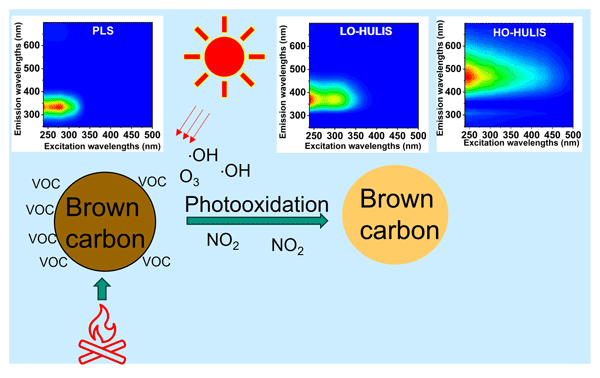
Abstract. Brown carbon (BrC) aerosols affect earth’s climate and originate mainly from biomass burning. However, chromophores and chemical composition of BrC remain difficult predict, especially considering BrC from different sources and aging e.g. by photooxidation. To address this gap, we studied emissions of burning beech wood, straw, plastics, and cow dung in an oxidative flow reactor allowing to conduct photooxidation aging of fresh emissions. After photooxidation, volatile organic compounds and heavier molecules were oxidized and formed more oxidized products. Phenolic-like substances (PLS) and less oxygenated humic-like substances (LO-HULIS) dominated the fluorescence of primary organic aerosol with 88 ± 7 %. After photooxidation, the PLS chromophore significantly decreased from 45 ± 8 % to 10 ± 6 % and humic-like substance increased from 55 ± 8 % to 90 ± 6 %, especially highly-oxygenated humic-like substance (HO-HULIS). To futher confirm the chromophore variation process during the photooxidation, links between chromophore and chemical composition were inverstigated. The HULIS chromophores were unsaturated and contained high fractions with 5 % –10 % of nitrogen containing molecules. In contrast, the PLS chromophores had low oxidation states and contained lower fraction (2 %) of nitrogen containing molecules. After photooxidation, oxidation of PLS chromophores and volatile organic compounds in presence of NOx were converted into HULIS with the higher fraction of nitrogen containing and unsaturation chromophores. This study extends the current understanding of formation and photochemcial aging of brown carbon chromophorese e.g. PLS, HO-HULIS, and LO-HULIS from open fires including their molecular composition. This will facilitate modelling of brown carbon aerosol e.g. in trasport models.
Competing interests: At least one of the (co-)authors is a member of the editorial board of Atmospheric Chemistry and Physics.
Publisher's note: Copernicus Publications remains neutral with regard to jurisdictional claims made in the text, published maps, institutional affiliations, or any other geographical representation in this paper. While Copernicus Publications makes every effort to include appropriate place names, the final responsibility lies with the authors. Views expressed in the text are those of the authors and do not necessarily reflect the views of the publisher.-
Notice on discussion status
The requested preprint has a corresponding peer-reviewed final revised paper. You are encouraged to refer to the final revised version.
-
Preprint
(1007 KB)
-
Supplement
(651 KB)
-
The requested preprint has a corresponding peer-reviewed final revised paper. You are encouraged to refer to the final revised version.
- Preprint
(1007 KB) - Metadata XML
-
Supplement
(651 KB) - BibTeX
- EndNote
- Final revised paper


Journal article(s) based on this preprint
Interactive discussion
Status: closed
-
RC1: 'Comment on egusphere-2026-559', Anonymous Referee #1, 11 Mar 2026
The comment was uploaded in the form of a supplement: https://egusphere.copernicus.org/preprints/2026/egusphere-2026-559/egusphere-2026-559-RC1-supplement.pdfCitation: https://doi.org/
10.5194/egusphere-2026-559-RC1 -
AC1: 'Reply on RC1', Feng Jiang, 22 May 2026
The comment was uploaded in the form of a supplement: https://egusphere.copernicus.org/preprints/2026/egusphere-2026-559/egusphere-2026-559-AC1-supplement.pdf
-
AC1: 'Reply on RC1', Feng Jiang, 22 May 2026
-
RC2: 'Comment on egusphere-2026-559', Anonymous Referee #2, 18 Mar 2026
In this manuscript, the authors report on the fluorescence and composition of primary and secondary organic aerosol from the combustion emissions of a range of fuels, including wood, grass, dung, and plastic. The selection of fuels is broad but would benefit from more clearly written rationale. In the experiments, the authors measured excitation-emission matrix spectra and chemical ionization mass spectra for filter-collected samples upstream and downstream of an oxidative flow reactor. The combination of EES and CIMS is strong, leading to new insights regarding the fractions of species in these organic aerosols before and after photochemical aging. The structure of the manuscript and the presentation of the results in figures are generally clear. However, there are many typos throughout the manuscript - I do not list them out below, but those found on the following line numbers are just a selection: 11, 20, 32, 105, 213, 295, 315, 337, and 348. In addition to these corrections, a thorough language revision is required - those found on the following line numbers are examples: 18, 21, 38, 43, 48, and 84. With revisions, the manuscript should be suitable for publication in ACP.
15: The graphical abstract should be revised since many of the elements (like tick labels) are too small to be legible at the size they will appear after publication. If EES spectra are shown, I recommend including axes labels.
54: I suggest revising this paragraph on past studies of aging. I think it is more accurate to say many rather than several studies have investigated aging. I understand there is not room to explore all aspects of these studies here, but the selection of features is too limited even for this space. For example, absorption enhancement is a common feature of OH radical oxidation, so it may justify mentioning briefly.
84: Based on the preceding material in the Introduction, it is surprising to see plastic included in this list of fuels. Plastic combustion should be introduced and rationalized earlier - why is it studied here?
92: Does this total of four include all replicates or just all conditions? If there are no replicate experiments, some acknowledgement of the inherent variability of biomass burning experiments – and consequent limitations – should be provided here.
96: What is the rationale for selecting polyethylene here?
105: Was the holding tank also washed or heated between experiments with different fuels? I would be concerned about cross-contamination, e.g., SVOCs from one fuel being released later during an experiment with another. Were control experiments performed to rule out this potential contamination? For example, if no SOA were observed when clean air was passed to it through the holding tank, then the flushing may be adequate.
114: Do you have a rough estimate of the ratio of ozone to OH?
119: I wonder if the POA and SOA labels are the best way to describe these materials, considering the POA was not filtered out before the OFR. Perhaps fresh and aged would be more accurate. In the future, strictly SOA could be accessed by filtering the POA before the OFR.
122: I would prefer to write EEM here rather than Aqualog, to focus on the technique rather than the model of instrument.
125: What was the rationale for using the methanol-soluble fraction (e.g., the high extraction efficiency in terms of mass)?
129: Why was the organic mass loading not clear? Were filter masses not measured/measurable? More broadly, I think it is worthwhile determining mass concentration for fluorescence, too (not just for absorbance), since it can influence quenching, etc.
189: Here, I was expecting a brief discussion of the contrast between the natural and manufactured (i.e., plastic) fuels.
192: It is surprising to me to see such similar emissions for wood and plastic fuels - see my comment on line 105.
210: I recommend reorganizing the panels here - POA could be aligned more clearly in the left column, and SOA in the right column.
215: See my comment on line 189.
229: Was each condition investigated once? See my comment on line 92.
285: Again, there are surprising similarities between plastic and biomass here. These similarities are a strong feature (e.g., we may be able to treat emissions of such diverse fuels similarly), and they justify discussion and/or rationalization.
308: The average molecular mass of the PLS fraction is interesting. Can you comment on whether it is consistent with, for example, monomers, dimers, oligomers, etc.?
309: Is this 5.9% by number or mass? Currently, it reads like number, but that would be inconsistent with the next paragraph, I believe.
329: This is an interesting combination of EES and CIMS, and a nice comparison.
334: This figure is not a detailed mechanism - more a conceptual illustration.
350: Is the placement of O3 and OH versus NO2 meaningful? Can you briefly comment on why N is lower for the NO2 branch?
355: Please number this section.
Citation: https://doi.org/10.5194/egusphere-2026-559-RC2 -
AC2: 'Reply on RC2', Feng Jiang, 22 May 2026
The comment was uploaded in the form of a supplement: https://egusphere.copernicus.org/preprints/2026/egusphere-2026-559/egusphere-2026-559-AC2-supplement.pdf
-
AC2: 'Reply on RC2', Feng Jiang, 22 May 2026
Peer review completion


Interactive discussion
Status: closed
-
RC1: 'Comment on egusphere-2026-559', Anonymous Referee #1, 11 Mar 2026
The comment was uploaded in the form of a supplement: https://egusphere.copernicus.org/preprints/2026/egusphere-2026-559/egusphere-2026-559-RC1-supplement.pdf
-
AC1: 'Reply on RC1', Feng Jiang, 22 May 2026
The comment was uploaded in the form of a supplement: https://egusphere.copernicus.org/preprints/2026/egusphere-2026-559/egusphere-2026-559-AC1-supplement.pdf
-
AC1: 'Reply on RC1', Feng Jiang, 22 May 2026
-
RC2: 'Comment on egusphere-2026-559', Anonymous Referee #2, 18 Mar 2026
In this manuscript, the authors report on the fluorescence and composition of primary and secondary organic aerosol from the combustion emissions of a range of fuels, including wood, grass, dung, and plastic. The selection of fuels is broad but would benefit from more clearly written rationale. In the experiments, the authors measured excitation-emission matrix spectra and chemical ionization mass spectra for filter-collected samples upstream and downstream of an oxidative flow reactor. The combination of EES and CIMS is strong, leading to new insights regarding the fractions of species in these organic aerosols before and after photochemical aging. The structure of the manuscript and the presentation of the results in figures are generally clear. However, there are many typos throughout the manuscript - I do not list them out below, but those found on the following line numbers are just a selection: 11, 20, 32, 105, 213, 295, 315, 337, and 348. In addition to these corrections, a thorough language revision is required - those found on the following line numbers are examples: 18, 21, 38, 43, 48, and 84. With revisions, the manuscript should be suitable for publication in ACP.
15: The graphical abstract should be revised since many of the elements (like tick labels) are too small to be legible at the size they will appear after publication. If EES spectra are shown, I recommend including axes labels.
54: I suggest revising this paragraph on past studies of aging. I think it is more accurate to say many rather than several studies have investigated aging. I understand there is not room to explore all aspects of these studies here, but the selection of features is too limited even for this space. For example, absorption enhancement is a common feature of OH radical oxidation, so it may justify mentioning briefly.
84: Based on the preceding material in the Introduction, it is surprising to see plastic included in this list of fuels. Plastic combustion should be introduced and rationalized earlier - why is it studied here?
92: Does this total of four include all replicates or just all conditions? If there are no replicate experiments, some acknowledgement of the inherent variability of biomass burning experiments – and consequent limitations – should be provided here.
96: What is the rationale for selecting polyethylene here?
105: Was the holding tank also washed or heated between experiments with different fuels? I would be concerned about cross-contamination, e.g., SVOCs from one fuel being released later during an experiment with another. Were control experiments performed to rule out this potential contamination? For example, if no SOA were observed when clean air was passed to it through the holding tank, then the flushing may be adequate.
114: Do you have a rough estimate of the ratio of ozone to OH?
119: I wonder if the POA and SOA labels are the best way to describe these materials, considering the POA was not filtered out before the OFR. Perhaps fresh and aged would be more accurate. In the future, strictly SOA could be accessed by filtering the POA before the OFR.
122: I would prefer to write EEM here rather than Aqualog, to focus on the technique rather than the model of instrument.
125: What was the rationale for using the methanol-soluble fraction (e.g., the high extraction efficiency in terms of mass)?
129: Why was the organic mass loading not clear? Were filter masses not measured/measurable? More broadly, I think it is worthwhile determining mass concentration for fluorescence, too (not just for absorbance), since it can influence quenching, etc.
189: Here, I was expecting a brief discussion of the contrast between the natural and manufactured (i.e., plastic) fuels.
192: It is surprising to me to see such similar emissions for wood and plastic fuels - see my comment on line 105.
210: I recommend reorganizing the panels here - POA could be aligned more clearly in the left column, and SOA in the right column.
215: See my comment on line 189.
229: Was each condition investigated once? See my comment on line 92.
285: Again, there are surprising similarities between plastic and biomass here. These similarities are a strong feature (e.g., we may be able to treat emissions of such diverse fuels similarly), and they justify discussion and/or rationalization.
308: The average molecular mass of the PLS fraction is interesting. Can you comment on whether it is consistent with, for example, monomers, dimers, oligomers, etc.?
309: Is this 5.9% by number or mass? Currently, it reads like number, but that would be inconsistent with the next paragraph, I believe.
329: This is an interesting combination of EES and CIMS, and a nice comparison.
334: This figure is not a detailed mechanism - more a conceptual illustration.
350: Is the placement of O3 and OH versus NO2 meaningful? Can you briefly comment on why N is lower for the NO2 branch?
355: Please number this section.
Citation: https://doi.org/10.5194/egusphere-2026-559-RC2 -
AC2: 'Reply on RC2', Feng Jiang, 22 May 2026
The comment was uploaded in the form of a supplement: https://egusphere.copernicus.org/preprints/2026/egusphere-2026-559/egusphere-2026-559-AC2-supplement.pdf
-
AC2: 'Reply on RC2', Feng Jiang, 22 May 2026
Peer review completion
Journal article(s) based on this preprint
Viewed
| HTML | XML | Total | Supplement | BibTeX | EndNote | |
|---|---|---|---|---|---|---|
| 1,179 | 626 | 118 | 1,923 | 218 | 107 | 152 |
- HTML: 1,179
- PDF: 626
- XML: 118
- Total: 1,923
- Supplement: 218
- BibTeX: 107
- EndNote: 152
Viewed (geographical distribution)
| Country | # | Views | % |
|---|
| Total: | 0 |
| HTML: | 0 |
| PDF: | 0 |
| XML: | 0 |
- 1
Feng Jiang

Jun Zhang
David Bell
Nadine Borduas-Dedekind
Andre S. H. Prevot
Hongbiao Cui
Thomas Leisner
The requested preprint has a corresponding peer-reviewed final revised paper. You are encouraged to refer to the final revised version.
- Preprint
(1007 KB) - Metadata XML
-
Supplement
(651 KB) - BibTeX
- EndNote
- Final revised paper