
the Creative Commons Attribution 4.0 License.
the Creative Commons Attribution 4.0 License.
 | 26 Feb 2026
Uncertainties in recent tropical stratospheric and tropospheric ozone changes restrict our understanding of future total column ozone change
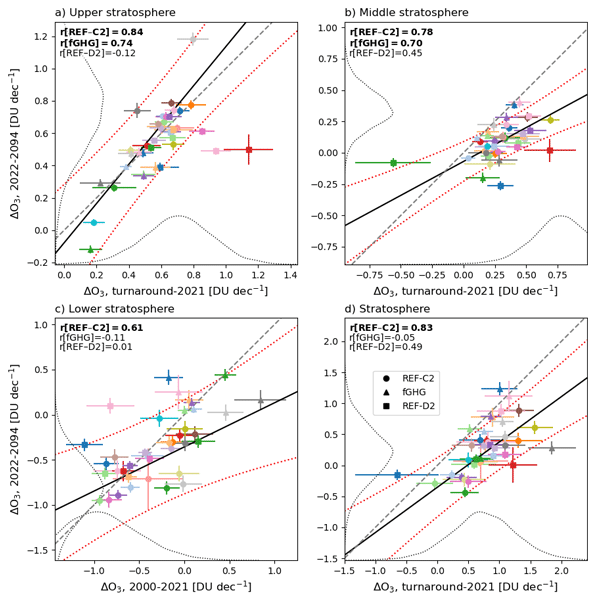
Abstract. A variety of chemical and dynamical processes in the troposphere and stratosphere affect tropical total column ozone (TCO), the net effect of which may cause changes in surface UV radiation and impact human and ecosystem health. We use dynamical linear modeling to estimate tropical trends in TCO and partial column ozone (PCO) in the troposphere and three stratospheric layers to assess agreement between satellite observational composites and chemistry–climate model (CCM) simulations from two multi-model experiments (CCMI-1 and CCMI-2022). While both model experiments show tropical TCO increases over 2000–2021, CCMI–2022 trends (+2.5 DU) agree slightly better with observations than CCMI-1 (+1.6 DU). However, this overall agreement obscures multiple systematic differences in PCO trends between the models and observations across atmospheric layers. For example, since 2000 tropical tropospheric PCO increased significantly in CCMI-2022 (+1.5 DU) but not in CCMI–1 (+0.3 DU), largely explaining the difference in TCO trends. Also, despite nearly identical stratospheric PCO trends, CCMI-2022 trends are slightly more negative in the lower stratospheric (by ~0.5 DU), compensated by more positive middle/upper stratosphere trends compared to CCMI-1. Crucially, substantial differences exist across observational PCO trends, particularly in the troposphere and middle/upper stratosphere, and these disagreements limit the ability to evaluate CCM fidelity. Furthermore, while the inter-model correlation between late and early 21st century trends is suggestive of a potential emergent constraint on future ozone trends, the spread in observational trends precludes its observational implementation.
Competing interests: At least one of the (co-)authors is a member of the editorial board of Atmospheric Chemistry and Physics.
Publisher's note: Copernicus Publications remains neutral with regard to jurisdictional claims made in the text, published maps, institutional affiliations, or any other geographical representation in this paper. While Copernicus Publications makes every effort to include appropriate place names, the final responsibility lies with the authors. Views expressed in the text are those of the authors and do not necessarily reflect the views of the publisher.-
Notice on discussion status
The requested preprint has a corresponding peer-reviewed final revised paper. You are encouraged to refer to the final revised version.
-
Preprint
(3138 KB)
-
The requested preprint has a corresponding peer-reviewed final revised paper. You are encouraged to refer to the final revised version.
- Preprint
(3138 KB) - Metadata XML
- BibTeX
- EndNote
- Final revised paper


Journal article(s) based on this preprint
Interactive discussion
Status: closed
-
RC1: 'Nice summary of observed and simulated ozone trends, questionable extrapolation to the far future.', Anonymous Referee #1, 03 May 2026
-
AC1: 'Reply on RC1', Sean Davis, 18 Aug 2026
The comment was uploaded in the form of a supplement: https://egusphere.copernicus.org/preprints/2026/egusphere-2026-532/egusphere-2026-532-AC1-supplement.pdf
-
AC1: 'Reply on RC1', Sean Davis, 18 Aug 2026
-
RC2: 'Comment on egusphere-2026-532', Anonymous Referee #2, 08 Jun 2026
Overview
This article presents recent stratospheric and tropospheric ozone trends in the tropics and investigates the agreement between satellites and CCMs. The authors use various satellite products and compare 2 model experiments. They estimate model and satellite data trends with a dynamical linear model and found large spread in the trend results. They conclude that satellite observations do not agree well with each other, which makes the model evaluation difficult.
Furthermore, the authors present long-term ozone changes until 2100 and evaluate model differences for that period. They also investigate the effect of different observational periods on the trend results and evaluate the ratio between depletion and recovery trends.
Finally, they analyze correlations between early and late 21st century trends to assess how the disagreement in observations affects the understanding of future recovery. They found that the large spread in observations propagate in the model predictions, and that there is no clear observational constraint that could be used to predict future ozone changes.
The manuscript presents a comprehensive analysis of tropical ozone trends and investigates current discrepancies between satellite observations and model estimates, which is an important contribution to the field of research and fits to ACP. Overall, the manuscript is well structured, with room for some improvement as suggested in the following comments:
Major comments
- Figures 3+4: Even though these figures give a nice overview over the data spread, they are very crowded and it is almost impossible to distinguish the lines and thus very hard to interpret them. There is just too much information in those figures. Please ask yourself what the main aim of the figures is and think about how to present the main message to the reader. If the main aim of the figures is to show the spread amongst the datasets, I suggest the following revision (2 options):
- Option 1 (my preference):
- Keep the colored model lines as they are (with thinner linewidth though) but remove the observational data in Fig. 3 and Fig. 4 and add an additional figure with the observational datasets (with differently colored lines).
- Use then the same new observational color code also for the Kernels in Fig. 5 and 11
- Show the spread of the observational data with a semi-transparent shading in Figs. 3+4, and the spread of the model data with a shading in the new observational figure, to make comparison between model and observations possible.
- Option 2 (if you really want everything in a single figure):
- In each panel, show all models with thin, semi-transparent lines in one color, and all observational lines with thin, semi-transparent lines in another color.
- If desired, you could highlight single lines in each panel (e.g. some of those that you mention in the text), for example by putting them in bold and by labelling them directly at the right edge of the lines
- If desired, you could add a bold line representing the mean of the models and the observations respectively
- I would suggest to use additional colors also for the observational datasets in the right panels. You could also label the bars with vertical labels on the x-axis, but it might be difficult to integrate that into the overall layout of the figure.
- Generally, I think that the lines can be thinner to increase visibility
- I see that you plot for each model the available realizations, which is not stated in the caption (the reader might wonder why there are several lines with the same color).
- Option 1 (my preference):
- Section 5 relies heavily on the degree of agreement between trend estimates (overlap coefficients), but the coefficients are not given in any figure or table. Please provide those values, for example in a correlation matrix (ideally colored with a heatmap function). I think such a representation would simplify the interpretation of the results and make it easier for the reader to follow.
- Section 7.3 and section 8 rely on the assumption, that late-century trends are correlated with the corresponding early-century trends (observational constraint). In the first paragraph of Section 7, you present the key questions that you want to answer, but I am missing some discussion about the physical reasons for a constraint-assumption. For example, why should high early-century ozone trends always lead to high end-of century ozone trends? In principle, there could be a change in trend-intensity over time. Please comment on that.
General comments
- Section 4.2 DLM example: in principle it is a nice idea to show an illustrative example of the DLM fit to the data, but the section is very short and the the purpose is not clearly stated.
- What do the authors want to show with the figure?
- Why is only the solar cycle shown and no other predictors?
- Please expand the text of Section 4.2 accordingly
- In some parts of the result sections, the authors give methodological details. The result sections would be smoother if those parts would be moved to the earlier methods/data sections:
- move DLM-explanations such as Kernel description (l. 378-383) to DLM section (Section 4)
- move the explanation of overlap coefficients (l. 401-404) to the previous paragraph, because it applies to all the following subsections of Section 5
- You compare 2 model experiments, CCMI-1 (with REF-C2 simulations) and CCMI-2022 (with REF-D2 simulations). Please be consistent when referring to those models/setups in the text. Sometimes you refer to CCMI-1 vs. CCMI-2022 experiments (e.g. l. 396), sometimes you use the full name CCMI-1 REF-C2 vs. CCMI-20222 REF-D2 (e.g. l. 414 or l. 360), and sometimes you refer only to REF-C2 vs. REF-D2 (e.g. l. 440). This leads to confusion. Please define in section 3 (CCM description) clear names that you will use throughout the whole manuscript.
Specific and technical comments
Introduction
- Line 76: The first sentence should introduce the broad context of the publication. Even though your first sentence gives important scientific information, it is very long, combines too many ideas and highlights secondary factors (e.g. details about clouds). Please revise.
- Line 85 "During this period since ~2000": please reformulate,
- Line 98 This sentence is not very clear, please revise
- Line 112 "growth of the region": Not clear what is growing, do you mean population increase? Please reformulate.
- Line 120-122: the percentage values are not consistent with the values given in Fig. 1, please correct
- Line 137 "span too wide a range": please reformulate, e.g. "we demonstrate in Sect. 8 that the current range of observational trend estimates is too large to effectively serve…."
Sect. 2
- Line 167, line 173, line182: repetition of "we also use/include", please vary.
- Line 185 "2004 and the 2024": remove "the"
- Line 205 "Note, …": "Note that …"
Table 1
- Improve the caption (e.g. CCMs used in this study to simulate ozone from 1960 to 2100)
- CNRM-MOCAGE: Does put the "*" to the name here, not to the number of realizations
Sect. 4
- Line 325: confusing sentence structure, move "and detrending": change to "… we compute the ENSO index by averaging and detrending the surface temperatures from each simulation…"
- Line 346 "shorter time periods such as the observational record": Reformulate. Shorter than what? Which observational record?
- Line 348 (caption Fig. 2) "tropopause – 1hPa": change to "tropopause to 1hPa"
- Line 349 (caption Fig. 2) "black lines with 1 sigma uncertainty shading": there is no shading for the lower black line, even though it is mentioned in the caption and given in the legend
Sect. 5
- Line 353: please improve the title of section 5, "observational period" is very vague, please adapt, e.g. to "Tropical ozone changes from 1980 to 2021"
- Line 378: move KDE description to Section 4 (see general comment)
- Line 401-404: move to previous section (see general comment) and provide a correlation matrix there (see major comment)
Sect. 6
- Line 519-522: please revise, it is not clear what the authors would like to say with this paragraph.
- Line 519: What does "relatively negative" mean? Do you mean smaller trends?
- Line 520: the upper stratospheric trend of ACCESS_CM2-Chem is not negative
- Line 521: remove "very", which is an unnecessary and subjective intensifier
- L 523 "somewhat different": reformulate
- Line 525 "dramatic increase": remove "dramatic", which is a non-scientific intensifier
Sect. 7
- Line 545: If I understand correctly, the full period is used as an input to DLM, but the trend is then determined for the same period as for the first estimate (1985-2021) to compare both. Please clarify that. It reads as if the 1985-2021-trend is compared with the 1960-2100-trend, which does not make sense in this context.
- Line 549: remove "very", which is an unnecessary intensifier
- Line 561 (caption Fig 8) "significant correlations are in bold": In this figure, all correlation coefficients are significant and thus bold, which makes this claim confusing here. It makes sense only in the following figures (Fig. 9 and Fig 10).
- Line 578 "a faster inorganic chlorine (Cly) increase before, and a faster decrease after, the peak Cly in the late 1990's": please remove the commas, otherwise the sentence is confusing
- Line 581 "(dotted line, Fig. 9a),.": remove comma
- Line 593 " multimodel-mean value of the Cly recovery/depletion trend ratio calculated over the same latitude (30° S–30° N) and vertical region from the REF-C2 experiment.": Figure captions should not contain new information. Please explain how the dotted lines are calculated also in Sect. 7.2.
- Line 610: BDC is not defined
Sect. 8
- Line 676: the observations and model distributions show similar widths in the middle stratosphere, but in the upper stratosphere, the observational widths are larger (even though less large than in the lower stratosphere). Please mention that.
Conclusion
- Line 730: please provide references for the negative lower stratospheric ozone trends.
- Line 745 and 747 "These results highlight": repetition, use e.g. "Ultimately, the results indicate …"
Citation: https://doi.org/10.5194/egusphere-2026-532-RC2 -
AC2: 'Reply on RC2', Sean Davis, 18 Aug 2026
The comment was uploaded in the form of a supplement: https://egusphere.copernicus.org/preprints/2026/egusphere-2026-532/egusphere-2026-532-AC2-supplement.pdf
- Figures 3+4: Even though these figures give a nice overview over the data spread, they are very crowded and it is almost impossible to distinguish the lines and thus very hard to interpret them. There is just too much information in those figures. Please ask yourself what the main aim of the figures is and think about how to present the main message to the reader. If the main aim of the figures is to show the spread amongst the datasets, I suggest the following revision (2 options):
Peer review completion


Interactive discussion
Status: closed
-
RC1: 'Nice summary of observed and simulated ozone trends, questionable extrapolation to the far future.', Anonymous Referee #1, 03 May 2026
Overall Assessment
The paper uses a dynamical linear model (DLM) to fit slowly varying smooth long-term trend lines to ozone time series from a number of sources: merged observed time series from satellites and simulated time series from two sets of multi-model simulation exercises. The obtained long-term trend lines are then used to derive ozone trends for several atmospheric layers and for different multi-decadal periods. The used data and the methodology are solid and consistent with many other publications. The derived trends are important and help to assess the expected recovery process of the ozone layer on the basis of both satellite observations and model simulations. Overall, I think this is a good and important paper and well suited for ACP.
Major Question
However, I do have a major problem with the extrapolations of trends from the 2000 to 2021 period to the end of the current century, which are presented in sections 7 and 8. To me there are so many uncertainties involved and the end results are, at best, very vague, uncertain and even doubtful. I think this entire part of the paper is unnecessary, weakens the main messages of the previous parts, and makes the paper longer and less clear. I strongly suggest to omit large parts of sections 7 and 8, especially Figs. 10 and 11 and their discussion. Ozone changes after 2030 or so depend a lot on future GHG emissions. CCMI-1 REF-C2 and CCMI-2022 REF-D2 use quite different GHG scenarios, have changes in the used models. Both model exercises make their own predictions, so there is not much point in repeating them here. Because the scenarios and models differ, and the real future emissions are likely to be different again, I don't see much point in using 2000 to 2021 changes to forecast anything in the far future. Matters get even worse when observed 2000 to 2021 changes that do not match the corresponding simulated changes are extrapolated to the end of the century using the poor correlations found for the model simulations. To me this seems a clear case of garbage in = garbage out, and an unnecessary, confusing and potentially misleading effort.
I do like Figure 8 and its discussion. Checking whether applying the DLM to the shorter (observational) period from 2000 to 2021 matches applying the DLM to the longer (simulated) period from 1960 to 2100 makes perfect sense.
I also like Figure 9 comparing the ozone trends during the period of decline with those during the recovery period. I would like to see the same Figure for the trends from the satellite observations. Or those observed trends should also be plotted in Figure 9 (might become too crowded).
Minor Comments
Line 65: are the DU numbers for trends - then they should be DU per decade, or are the for twenty year changes (not trends)? As is now, I found this misleading. Please clarify.
Line 72 to 74: This sentence does not make much sense to me, and captures the major problem I have indicated above. I strongly suggest to drop this sentence, and the corresponding parts of sections 7 and 8.
Line 114: I think you need to include a discussion of more recent tropospheric ozone trend updates from the TOAR II initiative. It would also be good to compare your tropospheric ozone trends to trends from TOAR II.
Line 181: one "a" too much in overlap
Line 193: I am not sure that Petropavlovskikh et al. 2025 is really a good reference for the SBUV-COH dataset. It would be better to also refer to the SBUV-COH Webpage / URL: https://www.star.nesdis.noaa.gov/data/smcd1/ozone/SBUV_OMPS_COH/
Line 238: Is that the MERRA2 zonal mean tropopause, since the satellite data sets all seem to be zonal means as well? Or are you using longitudinally resolved data. Please clarify.
Line 267: how similar are the WMO 2011 and WMO 2018 ODS scenarios (or their corresponding equivalent effective stratospheric chlorine). Can you make a statement on that?
Table 1: I think it would be helpful to have an additional comparable table that summarizes the different observational datasets. In all the following Figures I kept wondering which observational dataset is which.
Figure 2: It would be good to have a third panel that plots the CESM1-WACCM time series also just for the 1984 to 2021 period. Or plot the model results in the top panel along with the SWOOSH time series.
Figure 9: As mentioned above, it would be good to also compare the two trend periods for the satellite observations. Either also plotted in Figure 9 (might become too crowded), or in separate Figure.
Summary
Overall, I think this is a good and important paper that summarizes major ozone trend features of current observational and simulated records. The spread in the results is quite large and demonstrates substantial uncertainty in both observational records and model simulations. As indicated in my major comments, I feel that the paper would become shorter, clearer and more concise if the very speculative and uncertain extrapolations (Figs. 10 and 11 and their discussion) were omitted.
Citation: https://doi.org/10.5194/egusphere-2026-532-RC1 -
AC1: 'Reply on RC1', Sean Davis, 18 Aug 2026
The comment was uploaded in the form of a supplement: https://egusphere.copernicus.org/preprints/2026/egusphere-2026-532/egusphere-2026-532-AC1-supplement.pdf
-
AC1: 'Reply on RC1', Sean Davis, 18 Aug 2026
-
RC2: 'Comment on egusphere-2026-532', Anonymous Referee #2, 08 Jun 2026
Overview
This article presents recent stratospheric and tropospheric ozone trends in the tropics and investigates the agreement between satellites and CCMs. The authors use various satellite products and compare 2 model experiments. They estimate model and satellite data trends with a dynamical linear model and found large spread in the trend results. They conclude that satellite observations do not agree well with each other, which makes the model evaluation difficult.
Furthermore, the authors present long-term ozone changes until 2100 and evaluate model differences for that period. They also investigate the effect of different observational periods on the trend results and evaluate the ratio between depletion and recovery trends.
Finally, they analyze correlations between early and late 21st century trends to assess how the disagreement in observations affects the understanding of future recovery. They found that the large spread in observations propagate in the model predictions, and that there is no clear observational constraint that could be used to predict future ozone changes.
The manuscript presents a comprehensive analysis of tropical ozone trends and investigates current discrepancies between satellite observations and model estimates, which is an important contribution to the field of research and fits to ACP. Overall, the manuscript is well structured, with room for some improvement as suggested in the following comments:
Major comments
- Figures 3+4: Even though these figures give a nice overview over the data spread, they are very crowded and it is almost impossible to distinguish the lines and thus very hard to interpret them. There is just too much information in those figures. Please ask yourself what the main aim of the figures is and think about how to present the main message to the reader. If the main aim of the figures is to show the spread amongst the datasets, I suggest the following revision (2 options):
- Option 1 (my preference):
- Keep the colored model lines as they are (with thinner linewidth though) but remove the observational data in Fig. 3 and Fig. 4 and add an additional figure with the observational datasets (with differently colored lines).
- Use then the same new observational color code also for the Kernels in Fig. 5 and 11
- Show the spread of the observational data with a semi-transparent shading in Figs. 3+4, and the spread of the model data with a shading in the new observational figure, to make comparison between model and observations possible.
- Option 2 (if you really want everything in a single figure):
- In each panel, show all models with thin, semi-transparent lines in one color, and all observational lines with thin, semi-transparent lines in another color.
- If desired, you could highlight single lines in each panel (e.g. some of those that you mention in the text), for example by putting them in bold and by labelling them directly at the right edge of the lines
- If desired, you could add a bold line representing the mean of the models and the observations respectively
- I would suggest to use additional colors also for the observational datasets in the right panels. You could also label the bars with vertical labels on the x-axis, but it might be difficult to integrate that into the overall layout of the figure.
- Generally, I think that the lines can be thinner to increase visibility
- I see that you plot for each model the available realizations, which is not stated in the caption (the reader might wonder why there are several lines with the same color).
- Option 1 (my preference):
- Section 5 relies heavily on the degree of agreement between trend estimates (overlap coefficients), but the coefficients are not given in any figure or table. Please provide those values, for example in a correlation matrix (ideally colored with a heatmap function). I think such a representation would simplify the interpretation of the results and make it easier for the reader to follow.
- Section 7.3 and section 8 rely on the assumption, that late-century trends are correlated with the corresponding early-century trends (observational constraint). In the first paragraph of Section 7, you present the key questions that you want to answer, but I am missing some discussion about the physical reasons for a constraint-assumption. For example, why should high early-century ozone trends always lead to high end-of century ozone trends? In principle, there could be a change in trend-intensity over time. Please comment on that.
General comments
- Section 4.2 DLM example: in principle it is a nice idea to show an illustrative example of the DLM fit to the data, but the section is very short and the the purpose is not clearly stated.
- What do the authors want to show with the figure?
- Why is only the solar cycle shown and no other predictors?
- Please expand the text of Section 4.2 accordingly
- In some parts of the result sections, the authors give methodological details. The result sections would be smoother if those parts would be moved to the earlier methods/data sections:
- move DLM-explanations such as Kernel description (l. 378-383) to DLM section (Section 4)
- move the explanation of overlap coefficients (l. 401-404) to the previous paragraph, because it applies to all the following subsections of Section 5
- You compare 2 model experiments, CCMI-1 (with REF-C2 simulations) and CCMI-2022 (with REF-D2 simulations). Please be consistent when referring to those models/setups in the text. Sometimes you refer to CCMI-1 vs. CCMI-2022 experiments (e.g. l. 396), sometimes you use the full name CCMI-1 REF-C2 vs. CCMI-20222 REF-D2 (e.g. l. 414 or l. 360), and sometimes you refer only to REF-C2 vs. REF-D2 (e.g. l. 440). This leads to confusion. Please define in section 3 (CCM description) clear names that you will use throughout the whole manuscript.
Specific and technical comments
Introduction
- Line 76: The first sentence should introduce the broad context of the publication. Even though your first sentence gives important scientific information, it is very long, combines too many ideas and highlights secondary factors (e.g. details about clouds). Please revise.
- Line 85 "During this period since ~2000": please reformulate,
- Line 98 This sentence is not very clear, please revise
- Line 112 "growth of the region": Not clear what is growing, do you mean population increase? Please reformulate.
- Line 120-122: the percentage values are not consistent with the values given in Fig. 1, please correct
- Line 137 "span too wide a range": please reformulate, e.g. "we demonstrate in Sect. 8 that the current range of observational trend estimates is too large to effectively serve…."
Sect. 2
- Line 167, line 173, line182: repetition of "we also use/include", please vary.
- Line 185 "2004 and the 2024": remove "the"
- Line 205 "Note, …": "Note that …"
Table 1
- Improve the caption (e.g. CCMs used in this study to simulate ozone from 1960 to 2100)
- CNRM-MOCAGE: Does put the "*" to the name here, not to the number of realizations
Sect. 4
- Line 325: confusing sentence structure, move "and detrending": change to "… we compute the ENSO index by averaging and detrending the surface temperatures from each simulation…"
- Line 346 "shorter time periods such as the observational record": Reformulate. Shorter than what? Which observational record?
- Line 348 (caption Fig. 2) "tropopause – 1hPa": change to "tropopause to 1hPa"
- Line 349 (caption Fig. 2) "black lines with 1 sigma uncertainty shading": there is no shading for the lower black line, even though it is mentioned in the caption and given in the legend
Sect. 5
- Line 353: please improve the title of section 5, "observational period" is very vague, please adapt, e.g. to "Tropical ozone changes from 1980 to 2021"
- Line 378: move KDE description to Section 4 (see general comment)
- Line 401-404: move to previous section (see general comment) and provide a correlation matrix there (see major comment)
Sect. 6
- Line 519-522: please revise, it is not clear what the authors would like to say with this paragraph.
- Line 519: What does "relatively negative" mean? Do you mean smaller trends?
- Line 520: the upper stratospheric trend of ACCESS_CM2-Chem is not negative
- Line 521: remove "very", which is an unnecessary and subjective intensifier
- L 523 "somewhat different": reformulate
- Line 525 "dramatic increase": remove "dramatic", which is a non-scientific intensifier
Sect. 7
- Line 545: If I understand correctly, the full period is used as an input to DLM, but the trend is then determined for the same period as for the first estimate (1985-2021) to compare both. Please clarify that. It reads as if the 1985-2021-trend is compared with the 1960-2100-trend, which does not make sense in this context.
- Line 549: remove "very", which is an unnecessary intensifier
- Line 561 (caption Fig 8) "significant correlations are in bold": In this figure, all correlation coefficients are significant and thus bold, which makes this claim confusing here. It makes sense only in the following figures (Fig. 9 and Fig 10).
- Line 578 "a faster inorganic chlorine (Cly) increase before, and a faster decrease after, the peak Cly in the late 1990's": please remove the commas, otherwise the sentence is confusing
- Line 581 "(dotted line, Fig. 9a),.": remove comma
- Line 593 " multimodel-mean value of the Cly recovery/depletion trend ratio calculated over the same latitude (30° S–30° N) and vertical region from the REF-C2 experiment.": Figure captions should not contain new information. Please explain how the dotted lines are calculated also in Sect. 7.2.
- Line 610: BDC is not defined
Sect. 8
- Line 676: the observations and model distributions show similar widths in the middle stratosphere, but in the upper stratosphere, the observational widths are larger (even though less large than in the lower stratosphere). Please mention that.
Conclusion
- Line 730: please provide references for the negative lower stratospheric ozone trends.
- Line 745 and 747 "These results highlight": repetition, use e.g. "Ultimately, the results indicate …"
Citation: https://doi.org/10.5194/egusphere-2026-532-RC2 -
AC2: 'Reply on RC2', Sean Davis, 18 Aug 2026
The comment was uploaded in the form of a supplement: https://egusphere.copernicus.org/preprints/2026/egusphere-2026-532/egusphere-2026-532-AC2-supplement.pdf
- Figures 3+4: Even though these figures give a nice overview over the data spread, they are very crowded and it is almost impossible to distinguish the lines and thus very hard to interpret them. There is just too much information in those figures. Please ask yourself what the main aim of the figures is and think about how to present the main message to the reader. If the main aim of the figures is to show the spread amongst the datasets, I suggest the following revision (2 options):
Peer review completion
Journal article(s) based on this preprint
Viewed
| HTML | XML | Total | BibTeX | EndNote | |
|---|---|---|---|---|---|
| 1,393 | 506 | 127 | 2,026 | 145 | 190 |
- HTML: 1,393
- PDF: 506
- XML: 127
- Total: 2,026
- BibTeX: 145
- EndNote: 190
Viewed (geographical distribution)
| Country | # | Views | % |
|---|
| Total: | 0 |
| HTML: | 0 |
| PDF: | 0 |
| XML: | 0 |
- 1
Cited


2 citations as recorded by crossref.
- Stratospheric ozone projections under sulfur-based stratospheric aerosol injection: Insights from the multi-model G6-1.5K-SAI experiment E. Bednarz et al. https://doi.org/10.5194/acp-26-12751-2026
- Consistency between zonal mean stratospheric and total column ozone trends (2000–2024) B. Auffarth et al. https://doi.org/10.5194/acp-26-13359-2026

William Ball
Gabriel Chiodo
Justin Alsing
James Keeble
Hideharu Akiyoshi
Carlo Arosio
Ewa Bednarz
Andreas Chrysanthou
Melanie Coldewey-Egbers
Robert Damadeo
Sandip Dhomse
Mohamadou Diallo
Simone Dietmuller
Roland Eichinger
Stacey Frith
Birgit Hassler
Michaela Hegglin
Daan Hubert
Patrick Jöckel
Béatrice Josse
Natalya Kramarova
Diego Loyola
Eliane Maillard Barras
Marion Marchand
Olaf Morgenstern
David Plummer
Robert Portmann
Karen Rosenlof
Alexei Rozanov
Viktoria Sofieva
Johannes Staehelin
Timofei Sukhodolov
Kleareti Tourpali
Ronald Van der A
H. J. Ray Wang
Krzysztof Wargan
Shingo Watanabe
Mark Weber
Jeannette Wild
Yousuke Yamashita
Jerry Ziemke
The requested preprint has a corresponding peer-reviewed final revised paper. You are encouraged to refer to the final revised version.
- Preprint
(3138 KB) - Metadata XML
Overall Assessment
The paper uses a dynamical linear model (DLM) to fit slowly varying smooth long-term trend lines to ozone time series from a number of sources: merged observed time series from satellites and simulated time series from two sets of multi-model simulation exercises. The obtained long-term trend lines are then used to derive ozone trends for several atmospheric layers and for different multi-decadal periods. The used data and the methodology are solid and consistent with many other publications. The derived trends are important and help to assess the expected recovery process of the ozone layer on the basis of both satellite observations and model simulations. Overall, I think this is a good and important paper and well suited for ACP.
Major Question
However, I do have a major problem with the extrapolations of trends from the 2000 to 2021 period to the end of the current century, which are presented in sections 7 and 8. To me there are so many uncertainties involved and the end results are, at best, very vague, uncertain and even doubtful. I think this entire part of the paper is unnecessary, weakens the main messages of the previous parts, and makes the paper longer and less clear. I strongly suggest to omit large parts of sections 7 and 8, especially Figs. 10 and 11 and their discussion. Ozone changes after 2030 or so depend a lot on future GHG emissions. CCMI-1 REF-C2 and CCMI-2022 REF-D2 use quite different GHG scenarios, have changes in the used models. Both model exercises make their own predictions, so there is not much point in repeating them here. Because the scenarios and models differ, and the real future emissions are likely to be different again, I don't see much point in using 2000 to 2021 changes to forecast anything in the far future. Matters get even worse when observed 2000 to 2021 changes that do not match the corresponding simulated changes are extrapolated to the end of the century using the poor correlations found for the model simulations. To me this seems a clear case of garbage in = garbage out, and an unnecessary, confusing and potentially misleading effort.
I do like Figure 8 and its discussion. Checking whether applying the DLM to the shorter (observational) period from 2000 to 2021 matches applying the DLM to the longer (simulated) period from 1960 to 2100 makes perfect sense.
I also like Figure 9 comparing the ozone trends during the period of decline with those during the recovery period. I would like to see the same Figure for the trends from the satellite observations. Or those observed trends should also be plotted in Figure 9 (might become too crowded).
Minor Comments
Line 65: are the DU numbers for trends - then they should be DU per decade, or are the for twenty year changes (not trends)? As is now, I found this misleading. Please clarify.
Line 72 to 74: This sentence does not make much sense to me, and captures the major problem I have indicated above. I strongly suggest to drop this sentence, and the corresponding parts of sections 7 and 8.
Line 114: I think you need to include a discussion of more recent tropospheric ozone trend updates from the TOAR II initiative. It would also be good to compare your tropospheric ozone trends to trends from TOAR II.
Line 181: one "a" too much in overlap
Line 193: I am not sure that Petropavlovskikh et al. 2025 is really a good reference for the SBUV-COH dataset. It would be better to also refer to the SBUV-COH Webpage / URL: https://www.star.nesdis.noaa.gov/data/smcd1/ozone/SBUV_OMPS_COH/
Line 238: Is that the MERRA2 zonal mean tropopause, since the satellite data sets all seem to be zonal means as well? Or are you using longitudinally resolved data. Please clarify.
Line 267: how similar are the WMO 2011 and WMO 2018 ODS scenarios (or their corresponding equivalent effective stratospheric chlorine). Can you make a statement on that?
Table 1: I think it would be helpful to have an additional comparable table that summarizes the different observational datasets. In all the following Figures I kept wondering which observational dataset is which.
Figure 2: It would be good to have a third panel that plots the CESM1-WACCM time series also just for the 1984 to 2021 period. Or plot the model results in the top panel along with the SWOOSH time series.
Figure 9: As mentioned above, it would be good to also compare the two trend periods for the satellite observations. Either also plotted in Figure 9 (might become too crowded), or in separate Figure.
Summary
Overall, I think this is a good and important paper that summarizes major ozone trend features of current observational and simulated records. The spread in the results is quite large and demonstrates substantial uncertainty in both observational records and model simulations. As indicated in my major comments, I feel that the paper would become shorter, clearer and more concise if the very speculative and uncertain extrapolations (Figs. 10 and 11 and their discussion) were omitted.