
the Creative Commons Attribution 4.0 License.
the Creative Commons Attribution 4.0 License.
 | 03 Mar 2026
Thin Organic Films Unexpectedly Enhance Alcohol Uptake on Soot Analogs: Critical Implications for Aerosol Aging
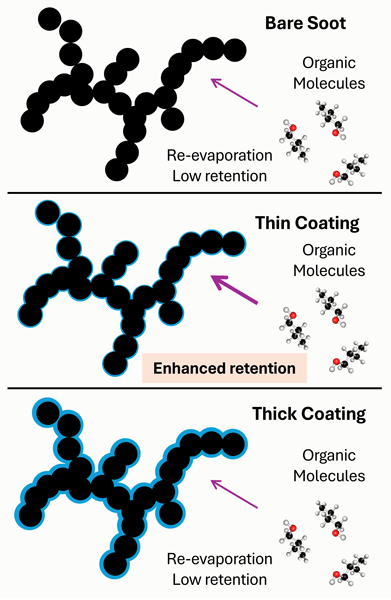
Abstract. Organic coatings strongly influence how gases are taken up by soot particles, yet the underlying kinetics are poorly understood. Environmental molecular beam experiments combined with time-of-flight mass spectrometry and molecular dynamics simulations were used to examine interactions between butanol clusters and graphite surfaces with thin and thick organic coatings over 180–300 K. Bare graphite shows two desorption pathways: a fast, temperature-insensitive channel and a slower channel peaking near 210–220 K. Thin organic coatings suppress the slow pathway entirely, consistent with rapid formation of a condensed alcohol layer that stabilizes surface-bound molecules. In contrast, thick organic layers enhance slow desorption and shift complete release to lower temperatures, indicating reduced molecular stability on corrugated organic surfaces. Analysis reveals similar activation energies and rate parameters for delayed desorption on graphite and thick coatings, pointing to a shared cluster-mediated mechanism. Translating these kinetics into an effective uptake framework shows that gas-particle exchange shifts between kinetic retention and desorption-limited regimes depending on coating structure and temperature. Simulations further demonstrate how surface morphology and coating thickness control cluster adsorption, reflection, and stability. Together, these findings show that thin organic films on aged soot can strongly enhance retention of semi-volatile organics, while thicker organic layers promote delayed release, with important implications for aerosol aging, secondary organic aerosol formation, and climate effects.
-
Notice on discussion status
The requested preprint has a corresponding peer-reviewed final revised paper. You are encouraged to refer to the final revised version.
-
Preprint
(1289 KB)
-
Supplement
(1111 KB)
-
The requested preprint has a corresponding peer-reviewed final revised paper. You are encouraged to refer to the final revised version.
- Preprint
(1289 KB) - Metadata XML
-
Supplement
(1111 KB) - BibTeX
- EndNote
- Final revised paper


Journal article(s) based on this preprint
Interactive discussion
Status: closed
-
RC1: 'Referee comment on egusphere-2026-525', Anonymous Referee #1, 23 Mar 2026
-
AC1: 'Reply on RC1', Xiangrui Kong, 27 Mar 2026
We thank the referee for the very positive and thoughtful assessment of our work. We especially appreciate the recognition of the value of combining EMB experiments with MD simulations, and the insightful discussion regarding non-equilibrium processes in SOA growth. We address the specific comments below.
Comment 1: Representativeness of the molecular beam energy distribution
The referee notes that the narrow, directed energy distribution in a molecular beam differs from thermal atmospheric conditions and asks whether this leads to different surface dynamics.
Response: We agree that the incident energy distribution in a molecular beam differs from the thermal distributions in the atmosphere. We have clarified this point in the revised manuscript.
Importantly, the processes investigated here (energy accommodation, trapping, cluster dissociation, and desorption) are governed by surface-controlled energy redistribution following impact, rather than by the exact form of the incident velocity distribution. As shown in our results, the scattered flux is dominated by thermal desorption (TD) with negligible inelastic scattering contributions, indicating that the incident kinetic energy is efficiently dissipated into surface and internal degrees of freedom prior to desorption. This implies that the system rapidly loses memory of the initial beam conditions, and the observed kinetics reflect intrinsic surface properties (e.g., binding, morphology, and energy dissipation pathways). These quantities are directly transferable to atmospheric conditions and are the same parameters used in kinetic aerosol models.
To clarify this, we have added a paragraph in the revised manuscript (Section 2.1): “While the molecular beam has a narrow and directed energy distribution, the observed dynamics are governed by rapid energy accommodation at the surface. The dominance of thermal desorption indicates efficient redistribution of the incident energy, such that the system largely loses memory of the initial velocity distribution. The extracted kinetic parameters therefore reflect intrinsic surface-controlled processes and are transferable to atmospheric conditions.”
Comment 2: Temperature range and absence of water vapor
The referee asks how higher atmospheric temperatures and the presence of water vapor may affect the results and their interpretation.
Response: We thank the referee for raising this important point regarding atmospheric relevance.
(a) Temperature effects: We note that our experimental range (180 - 300 K) already overlaps with atmospherically relevant conditions, particularly for the upper troposphere and cold boundary layers. More importantly, the key outcome of the study is the identification of a competition between incorporation and thermally activated desorption, which is explicitly captured through Arrhenius kinetics and the effective uptake coefficient framework.
As temperature increases, desorption rates increase accordingly, shifting the system toward a more desorption-limited regime, as shown in our kinetic analysis (Section 3.2). This behavior is fully consistent with expectations for warmer atmospheric conditions. We have clarified in the revised manuscript that while higher temperatures increase surface mobility and desorption rates, they do not alter the fundamental distinction between thin-film (kinetic retention) and thick-film (desorption-limited) regimes, which is controlled by morphology.
(b) Role of water vapor: We agree that water vapor is a key factor in atmospheric heterogeneous chemistry. While its inclusion is experimentally challenging in EMB, we have expanded the discussion in the revised manuscript to address its potential effects. Specifically, water may compete for adsorption sites and modify hydrogen-bonding networks, plasticize organic coatings, increasing molecular mobility, and alter energy dissipation and cluster stabilization. Based on our mechanistic findings, we expect that thin, disordered coatings may become even more accommodating in the presence of water due to enhanced energy dissipation and hydrogen bonding, whereas thick, ordered coatings may become more liquid-like, potentially reducing delayed desorption.
We have added a paragraph in Section 4 (Atmospheric Implications) discussing how humidity may modulate, but does not invalidate, the morphology-dependent kinetic regimes identified in this study: “Under atmospheric conditions, higher temperatures and the presence of water vapor may influence surface mobility and intermolecular interactions. Increasing temperature enhances desorption rates, shifting the system toward a more desorption-limited regime, consistent with our kinetic framework. Water vapor may further modify surface properties through adsorption and hydrogen bonding, affecting energy dissipation and molecular accommodation. While these factors may alter quantitative behavior, the morphology-dependent kinetic regimes identified here are expected to remain robust.”
Citation: https://doi.org/10.5194/egusphere-2026-525-AC1
-
AC1: 'Reply on RC1', Xiangrui Kong, 27 Mar 2026
-
RC2: 'Comment on egusphere-2026-525', Anonymous Referee #3, 26 Mar 2026
The present study focus on how organic coating influence of the parting of gaseous organic pollutants on soot. Environmental molecular beam experiments and molecular dynamics simulations were used. Critical result were found in this study, and these findings are very important in further understanding the aging of soot and formation of secondary organic aerosols. The organization and writing of the current manuscript is excellent, which can be published.
Several minor comments are suggested (optional)
(1)The presentation of the Arrhenius analysis in Figure 4 would benefit from greater clarity. The caption indicates that data are shown for the nopinone thick layer, but the main text states that both HOPG and the thick layer were analyzed. Including both datasets in the figure, or clearly stating in the caption why only one is shown, would improve transparency.
(2) The connection between the MD simulations and the experimental thickness regimes could be made more explicit. The simulations use slab thicknesses of 4, 6, and 15 layers to represent thin and thick coatings. Clarifying how these specific layer numbers correspond to the experimental "thin" (below ~8 nm) and "thick" (~1 μm) regimes would help bridge the molecular and macroscopic scales. A short justification in Section 3.3 would suffice.
Citation: https://doi.org/10.5194/egusphere-2026-525-RC2 -
AC2: 'Reply on RC2', Xiangrui Kong, 02 Apr 2026
We thank the referee for the positive evaluation of the manuscript and for recognizing the importance of the results for understanding soot aging and SOA formation. We also appreciate the helpful suggestions for improving clarity.
Comment 1: Clarity of Arrhenius analysis in Figure 4
The referee notes an inconsistency between the figure caption and the main text regarding which datasets are included.
Response: We thank the referee for identifying this ambiguity. In the revised manuscript, we have: clarified in both the main text and the figure caption that the Arrhenius analysis includes both HOPG and the nopinone thick layer, and explicitly stated that the thin coating is excluded because the slow TD channel is absent for this case.
We have also revised the caption: "Figure 4. Arrhenius plot of butanol desorption rate constants for the slow TD channel from HOPG and the nopinone thick layer. Both datasets are included in the analysis and exhibit comparable activation energies and pre-exponential factors. No data are shown for the thin nopinone coating because the slow TD channel is completely suppressed on this surface."
Main text: "The analysis includes the two surfaces exhibiting slow TD behavior, HOPG and the nopinone thick layer, whereas the thin coating is excluded due to the absence of the slow TD channel."
Comment 2: Connection between MD simulations and experimental thickness regimes
The referee suggests clarifying how MD slab thicknesses relate to experimental thin and thick coatings.
Response: We thank the referee for this important suggestion.
In the revised manuscript, we have clarified the connection between the MD slab thicknesses and the experimental coating regimes. Experimentally, the “thin” coating corresponds to a very low-coverage regime, likely approaching a monolayer, although its exact thickness is below the detection limit. The MD slabs with 4–6 layers (~2.8–3.5 nm) therefore represent a comparable regime in which substrate effects and surface disorder remain significant.
In contrast, the experimentally defined “thick” layer (~1 μm) represents a limit where substrate influence is no longer accessible and surface properties are governed entirely by the organic phase. This is consistent with the MD 15-layer (~9 nm) slab, which is sufficiently thick to screen substrate effects and exhibits a more ordered, bulk-like surface structure.
We now explicitly state that the MD simulations are designed to capture the transition from substrate-influenced, disordered surfaces to bulk-like organic layers, focusing on morphology, disorder, and defect density rather than absolute thickness.
To clarify this, we have added the following text in the revised manuscript (Section 2.2): “In the present simulations, the slab thicknesses are chosen to capture the transition from substrate-influenced, thin coatings to bulk-like organic layers, rather than to reproduce the full atmospheric thickness range. The thinner slabs represent a low-coverage regime where substrate effects remain important, whereas the thicker slab corresponds to a regime in which the organic layer effectively screens the substrate.”
Citation: https://doi.org/10.5194/egusphere-2026-525-AC2
-
AC2: 'Reply on RC2', Xiangrui Kong, 02 Apr 2026


Interactive discussion
Status: closed
-
RC1: 'Referee comment on egusphere-2026-525', Anonymous Referee #1, 23 Mar 2026
This is a well-written excellent example of how "chemical physics" experiments may be used to gain insight into atmospheric chemistry. The combination of molecular beam scattering results and molecular dynamics simulations is powerful and appropriate. The experiments and simulations are well described and I have no issue with the authors' interpretation of their results.
The question of interest - how do organic coatings on growing SOA particles influence accretion of gas phase organic compounds - is of real interest and importance. One school of thought is that equilibrium partitioning models capture all of the important processes; this (and similar) experiment suggests that the molecular interactions governing the gas-surface collision play an important role before equilibrium is reached. That is to say - one must acknowledge that the timescale for establishing equilibrium is necessarily longer than the collision time scales, so the possibility of non-equilibrium processes must be considered for a true picture of SOA formation and growth to emerge.
That all said, I do think that some more thought is required to highlight the real atmospheric significance of these findings. First, the very narrow and highly directed energy distribution in a molecular beam is far from representative of the thermal distributions important in the troposphere and lower stratosphere. Does this difference give rise to different dynamics at the surface as measured using the scattered beam than those of importance in the atmosphere? I think the authors should comment on this.
Second, the region of interest for SOA formation and growth is at a considerably higher temperature than the surface temperature range explored here. Presumably, this higher temperature will give rise to greater surface mobility, which may well impact the results at realistic temperatures. Similarly, the presence of water vapour in the troposphere is key to many heterogeneous chemical processes, but is neglected here (by necessity, in the experiments). I would like to see some consideration given to how these features of the real atmosphere might impact the results, and also the overall interpretation, presented here.
Citation: https://doi.org/10.5194/egusphere-2026-525-RC1 -
AC1: 'Reply on RC1', Xiangrui Kong, 27 Mar 2026
We thank the referee for the very positive and thoughtful assessment of our work. We especially appreciate the recognition of the value of combining EMB experiments with MD simulations, and the insightful discussion regarding non-equilibrium processes in SOA growth. We address the specific comments below.
Comment 1: Representativeness of the molecular beam energy distribution
The referee notes that the narrow, directed energy distribution in a molecular beam differs from thermal atmospheric conditions and asks whether this leads to different surface dynamics.
Response: We agree that the incident energy distribution in a molecular beam differs from the thermal distributions in the atmosphere. We have clarified this point in the revised manuscript.
Importantly, the processes investigated here (energy accommodation, trapping, cluster dissociation, and desorption) are governed by surface-controlled energy redistribution following impact, rather than by the exact form of the incident velocity distribution. As shown in our results, the scattered flux is dominated by thermal desorption (TD) with negligible inelastic scattering contributions, indicating that the incident kinetic energy is efficiently dissipated into surface and internal degrees of freedom prior to desorption. This implies that the system rapidly loses memory of the initial beam conditions, and the observed kinetics reflect intrinsic surface properties (e.g., binding, morphology, and energy dissipation pathways). These quantities are directly transferable to atmospheric conditions and are the same parameters used in kinetic aerosol models.
To clarify this, we have added a paragraph in the revised manuscript (Section 2.1): “While the molecular beam has a narrow and directed energy distribution, the observed dynamics are governed by rapid energy accommodation at the surface. The dominance of thermal desorption indicates efficient redistribution of the incident energy, such that the system largely loses memory of the initial velocity distribution. The extracted kinetic parameters therefore reflect intrinsic surface-controlled processes and are transferable to atmospheric conditions.”
Comment 2: Temperature range and absence of water vapor
The referee asks how higher atmospheric temperatures and the presence of water vapor may affect the results and their interpretation.
Response: We thank the referee for raising this important point regarding atmospheric relevance.
(a) Temperature effects: We note that our experimental range (180 - 300 K) already overlaps with atmospherically relevant conditions, particularly for the upper troposphere and cold boundary layers. More importantly, the key outcome of the study is the identification of a competition between incorporation and thermally activated desorption, which is explicitly captured through Arrhenius kinetics and the effective uptake coefficient framework.
As temperature increases, desorption rates increase accordingly, shifting the system toward a more desorption-limited regime, as shown in our kinetic analysis (Section 3.2). This behavior is fully consistent with expectations for warmer atmospheric conditions. We have clarified in the revised manuscript that while higher temperatures increase surface mobility and desorption rates, they do not alter the fundamental distinction between thin-film (kinetic retention) and thick-film (desorption-limited) regimes, which is controlled by morphology.
(b) Role of water vapor: We agree that water vapor is a key factor in atmospheric heterogeneous chemistry. While its inclusion is experimentally challenging in EMB, we have expanded the discussion in the revised manuscript to address its potential effects. Specifically, water may compete for adsorption sites and modify hydrogen-bonding networks, plasticize organic coatings, increasing molecular mobility, and alter energy dissipation and cluster stabilization. Based on our mechanistic findings, we expect that thin, disordered coatings may become even more accommodating in the presence of water due to enhanced energy dissipation and hydrogen bonding, whereas thick, ordered coatings may become more liquid-like, potentially reducing delayed desorption.
We have added a paragraph in Section 4 (Atmospheric Implications) discussing how humidity may modulate, but does not invalidate, the morphology-dependent kinetic regimes identified in this study: “Under atmospheric conditions, higher temperatures and the presence of water vapor may influence surface mobility and intermolecular interactions. Increasing temperature enhances desorption rates, shifting the system toward a more desorption-limited regime, consistent with our kinetic framework. Water vapor may further modify surface properties through adsorption and hydrogen bonding, affecting energy dissipation and molecular accommodation. While these factors may alter quantitative behavior, the morphology-dependent kinetic regimes identified here are expected to remain robust.”
Citation: https://doi.org/10.5194/egusphere-2026-525-AC1
-
AC1: 'Reply on RC1', Xiangrui Kong, 27 Mar 2026
-
RC2: 'Comment on egusphere-2026-525', Anonymous Referee #3, 26 Mar 2026
The present study focus on how organic coating influence of the parting of gaseous organic pollutants on soot. Environmental molecular beam experiments and molecular dynamics simulations were used. Critical result were found in this study, and these findings are very important in further understanding the aging of soot and formation of secondary organic aerosols. The organization and writing of the current manuscript is excellent, which can be published.
Several minor comments are suggested (optional)
(1)The presentation of the Arrhenius analysis in Figure 4 would benefit from greater clarity. The caption indicates that data are shown for the nopinone thick layer, but the main text states that both HOPG and the thick layer were analyzed. Including both datasets in the figure, or clearly stating in the caption why only one is shown, would improve transparency.
(2) The connection between the MD simulations and the experimental thickness regimes could be made more explicit. The simulations use slab thicknesses of 4, 6, and 15 layers to represent thin and thick coatings. Clarifying how these specific layer numbers correspond to the experimental "thin" (below ~8 nm) and "thick" (~1 μm) regimes would help bridge the molecular and macroscopic scales. A short justification in Section 3.3 would suffice.
Citation: https://doi.org/10.5194/egusphere-2026-525-RC2 -
AC2: 'Reply on RC2', Xiangrui Kong, 02 Apr 2026
We thank the referee for the positive evaluation of the manuscript and for recognizing the importance of the results for understanding soot aging and SOA formation. We also appreciate the helpful suggestions for improving clarity.
Comment 1: Clarity of Arrhenius analysis in Figure 4
The referee notes an inconsistency between the figure caption and the main text regarding which datasets are included.
Response: We thank the referee for identifying this ambiguity. In the revised manuscript, we have: clarified in both the main text and the figure caption that the Arrhenius analysis includes both HOPG and the nopinone thick layer, and explicitly stated that the thin coating is excluded because the slow TD channel is absent for this case.
We have also revised the caption: "Figure 4. Arrhenius plot of butanol desorption rate constants for the slow TD channel from HOPG and the nopinone thick layer. Both datasets are included in the analysis and exhibit comparable activation energies and pre-exponential factors. No data are shown for the thin nopinone coating because the slow TD channel is completely suppressed on this surface."
Main text: "The analysis includes the two surfaces exhibiting slow TD behavior, HOPG and the nopinone thick layer, whereas the thin coating is excluded due to the absence of the slow TD channel."
Comment 2: Connection between MD simulations and experimental thickness regimes
The referee suggests clarifying how MD slab thicknesses relate to experimental thin and thick coatings.
Response: We thank the referee for this important suggestion.
In the revised manuscript, we have clarified the connection between the MD slab thicknesses and the experimental coating regimes. Experimentally, the “thin” coating corresponds to a very low-coverage regime, likely approaching a monolayer, although its exact thickness is below the detection limit. The MD slabs with 4–6 layers (~2.8–3.5 nm) therefore represent a comparable regime in which substrate effects and surface disorder remain significant.
In contrast, the experimentally defined “thick” layer (~1 μm) represents a limit where substrate influence is no longer accessible and surface properties are governed entirely by the organic phase. This is consistent with the MD 15-layer (~9 nm) slab, which is sufficiently thick to screen substrate effects and exhibits a more ordered, bulk-like surface structure.
We now explicitly state that the MD simulations are designed to capture the transition from substrate-influenced, disordered surfaces to bulk-like organic layers, focusing on morphology, disorder, and defect density rather than absolute thickness.
To clarify this, we have added the following text in the revised manuscript (Section 2.2): “In the present simulations, the slab thicknesses are chosen to capture the transition from substrate-influenced, thin coatings to bulk-like organic layers, rather than to reproduce the full atmospheric thickness range. The thinner slabs represent a low-coverage regime where substrate effects remain important, whereas the thicker slab corresponds to a regime in which the organic layer effectively screens the substrate.”
Citation: https://doi.org/10.5194/egusphere-2026-525-AC2
-
AC2: 'Reply on RC2', Xiangrui Kong, 02 Apr 2026
Peer review completion


Journal article(s) based on this preprint
Viewed
| HTML | XML | Total | Supplement | BibTeX | EndNote | |
|---|---|---|---|---|---|---|
| 457 | 154 | 50 | 661 | 144 | 28 | 45 |
- HTML: 457
- PDF: 154
- XML: 50
- Total: 661
- Supplement: 144
- BibTeX: 28
- EndNote: 45
Viewed (geographical distribution)
| Country | # | Views | % |
|---|
| Total: | 0 |
| HTML: | 0 |
| PDF: | 0 |
| XML: | 0 |
- 1
Xiangrui Kong
Yongjian Lian
Shuai Jiang
Jan Pettersson
The requested preprint has a corresponding peer-reviewed final revised paper. You are encouraged to refer to the final revised version.
- Preprint
(1289 KB) - Metadata XML
-
Supplement
(1111 KB) - BibTeX
- EndNote
- Final revised paper
This is a well-written excellent example of how "chemical physics" experiments may be used to gain insight into atmospheric chemistry. The combination of molecular beam scattering results and molecular dynamics simulations is powerful and appropriate. The experiments and simulations are well described and I have no issue with the authors' interpretation of their results.
The question of interest - how do organic coatings on growing SOA particles influence accretion of gas phase organic compounds - is of real interest and importance. One school of thought is that equilibrium partitioning models capture all of the important processes; this (and similar) experiment suggests that the molecular interactions governing the gas-surface collision play an important role before equilibrium is reached. That is to say - one must acknowledge that the timescale for establishing equilibrium is necessarily longer than the collision time scales, so the possibility of non-equilibrium processes must be considered for a true picture of SOA formation and growth to emerge.
That all said, I do think that some more thought is required to highlight the real atmospheric significance of these findings. First, the very narrow and highly directed energy distribution in a molecular beam is far from representative of the thermal distributions important in the troposphere and lower stratosphere. Does this difference give rise to different dynamics at the surface as measured using the scattered beam than those of importance in the atmosphere? I think the authors should comment on this.
Second, the region of interest for SOA formation and growth is at a considerably higher temperature than the surface temperature range explored here. Presumably, this higher temperature will give rise to greater surface mobility, which may well impact the results at realistic temperatures. Similarly, the presence of water vapour in the troposphere is key to many heterogeneous chemical processes, but is neglected here (by necessity, in the experiments). I would like to see some consideration given to how these features of the real atmosphere might impact the results, and also the overall interpretation, presented here.