
the Creative Commons Attribution 4.0 License.
the Creative Commons Attribution 4.0 License.
 | 12 Feb 2026
Impacts of anthropogenic aerosols on a snowfall event – A case study in the Guanzhong Basin and its surrounding areas, China
Abstract. Impacts of anthropogenic aerosols on clouds and snowfall during winter precipitation events remain highly uncertain, particularly under heavy pollution. A winter snowfall event over the Guanzhong Basin (GZB) and its surrounding regions (GZBs), China, has been simulated using a cloud-resolving, fully coupled WRF-Chem model to quantify the respective roles of aerosol–radiation interactions (ARIs) and aerosol–cloud interactions (ACIs). The simulated temporal variation and spatial distribution of air pollutants and precipitation generally agree with the observations in the GZB+GZBs. Sensitivity experiments are performed to evaluate effects of ARIs and ACIs by changing the anthropogenic emissions. The precipitation response to ARIs and ACIs exhibits regional contrast in GZB and GZBs due to different aerosol concentrations. In the GZB, exclusion of ARIs leads to a slight increase in precipitation with increasing emissions, mainly associated with enhanced ice-phase precipitation induced by ACIs. ARIs increase the precipitation in the GZB when emissions increase reaches a threshold, caused by ARI-induced enhancement of relative humidity (RH) which increases ice water path and favors survival of falling ice particles. In contrast, precipitation in the GZBs decreases with increasing emissions, reflecting suppression of liquid-phase precipitation by ACIs and reductions in RH caused by ARIs. In addition, changes in anthropogenic emissions exert limited influence on the spatial distribution of precipitation across the combined GZB–GZBs region. These findings provide process-level insight into how ARIs and ACIs regulate snowfall under polluted conditions, with implications for improving aerosol–precipitation coupling in regional climate and weather models.
-
Notice on discussion status
The requested preprint has a corresponding peer-reviewed final revised paper. You are encouraged to refer to the final revised version.
-
Preprint
(13305 KB)
-
Supplement
(3364 KB)
-
The requested preprint has a corresponding peer-reviewed final revised paper. You are encouraged to refer to the final revised version.
- Preprint
(13305 KB) - Metadata XML
-
Supplement
(3364 KB) - BibTeX
- EndNote
- Final revised paper


Journal article(s) based on this preprint
Interactive discussion
Status: closed
-
RC1: 'Comment on egusphere-2026-500', Anonymous Referee #1, 16 Apr 2026
-
AC1: 'Reply on RC1', Guohui Li, 13 Jun 2026
The comment was uploaded in the form of a supplement: https://egusphere.copernicus.org/preprints/2026/egusphere-2026-500/egusphere-2026-500-AC1-supplement.pdf
-
AC1: 'Reply on RC1', Guohui Li, 13 Jun 2026
-
RC2: 'Comment on egusphere-2026-500', Anonymous Referee #2, 18 Apr 2026
This manuscript investigates the impacts of anthropogenic aerosols on a winter snowfall event over the Guanzhong Basin using WRF-Chem, with a focus on disentangling aerosol–radiation interactions (ARIs) and aerosol–cloud interactions (ACIs). The topic is scientifically important, especially given the large uncertainties in aerosol–precipitation interactions under polluted conditions. The study is generally well structured, and the model reasonably reproduces observed pollutants and precipitation. The attempt to separate ARI and ACI contributions and the identification of contrasting responses between GZB and surrounding regions are valuable. However, the manuscript still has several critical issues in physical interpretation, experimental design, and result robustness, which need to be addressed before publication.
- Wet scavenging refers to the effect of precipitation on aerosols, rather than the influence of aerosols on precipitation. In addition, the phrase “decreased solar radiation” is not appropriate to describe the impact of aerosols on precipitation.
- As shown in Figure 3, compared with the simulation results of PM₂.₅, O₃, and NO₂, the simulation errors of SO₂ are relatively larger. The authors should provide a clear explanation for these discrepancies.
- The boundary between the Guanzhong Basin (GZB) and its surrounding areas (GZBs) should be added in all figures to improve readability. Furthermore, the comparison of accumulated precipitation results should be separated between GZB and GZBs to ensure that no systematic differences are overlooked.
- The distinction between PM₂.₅ (in Section 3.2) and near-surface PM₂.₅ (in Section 3.3) is unclear. The authors should explicitly state how near-surface PM₂.₅ concentrations are calculated from the model simulation results.
- As shown in lines 190–193 and Figure 6, the statement “the single scattering albedo is about 0.88, indicating a strong absorbing atmosphere over GZB+GZBs” requires more careful validation: First, when comparing absorbing AOD with total AOD, the absorbing component contributes only about 10%, suggesting that non-absorbing aerosols may dominate. Second, as mentioned above, aerosols can decrease PBLH through ACIs, while absorbing aerosols can heat the near-surface atmosphere by absorbing solar radiation, potentially leading to an increase in PBLH. More detailed analysis should therefore be provided, including aerosol layer height, temperature profiles, and related diagnostics.
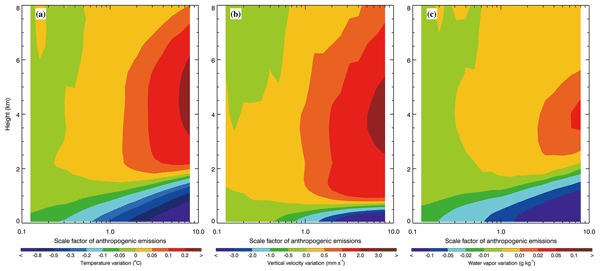
- Absorbing aerosols typically induce significant heating at the layer where they are present, leading to cooling of the atmosphere below, while exerting relatively minor influence above. However, as shown in Figure 7, no distinct warming layer is observed. In addition, although the positive and negative variations in temperature and water vapor content appear relatively consistent, the patterns of vertical velocity differ. For instance, in some regions both cooling and warming are evident, yet the corresponding vertical velocities remain positive. This discrepancy requires further clarification.
- The manuscript presents an interesting case study on aerosol impacts on snowfall using WRF-Chem, but the physical interpretation of aerosol–radiation interactions (ARIs) remains insufficiently supported. In particular, the study lacks a quantitative analysis of radiative heating rates or flux divergence, making it difficult to attribute the simulated temperature changes solely to ARIs rather than dynamical adjustments.
- The separation of aerosol–radiation interactions (ARIs) and aerosol–cloud interactions (ACIs) using sensitivity experiments may introduce methodological uncertainties. Given the nonlinear coupling between radiation, thermodynamics, and microphysics, the simple differencing approach (F_BASE minus F_ARI0) may not fully isolate ARI effects. The authors should discuss the potential nonlinearity and associated uncertainties more explicitly.
- The use of a wide range of anthropogenic emission scaling factors (AESF from 1/8 to 8) raises concerns regarding the realism of the experimental design. Such extreme perturbations may not represent realistic atmospheric conditions and could lead to artificial nonlinear responses, including the reported threshold behavior. A justification based on observed aerosol variability is needed.
Citation: https://doi.org/10.5194/egusphere-2026-500-RC2 -
AC2: 'Reply on RC2', Guohui Li, 13 Jun 2026
The comment was uploaded in the form of a supplement: https://egusphere.copernicus.org/preprints/2026/egusphere-2026-500/egusphere-2026-500-AC2-supplement.pdf
Peer review completion


Interactive discussion
Status: closed
-
RC1: 'Comment on egusphere-2026-500', Anonymous Referee #1, 16 Apr 2026
-
AC1: 'Reply on RC1', Guohui Li, 13 Jun 2026
The comment was uploaded in the form of a supplement: https://egusphere.copernicus.org/preprints/2026/egusphere-2026-500/egusphere-2026-500-AC1-supplement.pdf
-
AC1: 'Reply on RC1', Guohui Li, 13 Jun 2026
-
RC2: 'Comment on egusphere-2026-500', Anonymous Referee #2, 18 Apr 2026
This manuscript investigates the impacts of anthropogenic aerosols on a winter snowfall event over the Guanzhong Basin using WRF-Chem, with a focus on disentangling aerosol–radiation interactions (ARIs) and aerosol–cloud interactions (ACIs). The topic is scientifically important, especially given the large uncertainties in aerosol–precipitation interactions under polluted conditions. The study is generally well structured, and the model reasonably reproduces observed pollutants and precipitation. The attempt to separate ARI and ACI contributions and the identification of contrasting responses between GZB and surrounding regions are valuable. However, the manuscript still has several critical issues in physical interpretation, experimental design, and result robustness, which need to be addressed before publication.
- Wet scavenging refers to the effect of precipitation on aerosols, rather than the influence of aerosols on precipitation. In addition, the phrase “decreased solar radiation” is not appropriate to describe the impact of aerosols on precipitation.
- As shown in Figure 3, compared with the simulation results of PM₂.₅, O₃, and NO₂, the simulation errors of SO₂ are relatively larger. The authors should provide a clear explanation for these discrepancies.
- The boundary between the Guanzhong Basin (GZB) and its surrounding areas (GZBs) should be added in all figures to improve readability. Furthermore, the comparison of accumulated precipitation results should be separated between GZB and GZBs to ensure that no systematic differences are overlooked.
- The distinction between PM₂.₅ (in Section 3.2) and near-surface PM₂.₅ (in Section 3.3) is unclear. The authors should explicitly state how near-surface PM₂.₅ concentrations are calculated from the model simulation results.
- As shown in lines 190–193 and Figure 6, the statement “the single scattering albedo is about 0.88, indicating a strong absorbing atmosphere over GZB+GZBs” requires more careful validation: First, when comparing absorbing AOD with total AOD, the absorbing component contributes only about 10%, suggesting that non-absorbing aerosols may dominate. Second, as mentioned above, aerosols can decrease PBLH through ACIs, while absorbing aerosols can heat the near-surface atmosphere by absorbing solar radiation, potentially leading to an increase in PBLH. More detailed analysis should therefore be provided, including aerosol layer height, temperature profiles, and related diagnostics.
- Absorbing aerosols typically induce significant heating at the layer where they are present, leading to cooling of the atmosphere below, while exerting relatively minor influence above. However, as shown in Figure 7, no distinct warming layer is observed. In addition, although the positive and negative variations in temperature and water vapor content appear relatively consistent, the patterns of vertical velocity differ. For instance, in some regions both cooling and warming are evident, yet the corresponding vertical velocities remain positive. This discrepancy requires further clarification.
- The manuscript presents an interesting case study on aerosol impacts on snowfall using WRF-Chem, but the physical interpretation of aerosol–radiation interactions (ARIs) remains insufficiently supported. In particular, the study lacks a quantitative analysis of radiative heating rates or flux divergence, making it difficult to attribute the simulated temperature changes solely to ARIs rather than dynamical adjustments.
- The separation of aerosol–radiation interactions (ARIs) and aerosol–cloud interactions (ACIs) using sensitivity experiments may introduce methodological uncertainties. Given the nonlinear coupling between radiation, thermodynamics, and microphysics, the simple differencing approach (F_BASE minus F_ARI0) may not fully isolate ARI effects. The authors should discuss the potential nonlinearity and associated uncertainties more explicitly.
- The use of a wide range of anthropogenic emission scaling factors (AESF from 1/8 to 8) raises concerns regarding the realism of the experimental design. Such extreme perturbations may not represent realistic atmospheric conditions and could lead to artificial nonlinear responses, including the reported threshold behavior. A justification based on observed aerosol variability is needed.
Citation: https://doi.org/10.5194/egusphere-2026-500-RC2 -
AC2: 'Reply on RC2', Guohui Li, 13 Jun 2026
The comment was uploaded in the form of a supplement: https://egusphere.copernicus.org/preprints/2026/egusphere-2026-500/egusphere-2026-500-AC2-supplement.pdf
Peer review completion
Journal article(s) based on this preprint
Viewed
| HTML | XML | Total | Supplement | BibTeX | EndNote | |
|---|---|---|---|---|---|---|
| 923 | 561 | 95 | 1,579 | 264 | 239 | 267 |
- HTML: 923
- PDF: 561
- XML: 95
- Total: 1,579
- Supplement: 264
- BibTeX: 239
- EndNote: 267
Viewed (geographical distribution)
| Country | # | Views | % |
|---|
| Total: | 0 |
| HTML: | 0 |
| PDF: | 0 |
| XML: | 0 |
- 1
Yuning Yang
Naifang Bei

Ruonan Wang
Qing Ji
Haiyue Hong
Zhe Li
Xuexi Tie
Guohui Li
The requested preprint has a corresponding peer-reviewed final revised paper. You are encouraged to refer to the final revised version.
- Preprint
(13305 KB) - Metadata XML
-
Supplement
(3364 KB) - BibTeX
- EndNote
- Final revised paper
See the attachment.