
the Creative Commons Attribution 4.0 License.
the Creative Commons Attribution 4.0 License.
 | 10 Feb 2026
Brief Communication: Bed mapping of southern Greenland outlet glaciers using helicopter-borne ground penetrating radar (AIRETH)
Abstract. We present the first southern Greenland deployment of the redesigned Airborne Ice Radar of ETH Zurich (AIRETH). We surveyed 348 km of flight lines over three outlet glaciers and identified bed reflections along 102 km (29 %). The 25 MHz configuration achieved an effective penetration depth of about 300 m and a maximum inferred ice thickness of about 340 m, while bed detectability decreased over thicker and/or heavily crevassed ice. These results define the current depth limitation of our system and show that terrain-following helicopter surveys can provide targeted constraints that complement existing datasets in complex topography.
Competing interests: At least one of the (co-)authors is a member of the editorial board of The Cryosphere. The peer-review process was guided by an independent editor, and the authors also have no other competing interests to declare.
Publisher's note: Copernicus Publications remains neutral with regard to jurisdictional claims made in the text, published maps, institutional affiliations, or any other geographical representation in this paper. While Copernicus Publications makes every effort to include appropriate place names, the final responsibility lies with the authors. Views expressed in the text are those of the authors and do not necessarily reflect the views of the publisher.-
Notice on discussion status
The requested preprint has a corresponding peer-reviewed final revised paper. You are encouraged to refer to the final revised version.
-
Preprint
(10196 KB)
-
Supplement
(606 KB)
-
The requested preprint has a corresponding peer-reviewed final revised paper. You are encouraged to refer to the final revised version.
- Preprint
(10196 KB) - Metadata XML
-
Supplement
(606 KB) - BibTeX
- EndNote
- Final revised paper


Journal article(s) based on this preprint
Interactive discussion
Status: closed
-
RC1: 'Comment on egusphere-2026-488', Emanuele Forte, 10 Mar 2026
-
AC1: 'Reply on RC1', Ilaria Santin, 28 Apr 2026
We thank Reviewer 1 for the positive assessment of the manuscript and for the constructive comments. We have revised the manuscript to clarify the penetration-depth terminology, to discuss cases where the bed is interpretable along only one of two crossing profiles, and to expand the discussion of variability in basal radar expression. For ease of reference, the reviewer comments (RC) are reproduced below, followed by our responses in italics. The corresponding revised text included in the manuscript is reported in brackets { }.
- Clarification of penetration depth metrics
RC1.1: The text states that the effective penetration depth is approximately 300 m, reaching 340 m in around 5% of measurements. These values are reported multiple times throughout the manuscript, but they are somewhat confusing. I recommend marking the maximum penetration depth obtained, detailing that it is reduced under specific ice conditions.
We thank the reviewer for asking for better clarity about how the metrics are presented. We agree that the wording related to penetration depth was not sufficiently clear in the original manuscript, as it could give the impression of a single fixed penetration limit. In the revised version, we clarify that the value of approximately 300 m does not represent the absolute maximum detected ice thickness, but rather the thickness range over which basal reflections were most commonly detectable in our dataset. We now report the maximum detected ice thickness separately, which is approximately 340 m.
We revised the relevant passages throughout the manuscript and adopted a single phrasing distinguishing between the most common range of bed detectability and the maximum detected thickness.
The revised text in section 3.1 (L92-97) now reads:
{“The spatial distribution of bed returns is biased towards shallower glacier margins, whereas bed picks are mainly absent in the thicker central glacier sections. This pattern indicates that basal reflections were most commonly detectable up to ice thicknesses of approximately 300 m, although deeper detections were obtained locally. Only about 5% of bed picks correspond to ice thicknesses greater than 300 m, and the maximum detected ice thickness is approximately 340 m.}
- Basal detectability and directional/crossover differences
RC1.2: Figure 1 summarizes the ice thicknesses were the AIRETH profiles provide an interpretable glacier bad. There are crossing point at which such an interface is detected only along one of the two crossing profiles. This peculiar situation should be commented on and discussed.
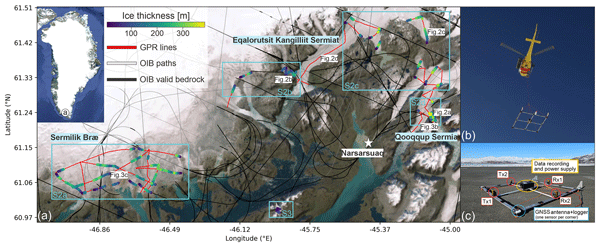
We thank the reviewer for pointing this out. We agree that cases where the bed is interpretable along only one of two crossing profiles required clearer discussion. In the revised manuscript, we now explain that such differences can arise from local variations in basal detectability, including profile orientation relative to glacier geometry, local ice thickness, crevassing, clutter, and out-of-plane reflections from steep valley walls. These factors can cause two crossing profiles to sample different imaging conditions in the vicinity of the intersection, so that a basal reflection may be clear along one line but not along the other.
The following text was added to Section 3.1 (L104-111):
{At some intersections between GPR profiles, a basal reflection is only interpretable along one of the crossing lines. This is not unexpected, because basal detectability depends on profile orientation relative to glacier geometry, as well as on local ice thickness, crevassing, clutter, and out-of-plane reflections from steep valley walls. Kirchhoff migration was applied using the same parameterization for all profiles, independent of survey orientation. However, because migration is applied along individual profiles, it may sharpen the imaging response preferentially in the along-track direction. Differences in flight speed between across-glacier and longitudinal survey modes, which result in different along-track trace densities prior to stacking, may further affect local signal quality and thus basal-reflection interpretability. As a result, the glacier bed may be interpretable along one profile but not along another, even at nearby crossings. Such differences do not necessarily imply inconsistent interpretation but rather reflect variable imaging conditions and data quality.}
- Variability in basal radar signature
RC1.3: Figure 2 shows examples of AIRETH-interpreted profiles. The authors state in the text that: " the basal return commonly manifests as a transition from low-amplitude, texture-like clutter to a zone of persistently higher backscatter", but this is not always the case, as is apparent from the examples themselves, as well as the supplementary material. The authors merely state that "in a few sectors (see Figure 2b–c), the bed forms a continuous, high-amplitude horizon." I recommend deepening the analysis by discussing the high radar signature variability in the text.
The reviewer raised an important point on the interpretation of the basal radar signature . To address it, we now clarify more explicitly how reported bed picks were distinguished from possible internal reflectors. In the revised manuscript (see relevant paragraph reproduced below), we state that bed picking was adapted to the local radar expression and guided by lateral continuity, targeting the deepest laterally coherent basal signal or the onset of persistent enhanced backscatter at the base of the ice. Where no such criterion could be met, no bed pick was assigned. In other words, our interpretation of the bed does not rely on a single characteristic reflector type, but on identifying the deepest coherent basal signal within the ice.
The paragraph in Section 3.1 (L114-120) is now rewritten as:
{The basal interface presents substantial variability in radar expression across the surveyed glaciers. In several profiles, it appears as a transition from low-amplitude, texture-like clutter to a zone of persistently higher backscatter (Figure 2a), whereas in others it forms a clearer and laterally continuous high-amplitude horizon (Figure 2c). Some profiles also show strong scattering immediately above the basal reflection, which is nevertheless still clearly recognizable (Figure 2b). Bed picking was adapted to the local radar expression and guided by lateral continuity, targeting the deepest laterally coherent basal signal or the onset of persistent enhanced backscatter at the base of the ice thickness. Where no such criterion could be met, no bed pick was assigned. Internal englacial reflectors are generally absent in the 25 MHz data. An exception is the relatively thin Narsaq Bræ (Supplementary Figure S3; location in Figure 1a), where profiles show a distinct internal scattering zone at about 20 m depth that is consistent with a cold–temperate ice transition within the glacier (Supplementary Figure S3b).}
Citation: https://doi.org/10.5194/egusphere-2026-488-AC1
-
AC1: 'Reply on RC1', Ilaria Santin, 28 Apr 2026
-
RC2: 'Comment on egusphere-2026-488', Thomas Teisberg, 26 Mar 2026
This paper introduces a helicopter-borne GPR survey carried out over several southern Greenland outlet glaciers. The radar survey was carried out with a low frequency impulse system carried at low ground speeds by helicopter close to the surface, all of which enable this survey to capture bed reflections in challenging conditions (temperature ice, steep valley walls). The survey produced new bed topography picks, which are compared against both other radar bed measurements (from NASA's Operation IceBridge flights) and the BedMachine basal topography data product.
Overall, the paper is a great contribution towards improving knowledge of Greenland outlet glacier topography and thinking about the best types of radar sounder instruments for particular locations. A few minor comments and suggestions are below:
1 - New radar data is most valuable when it is publicly released in useful formats. I would encourage the authors to release their original source radar data and processed radargrams. Particularly for the former, working with Open Polar Radar may be valuable as a publicly-accessible repository for such large datasets. Notably, those who generate bed topography data products may desire to use the bed picks from this data. In cases where this data differs from OIB surveys (as identified in Figure 3), creators of bed topography products must have access to both sets of radar data in order to make informed judgments.
2 - The migration of the radar data will produce an effective beam pattern that is narrower in the along-track direction as compared to the cross-track direction. This could account for places where only one of two crossing tracks has a detectable basal interface. It could also account for the cross-flow lines having better basal interface detection probability, as noted in the manuscript. Depending on how the processing was implemented, it is also likely that the different target flight speeds in across-flow and along-flow survey modes explains part of the difference in basal detection. It would be helpful to note the window over which migration was performed. These possible causes should be noted in the same section as the comment about better detection probability in the across-flow direction. If this is a subject of interest, a comparison of radargrams produced using only one of the two orthogonal antennas and/or without migration at a crossover point would be interesting.
3 - The comparison between newly collected bed measurements and OIB/BedMachine topography in Figure 3 is very interesting. In addition to the two radargrams showing comparisons against BedMachine, I would like to see what the comparison against OIB radargrams looks like for one of the large offset cases (such as the handful of points where OIB seems to have bed picks about 400 meter below the newly reported bed picks). Consider commenting on how you determine that the newly reported bed picks are not a cold-to-temperate transition (as the supplement suggests you have observed at least once). It would also be helpful to comment on the significance of the new bed picks seeming to diverge from BedMachine around 0 meters (which I interpreted to be 0 m WGS84).
4 - Related to the above, I would encourage the authors to remove the > 600 meter difference outlier criterion and include all offsets in the Figure 3 scatter plot. A difference in bed elevation in excess of 600 meters is potentially extremely important to modelling. Such an extreme difference likely results from an incorrect bed pick in some radar data source, which can only be reviewed and corrected if it is identified.
Overall, this paper and accompanying dataset are great contributions, and I look forward to seeing the manuscript published soon.
Citation: https://doi.org/10.5194/egusphere-2026-488-RC2 -
AC2: 'Reply on RC2', Ilaria Santin, 28 Apr 2026
We thank Reviewer 2 for the positive assessment of the manuscript and dataset and for the constructive suggestions. We have revised the manuscript and response to clarify data availability, directional differences in basal detectability, migration-related considerations, the comparison with OIB and BedMachine, and the treatment of large-offset points. For ease of reference, reviewer comments (RC) are reproduced below, followed by our responses in italics. The corresponding revised text included in the manuscript is reported in brackets { }.
- Data release and accessibility
RC2.1: 1 - New radar data is most valuable when it is publicly released in useful formats. I would encourage the authors to release their original source radar data and processed radargrams. Particularly for the former, working with Open Polar Radar may be valuable as a publicly-accessible repository for such large datasets. Notably, those who generate bed topography data products may desire to use the bed picks from this data. In cases where this data differs from OIB surveys (as identified in Figure 3), creators of bed topography products must have access to both sets of radar data in order to make informed judgments.
We agree that the value of newly acquired radar data is enhanced when the underlying products are made publicly available. We will make the bed picks and derived ice-thickness data publicly available, together with the radar data in SEG-Y(.sgy) format. We will update the corresponding data availability statement in the revised manuscript, providing a link to the corresponding online repository. The data will be distributed through ETH’s Research Collection, which is in line with the FAIR data principles.
- Basal detectability and directional/crossover differences
RC2.2: 2 - The migration of the radar data will produce an effective beam pattern that is narrower in the along-track direction as compared to the cross-track direction. This could account for places where only one of two crossing tracks has a detectable basal interface. It could also account for the cross-flow lines having better basal interface detection probability, as noted in the manuscript. Depending on how the processing was implemented, it is also likely that the different target flight speeds in across-flow and along-flow survey modes explains part of the difference in basal detection. It would be helpful to note the window over which migration was performed. These possible causes should be noted in the same section as the comment about better detection probability in the across-flow direction. If this is a subject of interest, a comparison of radargrams produced using only one of the two orthogonal antennas and/or without migration at a crossover point would be interesting.
We thank the reviewer for this helpful explanation of possible directional effects in basal detectability. We agree that migration and acquisition geometry may contribute to cases where only one of two crossing profiles shows an interpretable basal interface and may also partly explain the better detection probability along cross-glacier profiles. We have therefore added a sentence clarifying that Kirchhoff migration was applied using the same parameterization for all profiles, independent of survey orientation. The migration aperture was defined from the profile length, with a cosine taper over 5% of the aperture. Because migration was applied along individual profiles, the effective post-migration imaging response may differ between the along-track and cross-track directions. We also note that differences in flight speed between across-glacier and longitudinal survey modes led to different along-track trace densities prior to stacking, which may have affected local signal quality and basal-reflection interpretability.
Overall, such differences do not necessarily imply inconsistent interpretation but rather reflect variable imaging conditions and data quality.
We also agree that comparing the two antenna polarizations and/or unmigrated radargrams at selected crossover points would be an interesting follow-up analysis. However, because this is beyond the scope of the present Brief Communication, we did not include this additional comparison in the revised manuscript.
The following text was added to Section 3.1 (L104-111):
{At some intersections between GPR profiles, a basal reflection is only interpretable along one of the crossing lines. This is not unexpected, because basal detectability depends on profile orientation relative to glacier geometry, as well as on local ice thickness, crevassing, clutter, and out-of-plane reflections from steep valley walls. Kirchhoff migration was applied using the same parameterization for all profiles, independent of survey orientation. However, because migration is applied along individual profiles, it may sharpen the imaging response preferentially in the along-track direction. Differences in flight speed between across-glacier and longitudinal survey modes, which result in different along-track trace densities prior to stacking, may further affect local signal quality and thus basal-reflection interpretability. As a result, the glacier bed may be interpretable along one profile but not along another, even at nearby crossings. Such differences do not necessarily imply inconsistent interpretation but rather reflect variable imaging conditions and data quality}
- Comparison with existing datasets
RC2.3: 3 - The comparison between newly collected bed measurements and OIB/BedMachine topography in Figure 3 is very interesting. In addition to the two radargrams showing comparisons against BedMachine, I would like to see what the comparison against OIB radargrams looks like for one of the large offset cases (such as the handful of points where OIB seems to have bed picks about 400 meter below the newly reported bed picks). Consider commenting on how you determine that the newly reported bed picks are not a cold-to-temperate transition (as the supplement suggests you have observed at least once). It would also be helpful to comment on the significance of the new bed picks seeming to diverge from BedMachine around 0 meters (which I interpreted to be 0 m WGS84).
RC2.4: 4 - Related to the above, I would encourage the authors to remove the > 600 meter difference outlier criterion and include all offsets in the Figure 3 scatter plot. A difference in bed elevation in excess of 600 meters is potentially extremely important to modelling. Such an extreme difference likely results from an incorrect bed pick in some radar data source, which can only be reviewed and corrected if it is identified.
We thank the reviewer for raising valuable points regarding the comparison with OIB and BedMachine.
We agree that all points should be retained, including offsets greater than 600 m, and we updated Figure 3a accordingly.
Regarding the suggestion to include an OIB radargram example for one of the large-offset cases, we appreciate this suggestion, but we did not add such a panel. This is because in the study area, the AIRETH and OIB datasets intersect only at discrete crossing points and do not provide overlapping along-profile radar coverage (Figure 1a). A direct radargram-to-radargram comparison is therefore not possible. Even selecting a nearby OIB profile would not provide a representative like-for-like comparison, because the two radargrams would sample different along-profile geometries and surrounding bed conditions. We therefore retained the OIB comparison in terms of collocated crossing-point bed elevations only.
Regarding the possibility of misinterpretation for a cold–temperate ice transition (CTS) raised in RC2.3, internal englacial reflectors are generally absent in this dataset, and the Narsaq Bræ example is treated separately as a localized internal scattering feature rather than as bedrock. The interpretation of the Narsaq Bræ reflector as a likely CTS is supported by independent temperature measurements acquired close to the radar line, indicating cold near-surface ice in the upper part of the profile and temperate conditions lower on the glacier. This localized case was thus useful in recognizing that internal thermal horizons can occur, but it was not used as a bed pick.
Concerning the apparent divergence of some points from BedMachine around 0 m bed elevation, we inspected this pattern and found that it is not widespread across the dataset, but associated with two localized sectors, near Qooqqup Sermia and a tributary of Eqalorutsit Kangilliit Sermiat. We therefore do not interpret it as a general systematic offset in the comparison. In both areas, the AIRETH basal reflections appear clear and laterally coherent, whereas the BedMachine bed elevation is likely weakly constrained, as it relies largely on interpolation and/or mass-conservation-based estimates in areas with sparse direct radar constraints. We therefore suggest that these localized mismatches most likely reflect limitations of the BedMachine interpolation in these sectors rather than a dataset-wide bias. We note that complex local glacier geometry could further complicate the comparison, but we do not have sufficient evidence to develop that interpretation here. For this reason, we prefer not to overinterpret these localized discrepancies and did not expand on them in the manuscript. Figure A in the supplement material illustrates one representative example from the tributary of Eqalorutsit Kangilliit Sermiat. We also inspected the corresponding Qooqqup Sermia sector, but do not include a second panel here, as the figure is meant to illustrate the type of localized mismatch rather than to document every occurrence.
-
AC2: 'Reply on RC2', Ilaria Santin, 28 Apr 2026
Peer review completion


Interactive discussion
Status: closed
-
RC1: 'Comment on egusphere-2026-488', Emanuele Forte, 10 Mar 2026
The paper entitled Bed mapping of southern Greenland outlet glaciers using helicopter-borne ground penetrating radar (AIRETH) focuses on a new GPR dataset collected in March 2025 using a redesigned helicopter-borne radar. The manuscript is well written and organised. It contains interesting comparisons between the new ice thickness estimates and previous publicly available datasets from the same area. While the analysis is rigorous and meaningful, I suggest some possible improvements and clarifications:
- The text states that the effective penetration depth is approximately 300 m, reaching 340 m in around 5% of measurements. These values are reported multiple times throughout the manuscript, but they are somewhat confusing. I recommend marking the maximum penetration depth obtained, detailing that it is reduced under specific ice conditions.
- Figure 1 summarises the ice thicknesses were the AIRETH profiles provide an interpretable glacier bad. There are crossing point at which such an interface is detected only along one of the two crossing profiles. This peculiar situation should be commented on and discussed.
- Figure 2 shows examples of AIRETH-interpreted profiles. The authors state in the text that: " the basal return commonly manifests as a transition from low-amplitude, texture-like clutter to a zone of persistently higher backscatter", but this is not always the case, as is apparent from the examples themselves, as well as the supplementary material. The authors merely state that "in a few sectors (see Figure 2b–c), the bed forms a continuous, high-amplitude horizon." I recommend deepening the analysis by discussing the high radar signature variability in the text.
I recommend publishing the paper after the previous points have been addressed and a minor revision process has been completed.
-
AC1: 'Reply on RC1', Ilaria Santin, 28 Apr 2026
We thank Reviewer 1 for the positive assessment of the manuscript and for the constructive comments. We have revised the manuscript to clarify the penetration-depth terminology, to discuss cases where the bed is interpretable along only one of two crossing profiles, and to expand the discussion of variability in basal radar expression. For ease of reference, the reviewer comments (RC) are reproduced below, followed by our responses in italics. The corresponding revised text included in the manuscript is reported in brackets { }.
- Clarification of penetration depth metrics
RC1.1: The text states that the effective penetration depth is approximately 300 m, reaching 340 m in around 5% of measurements. These values are reported multiple times throughout the manuscript, but they are somewhat confusing. I recommend marking the maximum penetration depth obtained, detailing that it is reduced under specific ice conditions.
We thank the reviewer for asking for better clarity about how the metrics are presented. We agree that the wording related to penetration depth was not sufficiently clear in the original manuscript, as it could give the impression of a single fixed penetration limit. In the revised version, we clarify that the value of approximately 300 m does not represent the absolute maximum detected ice thickness, but rather the thickness range over which basal reflections were most commonly detectable in our dataset. We now report the maximum detected ice thickness separately, which is approximately 340 m.
We revised the relevant passages throughout the manuscript and adopted a single phrasing distinguishing between the most common range of bed detectability and the maximum detected thickness.
The revised text in section 3.1 (L92-97) now reads:
{“The spatial distribution of bed returns is biased towards shallower glacier margins, whereas bed picks are mainly absent in the thicker central glacier sections. This pattern indicates that basal reflections were most commonly detectable up to ice thicknesses of approximately 300 m, although deeper detections were obtained locally. Only about 5% of bed picks correspond to ice thicknesses greater than 300 m, and the maximum detected ice thickness is approximately 340 m.}
- Basal detectability and directional/crossover differences
RC1.2: Figure 1 summarizes the ice thicknesses were the AIRETH profiles provide an interpretable glacier bad. There are crossing point at which such an interface is detected only along one of the two crossing profiles. This peculiar situation should be commented on and discussed.
We thank the reviewer for pointing this out. We agree that cases where the bed is interpretable along only one of two crossing profiles required clearer discussion. In the revised manuscript, we now explain that such differences can arise from local variations in basal detectability, including profile orientation relative to glacier geometry, local ice thickness, crevassing, clutter, and out-of-plane reflections from steep valley walls. These factors can cause two crossing profiles to sample different imaging conditions in the vicinity of the intersection, so that a basal reflection may be clear along one line but not along the other.
The following text was added to Section 3.1 (L104-111):
{At some intersections between GPR profiles, a basal reflection is only interpretable along one of the crossing lines. This is not unexpected, because basal detectability depends on profile orientation relative to glacier geometry, as well as on local ice thickness, crevassing, clutter, and out-of-plane reflections from steep valley walls. Kirchhoff migration was applied using the same parameterization for all profiles, independent of survey orientation. However, because migration is applied along individual profiles, it may sharpen the imaging response preferentially in the along-track direction. Differences in flight speed between across-glacier and longitudinal survey modes, which result in different along-track trace densities prior to stacking, may further affect local signal quality and thus basal-reflection interpretability. As a result, the glacier bed may be interpretable along one profile but not along another, even at nearby crossings. Such differences do not necessarily imply inconsistent interpretation but rather reflect variable imaging conditions and data quality.}
- Variability in basal radar signature
RC1.3: Figure 2 shows examples of AIRETH-interpreted profiles. The authors state in the text that: " the basal return commonly manifests as a transition from low-amplitude, texture-like clutter to a zone of persistently higher backscatter", but this is not always the case, as is apparent from the examples themselves, as well as the supplementary material. The authors merely state that "in a few sectors (see Figure 2b–c), the bed forms a continuous, high-amplitude horizon." I recommend deepening the analysis by discussing the high radar signature variability in the text.
The reviewer raised an important point on the interpretation of the basal radar signature . To address it, we now clarify more explicitly how reported bed picks were distinguished from possible internal reflectors. In the revised manuscript (see relevant paragraph reproduced below), we state that bed picking was adapted to the local radar expression and guided by lateral continuity, targeting the deepest laterally coherent basal signal or the onset of persistent enhanced backscatter at the base of the ice. Where no such criterion could be met, no bed pick was assigned. In other words, our interpretation of the bed does not rely on a single characteristic reflector type, but on identifying the deepest coherent basal signal within the ice.
The paragraph in Section 3.1 (L114-120) is now rewritten as:
{The basal interface presents substantial variability in radar expression across the surveyed glaciers. In several profiles, it appears as a transition from low-amplitude, texture-like clutter to a zone of persistently higher backscatter (Figure 2a), whereas in others it forms a clearer and laterally continuous high-amplitude horizon (Figure 2c). Some profiles also show strong scattering immediately above the basal reflection, which is nevertheless still clearly recognizable (Figure 2b). Bed picking was adapted to the local radar expression and guided by lateral continuity, targeting the deepest laterally coherent basal signal or the onset of persistent enhanced backscatter at the base of the ice thickness. Where no such criterion could be met, no bed pick was assigned. Internal englacial reflectors are generally absent in the 25 MHz data. An exception is the relatively thin Narsaq Bræ (Supplementary Figure S3; location in Figure 1a), where profiles show a distinct internal scattering zone at about 20 m depth that is consistent with a cold–temperate ice transition within the glacier (Supplementary Figure S3b).}
Citation: https://doi.org/10.5194/egusphere-2026-488-AC1
-
AC1: 'Reply on RC1', Ilaria Santin, 28 Apr 2026
-
RC2: 'Comment on egusphere-2026-488', Thomas Teisberg, 26 Mar 2026
This paper introduces a helicopter-borne GPR survey carried out over several southern Greenland outlet glaciers. The radar survey was carried out with a low frequency impulse system carried at low ground speeds by helicopter close to the surface, all of which enable this survey to capture bed reflections in challenging conditions (temperature ice, steep valley walls). The survey produced new bed topography picks, which are compared against both other radar bed measurements (from NASA's Operation IceBridge flights) and the BedMachine basal topography data product.
Overall, the paper is a great contribution towards improving knowledge of Greenland outlet glacier topography and thinking about the best types of radar sounder instruments for particular locations. A few minor comments and suggestions are below:
1 - New radar data is most valuable when it is publicly released in useful formats. I would encourage the authors to release their original source radar data and processed radargrams. Particularly for the former, working with Open Polar Radar may be valuable as a publicly-accessible repository for such large datasets. Notably, those who generate bed topography data products may desire to use the bed picks from this data. In cases where this data differs from OIB surveys (as identified in Figure 3), creators of bed topography products must have access to both sets of radar data in order to make informed judgments.
2 - The migration of the radar data will produce an effective beam pattern that is narrower in the along-track direction as compared to the cross-track direction. This could account for places where only one of two crossing tracks has a detectable basal interface. It could also account for the cross-flow lines having better basal interface detection probability, as noted in the manuscript. Depending on how the processing was implemented, it is also likely that the different target flight speeds in across-flow and along-flow survey modes explains part of the difference in basal detection. It would be helpful to note the window over which migration was performed. These possible causes should be noted in the same section as the comment about better detection probability in the across-flow direction. If this is a subject of interest, a comparison of radargrams produced using only one of the two orthogonal antennas and/or without migration at a crossover point would be interesting.
3 - The comparison between newly collected bed measurements and OIB/BedMachine topography in Figure 3 is very interesting. In addition to the two radargrams showing comparisons against BedMachine, I would like to see what the comparison against OIB radargrams looks like for one of the large offset cases (such as the handful of points where OIB seems to have bed picks about 400 meter below the newly reported bed picks). Consider commenting on how you determine that the newly reported bed picks are not a cold-to-temperate transition (as the supplement suggests you have observed at least once). It would also be helpful to comment on the significance of the new bed picks seeming to diverge from BedMachine around 0 meters (which I interpreted to be 0 m WGS84).
4 - Related to the above, I would encourage the authors to remove the > 600 meter difference outlier criterion and include all offsets in the Figure 3 scatter plot. A difference in bed elevation in excess of 600 meters is potentially extremely important to modelling. Such an extreme difference likely results from an incorrect bed pick in some radar data source, which can only be reviewed and corrected if it is identified.
Overall, this paper and accompanying dataset are great contributions, and I look forward to seeing the manuscript published soon.
Citation: https://doi.org/10.5194/egusphere-2026-488-RC2 -
AC2: 'Reply on RC2', Ilaria Santin, 28 Apr 2026
We thank Reviewer 2 for the positive assessment of the manuscript and dataset and for the constructive suggestions. We have revised the manuscript and response to clarify data availability, directional differences in basal detectability, migration-related considerations, the comparison with OIB and BedMachine, and the treatment of large-offset points. For ease of reference, reviewer comments (RC) are reproduced below, followed by our responses in italics. The corresponding revised text included in the manuscript is reported in brackets { }.
- Data release and accessibility
RC2.1: 1 - New radar data is most valuable when it is publicly released in useful formats. I would encourage the authors to release their original source radar data and processed radargrams. Particularly for the former, working with Open Polar Radar may be valuable as a publicly-accessible repository for such large datasets. Notably, those who generate bed topography data products may desire to use the bed picks from this data. In cases where this data differs from OIB surveys (as identified in Figure 3), creators of bed topography products must have access to both sets of radar data in order to make informed judgments.
We agree that the value of newly acquired radar data is enhanced when the underlying products are made publicly available. We will make the bed picks and derived ice-thickness data publicly available, together with the radar data in SEG-Y(.sgy) format. We will update the corresponding data availability statement in the revised manuscript, providing a link to the corresponding online repository. The data will be distributed through ETH’s Research Collection, which is in line with the FAIR data principles.
- Basal detectability and directional/crossover differences
RC2.2: 2 - The migration of the radar data will produce an effective beam pattern that is narrower in the along-track direction as compared to the cross-track direction. This could account for places where only one of two crossing tracks has a detectable basal interface. It could also account for the cross-flow lines having better basal interface detection probability, as noted in the manuscript. Depending on how the processing was implemented, it is also likely that the different target flight speeds in across-flow and along-flow survey modes explains part of the difference in basal detection. It would be helpful to note the window over which migration was performed. These possible causes should be noted in the same section as the comment about better detection probability in the across-flow direction. If this is a subject of interest, a comparison of radargrams produced using only one of the two orthogonal antennas and/or without migration at a crossover point would be interesting.
We thank the reviewer for this helpful explanation of possible directional effects in basal detectability. We agree that migration and acquisition geometry may contribute to cases where only one of two crossing profiles shows an interpretable basal interface and may also partly explain the better detection probability along cross-glacier profiles. We have therefore added a sentence clarifying that Kirchhoff migration was applied using the same parameterization for all profiles, independent of survey orientation. The migration aperture was defined from the profile length, with a cosine taper over 5% of the aperture. Because migration was applied along individual profiles, the effective post-migration imaging response may differ between the along-track and cross-track directions. We also note that differences in flight speed between across-glacier and longitudinal survey modes led to different along-track trace densities prior to stacking, which may have affected local signal quality and basal-reflection interpretability.
Overall, such differences do not necessarily imply inconsistent interpretation but rather reflect variable imaging conditions and data quality.
We also agree that comparing the two antenna polarizations and/or unmigrated radargrams at selected crossover points would be an interesting follow-up analysis. However, because this is beyond the scope of the present Brief Communication, we did not include this additional comparison in the revised manuscript.
The following text was added to Section 3.1 (L104-111):
{At some intersections between GPR profiles, a basal reflection is only interpretable along one of the crossing lines. This is not unexpected, because basal detectability depends on profile orientation relative to glacier geometry, as well as on local ice thickness, crevassing, clutter, and out-of-plane reflections from steep valley walls. Kirchhoff migration was applied using the same parameterization for all profiles, independent of survey orientation. However, because migration is applied along individual profiles, it may sharpen the imaging response preferentially in the along-track direction. Differences in flight speed between across-glacier and longitudinal survey modes, which result in different along-track trace densities prior to stacking, may further affect local signal quality and thus basal-reflection interpretability. As a result, the glacier bed may be interpretable along one profile but not along another, even at nearby crossings. Such differences do not necessarily imply inconsistent interpretation but rather reflect variable imaging conditions and data quality}
- Comparison with existing datasets
RC2.3: 3 - The comparison between newly collected bed measurements and OIB/BedMachine topography in Figure 3 is very interesting. In addition to the two radargrams showing comparisons against BedMachine, I would like to see what the comparison against OIB radargrams looks like for one of the large offset cases (such as the handful of points where OIB seems to have bed picks about 400 meter below the newly reported bed picks). Consider commenting on how you determine that the newly reported bed picks are not a cold-to-temperate transition (as the supplement suggests you have observed at least once). It would also be helpful to comment on the significance of the new bed picks seeming to diverge from BedMachine around 0 meters (which I interpreted to be 0 m WGS84).
RC2.4: 4 - Related to the above, I would encourage the authors to remove the > 600 meter difference outlier criterion and include all offsets in the Figure 3 scatter plot. A difference in bed elevation in excess of 600 meters is potentially extremely important to modelling. Such an extreme difference likely results from an incorrect bed pick in some radar data source, which can only be reviewed and corrected if it is identified.
We thank the reviewer for raising valuable points regarding the comparison with OIB and BedMachine.
We agree that all points should be retained, including offsets greater than 600 m, and we updated Figure 3a accordingly.
Regarding the suggestion to include an OIB radargram example for one of the large-offset cases, we appreciate this suggestion, but we did not add such a panel. This is because in the study area, the AIRETH and OIB datasets intersect only at discrete crossing points and do not provide overlapping along-profile radar coverage (Figure 1a). A direct radargram-to-radargram comparison is therefore not possible. Even selecting a nearby OIB profile would not provide a representative like-for-like comparison, because the two radargrams would sample different along-profile geometries and surrounding bed conditions. We therefore retained the OIB comparison in terms of collocated crossing-point bed elevations only.
Regarding the possibility of misinterpretation for a cold–temperate ice transition (CTS) raised in RC2.3, internal englacial reflectors are generally absent in this dataset, and the Narsaq Bræ example is treated separately as a localized internal scattering feature rather than as bedrock. The interpretation of the Narsaq Bræ reflector as a likely CTS is supported by independent temperature measurements acquired close to the radar line, indicating cold near-surface ice in the upper part of the profile and temperate conditions lower on the glacier. This localized case was thus useful in recognizing that internal thermal horizons can occur, but it was not used as a bed pick.
Concerning the apparent divergence of some points from BedMachine around 0 m bed elevation, we inspected this pattern and found that it is not widespread across the dataset, but associated with two localized sectors, near Qooqqup Sermia and a tributary of Eqalorutsit Kangilliit Sermiat. We therefore do not interpret it as a general systematic offset in the comparison. In both areas, the AIRETH basal reflections appear clear and laterally coherent, whereas the BedMachine bed elevation is likely weakly constrained, as it relies largely on interpolation and/or mass-conservation-based estimates in areas with sparse direct radar constraints. We therefore suggest that these localized mismatches most likely reflect limitations of the BedMachine interpolation in these sectors rather than a dataset-wide bias. We note that complex local glacier geometry could further complicate the comparison, but we do not have sufficient evidence to develop that interpretation here. For this reason, we prefer not to overinterpret these localized discrepancies and did not expand on them in the manuscript. Figure A in the supplement material illustrates one representative example from the tributary of Eqalorutsit Kangilliit Sermiat. We also inspected the corresponding Qooqqup Sermia sector, but do not include a second panel here, as the figure is meant to illustrate the type of localized mismatch rather than to document every occurrence.
-
AC2: 'Reply on RC2', Ilaria Santin, 28 Apr 2026
Peer review completion
Journal article(s) based on this preprint
Viewed
| HTML | XML | Total | Supplement | BibTeX | EndNote | |
|---|---|---|---|---|---|---|
| 1,481 | 825 | 114 | 2,420 | 308 | 202 | 273 |
- HTML: 1,481
- PDF: 825
- XML: 114
- Total: 2,420
- Supplement: 308
- BibTeX: 202
- EndNote: 273
Viewed (geographical distribution)
| Country | # | Views | % |
|---|
| Total: | 0 |
| HTML: | 0 |
| PDF: | 0 |
| XML: | 0 |
- 1

Huw Horgan
Raphael Moser
Nanna Bjørnholt Karlsson
Faezeh Maghami Nick
Andreas Vieli
Anja Rutishauser
Hansruedi Maurer
Daniel Farinotti
The requested preprint has a corresponding peer-reviewed final revised paper. You are encouraged to refer to the final revised version.
- Preprint
(10196 KB) - Metadata XML
-
Supplement
(606 KB) - BibTeX
- EndNote
- Final revised paper
The paper entitled Bed mapping of southern Greenland outlet glaciers using helicopter-borne ground penetrating radar (AIRETH) focuses on a new GPR dataset collected in March 2025 using a redesigned helicopter-borne radar. The manuscript is well written and organised. It contains interesting comparisons between the new ice thickness estimates and previous publicly available datasets from the same area. While the analysis is rigorous and meaningful, I suggest some possible improvements and clarifications:
- The text states that the effective penetration depth is approximately 300 m, reaching 340 m in around 5% of measurements. These values are reported multiple times throughout the manuscript, but they are somewhat confusing. I recommend marking the maximum penetration depth obtained, detailing that it is reduced under specific ice conditions.
- Figure 1 summarises the ice thicknesses were the AIRETH profiles provide an interpretable glacier bad. There are crossing point at which such an interface is detected only along one of the two crossing profiles. This peculiar situation should be commented on and discussed.
- Figure 2 shows examples of AIRETH-interpreted profiles. The authors state in the text that: " the basal return commonly manifests as a transition from low-amplitude, texture-like clutter to a zone of persistently higher backscatter", but this is not always the case, as is apparent from the examples themselves, as well as the supplementary material. The authors merely state that "in a few sectors (see Figure 2b–c), the bed forms a continuous, high-amplitude horizon." I recommend deepening the analysis by discussing the high radar signature variability in the text.
I recommend publishing the paper after the previous points have been addressed and a minor revision process has been completed.