
the Creative Commons Attribution 4.0 License.
the Creative Commons Attribution 4.0 License.
 | 17 Feb 2026
Latent heat feedbacks and the self-lofting of seeded ice plumes: Insights from bin microphysics simulations
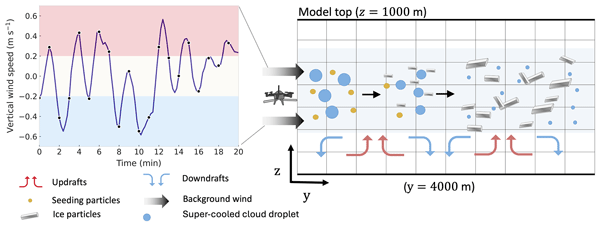
Abstract. The interaction between environmental dynamics and microphysical processes governs the efficacy of glaciogenic cloud seeding, yet the extent to which initial vertical wind conditions dictate the evolution of seeded ice plumes remains poorly constrained. We investigate the dynamical and microphysical life cycle of ice plumes in supercooled stratiform clouds using idealized Large-Eddy Simulations (LES) coupled with the bin microphysics scheme SCALE-AMPS. Simulations of a targeted CLOUDLAB seeding experiment are constrained and validated by in situ observations. An ensemble of 20 simulations initialized with varying vertical wind velocities reveals a fundamental transition: while the initial trajectory is kinematically governed by the environmental vertical wind at cloud seeding, the long-term evolution is dominated by internal thermodynamic feedbacks. We identify a "self-lofting" mechanism wherein buoyancy generated by latent heat release from rapid ice growth overcomes initial subsidence, causing even downdraft-seeded plumes to eventually ascend. This thermodynamic response creates a structural trade-off: plumes initiated in updrafts are terminated by the cloud-top inversion, whereas those in downdrafts experience delayed ascent, resulting in a lager vertical dispersion. This expanded vertical extent compensates for the lower mean altitude of downdraft plumes, ensuring their geometrical detectability by downstream sampling in in observations. Microphysically, downdraft plumes undergo transient sublimation near cloud base but recover following buoyancy-driven re-ascent. These findings demonstrate that glaciogenic seeding is dynamically robust in low stratus clouds, as the seeded ice plume acts as an active thermodynamic agent capable of sustaining its residence time in the mixed-phase layer independent of the initial vertical wind state.
-
Notice on discussion status
The requested preprint has a corresponding peer-reviewed final revised paper. You are encouraged to refer to the final revised version.
-
Preprint
(5835 KB)
-
The requested preprint has a corresponding peer-reviewed final revised paper. You are encouraged to refer to the final revised version.
- Preprint
(5835 KB) - Metadata XML
- BibTeX
- EndNote
- Final revised paper


Journal article(s) based on this preprint
Interactive discussion
Status: closed
-
RC1: 'Comment on egusphere-2026-470', Wojciech W. Grabowski, 07 Mar 2026
- AC1: 'Reply on RC1', Huiying Zhang, 14 May 2026
-
RC2: 'Comment on egusphere-2026-470', Anonymous Referee #2, 07 Apr 2026
Review of “Latent heat feedbacks and the self-lofting of seeded ice plumes: Insights from bin microphysics simulations” by Zhang et al. 2026.
The article investigates the dynamical feedback associated with latent heat release from glaciogenic seeding of super-cooled stratus clouds using large-eddy simulations. A case from the CLOUDLAB field campaign is considered for this study. The authors found differences in the vertical spread of the seeded plume and its bulk microphysical properties depending on the dynamical condition at the time of seeding (updraft versus downdraft). Furthermore, the results revealed a reversal of the plume downdraft to an updraft at lower levels when seeding occurred during a downdraft. Building on these findings, the authors hypothesize that differences in plume properties are primarily driven by variations in latent heat release during depositional ice growth. To support this claim, they show accumulated latent heat and its relation to the difference in vertical velocity.In my opinion, the manuscript is well written and will be a nice contribution to ACP. I only have the following minor comments and suggestions.
- Figure 6 – Please show separate plots from the simulations with updraft and downdraft seeding conditions. It will help visualize the evolution of the plume structure and be helpful for the readers to follow the later discussion. I also wonder if the detailed plume structure could be visualized a bit better (zooming over the plume location).
- L184: What's the third factor? The authors listed only two but mentioned: “attributed to three factors.” I assume the ice nucleation could be another major contributor to the deviation.
Is there any difference in ice nucleation magnitude and locations? Do you think a stochastic ice-nucleation scheme would yield more differences?
- L213-217: It would be much clearer and more convincing if the authors showed the local buoyancy tendencies arising from latent heat release and condensate/ice loading. Such tendencies would be straightforward to analyze from the LES model output to confirm the hypothesis. Another option is to turn off the latent heating feedback in the ice plume to directly test the hypostasis.
- L221: What do you mean by 'accumulated heat' and \Delta W? Please define it clearly (how is it calculated?).
- L227: I can’t see any appendix in the paper. Also, the appendix reference is missing (“see Appendix „„”). Did the authors remove it at some point? Please clarify or add the appendix figure.
- Figure 9 – Would it be possible to plot the time evolution of the vertical profile instead of the mean values (could also be added as another supporting figure in the appendix)? Since vertical dispersion differs between the updraft and downdraft seeding, it will be interesting to see how the vertical profiles evolve.
- L261-263: This is an interesting finding that PSDs are so resilient. It is a bit counterintuitive. I imagined that, with variabilities in nucleation altitude (and difference in vertical dispersion rates) between the downdraft- and updraft-seeded plumes, the PSD evolution (especially size dispersion) would differ due to different growth/supersaturation exposure histories. I wonder whether the finding is consistent across local PSDs constructed at different altitudes over time.
Citation: https://doi.org/10.5194/egusphere-2026-470-RC2 - AC2: 'Reply on RC2', Huiying Zhang, 14 May 2026
Peer review completion


Interactive discussion
Status: closed
-
RC1: 'Comment on egusphere-2026-470', Wojciech W. Grabowski, 07 Mar 2026
Review of “Latent heat feedbacks and the self-lofting of seeded ice plumes: Insights from bin microphysics simulations:” by Zhang et al. submitted to ACP.
Recommendation: accept after minor revisions.
This paper discusses numerical simulations of glaciogenic seeding of a stratiform cloud observed in the CLOUDLAB field project. This is a nice manuscript almost ready to be accepted. I only have several suggestions and technical comments that need to be addressed to clarify specific aspects of the presentation.
Specific comments.
- L. 24: delete “whereas”.
- The paragraph starting in L. 26. The discussion of latent heat release and buoyancy effects lacks clarity. First, there is always a competition between latent heat release due cloud particles growth (a positive impact on cloud buoyancy) and a negative impact associated with water/ice condensate loading. The buoyancy is given by Q(1+e qv – Q), where Q is the total condensate (water plus ice) and other symbols are as usual. Freezing of liquid water due to seeding does not change Q, but it provides an increase of Q due to the latent heat of freezing. This is the initial “kick” of the buoyancy resulting from seeding. The subsequent (arguably rapid) growth of the ice phase increases both Q and Q, but – similarly to the condensation – the latent heating due to additional diffusional growth of ice crystals is much larger than the additional loading effect. The thermodynamic effect of seeding after the initial “kick” is about extracting additional heating of the plume due to growth of ice particles and evaporation of cloud droplets that brings the environmental humidity closer to ice saturation. The net effect of the ice growth and evaporation of cloud water corresponds the latent heat of freezing (i.e., the difference between the latent heats of sublimation and condensation).
The above discussion reminds me of the cold invigoration (per Rosenfeld et al. 2008) where the latent heating approximately balances the condensate loading. Please see section 2a in Grabowski and Morrison (JAS 2021) if you are curious.
- L. 46 and 49. A reference to SCALE-AMPS (and perhaps an explanation of the acronym) is needed here.
- L. 78. Explain “inferred collision rate”.
- L. 83. “primitive equations” is incorrect. This term traditionally refers to the hydrostatic large-scale equations. I suggest “small scale nonhydrostatic equations” or something like that.
- L. 115. Please provide distribution parameters.
- Section 3.2, L. 85. The subgrid-scale scheme in the model excludes supersaturation fluctuations (e.g., as in Grabowski and Abade JAS 2017 and others), correct? Perhaps worth mentioning.
- Fig. 2, left panel. I assume the dots represent 20 members of ensemble simulations, correct?
- Figs. 4 and 5. It is not clear how ice and water statistics are derived from observations and from model simulations. The way statistics are gathered needs to be clearly explained. The horizontal scale in Fig. 5 is strange. It is not linear, correct? Why? Perhaps it follows the instrument used in the observations? Please explain/change.
- Results in section 4.2 This is a suggestion for a possible further quantification of the latent heating effects in cloud seeding experiments and simulations. I do not suggest to conduct such simulations for the current paper, but perhaps for the future publication(s).
Following 2 above, to unequivocally quantify the role of latent heating, one may manipulate numerical values of the latent heats in model simulations. Specifically, setting the latent heat of freezing to zero would allow to separate the initial “kick” of the seeding (i.e., initial freezing of cloud droplets) from the subsequent latent heating associated with the WBF ice growth. My feeling is that the initial “kick” is less important, but the subsequent growth of ice particles (i.e., reaching into the ice versus water saturation reservoir) is critical. Current simulations do not allow for such an assessment. In addition, by replacing latent heat of sublimation with the latent heat of condensation one can eliminate the net effect of ice growth and evaporation of cloud droplets in the WBF mechanism. Such additional model simulations can provide solid understanding of physical processes involved.
- A simple addition to the current manuscript following the above comment would be to include buoyancy plots as additional panels in Fig. 6.
- L. 227. I do not find any appendix in the paper. In general, it would be great to have a couple 3D visualizations of the ice plume from model simulations.
- Fig. 7. Similar to 9 above. Please define the plume. I assume IWC larger than a threshold, correct? Give the threshold value. How is the accumulated latent heat calculated? It excludes the latent heat of condensation, correct?
- Fig. 8. Provide details of the boxplots (range of percentiles, etc).
- Shaded areas in Fig. 9, 10, and 11. This is explained only in the Fig. 9 caption. But the explanation does not make sense: “Shaded areas represent the standard deviation across the ensemble members for each wind regime”. I would think “for all wind regimes”, correct? Please clarify. Add to captions of Fig. 10 and 11.
- Finally, I am curious if selected references to other glaciogenic seeding experiments should be included in the introduction (e.g., Tessendorf et al. BAMS. 2017 and references therein). This might provide a better context for the observations and simulations reported in the manuscript.
Signed: W. Grabowski.
Citation: https://doi.org/10.5194/egusphere-2026-470-RC1 - AC1: 'Reply on RC1', Huiying Zhang, 14 May 2026
-
RC2: 'Comment on egusphere-2026-470', Anonymous Referee #2, 07 Apr 2026
Review of “Latent heat feedbacks and the self-lofting of seeded ice plumes: Insights from bin microphysics simulations” by Zhang et al. 2026.
The article investigates the dynamical feedback associated with latent heat release from glaciogenic seeding of super-cooled stratus clouds using large-eddy simulations. A case from the CLOUDLAB field campaign is considered for this study. The authors found differences in the vertical spread of the seeded plume and its bulk microphysical properties depending on the dynamical condition at the time of seeding (updraft versus downdraft). Furthermore, the results revealed a reversal of the plume downdraft to an updraft at lower levels when seeding occurred during a downdraft. Building on these findings, the authors hypothesize that differences in plume properties are primarily driven by variations in latent heat release during depositional ice growth. To support this claim, they show accumulated latent heat and its relation to the difference in vertical velocity.In my opinion, the manuscript is well written and will be a nice contribution to ACP. I only have the following minor comments and suggestions.
- Figure 6 – Please show separate plots from the simulations with updraft and downdraft seeding conditions. It will help visualize the evolution of the plume structure and be helpful for the readers to follow the later discussion. I also wonder if the detailed plume structure could be visualized a bit better (zooming over the plume location).
- L184: What's the third factor? The authors listed only two but mentioned: “attributed to three factors.” I assume the ice nucleation could be another major contributor to the deviation.
Is there any difference in ice nucleation magnitude and locations? Do you think a stochastic ice-nucleation scheme would yield more differences?
- L213-217: It would be much clearer and more convincing if the authors showed the local buoyancy tendencies arising from latent heat release and condensate/ice loading. Such tendencies would be straightforward to analyze from the LES model output to confirm the hypothesis. Another option is to turn off the latent heating feedback in the ice plume to directly test the hypostasis.
- L221: What do you mean by 'accumulated heat' and \Delta W? Please define it clearly (how is it calculated?).
- L227: I can’t see any appendix in the paper. Also, the appendix reference is missing (“see Appendix „„”). Did the authors remove it at some point? Please clarify or add the appendix figure.
- Figure 9 – Would it be possible to plot the time evolution of the vertical profile instead of the mean values (could also be added as another supporting figure in the appendix)? Since vertical dispersion differs between the updraft and downdraft seeding, it will be interesting to see how the vertical profiles evolve.
- L261-263: This is an interesting finding that PSDs are so resilient. It is a bit counterintuitive. I imagined that, with variabilities in nucleation altitude (and difference in vertical dispersion rates) between the downdraft- and updraft-seeded plumes, the PSD evolution (especially size dispersion) would differ due to different growth/supersaturation exposure histories. I wonder whether the finding is consistent across local PSDs constructed at different altitudes over time.
Citation: https://doi.org/10.5194/egusphere-2026-470-RC2 - AC2: 'Reply on RC2', Huiying Zhang, 14 May 2026
Peer review completion
Journal article(s) based on this preprint
Viewed
| HTML | XML | Total | BibTeX | EndNote | |
|---|---|---|---|---|---|
| 985 | 589 | 103 | 1,677 | 109 | 154 |
- HTML: 985
- PDF: 589
- XML: 103
- Total: 1,677
- BibTeX: 109
- EndNote: 154
Viewed (geographical distribution)
| Country | # | Views | % |
|---|
| Total: | 0 |
| HTML: | 0 |
| PDF: | 0 |
| XML: | 0 |
- 1

Chia Rui Ong
Anurag Dipankar
Ulrike Lohmann
Jan Henneberger
The requested preprint has a corresponding peer-reviewed final revised paper. You are encouraged to refer to the final revised version.
- Preprint
(5835 KB) - Metadata XML
Review of “Latent heat feedbacks and the self-lofting of seeded ice plumes: Insights from bin microphysics simulations:” by Zhang et al. submitted to ACP.
Recommendation: accept after minor revisions.
This paper discusses numerical simulations of glaciogenic seeding of a stratiform cloud observed in the CLOUDLAB field project. This is a nice manuscript almost ready to be accepted. I only have several suggestions and technical comments that need to be addressed to clarify specific aspects of the presentation.
Specific comments.
The above discussion reminds me of the cold invigoration (per Rosenfeld et al. 2008) where the latent heating approximately balances the condensate loading. Please see section 2a in Grabowski and Morrison (JAS 2021) if you are curious.
Following 2 above, to unequivocally quantify the role of latent heating, one may manipulate numerical values of the latent heats in model simulations. Specifically, setting the latent heat of freezing to zero would allow to separate the initial “kick” of the seeding (i.e., initial freezing of cloud droplets) from the subsequent latent heating associated with the WBF ice growth. My feeling is that the initial “kick” is less important, but the subsequent growth of ice particles (i.e., reaching into the ice versus water saturation reservoir) is critical. Current simulations do not allow for such an assessment. In addition, by replacing latent heat of sublimation with the latent heat of condensation one can eliminate the net effect of ice growth and evaporation of cloud droplets in the WBF mechanism. Such additional model simulations can provide solid understanding of physical processes involved.
Signed: W. Grabowski.