
the Creative Commons Attribution 4.0 License.
the Creative Commons Attribution 4.0 License.
 | 19 Feb 2026
Impact of climate forcing time step on the modelled ice-sheet firn layer
Abstract. The firn layer regulates how an ice-sheet responds to climate change by modifying how changes in surface temperature, snow accumulation and ablation affect the ice-sheet mass balance. Firn properties are often simulated with a firn densification model. Firn models are forced with surface mass balance components, surface energy balance components and/or meteorological variables. In literature, a variety of climate forcing time steps have been used to force such firn models, ranging from 3-hours to 1-day, 1-month, or even annual. To investigate the impact of these different time steps, we force the firn densification model IMAU-FDM with different climate forcing time steps at the surface for the Antarctic Peninsula and southern Greenland Ice Sheet. We show that the modelled firn layer contains more pore space for larger forcing time steps, and that locations with limited firn pore space due to seasonal melt are most sensitive. The climate forcing time step impacts the creation of pore space by snowfall and the depletion of pore space by snowmelt and firn densification. The key in causing the differences in firn pore space is the presence or absence of a diurnal cycle in the input data. A climate forcing time step greater than a day allows for a non-physical coexistence of snowmelt and sub-zero surface temperatures, leading to immediate shallow refreezing of meltwater. Subsequent melting removes refrozen ice rather than porous firn, reducing the amount of firn air that is lost through melting. Therefore, the decoupled temperature and snowmelt in the upper layers give more firn air with a climate forcing time step larger than a day. We also found that firn density parameterizations can become unsuitable when applied outside the physical conditions or climate forcing time step on which they are based. These parameterizations lead to unrealistic firn densification and accumulation behavior in the model. We argue that (1) firn models require a timestep small enough to capture at least the diurnal cycle, (2) use of parameterizations should be critically assessed and used consistently with the way they were originally developed, and (3) the forcing time step should be considered when interpreting firn model output.
Competing interests: At least one of the (co-)authors is a member of the editorial board of The Cryosphere.
Publisher's note: Copernicus Publications remains neutral with regard to jurisdictional claims made in the text, published maps, institutional affiliations, or any other geographical representation in this paper. While Copernicus Publications makes every effort to include appropriate place names, the final responsibility lies with the authors. Views expressed in the text are those of the authors and do not necessarily reflect the views of the publisher.-
Notice on discussion status
The requested preprint has a corresponding peer-reviewed final revised paper. You are encouraged to refer to the final revised version.
-
Preprint
(12725 KB)
-
The requested preprint has a corresponding peer-reviewed final revised paper. You are encouraged to refer to the final revised version.
- Preprint
(12725 KB) - Metadata XML
- BibTeX
- EndNote
- Final revised paper


Journal article(s) based on this preprint
Interactive discussion
Status: closed
-
RC1: 'Comment on egusphere-2026-462', Anonymous Referee #1, 21 Mar 2026
-
AC1: 'Reply on RC1', Tesse van den Aker, 04 Jun 2026
The comment was uploaded in the form of a supplement: https://egusphere.copernicus.org/preprints/2026/egusphere-2026-462/egusphere-2026-462-AC1-supplement.pdf
-
AC1: 'Reply on RC1', Tesse van den Aker, 04 Jun 2026
-
RC2: 'Comment on egusphere-2026-462', Anonymous Referee #2, 08 Apr 2026
The following is a review of “Impact of climate forcing time step on the modelled ice-sheet firn layer” by T. E. A. van den Aker and others.
This paper presents a study of how model forcing temporal resolution affects results of simulations of firn evolution in south Greenland and the Antarctica Peninsula. A firn model is forced with output from the regional climate model RACMO, averaged temporally over various forcing intervals. In this way, the authors conduct sensitivity tests to compare runs forced with lower temporal resolution in against those with a higher 3-hourly forcing. Through simulation analysis, they diagnose reasons why the results diverge. They conclude that without representation of a diurnal cycle, firn air content is systematically overestimated, though they find the amount of divergence can vary spatially and temporally, depending on climate regime. The authors also find that model assumptions can have a significant impact on the simulated firn evolution, and as a result, they point out that it is important to use firn models in a way that is consistent with known model limitations and assumptions.
This is an impactful study, that clearly entails a lot of work and analysis. The results will be of interest to the firn modeling community, as well as to those that use firn products to interpret observations of land ice (e.g., altimetry). The figures and writing are of high quality, and I would therefore recommend this manuscript for publication in TC. However, I do suggest that the authors make major revisions to the paper. In its current form, I think that the manuscript touches on important points, but I have a few concerns about the paper organization and messaging. I also have a number of questions about the choice of diagnostics chosen to illustrate results, which I include below.
General comments:
- Please consider rephrasing statements throughout the manuscript that pertain to the setup of the particular model tested here. For example, it would be helpful to specify which conclusions/results are for your model vs. those that can be generalized to the other types of firn models mentioned in the manuscript. For example, coupled models that calculate mass balance components themselves would not necessarily follow these results. This is inconsistent because many models are introduced in the paper (Introduction and Table 1), but then within the rest of the manuscript there is little distinction between which results could be extrapolated to which models/model type.
- I think the conclusions would be more easily digested if they were more explicitly presented separately for the various climate/melt regimes outlined in the manuscript. I find that one of the more important results is that modeled firn behavior can be separated by regime, but I do not find that this is extensively articulated in sections like the abstract and conclusions. For example, there could be result statements that are for larger melt/MOA and then there could be those for lower melt/MOA.
- Please try to make it clearer to the reader that some results depend on spinup (choices/assumptions), and some of those spinup differences are model dependent. In addition, adding text and figures to specify whether those spinup differences actually affect the results of the forward historical runs would greatly help a reader better interpret the study results. For instance, should users of a firn products care about its temporal resolution (considering they care about FAC change over time)? What is the sensitivity of these results to temporal resolution, in what regimes does it matter, and for what types of models? These results are all touched upon in the manuscript, but I don’t think a general audience would come away with clear guidance or answers to these questions. I suggest that they could more overtly be presented by including explicit quantification, extended figures, and more organized conclusions. Please see some specific suggestions below.
Specific comments and suggestions:
Title: “on the modelled ice-sheet firn layer” sounds like the results presented here can be extrapolated to general modeling of the firn on ice sheets. While this might be true, it is unclear from the analysis, since so many results depend on the specific model being tested and its limitations. Please consider rephrasing. Maybe something like “on a modelled ice-sheet firn layer” or “on an ice-sheet firn layer model"?
Lines 10-14 (and Conclusion section): I suggest that these conclusions be rephrased to specify that some of the results are particular to the model setup being tested in this study. As is, they are presented in a way that is a bit disorganized, with results from the different regimes mixed together. I think it would be more helpful to the reader to spit up the results in digestible categories. For instance, I think it is important to state that results depend on different regimes (i.e. runoff/climate), that some results could be generalized for firn models as a whole, that some results are specifically tied to spinup (i.e. they may be specific to chosen methods and not extendable to all firn models), and that some are tied to key temporal processes (refreeze) - hence they strongly affect the evolution of the forward historical runs. As the authors note in the text, this latter result would be the one most important for altimetry corrections. Please note that most of this information is within the text, but I think the abstract and conclusions, especially, could present them more effectively to the reader upfront.
Line 14: Along the lines of the previous comment, please specifically note here that the problems mentioned are for a wet system.
Line 16: As an example of the points above: can you make all of these conclusions, based on the study done here, for any firn model? If not, then I think it is important to state here, for clarity, which results are for your type of firn model setup (i.e. one-way forcing of mass balance terms) and which are more general. Then, in maybe the discussion portion, it would be helpful to comment on which of those could be extended to a general firn model.
Line 34: As mentioned above, I don’t believe that you are testing the last two type of models listed. For instance, some models calculate mass balance terms, like melt, happening at different layers within the snow, and other models could simulate many more feedbacks not investigated here (i.e. processes like sublimation/evaporation simulated in-model). These models will likely have different requirements, especially for input temporal resolution. In light of this, please make sure these caveats are clearly articulated, to be clear to the reader the limitations of your results.
Line 133: Are these total FAC sum through the whole column (eg., down to close off, 830)? Please specify here for clarity.
Lines 142-143, Figure 3, Caption: Here I understand that you are showing the historical temporal average of the whole column. However, when showing mapped differences, that statistic has a bias in it, towards the earlier FAC states. Because FAC is cumulative, and a convolution of forcing and evolution over time. A more straight-forward comparison would be just to show the difference in FAC at the end of the simulation, since the last step FAC has all the cumulative evolution of the spinup and historical simulation already included in it. That being said, because the current maps illustrate mostly differences in the spinup states (as noted in the manuscript), I would suggest the authors add maps that show the FAC change during just the historical simulation. This is the diagnostic that a user of a firn product (eg, for altimetry) would find most important, i.e. something like dFAC/dt over the historical period. I realize that this might be a lot smaller, but I think it is important to present this change for users, and to explicitly quantify the difference in magnitude compared to the changes due to spinup only.
Line 155: Each of these processes impact the firn layer on different temporal scales. I suggest for each, that the authors clearly mention what the temporal scale is. This would help bridge the connection between processes that might be more significant on the scale of a spinup or processes that might occur over the historical period.
Line 176 and Line 181: Please note here that this result is specific to your model setup (i.e. in a different model, melt might not even occur at lower temporal resolutions – for examples, if melt is calculated within the model).
Figure 5, Caption: What is specifically meant here by “elevation change”? Please be more explicit about how this diagnostic is calculated, since it does not look to be the sum of the surface components. For example, is a mean mass balance subtracted out for ice flow divergence?
Figure 6, Caption: Please make it clear in this figure that melt is a forcing in your setup, and not modeled in this study, while refreeze is an output from this study’s model.
Line 193: “firn” -> “FAC” (?) as shown in Figure 3.
Line 193: “less densification” -> Please add a reference equation 3 here.
Line 200: “densification rate remains lower” might be more clear
Figure 9, Caption: Like mentioned for Figure 3 maps, I think it would be beneficial for the authors to add a plot of change in FAC over the historical (i.e. subtract out the beginning state). This would help illustrate if the FAC is diverging at all over time, or periodically, during the historic simulation. Spinup differences really hide this information, but I think its quantification is important to users of FAC, even if small compared to initial spinup spread. I realize that this is still not an apple to apple comparison between your different time step runs, because each simulation has a different starting state due to spinup, but I still think it is interesting to present, as long as that limitation is acknowledged.
Line 219: Please be more specific about the connection between firn and vulnerability here.
Line 237: Does it have a higher heat content overall or a higher heat content at depth? Please specify.
Line 247: It would strengthen the discuss here to point out that this result has strong implications also for estimates of mass balance and overall surface mass balance projections in the future.
Line 256: Please explicitly state for the reader how this impacts altimetry estimates of mass balance.
Line 260: This is well-stated, with reference the type of model fitting this conclusion. Please try to impart these type of statements throughout the manuscript and in the abstract.
Citation: https://doi.org/10.5194/egusphere-2026-462-RC2 -
AC2: 'Reply on RC2', Tesse van den Aker, 04 Jun 2026
The comment was uploaded in the form of a supplement: https://egusphere.copernicus.org/preprints/2026/egusphere-2026-462/egusphere-2026-462-AC2-supplement.pdf
Peer review completion


Interactive discussion
Status: closed
-
RC1: 'Comment on egusphere-2026-462', Anonymous Referee #1, 21 Mar 2026
Overview
As firn models and climate forcing datasets become more widely available, firn modeling is becoming an increasingly important avenue of cryospheric research. My initial impression was that this manuscript would primarily be of interest to researchers focused on the technical details of model application. However, the paper ultimately contains broader and more important implications for how firn processes are represented (or misrepresented) in models. I therefore consider this an important contribution that will be valuable to the broader cryospheric science community.Major Comments
1. Table 1 in the Introduction
Table 1 does not add much in its current form. The list of papers and their time steps does not appear to be exhaustive, which makes the table potentially misleading. Simply referencing some examples in the text may be sufficient. Alternatively, the introduction could include a more informative table or figure that explicitly links model time-step choices to processes, firn model classes, or data availability constraints, etc.2. Conceptual Overview (Figure 4)
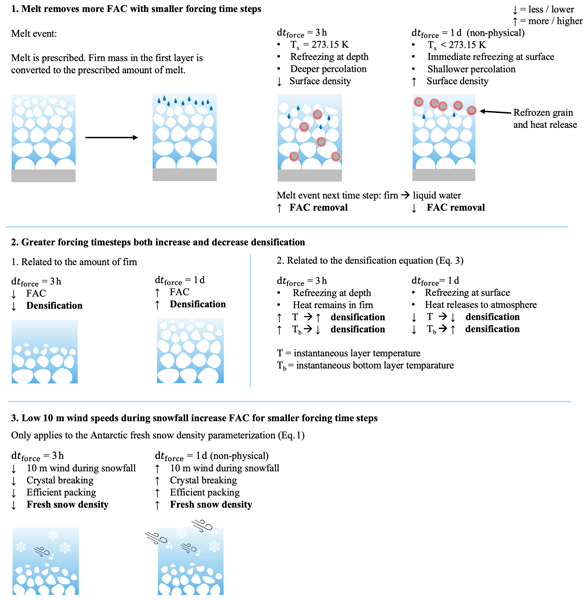
While a conceptual overview figure is a valuable addition to the paper, Figure 4 requires substantial revision. In its current form, the schematic is difficult to interpret and appears inconsistent with the physical processes described in the text (to be blunt, it looks like something generated by AI). A few examples of shortcomings: In Process 1, the depiction of large refreezing grains at depth versus smaller refreezing grains near the surface does not appear physically meaningful and is inconsistent with the description in the text; In Process 2, the distinction between the left and right panels is unclear, and the intended contrast is not adequately explained in either the caption or the manuscript; In Process 3, it is not clear how the illustrated elements relate to time stepping at all. Given the importance of this figure for synthesizing the paper’s key ideas, a clearer and more physically grounded conceptual diagram is needed.3. Formation of Ice Layers in the Model
The model description needs to explicitly explain how ice layers are formed in IMAU‑FDM. This information is essential for interpreting the results. For example, it is unclear whether daily forcing could artificially promote near‑surface ice slab formation due to the way meltwater refreezing and layer formation are implemented.
Without a clear description of how refreezing transitions into discrete ice layers, whether those layers are permeable or impermeable, and how they evolve over time, the reader cannot fully evaluate the paper’s conclusions regarding the impacts of model time step on firn structure and pore‑space evolution.4. Snowfall
The language surrounding “Snowfall” and Process 3 is confusing and needs revision. The term snowfall typically refers to a precipitation rate or mass flux, whereas this section is primarily concerned with the initial (fresh) snow density parameterization. Referring to this process as “Snowfall” is therefore confusing because the effect arises from how fresh snow density is prescribed as a function of meteorological variables that depend on time step. This distinction is important because elsewhere in the manuscript (e.g., in comparisons between Greenland and Antarctica), snowfall clearly refers to accumulation magnitude. Clarifying this terminology, or renaming this section, would substantially improve readability and reduce potential confusion. In fact, I am not confident that I have correctly deciphered the sections concerning snowfall.5. Organization
Section 3.1 (delta-FAC) is difficult to interpret when it is presented before the relevant physical context. At this stage in the manuscript, the reader does not yet understand the mechanisms responsible for the reported differences and so has little ability to absorb or evaluate the overall findings presented in this section. The manuscript would be more accessible if Section 3.2, describing the processes affected by time stepping, were presented first, followed by the resulting FAC differences. This structure would allow readers to interpret delta-FAC patterns in light of the governing processes.Minor Line‑by‑Line Comments
Line 4. “In literature …” is awkward phrasing. Consider “In the literature” or “Prior studies …”.Somewhere in the introduction it may be useful to note that, while time step is often constrained by spatial resolution and numerical stability in atmospheric or ice‑sheet models, this is generally not the case for purely one‑dimensional firn models. Clarifying this distinction would help contextualize the choice of forcing time steps.
Line 17. The term aliasing would be appropriate when referring to distortion or loss of the diurnal signal.
Line 41. “We want to …” is awkward and redundant; the intent is already clear and “want” can be removed.
Line 90. Does this statement assume that the entire firn column is at the melting point? How are ice layers handled in this context? This again highlights the need for a clearer description of ice‑layer formation in the model.
Figure 5. The two dashed line styles are nearly indistinguishable; these should be revised.
Figure 7. Adding a 1 m depth marker to the top panels would help the reader interpret the figure.
Citation: https://doi.org/10.5194/egusphere-2026-462-RC1 -
AC1: 'Reply on RC1', Tesse van den Aker, 04 Jun 2026
The comment was uploaded in the form of a supplement: https://egusphere.copernicus.org/preprints/2026/egusphere-2026-462/egusphere-2026-462-AC1-supplement.pdf
-
AC1: 'Reply on RC1', Tesse van den Aker, 04 Jun 2026
-
RC2: 'Comment on egusphere-2026-462', Anonymous Referee #2, 08 Apr 2026
The following is a review of “Impact of climate forcing time step on the modelled ice-sheet firn layer” by T. E. A. van den Aker and others.
This paper presents a study of how model forcing temporal resolution affects results of simulations of firn evolution in south Greenland and the Antarctica Peninsula. A firn model is forced with output from the regional climate model RACMO, averaged temporally over various forcing intervals. In this way, the authors conduct sensitivity tests to compare runs forced with lower temporal resolution in against those with a higher 3-hourly forcing. Through simulation analysis, they diagnose reasons why the results diverge. They conclude that without representation of a diurnal cycle, firn air content is systematically overestimated, though they find the amount of divergence can vary spatially and temporally, depending on climate regime. The authors also find that model assumptions can have a significant impact on the simulated firn evolution, and as a result, they point out that it is important to use firn models in a way that is consistent with known model limitations and assumptions.
This is an impactful study, that clearly entails a lot of work and analysis. The results will be of interest to the firn modeling community, as well as to those that use firn products to interpret observations of land ice (e.g., altimetry). The figures and writing are of high quality, and I would therefore recommend this manuscript for publication in TC. However, I do suggest that the authors make major revisions to the paper. In its current form, I think that the manuscript touches on important points, but I have a few concerns about the paper organization and messaging. I also have a number of questions about the choice of diagnostics chosen to illustrate results, which I include below.
General comments:
- Please consider rephrasing statements throughout the manuscript that pertain to the setup of the particular model tested here. For example, it would be helpful to specify which conclusions/results are for your model vs. those that can be generalized to the other types of firn models mentioned in the manuscript. For example, coupled models that calculate mass balance components themselves would not necessarily follow these results. This is inconsistent because many models are introduced in the paper (Introduction and Table 1), but then within the rest of the manuscript there is little distinction between which results could be extrapolated to which models/model type.
- I think the conclusions would be more easily digested if they were more explicitly presented separately for the various climate/melt regimes outlined in the manuscript. I find that one of the more important results is that modeled firn behavior can be separated by regime, but I do not find that this is extensively articulated in sections like the abstract and conclusions. For example, there could be result statements that are for larger melt/MOA and then there could be those for lower melt/MOA.
- Please try to make it clearer to the reader that some results depend on spinup (choices/assumptions), and some of those spinup differences are model dependent. In addition, adding text and figures to specify whether those spinup differences actually affect the results of the forward historical runs would greatly help a reader better interpret the study results. For instance, should users of a firn products care about its temporal resolution (considering they care about FAC change over time)? What is the sensitivity of these results to temporal resolution, in what regimes does it matter, and for what types of models? These results are all touched upon in the manuscript, but I don’t think a general audience would come away with clear guidance or answers to these questions. I suggest that they could more overtly be presented by including explicit quantification, extended figures, and more organized conclusions. Please see some specific suggestions below.
Specific comments and suggestions:
Title: “on the modelled ice-sheet firn layer” sounds like the results presented here can be extrapolated to general modeling of the firn on ice sheets. While this might be true, it is unclear from the analysis, since so many results depend on the specific model being tested and its limitations. Please consider rephrasing. Maybe something like “on a modelled ice-sheet firn layer” or “on an ice-sheet firn layer model"?
Lines 10-14 (and Conclusion section): I suggest that these conclusions be rephrased to specify that some of the results are particular to the model setup being tested in this study. As is, they are presented in a way that is a bit disorganized, with results from the different regimes mixed together. I think it would be more helpful to the reader to spit up the results in digestible categories. For instance, I think it is important to state that results depend on different regimes (i.e. runoff/climate), that some results could be generalized for firn models as a whole, that some results are specifically tied to spinup (i.e. they may be specific to chosen methods and not extendable to all firn models), and that some are tied to key temporal processes (refreeze) - hence they strongly affect the evolution of the forward historical runs. As the authors note in the text, this latter result would be the one most important for altimetry corrections. Please note that most of this information is within the text, but I think the abstract and conclusions, especially, could present them more effectively to the reader upfront.
Line 14: Along the lines of the previous comment, please specifically note here that the problems mentioned are for a wet system.
Line 16: As an example of the points above: can you make all of these conclusions, based on the study done here, for any firn model? If not, then I think it is important to state here, for clarity, which results are for your type of firn model setup (i.e. one-way forcing of mass balance terms) and which are more general. Then, in maybe the discussion portion, it would be helpful to comment on which of those could be extended to a general firn model.
Line 34: As mentioned above, I don’t believe that you are testing the last two type of models listed. For instance, some models calculate mass balance terms, like melt, happening at different layers within the snow, and other models could simulate many more feedbacks not investigated here (i.e. processes like sublimation/evaporation simulated in-model). These models will likely have different requirements, especially for input temporal resolution. In light of this, please make sure these caveats are clearly articulated, to be clear to the reader the limitations of your results.
Line 133: Are these total FAC sum through the whole column (eg., down to close off, 830)? Please specify here for clarity.
Lines 142-143, Figure 3, Caption: Here I understand that you are showing the historical temporal average of the whole column. However, when showing mapped differences, that statistic has a bias in it, towards the earlier FAC states. Because FAC is cumulative, and a convolution of forcing and evolution over time. A more straight-forward comparison would be just to show the difference in FAC at the end of the simulation, since the last step FAC has all the cumulative evolution of the spinup and historical simulation already included in it. That being said, because the current maps illustrate mostly differences in the spinup states (as noted in the manuscript), I would suggest the authors add maps that show the FAC change during just the historical simulation. This is the diagnostic that a user of a firn product (eg, for altimetry) would find most important, i.e. something like dFAC/dt over the historical period. I realize that this might be a lot smaller, but I think it is important to present this change for users, and to explicitly quantify the difference in magnitude compared to the changes due to spinup only.
Line 155: Each of these processes impact the firn layer on different temporal scales. I suggest for each, that the authors clearly mention what the temporal scale is. This would help bridge the connection between processes that might be more significant on the scale of a spinup or processes that might occur over the historical period.
Line 176 and Line 181: Please note here that this result is specific to your model setup (i.e. in a different model, melt might not even occur at lower temporal resolutions – for examples, if melt is calculated within the model).
Figure 5, Caption: What is specifically meant here by “elevation change”? Please be more explicit about how this diagnostic is calculated, since it does not look to be the sum of the surface components. For example, is a mean mass balance subtracted out for ice flow divergence?
Figure 6, Caption: Please make it clear in this figure that melt is a forcing in your setup, and not modeled in this study, while refreeze is an output from this study’s model.
Line 193: “firn” -> “FAC” (?) as shown in Figure 3.
Line 193: “less densification” -> Please add a reference equation 3 here.
Line 200: “densification rate remains lower” might be more clear
Figure 9, Caption: Like mentioned for Figure 3 maps, I think it would be beneficial for the authors to add a plot of change in FAC over the historical (i.e. subtract out the beginning state). This would help illustrate if the FAC is diverging at all over time, or periodically, during the historic simulation. Spinup differences really hide this information, but I think its quantification is important to users of FAC, even if small compared to initial spinup spread. I realize that this is still not an apple to apple comparison between your different time step runs, because each simulation has a different starting state due to spinup, but I still think it is interesting to present, as long as that limitation is acknowledged.
Line 219: Please be more specific about the connection between firn and vulnerability here.
Line 237: Does it have a higher heat content overall or a higher heat content at depth? Please specify.
Line 247: It would strengthen the discuss here to point out that this result has strong implications also for estimates of mass balance and overall surface mass balance projections in the future.
Line 256: Please explicitly state for the reader how this impacts altimetry estimates of mass balance.
Line 260: This is well-stated, with reference the type of model fitting this conclusion. Please try to impart these type of statements throughout the manuscript and in the abstract.
Citation: https://doi.org/10.5194/egusphere-2026-462-RC2 -
AC2: 'Reply on RC2', Tesse van den Aker, 04 Jun 2026
The comment was uploaded in the form of a supplement: https://egusphere.copernicus.org/preprints/2026/egusphere-2026-462/egusphere-2026-462-AC2-supplement.pdf
Peer review completion
Journal article(s) based on this preprint
Viewed
| HTML | XML | Total | BibTeX | EndNote | |
|---|---|---|---|---|---|
| 1,166 | 631 | 104 | 1,901 | 138 | 193 |
- HTML: 1,166
- PDF: 631
- XML: 104
- Total: 1,901
- BibTeX: 138
- EndNote: 193
Viewed (geographical distribution)
| Country | # | Views | % |
|---|
| Total: | 0 |
| HTML: | 0 |
| PDF: | 0 |
| XML: | 0 |
- 1
Tesse E. A. van den Aker

Peter Kuipers Munneke
Willem Jan van de Berg
Walter W. Immerzeel
Michiel R. van den Broeke
The requested preprint has a corresponding peer-reviewed final revised paper. You are encouraged to refer to the final revised version.
- Preprint
(12725 KB) - Metadata XML
Overview
As firn models and climate forcing datasets become more widely available, firn modeling is becoming an increasingly important avenue of cryospheric research. My initial impression was that this manuscript would primarily be of interest to researchers focused on the technical details of model application. However, the paper ultimately contains broader and more important implications for how firn processes are represented (or misrepresented) in models. I therefore consider this an important contribution that will be valuable to the broader cryospheric science community.
Major Comments
1. Table 1 in the Introduction
Table 1 does not add much in its current form. The list of papers and their time steps does not appear to be exhaustive, which makes the table potentially misleading. Simply referencing some examples in the text may be sufficient. Alternatively, the introduction could include a more informative table or figure that explicitly links model time-step choices to processes, firn model classes, or data availability constraints, etc.
2. Conceptual Overview (Figure 4)
While a conceptual overview figure is a valuable addition to the paper, Figure 4 requires substantial revision. In its current form, the schematic is difficult to interpret and appears inconsistent with the physical processes described in the text (to be blunt, it looks like something generated by AI). A few examples of shortcomings: In Process 1, the depiction of large refreezing grains at depth versus smaller refreezing grains near the surface does not appear physically meaningful and is inconsistent with the description in the text; In Process 2, the distinction between the left and right panels is unclear, and the intended contrast is not adequately explained in either the caption or the manuscript; In Process 3, it is not clear how the illustrated elements relate to time stepping at all. Given the importance of this figure for synthesizing the paper’s key ideas, a clearer and more physically grounded conceptual diagram is needed.
3. Formation of Ice Layers in the Model
The model description needs to explicitly explain how ice layers are formed in IMAU‑FDM. This information is essential for interpreting the results. For example, it is unclear whether daily forcing could artificially promote near‑surface ice slab formation due to the way meltwater refreezing and layer formation are implemented.
Without a clear description of how refreezing transitions into discrete ice layers, whether those layers are permeable or impermeable, and how they evolve over time, the reader cannot fully evaluate the paper’s conclusions regarding the impacts of model time step on firn structure and pore‑space evolution.
4. Snowfall
The language surrounding “Snowfall” and Process 3 is confusing and needs revision. The term snowfall typically refers to a precipitation rate or mass flux, whereas this section is primarily concerned with the initial (fresh) snow density parameterization. Referring to this process as “Snowfall” is therefore confusing because the effect arises from how fresh snow density is prescribed as a function of meteorological variables that depend on time step. This distinction is important because elsewhere in the manuscript (e.g., in comparisons between Greenland and Antarctica), snowfall clearly refers to accumulation magnitude. Clarifying this terminology, or renaming this section, would substantially improve readability and reduce potential confusion. In fact, I am not confident that I have correctly deciphered the sections concerning snowfall.
5. Organization
Section 3.1 (delta-FAC) is difficult to interpret when it is presented before the relevant physical context. At this stage in the manuscript, the reader does not yet understand the mechanisms responsible for the reported differences and so has little ability to absorb or evaluate the overall findings presented in this section. The manuscript would be more accessible if Section 3.2, describing the processes affected by time stepping, were presented first, followed by the resulting FAC differences. This structure would allow readers to interpret delta-FAC patterns in light of the governing processes.
Minor Line‑by‑Line Comments
Line 4. “In literature …” is awkward phrasing. Consider “In the literature” or “Prior studies …”.
Somewhere in the introduction it may be useful to note that, while time step is often constrained by spatial resolution and numerical stability in atmospheric or ice‑sheet models, this is generally not the case for purely one‑dimensional firn models. Clarifying this distinction would help contextualize the choice of forcing time steps.
Line 17. The term aliasing would be appropriate when referring to distortion or loss of the diurnal signal.
Line 41. “We want to …” is awkward and redundant; the intent is already clear and “want” can be removed.
Line 90. Does this statement assume that the entire firn column is at the melting point? How are ice layers handled in this context? This again highlights the need for a clearer description of ice‑layer formation in the model.
Figure 5. The two dashed line styles are nearly indistinguishable; these should be revised.
Figure 7. Adding a 1 m depth marker to the top panels would help the reader interpret the figure.