
the Creative Commons Attribution 4.0 License.
the Creative Commons Attribution 4.0 License.
 | 23 Mar 2026
Evolution of seepage driven networks in the lab
Abstract. During rain, water infiltrates the ground, where it flows as groundwater toward nearby rivers. There, its emergence can entrain sediments, triggering seepage erosion and thereby influencing the development and expansion of river networks. To investigate this process, we construct an experimental aquifer, made of erodible plastic sediments. A reservoir beneath the aquifer supplies water at a controlled recharge rate. We find that seepage erosion, driven by the resulting groundwater flow, is sufficient to initiate the formation and growth of a drainage network. For a given recharge rate, network growth eventually ceases as the drainage system reaches a steady-state morphology, in which sediments are everywhere at the threshold of motion. This observation indicates that the recharge rate of the aquifer selects the size of the network. In our experiment, the depth of the aquifer is small compared to its lateral extent, so that the flow of groundwater obeys the Dupuit-Boussinesq equation. As in natural systems, the water table in our experiment intersects the drainage network at the elevation of the streams. This condition provides the necessary boundary conditions to solve for the Dupuit-Boussinesq equation and reconstruct the shape of the water table around the river network. The resulting numerical solution agrees well with piezometric measurements carried out in the experimental aquifer and reveals that groundwater flow converges toward channel tips, where velocities are maximal. These results suggest that seepage erosion occurs only when groundwater velocity exceeds a critical threshold.
Competing interests: At least one of the (co-)authors is a member of the editorial board of Earth Surface Dynamics.
Publisher's note: Copernicus Publications remains neutral with regard to jurisdictional claims made in the text, published maps, institutional affiliations, or any other geographical representation in this paper. While Copernicus Publications makes every effort to include appropriate place names, the final responsibility lies with the authors. Views expressed in the text are those of the authors and do not necessarily reflect the views of the publisher.-
Notice on discussion status
The requested preprint has a corresponding peer-reviewed final revised paper. You are encouraged to refer to the final revised version.
-
Preprint
(3547 KB)
-
The requested preprint has a corresponding peer-reviewed final revised paper. You are encouraged to refer to the final revised version.
- Preprint
(3547 KB) - Metadata XML
- BibTeX
- EndNote
- Final revised paper


Journal article(s) based on this preprint
Interactive discussion
Status: closed
-
RC1: 'Comment on egusphere-2026-460', Anonymous Referee #1, 08 Apr 2026
-
AC2: 'Response to RC1: Comment on egusphere-2026-460', Céleste Romon, 09 Jun 2026
We would like to thank the referee for the positive feedback, and for the detailed commentary, which helped us to correct some mistakes and clarify the paper. In the following, we address every question and suggestion of the referee, and indicate the corresponding changes in the manuscript.
1. In terms of data collection, repeat photogrammetry was taken, and channel networks were analyzed through manual delineation of the tops of the channels only. Was there any effort to track the volume of the channel network? If multiple images were taken, they could be processed using Structure-from-motion to get topography. If not, was there anything else done to try and collect topographic data? Or monitor the sediment export?
→ We agree with the referee that measurements of the network topography would be valuable in the context of our experiment. Unfortunately, the grains of our experimental aquifer are homogeneous, making the surface of the aquifer insufficiently textured for photogrammetry. As an alternative, we tried to measure topography by projecting fringes on the network. However, the channel banks were too steep for this method to work, and led to large errors. Topographic measurements would have required significant changes in the experimental setup, which we plan to address in future work.
In response to this comment, we added the following clarifications at line 212: “However, to reconstruct the water table, we choose to neglect the network topography and set it to zero. While this method correctly captures the shape of the water table across most of the experimental domain, it overpredicts the discharge by a factor of about two near the channel tips. Measuring the topography would help us to resolve this discrepancy. Unfortunately, because of their homogeneous color, our grains lack the texture required to use photogrammetry. We are instead currently testing a fringe projection method to extract the topography”.
→ At the experiment outlet, water and sediments flowed into an overflowing tank. As the water level in the tank was kept constant, water coming from the experiment automatically flowed out. Conversely, sediments sank to its bottom and stayed in the tank. Thus, by measuring the weight of this tank in time - knowing the sediment and water densities - we estimated the mass of sediments flowing out. Unfortunately, the variations in water levels and important changes in water discharge induced significant errors in sediment mass estimates. In future work, we hope to build a more robust technique to measure the eroded sediment flux.
To address this question, we added in the Conclusions and Discussions section: “Establishing the exact nature of this relationship requires additional experiments. Moreover, precise measurements of the sediment flux would improve our ability to monitor the erosion intensity during network growth, which we currently assess only through visual observations.”
2. The discharge measurements were made by measuring the mass of water coming out of the basin over a set period of time (line 86). What time period did you use to measure discharge? Did that water also contain sediment? If so, how was that accounted for in the mass/time measurements?
→ Discharge measurement were performed over a time interval of 1 to 5 min. Indeed, the water flowing out of the aquifer contained sediments. However, as both the average sediment flux and the grain density are low (around 20 g.h−1 and 1500 kg.m−3), we consider that its impact on the discharge measurements is negligible.
To clarify this point, we added: “over time intervals ranging from 1 to 5 minutes” and “Because the sediment discharge is relatively low (about 20 g.h−1) compared with the water discharge (at least 6 kg.h−1), the sediment mass is negligible. Weighing the beaker thus yields a reliable estimate of the water discharge (Romon, 2025).” line 87.
3. The experiment ran for 35 days. Did you run it continuously? Overnight? How often did you measure things like discharge?
→ 25 days is the effective duration of the experiment, which we ran continuously as much as possible - including overnights and weekends. The only time it was stopped was because of a technical problem with the camera.
→ We measured discharge right before changing the water table height, then once more a couple minutes later. We sometimes did some extra measurements to add more data points, but these were not regular.
To answer these questions, we added: “measured the discharge of water leaving the aquifer, increased the recharge by a small amount (typically 0.1 L.min−1), then measured discharge once more (Fig. 3a).” on line 120 and: “- during which the experiment ran continuously -” on line 121.
4. On line 116-117, you note that you waited until the network had achieved a stable morphology before increasing the aquifer recharge rate. Please explain how you determined when the network was no longer eroding and had reached a stable morphology. Was it just through visual observation? Did you compare photos between different time periods?
→ As the referee mentioned, we used image comparison by subtracting photos from different time periods to identify any changes - or lack there of - at the channel tips. At the same time, we observed the network directly - where moving sediment were easy to see.
To clarify this point, we added: “we compared photographs from different time periods and waited until an absence of observable changes indicated that the network had reached a stable morphology.” line 118.
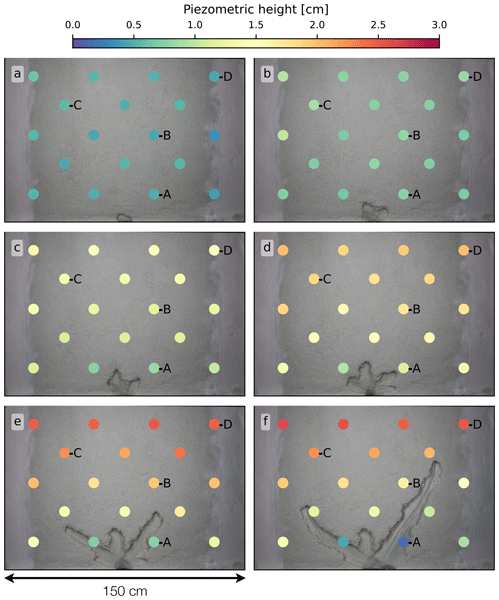
5. For the modeling, the assumption was made that the channel slope was not important as it was only 2% and thus the water table at the outlet was used to set the elevation of the water table throughout the channel network, making the water table slope essentially zero in the channel network (line 152-155). Looking at Figure 5a, it looks like there is about a 3cm drop over the experimental domain (150cm x 150cm), which is a 2% slope on the water table. Thus, the channel slope that is neglected is the same as the water table slope. It is thus not negligible. The result is that anywhere there is a channel, the water table gradient in the model will be artificially high adjacent to it because the water table elevation drops to zero there (same as the outlet). This will generate higher velocities along the edges of the channel because of the artificially high hydraulic gradient. This seems rather important. In lines 175-177, you note that the difference between the water table heights in the channels and the modeled heights is quite high, indicating that the channel slope cannot be neglected. Why did you neglect it then? Can you please explain how you handle this discrepancy in a way that does not impact the results and ensuing interpretation of the water table gradients in the vicinity of the channel network?
→ Indeed, the results in our manuscript indicate that the slope of the channels in the experimental network are non-negligible compared to the variations in water table elevation, highlighting the importance of measuring topography in any future experiments. Still, the piezometric data shows that simplifying the network elevation to h = 0 does not impact our reconstruction of the water table outside of the immediate vicinity of the channels.
→ However, as noted in this comment, this simplification artificially increases the gradient of the water table near the channel tips, causing a significant over-estimation of the groundwater velocity. Thus, we agree with the referee that the values of groundwater velocity presented in the article (figure 6 d-f) are not robust enough to be exploited.
→ Therefore, to evaluate the error that our simplification of the network topography induces, we discuss - in a second appendix (B) - the case of a simpler, one-dimensional system meant to represent a small section of our experiment in the vicinity of a channel tip. Using the analytical solution for the water table height in this one-dimensional configuration, we find that our simplified boundary condition (h= 0) results in an overestimation of the groundwater flux by a factor of about two. For the details of the computation, please refer to appendix B in the manuscript.
→ Although our simplification of the network topography (h= 0) induces a non-negligible error on the groundwater flux, it still allows an estimate of the right order of magnitude. Thus, we choose to represent the groundwater flux, q=−Kh∇h, in section 4 of the manuscript, instead of the velocity.
Consequently, we added on line 179: “The difference between our boundary condition and the actual water table height inside the drainage network (approximately 1 cm) results in an overestimation of the groundwater flux by a factor of about two (see appendix B)”. Most importantly, we have rewritten the last paragraph of section 4 (lines 187-194) and replaced figure 6 d-f. Correspondingly, we have changed the caption of figure 6, and several lines of the section Conclusions and Discussions.
6. The paper states that 6 experimental runs were conducted (line 104), yet only one of the runs is described here. While the approach of focusing on one experiment to highlight a particular process is reasonable, there are no data presented at all from the other 5 experiments. Could you combine some of the data from those experiments to bolster the data being presented here from a single experiment? I was left wanting some confirmation of the observations from this single experiment with more experiments, and since you ran more experiments, perhaps you can include some information on whether they support or contradict the observations seen in the one experiment presented here.
→ Unlike what the manuscript suggested, the 5 additional experiments served as preliminary tests. For some of them, we had not yet installed complete monitoring (piezometric data, discharge, regular photos...), and all were mostly used to test out the setup, so that a robust experiment (the one presented in the article) could be run.
To clarify the process that led to the experiment presented in the article, we changed line 106 to: “To investigate the formation of drainage networks in our laboratory aquifer, we ran several preliminary experimental runs, each lasting from a few days to a couple of weeks”, and line 109 to: “Over time”.
→ Several of the preliminary experiments led to the formation of drainage networks. Thus, we have added an appendix (A) to the article where we present some of our observations from these experimental runs, as well as pictures of the networks.
7. Lastly, there is no discussion section in the manuscript, tieing your observations back to the literature and to the natural world. The second paragraph in the conclusions section highlights this a little bit. I think the paper would be stronger if you could spend more time relating the results from here back to other experiments or the natural world.
→ We agree with the referee that the manuscript was lacking some discussion and links with natural world cases. Therefore, we titled the last section “Conclusions and Discussions”, added information about the perspectives our experiment offers, and linked our findings to studies of natural networks.
→ How might the results here inform channel network evolution models in heterogeneous aquifers? To understand the impact aquifer heterogeneity could have on groundwater flow and channel growth, we could build an experimental aquifer with various layers of different grain types. In such a context, we expect the variations of hydraulic conductivity to influence the groundwater flow, leading perhaps to different groundwater velocities in each layer.
→ How might these results combine with surface flow in natural systems to set the pace of channel network evolution? In these experiments and in the few field studies we have conducted (to be published), we have considered areas where overland flow is negligible compared to infiltration. To clarify this, we added “in areas where infiltration dominates over overland flow,” line 210.
→ What does it mean in terms of landscape evolution if seepage erosion reaches a steady-state and essentially stops unless aquifer recharge increases? This suggests that many natural networks might currently be in steady-state and are no longer growing significantly (not considering surface erosion, glacier melt, or extreme weather events). Moreover, current river networks might have a morphology due to past, stronger groundwater flow, no longer representative of today’s aquifer recharge.
To answer this question and, more generally, to develop on how our results can be linked to the natural world, we have rewritten three paragraphs of the Conclusion and Discussion section.
A few minor notes:
1. The term “ramified” is not one I was familiar with to describe dendritic or branching rivers. Consider using a different term, like branching. (This may be a regional issue – I am basedin the USA.)
→ In light of this comment, we have changed the term “ramified” to “branching” in the entire article (2 iterations).
2. What kind of plastic were you using? Did it have any cohesion?
→ As stated in the article, we used Guyson guyblast plastic media US type 2 (sizes ranging from d= 500 to 1000 µm and density ρ= 1500 kg.m2). Although we have not measured its cohesion, this plastic sand is angular and of irregular shape which makes it more cohesive than spheres.
3. On figures 2, 5, and 6, please include scale for the images or explain what area is covered in the figure captions.
→ We have added a scale on figures 2 and 5, and a clarification in the caption of figure 6: “Each reconstruction of the water table and of the associated groundwater flux spans over the entire experimental aquifer (150 ×150 cm)”
4. Line 212 should be “split” not “splitted”
→ We have corrected this spelling error.
5. Line 168 remove word “with” or “to” (we compare it to the piezometric. . . )
→ We have removed the word “with”.
6. Line 191 should be “velocity” not “vel”
→ We have replaced “vel” with “velocity”.
Citation: https://doi.org/10.5194/egusphere-2026-460-AC2
-
AC2: 'Response to RC1: Comment on egusphere-2026-460', Céleste Romon, 09 Jun 2026
-
RC2: 'Comment on egusphere-2026-460', V. Voller, 13 Apr 2026
Overview:
This paper presents an elegant experiment with an accompanying analysis that demonstrates essential ingredients and features related to the formation and growth of drainage networks. In particular, the work highlights the role of seepage erosion in initiation of drainage networks, indicates that the steady state size of such networks is determined by a threshold of motion condition, and demonstrates a possible linear relationship between the size (area) of the network and the recharge rate.
The experimental and analysis components of the work are very carefully detailed and explained. The authors take great care to note the possible limitation of their findings to field systems without undercutting the relevance or importance of the experimental results.
The analysis based on a FEM modeling using the Dupuit-Boussinesq approximation to predict the water table level at steady state is very nice. I fully agree with the authors that this approach may have a much wider application in groundwater flow and storage.
Rating:
This work makes an excellent and notable contribution to Earth Surface Dynamics. Providing experimental and analysis support for emerging ideas on the formation and control of drainage networks.
The scientific approach and methods used are excellent. The discussion is both appropriate and balanced, based on key work from the literature
The presentation is excellent; completed, compressive, clear, and concise.
Suggestions:
1. Line 122 — “splitted” should read “split”
2. The value and dimensions of alpha in the caption of Fig 4 do not look right.
3. After Eq(2) in addition to defining K might also be a good idea to define R.
Vaughan Voller, University of Minnesota
Citation: https://doi.org/10.5194/egusphere-2026-460-RC2 -
AC1: 'Response to RC2 : Comment on egusphere-2026-460', Céleste Romon, 09 Jun 2026
We would like to thank Vaughan Voller for taking the time to review our paper, and for his positive feedback and comments. In the following, we respond to his suggestions and indicate the changes we made accordingly in the manuscript.
1. Line 122 — “splitted” should read “split”
→ We corrected the spelling.
2. The value and dimensions of alpha in the caption of Fig 4 do not look right.
→ There was indeed an error in the caption of Fig. 4, where the linear function was written incorrectly. Thus, we replaced the previous caption with : “Blue dashed line: linear fit to the data A= αQ with α = 3.8·103 s.m−1”.
3. After Eq(2) in addition to defining K might also be a good idea to define R.
→ To clarify Eq. (2), we have added: “and R is the recharge rate”.
Citation: https://doi.org/10.5194/egusphere-2026-460-AC1
-
AC1: 'Response to RC2 : Comment on egusphere-2026-460', Céleste Romon, 09 Jun 2026
-
AC1: 'Response to RC2 : Comment on egusphere-2026-460', Céleste Romon, 09 Jun 2026
We would like to thank Vaughan Voller for taking the time to review our paper, and for his positive feedback and comments. In the following, we respond to his suggestions and indicate the changes we made accordingly in the manuscript.
1. Line 122 — “splitted” should read “split”
→ We corrected the spelling.
2. The value and dimensions of alpha in the caption of Fig 4 do not look right.
→ There was indeed an error in the caption of Fig. 4, where the linear function was written incorrectly. Thus, we replaced the previous caption with : “Blue dashed line: linear fit to the data A= αQ with α = 3.8·103 s.m−1”.
3. After Eq(2) in addition to defining K might also be a good idea to define R.
→ To clarify Eq. (2), we have added: “and R is the recharge rate”.
Citation: https://doi.org/10.5194/egusphere-2026-460-AC1 -
AC2: 'Response to RC1: Comment on egusphere-2026-460', Céleste Romon, 09 Jun 2026
We would like to thank the referee for the positive feedback, and for the detailed commentary, which helped us to correct some mistakes and clarify the paper. In the following, we address every question and suggestion of the referee, and indicate the corresponding changes in the manuscript.
1. In terms of data collection, repeat photogrammetry was taken, and channel networks were analyzed through manual delineation of the tops of the channels only. Was there any effort to track the volume of the channel network? If multiple images were taken, they could be processed using Structure-from-motion to get topography. If not, was there anything else done to try and collect topographic data? Or monitor the sediment export?
→ We agree with the referee that measurements of the network topography would be valuable in the context of our experiment. Unfortunately, the grains of our experimental aquifer are homogeneous, making the surface of the aquifer insufficiently textured for photogrammetry. As an alternative, we tried to measure topography by projecting fringes on the network. However, the channel banks were too steep for this method to work, and led to large errors. Topographic measurements would have required significant changes in the experimental setup, which we plan to address in future work.
In response to this comment, we added the following clarifications at line 212: “However, to reconstruct the water table, we choose to neglect the network topography and set it to zero. While this method correctly captures the shape of the water table across most of the experimental domain, it overpredicts the discharge by a factor of about two near the channel tips. Measuring the topography would help us to resolve this discrepancy. Unfortunately, because of their homogeneous color, our grains lack the texture required to use photogrammetry. We are instead currently testing a fringe projection method to extract the topography”.
→ At the experiment outlet, water and sediments flowed into an overflowing tank. As the water level in the tank was kept constant, water coming from the experiment automatically flowed out. Conversely, sediments sank to its bottom and stayed in the tank. Thus, by measuring the weight of this tank in time - knowing the sediment and water densities - we estimated the mass of sediments flowing out. Unfortunately, the variations in water levels and important changes in water discharge induced significant errors in sediment mass estimates. In future work, we hope to build a more robust technique to measure the eroded sediment flux.
To address this question, we added in the Conclusions and Discussions section: “Establishing the exact nature of this relationship requires additional experiments. Moreover, precise measurements of the sediment flux would improve our ability to monitor the erosion intensity during network growth, which we currently assess only through visual observations.”
2. The discharge measurements were made by measuring the mass of water coming out of the basin over a set period of time (line 86). What time period did you use to measure discharge? Did that water also contain sediment? If so, how was that accounted for in the mass/time measurements?
→ Discharge measurement were performed over a time interval of 1 to 5 min. Indeed, the water flowing out of the aquifer contained sediments. However, as both the average sediment flux and the grain density are low (around 20 g.h−1 and 1500 kg.m−3), we consider that its impact on the discharge measurements is negligible.
To clarify this point, we added: “over time intervals ranging from 1 to 5 minutes” and “Because the sediment discharge is relatively low (about 20 g.h−1) compared with the water discharge (at least 6 kg.h−1), the sediment mass is negligible. Weighing the beaker thus yields a reliable estimate of the water discharge (Romon, 2025).” line 87.
3. The experiment ran for 35 days. Did you run it continuously? Overnight? How often did you measure things like discharge?
→ 25 days is the effective duration of the experiment, which we ran continuously as much as possible - including overnights and weekends. The only time it was stopped was because of a technical problem with the camera.
→ We measured discharge right before changing the water table height, then once more a couple minutes later. We sometimes did some extra measurements to add more data points, but these were not regular.
To answer these questions, we added: “measured the discharge of water leaving the aquifer, increased the recharge by a small amount (typically 0.1 L.min−1), then measured discharge once more (Fig. 3a).” on line 120 and: “- during which the experiment ran continuously -” on line 121.
4. On line 116-117, you note that you waited until the network had achieved a stable morphology before increasing the aquifer recharge rate. Please explain how you determined when the network was no longer eroding and had reached a stable morphology. Was it just through visual observation? Did you compare photos between different time periods?
→ As the referee mentioned, we used image comparison by subtracting photos from different time periods to identify any changes - or lack there of - at the channel tips. At the same time, we observed the network directly - where moving sediment were easy to see.
To clarify this point, we added: “we compared photographs from different time periods and waited until an absence of observable changes indicated that the network had reached a stable morphology.” line 118.
5. For the modeling, the assumption was made that the channel slope was not important as it was only 2% and thus the water table at the outlet was used to set the elevation of the water table throughout the channel network, making the water table slope essentially zero in the channel network (line 152-155). Looking at Figure 5a, it looks like there is about a 3cm drop over the experimental domain (150cm x 150cm), which is a 2% slope on the water table. Thus, the channel slope that is neglected is the same as the water table slope. It is thus not negligible. The result is that anywhere there is a channel, the water table gradient in the model will be artificially high adjacent to it because the water table elevation drops to zero there (same as the outlet). This will generate higher velocities along the edges of the channel because of the artificially high hydraulic gradient. This seems rather important. In lines 175-177, you note that the difference between the water table heights in the channels and the modeled heights is quite high, indicating that the channel slope cannot be neglected. Why did you neglect it then? Can you please explain how you handle this discrepancy in a way that does not impact the results and ensuing interpretation of the water table gradients in the vicinity of the channel network?
→ Indeed, the results in our manuscript indicate that the slope of the channels in the experimental network are non-negligible compared to the variations in water table elevation, highlighting the importance of measuring topography in any future experiments. Still, the piezometric data shows that simplifying the network elevation to h = 0 does not impact our reconstruction of the water table outside of the immediate vicinity of the channels.
→ However, as noted in this comment, this simplification artificially increases the gradient of the water table near the channel tips, causing a significant over-estimation of the groundwater velocity. Thus, we agree with the referee that the values of groundwater velocity presented in the article (figure 6 d-f) are not robust enough to be exploited.
→ Therefore, to evaluate the error that our simplification of the network topography induces, we discuss - in a second appendix (B) - the case of a simpler, one-dimensional system meant to represent a small section of our experiment in the vicinity of a channel tip. Using the analytical solution for the water table height in this one-dimensional configuration, we find that our simplified boundary condition (h= 0) results in an overestimation of the groundwater flux by a factor of about two. For the details of the computation, please refer to appendix B in the manuscript.
→ Although our simplification of the network topography (h= 0) induces a non-negligible error on the groundwater flux, it still allows an estimate of the right order of magnitude. Thus, we choose to represent the groundwater flux, q=−Kh∇h, in section 4 of the manuscript, instead of the velocity.
Consequently, we added on line 179: “The difference between our boundary condition and the actual water table height inside the drainage network (approximately 1 cm) results in an overestimation of the groundwater flux by a factor of about two (see appendix B)”. Most importantly, we have rewritten the last paragraph of section 4 (lines 187-194) and replaced figure 6 d-f. Correspondingly, we have changed the caption of figure 6, and several lines of the section Conclusions and Discussions.
6. The paper states that 6 experimental runs were conducted (line 104), yet only one of the runs is described here. While the approach of focusing on one experiment to highlight a particular process is reasonable, there are no data presented at all from the other 5 experiments. Could you combine some of the data from those experiments to bolster the data being presented here from a single experiment? I was left wanting some confirmation of the observations from this single experiment with more experiments, and since you ran more experiments, perhaps you can include some information on whether they support or contradict the observations seen in the one experiment presented here.
→ Unlike what the manuscript suggested, the 5 additional experiments served as preliminary tests. For some of them, we had not yet installed complete monitoring (piezometric data, discharge, regular photos...), and all were mostly used to test out the setup, so that a robust experiment (the one presented in the article) could be run.
To clarify the process that led to the experiment presented in the article, we changed line 106 to: “To investigate the formation of drainage networks in our laboratory aquifer, we ran several preliminary experimental runs, each lasting from a few days to a couple of weeks”, and line 109 to: “Over time”.
→ Several of the preliminary experiments led to the formation of drainage networks. Thus, we have added an appendix (A) to the article where we present some of our observations from these experimental runs, as well as pictures of the networks.
7. Lastly, there is no discussion section in the manuscript, tieing your observations back to the literature and to the natural world. The second paragraph in the conclusions section highlights this a little bit. I think the paper would be stronger if you could spend more time relating the results from here back to other experiments or the natural world.
→ We agree with the referee that the manuscript was lacking some discussion and links with natural world cases. Therefore, we titled the last section “Conclusions and Discussions”, added information about the perspectives our experiment offers, and linked our findings to studies of natural networks.
→ How might the results here inform channel network evolution models in heterogeneous aquifers? To understand the impact aquifer heterogeneity could have on groundwater flow and channel growth, we could build an experimental aquifer with various layers of different grain types. In such a context, we expect the variations of hydraulic conductivity to influence the groundwater flow, leading perhaps to different groundwater velocities in each layer.
→ How might these results combine with surface flow in natural systems to set the pace of channel network evolution? In these experiments and in the few field studies we have conducted (to be published), we have considered areas where overland flow is negligible compared to infiltration. To clarify this, we added “in areas where infiltration dominates over overland flow,” line 210.
→ What does it mean in terms of landscape evolution if seepage erosion reaches a steady-state and essentially stops unless aquifer recharge increases? This suggests that many natural networks might currently be in steady-state and are no longer growing significantly (not considering surface erosion, glacier melt, or extreme weather events). Moreover, current river networks might have a morphology due to past, stronger groundwater flow, no longer representative of today’s aquifer recharge.
To answer this question and, more generally, to develop on how our results can be linked to the natural world, we have rewritten three paragraphs of the Conclusion and Discussion section.
A few minor notes:
1. The term “ramified” is not one I was familiar with to describe dendritic or branching rivers. Consider using a different term, like branching. (This may be a regional issue – I am basedin the USA.)
→ In light of this comment, we have changed the term “ramified” to “branching” in the entire article (2 iterations).
2. What kind of plastic were you using? Did it have any cohesion?
→ As stated in the article, we used Guyson guyblast plastic media US type 2 (sizes ranging from d= 500 to 1000 µm and density ρ= 1500 kg.m2). Although we have not measured its cohesion, this plastic sand is angular and of irregular shape which makes it more cohesive than spheres.
3. On figures 2, 5, and 6, please include scale for the images or explain what area is covered in the figure captions.
→ We have added a scale on figures 2 and 5, and a clarification in the caption of figure 6: “Each reconstruction of the water table and of the associated groundwater flux spans over the entire experimental aquifer (150 ×150 cm)”
4. Line 212 should be “split” not “splitted”
→ We have corrected this spelling error.
5. Line 168 remove word “with” or “to” (we compare it to the piezometric. . . )
→ We have removed the word “with”.
6. Line 191 should be “velocity” not “vel”
→ We have replaced “vel” with “velocity”.
Citation: https://doi.org/10.5194/egusphere-2026-460-AC2
Peer review completion


Interactive discussion
Status: closed
-
RC1: 'Comment on egusphere-2026-460', Anonymous Referee #1, 08 Apr 2026
Romon et al. describe an experiment in which they allow channel networks to develop through groundwater seepage, then model the water table elevations and groundwater flow. They posit that networks will grow until the system reaches steady-state and the groundwater velocities are at or under the threshold for mobility of sediment. Since the groundwater velocities are a function of total groundwater discharge, this means that the size of a seepage-driven network is a function of aquifer recharge (and thus groundwater discharge) rates.
The paper is short and to the point. The experimental set-up is fairly straightforward, the results are clearly described, and the modeling seems appropriate. The research is of interest to those studying drainage network evolution, particularly in low-gradient areas where seepage erosion might dominate over overland flow-driven erosion. I have a few questions about some points of the experimental set-up, data analysis and modeling, and a desire for more discussion on the implications of the experimental work.
In terms of data collection, repeat photogrammetry was taken, and channel networks were analyzed through manual delineation of the tops of the channels only. Was there any effort to track the volume of the channel network? If multiple images were taken, they could be processed using Structure-from-motion to get topography. If not, was there anything else done to try and collect topographic data? Or monitor the sediment export?
The discharge measurements were made by measuring the mass of water coming out of the basin over a set period of time (line 86). What time period did you use to measure discharge? Did that water also contain sediment? If so, how was that accounted for in the mass/time measurements?
The experiment ran for 35 days. Did you run it continuously? Overnight? How often did you measure things like discharge?
On line 116-117, you note that you waited until the network had achieved a stable morphology before increasing the aquifer recharge rate. Please explain how you determined when the network was no longer eroding and had reached a stable morphology. Was it just through visual observation? Did you compare photos between different time periods?
For the modeling, the assumption was made that the channel slope was not important as it was only 2% and thus the water table at the outlet was used to set the elevation of the water table throughout the channel network, making the water table slope essentially zero in the channel network (line 152-155). Looking at Figure 5a, it looks like there is about a 3cm drop over the experimental domain (150cm x 150cm), which is a 2% slope on the water table. Thus, the channel slope that is neglected is the same as the water table slope. It is thus not negligible. The result is that anywhere there is a channel, the water table gradient in the model will be artificially high adjacent to it because the water table elevation drops to zero there (same as the outlet). This will generate higher velocities along the edges of the channel because of the artificially high hydraulic gradient. This seems rather important. In lines 175-177, you note that the difference between the water table heights in the channels and the modeled heights is quite high, indicating that the channel slope cannot be neglected. Why did you neglect it then? Can you please explain how you handle this discrepancy in a way that does not impact the results and ensuing interpretation of the water table gradients in the vicinity of the channel network?
The paper states that 6 experimental runs were conducted (line 104), yet only one of the runs is described here. While the approach of focusing on one experiment to highlight a particular process is reasonable, there are no data presented at all from the other 5 experiments. Could you combine some of the data from those experiments to bolster the data being presented here from a single experiment? I was left wanting some confirmation of the observations from this single experiment with more experiments, and since you ran more experiments, perhaps you can include some information on whether they support or contradict the observations seen in the one experiment presented here.
Lastly, there is no discussion section in the manuscript, tieing your observations back to the literature and to the natural world. The second paragraph in the conclusions section highlights this a little bit. I think the paper would be stronger if you could spend more time relating the results from here back to other experiments or the natural world. What does it mean in terms of landscape evolution if seepage erosion reaches a steady-state and essentially stops unless aquifer recharge increases? How might the results here inform channel network evolution models in heterogeneous aquifers? How might these results combine with surface flow in natural systems to set the pace of channel network evolution?
A few minor notes:
The term “ramified” is not one I was familiar with to describe dendritic or branching rivers. Consider using a different term, like branching. (This may be a regional issue – I am based in the USA.)
What kind of plastic were you using? Did it have any cohesion?
On figures 2, 5, and 6, please include scale for the images or explain what area is covered in the figure captions.
Line 212 should be “split” not “splitted”
Line 168 remove word “with” or “to” (we compare it to the piezometric…)
Line 191 should be “velocity” not “vel”
Citation: https://doi.org/10.5194/egusphere-2026-460-RC1 -
AC2: 'Response to RC1: Comment on egusphere-2026-460', Céleste Romon, 09 Jun 2026
We would like to thank the referee for the positive feedback, and for the detailed commentary, which helped us to correct some mistakes and clarify the paper. In the following, we address every question and suggestion of the referee, and indicate the corresponding changes in the manuscript.
1. In terms of data collection, repeat photogrammetry was taken, and channel networks were analyzed through manual delineation of the tops of the channels only. Was there any effort to track the volume of the channel network? If multiple images were taken, they could be processed using Structure-from-motion to get topography. If not, was there anything else done to try and collect topographic data? Or monitor the sediment export?
→ We agree with the referee that measurements of the network topography would be valuable in the context of our experiment. Unfortunately, the grains of our experimental aquifer are homogeneous, making the surface of the aquifer insufficiently textured for photogrammetry. As an alternative, we tried to measure topography by projecting fringes on the network. However, the channel banks were too steep for this method to work, and led to large errors. Topographic measurements would have required significant changes in the experimental setup, which we plan to address in future work.
In response to this comment, we added the following clarifications at line 212: “However, to reconstruct the water table, we choose to neglect the network topography and set it to zero. While this method correctly captures the shape of the water table across most of the experimental domain, it overpredicts the discharge by a factor of about two near the channel tips. Measuring the topography would help us to resolve this discrepancy. Unfortunately, because of their homogeneous color, our grains lack the texture required to use photogrammetry. We are instead currently testing a fringe projection method to extract the topography”.
→ At the experiment outlet, water and sediments flowed into an overflowing tank. As the water level in the tank was kept constant, water coming from the experiment automatically flowed out. Conversely, sediments sank to its bottom and stayed in the tank. Thus, by measuring the weight of this tank in time - knowing the sediment and water densities - we estimated the mass of sediments flowing out. Unfortunately, the variations in water levels and important changes in water discharge induced significant errors in sediment mass estimates. In future work, we hope to build a more robust technique to measure the eroded sediment flux.
To address this question, we added in the Conclusions and Discussions section: “Establishing the exact nature of this relationship requires additional experiments. Moreover, precise measurements of the sediment flux would improve our ability to monitor the erosion intensity during network growth, which we currently assess only through visual observations.”
2. The discharge measurements were made by measuring the mass of water coming out of the basin over a set period of time (line 86). What time period did you use to measure discharge? Did that water also contain sediment? If so, how was that accounted for in the mass/time measurements?
→ Discharge measurement were performed over a time interval of 1 to 5 min. Indeed, the water flowing out of the aquifer contained sediments. However, as both the average sediment flux and the grain density are low (around 20 g.h−1 and 1500 kg.m−3), we consider that its impact on the discharge measurements is negligible.
To clarify this point, we added: “over time intervals ranging from 1 to 5 minutes” and “Because the sediment discharge is relatively low (about 20 g.h−1) compared with the water discharge (at least 6 kg.h−1), the sediment mass is negligible. Weighing the beaker thus yields a reliable estimate of the water discharge (Romon, 2025).” line 87.
3. The experiment ran for 35 days. Did you run it continuously? Overnight? How often did you measure things like discharge?
→ 25 days is the effective duration of the experiment, which we ran continuously as much as possible - including overnights and weekends. The only time it was stopped was because of a technical problem with the camera.
→ We measured discharge right before changing the water table height, then once more a couple minutes later. We sometimes did some extra measurements to add more data points, but these were not regular.
To answer these questions, we added: “measured the discharge of water leaving the aquifer, increased the recharge by a small amount (typically 0.1 L.min−1), then measured discharge once more (Fig. 3a).” on line 120 and: “- during which the experiment ran continuously -” on line 121.
4. On line 116-117, you note that you waited until the network had achieved a stable morphology before increasing the aquifer recharge rate. Please explain how you determined when the network was no longer eroding and had reached a stable morphology. Was it just through visual observation? Did you compare photos between different time periods?
→ As the referee mentioned, we used image comparison by subtracting photos from different time periods to identify any changes - or lack there of - at the channel tips. At the same time, we observed the network directly - where moving sediment were easy to see.
To clarify this point, we added: “we compared photographs from different time periods and waited until an absence of observable changes indicated that the network had reached a stable morphology.” line 118.
5. For the modeling, the assumption was made that the channel slope was not important as it was only 2% and thus the water table at the outlet was used to set the elevation of the water table throughout the channel network, making the water table slope essentially zero in the channel network (line 152-155). Looking at Figure 5a, it looks like there is about a 3cm drop over the experimental domain (150cm x 150cm), which is a 2% slope on the water table. Thus, the channel slope that is neglected is the same as the water table slope. It is thus not negligible. The result is that anywhere there is a channel, the water table gradient in the model will be artificially high adjacent to it because the water table elevation drops to zero there (same as the outlet). This will generate higher velocities along the edges of the channel because of the artificially high hydraulic gradient. This seems rather important. In lines 175-177, you note that the difference between the water table heights in the channels and the modeled heights is quite high, indicating that the channel slope cannot be neglected. Why did you neglect it then? Can you please explain how you handle this discrepancy in a way that does not impact the results and ensuing interpretation of the water table gradients in the vicinity of the channel network?
→ Indeed, the results in our manuscript indicate that the slope of the channels in the experimental network are non-negligible compared to the variations in water table elevation, highlighting the importance of measuring topography in any future experiments. Still, the piezometric data shows that simplifying the network elevation to h = 0 does not impact our reconstruction of the water table outside of the immediate vicinity of the channels.
→ However, as noted in this comment, this simplification artificially increases the gradient of the water table near the channel tips, causing a significant over-estimation of the groundwater velocity. Thus, we agree with the referee that the values of groundwater velocity presented in the article (figure 6 d-f) are not robust enough to be exploited.
→ Therefore, to evaluate the error that our simplification of the network topography induces, we discuss - in a second appendix (B) - the case of a simpler, one-dimensional system meant to represent a small section of our experiment in the vicinity of a channel tip. Using the analytical solution for the water table height in this one-dimensional configuration, we find that our simplified boundary condition (h= 0) results in an overestimation of the groundwater flux by a factor of about two. For the details of the computation, please refer to appendix B in the manuscript.
→ Although our simplification of the network topography (h= 0) induces a non-negligible error on the groundwater flux, it still allows an estimate of the right order of magnitude. Thus, we choose to represent the groundwater flux, q=−Kh∇h, in section 4 of the manuscript, instead of the velocity.
Consequently, we added on line 179: “The difference between our boundary condition and the actual water table height inside the drainage network (approximately 1 cm) results in an overestimation of the groundwater flux by a factor of about two (see appendix B)”. Most importantly, we have rewritten the last paragraph of section 4 (lines 187-194) and replaced figure 6 d-f. Correspondingly, we have changed the caption of figure 6, and several lines of the section Conclusions and Discussions.
6. The paper states that 6 experimental runs were conducted (line 104), yet only one of the runs is described here. While the approach of focusing on one experiment to highlight a particular process is reasonable, there are no data presented at all from the other 5 experiments. Could you combine some of the data from those experiments to bolster the data being presented here from a single experiment? I was left wanting some confirmation of the observations from this single experiment with more experiments, and since you ran more experiments, perhaps you can include some information on whether they support or contradict the observations seen in the one experiment presented here.
→ Unlike what the manuscript suggested, the 5 additional experiments served as preliminary tests. For some of them, we had not yet installed complete monitoring (piezometric data, discharge, regular photos...), and all were mostly used to test out the setup, so that a robust experiment (the one presented in the article) could be run.
To clarify the process that led to the experiment presented in the article, we changed line 106 to: “To investigate the formation of drainage networks in our laboratory aquifer, we ran several preliminary experimental runs, each lasting from a few days to a couple of weeks”, and line 109 to: “Over time”.
→ Several of the preliminary experiments led to the formation of drainage networks. Thus, we have added an appendix (A) to the article where we present some of our observations from these experimental runs, as well as pictures of the networks.
7. Lastly, there is no discussion section in the manuscript, tieing your observations back to the literature and to the natural world. The second paragraph in the conclusions section highlights this a little bit. I think the paper would be stronger if you could spend more time relating the results from here back to other experiments or the natural world.
→ We agree with the referee that the manuscript was lacking some discussion and links with natural world cases. Therefore, we titled the last section “Conclusions and Discussions”, added information about the perspectives our experiment offers, and linked our findings to studies of natural networks.
→ How might the results here inform channel network evolution models in heterogeneous aquifers? To understand the impact aquifer heterogeneity could have on groundwater flow and channel growth, we could build an experimental aquifer with various layers of different grain types. In such a context, we expect the variations of hydraulic conductivity to influence the groundwater flow, leading perhaps to different groundwater velocities in each layer.
→ How might these results combine with surface flow in natural systems to set the pace of channel network evolution? In these experiments and in the few field studies we have conducted (to be published), we have considered areas where overland flow is negligible compared to infiltration. To clarify this, we added “in areas where infiltration dominates over overland flow,” line 210.
→ What does it mean in terms of landscape evolution if seepage erosion reaches a steady-state and essentially stops unless aquifer recharge increases? This suggests that many natural networks might currently be in steady-state and are no longer growing significantly (not considering surface erosion, glacier melt, or extreme weather events). Moreover, current river networks might have a morphology due to past, stronger groundwater flow, no longer representative of today’s aquifer recharge.
To answer this question and, more generally, to develop on how our results can be linked to the natural world, we have rewritten three paragraphs of the Conclusion and Discussion section.
A few minor notes:
1. The term “ramified” is not one I was familiar with to describe dendritic or branching rivers. Consider using a different term, like branching. (This may be a regional issue – I am basedin the USA.)
→ In light of this comment, we have changed the term “ramified” to “branching” in the entire article (2 iterations).
2. What kind of plastic were you using? Did it have any cohesion?
→ As stated in the article, we used Guyson guyblast plastic media US type 2 (sizes ranging from d= 500 to 1000 µm and density ρ= 1500 kg.m2). Although we have not measured its cohesion, this plastic sand is angular and of irregular shape which makes it more cohesive than spheres.
3. On figures 2, 5, and 6, please include scale for the images or explain what area is covered in the figure captions.
→ We have added a scale on figures 2 and 5, and a clarification in the caption of figure 6: “Each reconstruction of the water table and of the associated groundwater flux spans over the entire experimental aquifer (150 ×150 cm)”
4. Line 212 should be “split” not “splitted”
→ We have corrected this spelling error.
5. Line 168 remove word “with” or “to” (we compare it to the piezometric. . . )
→ We have removed the word “with”.
6. Line 191 should be “velocity” not “vel”
→ We have replaced “vel” with “velocity”.
Citation: https://doi.org/10.5194/egusphere-2026-460-AC2
-
AC2: 'Response to RC1: Comment on egusphere-2026-460', Céleste Romon, 09 Jun 2026
-
RC2: 'Comment on egusphere-2026-460', V. Voller, 13 Apr 2026
Overview:
This paper presents an elegant experiment with an accompanying analysis that demonstrates essential ingredients and features related to the formation and growth of drainage networks. In particular, the work highlights the role of seepage erosion in initiation of drainage networks, indicates that the steady state size of such networks is determined by a threshold of motion condition, and demonstrates a possible linear relationship between the size (area) of the network and the recharge rate.
The experimental and analysis components of the work are very carefully detailed and explained. The authors take great care to note the possible limitation of their findings to field systems without undercutting the relevance or importance of the experimental results.
The analysis based on a FEM modeling using the Dupuit-Boussinesq approximation to predict the water table level at steady state is very nice. I fully agree with the authors that this approach may have a much wider application in groundwater flow and storage.
Rating:
This work makes an excellent and notable contribution to Earth Surface Dynamics. Providing experimental and analysis support for emerging ideas on the formation and control of drainage networks.
The scientific approach and methods used are excellent. The discussion is both appropriate and balanced, based on key work from the literature
The presentation is excellent; completed, compressive, clear, and concise.
Suggestions:
1. Line 122 — “splitted” should read “split”
2. The value and dimensions of alpha in the caption of Fig 4 do not look right.
3. After Eq(2) in addition to defining K might also be a good idea to define R.
Vaughan Voller, University of Minnesota
Citation: https://doi.org/10.5194/egusphere-2026-460-RC2 -
AC1: 'Response to RC2 : Comment on egusphere-2026-460', Céleste Romon, 09 Jun 2026
We would like to thank Vaughan Voller for taking the time to review our paper, and for his positive feedback and comments. In the following, we respond to his suggestions and indicate the changes we made accordingly in the manuscript.
1. Line 122 — “splitted” should read “split”
→ We corrected the spelling.
2. The value and dimensions of alpha in the caption of Fig 4 do not look right.
→ There was indeed an error in the caption of Fig. 4, where the linear function was written incorrectly. Thus, we replaced the previous caption with : “Blue dashed line: linear fit to the data A= αQ with α = 3.8·103 s.m−1”.
3. After Eq(2) in addition to defining K might also be a good idea to define R.
→ To clarify Eq. (2), we have added: “and R is the recharge rate”.
Citation: https://doi.org/10.5194/egusphere-2026-460-AC1
-
AC1: 'Response to RC2 : Comment on egusphere-2026-460', Céleste Romon, 09 Jun 2026
-
AC1: 'Response to RC2 : Comment on egusphere-2026-460', Céleste Romon, 09 Jun 2026
We would like to thank Vaughan Voller for taking the time to review our paper, and for his positive feedback and comments. In the following, we respond to his suggestions and indicate the changes we made accordingly in the manuscript.
1. Line 122 — “splitted” should read “split”
→ We corrected the spelling.
2. The value and dimensions of alpha in the caption of Fig 4 do not look right.
→ There was indeed an error in the caption of Fig. 4, where the linear function was written incorrectly. Thus, we replaced the previous caption with : “Blue dashed line: linear fit to the data A= αQ with α = 3.8·103 s.m−1”.
3. After Eq(2) in addition to defining K might also be a good idea to define R.
→ To clarify Eq. (2), we have added: “and R is the recharge rate”.
Citation: https://doi.org/10.5194/egusphere-2026-460-AC1 -
AC2: 'Response to RC1: Comment on egusphere-2026-460', Céleste Romon, 09 Jun 2026
We would like to thank the referee for the positive feedback, and for the detailed commentary, which helped us to correct some mistakes and clarify the paper. In the following, we address every question and suggestion of the referee, and indicate the corresponding changes in the manuscript.
1. In terms of data collection, repeat photogrammetry was taken, and channel networks were analyzed through manual delineation of the tops of the channels only. Was there any effort to track the volume of the channel network? If multiple images were taken, they could be processed using Structure-from-motion to get topography. If not, was there anything else done to try and collect topographic data? Or monitor the sediment export?
→ We agree with the referee that measurements of the network topography would be valuable in the context of our experiment. Unfortunately, the grains of our experimental aquifer are homogeneous, making the surface of the aquifer insufficiently textured for photogrammetry. As an alternative, we tried to measure topography by projecting fringes on the network. However, the channel banks were too steep for this method to work, and led to large errors. Topographic measurements would have required significant changes in the experimental setup, which we plan to address in future work.
In response to this comment, we added the following clarifications at line 212: “However, to reconstruct the water table, we choose to neglect the network topography and set it to zero. While this method correctly captures the shape of the water table across most of the experimental domain, it overpredicts the discharge by a factor of about two near the channel tips. Measuring the topography would help us to resolve this discrepancy. Unfortunately, because of their homogeneous color, our grains lack the texture required to use photogrammetry. We are instead currently testing a fringe projection method to extract the topography”.
→ At the experiment outlet, water and sediments flowed into an overflowing tank. As the water level in the tank was kept constant, water coming from the experiment automatically flowed out. Conversely, sediments sank to its bottom and stayed in the tank. Thus, by measuring the weight of this tank in time - knowing the sediment and water densities - we estimated the mass of sediments flowing out. Unfortunately, the variations in water levels and important changes in water discharge induced significant errors in sediment mass estimates. In future work, we hope to build a more robust technique to measure the eroded sediment flux.
To address this question, we added in the Conclusions and Discussions section: “Establishing the exact nature of this relationship requires additional experiments. Moreover, precise measurements of the sediment flux would improve our ability to monitor the erosion intensity during network growth, which we currently assess only through visual observations.”
2. The discharge measurements were made by measuring the mass of water coming out of the basin over a set period of time (line 86). What time period did you use to measure discharge? Did that water also contain sediment? If so, how was that accounted for in the mass/time measurements?
→ Discharge measurement were performed over a time interval of 1 to 5 min. Indeed, the water flowing out of the aquifer contained sediments. However, as both the average sediment flux and the grain density are low (around 20 g.h−1 and 1500 kg.m−3), we consider that its impact on the discharge measurements is negligible.
To clarify this point, we added: “over time intervals ranging from 1 to 5 minutes” and “Because the sediment discharge is relatively low (about 20 g.h−1) compared with the water discharge (at least 6 kg.h−1), the sediment mass is negligible. Weighing the beaker thus yields a reliable estimate of the water discharge (Romon, 2025).” line 87.
3. The experiment ran for 35 days. Did you run it continuously? Overnight? How often did you measure things like discharge?
→ 25 days is the effective duration of the experiment, which we ran continuously as much as possible - including overnights and weekends. The only time it was stopped was because of a technical problem with the camera.
→ We measured discharge right before changing the water table height, then once more a couple minutes later. We sometimes did some extra measurements to add more data points, but these were not regular.
To answer these questions, we added: “measured the discharge of water leaving the aquifer, increased the recharge by a small amount (typically 0.1 L.min−1), then measured discharge once more (Fig. 3a).” on line 120 and: “- during which the experiment ran continuously -” on line 121.
4. On line 116-117, you note that you waited until the network had achieved a stable morphology before increasing the aquifer recharge rate. Please explain how you determined when the network was no longer eroding and had reached a stable morphology. Was it just through visual observation? Did you compare photos between different time periods?
→ As the referee mentioned, we used image comparison by subtracting photos from different time periods to identify any changes - or lack there of - at the channel tips. At the same time, we observed the network directly - where moving sediment were easy to see.
To clarify this point, we added: “we compared photographs from different time periods and waited until an absence of observable changes indicated that the network had reached a stable morphology.” line 118.
5. For the modeling, the assumption was made that the channel slope was not important as it was only 2% and thus the water table at the outlet was used to set the elevation of the water table throughout the channel network, making the water table slope essentially zero in the channel network (line 152-155). Looking at Figure 5a, it looks like there is about a 3cm drop over the experimental domain (150cm x 150cm), which is a 2% slope on the water table. Thus, the channel slope that is neglected is the same as the water table slope. It is thus not negligible. The result is that anywhere there is a channel, the water table gradient in the model will be artificially high adjacent to it because the water table elevation drops to zero there (same as the outlet). This will generate higher velocities along the edges of the channel because of the artificially high hydraulic gradient. This seems rather important. In lines 175-177, you note that the difference between the water table heights in the channels and the modeled heights is quite high, indicating that the channel slope cannot be neglected. Why did you neglect it then? Can you please explain how you handle this discrepancy in a way that does not impact the results and ensuing interpretation of the water table gradients in the vicinity of the channel network?
→ Indeed, the results in our manuscript indicate that the slope of the channels in the experimental network are non-negligible compared to the variations in water table elevation, highlighting the importance of measuring topography in any future experiments. Still, the piezometric data shows that simplifying the network elevation to h = 0 does not impact our reconstruction of the water table outside of the immediate vicinity of the channels.
→ However, as noted in this comment, this simplification artificially increases the gradient of the water table near the channel tips, causing a significant over-estimation of the groundwater velocity. Thus, we agree with the referee that the values of groundwater velocity presented in the article (figure 6 d-f) are not robust enough to be exploited.
→ Therefore, to evaluate the error that our simplification of the network topography induces, we discuss - in a second appendix (B) - the case of a simpler, one-dimensional system meant to represent a small section of our experiment in the vicinity of a channel tip. Using the analytical solution for the water table height in this one-dimensional configuration, we find that our simplified boundary condition (h= 0) results in an overestimation of the groundwater flux by a factor of about two. For the details of the computation, please refer to appendix B in the manuscript.
→ Although our simplification of the network topography (h= 0) induces a non-negligible error on the groundwater flux, it still allows an estimate of the right order of magnitude. Thus, we choose to represent the groundwater flux, q=−Kh∇h, in section 4 of the manuscript, instead of the velocity.
Consequently, we added on line 179: “The difference between our boundary condition and the actual water table height inside the drainage network (approximately 1 cm) results in an overestimation of the groundwater flux by a factor of about two (see appendix B)”. Most importantly, we have rewritten the last paragraph of section 4 (lines 187-194) and replaced figure 6 d-f. Correspondingly, we have changed the caption of figure 6, and several lines of the section Conclusions and Discussions.
6. The paper states that 6 experimental runs were conducted (line 104), yet only one of the runs is described here. While the approach of focusing on one experiment to highlight a particular process is reasonable, there are no data presented at all from the other 5 experiments. Could you combine some of the data from those experiments to bolster the data being presented here from a single experiment? I was left wanting some confirmation of the observations from this single experiment with more experiments, and since you ran more experiments, perhaps you can include some information on whether they support or contradict the observations seen in the one experiment presented here.
→ Unlike what the manuscript suggested, the 5 additional experiments served as preliminary tests. For some of them, we had not yet installed complete monitoring (piezometric data, discharge, regular photos...), and all were mostly used to test out the setup, so that a robust experiment (the one presented in the article) could be run.
To clarify the process that led to the experiment presented in the article, we changed line 106 to: “To investigate the formation of drainage networks in our laboratory aquifer, we ran several preliminary experimental runs, each lasting from a few days to a couple of weeks”, and line 109 to: “Over time”.
→ Several of the preliminary experiments led to the formation of drainage networks. Thus, we have added an appendix (A) to the article where we present some of our observations from these experimental runs, as well as pictures of the networks.
7. Lastly, there is no discussion section in the manuscript, tieing your observations back to the literature and to the natural world. The second paragraph in the conclusions section highlights this a little bit. I think the paper would be stronger if you could spend more time relating the results from here back to other experiments or the natural world.
→ We agree with the referee that the manuscript was lacking some discussion and links with natural world cases. Therefore, we titled the last section “Conclusions and Discussions”, added information about the perspectives our experiment offers, and linked our findings to studies of natural networks.
→ How might the results here inform channel network evolution models in heterogeneous aquifers? To understand the impact aquifer heterogeneity could have on groundwater flow and channel growth, we could build an experimental aquifer with various layers of different grain types. In such a context, we expect the variations of hydraulic conductivity to influence the groundwater flow, leading perhaps to different groundwater velocities in each layer.
→ How might these results combine with surface flow in natural systems to set the pace of channel network evolution? In these experiments and in the few field studies we have conducted (to be published), we have considered areas where overland flow is negligible compared to infiltration. To clarify this, we added “in areas where infiltration dominates over overland flow,” line 210.
→ What does it mean in terms of landscape evolution if seepage erosion reaches a steady-state and essentially stops unless aquifer recharge increases? This suggests that many natural networks might currently be in steady-state and are no longer growing significantly (not considering surface erosion, glacier melt, or extreme weather events). Moreover, current river networks might have a morphology due to past, stronger groundwater flow, no longer representative of today’s aquifer recharge.
To answer this question and, more generally, to develop on how our results can be linked to the natural world, we have rewritten three paragraphs of the Conclusion and Discussion section.
A few minor notes:
1. The term “ramified” is not one I was familiar with to describe dendritic or branching rivers. Consider using a different term, like branching. (This may be a regional issue – I am basedin the USA.)
→ In light of this comment, we have changed the term “ramified” to “branching” in the entire article (2 iterations).
2. What kind of plastic were you using? Did it have any cohesion?
→ As stated in the article, we used Guyson guyblast plastic media US type 2 (sizes ranging from d= 500 to 1000 µm and density ρ= 1500 kg.m2). Although we have not measured its cohesion, this plastic sand is angular and of irregular shape which makes it more cohesive than spheres.
3. On figures 2, 5, and 6, please include scale for the images or explain what area is covered in the figure captions.
→ We have added a scale on figures 2 and 5, and a clarification in the caption of figure 6: “Each reconstruction of the water table and of the associated groundwater flux spans over the entire experimental aquifer (150 ×150 cm)”
4. Line 212 should be “split” not “splitted”
→ We have corrected this spelling error.
5. Line 168 remove word “with” or “to” (we compare it to the piezometric. . . )
→ We have removed the word “with”.
6. Line 191 should be “velocity” not “vel”
→ We have replaced “vel” with “velocity”.
Citation: https://doi.org/10.5194/egusphere-2026-460-AC2
Peer review completion
Journal article(s) based on this preprint
Video supplement
Video of a drainage network formed by seepage erosion in a experimental aquifer Céleste Romon et al. https://dataverse.ipgp.fr/privateurl.xhtml?token=4783d3f4-5526-4470-9256-480e26268ad6
Viewed
| HTML | XML | Total | BibTeX | EndNote | |
|---|---|---|---|---|---|
| 548 | 231 | 44 | 823 | 38 | 44 |
- HTML: 548
- PDF: 231
- XML: 44
- Total: 823
- BibTeX: 38
- EndNote: 44
Viewed (geographical distribution)
| Country | # | Views | % |
|---|
| Total: | 0 |
| HTML: | 0 |
| PDF: | 0 |
| XML: | 0 |
- 1
Céleste Romon
Eric Lajeunesse
François Métivier
The requested preprint has a corresponding peer-reviewed final revised paper. You are encouraged to refer to the final revised version.
- Preprint
(3547 KB) - Metadata XML
Romon et al. describe an experiment in which they allow channel networks to develop through groundwater seepage, then model the water table elevations and groundwater flow. They posit that networks will grow until the system reaches steady-state and the groundwater velocities are at or under the threshold for mobility of sediment. Since the groundwater velocities are a function of total groundwater discharge, this means that the size of a seepage-driven network is a function of aquifer recharge (and thus groundwater discharge) rates.
The paper is short and to the point. The experimental set-up is fairly straightforward, the results are clearly described, and the modeling seems appropriate. The research is of interest to those studying drainage network evolution, particularly in low-gradient areas where seepage erosion might dominate over overland flow-driven erosion. I have a few questions about some points of the experimental set-up, data analysis and modeling, and a desire for more discussion on the implications of the experimental work.
In terms of data collection, repeat photogrammetry was taken, and channel networks were analyzed through manual delineation of the tops of the channels only. Was there any effort to track the volume of the channel network? If multiple images were taken, they could be processed using Structure-from-motion to get topography. If not, was there anything else done to try and collect topographic data? Or monitor the sediment export?
The discharge measurements were made by measuring the mass of water coming out of the basin over a set period of time (line 86). What time period did you use to measure discharge? Did that water also contain sediment? If so, how was that accounted for in the mass/time measurements?
The experiment ran for 35 days. Did you run it continuously? Overnight? How often did you measure things like discharge?
On line 116-117, you note that you waited until the network had achieved a stable morphology before increasing the aquifer recharge rate. Please explain how you determined when the network was no longer eroding and had reached a stable morphology. Was it just through visual observation? Did you compare photos between different time periods?
For the modeling, the assumption was made that the channel slope was not important as it was only 2% and thus the water table at the outlet was used to set the elevation of the water table throughout the channel network, making the water table slope essentially zero in the channel network (line 152-155). Looking at Figure 5a, it looks like there is about a 3cm drop over the experimental domain (150cm x 150cm), which is a 2% slope on the water table. Thus, the channel slope that is neglected is the same as the water table slope. It is thus not negligible. The result is that anywhere there is a channel, the water table gradient in the model will be artificially high adjacent to it because the water table elevation drops to zero there (same as the outlet). This will generate higher velocities along the edges of the channel because of the artificially high hydraulic gradient. This seems rather important. In lines 175-177, you note that the difference between the water table heights in the channels and the modeled heights is quite high, indicating that the channel slope cannot be neglected. Why did you neglect it then? Can you please explain how you handle this discrepancy in a way that does not impact the results and ensuing interpretation of the water table gradients in the vicinity of the channel network?
The paper states that 6 experimental runs were conducted (line 104), yet only one of the runs is described here. While the approach of focusing on one experiment to highlight a particular process is reasonable, there are no data presented at all from the other 5 experiments. Could you combine some of the data from those experiments to bolster the data being presented here from a single experiment? I was left wanting some confirmation of the observations from this single experiment with more experiments, and since you ran more experiments, perhaps you can include some information on whether they support or contradict the observations seen in the one experiment presented here.
Lastly, there is no discussion section in the manuscript, tieing your observations back to the literature and to the natural world. The second paragraph in the conclusions section highlights this a little bit. I think the paper would be stronger if you could spend more time relating the results from here back to other experiments or the natural world. What does it mean in terms of landscape evolution if seepage erosion reaches a steady-state and essentially stops unless aquifer recharge increases? How might the results here inform channel network evolution models in heterogeneous aquifers? How might these results combine with surface flow in natural systems to set the pace of channel network evolution?
A few minor notes:
The term “ramified” is not one I was familiar with to describe dendritic or branching rivers. Consider using a different term, like branching. (This may be a regional issue – I am based in the USA.)
What kind of plastic were you using? Did it have any cohesion?
On figures 2, 5, and 6, please include scale for the images or explain what area is covered in the figure captions.
Line 212 should be “split” not “splitted”
Line 168 remove word “with” or “to” (we compare it to the piezometric…)
Line 191 should be “velocity” not “vel”