
the Creative Commons Attribution 4.0 License.
the Creative Commons Attribution 4.0 License.
 | 20 Feb 2026
Riukojietna, a small low-altitude ice cap that may have persisted through the Holocene: Evidence from combining cosmogenic multi-nuclide dating and lacustrine sediment records
Abstract. Riukojietna, a small, low-altitude, low-gradient plateau ice cap in northern Sweden, has been retreating rapidly over at least the last century. Its low surface gradient implies that it should be quite sensitive to, and therefore a potentially valuable indicator of, climate change since regional deglaciation at 9.8 ka. Here, we assess its former extent and activity by combining cosmogenic nuclide measurements in bedrock (in situ 14C, 10Be, and 26Al) that constrain ice-free and ice-buried conditions with indirect evidence of glacial activity from proglacial lake sediment records, complemented by historical ice thickness reconstructions. These data are the basis for subsequent forward modeling of measured cosmogenic nuclide concentrations to constrain the Holocene history of Riukojietna.
The ice cap has an outlet glacier tongue that drains to the northeast, with a bouldery moraine deposit further down valley constraining its extent at the end of the Little Ice Age (LIA, ca. 1910 CE). Five cosmogenic nuclide samples were collected: two from bedrock on the plateau adjacent to the ice cap, two from a bedrock knob protruding from the outlet glacier tongue (exposed in 2011), and one from an outcrop adjacent to the LIA moraine at the outlet of the most proximal of a series of four proglacial lakes. The latter sample yielded concentrations of 14C, 10Be, and 26Al consistent with continuous exposure since 8.1 ± 0.1 ka (weighted mean). Nuclide measurements in the other four samples indicate complex exposure/burial histories. Lake cores from Pajep Luoktejaure, the third of the four down-valley proglacial lakes, indicate up to three periods of glacigenic sediment deposition since deglaciation, separated by gyttja, with radiocarbon age constraints from bulk sediment and plant macrofossils.
Modeled in situ 14C inventories for the two plateau samples are consistent with early Holocene ice cover, followed by exposure between 8.1 ± 0.1 ka and the start of Riukojietna neoglacial expansion 1.8 ± 0.1 cal ka BP, yet 10Be and 26Al concentrations are underestimated, indicating significant pre-Last Glacial Maximum exposure not considered in the modeling. Modeled in situ 14C concentrations of the samples from the emerging bedrock knob with this ice-cover history and a subglacial erosion rate of 0.05 mm yr-1 are consistent with the measured values, while 10Be and 26Al concentrations again underestimate the measured values. Observed glacigenic laminated sediments in Pajep Luoktejaure between ca. 5.4–5.0 ka may indicate a brief readvance over the sampled cosmogenic nuclide sites, but agreement between modeled and measured in situ 14C values deteriorates slightly with that ice-cover interval. We use these results to infer that Riukojietna persisted during the Holocene Thermal Maximum (ca. 8–5 ka), in contrast to earlier suggestions that Scandinavian glaciers vanished during the Holocene, as a result of increased precipitation due to atmospheric circulation changes. The glacier has been in a retracted state similar or smaller than today during the late Holocene, as climate grew colder and drier. This approach combining short- and long-lived cosmogenic nuclides with lake sediments can thus provide new constraints on high-latitude Holocene glacial and paleoclimate history.
-
Notice on discussion status
The requested preprint has a corresponding peer-reviewed final revised paper. You are encouraged to refer to the final revised version.
-
Preprint
(6328 KB)
-
Supplement
(6186 KB)
-
The requested preprint has a corresponding peer-reviewed final revised paper. You are encouraged to refer to the final revised version.
- Preprint
(6328 KB) - Metadata XML
-
Supplement
(6186 KB) - BibTeX
- EndNote
- Final revised paper


Journal article(s) based on this preprint
Interactive discussion
Status: closed
-
RC1: 'Comment on egusphere-2026-447', Irene Schimmelpfennig, 23 Mar 2026
- AC1: 'Reply on RC1', Arjen Stroeven, 16 May 2026
-
RC2: 'Comment on egusphere-2026-447', Anonymous Referee #2, 10 Apr 2026
Summary & General Impressions:
Stroven et al. use 14C, 26Al, and 10Be exposure dating in 5 bedrock samples and a proglacial lacustrine sediment record to reconstruct the Holocene behavior of the now small Riukojietna ice cap in northern Sweden. I thoroughly enjoyed reading this paper – it is well written and the figures are excellent. I was particularly impressed to see the ice thickness reconstructions and how they were employed in the forward modeling exercise to i) include nuclide production through thin ice and ii) implement a thickness threshold for subglacial erosion. Overall, I agree with their use of multiple dating approaches and the technical approach to the modeling exercise. However, I’m not yet convinced that the data support the preferred interpretation that this low-altitude ice cap survived the Holocene Thermal Maximum (albeit at times inactive) as the title and text imply. Given the data presented in the paper, I’m more convinced by the conservative interpretation (also stated in the text, although somewhat buried) that ice cap was smaller than today for most of the Holocene, which allows that the ice cap survived the HTM, but does not require it. Below, I describe a few additional considerations, exercises, and datasets that I felt were missing or incompletely described in the manuscript, as well as a short list of minor comments and technical corrections.
Specific comments:
1. Deglaciation age from lake outlet sample (16-005): This single triple-nuclide exposure age from near the LIA moraine is a key constraint in the inferred glacial history, so it would be helpful to have a little more information:
- Uncertainty: It’s reassuring that all three nuclides give consistent exposure ages, although the stated uncertainty of 0.1 ka is quite low. Given that these are three independent measurements, I wonder if performing standard error propagation is a more appropriate approach for evaluating the uncertainty than using the standard deviation. This would only increase the uncertainty slightly but may give a better estimation of the true error.
- Lines 187-189: What is the relationship of this sample to the LIA moraine? It is hard to tell from the map whether it was collected outboard of the moraine, but the photo in Figure 2d and Figure S4 suggest it was collected at or slightly inboard the moraine. If so, could the age slightly underestimate the true deglaciation age if there were a few hundred years of LIA ice cover (with or without erosion)? How much burial and/or erosion is allowed before the three nuclide concentrations are no longer concordant?
2. Lacustrine record & interpretation: The preferred interpretation that Riukojietna never disappeared completely during the Holocene hinges in large part on the interpretation that glaciogenic sediment entered Pajep Luoktejaure until ~5.0 ka (e.g., Lines 545-549). Given the importance of this interpretation, I suggest some additions to help convince the reader of this important claim:
- Section 3.2 (starting on Line 244): Several described datasets are not included in the paper that I suggest adding to the supplement. These include the core logs and LOI data from cores PL2 & PL4 (Line 251), which are stated to have overlapping stratigraphy with the long core, as well as the x-ray images and grain-size data described for PL1-169 and PL3-2 (Lines 254-259). I looked for and couldn’t find the x-ray images in the cited paper (Rosqvist et al., 2004), but did find relative density plots for different cores from Lake 1009 and Pajep Luoktejaure (Karlén, 1981, cited elsewhere in the paper) so perhaps this was mis-cited?
- Line 440-442: Did the authors consider other sediment sources from the catchment that could explain the diffuse laminations in the higher organic content section between 107 and 91 cm, such as episodic contributions from the slope above the lake, which I imagine would have been quite an active periglacial landscape upon retreat of the FIS?
3. Integration of records & role of forward modeling: It appears that the modeling exercise is used to validate the glacial history inferred from the lake record/single down valley exposure age. However, there are some inconsistencies between the measured 14C concentrations and those modelled with using this history and I would have liked to see an exploration of alternate exposure/burial histories that might better explain the measured 14C concentrations as well as the 10Be concentrations in samples -003 and -004. Doing so would fully realize the authors’ stated approach of “combining direct evidence for ice-free and ice-burial durations from cosmogenic nuclide chronometry… and indirect evidence of extent and glacial activity derived from proglacial lacustrine records” (Lines 102-104). I believe the following suggestions would be relatively easy to implement with the existing code.
- Calculate the exposure & burial durations implied by the simplest two stage model for -003 & -004 – at present, these are inferred from the two-nuclide diagram, but appear overstated for -003 & -004 as 4–5 kyr (Line 413; it looks closer to 2.5–5 kyr). I agree that -001 & -002 have clear inheritance and can’t yield an interpretable burial age.
- Evaluate the two-state history in light of the preferred history from Section 5.2 – Based on the apparent 10Be ages and where the data plot on the two-nuclide diagram, it appears the combined histories will be something like 8.5–11.5 ka. The high end of this is obviously too long given the regional deglaciation age of 9.8 ka and implies some 10Be inheritance as stated, but the lower end might be allowable.
- Consider deglaciation of the plateau/knob samples before 8.1 ka – I suspect that if you loosen the deglaciation age (see Specific Comment 1 about the lake outlet sample), you can more closely (or completely) match both the 14C and 10Be for samples -003 and -004 (with a little more LIA erosion) and hit the 14C for -001 and -002 (with very little or no LIA erosion). Finding such a history would make it harder to argue that the ice cap never disappeared completely, but this possibility should be explored. An easy way to do this would be to just iteratively play with the deglaciation age and sample-specific erosion rates. Alternatively, you could fit the deglaciation age & erosion rate for sample -003, then apply that exposure history to the other samples to see if you can match the measured concentrations with less erosion. If there are no histories that better match the measured nuclide concentrations, or if the histories and/or erosion rates are unrealistic, then the current preferred history, and inference that -003 and -004 have a small degree of 10Be inheritance, is probably most reasonable
Minor comments & technical corrections:
- Abstract: Although well written, the abstract is quite long and detailed. I suggest shortening it by removing the more specific details and instead summarizing the key results and findings from the lake sediments, bedrock samples, and the modeling exercise. For example, the description of the sediment record could be shortened to something like “We infer three periods of glaciogenic sediment deposition >9.8 ka, from 5.4–5.0 ka, and after 1.8 ka, with intervening gyttja that indicates minimal or no glacial influence.” Similarly, the cosmogenic-nuclide results could be shortened, for example: “Cosmogenic 14C, 26Al, and 10Be concentrations in a bedrock sample near the LIA moraine indicate continuous exposure since 8.1 ± 0.1 ka. Nuclide measurements in four bedrock samples from recently exposed bedrock indicate complex exposure/burial histories. We perform a forward modeling exercise to determine whether the cosmogenic-nuclide concentrations in the recently exposed bedrock samples are consistent with the glacial history inferred from the lake sediment record and the deglaciation age of 8.1 ka...”
- Line 20: Specify 5 bedrock samples.
- Line 318: State range for each nuclide individually.
- Lines 403-417: Consider moving the discussion of the complex histories to the modeling section (5.3) to improve flow.
- Lines 422-430: Is this paragraph necessary? It’s clear from the 10Be and 26Al inheritance in the plateau samples that the southeastern tongue is less erosive, but there’s not enough information here to evaluate the relative sediment contributions of each tongue to Pajep Luoktejaure throughout the entire Holocene. I might be missing something, but I’m not sure knowing the relative contributions would influence the interpretation of the lake sediments.
- Line 435: Restate that the age comes from the next lake down.
- Line 439: To avoid confusion with a glacier readvance, I suggest rewording “remained in a relatively advances position during the early Holocene” to something like, “had not yet retreated from the glacier catchment during the early Holocene.”
- Line 545: Should 4.8 ka be 5.0 ka?
- Figure 4c: It would be helpful to indicate on the figure how the timing of inferred glacial activity was determined since a range of methods were used (radiocarbon from this core, radiocarbon from the lake below, inferred from the age model, exposure dating). It would also be helpful to add lines that connect the stratigraphy/inferred glacial activity across the panels.
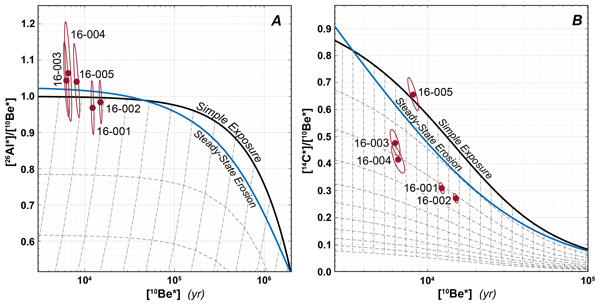
- Figure 3b: Are the vertical dashed lines (decay trajectories) also meant to represent exposure isochrons? If so, what is the spacing? Including fewer decay trajectories that correspond to interpretable exposure durations for a simple exposure/burial history would aid the reader in quickly interpreting the figure, although this may require restricting the x-axis limits.
Citation: https://doi.org/10.5194/egusphere-2026-447-RC2 - AC2: 'Reply on RC2', Arjen Stroeven, 16 May 2026
Peer review completion


Interactive discussion
Status: closed
-
RC1: 'Comment on egusphere-2026-447', Irene Schimmelpfennig, 23 Mar 2026
Dear editor and authors
This manuscript reports new cosmogenic multi-nuclide data from proglacial bedrock and sediment record data from a proglacial lake at a small ice cap in northern Sweden, used to reconstruct the local Holocene glacial history and to interpret the underlying paleoclimatic conditions. The study and data are very useful for the understanding of the Holocene glacier and climate evolution in Scandinavian high latitudes, especially due to the combination of different geochronological and geomorphic/paleoenvironmental approaches, which allow for a more complete scenario than the application of one of the approaches alone. The manuscript is very well written, structured and illustrated. I appreciated reading it and recommend its publication in Climate of the Past. I suggest a few minor issues be addressed though.
My main comments relate to the interpretation of the cosmogenic nuclide data:
Altogether, the fit between the modelled and measured nuclide concentrations and the overall consistency between the complementary records are remarkably good. However, several uncertainties seem to be underestimated or have been ignored, which could in some cases explain the observed slight misfit between modelled and measured nuclide concentrations (or in other cases worsen it). I therefore suggest to add them to the discussion.
First. One of the key pieces of information for the interpretation of the exposure-burial history of the ice cap is the timing of glacier retreat from Lake 1063 (calculated as 8.1±0.1 ka from the exposure ages of the three nuclides), but its uncertainty is likely underestimated and should be better discussed.
- Lines 322-323: I’m not convinced of using the weighted mean approach for this calculation, as it underestimates the uncertainty of the result. Is the weighted mean age calculated with the internal or external uncertainties of the ages from the three nuclides? Is a ~1% uncertainty of this age realistic given that the production rate uncertainties for the different nuclides are 7-11%? I don't think so.
- The effect of snow cover on the nuclide concentrations has completely been ignored. I guess that there is quite a lot of snow fall in that region. Although I’m not in favor of applying a default snow correction to the interpreted ages, a potential snow effect on this glacier retreat age should at least be acknowledged with an approximate idea of how much this could make it older.
Second. The muogenic contribution to total 14C production is still not well constrained, but it is substantially higher than for 10Be and 26Al. Therefore, 30 m of ice cover might not be sufficient to shield a surface completely from 14C production (Lines 62-63, 309). According to model results in other studies, 14C production is still ~4% of that at the surface at 30 m beneath the ice (Hippe, 2017, http://dx.doi.org/10.1016/j.quascirev.2017.07.020). The effect is probably still small in this setting, but the related uncertainty could be worth being mentioned in the discussion.
10Be and 26Al ages are indistinguishable within uncertainties for all five bedrock samples. This is stated in line 325, followed by disregard of the 26Al in the following interpretations (except that both 10Be and 26Al indicate inheritance, line 509). However, it would be interesting to explore and explain the implications of this apparent age consistency for the long-term history of the ice cap: in lines 409-410 it is stated that that the combined information from the 14C-10Be concentrations and the deglaciation age (~10 ka) can only be explained through pre-LGM exposure. But when did this pre-exposure occur at the earliest? It should be possible to infer this from the fact that 26Al has not yet notably decayed compared to 10Be.
I suggest to shorten and simplify the abstract, which is currently very long and contains a lot of details.
Minor suggestions per line:
- Line 44: I suggest rephrasing to clarifier that “as a result of…” refers to the first part of the sentence
- Lines 102 (and conclusions, line 595): I suggest removing “direct” in front of evidence, as complementary information is needed to interpret the nuclide concentrations and to use them as reliable constraints on the ice cap dimensions and exposure-burial durations.
- Line 234: add that these are spallation production rates
- Lines 239-243 and caption of figure 2: specify if the ages are shown with their internal or external uncertainties
- Lines 339-340: “hence corresponding units are in years” could be removed, as the information is already provided 4 lines above.
- Line 361: should “LOI record against age” be in quotation marks? Otherwise the wording is unclear.
- Lines 392-393: The relevance of the part “in relation to…Pajep Luoktejaure” seems unclear in this sentence. I would remove it from here and make a new sentence afterwards, e.g. “This is corroborated by the minerogenic input seen…” or “This is used to constrain the timing of minerogenic input…”, depending on what you want to say here.
- Line 401: the white dots would be better visible if they had another color.
I hope these comments are useful.
Best regards,
Irene Schimmelpfennig
Citation: https://doi.org/10.5194/egusphere-2026-447-RC1 - AC1: 'Reply on RC1', Arjen Stroeven, 16 May 2026
-
RC2: 'Comment on egusphere-2026-447', Anonymous Referee #2, 10 Apr 2026
Summary & General Impressions:
Stroven et al. use 14C, 26Al, and 10Be exposure dating in 5 bedrock samples and a proglacial lacustrine sediment record to reconstruct the Holocene behavior of the now small Riukojietna ice cap in northern Sweden. I thoroughly enjoyed reading this paper – it is well written and the figures are excellent. I was particularly impressed to see the ice thickness reconstructions and how they were employed in the forward modeling exercise to i) include nuclide production through thin ice and ii) implement a thickness threshold for subglacial erosion. Overall, I agree with their use of multiple dating approaches and the technical approach to the modeling exercise. However, I’m not yet convinced that the data support the preferred interpretation that this low-altitude ice cap survived the Holocene Thermal Maximum (albeit at times inactive) as the title and text imply. Given the data presented in the paper, I’m more convinced by the conservative interpretation (also stated in the text, although somewhat buried) that ice cap was smaller than today for most of the Holocene, which allows that the ice cap survived the HTM, but does not require it. Below, I describe a few additional considerations, exercises, and datasets that I felt were missing or incompletely described in the manuscript, as well as a short list of minor comments and technical corrections.
Specific comments:
1. Deglaciation age from lake outlet sample (16-005): This single triple-nuclide exposure age from near the LIA moraine is a key constraint in the inferred glacial history, so it would be helpful to have a little more information:
- Uncertainty: It’s reassuring that all three nuclides give consistent exposure ages, although the stated uncertainty of 0.1 ka is quite low. Given that these are three independent measurements, I wonder if performing standard error propagation is a more appropriate approach for evaluating the uncertainty than using the standard deviation. This would only increase the uncertainty slightly but may give a better estimation of the true error.
- Lines 187-189: What is the relationship of this sample to the LIA moraine? It is hard to tell from the map whether it was collected outboard of the moraine, but the photo in Figure 2d and Figure S4 suggest it was collected at or slightly inboard the moraine. If so, could the age slightly underestimate the true deglaciation age if there were a few hundred years of LIA ice cover (with or without erosion)? How much burial and/or erosion is allowed before the three nuclide concentrations are no longer concordant?
2. Lacustrine record & interpretation: The preferred interpretation that Riukojietna never disappeared completely during the Holocene hinges in large part on the interpretation that glaciogenic sediment entered Pajep Luoktejaure until ~5.0 ka (e.g., Lines 545-549). Given the importance of this interpretation, I suggest some additions to help convince the reader of this important claim:
- Section 3.2 (starting on Line 244): Several described datasets are not included in the paper that I suggest adding to the supplement. These include the core logs and LOI data from cores PL2 & PL4 (Line 251), which are stated to have overlapping stratigraphy with the long core, as well as the x-ray images and grain-size data described for PL1-169 and PL3-2 (Lines 254-259). I looked for and couldn’t find the x-ray images in the cited paper (Rosqvist et al., 2004), but did find relative density plots for different cores from Lake 1009 and Pajep Luoktejaure (Karlén, 1981, cited elsewhere in the paper) so perhaps this was mis-cited?
- Line 440-442: Did the authors consider other sediment sources from the catchment that could explain the diffuse laminations in the higher organic content section between 107 and 91 cm, such as episodic contributions from the slope above the lake, which I imagine would have been quite an active periglacial landscape upon retreat of the FIS?
3. Integration of records & role of forward modeling: It appears that the modeling exercise is used to validate the glacial history inferred from the lake record/single down valley exposure age. However, there are some inconsistencies between the measured 14C concentrations and those modelled with using this history and I would have liked to see an exploration of alternate exposure/burial histories that might better explain the measured 14C concentrations as well as the 10Be concentrations in samples -003 and -004. Doing so would fully realize the authors’ stated approach of “combining direct evidence for ice-free and ice-burial durations from cosmogenic nuclide chronometry… and indirect evidence of extent and glacial activity derived from proglacial lacustrine records” (Lines 102-104). I believe the following suggestions would be relatively easy to implement with the existing code.
- Calculate the exposure & burial durations implied by the simplest two stage model for -003 & -004 – at present, these are inferred from the two-nuclide diagram, but appear overstated for -003 & -004 as 4–5 kyr (Line 413; it looks closer to 2.5–5 kyr). I agree that -001 & -002 have clear inheritance and can’t yield an interpretable burial age.
- Evaluate the two-state history in light of the preferred history from Section 5.2 – Based on the apparent 10Be ages and where the data plot on the two-nuclide diagram, it appears the combined histories will be something like 8.5–11.5 ka. The high end of this is obviously too long given the regional deglaciation age of 9.8 ka and implies some 10Be inheritance as stated, but the lower end might be allowable.
- Consider deglaciation of the plateau/knob samples before 8.1 ka – I suspect that if you loosen the deglaciation age (see Specific Comment 1 about the lake outlet sample), you can more closely (or completely) match both the 14C and 10Be for samples -003 and -004 (with a little more LIA erosion) and hit the 14C for -001 and -002 (with very little or no LIA erosion). Finding such a history would make it harder to argue that the ice cap never disappeared completely, but this possibility should be explored. An easy way to do this would be to just iteratively play with the deglaciation age and sample-specific erosion rates. Alternatively, you could fit the deglaciation age & erosion rate for sample -003, then apply that exposure history to the other samples to see if you can match the measured concentrations with less erosion. If there are no histories that better match the measured nuclide concentrations, or if the histories and/or erosion rates are unrealistic, then the current preferred history, and inference that -003 and -004 have a small degree of 10Be inheritance, is probably most reasonable
Minor comments & technical corrections:
- Abstract: Although well written, the abstract is quite long and detailed. I suggest shortening it by removing the more specific details and instead summarizing the key results and findings from the lake sediments, bedrock samples, and the modeling exercise. For example, the description of the sediment record could be shortened to something like “We infer three periods of glaciogenic sediment deposition >9.8 ka, from 5.4–5.0 ka, and after 1.8 ka, with intervening gyttja that indicates minimal or no glacial influence.” Similarly, the cosmogenic-nuclide results could be shortened, for example: “Cosmogenic 14C, 26Al, and 10Be concentrations in a bedrock sample near the LIA moraine indicate continuous exposure since 8.1 ± 0.1 ka. Nuclide measurements in four bedrock samples from recently exposed bedrock indicate complex exposure/burial histories. We perform a forward modeling exercise to determine whether the cosmogenic-nuclide concentrations in the recently exposed bedrock samples are consistent with the glacial history inferred from the lake sediment record and the deglaciation age of 8.1 ka...”
- Line 20: Specify 5 bedrock samples.
- Line 318: State range for each nuclide individually.
- Lines 403-417: Consider moving the discussion of the complex histories to the modeling section (5.3) to improve flow.
- Lines 422-430: Is this paragraph necessary? It’s clear from the 10Be and 26Al inheritance in the plateau samples that the southeastern tongue is less erosive, but there’s not enough information here to evaluate the relative sediment contributions of each tongue to Pajep Luoktejaure throughout the entire Holocene. I might be missing something, but I’m not sure knowing the relative contributions would influence the interpretation of the lake sediments.
- Line 435: Restate that the age comes from the next lake down.
- Line 439: To avoid confusion with a glacier readvance, I suggest rewording “remained in a relatively advances position during the early Holocene” to something like, “had not yet retreated from the glacier catchment during the early Holocene.”
- Line 545: Should 4.8 ka be 5.0 ka?
- Figure 4c: It would be helpful to indicate on the figure how the timing of inferred glacial activity was determined since a range of methods were used (radiocarbon from this core, radiocarbon from the lake below, inferred from the age model, exposure dating). It would also be helpful to add lines that connect the stratigraphy/inferred glacial activity across the panels.
- Figure 3b: Are the vertical dashed lines (decay trajectories) also meant to represent exposure isochrons? If so, what is the spacing? Including fewer decay trajectories that correspond to interpretable exposure durations for a simple exposure/burial history would aid the reader in quickly interpreting the figure, although this may require restricting the x-axis limits.
Citation: https://doi.org/10.5194/egusphere-2026-447-RC2 - AC2: 'Reply on RC2', Arjen Stroeven, 16 May 2026
Peer review completion
Journal article(s) based on this preprint
Viewed
| HTML | XML | Total | Supplement | BibTeX | EndNote | |
|---|---|---|---|---|---|---|
| 859 | 445 | 109 | 1,413 | 163 | 82 | 139 |
- HTML: 859
- PDF: 445
- XML: 109
- Total: 1,413
- Supplement: 163
- BibTeX: 82
- EndNote: 139
Viewed (geographical distribution)
| Country | # | Views | % |
|---|
| Total: | 0 |
| HTML: | 0 |
| PDF: | 0 |
| XML: | 0 |
- 1
Arjen P. Stroeven

Gunhild C. Rosqvist
Allie J. Koester
Jane L. Andersen
Carl-Anton Wahlström
Nathaniel A. Lifton
The requested preprint has a corresponding peer-reviewed final revised paper. You are encouraged to refer to the final revised version.
- Preprint
(6328 KB) - Metadata XML
-
Supplement
(6186 KB) - BibTeX
- EndNote
- Final revised paper
Dear editor and authors
This manuscript reports new cosmogenic multi-nuclide data from proglacial bedrock and sediment record data from a proglacial lake at a small ice cap in northern Sweden, used to reconstruct the local Holocene glacial history and to interpret the underlying paleoclimatic conditions. The study and data are very useful for the understanding of the Holocene glacier and climate evolution in Scandinavian high latitudes, especially due to the combination of different geochronological and geomorphic/paleoenvironmental approaches, which allow for a more complete scenario than the application of one of the approaches alone. The manuscript is very well written, structured and illustrated. I appreciated reading it and recommend its publication in Climate of the Past. I suggest a few minor issues be addressed though.
My main comments relate to the interpretation of the cosmogenic nuclide data:
Altogether, the fit between the modelled and measured nuclide concentrations and the overall consistency between the complementary records are remarkably good. However, several uncertainties seem to be underestimated or have been ignored, which could in some cases explain the observed slight misfit between modelled and measured nuclide concentrations (or in other cases worsen it). I therefore suggest to add them to the discussion.
First. One of the key pieces of information for the interpretation of the exposure-burial history of the ice cap is the timing of glacier retreat from Lake 1063 (calculated as 8.1±0.1 ka from the exposure ages of the three nuclides), but its uncertainty is likely underestimated and should be better discussed.
Second. The muogenic contribution to total 14C production is still not well constrained, but it is substantially higher than for 10Be and 26Al. Therefore, 30 m of ice cover might not be sufficient to shield a surface completely from 14C production (Lines 62-63, 309). According to model results in other studies, 14C production is still ~4% of that at the surface at 30 m beneath the ice (Hippe, 2017, http://dx.doi.org/10.1016/j.quascirev.2017.07.020). The effect is probably still small in this setting, but the related uncertainty could be worth being mentioned in the discussion.
10Be and 26Al ages are indistinguishable within uncertainties for all five bedrock samples. This is stated in line 325, followed by disregard of the 26Al in the following interpretations (except that both 10Be and 26Al indicate inheritance, line 509). However, it would be interesting to explore and explain the implications of this apparent age consistency for the long-term history of the ice cap: in lines 409-410 it is stated that that the combined information from the 14C-10Be concentrations and the deglaciation age (~10 ka) can only be explained through pre-LGM exposure. But when did this pre-exposure occur at the earliest? It should be possible to infer this from the fact that 26Al has not yet notably decayed compared to 10Be.
I suggest to shorten and simplify the abstract, which is currently very long and contains a lot of details.
Minor suggestions per line:
I hope these comments are useful.
Best regards,
Irene Schimmelpfennig