
the Creative Commons Attribution 4.0 License.
the Creative Commons Attribution 4.0 License.
 | 19 Feb 2026
Post launch spectral and radiometric performances of MAJIS, the VIS-NIR imaging spectrometer of JUICE
Abstract. The post-launch spectral and radiometric performances of MAJIS, the VISNIR imaging spectrometer of the ESA Jupiter Icy Moon Explorer (JUICE), have been evaluated using observations performed during the Lunar-Earth Gravitational Assist (LEGA) of August 19–20 2024 and observations of the Internal Calibration Unit (ICU). Observations of the Earth provided a comprehensive check of the spectral performances taking advantage of narrow atmospheric absorption bands over the full wavelength range of MAJIS (0.5 – 5.56 µm). This was of particular interest for wavelengths larger than 3.5 µm due to limitations of the ground calibration setup in this wavelength range. The radiometric performance of MAJIS has been reassessed considering the updated spectral calibration and the comparison of ICU observations before and after launch. On this basis, the observations of the Earth and Moon by MAJIS were compared to that of other instruments. The very good agreement with atmospheric spectral features observed by Earth observation instruments validate the updated spectral calibration of MAJIS. Comparing radiances for the Earth is not straightforward due to the very specific photometric angles for MAJIS observations (phase ~ 90°, “glint spot”) and the high time variability of cloud patterns. A good agreement has been obtained within these limitations and the MAJIS radiance evaluations for the Moon are also consistent with that obtained by instruments on lunar orbiters, which indicates that the post-launch absolute radiometric calibration of MAJIS is close to the mark. These comparisons benefited from the high quality of the MAJIS data obtained during the LEGA with a very high operability and a SNR up to 400 (more with stacking). Extrapolating the operating conditions at 1 AU to those at 5 AU confirm that MAJIS will obtain high quality data during the science operations phase around Jupiter.
-
Notice on discussion status
The requested preprint has a corresponding peer-reviewed final revised paper. You are encouraged to refer to the final revised version.
-
Preprint
(2476 KB)
-
The requested preprint has a corresponding peer-reviewed final revised paper. You are encouraged to refer to the final revised version.
- Preprint
(2476 KB) - Metadata XML
- BibTeX
- EndNote
- Final revised paper


Journal article(s) based on this preprint
Interactive discussion
Status: closed
-
RC1: 'Comment on egusphere-2026-410', Benjamin Bultel, 13 May 2026
-
AC1: 'Reply on RC1', Yves Langevin, 18 May 2026
Here are our replies to each specific comments. If more details are needed, let us know (a warning in red indicates that one cannot put in a revised version a as supplement, and it will in any case have to wait for the comments of a second referee due May 25th).
My main recommendation would be to add a table to summarise all the artefacts and corrections, the ranges of wavelength it is affecting, their origin, and the correction applied.
The recommended table on artefacts and mitigation will be added (it is mainly based on Langevin et al., 2024, but this information is indeed also of interest for the post-launch adjustment of the spectral and radiometric calibration
- Line 73: Stacking always makes the signal better. Maybe this precision is not needed here.
- Comment accepted, new formulation : “(up to 450 for single spectra)”
- Lines 107 and 113: the shift it 5.4nm but the correction is 5.2nm, why? Is it a typo?
- Typo indeed.2 nm replaced by 5.4 nm (the value from Haffoud et al. 2024)
- Lines 156-159: Any threshold values for when it occurs? How much is the underestimation? It seems a lot since it is a log scale.
- For very deep absorption bands (e.g. H2O 1.9 µm), the underestimation is indeed by a factor of 10. However, section 2.1 addresses the post-launch evolution of the spectral calibration, which relies on the location of spectral features for which the 4A/OP model results are reliable), not on their strengths. New formulation of this paragraph:
The radiative transfer simulations are in good overall agreement with the MAJIS observations. However, the 4A/OP synthetic spectra underestimate the radiance by factors of up to 10 within strong water absorption bands (e.g. at 1.9 µm). This can result from an issue with the selected BRDF or from contamination by aerosols, which has not been considered. There is no impact on the post-launch spectral calibration which is the focus of this section as a wider BRDF or a contamination by aerosols results in a larger radiance in nearly saturated absorption bands without changing their wavelength.
- Line 189: what are the size of these windows and what size where tested?
- New formulation :
« The same calculations have been performed with 5 sliding windows widths (40, 50, 60, 70, 80 spectels) for assessing the robustness of the spectral residuals »
- Figure 3: Depth of absorptions at 1.1 and 1.4 is underestimated. It is not really discussed is such term in the MS. Around 2.3, the “noise” is about PRISMA or MAJIS? It was not clear to me in the text.
- Our view is that it is the radiances from the 4A/OP model which are underestimated, most likely due to a dust scattering contribution not considered in the model, not the depth of absorption which is underestimated by MAJIS. This is confirmed by the relatively good agreement on 1.4 µm and 1.9 µm band depths with MAJIS and with PRISMA as both instruments are similarly impacted by a contribution by dust scattering. The comparison with PRISMA is definitely relevant for the post-launch spectral calibration of MAJIS (section 2). However, as discussed in section 4.2.6, no good match with PRISMA in time and location was identified, which made it difficult to use the comparison of absolute radiances and absorption feature strengths from PRISMA and MAJIS for updating the radiometric calibration.
- “noise”: As shown in Figure 3, The SNR is higher for MAJIS than for PRISMA in deep absorption bands. New formulation:
« for wavelengths larger than 1.6 µm the PRISMA data becomes noisy for deep absorption bands”.
- Figures A1 and A2 are very small and difficult to read.
- These two figures have been reduced to 15 panels (3 lines of 5) instead of 26 panels (3 lines of 7 + 1 line of 5), increasing by 40% the width and by 33% the height of each panel for the same figure size so as to make them more easy to read. They are complementary to Fig. 5 in the text which provides full details for all 4 tested wavelength ranges at one position. The main purpose of including these two figures as an appendix is to show that reliable results have been obtained at all positions along the slit, so that further reduction of the number of panels is not recommended.
- Table 2: this table is very useful. Doing the same for all other instruments would make things easier for readers.
- Lines 1066-1068: why TROPOMI is mentioned here? It is not clear.
- The mention of TROPOMI is made here in the context of the cross-calibration of the IR channel (2.28 µm to 5.54 µm), with IASI providing the most comprehensive overlap (from 3.7 to 5.54 µm) while TROPOMI provides data at 2.32 and 2.36 µm, close to the short wavelength end of the MAJIS IR channel range. A new formulation is proposed to make the complementarity clearer in this context:
IASI is an instrument on-board the METOP satellites of Eumetsat. The spectral range of IASI (3.7 µm to 15.5 µm) overlaps more than half of the spectral range of the IR channel of MAJIS (2.28 to 5.57 µm). As indicated in section 4.2.4, comparisons with TROPOMI provided complementary cross-calibration information for the lowest wavelengths of the IR channel, which are not covered by IASI.
- Figure 21: add a legend on the figure
- The figure has been modified adding a label for each curve with the same color.
Citation: https://doi.org/10.5194/egusphere-2026-410-AC1 - Line 73: Stacking always makes the signal better. Maybe this precision is not needed here.
-
AC1: 'Reply on RC1', Yves Langevin, 18 May 2026
-
RC2: 'Comment on egusphere-2026-410', Jason W. Barnes, 09 Jul 2026
Editor:I have completed my review of EGU manuscript egusphere-2026-410, entitled "Postlaunch spectral and radiometric performances of MAJIS, the VIS-NIR imagingspectrometer of JUICE" by Yves Langevin and coauthors. The manuscript usesspacecraft observations of the Earth and Moon to refine the spectroscopic andradiometric calibration parameters for the MAJIS instrument. The work is novel,significant in its implications for future JUICE science, and without evidenterrors. I recommend that this manuscript be published in its currentform, and leave comments for the authors below.* The use of radiative transfer models to secure the wavelength calibrationworked better than I expected. That it did so well speaks to the value of usingEarth as a calibration target since it is so exquisitely well-known (compared toplanetary targets anyway).* The word "convolute" and "convoluted" should probably ought to be "convolve"and "convolved".- Jason W. BarnesProfessor of PhysicsUniversity of IdahoCitation: https://doi.org/
10.5194/egusphere-2026-410-RC2 -
AC2: 'Reply on RC2', Yves Langevin, 09 Jul 2026
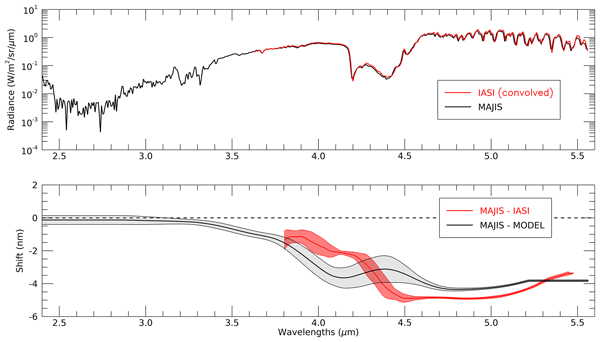
We fully concur with the first comment: the MAJIS spectral calibration definitely benefited from the comparison of MAJIS earth spectra to that obtained by Earth observation instruments. In particular, this made it possible to reliably monitor the small spectral shifts observed after launch and to confirm that the expected spectral resolution (FWHM) had been achieved by MAJIS. The very good match between radiances observed by MAJIS and IASI from 3.4 to 5.54 µm significantly exceeded our expectations and was very positively received by the Earth atmosphere community.
The second recommendation ("convolved" instead of "convoluted" has already been implemented.
Citation: https://doi.org/10.5194/egusphere-2026-410-AC2
-
AC2: 'Reply on RC2', Yves Langevin, 09 Jul 2026
Peer review completion


Interactive discussion
Status: closed
-
RC1: 'Comment on egusphere-2026-410', Benjamin Bultel, 13 May 2026
The manuscript (MS) « Post launch spectral and radiometric performances of MAJIS, the VIS-NIR imaging spectrometer of Juice» by Yves Langevin and collaborators reports on the MAJIS performance during the Lunar-Earth Gravitational Assist of August 19-20/2024. The quality of the data and the methodological thoroughness are impressive. MAJIS’s performance (e.g., SNR > 400) well meet its expectations and will undoubtedly enable groundbreaking discoveries about the Jovian moons’ surfaces. I have a few minor comments/suggestions detailed below. My main recommendation would be to add a table to summarise all the artefacts and corrections, the ranges of wavelength it is affecting, their origin, and the correction applied. Overall, the MS is of high quality, and I support its publication. I was impressed by the work done, the performance of MAJIS and the mastery of the team’s on MAJIS behaviour.
- Line 73: Stacking always makes the signal better. Maybe this precision is not needed here.
- Lines 107 and 113: the shift it 5.4nm but the correction is 5.2nm, why? Is it a typo?
- Lines 156-159: Any threshold values for when it occurs? How much is the underestimation? It seems a lot since it is a log scale.
- Line 189: what are the size of these windows and what size where tested?
- Figure 3: Depth of absorptions at 1.1 and 1.4 is underestimated. It is not really discussed is such term in the MS. Around 2.3, the “noise” is about PRISMA or MAJIS? It was not clear to me in the text.
- Figures A1 and A2 are very small and difficult to read.
- Table 2: this table is very useful. Doing the same for all other instruments would make things easier for readers.
- Lines 1066-1068: why TROPOMI is mentioned here? It is not clear.
- Figure 21: add a legend on the figure
This manuscript is of high quality and deserves publication in its current form, with the minor revisions suggested above. The work is technically sound, the data are robust, and the implications for the JUICE mission are profound.
I was particularly impressed by the rigor of the cross-instrument validation, the transparency in discussing limitations and the proactive approach to updating calibration pipelines for future data.
Benjamin Bultel
Citation: https://doi.org/10.5194/egusphere-2026-410-RC1 -
AC1: 'Reply on RC1', Yves Langevin, 18 May 2026
Here are our replies to each specific comments. If more details are needed, let us know (a warning in red indicates that one cannot put in a revised version a as supplement, and it will in any case have to wait for the comments of a second referee due May 25th).
My main recommendation would be to add a table to summarise all the artefacts and corrections, the ranges of wavelength it is affecting, their origin, and the correction applied.
The recommended table on artefacts and mitigation will be added (it is mainly based on Langevin et al., 2024, but this information is indeed also of interest for the post-launch adjustment of the spectral and radiometric calibration
- Line 73: Stacking always makes the signal better. Maybe this precision is not needed here.
- Comment accepted, new formulation : “(up to 450 for single spectra)”
- Lines 107 and 113: the shift it 5.4nm but the correction is 5.2nm, why? Is it a typo?
- Typo indeed.2 nm replaced by 5.4 nm (the value from Haffoud et al. 2024)
- Lines 156-159: Any threshold values for when it occurs? How much is the underestimation? It seems a lot since it is a log scale.
- For very deep absorption bands (e.g. H2O 1.9 µm), the underestimation is indeed by a factor of 10. However, section 2.1 addresses the post-launch evolution of the spectral calibration, which relies on the location of spectral features for which the 4A/OP model results are reliable), not on their strengths. New formulation of this paragraph:
The radiative transfer simulations are in good overall agreement with the MAJIS observations. However, the 4A/OP synthetic spectra underestimate the radiance by factors of up to 10 within strong water absorption bands (e.g. at 1.9 µm). This can result from an issue with the selected BRDF or from contamination by aerosols, which has not been considered. There is no impact on the post-launch spectral calibration which is the focus of this section as a wider BRDF or a contamination by aerosols results in a larger radiance in nearly saturated absorption bands without changing their wavelength.
- Line 189: what are the size of these windows and what size where tested?
- New formulation :
« The same calculations have been performed with 5 sliding windows widths (40, 50, 60, 70, 80 spectels) for assessing the robustness of the spectral residuals »
- Figure 3: Depth of absorptions at 1.1 and 1.4 is underestimated. It is not really discussed is such term in the MS. Around 2.3, the “noise” is about PRISMA or MAJIS? It was not clear to me in the text.
- Our view is that it is the radiances from the 4A/OP model which are underestimated, most likely due to a dust scattering contribution not considered in the model, not the depth of absorption which is underestimated by MAJIS. This is confirmed by the relatively good agreement on 1.4 µm and 1.9 µm band depths with MAJIS and with PRISMA as both instruments are similarly impacted by a contribution by dust scattering. The comparison with PRISMA is definitely relevant for the post-launch spectral calibration of MAJIS (section 2). However, as discussed in section 4.2.6, no good match with PRISMA in time and location was identified, which made it difficult to use the comparison of absolute radiances and absorption feature strengths from PRISMA and MAJIS for updating the radiometric calibration.
- “noise”: As shown in Figure 3, The SNR is higher for MAJIS than for PRISMA in deep absorption bands. New formulation:
« for wavelengths larger than 1.6 µm the PRISMA data becomes noisy for deep absorption bands”.
- Figures A1 and A2 are very small and difficult to read.
- These two figures have been reduced to 15 panels (3 lines of 5) instead of 26 panels (3 lines of 7 + 1 line of 5), increasing by 40% the width and by 33% the height of each panel for the same figure size so as to make them more easy to read. They are complementary to Fig. 5 in the text which provides full details for all 4 tested wavelength ranges at one position. The main purpose of including these two figures as an appendix is to show that reliable results have been obtained at all positions along the slit, so that further reduction of the number of panels is not recommended.
- Table 2: this table is very useful. Doing the same for all other instruments would make things easier for readers.
- Lines 1066-1068: why TROPOMI is mentioned here? It is not clear.
- The mention of TROPOMI is made here in the context of the cross-calibration of the IR channel (2.28 µm to 5.54 µm), with IASI providing the most comprehensive overlap (from 3.7 to 5.54 µm) while TROPOMI provides data at 2.32 and 2.36 µm, close to the short wavelength end of the MAJIS IR channel range. A new formulation is proposed to make the complementarity clearer in this context:
IASI is an instrument on-board the METOP satellites of Eumetsat. The spectral range of IASI (3.7 µm to 15.5 µm) overlaps more than half of the spectral range of the IR channel of MAJIS (2.28 to 5.57 µm). As indicated in section 4.2.4, comparisons with TROPOMI provided complementary cross-calibration information for the lowest wavelengths of the IR channel, which are not covered by IASI.
- Figure 21: add a legend on the figure
- The figure has been modified adding a label for each curve with the same color.
Citation: https://doi.org/10.5194/egusphere-2026-410-AC1 - Line 73: Stacking always makes the signal better. Maybe this precision is not needed here.
-
RC2: 'Comment on egusphere-2026-410', Jason W. Barnes, 09 Jul 2026
Editor:I have completed my review of EGU manuscript egusphere-2026-410, entitled "Postlaunch spectral and radiometric performances of MAJIS, the VIS-NIR imagingspectrometer of JUICE" by Yves Langevin and coauthors. The manuscript usesspacecraft observations of the Earth and Moon to refine the spectroscopic andradiometric calibration parameters for the MAJIS instrument. The work is novel,significant in its implications for future JUICE science, and without evidenterrors. I recommend that this manuscript be published in its currentform, and leave comments for the authors below.* The use of radiative transfer models to secure the wavelength calibrationworked better than I expected. That it did so well speaks to the value of usingEarth as a calibration target since it is so exquisitely well-known (compared toplanetary targets anyway).* The word "convolute" and "convoluted" should probably ought to be "convolve"and "convolved".- Jason W. BarnesProfessor of PhysicsUniversity of IdahoCitation: https://doi.org/
10.5194/egusphere-2026-410-RC2 -
AC2: 'Reply on RC2', Yves Langevin, 09 Jul 2026
We fully concur with the first comment: the MAJIS spectral calibration definitely benefited from the comparison of MAJIS earth spectra to that obtained by Earth observation instruments. In particular, this made it possible to reliably monitor the small spectral shifts observed after launch and to confirm that the expected spectral resolution (FWHM) had been achieved by MAJIS. The very good match between radiances observed by MAJIS and IASI from 3.4 to 5.54 µm significantly exceeded our expectations and was very positively received by the Earth atmosphere community.
The second recommendation ("convolved" instead of "convoluted" has already been implemented.
Citation: https://doi.org/10.5194/egusphere-2026-410-AC2
-
AC2: 'Reply on RC2', Yves Langevin, 09 Jul 2026
Peer review completion
Journal article(s) based on this preprint
Viewed
| HTML | XML | Total | BibTeX | EndNote | |
|---|---|---|---|---|---|
| 863 | 451 | 86 | 1,400 | 130 | 140 |
- HTML: 863
- PDF: 451
- XML: 86
- Total: 1,400
- BibTeX: 130
- EndNote: 140
Viewed (geographical distribution)
| Country | # | Views | % |
|---|
| Total: | 0 |
| HTML: | 0 |
| PDF: | 0 |
| XML: | 0 |
- 1
Cited


3 citations as recorded by crossref.
- ESA/JUICE encounters Earth/Moon in 2024: overview of the Moons And Jupiter Imaging Spectrometer (MAJIS) observations F. Poulet et al. https://doi.org/10.5194/angeo-44-163-2026
- JUICE-MAJIS Earth observations during the 2024 gravity assist: first analysis and comparison with PRISMA data F. Oliva et al. https://doi.org/10.5194/angeo-44-511-2026
- The JUICE 2024 close flyby of the Moon: thermal assessment from MAJIS F. Tosi et al. https://doi.org/10.5194/angeo-44-547-2026
Yves Langevin

Sébastien Rodriguez
Sandrine Guerlet
François Poulet
Giuseppe Piccioni
Livio Agostini
Raymond Armante
Emiliano D’Aversa
Gianrico Filacchione
Leigh Fletcher
Fabrizio Oliva
Clément Royer
Benoit Seignovert
Katrin Stephan
Federico Tosi
Tim Trent
The requested preprint has a corresponding peer-reviewed final revised paper. You are encouraged to refer to the final revised version.
- Preprint
(2476 KB) - Metadata XML
The manuscript (MS) « Post launch spectral and radiometric performances of MAJIS, the VIS-NIR imaging spectrometer of Juice» by Yves Langevin and collaborators reports on the MAJIS performance during the Lunar-Earth Gravitational Assist of August 19-20/2024. The quality of the data and the methodological thoroughness are impressive. MAJIS’s performance (e.g., SNR > 400) well meet its expectations and will undoubtedly enable groundbreaking discoveries about the Jovian moons’ surfaces. I have a few minor comments/suggestions detailed below. My main recommendation would be to add a table to summarise all the artefacts and corrections, the ranges of wavelength it is affecting, their origin, and the correction applied. Overall, the MS is of high quality, and I support its publication. I was impressed by the work done, the performance of MAJIS and the mastery of the team’s on MAJIS behaviour.
This manuscript is of high quality and deserves publication in its current form, with the minor revisions suggested above. The work is technically sound, the data are robust, and the implications for the JUICE mission are profound.
I was particularly impressed by the rigor of the cross-instrument validation, the transparency in discussing limitations and the proactive approach to updating calibration pipelines for future data.
Benjamin Bultel