
the Creative Commons Attribution 4.0 License.
the Creative Commons Attribution 4.0 License.
 | 20 Feb 2026
Meteorological Drivers of Extreme Swells on the Peruvian Coast
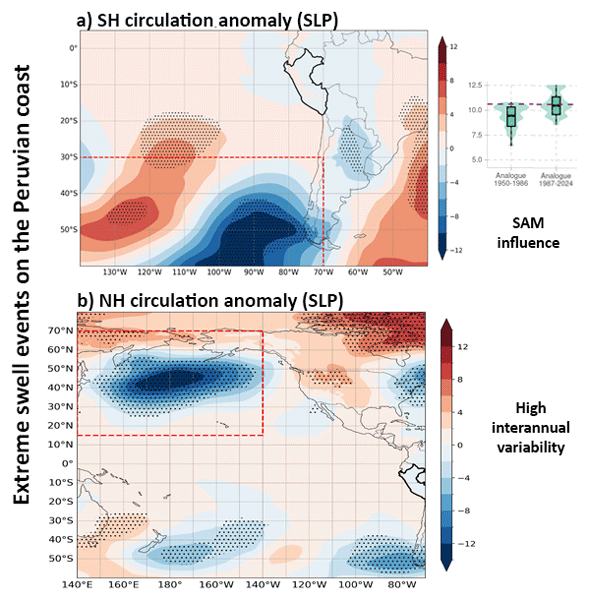
Abstract. In this study, we analyze the meteorological configurations leading to extreme ocean swells along the Peruvian coast, which are frequently produced by remote Pacific storms from both hemispheres. Using extreme-swell warnings from the Peruvian Navy and ERA5 reanalysis, we examine five austral-winter Southern Hemisphere (SH) events (very strong, south-westerly) and six boreal-winter Northern Hemisphere (NH) events (strong, north-westerly). Event-centred composites are computed over lead windows guided by estimated swell travel times (3–4 days in the SH; 8–11 days in the NH). In both hemispheres, a deep extratropical cyclone becomes vertically aligned from sea-level pressure through 500 hPa to 250 hPa before coastal peak swell, while an upper-level jet core strengthens and organizes a persistent corridor of enhanced surface westerlies over the swell-generation region. In the SH, coherent surrounding ridging tightens the meridional pressure gradient and co-occurs with a strengthened, sharper polar-front jet. In the NH, preconditioning is dominated by a deep central–western North Pacific low with comparatively weak, localized ridging and a markedly intensified, more zonally extended subtropical jet, while the polar-front jet weakens. A flow-analogue framework suggests a recent strengthening of SH event-related surface winds consistent with increased large-scale pressure contrasts and a shift toward more positive Southern Annular Mode conditions, whereas NH events show no robust trend and attribution is obscured by strong interannual-to-decadal variability. These results can support earlier recognition of remote swell hazards affecting Peru and, consequently, can lead to an improvement of early warning systems.
-
Notice on discussion status
The requested preprint has a corresponding peer-reviewed final revised paper. You are encouraged to refer to the final revised version.
-
Preprint
(1648 KB)
-
Supplement
(1045 KB)
-
The requested preprint has a corresponding peer-reviewed final revised paper. You are encouraged to refer to the final revised version.
- Preprint
(1648 KB) - Metadata XML
-
Supplement
(1045 KB) - BibTeX
- EndNote
- Final revised paper


Journal article(s) based on this preprint
Interactive discussion
Status: closed
-
CC1: 'Comment on egusphere-2026-408', Momme Hell, 24 Feb 2026
-
CC2: 'Reply on CC1', Soledad Maribel Collazo Inglesini, 24 Feb 2026
Thank you for pointing this out. Upon careful inspection, we confirm that the co-authors in the Hell et al. (2021) citation were indeed listed incorrectly, while the title, journal, and DOI were correct. We apologize for this oversight, which occurred during the reformatting of references to comply with the journal's style requirements.
We have thoroughly reviewed all references in the manuscript. The corrected citation reads:
Hell, M. C., Ayet, A., & Chapron, B. Swell generation under extra-tropical storms. Journal of Geophysical Research: Oceans, 126, e2021JC017637. https://doi.org/10.1029/2021JC017637, 2021
During this verification process, we also identified and corrected an error in the citation of Semedo et al. (2011). All remaining references have been thoroughly checked and confirmed to be accurate.
Citation: https://doi.org/10.5194/egusphere-2026-408-CC2
-
CC2: 'Reply on CC1', Soledad Maribel Collazo Inglesini, 24 Feb 2026
-
RC1: 'Comment on egusphere-2026-408', Anonymous Referee #1, 19 Apr 2026
This study uses extreme swell warnings issued by the Peruvian Navy and ERA5 reanalysis data to analyze the atmospheric circulation precursors of extreme swell events in the Southern Hemisphere (5 events) and Northern Hemisphere (6 events). It reveals the hemispherically differentiated configuration of the polar-front jet and the subtropical jet, and employs a flow-analogue approach to assess the impact of climate change on event intensity. The research topic has clear practical value, the methodology is relatively advanced, and the results are directly relevant to swell early warning along the Peruvian coast. The overall scientific quality is good; however, there are several methodological limitations and deficiencies in result interpretation. It is recommended that the manuscript be revised before acceptance. The specific suggestions are as follows:
1. Only five SH events and six NH events are included, spanning 17 years. The conclusions may be affected by interdecadal bias, raising doubts about their generalizability. It is recommended to extend the event selection period back to beyond 1980 (using earlier wave reanalysis or historical documentary records) to increase the number of events.
2. The study uses a fixed great-circle distance and a constant wave period (16–20 s), without considering nonlinear dissipation, refraction, diffraction, or background currents (e.g., equatorial currents) during wave propagation. The 8‑ to 11‑day composite window for NH events may incorporate substantial unrelated meteorological noise. It is recommended to use at least one wave hindcast model (e.g., WAVEWATCH III) to simulate one or two representative events (one from each hemisphere), validating the wave height, period, and travel time from the generation region to the Peruvian coast. If such modelling is not feasible, a sensitivity analysis should be added: recompute the travel-time window using different wave periods (14–22 s) and great-circle distances (±10%), and assess the sensitivity of the composite fields to window shifts.
3. For NH events, wind speeds weaken in E6–E8 but strengthen in E9–E11. Although modes such as PDO, ENSO, PNA, AO, and WP are listed, their influences are inconsistent across events, and no unified physical explanation or statistical model is provided. It is recommended to divide the NH events into two groups (E6–E8 vs. E9–E11) and perform separate composite and flow-analogue analyses for each group, comparing the phase distributions of modes such as PDO and ENSO between the two groups. In addition, multiple linear regression or random forest methods should be used to quantify the relative contributions of each climate mode to the 10‑m wind speed anomalies and to identify the dominant factors.
4. The flow-analogue method uses only SLP, Z500, and Z250, without including boundary conditions such as sea surface temperature (SST) or sea ice. This may mistakenly classify weather patterns that are dynamically similar but thermodynamically different as the same type, thereby introducing spurious climate change signals. It is recommended to add the SST field (e.g., monthly SST anomalies) as a fourth variable in the analogue similarity calculation, or at least to perform a sensitivity test: keep the existing three variables unchanged, but use the SST anomalies corresponding to the analogue dates as a posteriori diagnostic variable to test whether SST differs significantly between the earlier and later periods.
5. The study uses only the significant height of wind waves (SHWW) in the generation region as an indicator of swell generation, without providing measured wave height, period, or energy spectral data at the Peruvian coast. The causal chain between the source region and coastal impacts is therefore incomplete. It is recommended to use measured wave data from at least one coastal site in Peru (e.g., Callao, Miraflores, or Paita), which may come from wave buoys, tide gauge inversion, or ERA5 nearshore points, and to produce time-series plots for one or two typical events (e.g., E1 and E9) showing the evolution from SHWW anomalies in the source region to nearshore wave heights, thereby directly illustrating the wave evolution during propagation. If measured data are unavailable, significant wave height time series should be extracted from ERA5 nearshore points (within 50 km of the coast) and subjected to lagged correlation analysis with the SHWW anomalies in the generation region (with the lag time set to the estimated travel time) to quantitatively verify the causal relationship.
Citation: https://doi.org/10.5194/egusphere-2026-408-RC1 - AC1: 'Reply on RC1', Soledad Maribel Collazo Inglesini, 02 Jun 2026
-
RC2: 'Comment on egusphere-2026-408', Anonymous Referee #2, 08 May 2026
Summary:
This manuscript examines a set of extreme swell events along the coast of Peru and connects them to jet characteristics in both the Southern and Northern Hemisphere. The recorded extreme swells coincide with strong wind events in either hemisphere. The circulation patterns are then related to a larger sample of events using an analogue approach with an accounting for the long-term changes in wind speed between the mid 20th century and the more recent period. The connections between the remote drivers of extreme swell events is important for planning purposes and the current work is a nice addition to this understanding with some examination of the historical changes in these drivers that could inform potential future projections of extreme swell events. I have some broad suggestions related to the
Main comments:
There is a relatively small sample size of these events presented and presumably available from the Peruvian Navy records. Especially in the case of the Northern Hemisphere generated events, this introduces a very large degree of uncertainty in the types of events and the background conditions. There is discussion related to the PDO and IPO, but all the events are during 2010 or later, and thus are likely not sampling a representative range of the full variability associated with these modes or their trajectories. It’s not clear to me that the Southern Hemisphere analogue, where a climate change signal is detected, is representative of the swell events in general. Additional discussion related to these limitations could be added to the analogue analysis and discussion.
The authors do account for this somewhat with the flow analogues, but the primary novelty of the manuscript is the connection between extratropical cyclones or large-scale circulation patterns and the swells from this specific dataset. It would be ideal to make more of a connection between the analogues and the swell data where and if possible.
While the statistical tests suggest significance, the box plots for extreme events in Figure 2 and 5 are still within the spreads of the climatological boxplots in all cases. It is not clear that there is a distinction being made between the two groups and it does not necessarily highlight any of the jet metrics being examined. These figures require revisiting or expanded discussion to make their point. The authors could consider removing these figures because the primary conclusions would not be impacted.
Specific comments:
Table 1: The classifications for the Southern Hemisphere events are all “Very Strong” versus only “Strong” in the Northern Hemisphere. Can you provide more information on the definition of “extreme” and “strong” swells? Please make clear the distinction between the classifications taken from the Peruvian Navy records and those in the Northern Hemisphere.
Line 71-72: It wasn’t initially clear that the swells were generated in the Northern Hemisphere and registered along the Peruvian coast. Please make this clearer.
Equation 1: Nitpicking but could you make the g in Gg a subscript to make clearer it is group velocity not another gravitational constant.
Line 96-97: Were there any considerations for modifying the approach for characterizing jet stream characteristics when applying it to the Northern Hemisphere, since Collazo et al. (2024) was only focused on this Southern Hemisphere region near South America.
Line 196: Are you accounting for different numbers of samples in the MW and KS statistical tests? Qualitatively the extreme distribution doesn’t look like a distinct distribution from the climatology, though the tests suggest they are and I’m concerned that is due to sampling.
Line 205: How similar are the SLP patterns for the other events? The SLP patterns in Fig. 3 look quite different from those in Fig. 1, so I’m wondering how representative they are of the other events.
Line 216: Perhaps checking an Amundsen Sea Low index in addition to the SAM would be more targeted based on the composite patterns. It might not give substantially different interpretations, being highly correlated with the SAM, but might provide a more nuanced regional signal or predictive power.
Line 223: It would be good to introduce the counterfactual approach here in the text before discussing the results, rather than only in the figure caption.
Line 224-225: In addition to changes in the SAM, studies have shown strengthening of the Southern Hemisphere over the satellite period that are expected to continue in the future in response to anthropogenic forcing (Priestley and Catto, 2022).
Line 226: The timing of the SAM changes and their relationship with the stated external forcings is somewhat difficult to gauge given the time period available in this study. But an additional factor that might be interesting in this case is the rapid decline of sea ice cover beginning around 2016. Perhaps this exposed more ocean surface and increased fetch in the region.
Line 282: The 10m wind anomalies for the Northern Hemisphere composites occur behind the SHWW anomalies, but in the Southern Hemisphere it the opposite. Why causes this difference?
Lines 354-355: Looks like maybe the sentence got cut off around “intensifies”
References:
Priestley, M. D. K., and J. L. Catto. Future changes in the extratropical storm tracks and cyclone intensity, wind speed, and structure, Weather Clim. Dynam., 3, 337–360. 2022.
Citation: https://doi.org/10.5194/egusphere-2026-408-RC2 - AC2: 'Reply on RC2', Soledad Maribel Collazo Inglesini, 02 Jun 2026
Peer review completion


Interactive discussion
Status: closed
-
CC1: 'Comment on egusphere-2026-408', Momme Hell, 24 Feb 2026
At least one citation in the bibliography is incorrect (Hell et al., 2021) and lists the wrong co-authors.
This suggests the use of an LLM for citation generation.Citation: https://doi.org/10.5194/egusphere-2026-408-CC1 -
CC2: 'Reply on CC1', Soledad Maribel Collazo Inglesini, 24 Feb 2026
Thank you for pointing this out. Upon careful inspection, we confirm that the co-authors in the Hell et al. (2021) citation were indeed listed incorrectly, while the title, journal, and DOI were correct. We apologize for this oversight, which occurred during the reformatting of references to comply with the journal's style requirements.
We have thoroughly reviewed all references in the manuscript. The corrected citation reads:
Hell, M. C., Ayet, A., & Chapron, B. Swell generation under extra-tropical storms. Journal of Geophysical Research: Oceans, 126, e2021JC017637. https://doi.org/10.1029/2021JC017637, 2021
During this verification process, we also identified and corrected an error in the citation of Semedo et al. (2011). All remaining references have been thoroughly checked and confirmed to be accurate.
Citation: https://doi.org/10.5194/egusphere-2026-408-CC2
-
CC2: 'Reply on CC1', Soledad Maribel Collazo Inglesini, 24 Feb 2026
-
RC1: 'Comment on egusphere-2026-408', Anonymous Referee #1, 19 Apr 2026
This study uses extreme swell warnings issued by the Peruvian Navy and ERA5 reanalysis data to analyze the atmospheric circulation precursors of extreme swell events in the Southern Hemisphere (5 events) and Northern Hemisphere (6 events). It reveals the hemispherically differentiated configuration of the polar-front jet and the subtropical jet, and employs a flow-analogue approach to assess the impact of climate change on event intensity. The research topic has clear practical value, the methodology is relatively advanced, and the results are directly relevant to swell early warning along the Peruvian coast. The overall scientific quality is good; however, there are several methodological limitations and deficiencies in result interpretation. It is recommended that the manuscript be revised before acceptance. The specific suggestions are as follows:
1. Only five SH events and six NH events are included, spanning 17 years. The conclusions may be affected by interdecadal bias, raising doubts about their generalizability. It is recommended to extend the event selection period back to beyond 1980 (using earlier wave reanalysis or historical documentary records) to increase the number of events.
2. The study uses a fixed great-circle distance and a constant wave period (16–20 s), without considering nonlinear dissipation, refraction, diffraction, or background currents (e.g., equatorial currents) during wave propagation. The 8‑ to 11‑day composite window for NH events may incorporate substantial unrelated meteorological noise. It is recommended to use at least one wave hindcast model (e.g., WAVEWATCH III) to simulate one or two representative events (one from each hemisphere), validating the wave height, period, and travel time from the generation region to the Peruvian coast. If such modelling is not feasible, a sensitivity analysis should be added: recompute the travel-time window using different wave periods (14–22 s) and great-circle distances (±10%), and assess the sensitivity of the composite fields to window shifts.
3. For NH events, wind speeds weaken in E6–E8 but strengthen in E9–E11. Although modes such as PDO, ENSO, PNA, AO, and WP are listed, their influences are inconsistent across events, and no unified physical explanation or statistical model is provided. It is recommended to divide the NH events into two groups (E6–E8 vs. E9–E11) and perform separate composite and flow-analogue analyses for each group, comparing the phase distributions of modes such as PDO and ENSO between the two groups. In addition, multiple linear regression or random forest methods should be used to quantify the relative contributions of each climate mode to the 10‑m wind speed anomalies and to identify the dominant factors.
4. The flow-analogue method uses only SLP, Z500, and Z250, without including boundary conditions such as sea surface temperature (SST) or sea ice. This may mistakenly classify weather patterns that are dynamically similar but thermodynamically different as the same type, thereby introducing spurious climate change signals. It is recommended to add the SST field (e.g., monthly SST anomalies) as a fourth variable in the analogue similarity calculation, or at least to perform a sensitivity test: keep the existing three variables unchanged, but use the SST anomalies corresponding to the analogue dates as a posteriori diagnostic variable to test whether SST differs significantly between the earlier and later periods.
5. The study uses only the significant height of wind waves (SHWW) in the generation region as an indicator of swell generation, without providing measured wave height, period, or energy spectral data at the Peruvian coast. The causal chain between the source region and coastal impacts is therefore incomplete. It is recommended to use measured wave data from at least one coastal site in Peru (e.g., Callao, Miraflores, or Paita), which may come from wave buoys, tide gauge inversion, or ERA5 nearshore points, and to produce time-series plots for one or two typical events (e.g., E1 and E9) showing the evolution from SHWW anomalies in the source region to nearshore wave heights, thereby directly illustrating the wave evolution during propagation. If measured data are unavailable, significant wave height time series should be extracted from ERA5 nearshore points (within 50 km of the coast) and subjected to lagged correlation analysis with the SHWW anomalies in the generation region (with the lag time set to the estimated travel time) to quantitatively verify the causal relationship.
Citation: https://doi.org/10.5194/egusphere-2026-408-RC1 - AC1: 'Reply on RC1', Soledad Maribel Collazo Inglesini, 02 Jun 2026
-
RC2: 'Comment on egusphere-2026-408', Anonymous Referee #2, 08 May 2026
Summary:
This manuscript examines a set of extreme swell events along the coast of Peru and connects them to jet characteristics in both the Southern and Northern Hemisphere. The recorded extreme swells coincide with strong wind events in either hemisphere. The circulation patterns are then related to a larger sample of events using an analogue approach with an accounting for the long-term changes in wind speed between the mid 20th century and the more recent period. The connections between the remote drivers of extreme swell events is important for planning purposes and the current work is a nice addition to this understanding with some examination of the historical changes in these drivers that could inform potential future projections of extreme swell events. I have some broad suggestions related to the
Main comments:
There is a relatively small sample size of these events presented and presumably available from the Peruvian Navy records. Especially in the case of the Northern Hemisphere generated events, this introduces a very large degree of uncertainty in the types of events and the background conditions. There is discussion related to the PDO and IPO, but all the events are during 2010 or later, and thus are likely not sampling a representative range of the full variability associated with these modes or their trajectories. It’s not clear to me that the Southern Hemisphere analogue, where a climate change signal is detected, is representative of the swell events in general. Additional discussion related to these limitations could be added to the analogue analysis and discussion.
The authors do account for this somewhat with the flow analogues, but the primary novelty of the manuscript is the connection between extratropical cyclones or large-scale circulation patterns and the swells from this specific dataset. It would be ideal to make more of a connection between the analogues and the swell data where and if possible.
While the statistical tests suggest significance, the box plots for extreme events in Figure 2 and 5 are still within the spreads of the climatological boxplots in all cases. It is not clear that there is a distinction being made between the two groups and it does not necessarily highlight any of the jet metrics being examined. These figures require revisiting or expanded discussion to make their point. The authors could consider removing these figures because the primary conclusions would not be impacted.
Specific comments:
Table 1: The classifications for the Southern Hemisphere events are all “Very Strong” versus only “Strong” in the Northern Hemisphere. Can you provide more information on the definition of “extreme” and “strong” swells? Please make clear the distinction between the classifications taken from the Peruvian Navy records and those in the Northern Hemisphere.
Line 71-72: It wasn’t initially clear that the swells were generated in the Northern Hemisphere and registered along the Peruvian coast. Please make this clearer.
Equation 1: Nitpicking but could you make the g in Gg a subscript to make clearer it is group velocity not another gravitational constant.
Line 96-97: Were there any considerations for modifying the approach for characterizing jet stream characteristics when applying it to the Northern Hemisphere, since Collazo et al. (2024) was only focused on this Southern Hemisphere region near South America.
Line 196: Are you accounting for different numbers of samples in the MW and KS statistical tests? Qualitatively the extreme distribution doesn’t look like a distinct distribution from the climatology, though the tests suggest they are and I’m concerned that is due to sampling.
Line 205: How similar are the SLP patterns for the other events? The SLP patterns in Fig. 3 look quite different from those in Fig. 1, so I’m wondering how representative they are of the other events.
Line 216: Perhaps checking an Amundsen Sea Low index in addition to the SAM would be more targeted based on the composite patterns. It might not give substantially different interpretations, being highly correlated with the SAM, but might provide a more nuanced regional signal or predictive power.
Line 223: It would be good to introduce the counterfactual approach here in the text before discussing the results, rather than only in the figure caption.
Line 224-225: In addition to changes in the SAM, studies have shown strengthening of the Southern Hemisphere over the satellite period that are expected to continue in the future in response to anthropogenic forcing (Priestley and Catto, 2022).
Line 226: The timing of the SAM changes and their relationship with the stated external forcings is somewhat difficult to gauge given the time period available in this study. But an additional factor that might be interesting in this case is the rapid decline of sea ice cover beginning around 2016. Perhaps this exposed more ocean surface and increased fetch in the region.
Line 282: The 10m wind anomalies for the Northern Hemisphere composites occur behind the SHWW anomalies, but in the Southern Hemisphere it the opposite. Why causes this difference?
Lines 354-355: Looks like maybe the sentence got cut off around “intensifies”
References:
Priestley, M. D. K., and J. L. Catto. Future changes in the extratropical storm tracks and cyclone intensity, wind speed, and structure, Weather Clim. Dynam., 3, 337–360. 2022.
Citation: https://doi.org/10.5194/egusphere-2026-408-RC2 - AC2: 'Reply on RC2', Soledad Maribel Collazo Inglesini, 02 Jun 2026
Peer review completion
Journal article(s) based on this preprint
Viewed
| HTML | XML | Total | Supplement | BibTeX | EndNote | |
|---|---|---|---|---|---|---|
| 957 | 513 | 109 | 1,579 | 172 | 147 | 185 |
- HTML: 957
- PDF: 513
- XML: 109
- Total: 1,579
- Supplement: 172
- BibTeX: 147
- EndNote: 185
Viewed (geographical distribution)
| Country | # | Views | % |
|---|
| Total: | 0 |
| HTML: | 0 |
| PDF: | 0 |
| XML: | 0 |
- 1
Gonzalo Agurto

Ricardo García-Herrera
The requested preprint has a corresponding peer-reviewed final revised paper. You are encouraged to refer to the final revised version.
- Preprint
(1648 KB) - Metadata XML
-
Supplement
(1045 KB) - BibTeX
- EndNote
- Final revised paper
At least one citation in the bibliography is incorrect (Hell et al., 2021) and lists the wrong co-authors.
This suggests the use of an LLM for citation generation.