
the Creative Commons Attribution 4.0 License.
the Creative Commons Attribution 4.0 License.
 | 02 Mar 2026
Ecosystem-scale biogenic volatile organic compound fluxes over rapeseed by eddy-covariance
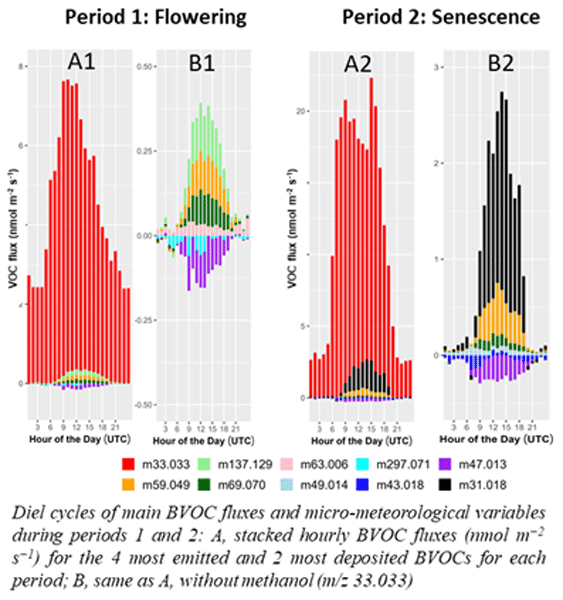
Abstract. Biogenic volatile organic compounds (BVOC) are key precursors of ozone and secondary organic aerosols, yet their emissions from croplands remain poorly characterized. Here, we report what is, to our knowledge, the first ecosystem-scale quantification of BVOC fluxes over a rapeseed crop during fruit development and senescence. Measurements were conducted at the FR-Gri ICOS site near Paris (France) in May–June 2017 using eddy covariance with a proton-transfer-reaction quadripole ion guide time-of-flight mass spectrometer (PTR-Qi-TOF-MS). Complementary flux estimates were obtained via an aerodynamic resistance approach using a five-level vertical concentration profile. In total, 42 BVOC were significantly emitted or deposited. Methanol dominated emissions during fruit development (about 90 % of total molar flux), followed by acetone, monoterpenes and isoprene. During senescence, formaldehyde and methanethiol emerged as additional contributors. Deposition fluxes were mainly attributed to formic acid (about 50 %), with smaller contributions from other oxygenates. Several BVOC, including formaldehyde and acetic acid, exhibited bidirectional fluxes. Agreement between aerodynamic resistance and eddy-covariance fluxes was generally acceptable for non-reactive BVOC (R² ranging 5–31 %), but diverged for reactive compounds due to longer residence times in profile tubing. This effect helped reveal episodic, atypical deposition of monoterpenes, isoprene, and siloxanes, likely linked to herbicide-related advection from neighbouring fields. Our findings eventually demonstrate that BVOC contribution to total OH reactivity is mostly due to terpenoids (about 40 %), suggesting that MEGAN2.1 would substantially underestimate terpenoid emissions from oilseed rape, implying a larger role of croplands in secondary organic aerosol formation than currently represented.
-
Notice on discussion status
The requested preprint has a corresponding peer-reviewed final revised paper. You are encouraged to refer to the final revised version.
-
Preprint
(2269 KB)
-
Supplement
(5930 KB)
-
The requested preprint has a corresponding peer-reviewed final revised paper. You are encouraged to refer to the final revised version.
- Preprint
(2269 KB) - Metadata XML
-
Supplement
(5930 KB) - BibTeX
- EndNote
- Final revised paper


Journal article(s) based on this preprint
Interactive discussion
Status: closed
- RC1: 'Comment on egusphere-2026-401', Anonymous Referee #2, 23 Mar 2026
-
RC2: 'Comment on egusphere-2026-401', Anonymous Referee #1, 03 May 2026
General comments
Buysse et al present a manuscript showing BVOC fluxes measured in a rapeseed field in France. This is a crop that has seldom been studied for its ecosystem-scale emissions. Partly due to this lack of data, this work is a valuable dataset that deserves to be published. The manuscript mixes several analysis approaches (average diel cycles, measurement-model comparison, OH reactivity, and strange phenomena with high mixing ratios and deposition). However, there are some points that should be addressed before accepting the manuscript. The text would also benefit from some improvement of the structure and readability of the text.
Specific comments
-L275: Eq 9 has the Guenther light-independent temperature algorithm duplicated in the denominator.
-L282-291, Table 2, L440-468: I am not that familiar with the works of Gomez et al (2021) and Havermann et al (2022), and I have not read those in detail, but I am familiar with the MEGAN2.1 model. The comparison of measured fluxes with the MEGAN2.1 SEF and its derived fluxes is not as straightforward as the authors have made it seem. First of all, the SEF from MEGAN2.1 are canopy-scale emission factors. So, in principle, to compare them to the EC emissions measured in this work, it is not needed to transform the measurements into leaf-level emission factors. However, MEGAN2.1 relies on canopy models to derive the light and temperature conditions (to use with its "extended" version of the light and temperature Guenther algorithms) of a number of different levels inside the canopy. To make the MEGAN2.1 model work with such a layered canopy, the canopy-scale emission factors in the Guenther et al 2021 paper are standardized to correspond to a canopy with a LAI of 5. Thus, it is not that straightforward to simply use the simplest version of the leaf-level light and temperature Guenther algorithms, together with the MEGAN2.1 SEFs, and declare that this is a comparison with the MEGAN2.1 model results.
While it can be legitimate to use those leaf-level algorithms to compare with measurements, either by converting the measured emission factors to leaf-level (as done in this work) or by assuming that the canopy is a "big leaf" (and applying those algorithms to the canopy flux data), this needs to be conveniently and clearly explained in the manuscript to avoid confusion or claims of "comparison with MEGAN2.1".
-L720: An air quality station in Paris, which is 40 km apart and, without more information in the text, probably affected by a substantial urban influence, may not be the best comparison possible for the dynamics and magnitude of isoprene mixing ratios measured in a crop field.
-Sections 3.4 and 4.9 (high deposition fluxes): Those particular episodes seem interesting and obviously something was happening at the field site. But what is the distance of this nearby field from the EC tower? Because the difference in mixing ratios between the 2 inlet lines due to a 8s longer residence time in the profile tube must mean that the emissions were very close to the measurement point (¿?). Moreover, was that field inside the footprint of the EC measurements during all those hours of high deposition fluxes? If not, I am not convinced that the mixing ratios would show such a strong correlation with the vertical wind speed (so no EC fluxes would be computed). Did the authors check the contribution of different eddy frequencies to the total measured flux during those periods, to see if the distribution differed from the other "normal" periods?
-L557: Maybe I misunderstood something, but why would the share of methanol from soil be larger than that of vegetation if those studies showed at least 56% of the contribution from plants?
-Fig 4: are the fluxes of m/z 31.01 (formaldehyde) shown in panels B1 and C1? Maybe I can see them in panel C2, but not in panel C1.
Technical corrections-L16: quadrupole, not quadripole
-Table 1: the name of D4-siloxane in English does not have written accents.
-Fig. 3: I suggest alerting the reader that the Y axis ranges of the graphs on each side of the figure are different.
-L395: there seem to be too many parentheses in this paragraph.
-L635: A period is missing after the word "active".
-L660: was or was not observed in the present study?
-L733: the parenthesis with Silwet inside is probably not needed in this paragraph.
Citation: https://doi.org/10.5194/egusphere-2026-401-RC2 -
AC1: 'Final author comment to both reviewer comments on egusphere-2026-401', Pauline Buysse, 12 Jun 2026
Dear Editor and Reviewers,
We thank both Reviewers for their valuable comments that held all our attention, and which we carefully address in the two pdf files (one per Reviewer) attached to this message, together with an excel file detailing the criteria we used to distinguish sub-periods 3 and 4 from sub-periods 1 and 2 (more explanation about this in the pdf file that answers to comments from reviewer #2).
In brief, the two main changes we propose to bring to the revised form of the manuscript are:
1. In response to comments addressed by both Reviewers on this topic (detailed answer in the pdf file containing answers to comments by Reviewer #2), we will remove the sections related to sub-periods 3 and 4, and only provide the BVOC concentration data acquired with the gradient method as a supplementary material (as they are used to filter out these sub-periods 3 and 4).
2. We have re-calculated Standard Emission Factors based on Guenther et al. (2012) equations, as we ackowledge, as an answer to comments by Reviewer #1, that we did not stricly use the MEGAN2.1 model in the initial version of the manuscript. The detailed answer on this topic can be found in the pdf file containing answers to comments by Reviewer #1.
In both pdf files, we copied all comments by the Reviewers and we answer them one by one in green colour.
We sincerely hope that the answers we provide to the comments will help to clarify the manuscript and that the modifications we propose to bring to the revised form of the manuscript will be found suitable.
Pauline Buysse, on behalf of the co-authors
Peer review completion


Interactive discussion
Status: closed
-
RC1: 'Comment on egusphere-2026-401', Anonymous Referee #2, 23 Mar 2026
General comments
Buysse et al. describe BVOC exchanges from a rapeseed crop in a temperate environment, measured at the ecosystem scale. From these, they derive standard emission factors and compare them with those currently used in the MEGANv2.1 model. The dataset spans two months, covering the maturity and senescence phases of the crop, and thus partially highlights the impact of phenology on exchanges. They also estimate OH reactivity levels, showing the importance of quantifying monoterpenes and isoprene, which are weakly emitted but contribute significantly to total OH reactivity. They also identify episodes of unusual deposition for compounds typically considered as emitted species and attempt to determine their causes.
The manuscript is well written (except for the remarks below), relies on a solid methodology and state-of-the-art instrumentation, and the results are well illustrated. It should enable the community to incorporate these findings to update emission factors for this crop. The data analysis is rather conventional and entirely phenomenological, with originality mainly stemming from the detailed investigation of a crop of regional and global importance whose BVOC exchanges remain poorly characterized. Overall, this work offers useful and timely information for updating rapeseed emission factors and understanding BVOC dynamics. The availability of data and code on an INRAE repository is a strong positive aspect, promoting transparency and reproducibility. Nonetheless, I recommend major revisions to address the points raised in the following comments.
My main concern relates to the analysis of periods influenced by the advection of large amounts of certain compounds:
My understanding of your manuscript is as follows: under northeasterly winds, high concentrations of monoterpenes and siloxanes are advected to the tower. These induce atmospheric chemistry leading to the destruction of these monoterpenes and siloxanes, as well as isoprene, below the EC measurement height, resulting in strong negative fluxes (deposition). To support this hypothesis, you derive a reaction rate from the differences in concentrations measured simultaneously using a short sampling line (EC) and a longer one (profile). You assume that there are no wall effects and no influence of radiation, and therefore that these reaction rates are representative of what occurs in ambient air during daytime. If I have understood your reasoning correctly, could you discuss the plausibility of this hypothesis (which seems rather bold to me) and its implications (given the very short implied lifetimes: substantial destruction already during transport from the adjacent field to the tower, destruction also within the 3.6 m EC inlet, which reactions would affect isoprene in terms of deposition, and why is it not similarly destroyed in the profile inlet)? Could you also estimate the implied local sink and compare it with the deposition fluxes measured by EC? If I have misunderstood your argument, then I believe this entire section should be rewritten. In any case, I find it confusing, with repetitions and a thread that is difficult to follow.
Furthermore, once this non-purely local effect has been identified, why not filter it out from the entire dataset using quantitative criteria, for example based on wind direction and/or concentration characteristics? Instead, the dataset is divided somewhat arbitrarily into periods affected or not by this phenomenon.
In summary, the analysis of these deposition events appears underdeveloped and insufficiently justified. In its current form, my recommendation would be to simply filter out these episodes using criteria described in the Methods section and possibly move their (improved) description to the supplementary materials.
If this section is to be retained in the main text, could you also more clearly discuss the usefulness of studying these deposition events, beyond the need to identify and filter them when isolating purely local ecosystem processes?
I also question the usefulness of presenting fluxes derived from the flux-gradient method. Since you have access to a more direct and accurate method (eddy covariance), why include less reliable flux estimates for the same periods? What is their added value? Moreover, they are not actually used in the paper.
Specific comments
L94: more precise coordinates would allow locating the field on google earth (actually it’s far off).
L157-164: The sentence is unclear and appears to be missing a verb in its second part (“…and for methanol by comparing…”). Please reformulate for clarity. In addition, more methodological detail is needed. (i) It is not explained how the comparison with the PTR-HR-MS instrument was used to derive a calibration factor for methanol (e.g., why only for methanol and was a regression between co-located measurements performed?). (ii) How does this methanol calibration factor compare with the one obtained from the “one-off” calibration and with the toluene strategy? (iii) Please clarify when this “one-off calibration” was performed, and whether the instrumental conditions (in particular the settings and toluene sensitivity) were identical to those during the May–June measurement period. These details are important to assess the robustness and representativeness of the calibration.
L169: Was 2 minutes sufficiently long to stabilize the background concentrations?
L178-179: no detectable dependance of the timelag on relative humidity for any compound? Why was it tested only on a selection of BVOCs?
L180: Why is the standard deviation used here instead of the root mean square deviation (RMSD), as described in Langford et al. (2015; doi:10.5194/amt-8-4197-2015, Eq. 9 and associated discussion)?
Technical corrections
L18: “42 BVOC”. Should “BVOC” be pluralized (“BVOCs”) here, since it is used as a countable noun referring to multiple compounds? If so, please correct this throughout the manuscript where applicable.
L149: use a capital for si
L174: “denote time averages”
L194 : a closing parenthesis is missing
L207: add a coma: “…analogy, the …”
Figure 3: The resolution should be improved, as the m/z values are difficult to read (slightly blurred).
L381: “exchanged fluxes”, remove “exchanged”
L383: a closing parenthesis is missing
L412: “making it more difficult to detect it”, delete the second it
Figure 3, 4 and 5: uniformizing the way to mention the sub-period would help (fig 4 with the top title is nice)
L527-530: consider rephrasing (show is used three times in the same sentence)
L569: “closer much” should be “much closer”
Citation: https://doi.org/10.5194/egusphere-2026-401-RC1 -
RC2: 'Comment on egusphere-2026-401', Anonymous Referee #1, 03 May 2026
General comments
Buysse et al present a manuscript showing BVOC fluxes measured in a rapeseed field in France. This is a crop that has seldom been studied for its ecosystem-scale emissions. Partly due to this lack of data, this work is a valuable dataset that deserves to be published. The manuscript mixes several analysis approaches (average diel cycles, measurement-model comparison, OH reactivity, and strange phenomena with high mixing ratios and deposition). However, there are some points that should be addressed before accepting the manuscript. The text would also benefit from some improvement of the structure and readability of the text.
Specific comments
-L275: Eq 9 has the Guenther light-independent temperature algorithm duplicated in the denominator.
-L282-291, Table 2, L440-468: I am not that familiar with the works of Gomez et al (2021) and Havermann et al (2022), and I have not read those in detail, but I am familiar with the MEGAN2.1 model. The comparison of measured fluxes with the MEGAN2.1 SEF and its derived fluxes is not as straightforward as the authors have made it seem. First of all, the SEF from MEGAN2.1 are canopy-scale emission factors. So, in principle, to compare them to the EC emissions measured in this work, it is not needed to transform the measurements into leaf-level emission factors. However, MEGAN2.1 relies on canopy models to derive the light and temperature conditions (to use with its "extended" version of the light and temperature Guenther algorithms) of a number of different levels inside the canopy. To make the MEGAN2.1 model work with such a layered canopy, the canopy-scale emission factors in the Guenther et al 2021 paper are standardized to correspond to a canopy with a LAI of 5. Thus, it is not that straightforward to simply use the simplest version of the leaf-level light and temperature Guenther algorithms, together with the MEGAN2.1 SEFs, and declare that this is a comparison with the MEGAN2.1 model results.
While it can be legitimate to use those leaf-level algorithms to compare with measurements, either by converting the measured emission factors to leaf-level (as done in this work) or by assuming that the canopy is a "big leaf" (and applying those algorithms to the canopy flux data), this needs to be conveniently and clearly explained in the manuscript to avoid confusion or claims of "comparison with MEGAN2.1".
-L720: An air quality station in Paris, which is 40 km apart and, without more information in the text, probably affected by a substantial urban influence, may not be the best comparison possible for the dynamics and magnitude of isoprene mixing ratios measured in a crop field.
-Sections 3.4 and 4.9 (high deposition fluxes): Those particular episodes seem interesting and obviously something was happening at the field site. But what is the distance of this nearby field from the EC tower? Because the difference in mixing ratios between the 2 inlet lines due to a 8s longer residence time in the profile tube must mean that the emissions were very close to the measurement point (¿?). Moreover, was that field inside the footprint of the EC measurements during all those hours of high deposition fluxes? If not, I am not convinced that the mixing ratios would show such a strong correlation with the vertical wind speed (so no EC fluxes would be computed). Did the authors check the contribution of different eddy frequencies to the total measured flux during those periods, to see if the distribution differed from the other "normal" periods?
-L557: Maybe I misunderstood something, but why would the share of methanol from soil be larger than that of vegetation if those studies showed at least 56% of the contribution from plants?
-Fig 4: are the fluxes of m/z 31.01 (formaldehyde) shown in panels B1 and C1? Maybe I can see them in panel C2, but not in panel C1.
Technical corrections-L16: quadrupole, not quadripole
-Table 1: the name of D4-siloxane in English does not have written accents.
-Fig. 3: I suggest alerting the reader that the Y axis ranges of the graphs on each side of the figure are different.
-L395: there seem to be too many parentheses in this paragraph.
-L635: A period is missing after the word "active".
-L660: was or was not observed in the present study?
-L733: the parenthesis with Silwet inside is probably not needed in this paragraph.
Citation: https://doi.org/10.5194/egusphere-2026-401-RC2 -
AC1: 'Final author comment to both reviewer comments on egusphere-2026-401', Pauline Buysse, 12 Jun 2026
Dear Editor and Reviewers,
We thank both Reviewers for their valuable comments that held all our attention, and which we carefully address in the two pdf files (one per Reviewer) attached to this message, together with an excel file detailing the criteria we used to distinguish sub-periods 3 and 4 from sub-periods 1 and 2 (more explanation about this in the pdf file that answers to comments from reviewer #2).
In brief, the two main changes we propose to bring to the revised form of the manuscript are:
1. In response to comments addressed by both Reviewers on this topic (detailed answer in the pdf file containing answers to comments by Reviewer #2), we will remove the sections related to sub-periods 3 and 4, and only provide the BVOC concentration data acquired with the gradient method as a supplementary material (as they are used to filter out these sub-periods 3 and 4).
2. We have re-calculated Standard Emission Factors based on Guenther et al. (2012) equations, as we ackowledge, as an answer to comments by Reviewer #1, that we did not stricly use the MEGAN2.1 model in the initial version of the manuscript. The detailed answer on this topic can be found in the pdf file containing answers to comments by Reviewer #1.
In both pdf files, we copied all comments by the Reviewers and we answer them one by one in green colour.
We sincerely hope that the answers we provide to the comments will help to clarify the manuscript and that the modifications we propose to bring to the revised form of the manuscript will be found suitable.
Pauline Buysse, on behalf of the co-authors
Peer review completion
Journal article(s) based on this preprint
Data sets
Data_ECFlux_COV3ER2017 Pauline Buysse https://doi.org/10.57745/AIINCW
Viewed
| HTML | XML | Total | Supplement | BibTeX | EndNote | |
|---|---|---|---|---|---|---|
| 834 | 498 | 101 | 1,433 | 213 | 115 | 137 |
- HTML: 834
- PDF: 498
- XML: 101
- Total: 1,433
- Supplement: 213
- BibTeX: 115
- EndNote: 137
Viewed (geographical distribution)
| Country | # | Views | % |
|---|
| Total: | 0 |
| HTML: | 0 |
| PDF: | 0 |
| XML: | 0 |
- 1

Florence Lafouge
Raluca Ciuraru
Brigitte Durand
Olivier Zurfluh
Céline Décuq
Olivier Fanucci
Lais Gonzaga Gomez
Jean-Christophe Gueudet
Sandy Bsaibes
Nora Zannoni
Valérie Gros
Benjamin Loubet
The requested preprint has a corresponding peer-reviewed final revised paper. You are encouraged to refer to the final revised version.
- Preprint
(2269 KB) - Metadata XML
-
Supplement
(5930 KB) - BibTeX
- EndNote
- Final revised paper
General comments
Buysse et al. describe BVOC exchanges from a rapeseed crop in a temperate environment, measured at the ecosystem scale. From these, they derive standard emission factors and compare them with those currently used in the MEGANv2.1 model. The dataset spans two months, covering the maturity and senescence phases of the crop, and thus partially highlights the impact of phenology on exchanges. They also estimate OH reactivity levels, showing the importance of quantifying monoterpenes and isoprene, which are weakly emitted but contribute significantly to total OH reactivity. They also identify episodes of unusual deposition for compounds typically considered as emitted species and attempt to determine their causes.
The manuscript is well written (except for the remarks below), relies on a solid methodology and state-of-the-art instrumentation, and the results are well illustrated. It should enable the community to incorporate these findings to update emission factors for this crop. The data analysis is rather conventional and entirely phenomenological, with originality mainly stemming from the detailed investigation of a crop of regional and global importance whose BVOC exchanges remain poorly characterized. Overall, this work offers useful and timely information for updating rapeseed emission factors and understanding BVOC dynamics. The availability of data and code on an INRAE repository is a strong positive aspect, promoting transparency and reproducibility. Nonetheless, I recommend major revisions to address the points raised in the following comments.
My main concern relates to the analysis of periods influenced by the advection of large amounts of certain compounds:
My understanding of your manuscript is as follows: under northeasterly winds, high concentrations of monoterpenes and siloxanes are advected to the tower. These induce atmospheric chemistry leading to the destruction of these monoterpenes and siloxanes, as well as isoprene, below the EC measurement height, resulting in strong negative fluxes (deposition). To support this hypothesis, you derive a reaction rate from the differences in concentrations measured simultaneously using a short sampling line (EC) and a longer one (profile). You assume that there are no wall effects and no influence of radiation, and therefore that these reaction rates are representative of what occurs in ambient air during daytime. If I have understood your reasoning correctly, could you discuss the plausibility of this hypothesis (which seems rather bold to me) and its implications (given the very short implied lifetimes: substantial destruction already during transport from the adjacent field to the tower, destruction also within the 3.6 m EC inlet, which reactions would affect isoprene in terms of deposition, and why is it not similarly destroyed in the profile inlet)? Could you also estimate the implied local sink and compare it with the deposition fluxes measured by EC? If I have misunderstood your argument, then I believe this entire section should be rewritten. In any case, I find it confusing, with repetitions and a thread that is difficult to follow.
Furthermore, once this non-purely local effect has been identified, why not filter it out from the entire dataset using quantitative criteria, for example based on wind direction and/or concentration characteristics? Instead, the dataset is divided somewhat arbitrarily into periods affected or not by this phenomenon.
In summary, the analysis of these deposition events appears underdeveloped and insufficiently justified. In its current form, my recommendation would be to simply filter out these episodes using criteria described in the Methods section and possibly move their (improved) description to the supplementary materials.
If this section is to be retained in the main text, could you also more clearly discuss the usefulness of studying these deposition events, beyond the need to identify and filter them when isolating purely local ecosystem processes?
I also question the usefulness of presenting fluxes derived from the flux-gradient method. Since you have access to a more direct and accurate method (eddy covariance), why include less reliable flux estimates for the same periods? What is their added value? Moreover, they are not actually used in the paper.
Specific comments
L94: more precise coordinates would allow locating the field on google earth (actually it’s far off).
L157-164: The sentence is unclear and appears to be missing a verb in its second part (“…and for methanol by comparing…”). Please reformulate for clarity. In addition, more methodological detail is needed. (i) It is not explained how the comparison with the PTR-HR-MS instrument was used to derive a calibration factor for methanol (e.g., why only for methanol and was a regression between co-located measurements performed?). (ii) How does this methanol calibration factor compare with the one obtained from the “one-off” calibration and with the toluene strategy? (iii) Please clarify when this “one-off calibration” was performed, and whether the instrumental conditions (in particular the settings and toluene sensitivity) were identical to those during the May–June measurement period. These details are important to assess the robustness and representativeness of the calibration.
L169: Was 2 minutes sufficiently long to stabilize the background concentrations?
L178-179: no detectable dependance of the timelag on relative humidity for any compound? Why was it tested only on a selection of BVOCs?
L180: Why is the standard deviation used here instead of the root mean square deviation (RMSD), as described in Langford et al. (2015; doi:10.5194/amt-8-4197-2015, Eq. 9 and associated discussion)?
Technical corrections
L18: “42 BVOC”. Should “BVOC” be pluralized (“BVOCs”) here, since it is used as a countable noun referring to multiple compounds? If so, please correct this throughout the manuscript where applicable.
L149: use a capital for si
L174: “denote time averages”
L194 : a closing parenthesis is missing
L207: add a coma: “…analogy, the …”
Figure 3: The resolution should be improved, as the m/z values are difficult to read (slightly blurred).
L381: “exchanged fluxes”, remove “exchanged”
L383: a closing parenthesis is missing
L412: “making it more difficult to detect it”, delete the second it
Figure 3, 4 and 5: uniformizing the way to mention the sub-period would help (fig 4 with the top title is nice)
L527-530: consider rephrasing (show is used three times in the same sentence)
L569: “closer much” should be “much closer”