
the Creative Commons Attribution 4.0 License.
the Creative Commons Attribution 4.0 License.
 | 11 Feb 2026
Assessing Earth’s Skin Temperature Trends: Consistent Signals from IASI, MODIS, CCI and ERA5
Abstract. Earth’s skin temperature (Tskin), i.e. land and sea surface temperature (LST and SST), directly reflects surface–atmosphere energy exchanges and is an Essential Climate Variable (ECV). Yet it remains less exploited than near-surface air temperature in climate monitoring. Here, we intercompare and assess the capability of several infrared sounders and Tskin products to monitor climate variability during morning and evening overpasses from a multi-sensor perspective over 2008–2022. Two Infrared Atmospheric Sounding Interferometer (IASI) satellite products are analysed: the EUMETSAT all-sky Climate Data Record (IASI-CDR) (all-sky) and a newly developed clear-sky neural-network product (IASI-NN). These IASI products are compared with the Moderate Resolution Imaging Spectroradiometer MODIS Terra Land Surface Temperature (LST) (v6.1), ESA LST CCI (v3.00), and ERA5 skin temperature.
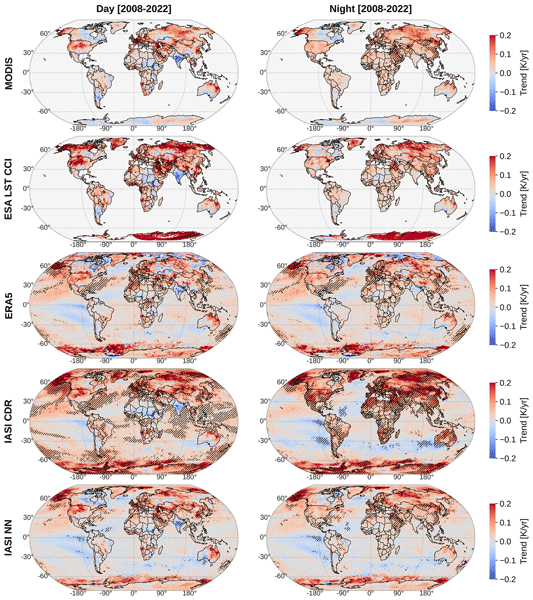
Over land, daytime global means agree within ~2 K across datasets, but LST CCI is consistently higher, and deseasonalised anomalies are highly consistent, except for LST CCI, which exhibits sensor-transition discontinuities. At night, MODIS shows a prevalent cold bias relative to all other products. Over the ocean, inter-dataset biases between IASI and ERA5 generally remain below 1 K. Trend analyses reveal robust warming in Tskin since 2008 across the different datasets, while significant regional cooling is observed over India (daytime) and parts of central/eastern Africa, and in in the southeastern Pacific associated with the Humboldt upwelling system.
-
Notice on discussion status
The requested preprint has a corresponding peer-reviewed final revised paper. You are encouraged to refer to the final revised version.
-
Preprint
(2566 KB)
-
Supplement
(418 KB)
-
The requested preprint has a corresponding peer-reviewed final revised paper. You are encouraged to refer to the final revised version.
- Preprint
(2566 KB) - Metadata XML
-
Supplement
(418 KB) - BibTeX
- EndNote
- Final revised paper


Journal article(s) based on this preprint
Interactive discussion
Status: closed
-
RC1: 'Comment on egusphere-2026-400', Anonymous Referee #1, 26 Feb 2026
-
AC1: 'Reply on RC1', Sarah Safieddine, 13 Apr 2026
The comment was uploaded in the form of a supplement: https://egusphere.copernicus.org/preprints/2026/egusphere-2026-400/egusphere-2026-400-AC1-supplement.pdf
-
AC1: 'Reply on RC1', Sarah Safieddine, 13 Apr 2026
-
RC2: 'Comment on egusphere-2026-400', Anonymous Referee #2, 09 Mar 2026
The topic of this paper is of high interest. Indeed, multiple skin temperature datasets are currently available, yet this variable has not received much attention from the climate community. There are three main reasons for this: 1) Clouds introduce substantial uncertainties and errors in LST/SST retrievals. 2) Multi-sensor datasets often suffer from inhomogeneities during sensor transitions, making the calculation of trends extremely challenging and uncertain, ad 3) Even the highest-quality datasets are still not long enough to allow the derivation of robust and meaningful trends.
Therefore, in a paper whose main motivation is to encourage the use of these datasets, I would expect these issues to be addressed with particular care. Unfortunately, this does not appear to be the case here. All-sky datasets are compared with clear-sky datasets, and sea ice is not treated appropriately. The LST CCI dataset exhibits clear problems when compared with the remaining datasets (large biases and apparent inhomogeneities). The manuscript even states that “This version of the CCI product has not yet been fully validated,” which raises the question of why it is used in the analysis at all.
Regarding the selection of datasets, one may also question why ERA5-Land was not used over land, given that surface processes are represented much more accurately there. ERA5 appears to be treated as an absolute “truth,” despite the fact that it has several well-documented issues. Over the ocean, similarly to the approach taken over land, it is unclear why a CCI-like product was not included in the comparison (see minor comments below). Additionally, the IASI-NN product does not appear to have been validated (at least no reference to a validation study is provided).
Overall, I feel that there are too many unresolved issues, and that both the discussion and the data treatment remain too superficial. Therefore, I recommend that the paper undergo major revision before it can be considered for final publication.
List of Issues:
- L14 – “Earth’s skin temperature (Tskin), i.e. land and sea surface temperature (LST and SST)” – perhaps ice should also be mentioned.
- L16 – “infrared sounders” should be “sounder”, since only IASI is used.
- L39 – “Owing to its direct sensitivity to surface–atmosphere interactions, Tskin serves as a reliable tracer of climate variability.”
This statement appears to be more of a hypothesis that the paper aims to demonstrate rather than an established premise. Many researchers would disagree with this claim, since Tskin datasets are affected by several issues that limit their reliability. These challenges are precisely why they remain underused in climate studies. - L44–45 – Please format variable symbols in italic.
- Section 2.3 – For a full understanding of the results, the manuscript should provide a broader explanation of how ERA5 Tskin is derived in the model for both land and ocean. The caveats associated with ERA5 Tskin are not sufficiently emphasized and may create the misleading impression that it can be used as an absolute “truth.” It would also be useful to comment on the independence of ERA5 relative to the other datasets.
- L104 – “making a reference instrument” → “making it a reference instrument.”
- Table 1 – The table is not rendered correctly in the manuscript version I am reading.
- Section 2.5.1 – It would be useful to explicitly state that this variability is completely missed in ERA5, which relies on static ancillary information.
- Figure S1 – This figure raises several questions. For example, what is the source of the statistically significant positive trends over desert regions?
Also correct the typo in the caption: “emissvities” → “emissivities.” - L172 – “January 2018 onward” – onward until when? Please specify the last month included in the analysis.
- L185 – It may be fairer to use ERA5-Land in this comparison, as the representation of land surface processes is significantly improved relative to ERA5.
- L195 – “The shift from ASTER to MODIS/Terra in April 2012” – this likely refers to a shift from AATSR, not ASTER.
- L197 – “This version of the CCI product has not yet been fully validated.”
What aspects are still missing from the validation? Why is the dataset published and used here if it has not been fully validated? - L230 – “More generally, the IASI-NN product is the only one that is clear-sky.”
This was not clear earlier in the manuscript. In addition, this statement is not entirely correct, as MODIS and LST CCI are also clear-sky products. Please highlight this earlier in Section 2, since this distinction is crucial for understanding differences among the datasets. - Figure 3 – The top and bottom axis labels are partially cut off. Please correct.
- Section 3.2 – A fair comparison would include SST from CCI. Please consider including it in a revised manuscript, as it would be valuable to assess how an independent satellite-based dataset represents these signals. Based on the results shown in Figure 5, I suggest using the SST/IST product:
https://data.marine.copernicus.eu/product/SST_GLO_SST_L4_REP_OBSERVATIONS_010_024/description
which properly accounts for temperatures over sea ice. - L280 – Given the large daytime inhomogeneity for CCI in 2012, a cautionary note regarding the interpretation of trends should appear at the beginning of Section 4. Currently, this is only mentioned later in the discussion.
- L310 – “except IASI-NN ones over sea.” This statement appears somewhat overstated. Even over land, the areas showing significant trends are quite limited.
- Although significant trends are shown in the emissivity maps in Figure S1, no interpretation is provided regarding how these trends may affect the LST trends in datasets that rely on these emissivity inputs.
- Figure 6 – It is confusing that LST CCI provides values over sea ice. These were masked in the comparisons shown in Figure 2 but not in Figure 6. Please ensure consistency (also in Figure S2).
Additionally, correct the occurrences of “°K” in the caption.
Citation: https://doi.org/10.5194/egusphere-2026-400-RC2 -
AC2: 'Reply on RC2', Sarah Safieddine, 05 Jun 2026
The comment was uploaded in the form of a supplement: https://egusphere.copernicus.org/preprints/2026/egusphere-2026-400/egusphere-2026-400-AC2-supplement.pdf
-
RC3: 'Comment on egusphere-2026-400', Anonymous Referee #3, 23 Apr 2026
This study compares several skin temperature products: four remote sensing products and one reanalysis (ERA5) product. It considers their spatial biases as well as biases in global-mean trends. In principle, if carefully done, this is a valuable exercise and could be very useful to the community. In its current form, however, large ambiguities in make the study’s results difficult to interpret. I recommend major revisions.
General Comments
Please address what “skin temperature” actually means. For the ocean surface, does it refer to the upper micrometers? Millimeters? Does the quantity measured depend on the remote sensing method? There can be significant thermal contrasts in just the very top of the ocean surface, so this is important to address.
Sea ice: How do these different datasets measure the skin temperature in areas with sea ice, and how might this affect the overall results of your study?
Clouds: it doesn’t make sense to directly compare temperatures in clear-sky and all-sky datasets.
It’s unclear to me how discontinuities in satellite observations in space and time are accounted for in this analysis. In spatially and temporally complete SST or near-surface land temperature products, algorithmic adjustments are made to fill in spatial and temporal gaps, such that averaged values can be interpreted to represent a best estimate of a global mean or a daily/monthly mean. To what extent are these observational products homogenized? See comments below.
Temporal coverage: Are “daytime” temperatures specifically referring to 9:30am or 10am temperatures? Please be more specific about how the correction to the temperatures based on local crossing times are made.
Spatial coverage: Is the spatial coverage clear sky or all sky? Are we considering a true global mean? If so, how are areas not “seen” by the satellite filled in? These are all major ambiguities that must be accounted for and described before making an “apples to apples” comparison between data products.
Generally, these issues must be treated with more specificity, rather than with broad allusion, for the comparisons made to be useful and interpretable.
On the use of reanalysis: in this study, reanalysis is treated as if it were another observational product. However, reanalysis is a fundamentally different type of data product, as it assimilates observations into a model, and prognostically predicts skin temperature. It is interesting to include reanalysis but these distinctions should be maintained throughout the text. Also, have there been comparisons between skin temperature values in other reanalysis products?
Some figure captions are not adequately descriptive.
Data availability: can you make the regridded and harmonized (to local time) data available? Or the code used to perform the harmonization?
Specific comments
Introduction: As written, the introduction doesn’t provide adequate context for the reader, instead jumping immediately into the details of each dataset. The paper should be accessible to researchers who may be interested in using skin temperature for scientific analysis, but may not be already familiar with each of the individual data products. In the introduction, therefore, I would suggest the following. Around line 40, instead of or in addition to presenting a general statement of Planck’s law, some broad discussion of remote sensing methods capable of measuring skin temperature and the strengths and weaknesses of these methods would be warranted. I.e., infrared sensing offers a good measure of physical temperatures as surfaces tend to have emissivities close to unity at thermal IR wavelengths, but infrared sensing of surface temperature is only possible in cloud-free areas, and there is some sensitivity to water vapor as well. Microwave sensing is less sensitive to clouds, but emissivity vary and the resolution is less sharp… etc. Satellites have incomplete spatial coverage, moreover… Basically, before you discuss each of the individual datasets, it would be helpful to discuss: what are some of the key sources of uncertainty that could lead to variation across these products?
Line 70: you don’t need to repeat that you regridded to 1x1 for every dataset. Also to clarify, did you regrid for all the analysis, or just the spatial comparison?
Line 86: Please add a little more detail about how this adjustment was made.
Line 90: ERA5 is reanalysis, not an observational product. How is surface temperature data assimilated into ERA5?
Section 2: In general, what criteria did you use to select which datasets to analyze?
Line 197: This version of the CCI product “has not been fully validated” – so it has been partly validated already? If so, how? What are the implications of using unvalidated data in your analysis?
Line 213: Please describe the local time conversion method.
Figure 3: I’m confused about what these global mean values are meant to capture. What happens over sea ice, what happens over
Figure 4: how do you treat sea ice?
Line 251: Biases between the SST datasets?
Line 284: historical trends – over what period?
Line 295: Regarding extreme rainfall events, how is this related to heating and cooling trends?
Figure 6: What is the color coding?
Technical corrections
Line 66: should read “between 9:30am and 10:30pm”
Line 81: “is” à “has been”
Citation: https://doi.org/10.5194/egusphere-2026-400-RC3 -
AC3: 'Reply on RC3', Sarah Safieddine, 05 Jun 2026
The comment was uploaded in the form of a supplement: https://egusphere.copernicus.org/preprints/2026/egusphere-2026-400/egusphere-2026-400-AC3-supplement.pdf
-
AC3: 'Reply on RC3', Sarah Safieddine, 05 Jun 2026
Peer review completion


Interactive discussion
Status: closed
-
RC1: 'Comment on egusphere-2026-400', Anonymous Referee #1, 26 Feb 2026
This paper entitled "Assessing Earth's skin temperature trends: consistent signals from IASI, MODIS, CCI and ERA5" intends first to evaluate several datasets of skin temperature (over ocean and continents) and then to compare their respective trends.
Major comments:
- The datasets that are compared are not coherent. Some are clear-sky, other are all sky. Introducing cloudy skin temperatures in the analysis biases the dataset toward colder temperatures. Uncertainties are also higher below the clouds. Comparing datasets so different in nature is not reasonable and I suggest that you do the SAME cloud filtering for each of the datasets so that you can do an analysis on clear-sky only.
- The diagnostics that are used in the analysis are misleading in my opinion. You perform a lot of averaging on the data and then evaluate the biases on this averaged data. This is not correct. For instance, you can have a dataset with 50% of the samples with -5C of bias, and 50% of the samples with +5C biases, if you average these biases, you will come up with a 0 bias... This is what we can see for instance in Fig2 (column 1 and row 2) where you have very high values and low values, then compute the average bias in Table 3 (if I interpret correctly) at -0.63C. You cannot say that the overal bias between MODIS and ERA is -0.63C... This is highly misleading.
- Figure 1, first plot, the ESA CCI is 8°C higher than the other datasets. It means that their global average over land in the whole planet is 8°C higher than the other datasets, at 30°C... ESA CCI LST has been highly evaluated, there are papers and reports on its evaluation, so I believe there are an error in the way the data is represented. With such differences, you need to investigate what is happening, cannot just continue the analysis as if everything is normal.
- Figure 2, there is a longitudinal structure in the ERA5 data (the vertical bands). You mention this issue but do not solve it.
- You retrieval based on IASI information was trained on the IASU Eumetsat product that is based on IASI data and microwave observations, trained on ERA5 skin temperatures. First issue: training a IASI retrieval, on a IASI retrieval trained on ERA5 targets. I do not see the advantage compared to the retrieval based on ERA5 targets... Second, how can we inter-compare all these products that are not a all independent? And why are such large differences between the datasets?
Minor comments:
- You use in the title "CCI" for LST ESA CCI. CCI is used by NASA for many variables so this is ambiguous.
- Abstract: in general, no paragraphs in an abstract.
- Line 26: "in in"
- In your NN model, you have the pixel number (in the orbit). What is important in terms of radiative transfer (and then for the retrieval) is the incidence angle. There is a relationship between the pixel number and this incidence angle. I believe giving the angle would really be more adequate than this indicator, discrete, and non monotonic information.
- Figure 3 : I already commented on the fact that these numbers are misleading. You are averaging spatially the biases that are positive and negative, this can give you artificially low medium bias. We can see clearly in the maps of Figure 2 that biases are truly non neglectable. To obtain numbers that can synthetize the bias and RMS between the two datasets: 1) you need to do you analysis for each retrieval (don't average on 1° boxes, as this already smooth everything) and everything needs to be done at the native resolution; 2) you need to use the same filters (for clouds, etc.) so that you can compare couple of retrievals for same location and same time; 3) you can represent the maps of bias and RMS at native resolution; 4) if you want to obtain a single number, you can aberage the pixel RMS (as they are positive) but not the biases (I would recommend the average of the pixel biases).
Citation: https://doi.org/10.5194/egusphere-2026-400-RC1 -
AC1: 'Reply on RC1', Sarah Safieddine, 13 Apr 2026
The comment was uploaded in the form of a supplement: https://egusphere.copernicus.org/preprints/2026/egusphere-2026-400/egusphere-2026-400-AC1-supplement.pdf
-
AC1: 'Reply on RC1', Sarah Safieddine, 13 Apr 2026
-
RC2: 'Comment on egusphere-2026-400', Anonymous Referee #2, 09 Mar 2026
The topic of this paper is of high interest. Indeed, multiple skin temperature datasets are currently available, yet this variable has not received much attention from the climate community. There are three main reasons for this: 1) Clouds introduce substantial uncertainties and errors in LST/SST retrievals. 2) Multi-sensor datasets often suffer from inhomogeneities during sensor transitions, making the calculation of trends extremely challenging and uncertain, ad 3) Even the highest-quality datasets are still not long enough to allow the derivation of robust and meaningful trends.
Therefore, in a paper whose main motivation is to encourage the use of these datasets, I would expect these issues to be addressed with particular care. Unfortunately, this does not appear to be the case here. All-sky datasets are compared with clear-sky datasets, and sea ice is not treated appropriately. The LST CCI dataset exhibits clear problems when compared with the remaining datasets (large biases and apparent inhomogeneities). The manuscript even states that “This version of the CCI product has not yet been fully validated,” which raises the question of why it is used in the analysis at all.
Regarding the selection of datasets, one may also question why ERA5-Land was not used over land, given that surface processes are represented much more accurately there. ERA5 appears to be treated as an absolute “truth,” despite the fact that it has several well-documented issues. Over the ocean, similarly to the approach taken over land, it is unclear why a CCI-like product was not included in the comparison (see minor comments below). Additionally, the IASI-NN product does not appear to have been validated (at least no reference to a validation study is provided).
Overall, I feel that there are too many unresolved issues, and that both the discussion and the data treatment remain too superficial. Therefore, I recommend that the paper undergo major revision before it can be considered for final publication.
List of Issues:
- L14 – “Earth’s skin temperature (Tskin), i.e. land and sea surface temperature (LST and SST)” – perhaps ice should also be mentioned.
- L16 – “infrared sounders” should be “sounder”, since only IASI is used.
- L39 – “Owing to its direct sensitivity to surface–atmosphere interactions, Tskin serves as a reliable tracer of climate variability.”
This statement appears to be more of a hypothesis that the paper aims to demonstrate rather than an established premise. Many researchers would disagree with this claim, since Tskin datasets are affected by several issues that limit their reliability. These challenges are precisely why they remain underused in climate studies. - L44–45 – Please format variable symbols in italic.
- Section 2.3 – For a full understanding of the results, the manuscript should provide a broader explanation of how ERA5 Tskin is derived in the model for both land and ocean. The caveats associated with ERA5 Tskin are not sufficiently emphasized and may create the misleading impression that it can be used as an absolute “truth.” It would also be useful to comment on the independence of ERA5 relative to the other datasets.
- L104 – “making a reference instrument” → “making it a reference instrument.”
- Table 1 – The table is not rendered correctly in the manuscript version I am reading.
- Section 2.5.1 – It would be useful to explicitly state that this variability is completely missed in ERA5, which relies on static ancillary information.
- Figure S1 – This figure raises several questions. For example, what is the source of the statistically significant positive trends over desert regions?
Also correct the typo in the caption: “emissvities” → “emissivities.” - L172 – “January 2018 onward” – onward until when? Please specify the last month included in the analysis.
- L185 – It may be fairer to use ERA5-Land in this comparison, as the representation of land surface processes is significantly improved relative to ERA5.
- L195 – “The shift from ASTER to MODIS/Terra in April 2012” – this likely refers to a shift from AATSR, not ASTER.
- L197 – “This version of the CCI product has not yet been fully validated.”
What aspects are still missing from the validation? Why is the dataset published and used here if it has not been fully validated? - L230 – “More generally, the IASI-NN product is the only one that is clear-sky.”
This was not clear earlier in the manuscript. In addition, this statement is not entirely correct, as MODIS and LST CCI are also clear-sky products. Please highlight this earlier in Section 2, since this distinction is crucial for understanding differences among the datasets. - Figure 3 – The top and bottom axis labels are partially cut off. Please correct.
- Section 3.2 – A fair comparison would include SST from CCI. Please consider including it in a revised manuscript, as it would be valuable to assess how an independent satellite-based dataset represents these signals. Based on the results shown in Figure 5, I suggest using the SST/IST product:
https://data.marine.copernicus.eu/product/SST_GLO_SST_L4_REP_OBSERVATIONS_010_024/description
which properly accounts for temperatures over sea ice. - L280 – Given the large daytime inhomogeneity for CCI in 2012, a cautionary note regarding the interpretation of trends should appear at the beginning of Section 4. Currently, this is only mentioned later in the discussion.
- L310 – “except IASI-NN ones over sea.” This statement appears somewhat overstated. Even over land, the areas showing significant trends are quite limited.
- Although significant trends are shown in the emissivity maps in Figure S1, no interpretation is provided regarding how these trends may affect the LST trends in datasets that rely on these emissivity inputs.
- Figure 6 – It is confusing that LST CCI provides values over sea ice. These were masked in the comparisons shown in Figure 2 but not in Figure 6. Please ensure consistency (also in Figure S2).
Additionally, correct the occurrences of “°K” in the caption.
Citation: https://doi.org/10.5194/egusphere-2026-400-RC2 -
AC2: 'Reply on RC2', Sarah Safieddine, 05 Jun 2026
The comment was uploaded in the form of a supplement: https://egusphere.copernicus.org/preprints/2026/egusphere-2026-400/egusphere-2026-400-AC2-supplement.pdf
-
RC3: 'Comment on egusphere-2026-400', Anonymous Referee #3, 23 Apr 2026
This study compares several skin temperature products: four remote sensing products and one reanalysis (ERA5) product. It considers their spatial biases as well as biases in global-mean trends. In principle, if carefully done, this is a valuable exercise and could be very useful to the community. In its current form, however, large ambiguities in make the study’s results difficult to interpret. I recommend major revisions.
General Comments
Please address what “skin temperature” actually means. For the ocean surface, does it refer to the upper micrometers? Millimeters? Does the quantity measured depend on the remote sensing method? There can be significant thermal contrasts in just the very top of the ocean surface, so this is important to address.
Sea ice: How do these different datasets measure the skin temperature in areas with sea ice, and how might this affect the overall results of your study?
Clouds: it doesn’t make sense to directly compare temperatures in clear-sky and all-sky datasets.
It’s unclear to me how discontinuities in satellite observations in space and time are accounted for in this analysis. In spatially and temporally complete SST or near-surface land temperature products, algorithmic adjustments are made to fill in spatial and temporal gaps, such that averaged values can be interpreted to represent a best estimate of a global mean or a daily/monthly mean. To what extent are these observational products homogenized? See comments below.
Temporal coverage: Are “daytime” temperatures specifically referring to 9:30am or 10am temperatures? Please be more specific about how the correction to the temperatures based on local crossing times are made.
Spatial coverage: Is the spatial coverage clear sky or all sky? Are we considering a true global mean? If so, how are areas not “seen” by the satellite filled in? These are all major ambiguities that must be accounted for and described before making an “apples to apples” comparison between data products.
Generally, these issues must be treated with more specificity, rather than with broad allusion, for the comparisons made to be useful and interpretable.
On the use of reanalysis: in this study, reanalysis is treated as if it were another observational product. However, reanalysis is a fundamentally different type of data product, as it assimilates observations into a model, and prognostically predicts skin temperature. It is interesting to include reanalysis but these distinctions should be maintained throughout the text. Also, have there been comparisons between skin temperature values in other reanalysis products?
Some figure captions are not adequately descriptive.
Data availability: can you make the regridded and harmonized (to local time) data available? Or the code used to perform the harmonization?
Specific comments
Introduction: As written, the introduction doesn’t provide adequate context for the reader, instead jumping immediately into the details of each dataset. The paper should be accessible to researchers who may be interested in using skin temperature for scientific analysis, but may not be already familiar with each of the individual data products. In the introduction, therefore, I would suggest the following. Around line 40, instead of or in addition to presenting a general statement of Planck’s law, some broad discussion of remote sensing methods capable of measuring skin temperature and the strengths and weaknesses of these methods would be warranted. I.e., infrared sensing offers a good measure of physical temperatures as surfaces tend to have emissivities close to unity at thermal IR wavelengths, but infrared sensing of surface temperature is only possible in cloud-free areas, and there is some sensitivity to water vapor as well. Microwave sensing is less sensitive to clouds, but emissivity vary and the resolution is less sharp… etc. Satellites have incomplete spatial coverage, moreover… Basically, before you discuss each of the individual datasets, it would be helpful to discuss: what are some of the key sources of uncertainty that could lead to variation across these products?
Line 70: you don’t need to repeat that you regridded to 1x1 for every dataset. Also to clarify, did you regrid for all the analysis, or just the spatial comparison?
Line 86: Please add a little more detail about how this adjustment was made.
Line 90: ERA5 is reanalysis, not an observational product. How is surface temperature data assimilated into ERA5?
Section 2: In general, what criteria did you use to select which datasets to analyze?
Line 197: This version of the CCI product “has not been fully validated” – so it has been partly validated already? If so, how? What are the implications of using unvalidated data in your analysis?
Line 213: Please describe the local time conversion method.
Figure 3: I’m confused about what these global mean values are meant to capture. What happens over sea ice, what happens over
Figure 4: how do you treat sea ice?
Line 251: Biases between the SST datasets?
Line 284: historical trends – over what period?
Line 295: Regarding extreme rainfall events, how is this related to heating and cooling trends?
Figure 6: What is the color coding?
Technical corrections
Line 66: should read “between 9:30am and 10:30pm”
Line 81: “is” à “has been”
Citation: https://doi.org/10.5194/egusphere-2026-400-RC3 -
AC3: 'Reply on RC3', Sarah Safieddine, 05 Jun 2026
The comment was uploaded in the form of a supplement: https://egusphere.copernicus.org/preprints/2026/egusphere-2026-400/egusphere-2026-400-AC3-supplement.pdf
-
AC3: 'Reply on RC3', Sarah Safieddine, 05 Jun 2026
Peer review completion
Journal article(s) based on this preprint
Viewed
| HTML | XML | Total | Supplement | BibTeX | EndNote | |
|---|---|---|---|---|---|---|
| 1,118 | 672 | 130 | 1,920 | 218 | 218 | 214 |
- HTML: 1,118
- PDF: 672
- XML: 130
- Total: 1,920
- Supplement: 218
- BibTeX: 218
- EndNote: 214
Viewed (geographical distribution)
| Country | # | Views | % |
|---|
| Total: | 0 |
| HTML: | 0 |
| PDF: | 0 |
| XML: | 0 |
- 1
Sarah Safieddine

Selviga Sinnathamby
Juliette Hadji-Lazaro
Marie Doutriaux-Boucher
Darren Ghent
Simon Whitburn
Lieven Clarisse
Cathy Clerbaux
The requested preprint has a corresponding peer-reviewed final revised paper. You are encouraged to refer to the final revised version.
- Preprint
(2566 KB) - Metadata XML
-
Supplement
(418 KB) - BibTeX
- EndNote
- Final revised paper
This paper entitled "Assessing Earth's skin temperature trends: consistent signals from IASI, MODIS, CCI and ERA5" intends first to evaluate several datasets of skin temperature (over ocean and continents) and then to compare their respective trends.
Major comments:
- The datasets that are compared are not coherent. Some are clear-sky, other are all sky. Introducing cloudy skin temperatures in the analysis biases the dataset toward colder temperatures. Uncertainties are also higher below the clouds. Comparing datasets so different in nature is not reasonable and I suggest that you do the SAME cloud filtering for each of the datasets so that you can do an analysis on clear-sky only.
- The diagnostics that are used in the analysis are misleading in my opinion. You perform a lot of averaging on the data and then evaluate the biases on this averaged data. This is not correct. For instance, you can have a dataset with 50% of the samples with -5C of bias, and 50% of the samples with +5C biases, if you average these biases, you will come up with a 0 bias... This is what we can see for instance in Fig2 (column 1 and row 2) where you have very high values and low values, then compute the average bias in Table 3 (if I interpret correctly) at -0.63C. You cannot say that the overal bias between MODIS and ERA is -0.63C... This is highly misleading.
- Figure 1, first plot, the ESA CCI is 8°C higher than the other datasets. It means that their global average over land in the whole planet is 8°C higher than the other datasets, at 30°C... ESA CCI LST has been highly evaluated, there are papers and reports on its evaluation, so I believe there are an error in the way the data is represented. With such differences, you need to investigate what is happening, cannot just continue the analysis as if everything is normal.
- Figure 2, there is a longitudinal structure in the ERA5 data (the vertical bands). You mention this issue but do not solve it.
- You retrieval based on IASI information was trained on the IASU Eumetsat product that is based on IASI data and microwave observations, trained on ERA5 skin temperatures. First issue: training a IASI retrieval, on a IASI retrieval trained on ERA5 targets. I do not see the advantage compared to the retrieval based on ERA5 targets... Second, how can we inter-compare all these products that are not a all independent? And why are such large differences between the datasets?
Minor comments:
- You use in the title "CCI" for LST ESA CCI. CCI is used by NASA for many variables so this is ambiguous.
- Abstract: in general, no paragraphs in an abstract.
- Line 26: "in in"
- In your NN model, you have the pixel number (in the orbit). What is important in terms of radiative transfer (and then for the retrieval) is the incidence angle. There is a relationship between the pixel number and this incidence angle. I believe giving the angle would really be more adequate than this indicator, discrete, and non monotonic information.
- Figure 3 : I already commented on the fact that these numbers are misleading. You are averaging spatially the biases that are positive and negative, this can give you artificially low medium bias. We can see clearly in the maps of Figure 2 that biases are truly non neglectable. To obtain numbers that can synthetize the bias and RMS between the two datasets: 1) you need to do you analysis for each retrieval (don't average on 1° boxes, as this already smooth everything) and everything needs to be done at the native resolution; 2) you need to use the same filters (for clouds, etc.) so that you can compare couple of retrievals for same location and same time; 3) you can represent the maps of bias and RMS at native resolution; 4) if you want to obtain a single number, you can aberage the pixel RMS (as they are positive) but not the biases (I would recommend the average of the pixel biases).