
the Creative Commons Attribution 4.0 License.
the Creative Commons Attribution 4.0 License.
 | 12 Mar 2026
Interface-dominated hydroxymethanesulfonate and its isomer formation provides key mechanisms for reconciling the atmospheric sulfur budget gap in polluted and cold environments
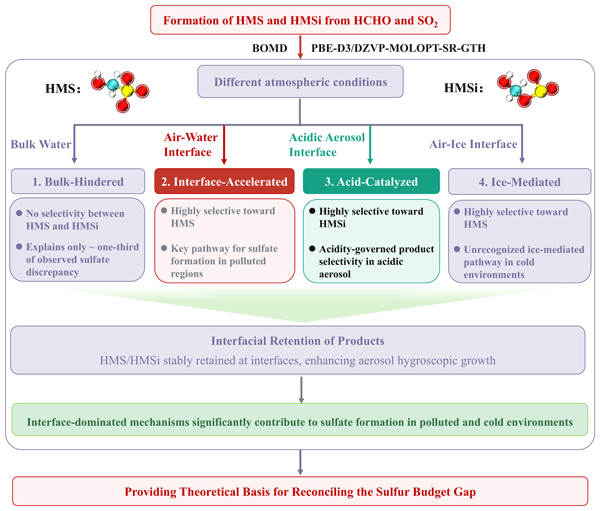
Abstract. Hydroxymethanesulfonate (HMS) is a critical source of particulate sulfur, formed by formaldehyde (HCHO) and sulfur dioxide (SO2) in droplets. Current models relying on bulk aqueous-phase HMS formation only explain ~one-third of unexplained sulfate concentrations, leaving gaps in atmospheric sulfur budget, especially in polluted and cold environments. Using Born–Oppenheimer molecular dynamics simulations, we explored HMS and its isomer hydroxymethyl sulfite (HMSi) formation mechanisms across aqueous phase and air–water/ice interfaces. Air–water interfaces enable nearly barrierless HMS formation (0.6 kcal mol-1) via unique stepwise water-mediated proton transfer, preferring HMS over HMSi (0.6 vs. 6.1 kcal mol-1), which contrasts sharply with the competitive pathways observed in the bulk aqueous phase (7.7 vs. 7.6 kcal mol⁻¹). In contrast, protonation of formaldehyde under strongly acidic conditions reverses reaction selectivity, favoring HMSi formation over HMS. Importantly, these reaction mechanisms remain viable at air–ice interfaces in cold environments including polar areas and the upper troposphere, revealing ice surfaces as previously overlooked yet significant sites for atmospheric organosulfate formation. Our findings establish that interfacial mechanisms dominate HMS and HMSi formation in both polluted and cold environments, helping to reconcile model-observation discrepancies in the atmospheric sulfur budget.
-
Notice on discussion status
The requested preprint has a corresponding peer-reviewed final revised paper. You are encouraged to refer to the final revised version.
-
Preprint
(1473 KB)
-
Supplement
(2391 KB)
-
The requested preprint has a corresponding peer-reviewed final revised paper. You are encouraged to refer to the final revised version.
- Preprint
(1473 KB) - Metadata XML
-
Supplement
(2391 KB) - BibTeX
- EndNote
- Final revised paper


Journal article(s) based on this preprint
Interactive discussion
Status: closed
-
RC1: 'Comment on egusphere-2026-388', Anonymous Referee #1, 23 Mar 2026
The comment was uploaded in the form of a supplement: https://egusphere.copernicus.org/preprints/2026/egusphere-2026-388/egusphere-2026-388-RC1-supplement.pdfCitation: https://doi.org/
10.5194/egusphere-2026-388-RC1 -
AC1: 'Reply on RC1', Xiuhui Zhang, 24 May 2026
Responses to Referee #1’s comments
We are grateful to the reviewers for their professional and helpful comments on our manuscript “Interface-dominated hydroxymethanesulfonate and its isomer formation provides key mechanisms for reconciling the atmospheric sulfur budget gap in polluted and cold environments” (MS No.: egusphere-2026-388). Accordingly, we have carefully revised the manuscript. The point-to-point responses to the Referee #1’s comments are summarized as follows:
Referee #1:
This study investigates the role of air–water and air–ice interfaces in accelerating the formation of hydroxymethanesulfonate (HMS) and its structural isomer hydroxymethyl sulfite (HMSi) from the reaction of formaldehyde (HCHO) with bisulfite (HOSO2⁻). The work aims to provide a molecular-level mechanistic basis for the long-standing discrepancy between modeled and observed sulfate concentrations, commonly referred to as the "sulfur budget gap" in atmospheric chemistry. By employing Born–Oppenheimer molecular dynamics (BOMD) simulations with metadynamics enhancement, the authors reveal a distinctive stepwise water-mediated proton transfer mechanism at the air–water interface that dramatically lowers the free energy barrier for HMS formation relative to the bulk aqueous phase. The research perspective is novel, and the extensions to strongly acidic aerosol environments and cold-region ice surfaces are of considerable atmospheric relevance. As a well-designed theoretical study with clear implications for atmospheric sulfur cycling, I recommend this work for publication in Atmospheric Chemistry and Physics, subject to the following comments being adequately addressed.
Response: We sincerely appreciate the reviewer’s valuable comments. We have revised the manuscript accordingly.
--------------------
Major and Specific Comments:
Comment 1: The authors identify four distinct mechanistic regimes for HMS and HMSi formation: the bulk aqueous phase, the air–water interface, the strongly acidic aerosol interface, and the air–ice interface. Each regime exhibits different reaction selectivity and kinetics, with free energy barriers ranging from near-zero at the air–water interface to approximately 7.7 kcal mol-1 in the bulk phase. These interfacial mechanisms could have significant implications for atmospheric sulfur budgets, but their impact can only be fully assessed by incorporating them into atmospheric chemical transport models. What challenges do the authors foresee in translating these molecular-level findings into parameterizations suitable for regional or global models?
Response: We sincerely thank the reviewer for this insightful comment, which has prompted us to think more concretely about how our molecular-level findings can be translated into atmospheric models. Building on the mechanistic insights established in this work, we envision two complementary directions in which our simulations can contribute to cross-scale atmospheric modeling, while also recognizing the substantial challenges that must be overcome to realize this translation. First, the temperature-dependent reaction mechanisms identified in this study (covering 223 K, 243 K, and 298 K) provide a foundation for constructing a temperature-resolved database of reaction rate coefficients for interfacial HMS and HMSi formation. However, generating such a database covering the full range of atmospherically relevant temperatures requires extensive BOMD and metadynamics simulations at multiple temperatures, each of which is computationally expensive. The lack of efficient simulation strategies for systematically covering this temperature range therefore represents a significant challenge, and overcoming it will require the development of more efficient computational protocols, such as enhanced sampling schemes or machine-learning-assisted potential energy surface construction, before a comprehensive temperature-resolved rate coefficient parameterization can be made available to chemical transport models. Second, the acidity-dependent mechanistic switch between HMS-selective and HMSi-selective pathways, together with the distinct mechanisms operating in different media (bulk aqueous phase, air–water interface, and air–ice interface), suggests that atmospheric models would need to apply different reaction mechanisms depending on local aerosol acidity and phase state. This implementation faces a substantial challenge, because the spatial and temporal distributions of aerosol pH and phase state are not yet well constrained in current atmospheric models, particularly under conditions of low relative humidity and low temperature. Without sufficiently constrained aerosol acidity and phase information, it is difficult to apply the appropriate mechanistic regime identified in this study to the corresponding atmospheric environment. In our future work, we plan to address these challenges by developing more efficient simulation strategies for expanding the temperature coverage of our BOMD framework, and by coordinating with atmospheric modeling efforts to better constrain aerosol acidity and phase distributions, ultimately enabling a more accurate representation of interfacial sulfur chemistry in global atmospheric models. We have also added a brief summary of these challenges at the end of Section 4 of the revised manuscript as follows:
“Extending these mechanistic findings to atmospheric models requires further effort, including additional simulations across a wider temperature range and improved characterization of aerosol acidity.”
--------------------
Comment 2: The authors describe HMS formation at the air–water interface by noting that the distance between the carbon atom of HCHO and the sulfur atom of HOSO2⁻ decreases to approximately 1.95 Å during the reaction, which is interpreted as covalent bond formation (Section 3.2, Figure 2d). However, the assignment of covalent bond formation currently relies primarily on the shortening of interatomic distance, which is suggestive but not definitive. The conclusion would be more convincing if the authors could supplement this geometric evidence with a quantitative bond order analysis along the reaction coordinate.
Response: We sincerely thank the reviewer for this valuable suggestion. We agree that the assignment of S–C bond formation should be supported by quantitative electronic structure evidence beyond geometric criteria alone. To address this concern, we have performed Mayer bond order analysis for the S–C interaction in the reaction intermediate at the air–water interface. The calculated Mayer bond order is 0.57, indicating that a S–C bond is developing at this intermediate stage of the reaction, with further consolidation expected upon completion to form the final HMS product. We have revised the manuscript to include this information in Section 3.2 of the revised manuscript as follows:
“During the reaction, the distance between the C atom of HCHO and the S atom of HOSO2⁻ gradually decreases to approximately 1.95 Å (Figure 2d, e), with a corresponding Mayer bond order of 0.57, indicating that an S–C bonding interaction has been established at this intermediate stage.”
--------------------
Comment 3: The manuscript reports that under strongly acidic conditions, product selectivity reverses from preferential HMS formation to HMSi dominance, with an HMS:HMSi ratio of approximately 1:3 based on analyses of 25 independent BOMD trajectories (Section 3.3). This is a mechanistically significant finding, particularly given that strongly acidic aerosols span approximately 20% of the global surface atmosphere. Given that HMS and HMSi differ in their bonding arrangements, with HMS characterized by a direct C–S bond and HMSi by a C–O–S linkage, it would be helpful if the authors could comment on whether existing analytical techniques, for example ion chromatography or high-resolution mass spectrometry, are sufficient to distinguish these two isomers. Addressing this point would help the observational community assess the testability of the paper’s predictions.
Response: We sincerely thank the reviewer for this valuable suggestion, which has important implications for the experimental testability of our predictions. HMS and HMSi differ fundamentally in their bonding: HMS features a direct C–S bond, while HMSi contains a C–O–S linkage. These distinct structural features may produce different signatures in suitable analytical techniques. Although conventional aerosol mass spectrometry has limited ability to quantify HMS in complex mixtures due to fragment overlap with other sulfur species (Moch et al., 2018; Dovrou et al., 2019), ion chromatography has been used to specifically detect HMS in ambient samples (Wei et al., 2020; Campbell et al., 2022). Whether existing ion chromatography or high-resolution tandem mass spectrometry techniques can resolve HMS from HMSi has not, to our knowledge, been directly tested, since HMSi has not yet been confirmed in atmospheric samples. Given their differences in charge distribution and molecular geometry, HMS and HMSi may in principle exhibit different chromatographic retention times and distinct fragmentation patterns in high-resolution tandem mass spectrometry, but experimental verification will be required to establish whether existing methods are sufficient or whether dedicated method development is needed. We have added a brief discussion of analytical testability at the end of Section 3.3 of the revised manuscript as follows:
“From an analytical perspective, HMS and HMSi differ in charge distribution, molecular geometry, and bonding arrangements at the sulfur center, which may in principle enable their separation by targeted ion chromatography and their differentiation by high-resolution tandem mass spectrometry. Both techniques have been successfully applied to HMS detection (Wei et al., 2020; Campbell et al., 2022), although dedicated method development and experimental verification will be required to confirm the resolution of these two isomers in ambient samples.”
--------------------
Comment 4: The air–ice section is both interesting and potentially important. However, the atmospheric relevance of this chemistry could be articulated more clearly. In particular, could the authors explain why reactions on ice surfaces should be considered important in the atmosphere, rather than simply being treated as a special case under low-temperature conditions?
Response: We sincerely thank the reviewer for this comment, which has prompted us to articulate the atmospheric significance of the ice-surface pathway more clearly. The case for atmospheric importance can be supported from three perspectives, as described below. First, ice-containing surfaces are widely distributed across the atmosphere, spanning multiple altitudinal and geographic regimes. In the upper troposphere, cirrus clouds cover a substantial fraction of the Earth’s surface on average, providing extensive ice surface at high altitudes. At mid-latitudes, mixed-phase clouds containing ice particles are prevalent throughout tropospheric environments. In polar boundary layers, ice crystals can dominate the condensed-phase surface area, providing reactive interfaces with high surface-to-volume ratios that often exceed those of liquid aerosol droplets in the same environment. Together, these ice surfaces represent a globally distributed atmospheric interface rather than a localised feature confined to specific regions. Second, the precursors for HMS formation are ubiquitous in cold regions. As discussed in Section 3.4, HCHO is produced from snowpack photochemistry in polar regions (Sumner and Shepson, 1999), and SO2 is present throughout the troposphere including the upper troposphere and lower stratosphere (Höpfner et al., 2015; Joppe et al., 2024). Their coexistence with abundant ice surfaces creates favourable conditions for heterogeneous HMS formation, which is consistent with field observations reporting enhanced HMS concentrations during extreme cold in Fairbanks, Alaska (Campbell et al., 2024). Third, current atmospheric models do not include organosulfur chemistry on ice surfaces. If this pathway is active, as our simulations demonstrate at both 243 K and 223 K, then models are systematically missing a source of atmospheric organosulfur compounds across cold environments ranging from polar boundary layers to cirrus-influenced regions of the upper troposphere. Taken together, these factors indicate that ice-mediated HMS formation should not be regarded as a special case under low-temperature conditions but as a globally distributed gap in current model representations of atmospheric sulfur cycling.
--------------------
Comment 5: While the simplified model used here is reasonable for mechanistic exploration, the authors may wish to note more clearly that real atmospheric aerosol and cloud-droplet interfaces are chemically much more complex. In addition to HCHO and HOSO₂⁻, these interfaces may contain dissolved oxidants, organic species, transition metal ions, and other S(IV) components, all of which could influence interfacial reactivity by competing for reactive sites or modifying the local environment. The authors should acknowledge this chemical complexity as a limitation of the current simulations.
Response: We sincerely thank the reviewer for this insightful suggestion, which helps readers better understand the scope and limitations of the present study. The real atmosphere is chemically complex, and aerosol and cloud-droplet interfaces typically contain a wide variety of species beyond HCHO and HOSO2⁻, including dissolved oxidants (e.g., H2O2, O3, and OH radicals), organic species (e.g., organic acids, alcohols, and carbonyls), transition metal ions (e.g., Fe3+ and Mn2+), and other S(IV) components (e.g., SO32- in different protonation states). These components are likely to influence interfacial HMS and HMSi formation by competing for reactive sites, modifying local hydrogen bonding networks, altering interfacial acidity, or providing alternative reaction channels. In this study, we focus on the elementary reaction between HCHO and HOSO2⁻ because these are the canonical precursors of HMS and represent the minimal chemical system required to elucidate the intrinsic interfacial reaction mechanisms and selectivity rules. We have expanded the discussion to better reflect real atmospheric conditions and to acknowledge the limitation that the present simulations cannot comprehensively examine all coexisting species. The corresponding revision has been added at the end of Section 3.4 in the revised manuscript as follows:
“It should be noted that real atmospheric aerosol and cloud-droplet interfaces are chemically more complex than the simplified system examined here, and they may contain dissolved oxidants, organic species, transition metal ions, and other S(IV) components that could influence interfacial reactivity by competing for reactive sites or modifying the local environment. In future work, we intend to confirm the impacts of other atmospheric components.”
Reference:
Moch, J. M., Dovrou, E., Mickley, L. J., Keutsch, F. N., Cheng, Y., Jacob, D. J., Jiang, J., Li, M., Munger, J. W., Qiao, X., and Zhang, Q.: Contribution of Hydroxymethane Sulfonate to Ambient Particulate Matter: A Potential Explanation for High Particulate Sulfur During Severe Winter Haze in Beijing, Geophys. Res. Lett., 45, 11,969–11,979, https://doi.org/10.1029/2018gl079309, 2018.
Dovrou, E., Lim, C. Y., Canagaratna, M. R., Kroll, J. H., Worsnop, D. R., and Keutsch, F. N.: Measurement techniques for identifying and quantifying hydroxymethanesulfonate (HMS) in an aqueous matrix and particulate matter using aerosol mass spectrometry and ion chromatography, Atmos. Meas. Tech., 12, 5303–5315, https://doi.org/10.5194/amt-12-5303-2019, 2019.
Wei, L., Fu, P., Chen, X., An, N., Yue, S., Ren, H., Zhao, W., Xie, Q., Sun, Y., Zhu, Q.-F., Wang, Z., and Feng, Y.-Q.: Quantitative Determination of Hydroxymethanesulfonate (HMS) Using Ion Chromatography and UHPLC-LTQ-Orbitrap Mass Spectrometry: A Missing Source of Sulfur during Haze Episodes in Beijing, Environ. Sci. Technol. Lett., 7, 701–707, https://doi.org/10.1021/acs.estlett.0c00528, 2020.
Campbell, J. R., Battaglia, M., Jr., Dingilian, K., Cesler-Maloney, M., St Clair, J. M., Hanisco, T. F., Robinson, E., DeCarlo, P., Simpson, W., Nenes, A., Weber, R. J., and Mao, J.: Source and Chemistry of Hydroxymethanesulfonate (HMS) in Fairbanks, Alaska, Environ. Sci. Technol., 56, 7657–7667, https://doi.org/10.1021/acs.est.2c00410, 2022.
Sumner, A. L. and Shepson, P. B.: Snowpack production of formaldehyde and its effect on the Arctic troposphere, Nature, 398, 230–233, https://doi.org/10.1038/18423, 1999.
Höpfner, M., Boone, C. D., Funke, B., Glatthor, N., Grabowski, U., Günther, A., Kellmann, S., Kiefer, M., Linden, A., Lossow, S., Pumphrey, H. C., Read, W. G., Roiger, A., Stiller, G., Schlager, H., von Clarmann, T., and Wissmüller, K.: Sulfur dioxide (SO2) from MIPAS in the upper troposphere and lower stratosphere 2002–2012, Atmos. Chem. Phys., 15, 7017–7037, https://doi.org/10.5194/acp-15-7017-2015, 2015.
Joppe, P., Schneider, J., Kaiser, K., Fischer, H., Hoor, P., Kunkel, D., Lachnitt, H.-C., Marsing, A., Röder, L., Schlager, H., Tomsche, L., Voigt, C., Zahn, A., and Borrmann, S.: The influence of extratropical cross-tropopause mixing on the correlation between ozone and sulfate aerosol in the lowermost stratosphere, Atmos. Chem. Phys., 24, 7499–7522, https://doi.org/10.5194/acp-24-7499-2024, 2024.
Campbell, J. R., Michael, B., Jr., Dingilian, K. K., Cesler-Maloney, M., Simpson, W. R., Robinson, E. S., DeCarlo, P. F., Temime-Roussel, B., D'Anna, B., Holen, A. L., Wu, J., Pratt, K. A., Dibb, J. E., Nenes, A., Weber, R. J., and Mao, J.: Enhanced aqueous formation and neutralization of fine atmospheric particles driven by extreme cold, Sci. Adv., 10, eado4373, https://doi.org/10.1126/sciadv.ado4373, 2024.
-
AC1: 'Reply on RC1', Xiuhui Zhang, 24 May 2026
-
RC2: 'Comment on egusphere-2026-388', Anonymous Referee #2, 29 Apr 2026
Liu et al. investigated the formation mechanisms of HMS and HMSi in aqueous phase and at air-water/ice interfaces using quantum chemistry calculations with ORCA and BOMD simulations with the CP2K package, and observed a nearly barrierless HMS formation route at air-water/ice interfaces and a competitive formation energy barrier in the bulk aqueous phase. Interestingly, the formation route reverses for the interfacial reactions when the pH drops below 2, which indicates the importance of aerosol acidity in product formation.
In the revised manuscript, the authors have carefully addressed the proposed comments. In particular, the title is moderated, the aerosol pH statement is clarified, additional metadynamics convergence diagostics have been provided, the use of PBE-D3 has been better justified, the initial configurations for the unbiased BOMD trajectories have been clarified, and a conceptual scheme has been added. These changes substantially enhanced the clarity and scientific rigor of the manuscript.
However, several issues still exist before a confident acceptance.
First of all, although the title has been moderated, the abstract and conclusion still contain claims that exceed what can be demonstrated by molecular simulations alone. For example, the statement that interfacial mechanisms dominate HMS and HMSi formation cannot not quantitatively supported without considering atmospheric flux estimates and chemical transport model computations. I would recommend replacing such language with more cautious wording, such as "may substantially enhance formation" or "may provide efficient pathways for HMS/HMSi formation" which can lower down the tone of the statement.
Second, the author correctly acknowledged the comment that geometric exposure of the HMS hydroxyl radical may not directly prove enhanced oxidation. However, the conclusion still states that this exposure accelerates conversion to sulfate, which should be aligned with the revisions in the previous chapter and the response letter.
Third, the aerosol pH statement has been improved in the Introduction, but the conclusion still refers to strongly acidic regions as encompassing approximately 20% of Earth’s surface atmosphere. This should be revised to retain the same spatiotemporal constraints described earlier so as to provide a better implication of spatiotemporal predictions.
Overall, I would recommend the manuscript to be accepted after minor revisions described above.
Citation: https://doi.org/10.5194/egusphere-2026-388-RC2 -
AC2: 'Reply on RC2', Xiuhui Zhang, 24 May 2026
Responses to Referee #2’s comments
Thank you very much for your handling our manuscript “Interface-dominated hydroxymethanesulfonate and its isomer formation provides key mechanisms for reconciling the atmospheric sulfur budget gap in polluted and cold environments” (MS No.: egusphere-2026-388). The point-to-point responses to the Referee #2’s comments are summarized below:
Referee #2:
Liu et al. investigated the formation mechanisms of HMS and HMSi in aqueous phase and at air-water/ice interfaces using quantum chemistry calculations with ORCA and BOMD simulations with the CP2K package, and observed a nearly barrierless HMS formation route at air-water/ice interfaces and a competitive formation energy barrier in the bulk aqueous phase. Interestingly, the formation route reverses for the interfacial reactions when the pH drops below 2, which indicates the importance of aerosol acidity in product formation.
In the revised manuscript, the authors have carefully addressed the proposed comments. In particular, the title is moderated, the aerosol pH statement is clarified, additional metadynamics convergence diagostics have been provided, the use of PBE-D3 has been better justified, the initial configurations for the unbiased BOMD trajectories have been clarified, and a conceptual scheme has been added. These changes substantially enhanced the clarity and scientific rigor of the manuscript.
Response: Thanks for the reviewer’s professional and valuable comments. We have addressed all comments point by point and made the corresponding revisions in the manuscript. The detailed responses are listed as follows.
--------------------
Major and Specific Comments:
Comment 1: First of all, although the title has been moderated, the abstract and conclusion still contain claims that exceed what can be demonstrated by molecular simulations alone. For example, the statement that interfacial mechanisms dominate HMS and HMSi formation cannot not quantitatively supported without considering atmospheric flux estimates and chemical transport model computations. I would recommend replacing such language with more cautious wording, such as "may substantially enhance formation" or "may provide efficient pathways for HMS/HMSi formation" which can lower down the tone of the statement.
Response: We sincerely thank the reviewer for this careful and valuable comment. We have rephrased relevant statement cautiously throughout the abstract, introduction, and conclusions to soften the tone of the statement and reflect the mechanistic nature of our findings without implying quantitative atmospheric closure. The corresponding revisions are as follows.
In the Abstract (Page 1, lines 19–21), the “Our findings establish that interfacial mechanisms dominate HMS and HMSi formation in both polluted and cold environments, helping to reconcile model-observation discrepancies in the atmospheric sulfur budget” has been revised to “Our findings suggest that interfacial mechanisms may provide efficient pathways for HMS and HMSi formation in both polluted and cold environments, helping to reconcile model-observation discrepancies in the atmospheric sulfur budget.”
In the Introduction (Page 4, lines 97–98), the phrase “we aim to reveal interfacial-dominated sulfur cycling mechanisms” has been revised to “we aim to reveal interfacial sulfur cycling mechanisms.”
In the Conclusions (Page 15, lines 358–361), the sentence “At air–water interfaces in polluted aerosols, HMS formation proceeds with a dramatically reduced barrier of 0.6 kcal mol-1 through stepwise water-mediated proton transfer, while HMSi formation faces a substantially higher barrier of 6.1 kcal mol-1” has been revised to “At air–water interfaces in polluted aerosols, HMS formation proceeds with a substantially reduced barrier of 0.6 kcal mol-1 through stepwise water-mediated proton transfer, while HMSi formation faces a higher barrier of 6.1 kcal mol-1, suggesting that interfacial chemistry may substantially enhance HMS formation relative to the bulk aqueous phase.”
We hope these revisions appropriately moderate the tone of our claims while preserving the mechanistic significance of the findings.
--------------------
Comment 2: Second, the author correctly acknowledged the comment that geometric exposure of the HMS hydroxyl radical may not directly prove enhanced oxidation. However, the conclusion still states that this exposure accelerates conversion to sulfate, which should be aligned with the revisions in the previous chapter and the response letter.
Response: We sincerely thank the reviewer for catching this inconsistency. We agree that the conclusions should be aligned with the more cautious wording adopted in Section 3.5 and in our previous response letter. Accordingly, we have revised the corresponding sentence in the Conclusions to remove the strong claim about accelerated conversion to sulfate. The revision is as follows.
In the Conclusions (Page 15, lines 373–374), the original sentence “This enhanced gas-phase exposure renders HMS more accessible to atmospheric oxidants including hydroxyl radicals, accelerating its conversion to sulfate” has been revised to “This enhanced gas-phase exposure may render HMS more accessible to atmospheric oxidants including hydroxyl radicals, potentially facilitating its interfacial oxidation due to orientation preferences.”
--------------------
Comment 3: Third, the aerosol pH statement has been improved in the Introduction, but the conclusion still refers to strongly acidic regions as encompassing approximately 20% of Earth’s surface atmosphere. This should be revised to retain the same spatiotemporal constraints described earlier so as to provide a better implication of spatiotemporal predictions.
Response: We sincerely thank the reviewer for this careful observation. We agree that the conclusions should retain the same spatiotemporal and methodological constraints already adopted in the Introduction. Accordingly, we have revised the corresponding sentence in the Conclusions to align with the more accurate phrasing introduced in the previous round. The revision is as follows.
In the Conclusions (Page 15, lines 364–367), the original sentence “Because strongly acidic regions encompass approximately 20% of Earth’s surface atmosphere (Li et al., 2022), this acid-catalyzed pathway addresses previously uncharacterized sulfur sources in marine and polluted continental environments” has been revised to “Based on global surface-layer aerosol pH estimates using annual-mean GEOS-Chem simulations coupled with E-AIM thermodynamic calculations, aerosol pH in the range of −1 to 1 occurs over at least 20% of the global surface area where the model successfully converges (Li et al., 2022).”
Reference:
Li, M., Su, H., Zheng, G., Kuhn, U., Kim, N., Li, G., Ma, N., Poschl, U., and Cheng, Y.: Aerosol pH and Ion Activities of HSO4⁻ and SO4²⁻ in Supersaturated Single Droplets, Environ. Sci. Technol., 56, 12863–12872, https://doi.org/10.1021/acs.est.2c01378, 2022.
-
AC2: 'Reply on RC2', Xiuhui Zhang, 24 May 2026
Peer review completion


Interactive discussion
Status: closed
-
RC1: 'Comment on egusphere-2026-388', Anonymous Referee #1, 23 Mar 2026
The comment was uploaded in the form of a supplement: https://egusphere.copernicus.org/preprints/2026/egusphere-2026-388/egusphere-2026-388-RC1-supplement.pdf
-
AC1: 'Reply on RC1', Xiuhui Zhang, 24 May 2026
Responses to Referee #1’s comments
We are grateful to the reviewers for their professional and helpful comments on our manuscript “Interface-dominated hydroxymethanesulfonate and its isomer formation provides key mechanisms for reconciling the atmospheric sulfur budget gap in polluted and cold environments” (MS No.: egusphere-2026-388). Accordingly, we have carefully revised the manuscript. The point-to-point responses to the Referee #1’s comments are summarized as follows:
Referee #1:
This study investigates the role of air–water and air–ice interfaces in accelerating the formation of hydroxymethanesulfonate (HMS) and its structural isomer hydroxymethyl sulfite (HMSi) from the reaction of formaldehyde (HCHO) with bisulfite (HOSO2⁻). The work aims to provide a molecular-level mechanistic basis for the long-standing discrepancy between modeled and observed sulfate concentrations, commonly referred to as the "sulfur budget gap" in atmospheric chemistry. By employing Born–Oppenheimer molecular dynamics (BOMD) simulations with metadynamics enhancement, the authors reveal a distinctive stepwise water-mediated proton transfer mechanism at the air–water interface that dramatically lowers the free energy barrier for HMS formation relative to the bulk aqueous phase. The research perspective is novel, and the extensions to strongly acidic aerosol environments and cold-region ice surfaces are of considerable atmospheric relevance. As a well-designed theoretical study with clear implications for atmospheric sulfur cycling, I recommend this work for publication in Atmospheric Chemistry and Physics, subject to the following comments being adequately addressed.
Response: We sincerely appreciate the reviewer’s valuable comments. We have revised the manuscript accordingly.
--------------------
Major and Specific Comments:
Comment 1: The authors identify four distinct mechanistic regimes for HMS and HMSi formation: the bulk aqueous phase, the air–water interface, the strongly acidic aerosol interface, and the air–ice interface. Each regime exhibits different reaction selectivity and kinetics, with free energy barriers ranging from near-zero at the air–water interface to approximately 7.7 kcal mol-1 in the bulk phase. These interfacial mechanisms could have significant implications for atmospheric sulfur budgets, but their impact can only be fully assessed by incorporating them into atmospheric chemical transport models. What challenges do the authors foresee in translating these molecular-level findings into parameterizations suitable for regional or global models?
Response: We sincerely thank the reviewer for this insightful comment, which has prompted us to think more concretely about how our molecular-level findings can be translated into atmospheric models. Building on the mechanistic insights established in this work, we envision two complementary directions in which our simulations can contribute to cross-scale atmospheric modeling, while also recognizing the substantial challenges that must be overcome to realize this translation. First, the temperature-dependent reaction mechanisms identified in this study (covering 223 K, 243 K, and 298 K) provide a foundation for constructing a temperature-resolved database of reaction rate coefficients for interfacial HMS and HMSi formation. However, generating such a database covering the full range of atmospherically relevant temperatures requires extensive BOMD and metadynamics simulations at multiple temperatures, each of which is computationally expensive. The lack of efficient simulation strategies for systematically covering this temperature range therefore represents a significant challenge, and overcoming it will require the development of more efficient computational protocols, such as enhanced sampling schemes or machine-learning-assisted potential energy surface construction, before a comprehensive temperature-resolved rate coefficient parameterization can be made available to chemical transport models. Second, the acidity-dependent mechanistic switch between HMS-selective and HMSi-selective pathways, together with the distinct mechanisms operating in different media (bulk aqueous phase, air–water interface, and air–ice interface), suggests that atmospheric models would need to apply different reaction mechanisms depending on local aerosol acidity and phase state. This implementation faces a substantial challenge, because the spatial and temporal distributions of aerosol pH and phase state are not yet well constrained in current atmospheric models, particularly under conditions of low relative humidity and low temperature. Without sufficiently constrained aerosol acidity and phase information, it is difficult to apply the appropriate mechanistic regime identified in this study to the corresponding atmospheric environment. In our future work, we plan to address these challenges by developing more efficient simulation strategies for expanding the temperature coverage of our BOMD framework, and by coordinating with atmospheric modeling efforts to better constrain aerosol acidity and phase distributions, ultimately enabling a more accurate representation of interfacial sulfur chemistry in global atmospheric models. We have also added a brief summary of these challenges at the end of Section 4 of the revised manuscript as follows:
“Extending these mechanistic findings to atmospheric models requires further effort, including additional simulations across a wider temperature range and improved characterization of aerosol acidity.”
--------------------
Comment 2: The authors describe HMS formation at the air–water interface by noting that the distance between the carbon atom of HCHO and the sulfur atom of HOSO2⁻ decreases to approximately 1.95 Å during the reaction, which is interpreted as covalent bond formation (Section 3.2, Figure 2d). However, the assignment of covalent bond formation currently relies primarily on the shortening of interatomic distance, which is suggestive but not definitive. The conclusion would be more convincing if the authors could supplement this geometric evidence with a quantitative bond order analysis along the reaction coordinate.
Response: We sincerely thank the reviewer for this valuable suggestion. We agree that the assignment of S–C bond formation should be supported by quantitative electronic structure evidence beyond geometric criteria alone. To address this concern, we have performed Mayer bond order analysis for the S–C interaction in the reaction intermediate at the air–water interface. The calculated Mayer bond order is 0.57, indicating that a S–C bond is developing at this intermediate stage of the reaction, with further consolidation expected upon completion to form the final HMS product. We have revised the manuscript to include this information in Section 3.2 of the revised manuscript as follows:
“During the reaction, the distance between the C atom of HCHO and the S atom of HOSO2⁻ gradually decreases to approximately 1.95 Å (Figure 2d, e), with a corresponding Mayer bond order of 0.57, indicating that an S–C bonding interaction has been established at this intermediate stage.”
--------------------
Comment 3: The manuscript reports that under strongly acidic conditions, product selectivity reverses from preferential HMS formation to HMSi dominance, with an HMS:HMSi ratio of approximately 1:3 based on analyses of 25 independent BOMD trajectories (Section 3.3). This is a mechanistically significant finding, particularly given that strongly acidic aerosols span approximately 20% of the global surface atmosphere. Given that HMS and HMSi differ in their bonding arrangements, with HMS characterized by a direct C–S bond and HMSi by a C–O–S linkage, it would be helpful if the authors could comment on whether existing analytical techniques, for example ion chromatography or high-resolution mass spectrometry, are sufficient to distinguish these two isomers. Addressing this point would help the observational community assess the testability of the paper’s predictions.
Response: We sincerely thank the reviewer for this valuable suggestion, which has important implications for the experimental testability of our predictions. HMS and HMSi differ fundamentally in their bonding: HMS features a direct C–S bond, while HMSi contains a C–O–S linkage. These distinct structural features may produce different signatures in suitable analytical techniques. Although conventional aerosol mass spectrometry has limited ability to quantify HMS in complex mixtures due to fragment overlap with other sulfur species (Moch et al., 2018; Dovrou et al., 2019), ion chromatography has been used to specifically detect HMS in ambient samples (Wei et al., 2020; Campbell et al., 2022). Whether existing ion chromatography or high-resolution tandem mass spectrometry techniques can resolve HMS from HMSi has not, to our knowledge, been directly tested, since HMSi has not yet been confirmed in atmospheric samples. Given their differences in charge distribution and molecular geometry, HMS and HMSi may in principle exhibit different chromatographic retention times and distinct fragmentation patterns in high-resolution tandem mass spectrometry, but experimental verification will be required to establish whether existing methods are sufficient or whether dedicated method development is needed. We have added a brief discussion of analytical testability at the end of Section 3.3 of the revised manuscript as follows:
“From an analytical perspective, HMS and HMSi differ in charge distribution, molecular geometry, and bonding arrangements at the sulfur center, which may in principle enable their separation by targeted ion chromatography and their differentiation by high-resolution tandem mass spectrometry. Both techniques have been successfully applied to HMS detection (Wei et al., 2020; Campbell et al., 2022), although dedicated method development and experimental verification will be required to confirm the resolution of these two isomers in ambient samples.”
--------------------
Comment 4: The air–ice section is both interesting and potentially important. However, the atmospheric relevance of this chemistry could be articulated more clearly. In particular, could the authors explain why reactions on ice surfaces should be considered important in the atmosphere, rather than simply being treated as a special case under low-temperature conditions?
Response: We sincerely thank the reviewer for this comment, which has prompted us to articulate the atmospheric significance of the ice-surface pathway more clearly. The case for atmospheric importance can be supported from three perspectives, as described below. First, ice-containing surfaces are widely distributed across the atmosphere, spanning multiple altitudinal and geographic regimes. In the upper troposphere, cirrus clouds cover a substantial fraction of the Earth’s surface on average, providing extensive ice surface at high altitudes. At mid-latitudes, mixed-phase clouds containing ice particles are prevalent throughout tropospheric environments. In polar boundary layers, ice crystals can dominate the condensed-phase surface area, providing reactive interfaces with high surface-to-volume ratios that often exceed those of liquid aerosol droplets in the same environment. Together, these ice surfaces represent a globally distributed atmospheric interface rather than a localised feature confined to specific regions. Second, the precursors for HMS formation are ubiquitous in cold regions. As discussed in Section 3.4, HCHO is produced from snowpack photochemistry in polar regions (Sumner and Shepson, 1999), and SO2 is present throughout the troposphere including the upper troposphere and lower stratosphere (Höpfner et al., 2015; Joppe et al., 2024). Their coexistence with abundant ice surfaces creates favourable conditions for heterogeneous HMS formation, which is consistent with field observations reporting enhanced HMS concentrations during extreme cold in Fairbanks, Alaska (Campbell et al., 2024). Third, current atmospheric models do not include organosulfur chemistry on ice surfaces. If this pathway is active, as our simulations demonstrate at both 243 K and 223 K, then models are systematically missing a source of atmospheric organosulfur compounds across cold environments ranging from polar boundary layers to cirrus-influenced regions of the upper troposphere. Taken together, these factors indicate that ice-mediated HMS formation should not be regarded as a special case under low-temperature conditions but as a globally distributed gap in current model representations of atmospheric sulfur cycling.
--------------------
Comment 5: While the simplified model used here is reasonable for mechanistic exploration, the authors may wish to note more clearly that real atmospheric aerosol and cloud-droplet interfaces are chemically much more complex. In addition to HCHO and HOSO₂⁻, these interfaces may contain dissolved oxidants, organic species, transition metal ions, and other S(IV) components, all of which could influence interfacial reactivity by competing for reactive sites or modifying the local environment. The authors should acknowledge this chemical complexity as a limitation of the current simulations.
Response: We sincerely thank the reviewer for this insightful suggestion, which helps readers better understand the scope and limitations of the present study. The real atmosphere is chemically complex, and aerosol and cloud-droplet interfaces typically contain a wide variety of species beyond HCHO and HOSO2⁻, including dissolved oxidants (e.g., H2O2, O3, and OH radicals), organic species (e.g., organic acids, alcohols, and carbonyls), transition metal ions (e.g., Fe3+ and Mn2+), and other S(IV) components (e.g., SO32- in different protonation states). These components are likely to influence interfacial HMS and HMSi formation by competing for reactive sites, modifying local hydrogen bonding networks, altering interfacial acidity, or providing alternative reaction channels. In this study, we focus on the elementary reaction between HCHO and HOSO2⁻ because these are the canonical precursors of HMS and represent the minimal chemical system required to elucidate the intrinsic interfacial reaction mechanisms and selectivity rules. We have expanded the discussion to better reflect real atmospheric conditions and to acknowledge the limitation that the present simulations cannot comprehensively examine all coexisting species. The corresponding revision has been added at the end of Section 3.4 in the revised manuscript as follows:
“It should be noted that real atmospheric aerosol and cloud-droplet interfaces are chemically more complex than the simplified system examined here, and they may contain dissolved oxidants, organic species, transition metal ions, and other S(IV) components that could influence interfacial reactivity by competing for reactive sites or modifying the local environment. In future work, we intend to confirm the impacts of other atmospheric components.”
Reference:
Moch, J. M., Dovrou, E., Mickley, L. J., Keutsch, F. N., Cheng, Y., Jacob, D. J., Jiang, J., Li, M., Munger, J. W., Qiao, X., and Zhang, Q.: Contribution of Hydroxymethane Sulfonate to Ambient Particulate Matter: A Potential Explanation for High Particulate Sulfur During Severe Winter Haze in Beijing, Geophys. Res. Lett., 45, 11,969–11,979, https://doi.org/10.1029/2018gl079309, 2018.
Dovrou, E., Lim, C. Y., Canagaratna, M. R., Kroll, J. H., Worsnop, D. R., and Keutsch, F. N.: Measurement techniques for identifying and quantifying hydroxymethanesulfonate (HMS) in an aqueous matrix and particulate matter using aerosol mass spectrometry and ion chromatography, Atmos. Meas. Tech., 12, 5303–5315, https://doi.org/10.5194/amt-12-5303-2019, 2019.
Wei, L., Fu, P., Chen, X., An, N., Yue, S., Ren, H., Zhao, W., Xie, Q., Sun, Y., Zhu, Q.-F., Wang, Z., and Feng, Y.-Q.: Quantitative Determination of Hydroxymethanesulfonate (HMS) Using Ion Chromatography and UHPLC-LTQ-Orbitrap Mass Spectrometry: A Missing Source of Sulfur during Haze Episodes in Beijing, Environ. Sci. Technol. Lett., 7, 701–707, https://doi.org/10.1021/acs.estlett.0c00528, 2020.
Campbell, J. R., Battaglia, M., Jr., Dingilian, K., Cesler-Maloney, M., St Clair, J. M., Hanisco, T. F., Robinson, E., DeCarlo, P., Simpson, W., Nenes, A., Weber, R. J., and Mao, J.: Source and Chemistry of Hydroxymethanesulfonate (HMS) in Fairbanks, Alaska, Environ. Sci. Technol., 56, 7657–7667, https://doi.org/10.1021/acs.est.2c00410, 2022.
Sumner, A. L. and Shepson, P. B.: Snowpack production of formaldehyde and its effect on the Arctic troposphere, Nature, 398, 230–233, https://doi.org/10.1038/18423, 1999.
Höpfner, M., Boone, C. D., Funke, B., Glatthor, N., Grabowski, U., Günther, A., Kellmann, S., Kiefer, M., Linden, A., Lossow, S., Pumphrey, H. C., Read, W. G., Roiger, A., Stiller, G., Schlager, H., von Clarmann, T., and Wissmüller, K.: Sulfur dioxide (SO2) from MIPAS in the upper troposphere and lower stratosphere 2002–2012, Atmos. Chem. Phys., 15, 7017–7037, https://doi.org/10.5194/acp-15-7017-2015, 2015.
Joppe, P., Schneider, J., Kaiser, K., Fischer, H., Hoor, P., Kunkel, D., Lachnitt, H.-C., Marsing, A., Röder, L., Schlager, H., Tomsche, L., Voigt, C., Zahn, A., and Borrmann, S.: The influence of extratropical cross-tropopause mixing on the correlation between ozone and sulfate aerosol in the lowermost stratosphere, Atmos. Chem. Phys., 24, 7499–7522, https://doi.org/10.5194/acp-24-7499-2024, 2024.
Campbell, J. R., Michael, B., Jr., Dingilian, K. K., Cesler-Maloney, M., Simpson, W. R., Robinson, E. S., DeCarlo, P. F., Temime-Roussel, B., D'Anna, B., Holen, A. L., Wu, J., Pratt, K. A., Dibb, J. E., Nenes, A., Weber, R. J., and Mao, J.: Enhanced aqueous formation and neutralization of fine atmospheric particles driven by extreme cold, Sci. Adv., 10, eado4373, https://doi.org/10.1126/sciadv.ado4373, 2024.
-
AC1: 'Reply on RC1', Xiuhui Zhang, 24 May 2026
-
RC2: 'Comment on egusphere-2026-388', Anonymous Referee #2, 29 Apr 2026
Liu et al. investigated the formation mechanisms of HMS and HMSi in aqueous phase and at air-water/ice interfaces using quantum chemistry calculations with ORCA and BOMD simulations with the CP2K package, and observed a nearly barrierless HMS formation route at air-water/ice interfaces and a competitive formation energy barrier in the bulk aqueous phase. Interestingly, the formation route reverses for the interfacial reactions when the pH drops below 2, which indicates the importance of aerosol acidity in product formation.
In the revised manuscript, the authors have carefully addressed the proposed comments. In particular, the title is moderated, the aerosol pH statement is clarified, additional metadynamics convergence diagostics have been provided, the use of PBE-D3 has been better justified, the initial configurations for the unbiased BOMD trajectories have been clarified, and a conceptual scheme has been added. These changes substantially enhanced the clarity and scientific rigor of the manuscript.
However, several issues still exist before a confident acceptance.
First of all, although the title has been moderated, the abstract and conclusion still contain claims that exceed what can be demonstrated by molecular simulations alone. For example, the statement that interfacial mechanisms dominate HMS and HMSi formation cannot not quantitatively supported without considering atmospheric flux estimates and chemical transport model computations. I would recommend replacing such language with more cautious wording, such as "may substantially enhance formation" or "may provide efficient pathways for HMS/HMSi formation" which can lower down the tone of the statement.
Second, the author correctly acknowledged the comment that geometric exposure of the HMS hydroxyl radical may not directly prove enhanced oxidation. However, the conclusion still states that this exposure accelerates conversion to sulfate, which should be aligned with the revisions in the previous chapter and the response letter.
Third, the aerosol pH statement has been improved in the Introduction, but the conclusion still refers to strongly acidic regions as encompassing approximately 20% of Earth’s surface atmosphere. This should be revised to retain the same spatiotemporal constraints described earlier so as to provide a better implication of spatiotemporal predictions.
Overall, I would recommend the manuscript to be accepted after minor revisions described above.
Citation: https://doi.org/10.5194/egusphere-2026-388-RC2 -
AC2: 'Reply on RC2', Xiuhui Zhang, 24 May 2026
Responses to Referee #2’s comments
Thank you very much for your handling our manuscript “Interface-dominated hydroxymethanesulfonate and its isomer formation provides key mechanisms for reconciling the atmospheric sulfur budget gap in polluted and cold environments” (MS No.: egusphere-2026-388). The point-to-point responses to the Referee #2’s comments are summarized below:
Referee #2:
Liu et al. investigated the formation mechanisms of HMS and HMSi in aqueous phase and at air-water/ice interfaces using quantum chemistry calculations with ORCA and BOMD simulations with the CP2K package, and observed a nearly barrierless HMS formation route at air-water/ice interfaces and a competitive formation energy barrier in the bulk aqueous phase. Interestingly, the formation route reverses for the interfacial reactions when the pH drops below 2, which indicates the importance of aerosol acidity in product formation.
In the revised manuscript, the authors have carefully addressed the proposed comments. In particular, the title is moderated, the aerosol pH statement is clarified, additional metadynamics convergence diagostics have been provided, the use of PBE-D3 has been better justified, the initial configurations for the unbiased BOMD trajectories have been clarified, and a conceptual scheme has been added. These changes substantially enhanced the clarity and scientific rigor of the manuscript.
Response: Thanks for the reviewer’s professional and valuable comments. We have addressed all comments point by point and made the corresponding revisions in the manuscript. The detailed responses are listed as follows.
--------------------
Major and Specific Comments:
Comment 1: First of all, although the title has been moderated, the abstract and conclusion still contain claims that exceed what can be demonstrated by molecular simulations alone. For example, the statement that interfacial mechanisms dominate HMS and HMSi formation cannot not quantitatively supported without considering atmospheric flux estimates and chemical transport model computations. I would recommend replacing such language with more cautious wording, such as "may substantially enhance formation" or "may provide efficient pathways for HMS/HMSi formation" which can lower down the tone of the statement.
Response: We sincerely thank the reviewer for this careful and valuable comment. We have rephrased relevant statement cautiously throughout the abstract, introduction, and conclusions to soften the tone of the statement and reflect the mechanistic nature of our findings without implying quantitative atmospheric closure. The corresponding revisions are as follows.
In the Abstract (Page 1, lines 19–21), the “Our findings establish that interfacial mechanisms dominate HMS and HMSi formation in both polluted and cold environments, helping to reconcile model-observation discrepancies in the atmospheric sulfur budget” has been revised to “Our findings suggest that interfacial mechanisms may provide efficient pathways for HMS and HMSi formation in both polluted and cold environments, helping to reconcile model-observation discrepancies in the atmospheric sulfur budget.”
In the Introduction (Page 4, lines 97–98), the phrase “we aim to reveal interfacial-dominated sulfur cycling mechanisms” has been revised to “we aim to reveal interfacial sulfur cycling mechanisms.”
In the Conclusions (Page 15, lines 358–361), the sentence “At air–water interfaces in polluted aerosols, HMS formation proceeds with a dramatically reduced barrier of 0.6 kcal mol-1 through stepwise water-mediated proton transfer, while HMSi formation faces a substantially higher barrier of 6.1 kcal mol-1” has been revised to “At air–water interfaces in polluted aerosols, HMS formation proceeds with a substantially reduced barrier of 0.6 kcal mol-1 through stepwise water-mediated proton transfer, while HMSi formation faces a higher barrier of 6.1 kcal mol-1, suggesting that interfacial chemistry may substantially enhance HMS formation relative to the bulk aqueous phase.”
We hope these revisions appropriately moderate the tone of our claims while preserving the mechanistic significance of the findings.
--------------------
Comment 2: Second, the author correctly acknowledged the comment that geometric exposure of the HMS hydroxyl radical may not directly prove enhanced oxidation. However, the conclusion still states that this exposure accelerates conversion to sulfate, which should be aligned with the revisions in the previous chapter and the response letter.
Response: We sincerely thank the reviewer for catching this inconsistency. We agree that the conclusions should be aligned with the more cautious wording adopted in Section 3.5 and in our previous response letter. Accordingly, we have revised the corresponding sentence in the Conclusions to remove the strong claim about accelerated conversion to sulfate. The revision is as follows.
In the Conclusions (Page 15, lines 373–374), the original sentence “This enhanced gas-phase exposure renders HMS more accessible to atmospheric oxidants including hydroxyl radicals, accelerating its conversion to sulfate” has been revised to “This enhanced gas-phase exposure may render HMS more accessible to atmospheric oxidants including hydroxyl radicals, potentially facilitating its interfacial oxidation due to orientation preferences.”
--------------------
Comment 3: Third, the aerosol pH statement has been improved in the Introduction, but the conclusion still refers to strongly acidic regions as encompassing approximately 20% of Earth’s surface atmosphere. This should be revised to retain the same spatiotemporal constraints described earlier so as to provide a better implication of spatiotemporal predictions.
Response: We sincerely thank the reviewer for this careful observation. We agree that the conclusions should retain the same spatiotemporal and methodological constraints already adopted in the Introduction. Accordingly, we have revised the corresponding sentence in the Conclusions to align with the more accurate phrasing introduced in the previous round. The revision is as follows.
In the Conclusions (Page 15, lines 364–367), the original sentence “Because strongly acidic regions encompass approximately 20% of Earth’s surface atmosphere (Li et al., 2022), this acid-catalyzed pathway addresses previously uncharacterized sulfur sources in marine and polluted continental environments” has been revised to “Based on global surface-layer aerosol pH estimates using annual-mean GEOS-Chem simulations coupled with E-AIM thermodynamic calculations, aerosol pH in the range of −1 to 1 occurs over at least 20% of the global surface area where the model successfully converges (Li et al., 2022).”
Reference:
Li, M., Su, H., Zheng, G., Kuhn, U., Kim, N., Li, G., Ma, N., Poschl, U., and Cheng, Y.: Aerosol pH and Ion Activities of HSO4⁻ and SO4²⁻ in Supersaturated Single Droplets, Environ. Sci. Technol., 56, 12863–12872, https://doi.org/10.1021/acs.est.2c01378, 2022.
-
AC2: 'Reply on RC2', Xiuhui Zhang, 24 May 2026
Peer review completion
Journal article(s) based on this preprint
Viewed
| HTML | XML | Total | Supplement | BibTeX | EndNote | |
|---|---|---|---|---|---|---|
| 810 | 369 | 85 | 1,264 | 207 | 111 | 129 |
- HTML: 810
- PDF: 369
- XML: 85
- Total: 1,264
- Supplement: 207
- BibTeX: 111
- EndNote: 129
Viewed (geographical distribution)
| Country | # | Views | % |
|---|
| Total: | 0 |
| HTML: | 0 |
| PDF: | 0 |
| XML: | 0 |
- 1
Yang Liu
Xiaohua Yang
Yuchen Zhang
The requested preprint has a corresponding peer-reviewed final revised paper. You are encouraged to refer to the final revised version.
- Preprint
(1473 KB) - Metadata XML
-
Supplement
(2391 KB) - BibTeX
- EndNote
- Final revised paper