
the Creative Commons Attribution 4.0 License.
the Creative Commons Attribution 4.0 License.
 | 03 Feb 2026
Biogeochemical Dichotomy and Intra-Order Variability in Miliolid and Rotaliid Foraminifera
Abstract. Foraminiferal geochemical records reflect both environmental and biological influences. Disentangling these factors is essential for improving their application in marine monitoring and contributing valuable insights into the evolution across major foraminiferal lineages. Calcifying foraminifera evolved independently, with miliolids and rotaliids represent the most widespread and ecologically dominant calcifying foraminiferal groups. Most geochemical studies to date have focused on rotaliids, despite the importance of miliolids in ecological and environmental roles as prolific calcifiers. This study leverages the unique southeastern Mediterranean Israeli coastal waters, where dominant representatives of both groups co-occur in the same habitats, allowing for a direct comparison of bioincorporation differences, known as the vital effect. This setting also allowed for within-group variability and the identification of biological and environmental elemental signatures characteristic of specific taxa. Elemental incorporations in tests of six co-occurring taxa were analyzed: three rotaliids and three miliolids, from an oligotrophic Mediterranean marine reserve using whole-test ICP-MS analyses. Results reveal a clear geochemical dichotomy, with miliolids exhibiting consistently higher element/Ca ratios than rotaliids for nearly all measured elements, except Li, which shows the opposite trend. The contrast is strongest for rare earth elements (REEs) with order of magnitude differences (up to 45 times), and moderate but systematic for other elements (e.g., Zn, Cd, Fe). This dichotomy likely reflects fundamental differences in biomineralization pathways between the two orders. Within each order, element/Ca ratios show distinct patterns: in some taxa, variability appears to be biologically controlled through biomineralization processes, while in others it seems environmentally driven, reflecting the chemical composition of the surrounding water.
-
Notice on discussion status
The requested preprint has a corresponding peer-reviewed final revised paper. You are encouraged to refer to the final revised version.
-
Preprint
(1302 KB)
-
Supplement
(75 KB)
-
The requested preprint has a corresponding peer-reviewed final revised paper. You are encouraged to refer to the final revised version.
- Preprint
(1302 KB) - Metadata XML
-
Supplement
(75 KB) - BibTeX
- EndNote
- Final revised paper


Journal article(s) based on this preprint
Interactive discussion
Status: closed
-
RC1: 'Comment on egusphere-2026-38', Lennart de Nooijer, 04 Feb 2026
-
AC1: 'Reply on RC1', Sigal Abramovich, 07 May 2026
Lennart de Nooijer
Dear editor,
I have carefully read the manuscript by Hoober and co-workers on the El/Ca of several rotaliid and miliolid foraminifera (egusphere-2026-38). Overall, I am very enthusiastic about the presented dataset! Adding ‘unusual’ elements and overlooked species to the global dataset is indeed the only way to come to an integrated understanding of foraminiferal biomineralization. It is also necessary to improve the applicability (e.g. development of new proxies) of foraminiferal El/Ca downcore. I do recommend publication of this manuscript in EGUsphere, but only after major revisions. The important issues I have with this work are listed below and concern 1) a lack of ICP-MS- and statistics-related details in the methods, 2) representation of the main results and 3) a more elaborate discussion of the main findings. In addition, minor corrections are provided through the annotated pdf.Sincerely, Lennart de Nooijer
We thank Lennart for the careful and constructive evaluation of our manuscript and for the very positive assessment of the dataset. We especially appreciate his suggestion to engage with the recent conceptual synthesis by Branson and de Nooijer (2025). Reading and incorporating this work was very helpful and gave us new insight into possible biomineralization mechanisms behind our data. It encouraged us to think more deeply about calcifying-fluid modification, Rayleigh-type enrichment, Mg exclusion, and the species-level ranking of El/Ca values within rotaliids.
In response to the comments, we substantially revised the manuscript. First, we expanded the Methods section to include additional ICP-MS details, including standards, limits of detection, measured isotopes, interference control, and the statistical treatment of the data. We also clarified the PCA methodology, including data filtering, scaling, software, interpretation of species centroids, and the reason why Rosalina globularis was excluded from the final PCA.
Second, we reorganized the presentation of the results to reduce redundancy among figures. In particular, we removed the original Figure 3, which was confusing and overlapped with other figures. The revised figure sequence now more clearly separates the order-level comparison between miliolids and rotaliids from the species-level variability within each order. We also clarified the boxplot conventions and the meaning of the statistical significance symbols.
Third, we substantially revised the Discussion. We present the miliolid–rotaliid contrast as a strong first-order inter-order pattern, while explicitly acknowledging the important intra-order and species-level variability. We also expanded the mechanistic interpretation by incorporating the ideas of Branson and de Nooijer (2025), Elderfield et al. (1996), and Marchitto et al. (2018), including the balance between Ca addition, calcifying-fluid renewal, Rayleigh-type enrichment, Mg exclusion, calcification kinetics, and element-specific transport. Finally, we added a broader comparison with published El/Ca datasets in the Supplementary Material, which helped us better place our results within the existing literature and highlight the contribution of the present dataset, particularly for miliolids and REEs
Methods
I see that cleaning and dissolution of the foraminiferal shells did not lead to samples with a similar Ca concentration. This is, however, important to minimize matrix-effects.
All samples were subjected to identical cleaning, dissolution, and dilution procedures. Although the foraminiferal samples represent different species and therefore did not yield identical absolute Ca concentrations due to variations in shell mass, potential matrix effects were minimized by normalization of all elemental concentrations to Ca (El/Ca ratios). Consequently, variations in absolute Ca concentration do not affect the comparison of trace-element compositions among samples, and inter-species differences primarily reflect variation in trace-element incorporation rather than analytical matrix effects.
Also, the names of the standards need to be included; I suspect the second ‘standard’, the homogenized shells of A. lobifera, does not count as a standard (see e.g. Boer et al., 2022). Geostandards and Geoanalytical Research 46(3): 411-432. DOI: 10.1111/ggr.12425.
Indeed, the homogenized A. lobifera shells do not constitute an independent reference material for accuracy assessment. These materials were used only to monitor analytical reproducibility, while accuracy was evaluated exclusively using the in-house carbonate standard M16-8 with assigned values. See line 123 of the revised manuscript.
Finally, basic metrics of the measurements should be provided: e.g. accuracies or LODs, as well as the masses scanned (e.g. which isotope(s) of Mg were measured?) and any procedures to account for interferences. We have expanded the analytical Methods section to include basic performance metrics of the elemental measurements. Specifically, Limits of detection (LODs) were determined based on repeated measurements of procedural blanks and are now reported in the Supplementary Material (Table S1B). The isotopes list (24Mg, 43Ca, 55Mn, 63Cu, 88Sr, 111Cd, 139La, 146Nd, 147Sm, 208Pb, and 238U) was added to the methods (lines 118-119). Potential polyatomic and isobaric interferences were minimized by appropriate isotope selection and instrument tuning. For elements prone to interferences (e.g. Mg, Mn), background subtraction and oxide production monitoring were applied following standard ICP-MS protocols. These procedures are now described in the Methods (lines 120-121).
Vital statistical information is missing. A PCA is presented, but not mentioned in the method section. What software was used to do the PCA and how was the data treated (normalized, transformed, etc.)? Was all data included? I guess the larger dots are the averages for that species, but the caption doesn’t say so. What happened to Rosalina (not included in the PCA)?
We agree that the description of the PCA was insufficient in the original version, and we have now clarified the methodology, data treatment, and figure interpretation accordingly (Lines 138-140). PCA was performed in R (version 4.1.1) using the prcomp() function from the base stats package, with visualization carried out using the factoextra and ggplot2 packages.
Before PCA, elements with > 50% missing values were excluded (Lines 139-140). The remaining data were mean-centered and scaled to unit variance (z-score standardization), such that PCA was conducted on the correlation matrix. No additional transformations (e.g. log transformation) were applied. The larger symbols indicate species centroids, corresponding to the multivariate mean position of each species in PCA space, and ellipses represent the 95% confidence region. This information was added to the figure 3 (former figure 5) caption.
Rosalina samples were not included in the final PCA because, after element filtering, all Rosalina samples contained missing values in at least one of the retained elements and were therefore excluded during the PCA preprocessing step. This has now been clarified in the Methods section and the figure caption to avoid ambiguity. We have revised both the Methods section and Figure 3 caption to address these points and improve transparency.
Results
Figures 2, 3 and 4 overlap with each other and therefore the results may be better presented differently.
We agree that the original Figures 2-4 were partially overlapping because they were derived from the same dataset. To improve clarity and avoid redundancy, Figure 3 has been removed from the revised manuscript.In the revised version, the remaining figures serve distinct and complementary purposes:Figure 2 summarizes the order-level contrast (miliolids vs. rotaliids), emphasizing the magnitude and consistency of the inter-order geochemical differences.Figure 4 presents the species-level variability within each order, highlighting taxon-specific distributions and statistically significant differences among species.
We believe that this revision simplifies the presentation of the results while still clearly conveying both the first-order differences between the two orders and the variability among species within each group.
Btw, the box-whisker plots of figure 2 are unclear: often the whiskers extend towards the minimum and maximum values, but here there seem to be outliers identified. If/ how this is done, however, is not mentioned in the Methods.
In Figure 2, boxplots follow the standard Tukey convention: the box represents the interquartile range (IQR), the median is shown as a horizontal line, and whiskers extend to the most extreme data points within 1.5×IQR. Data points beyond this range are plotted as outliers. We have now explicitly added this description to the Methods section and clarified it in the Figure 2 caption, ensuring transparency in the statistical visualization.
And what is the difference between two (Sr) and three asterisks (e.g. Mg)? Horizontal axes do not have to have ‘Rotaliids’ and ‘Miliolids’; those are already in the legend.
The asterisks indicate different levels of statistical significance following Mann–Whitney U tests with FDR correction (p < 0.05, p < 0.01, p < 0.001). This has now been clearly stated in the Figure 2 caption and referenced in Methods.
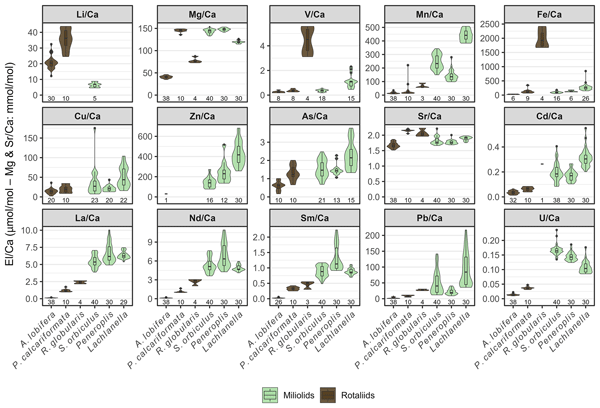
More importantly, Figure 3 is confusing and I am not sure what it says relative to figure 2. For example, the Nd/Ca vary greatly within the Rotaliida (more than an order of magnitude), while those of the miliolids are much more similar. Figure 2, however, suggests the opposite.
Figures 2 and 3 were based on the same dataset and were intended to show complementary aspects of the results. For Nd/Ca, miliolids are approximately 40× higher than rotaliids in Figure 2, and Figure 3 showed the same general pattern: miliolids were strongly enriched relative to Amphistegina lobifera, whereas rotaliids, including the relatively enriched P. calcariformata and Rosalina, remained much lower.
We agree, however, that the presentation in Figure 3 may have been confusing, particularly because the logarithmic y-axis compressed large absolute differences and made the relationship between Figures 2 and 3 less clear. Since Figure 3 did not add sufficiently distinct information beyond what is already shown more clearly in Figures 2 and 4, we have decided to remove Figure 3 from the revised manuscript. This revision simplifies the presentation of the results and avoids redundancy, while retaining the key order-level and species-level patterns in the remaining figures.
Figure 3 is maybe meant to show the differences between species, but that can better be included in figure 2. But then it becomes just like figure 4.
We agree that inter-order patterns represent an essential first-order result, and this is precisely why we retain an order-level presentation. The miliolid-rotaliid geochemical dichotomy clearly exists across elements, with notable exceptions. Highlighting this structure allows the readers to recognize both the dominant inter-order signal and the taxa that deviate from it (e.g., P. calcariformata and Rosalina). These exceptions are central to the manuscript’s purpose to emphasize taxon-specific geochemical behavior rather than treat orders as internally uniform (Figure 4).
The overall differences between elements (i.e. in being enriched in the miliolids compared to the rotaliids) is also summarized in figure 5. So, I think figures 2 and 3 can be removed: figure 4 essentially has all the data and figure 5 summarizes all that data. Table 1 can also be removed: the actual data is in table S2 and the numbers that are now in table 1 are already in figure 2/ 4. The order in which the figures are referred to in the text is incorrect (line 157), which to me also indicates that the order of the figures/ their contents should be changed. Section 3.2 is called ‘intra-order variability’, but this is already shown in the preceding section (figure 3).
We have removed Table 1, as the numerical values are indeed available in Table S2 and are also represented graphically. Regarding the figures, we agree that there was some redundancy in the original version and that the figure order required clarification. We have therefore revised the order of figures to ensure a logical progression in the manuscript and corrected the corresponding in-text citations.
Discussion
The authors are keen on stating that there is a systematic difference between rotaliids and miliolids, but that is not apparent from this dataset. The difference in biomineralization mechanisms is well documented and it makes perfect sense that this translates to an overall difference in elemental (and isotopic) composition. However, the results presented here paint a more nuanced picture: Mg/Ca varies within rotaliids, with one species having a similar Mg/Ca as the three miliolids (figure 4). For As, La and Nd, the averages may be different, but ratios within the rotaliids and miliolids for these elements are large compared to the between-group variability. This doesn’t convince me of a clear dichotomy (e.g. line 272).
We appreciate this comment and agree that the dataset is more nuanced than a simple binary separation between miliolids and rotaliids. We have revised the manuscript to make this nuance clearer. At the same time, we retain the term “dichotomy” because we use it to describe the first-order miliolid–rotaliid pattern, not an absolute separation for every element or species. This terminology is also consistent with the well-established differences in miliolid and rotaliid test formation and El/Ca, as also noted by Ellen Thomas.
Across most measured elements, miliolids show higher El/Ca ratios than rotaliids, with the strongest contrasts observed for REEs, Mn, Pb, and U. We now emphasize that this first-order inter-order pattern is modified by substantial intra-order and species-level variability. Mg/Ca is treated explicitly as a special case: it is better described as a continuum between rotaliids and miliolids rather than a strict dichotomy. Within this continuum, however, miliolids consistently occupy the high-Mg/Ca end, whereas rotaliids show a broader range, including P. calcariformata, which approaches miliolid values.
We also revised the Discussion to clarify that the novelty of the manuscript is not the basic recognition that miliolids and rotaliids biomineralize differently, but rather the demonstration that this first-order pattern extends across a broad suite of elements in co-occurring taxa, including elements for which data are still scarce, particularly REEs and miliolids.
In short, these data require some more in-depth thinking. When not considering rotaliids versus miliolids, there is a pattern that seems very consistent, but not thematized by the authors: high and low El/Ca are correlated within species. This is likely the ground for ordering the species as was done in figure 4: A. lobifera has lowest El/Ca for almost all elements, P. calcariformata second lowest, etc. This inter-element correlation may indicate the influence of certain (physiological) processes. See Branson and De Nooijer, 2025. Elements 21: 105-111. DOI: 10.2138/gselements.21.2.105 for some ideas on this. Marchitto et al. (2018), EPSL 481: 20-29 is another great article that aims at mechanistically explaining observed correlations between elements. I encourage the authors to explore similar ideas.
This is an important observation, and we have now revised the Discussion to address it directly. We agree that the rotaliid data show a consistent species-level ranking rather than scattered element-by-element variability. In particular, A. lobifera generally exhibits the lowest El/Ca ratios across many elements, whereas P. calcariformata shows higher values for several elements, including Mg/Ca. We now explicitly discuss this ranking as evidence that high and low El/Ca values are partly correlated within species, suggesting shared physiological controls on elemental incorporation.
Following this suggestion, we incorporated the conceptual synthesis of Branson and de Nooijer (2025), as well as the mechanistic approach of Marchitto et al. (2018), into the revised Discussion. We now interpret the species-level ranking in terms of differences in calcifying-fluid regulation, including Ca addition, calcifying-fluid renewal, precipitation dynamics, Rayleigh-type enrichment, Mg exclusion, and calcification kinetics.
Specifically, we suggest that the consistently low El/Ca values in A. lobifera may reflect stronger or more persistent physiological regulation of the calcifying fluid, such as more effective Ca addition, more frequent renewal of the calcifying medium, reduced precipitation-driven enrichment, or slower and more regulated calcification. Its thick, multilayered test may further average numerous chamber-formation and secondary-calcification events toward a stable species-specific low-El/Ca signature. By contrast, the higher El/Ca values of P. calcariformata may reflect lower renewal, weaker trace-element exclusion, stronger precipitation-driven evolution of the calcifying fluid, or faster calcification kinetics. This addition helped us better separate two levels of structure in the data: the first-order miliolid-rotaliid dichotomy and the species-level physiological variability within each order.
In addition, there is much more literature on miliolid (and large benthic rotaliid) El/Ca. It may be that after combining these new data with existing data provides indeed a (more) robust picture of rotaliid versus miliolid shell chemistry, but that should than be included in this discussion. It may may also lead to the acknowledgement that in rotaliids in particular, the El/Ca can vary greatly, which begs the question what ‘the rotaliid calcification mechanism’ really is and how it relates to El/Ca…
We agree and have substantially expanded the comparison with published data. We compiled available published El/Ca data for each measured element and added these comparisons to the Supplementary Material as Figs. S1–S15. These figures allow readers to evaluate how our data compare with previous measurements across taxa, environments, and analytical approaches.
This comparison strengthened and refined our interpretation. It shows that the present study substantially expands the available dataset for miliolids and for REEs, for which published data remain limited. At the same time, it confirms that rotaliids display considerable El/Ca variability and should not be treated as a chemically uniform group. We now state this explicitly in the revised Discussion.
We also revised the text to avoid implying that there is a single uniform “rotaliid calcification mechanism.” Instead, we now describe rotaliid calcification as a shared perforate biomineralization pathway that is modified by species-specific physiological controls. This framing better captures the observed ranking from low El/Ca in A. lobifera to higher values in P. calcariformata, while preserving the broader miliolid-rotaliid contrast.
Citation: https://doi.org/10.5194/egusphere-2026-38-AC1 -
AC3: 'Reply on RC1', Sigal Abramovich, 07 May 2026
The comment was uploaded in the form of a supplement: https://egusphere.copernicus.org/preprints/2026/egusphere-2026-38/egusphere-2026-38-AC3-supplement.pdf
- AC4: 'Reply on RC1', Sigal Abramovich, 07 May 2026
-
AC1: 'Reply on RC1', Sigal Abramovich, 07 May 2026
-
RC2: 'Comment on egusphere-2026-38', Ellen Thomas, 01 Mar 2026
Comments on Biogeochemical Dichotomy and Intra-Order Variability in Miliolid and Rotaliid Foraminifera
Ellen Thomas
Overall, I liked this dataset on El/Ca in the two main clades of calcifying benthic foraminifera, including some commonly analyzed El/Ca data (e.g. Mg/Ca) and some El/Ca on which not many data are available (e.g., REE/Ca), and think it is suitable for publication. However, I see problems in the discussion/interpretation of the data, and the authors do not clearly explain what is novel in their story, since dichotomy between miliolid/rotaliid test formation and El/Ca has been long and extensively documented. I therefore recommend potential acceptance after major revision.
As I understand the main goal of this work, the authors aim to evaluate the (relative or absolute) importance of 'biological' and 'environmental' effects on incorporation of trace elements in foraminiferal calcite, and do this by analyzing representatives of different, widely divergent foraminiferal clades from the same samples (i.e., same environment). My problems are the following:
- The authors have not collected/presented environmental data on factors that could influence element incorporation at the sample locality, e.g., temperature (clearly of importance of Mg/Ca), salinity, carbonate saturation, Ca-concentration, pH. Without such data, we do not know what El/Ca would be at equilibrium precipitation at the location, and we cannot compare data correctly to data from other locations. In my opinion, one should compare El/Ca in non-biologically precipitated calcite with that in foraminifera in order to fully evaluate the relative importance of 'environmental' and 'biological'; effects. I would expect that for most elements discussed here, distribution coefficients are available, so one could calculate at least the theoretical El/Ca (and in quite a few cases, e.g., see below, cultivation data are available).
- Linked to 1: this may well be minor at the studied locality, but I wonder about the comparison of data on larger and smaller foraminiferal taxa and a potential source of differences by taxon. In general, larger foraminifera have longer life times than smaller ones (possibly years vs. weeks), thus whole-test analyses of larger foraminifera would represent longer time periods. Is there short-term variability in the environment which might show up differently in analysis of shorter-lived vs. longer-lived taxa?
- Importantly, I think the authors do not sufficiently compare their data with the large amount of published material - I provide just a few instances below, where I list e.g. several publications on El/Ca in Amphistegina, a genus studied here. Yes, many fewer data are available on miliolids than on rotaliids, but the authors do not refer to e.g., the classical data in Blackmon and Todd 1959 (J of Paleontology 33, 1-15) including data points on Mg/Ca in miliolids in similarly shallow environments as the present study. Nardelli et al., 2016, comment on Zn in a miliolid (Mar Micropal 126, 42-49). Planktic forams are all rotaliids, so how do their values in e.g., Nd/Ca in planktic forams sampled in the water column (in contrast to sediment) compare with the ones shown here? (e.g. Pomies et al., EPSL 2002, 1031-1045)? How about Palmer 1985, EPSL 73, 285-298 on REE, specifically 'lattice REE', or Haley et al., 2005, EPSL 239, 79-97? How about Li/Ca (LeHouedec et al., 2021, G3, 22, e2020GC009496)? or Langer et al., 2015, and Charrieau et al., 2023, on Li incorporation, in Amphistegina (Charriaeu et al., 2023; Minerals 2023, 13, 127; including cultivation data)? Levi et al., 2019, on various trace elements and intrashell variability within Amphistegina (Front Earth Sci 7, 247)? Raitsch et al., 2010, Biogeosciences 7, 869-881,: Ca-saturation state effects on Mg and Sr incorporation in Heterostegina? I thus think that the authors do not look into possible reasons for the extent and /or lack thereof of the dichotomy in sufficient detail, by comparison with relevant literature.
I would have greatly appreciated a table in which the authors, for every El/Ca analyzed, compare their values with a range of published ones (as far as possible), to show the reader which of their El/Ca data are novel (or novel for miliolids), to what extent El/Ca at the studied location compare to data in other environments, e.g. in other species of rotaliids, in order to better evaluate the importance of environmental effects. In my opinion, the authors' conclusions on the predominance of the biotic effects may not be as convincing if more literature is considered. Specifically, the authors pay little attention to the long-known great variability within Mg/Ca in rotaliids (where environmental effects, of temperature, are obviously present), with some rotaliids having Mg/Ca values as high as miliolids (as they show in their figs. 2, 4). In Mg/Ca data discussion if variability there is no mention of the potential effects on the dichotomy of of the commonly observed banding in rotaliids, which obviously does not occur in miliolids (e.g., see van Dijk et al., 2019, for review and reference to plankton and benthos incl. Amphistegina; Front Earth Sci 7, 281; Geerken et al., 2019, Sci Reports, 9, 3598; Amphistegina and Ammonia). In conclusion, I think that there is insufficient evaluation of the abundant literature, to justify the statement that the authors established 'baseline element ranges for both orders' (282-283).
Lesser importance:
- I do not think Figure 3 particularly informative; what is its goal?
- Typos in name R. globularis/glabolaris (fig 4).
- 233: the authors state that 'Mn/Ca in Lachlanella provides one of the clearest examples of an environmentally influenced signal .This is of course a subjective statement, possibly based mainly on data in this paper, but I would say that the widespread use of Mg/Ca as temperature proxy shows that Mg/Ca is possibly the clearest example of an environmentally based signal.
- 261: give reference for statement that Mg/Ca rose in Eocene - in many publications time resolution is too low to state so with confidence, and it may have risen much later, in the Neogene (e.g. see Evans et al., 2026, PNAS 123, e251178112)
- 278: any evidence for this non-linear uptake?
Citation: https://doi.org/10.5194/egusphere-2026-38-RC2 -
AC2: 'Reply on RC2', Sigal Abramovich, 07 May 2026
Ellen Thomas
Overall, I liked this dataset on El/Ca in the two main clades of calcifying benthic foraminifera, including some commonly analyzed El/Ca data (e.g. Mg/Ca) and some El/Ca on which not many data are available (e.g., REE/Ca), and think it is suitable for publication. However, I see problems in the discussion/interpretation of the data, and the authors do not clearly explain what is novel in their story, since dichotomy between miliolid/rotaliid test formation and El/Ca has been long and extensively documented. I therefore recommend potential acceptance after major revision.
We thank Ellen Thomas for the positive evaluation of the dataset and for pointing out that the novelty was not sufficiently clear. We agree that differences in test formation between miliolids and rotaliids are well known, and that Mg/Ca differences have been widely documented.
However, the broader El/Ca pattern is not equally well established for the full suite of elements examined here. Data on miliolids remain sparse compared with rotaliids, and this is especially true for REEs and other less commonly measured elements. We have therefore revised the manuscript to clarify that the novelty is not the recognition of different biomineralization pathways, but the demonstration that this distinction is expressed across a broad suite of elements in co-occurring miliolid and rotaliid taxa from the same environment.
To address this point directly, we added a comparison with available published data for each measured element in the Supplementary Material, highlighting the contribution of this study (Figs. S1–S15). This comparison shows that our study substantially expands the available geochemical dataset for miliolids and for REEs, while also confirming that rotaliids display considerable El/Ca variability. We also revised the Discussion to better
acknowledge previous work and to emphasize both the first-order inter-order pattern and the important species-level variability.
As I understand the main goal of this work, the authors aim to evaluate the (relative or absolute) importance of 'biological' and 'environmental' effects on incorporation of trace elements in foraminiferal calcite, and do this by analyzing representatives of different, widely divergent foraminiferal clades from the same samples (i.e., same environment). My problems are the following:
The authors have not collected/presented environmental data on factors that could influence element incorporation at the sample locality, e.g., temperature (clearly of importance of Mg/Ca), salinity, carbonate saturation, Ca-concentration, pH. Without such data, we do not know what El/Ca would be at equilibrium precipitation at the location, and we cannot compare data correctly to data from other locations. In my opinion, one should compare El/Ca in non-biologically precipitated calcite with that in foraminifera in order to fully evaluate the relative importance of 'environmental' and 'biological'; effects. I would expect that for most elements discussed here, distribution coefficients are available, so one could calculate at least the theoretical El/Ca (and in quite a few cases, e.g., see below, cultivation data are available).
We agree that environmental context is important for interpreting El/Ca data and for comparing our results with other studies. We have therefore added regional environmental information for the Nahsholim/Dor HaBonim coastal area to the revised manuscript. Although site-specific carbonate-system measurements were not collected during sampling, regional monitoring of the Israeli Mediterranean shelf indicates that the area is representative of shallow eastern Levantine coastal seawater, with near-surface temperatures of approximately 16-18°C in winter and 28-30°C in summer, salinity of ~38.8-39.6, and slightly alkaline seawater pH of ~8.1-8.2. These values indicate strong seasonal temperature variability, persistently high salinity, and relatively stable alkaline carbonate-system conditions.
We also clarify that the main objective of this study was not to calculate equilibrium precipitation values or to quantify absolute partitioning relative to inorganic calcite. Rather, the study was designed as a comparative test among co-occurring taxa collected from the same coastal setting and, in many cases, the same habitats. Because these taxa experienced broadly shared ambient seawater conditions, their systematic differences in El/Ca can be interpreted primarily as taxon-specific and order-level differences in elemental incorporation. In this context, comparison with inorganic calcite is not required to establish the relative differences among the taxa studied here, although it may provide an additional constraint in future experimental work.
Linked to 1: this may well be minor at the studied locality, but I wonder about the comparison of data on larger and smaller foraminiferal taxa and a potential source of differences by taxon. In general, larger foraminifera have longer life times than smaller ones (possibly years vs. weeks), thus whole-test analyses of larger foraminifera would represent longer time periods. Is there short-term variability in the environment which might show up differently in analysis of shorter-lived vs. longer-lived taxa?
We agree that differences in life span, test size, and test architecture may influence whole-test chemistry, because larger and longer-lived taxa may integrate environmental and physiological variability over longer time periods than smaller taxa. We now address this point in the revised Discussion. In particular, we discuss A. lobifera, which has a thick, multilayered test and therefore integrates numerous chamber-formation and secondary-calcification events over its lifetime.
At the same time, we do not think that size or life span alone explains the observed patterns. For example, small planktonic rotaliids and small benthic taxa such as Ammonia commonly show low Mg/Ca, whereas P. calcariformata shows high Mg/Ca despite being a rotaliid. We therefore interpret test size and life span as factors that influence signal integration, rather than as primary controls on El/Ca. In the revised text, we now state that whole-test analyses may average multiple calcification events toward a persistent species-specific signature. This may contribute to the consistently low El/Ca values of A. lobifera if repeated calcification events occur under strong physiological regulation.
Importantly, I think the authors do not sufficiently compare their data with the large amount of published material - I provide just a few instances below, where I list e.g. several publications on El/Ca in Amphistegina, a genus studied here. Yes, many fewer data are available on miliolids than on rotaliids, but the authors do not refer to e.g., the classical data in Blackmon and Todd 1959 (J of Paleontology 33, 1-15) including data points on Mg/Ca in miliolids in similarly shallow environments as the present study. Nardelli et al., 2016, comment on Zn in a miliolid (Mar Micropal 126, 42-49). Planktic forams are all rotaliids, so how do their values in e.g., Nd/Ca in planktic forams sampled in the water column (in contrast to sediment) compare with the ones shown here? (e.g. Pomies et al., EPSL 2002, 1031-1045)? How about Palmer 1985, EPSL 73, 285-298 on REE, specifically 'lattice REE', or Haley et al., 2005, EPSL 239, 79-97? How about Li/Ca (LeHouedec et al., 2021, G3, 22, e2020GC009496)? or Langer et al., 2015, and Charrieau et al., 2023, on Li incorporation, in Amphistegina (Charriaeu et al., 2023; Minerals 2023, 13, 127; including cultivation data)? Levi et al., 2019, on various trace elements and intrashell variability within Amphistegina (Front Earth Sci 7, 247)? Raitsch et al., 2010, Biogeosciences 7, 869-881,: Ca-saturation state effects on Mg and Sr incorporation in Heterostegina? I thus think that the authors do not look into possible reasons for the extent and /or lack thereof of the dichotomy in sufficient detail, by comparison with relevant literature.
I would have greatly appreciated a table in which the authors, for every El/Ca analyzed, compare their values with a range of published ones (as far as possible), to show the reader which of their El/Ca data are novel (or novel for miliolids), to what extent El/Ca at the studied location compare to data in other environments, e.g. in other species of rotaliids, in order to better evaluate the importance of environmental effects. In my opinion, the authors' conclusions on the predominance of the biotic effects may not be as convincing if more literature is considered.
We agree and have substantially expanded the comparison with existing literature. Instead of a single table, we prepared element-by-element graphical comparisons, now included in the Supplementary Material as Figs. S1-S15. These figures compile available published El/Ca data for each measured element and allow the reader to compare our values with previous measurements across taxa, environments, and analytical approaches. We have also incorporated and discussed the additional literature suggested by the reviewer, including studies addressing Mg/Ca variability, Li incorporation (e.g., Le Houedec et al.; Charrieau et al.), REEs (e.g., Palmer; Haley et al.), intrashell variability (e.g., Levi et al.), and carbonate system effects (e.g., Raitzsch et al.), among others.
Importantly, in assembling these comparisons we aimed to maintain “apples-to-apples” consistency as much as possible. Not all published datasets are directly comparable due to differences in: Sample type (cultured vs. field-collected; sediment vs. water column), cleaning protocols and contamination control, environmental context. For this reason, some datasets were not included in the graphical compilation or are discussed with caution. For example, in Nardelli et al., 2016 the authors note that the “control” seawater used in the experiment was inadvertently contaminated prior to analysis, which complicates its use as a natural baseline for Zn/Ca comparison. Similar considerations apply to other datasets where experimental conditions or analytical artifacts limit direct comparability to our field-based measurements.
This addition substantially strengthens the revised manuscript. It shows that our study expands the available dataset for miliolids, which remain underrepresented relative to rotaliids, and especially expands available data for REEs. It also confirms that rotaliids display substantial El/Ca variability and should not be treated as chemically uniform. We now refer to this comparison explicitly in the revised Discussion and use it to clarify the novelty of the study: not the basic recognition that miliolids and rotaliids biomineralize differently, but the demonstration that this first-order pattern extends across a broad suite of elements in co-occurring taxa, including elements that are still poorly constrained in miliolids and REEs in both groups.
Specifically, the authors pay little attention to the long-known great variability within Mg/Ca in rotaliids (where environmental effects, of temperature, are obviously present), with some rotaliids having Mg/Ca values as high as miliolids (as they show in their figs. 2, 4). In Mg/Ca data discussion if variability there is no mention of the potential effects on the dichotomy of of the commonly observed banding in rotaliids, which obviously does not occur in miliolids (e.g., see van Dijk et al., 2019, for review and reference to plankton and benthos
incl. Amphistegina; Front Earth Sci 7, 281; Geerken et al., 2019, Sci Reports, 9, 3598; Amphistegina and Ammonia). In conclusion, I think that there is insufficient evaluation of the abundant literature, to justify the statement that the authors established 'baseline element ranges for both orders' (282-283).
We agree and have revised the Mg/Ca discussion accordingly. We now explicitly state that Mg/Ca is best described as a continuum between rotaliids and miliolids rather than a strict dichotomy. Miliolids consistently occupy the high-Mg/Ca end, but rotaliids show a broad range, including species such as P. calcariformata that overlap with miliolid values.
We also expanded the discussion of Mg/Ca variability in rotaliids and now refer to previous LA-ICP-MS and NanoSIMS studies showing strong intra-individual variability, including Mg banding and possible diurnal effects. Because our study is based on whole-test ICP-MS analyses, it averages chamber-scale and banding-related variability. This is a limitation with respect to resolving intra-test processes, but it is also useful for identifying persistent taxon-level differences among co-occurring species. We now make this distinction clearer in the revised Discussion.
In addition, we revised the mechanistic discussion to clarify that Mg requires a separate interpretation from most trace elements. Although miliolids show high Mg/Ca relative to most rotaliids, Mg incorporation remains biologically suppressed relative to inorganic calcite. Thus, high Mg/Ca in miliolids reflects weaker Mg exclusion or higher Mg/Ca in the calcifying fluid relative to many rotaliids, rather than absence of biological control.
Lesser importance:
I do not think Figure 3 particularly informative; what is its goal?
Agree. We removed the original Figure 3 from the revised manuscript.Typos in name R. globularis/glabolaris (fig 4).
Thank you for noting this typographical error. The species name has been corrected to Rosalina globularis throughout the manuscript and in the figure.233: the authors state that 'Mn/Ca in Lachlanella provides one of the clearest examples of an environmentally influenced signal .This is of course a subjective statement, possibly based mainly on data in this paper, but I would say that the widespread use of Mg/Ca as temperature proxy shows that Mg/Ca is possibly the clearest example of an environmentally based signal.
We agree and have softened this statement. We did not intend to imply that Mn/Ca is the clearest environmentally controlled signal in foraminifera in general. We revised the wording to refer to Mn/Ca in Lachlanella as a likely example of a microhabitat-related redox influence within our dataset. We also clarified that this interpretation is based on the co-enrichment of Mn, Fe, and V and the association of Lachlanella with denser algal turf microhabitats, where periodic oxygen depletion may occur.
261: give reference for statement that Mg/Ca rose in Eocene - in many publications time resolution is too low to state so with confidence, and it may have risen much later, in the Neogene (e.g. see Evans et al., 2026, PNAS 123, e251178112)
We agree that the original wording was too strong. We revised this part of the Discussion to avoid relying on a precise timing of seawater Mg/Ca increase as a central argument. Instead, we now state the point more cautiously and emphasize that Mg incorporation appears primarily governed by species-specific biological regulation rather than by ambient seawater chemistry alone. We also added the relevant reference suggested by the reviewer where appropriate.
278: any evidence for this non-linear uptake?
In the revised text, we now state that elevated uptake and possible stronger Rayleigh-type enrichment in miliolids may result in element-specific or non-linear incorporation, especially under elevated concentrations, and that this requires species- and element-specific calibration experiments.
Citation: https://doi.org/10.5194/egusphere-2026-38-AC2
Peer review completion


Interactive discussion
Status: closed
-
RC1: 'Comment on egusphere-2026-38', Lennart de Nooijer, 04 Feb 2026
Dear editor,
I have carefully read the manuscript by Hoober and co-workers on the El/Ca of several rotaliid and miliolid foraminifera (egusphere-2026-38). Overall, I am very enthusiastic about the presented dataset! Adding ‘unusual’ elements and overlooked species to the global dataset is indeed the only way to come to an integrated understanding of foraminiferal biomineralization. It is also necessary to improve the applicability (e.g. development of new proxies) of foraminiferal El/Ca downcore. I do recommend publication of this manuscript in EGUsphere, but only after major revisions. The important issues I have with this work are listed below and concern 1) a lack of ICP-MS- and statistics-related details in the methods, 2) representation of the main results and 3) a more elaborate discussion of the main findings. In addition, minor corrections are provided through the annotated pdf.
Sincerely,
Lennart de NooijerMethods
I see that cleaning and dissolution of the foraminiferal shells did not lead to samples with a similar Ca concentration. This is, however, important to minimize matrix-effects. Also, the names of the standards need to be included; I suspect the second ‘standard’, the homogenized shells of A. lobifera, does not count as a standard (see e.g. Boer et al., 2022). Geostandards and Geoanalytical Research 46(3): 411-432. DOI: 10.1111/ggr.12425. Finally, basic metrics of the measurements should be provided: e.g. accuracies or LODs, as well as the masses scanned (e.g. which isotope(s) of Mg were measured?) and any procedures to account for interferences.
Vital statistical information is missing. A PCA is presented, but not mentioned in the method section. What software was used to do the PCA and how was the data treated (normalized, transformed, etc.)? Was all data included? I guess the larger dots are the averages for that species, but the caption doesn’t say so. What happened to Rosalina (not included in the PCA)?
Results
Figures 2, 3 and 4 overlap with each other and therefore the results may be better presented differently. Btw, the box-whisker plots of figure 2 are unclear: often the whiskers extend towards the minimum and maximum values, but here there seem to be outliers identified. If/ how this is done, however, is not mentioned in the Methods. And what is the difference between two (Sr) and three asterisks (e.g. Mg)? Horizontal axes do not have to have ‘Rotaliids’ and ‘Miliolids’; those are already in the legend.
More importantly, figure 3 is confusing and I am not sure what it says relative to figure 2. For example, the Nd/Ca vary greatly within the Rotaliida (more than an order of magnitude), while those of the miliolids are much more similar. Figure 2, however, suggests the opposite. Figure 3 is maybe meant to show the differences between species, but that can better be included in figure 2. But then it becomes just like figure 4. The overall differences between elements (i.e. in being enriched in the miliolids compared to the rotaliids) is also summarized in figure 5. So, I think figures 2 and 3 can be removed: figure 4 essentially has all the data and figure 5 summarizes all that data. Table 1 can also be removed: the actual data is in table S2 and the numbers that are now in table 1 are already in figure 2/ 4. The order in which the figures are referred to in the text is incorrect (line 157), which to me also indicates that the order of the figures/ their contents should be changed. Section 3.2 is called ‘intra-order variability’, but this is already shown in the preceding section (figure 3).
Discussion
The authors are keen on stating that there is a systematic difference between rotaliids and miliolids, but that is not apparent from this dataset. The difference in biomineralization mechanisms is well documented and it makes perfect sense that this translates to an overall difference in elemental (and isotopic) composition. However, the results presented here paint a more nuanced picture: Mg/Ca varies within rotaliids, with one species having a similar Mg/Ca as the three miliolids (figure 4). For As, La and Nd, the averages may be different, but ratios within the rotaliids and miliolids for these elements are large compared to the between-group variability. This doesn’t convince me of a clear dichotomy (e.g. line 272).
In short, these data require some more in-depth thinking. When not considering rotaliids versus miliolids, there is a pattern that seems very consistent, but not thematized by the authors: high and low El/Ca are correlated within species. This is likely the ground for ordering the species as was done in figure 4: A. lobifera has lowest El/Ca for almost all elements, P. calcariformata second lowest, etc. This inter-element correlation may indicate the influence of certain (physiological) processes. See Branson and De Nooijer, 2025. Elements 21: 105-111. DOI: 10.2138/gselements.21.2.105 for some ideas on this. Marchitto et al. (2018), EPSL 481: 20-29 is another great article that aims at mechanistically explaining observed correlations between elements. I encourage the authors to explore similar ideas.
In addition, there is much more literature on miliolid (and large benthic rotaliid) El/Ca. It may be that after combining these new data with existing data provides indeed a (more) robust picture of rotaliid versus miliolid shell chemistry, but that should than be included in this discussion. It may may also lead to the acknowledgement that in rotaliids in particular, the El/Ca can vary greatly, which begs the question what ‘the rotaliid calcification mechanism’ really is and how it relates to El/Ca…
-
AC1: 'Reply on RC1', Sigal Abramovich, 07 May 2026
Lennart de Nooijer
Dear editor,
I have carefully read the manuscript by Hoober and co-workers on the El/Ca of several rotaliid and miliolid foraminifera (egusphere-2026-38). Overall, I am very enthusiastic about the presented dataset! Adding ‘unusual’ elements and overlooked species to the global dataset is indeed the only way to come to an integrated understanding of foraminiferal biomineralization. It is also necessary to improve the applicability (e.g. development of new proxies) of foraminiferal El/Ca downcore. I do recommend publication of this manuscript in EGUsphere, but only after major revisions. The important issues I have with this work are listed below and concern 1) a lack of ICP-MS- and statistics-related details in the methods, 2) representation of the main results and 3) a more elaborate discussion of the main findings. In addition, minor corrections are provided through the annotated pdf.Sincerely, Lennart de Nooijer
We thank Lennart for the careful and constructive evaluation of our manuscript and for the very positive assessment of the dataset. We especially appreciate his suggestion to engage with the recent conceptual synthesis by Branson and de Nooijer (2025). Reading and incorporating this work was very helpful and gave us new insight into possible biomineralization mechanisms behind our data. It encouraged us to think more deeply about calcifying-fluid modification, Rayleigh-type enrichment, Mg exclusion, and the species-level ranking of El/Ca values within rotaliids.
In response to the comments, we substantially revised the manuscript. First, we expanded the Methods section to include additional ICP-MS details, including standards, limits of detection, measured isotopes, interference control, and the statistical treatment of the data. We also clarified the PCA methodology, including data filtering, scaling, software, interpretation of species centroids, and the reason why Rosalina globularis was excluded from the final PCA.
Second, we reorganized the presentation of the results to reduce redundancy among figures. In particular, we removed the original Figure 3, which was confusing and overlapped with other figures. The revised figure sequence now more clearly separates the order-level comparison between miliolids and rotaliids from the species-level variability within each order. We also clarified the boxplot conventions and the meaning of the statistical significance symbols.
Third, we substantially revised the Discussion. We present the miliolid–rotaliid contrast as a strong first-order inter-order pattern, while explicitly acknowledging the important intra-order and species-level variability. We also expanded the mechanistic interpretation by incorporating the ideas of Branson and de Nooijer (2025), Elderfield et al. (1996), and Marchitto et al. (2018), including the balance between Ca addition, calcifying-fluid renewal, Rayleigh-type enrichment, Mg exclusion, calcification kinetics, and element-specific transport. Finally, we added a broader comparison with published El/Ca datasets in the Supplementary Material, which helped us better place our results within the existing literature and highlight the contribution of the present dataset, particularly for miliolids and REEs
Methods
I see that cleaning and dissolution of the foraminiferal shells did not lead to samples with a similar Ca concentration. This is, however, important to minimize matrix-effects.
All samples were subjected to identical cleaning, dissolution, and dilution procedures. Although the foraminiferal samples represent different species and therefore did not yield identical absolute Ca concentrations due to variations in shell mass, potential matrix effects were minimized by normalization of all elemental concentrations to Ca (El/Ca ratios). Consequently, variations in absolute Ca concentration do not affect the comparison of trace-element compositions among samples, and inter-species differences primarily reflect variation in trace-element incorporation rather than analytical matrix effects.
Also, the names of the standards need to be included; I suspect the second ‘standard’, the homogenized shells of A. lobifera, does not count as a standard (see e.g. Boer et al., 2022). Geostandards and Geoanalytical Research 46(3): 411-432. DOI: 10.1111/ggr.12425.
Indeed, the homogenized A. lobifera shells do not constitute an independent reference material for accuracy assessment. These materials were used only to monitor analytical reproducibility, while accuracy was evaluated exclusively using the in-house carbonate standard M16-8 with assigned values. See line 123 of the revised manuscript.
Finally, basic metrics of the measurements should be provided: e.g. accuracies or LODs, as well as the masses scanned (e.g. which isotope(s) of Mg were measured?) and any procedures to account for interferences. We have expanded the analytical Methods section to include basic performance metrics of the elemental measurements. Specifically, Limits of detection (LODs) were determined based on repeated measurements of procedural blanks and are now reported in the Supplementary Material (Table S1B). The isotopes list (24Mg, 43Ca, 55Mn, 63Cu, 88Sr, 111Cd, 139La, 146Nd, 147Sm, 208Pb, and 238U) was added to the methods (lines 118-119). Potential polyatomic and isobaric interferences were minimized by appropriate isotope selection and instrument tuning. For elements prone to interferences (e.g. Mg, Mn), background subtraction and oxide production monitoring were applied following standard ICP-MS protocols. These procedures are now described in the Methods (lines 120-121).
Vital statistical information is missing. A PCA is presented, but not mentioned in the method section. What software was used to do the PCA and how was the data treated (normalized, transformed, etc.)? Was all data included? I guess the larger dots are the averages for that species, but the caption doesn’t say so. What happened to Rosalina (not included in the PCA)?
We agree that the description of the PCA was insufficient in the original version, and we have now clarified the methodology, data treatment, and figure interpretation accordingly (Lines 138-140). PCA was performed in R (version 4.1.1) using the prcomp() function from the base stats package, with visualization carried out using the factoextra and ggplot2 packages.
Before PCA, elements with > 50% missing values were excluded (Lines 139-140). The remaining data were mean-centered and scaled to unit variance (z-score standardization), such that PCA was conducted on the correlation matrix. No additional transformations (e.g. log transformation) were applied. The larger symbols indicate species centroids, corresponding to the multivariate mean position of each species in PCA space, and ellipses represent the 95% confidence region. This information was added to the figure 3 (former figure 5) caption.
Rosalina samples were not included in the final PCA because, after element filtering, all Rosalina samples contained missing values in at least one of the retained elements and were therefore excluded during the PCA preprocessing step. This has now been clarified in the Methods section and the figure caption to avoid ambiguity. We have revised both the Methods section and Figure 3 caption to address these points and improve transparency.
Results
Figures 2, 3 and 4 overlap with each other and therefore the results may be better presented differently.
We agree that the original Figures 2-4 were partially overlapping because they were derived from the same dataset. To improve clarity and avoid redundancy, Figure 3 has been removed from the revised manuscript.In the revised version, the remaining figures serve distinct and complementary purposes:Figure 2 summarizes the order-level contrast (miliolids vs. rotaliids), emphasizing the magnitude and consistency of the inter-order geochemical differences.Figure 4 presents the species-level variability within each order, highlighting taxon-specific distributions and statistically significant differences among species.
We believe that this revision simplifies the presentation of the results while still clearly conveying both the first-order differences between the two orders and the variability among species within each group.
Btw, the box-whisker plots of figure 2 are unclear: often the whiskers extend towards the minimum and maximum values, but here there seem to be outliers identified. If/ how this is done, however, is not mentioned in the Methods.
In Figure 2, boxplots follow the standard Tukey convention: the box represents the interquartile range (IQR), the median is shown as a horizontal line, and whiskers extend to the most extreme data points within 1.5×IQR. Data points beyond this range are plotted as outliers. We have now explicitly added this description to the Methods section and clarified it in the Figure 2 caption, ensuring transparency in the statistical visualization.
And what is the difference between two (Sr) and three asterisks (e.g. Mg)? Horizontal axes do not have to have ‘Rotaliids’ and ‘Miliolids’; those are already in the legend.
The asterisks indicate different levels of statistical significance following Mann–Whitney U tests with FDR correction (p < 0.05, p < 0.01, p < 0.001). This has now been clearly stated in the Figure 2 caption and referenced in Methods.
More importantly, Figure 3 is confusing and I am not sure what it says relative to figure 2. For example, the Nd/Ca vary greatly within the Rotaliida (more than an order of magnitude), while those of the miliolids are much more similar. Figure 2, however, suggests the opposite.
Figures 2 and 3 were based on the same dataset and were intended to show complementary aspects of the results. For Nd/Ca, miliolids are approximately 40× higher than rotaliids in Figure 2, and Figure 3 showed the same general pattern: miliolids were strongly enriched relative to Amphistegina lobifera, whereas rotaliids, including the relatively enriched P. calcariformata and Rosalina, remained much lower.
We agree, however, that the presentation in Figure 3 may have been confusing, particularly because the logarithmic y-axis compressed large absolute differences and made the relationship between Figures 2 and 3 less clear. Since Figure 3 did not add sufficiently distinct information beyond what is already shown more clearly in Figures 2 and 4, we have decided to remove Figure 3 from the revised manuscript. This revision simplifies the presentation of the results and avoids redundancy, while retaining the key order-level and species-level patterns in the remaining figures.
Figure 3 is maybe meant to show the differences between species, but that can better be included in figure 2. But then it becomes just like figure 4.
We agree that inter-order patterns represent an essential first-order result, and this is precisely why we retain an order-level presentation. The miliolid-rotaliid geochemical dichotomy clearly exists across elements, with notable exceptions. Highlighting this structure allows the readers to recognize both the dominant inter-order signal and the taxa that deviate from it (e.g., P. calcariformata and Rosalina). These exceptions are central to the manuscript’s purpose to emphasize taxon-specific geochemical behavior rather than treat orders as internally uniform (Figure 4).
The overall differences between elements (i.e. in being enriched in the miliolids compared to the rotaliids) is also summarized in figure 5. So, I think figures 2 and 3 can be removed: figure 4 essentially has all the data and figure 5 summarizes all that data. Table 1 can also be removed: the actual data is in table S2 and the numbers that are now in table 1 are already in figure 2/ 4. The order in which the figures are referred to in the text is incorrect (line 157), which to me also indicates that the order of the figures/ their contents should be changed. Section 3.2 is called ‘intra-order variability’, but this is already shown in the preceding section (figure 3).
We have removed Table 1, as the numerical values are indeed available in Table S2 and are also represented graphically. Regarding the figures, we agree that there was some redundancy in the original version and that the figure order required clarification. We have therefore revised the order of figures to ensure a logical progression in the manuscript and corrected the corresponding in-text citations.
Discussion
The authors are keen on stating that there is a systematic difference between rotaliids and miliolids, but that is not apparent from this dataset. The difference in biomineralization mechanisms is well documented and it makes perfect sense that this translates to an overall difference in elemental (and isotopic) composition. However, the results presented here paint a more nuanced picture: Mg/Ca varies within rotaliids, with one species having a similar Mg/Ca as the three miliolids (figure 4). For As, La and Nd, the averages may be different, but ratios within the rotaliids and miliolids for these elements are large compared to the between-group variability. This doesn’t convince me of a clear dichotomy (e.g. line 272).
We appreciate this comment and agree that the dataset is more nuanced than a simple binary separation between miliolids and rotaliids. We have revised the manuscript to make this nuance clearer. At the same time, we retain the term “dichotomy” because we use it to describe the first-order miliolid–rotaliid pattern, not an absolute separation for every element or species. This terminology is also consistent with the well-established differences in miliolid and rotaliid test formation and El/Ca, as also noted by Ellen Thomas.
Across most measured elements, miliolids show higher El/Ca ratios than rotaliids, with the strongest contrasts observed for REEs, Mn, Pb, and U. We now emphasize that this first-order inter-order pattern is modified by substantial intra-order and species-level variability. Mg/Ca is treated explicitly as a special case: it is better described as a continuum between rotaliids and miliolids rather than a strict dichotomy. Within this continuum, however, miliolids consistently occupy the high-Mg/Ca end, whereas rotaliids show a broader range, including P. calcariformata, which approaches miliolid values.
We also revised the Discussion to clarify that the novelty of the manuscript is not the basic recognition that miliolids and rotaliids biomineralize differently, but rather the demonstration that this first-order pattern extends across a broad suite of elements in co-occurring taxa, including elements for which data are still scarce, particularly REEs and miliolids.
In short, these data require some more in-depth thinking. When not considering rotaliids versus miliolids, there is a pattern that seems very consistent, but not thematized by the authors: high and low El/Ca are correlated within species. This is likely the ground for ordering the species as was done in figure 4: A. lobifera has lowest El/Ca for almost all elements, P. calcariformata second lowest, etc. This inter-element correlation may indicate the influence of certain (physiological) processes. See Branson and De Nooijer, 2025. Elements 21: 105-111. DOI: 10.2138/gselements.21.2.105 for some ideas on this. Marchitto et al. (2018), EPSL 481: 20-29 is another great article that aims at mechanistically explaining observed correlations between elements. I encourage the authors to explore similar ideas.
This is an important observation, and we have now revised the Discussion to address it directly. We agree that the rotaliid data show a consistent species-level ranking rather than scattered element-by-element variability. In particular, A. lobifera generally exhibits the lowest El/Ca ratios across many elements, whereas P. calcariformata shows higher values for several elements, including Mg/Ca. We now explicitly discuss this ranking as evidence that high and low El/Ca values are partly correlated within species, suggesting shared physiological controls on elemental incorporation.
Following this suggestion, we incorporated the conceptual synthesis of Branson and de Nooijer (2025), as well as the mechanistic approach of Marchitto et al. (2018), into the revised Discussion. We now interpret the species-level ranking in terms of differences in calcifying-fluid regulation, including Ca addition, calcifying-fluid renewal, precipitation dynamics, Rayleigh-type enrichment, Mg exclusion, and calcification kinetics.
Specifically, we suggest that the consistently low El/Ca values in A. lobifera may reflect stronger or more persistent physiological regulation of the calcifying fluid, such as more effective Ca addition, more frequent renewal of the calcifying medium, reduced precipitation-driven enrichment, or slower and more regulated calcification. Its thick, multilayered test may further average numerous chamber-formation and secondary-calcification events toward a stable species-specific low-El/Ca signature. By contrast, the higher El/Ca values of P. calcariformata may reflect lower renewal, weaker trace-element exclusion, stronger precipitation-driven evolution of the calcifying fluid, or faster calcification kinetics. This addition helped us better separate two levels of structure in the data: the first-order miliolid-rotaliid dichotomy and the species-level physiological variability within each order.
In addition, there is much more literature on miliolid (and large benthic rotaliid) El/Ca. It may be that after combining these new data with existing data provides indeed a (more) robust picture of rotaliid versus miliolid shell chemistry, but that should than be included in this discussion. It may may also lead to the acknowledgement that in rotaliids in particular, the El/Ca can vary greatly, which begs the question what ‘the rotaliid calcification mechanism’ really is and how it relates to El/Ca…
We agree and have substantially expanded the comparison with published data. We compiled available published El/Ca data for each measured element and added these comparisons to the Supplementary Material as Figs. S1–S15. These figures allow readers to evaluate how our data compare with previous measurements across taxa, environments, and analytical approaches.
This comparison strengthened and refined our interpretation. It shows that the present study substantially expands the available dataset for miliolids and for REEs, for which published data remain limited. At the same time, it confirms that rotaliids display considerable El/Ca variability and should not be treated as a chemically uniform group. We now state this explicitly in the revised Discussion.
We also revised the text to avoid implying that there is a single uniform “rotaliid calcification mechanism.” Instead, we now describe rotaliid calcification as a shared perforate biomineralization pathway that is modified by species-specific physiological controls. This framing better captures the observed ranking from low El/Ca in A. lobifera to higher values in P. calcariformata, while preserving the broader miliolid-rotaliid contrast.
Citation: https://doi.org/10.5194/egusphere-2026-38-AC1 -
AC3: 'Reply on RC1', Sigal Abramovich, 07 May 2026
The comment was uploaded in the form of a supplement: https://egusphere.copernicus.org/preprints/2026/egusphere-2026-38/egusphere-2026-38-AC3-supplement.pdf
- AC4: 'Reply on RC1', Sigal Abramovich, 07 May 2026
-
AC1: 'Reply on RC1', Sigal Abramovich, 07 May 2026
-
RC2: 'Comment on egusphere-2026-38', Ellen Thomas, 01 Mar 2026
Comments on Biogeochemical Dichotomy and Intra-Order Variability in Miliolid and Rotaliid Foraminifera
Ellen Thomas
Overall, I liked this dataset on El/Ca in the two main clades of calcifying benthic foraminifera, including some commonly analyzed El/Ca data (e.g. Mg/Ca) and some El/Ca on which not many data are available (e.g., REE/Ca), and think it is suitable for publication. However, I see problems in the discussion/interpretation of the data, and the authors do not clearly explain what is novel in their story, since dichotomy between miliolid/rotaliid test formation and El/Ca has been long and extensively documented. I therefore recommend potential acceptance after major revision.
As I understand the main goal of this work, the authors aim to evaluate the (relative or absolute) importance of 'biological' and 'environmental' effects on incorporation of trace elements in foraminiferal calcite, and do this by analyzing representatives of different, widely divergent foraminiferal clades from the same samples (i.e., same environment). My problems are the following:
- The authors have not collected/presented environmental data on factors that could influence element incorporation at the sample locality, e.g., temperature (clearly of importance of Mg/Ca), salinity, carbonate saturation, Ca-concentration, pH. Without such data, we do not know what El/Ca would be at equilibrium precipitation at the location, and we cannot compare data correctly to data from other locations. In my opinion, one should compare El/Ca in non-biologically precipitated calcite with that in foraminifera in order to fully evaluate the relative importance of 'environmental' and 'biological'; effects. I would expect that for most elements discussed here, distribution coefficients are available, so one could calculate at least the theoretical El/Ca (and in quite a few cases, e.g., see below, cultivation data are available).
- Linked to 1: this may well be minor at the studied locality, but I wonder about the comparison of data on larger and smaller foraminiferal taxa and a potential source of differences by taxon. In general, larger foraminifera have longer life times than smaller ones (possibly years vs. weeks), thus whole-test analyses of larger foraminifera would represent longer time periods. Is there short-term variability in the environment which might show up differently in analysis of shorter-lived vs. longer-lived taxa?
- Importantly, I think the authors do not sufficiently compare their data with the large amount of published material - I provide just a few instances below, where I list e.g. several publications on El/Ca in Amphistegina, a genus studied here. Yes, many fewer data are available on miliolids than on rotaliids, but the authors do not refer to e.g., the classical data in Blackmon and Todd 1959 (J of Paleontology 33, 1-15) including data points on Mg/Ca in miliolids in similarly shallow environments as the present study. Nardelli et al., 2016, comment on Zn in a miliolid (Mar Micropal 126, 42-49). Planktic forams are all rotaliids, so how do their values in e.g., Nd/Ca in planktic forams sampled in the water column (in contrast to sediment) compare with the ones shown here? (e.g. Pomies et al., EPSL 2002, 1031-1045)? How about Palmer 1985, EPSL 73, 285-298 on REE, specifically 'lattice REE', or Haley et al., 2005, EPSL 239, 79-97? How about Li/Ca (LeHouedec et al., 2021, G3, 22, e2020GC009496)? or Langer et al., 2015, and Charrieau et al., 2023, on Li incorporation, in Amphistegina (Charriaeu et al., 2023; Minerals 2023, 13, 127; including cultivation data)? Levi et al., 2019, on various trace elements and intrashell variability within Amphistegina (Front Earth Sci 7, 247)? Raitsch et al., 2010, Biogeosciences 7, 869-881,: Ca-saturation state effects on Mg and Sr incorporation in Heterostegina? I thus think that the authors do not look into possible reasons for the extent and /or lack thereof of the dichotomy in sufficient detail, by comparison with relevant literature.
I would have greatly appreciated a table in which the authors, for every El/Ca analyzed, compare their values with a range of published ones (as far as possible), to show the reader which of their El/Ca data are novel (or novel for miliolids), to what extent El/Ca at the studied location compare to data in other environments, e.g. in other species of rotaliids, in order to better evaluate the importance of environmental effects. In my opinion, the authors' conclusions on the predominance of the biotic effects may not be as convincing if more literature is considered. Specifically, the authors pay little attention to the long-known great variability within Mg/Ca in rotaliids (where environmental effects, of temperature, are obviously present), with some rotaliids having Mg/Ca values as high as miliolids (as they show in their figs. 2, 4). In Mg/Ca data discussion if variability there is no mention of the potential effects on the dichotomy of of the commonly observed banding in rotaliids, which obviously does not occur in miliolids (e.g., see van Dijk et al., 2019, for review and reference to plankton and benthos incl. Amphistegina; Front Earth Sci 7, 281; Geerken et al., 2019, Sci Reports, 9, 3598; Amphistegina and Ammonia). In conclusion, I think that there is insufficient evaluation of the abundant literature, to justify the statement that the authors established 'baseline element ranges for both orders' (282-283).
Lesser importance:
- I do not think Figure 3 particularly informative; what is its goal?
- Typos in name R. globularis/glabolaris (fig 4).
- 233: the authors state that 'Mn/Ca in Lachlanella provides one of the clearest examples of an environmentally influenced signal .This is of course a subjective statement, possibly based mainly on data in this paper, but I would say that the widespread use of Mg/Ca as temperature proxy shows that Mg/Ca is possibly the clearest example of an environmentally based signal.
- 261: give reference for statement that Mg/Ca rose in Eocene - in many publications time resolution is too low to state so with confidence, and it may have risen much later, in the Neogene (e.g. see Evans et al., 2026, PNAS 123, e251178112)
- 278: any evidence for this non-linear uptake?
Citation: https://doi.org/10.5194/egusphere-2026-38-RC2 -
AC2: 'Reply on RC2', Sigal Abramovich, 07 May 2026
Ellen Thomas
Overall, I liked this dataset on El/Ca in the two main clades of calcifying benthic foraminifera, including some commonly analyzed El/Ca data (e.g. Mg/Ca) and some El/Ca on which not many data are available (e.g., REE/Ca), and think it is suitable for publication. However, I see problems in the discussion/interpretation of the data, and the authors do not clearly explain what is novel in their story, since dichotomy between miliolid/rotaliid test formation and El/Ca has been long and extensively documented. I therefore recommend potential acceptance after major revision.
We thank Ellen Thomas for the positive evaluation of the dataset and for pointing out that the novelty was not sufficiently clear. We agree that differences in test formation between miliolids and rotaliids are well known, and that Mg/Ca differences have been widely documented.
However, the broader El/Ca pattern is not equally well established for the full suite of elements examined here. Data on miliolids remain sparse compared with rotaliids, and this is especially true for REEs and other less commonly measured elements. We have therefore revised the manuscript to clarify that the novelty is not the recognition of different biomineralization pathways, but the demonstration that this distinction is expressed across a broad suite of elements in co-occurring miliolid and rotaliid taxa from the same environment.
To address this point directly, we added a comparison with available published data for each measured element in the Supplementary Material, highlighting the contribution of this study (Figs. S1–S15). This comparison shows that our study substantially expands the available geochemical dataset for miliolids and for REEs, while also confirming that rotaliids display considerable El/Ca variability. We also revised the Discussion to better
acknowledge previous work and to emphasize both the first-order inter-order pattern and the important species-level variability.
As I understand the main goal of this work, the authors aim to evaluate the (relative or absolute) importance of 'biological' and 'environmental' effects on incorporation of trace elements in foraminiferal calcite, and do this by analyzing representatives of different, widely divergent foraminiferal clades from the same samples (i.e., same environment). My problems are the following:
The authors have not collected/presented environmental data on factors that could influence element incorporation at the sample locality, e.g., temperature (clearly of importance of Mg/Ca), salinity, carbonate saturation, Ca-concentration, pH. Without such data, we do not know what El/Ca would be at equilibrium precipitation at the location, and we cannot compare data correctly to data from other locations. In my opinion, one should compare El/Ca in non-biologically precipitated calcite with that in foraminifera in order to fully evaluate the relative importance of 'environmental' and 'biological'; effects. I would expect that for most elements discussed here, distribution coefficients are available, so one could calculate at least the theoretical El/Ca (and in quite a few cases, e.g., see below, cultivation data are available).
We agree that environmental context is important for interpreting El/Ca data and for comparing our results with other studies. We have therefore added regional environmental information for the Nahsholim/Dor HaBonim coastal area to the revised manuscript. Although site-specific carbonate-system measurements were not collected during sampling, regional monitoring of the Israeli Mediterranean shelf indicates that the area is representative of shallow eastern Levantine coastal seawater, with near-surface temperatures of approximately 16-18°C in winter and 28-30°C in summer, salinity of ~38.8-39.6, and slightly alkaline seawater pH of ~8.1-8.2. These values indicate strong seasonal temperature variability, persistently high salinity, and relatively stable alkaline carbonate-system conditions.
We also clarify that the main objective of this study was not to calculate equilibrium precipitation values or to quantify absolute partitioning relative to inorganic calcite. Rather, the study was designed as a comparative test among co-occurring taxa collected from the same coastal setting and, in many cases, the same habitats. Because these taxa experienced broadly shared ambient seawater conditions, their systematic differences in El/Ca can be interpreted primarily as taxon-specific and order-level differences in elemental incorporation. In this context, comparison with inorganic calcite is not required to establish the relative differences among the taxa studied here, although it may provide an additional constraint in future experimental work.
Linked to 1: this may well be minor at the studied locality, but I wonder about the comparison of data on larger and smaller foraminiferal taxa and a potential source of differences by taxon. In general, larger foraminifera have longer life times than smaller ones (possibly years vs. weeks), thus whole-test analyses of larger foraminifera would represent longer time periods. Is there short-term variability in the environment which might show up differently in analysis of shorter-lived vs. longer-lived taxa?
We agree that differences in life span, test size, and test architecture may influence whole-test chemistry, because larger and longer-lived taxa may integrate environmental and physiological variability over longer time periods than smaller taxa. We now address this point in the revised Discussion. In particular, we discuss A. lobifera, which has a thick, multilayered test and therefore integrates numerous chamber-formation and secondary-calcification events over its lifetime.
At the same time, we do not think that size or life span alone explains the observed patterns. For example, small planktonic rotaliids and small benthic taxa such as Ammonia commonly show low Mg/Ca, whereas P. calcariformata shows high Mg/Ca despite being a rotaliid. We therefore interpret test size and life span as factors that influence signal integration, rather than as primary controls on El/Ca. In the revised text, we now state that whole-test analyses may average multiple calcification events toward a persistent species-specific signature. This may contribute to the consistently low El/Ca values of A. lobifera if repeated calcification events occur under strong physiological regulation.
Importantly, I think the authors do not sufficiently compare their data with the large amount of published material - I provide just a few instances below, where I list e.g. several publications on El/Ca in Amphistegina, a genus studied here. Yes, many fewer data are available on miliolids than on rotaliids, but the authors do not refer to e.g., the classical data in Blackmon and Todd 1959 (J of Paleontology 33, 1-15) including data points on Mg/Ca in miliolids in similarly shallow environments as the present study. Nardelli et al., 2016, comment on Zn in a miliolid (Mar Micropal 126, 42-49). Planktic forams are all rotaliids, so how do their values in e.g., Nd/Ca in planktic forams sampled in the water column (in contrast to sediment) compare with the ones shown here? (e.g. Pomies et al., EPSL 2002, 1031-1045)? How about Palmer 1985, EPSL 73, 285-298 on REE, specifically 'lattice REE', or Haley et al., 2005, EPSL 239, 79-97? How about Li/Ca (LeHouedec et al., 2021, G3, 22, e2020GC009496)? or Langer et al., 2015, and Charrieau et al., 2023, on Li incorporation, in Amphistegina (Charriaeu et al., 2023; Minerals 2023, 13, 127; including cultivation data)? Levi et al., 2019, on various trace elements and intrashell variability within Amphistegina (Front Earth Sci 7, 247)? Raitsch et al., 2010, Biogeosciences 7, 869-881,: Ca-saturation state effects on Mg and Sr incorporation in Heterostegina? I thus think that the authors do not look into possible reasons for the extent and /or lack thereof of the dichotomy in sufficient detail, by comparison with relevant literature.
I would have greatly appreciated a table in which the authors, for every El/Ca analyzed, compare their values with a range of published ones (as far as possible), to show the reader which of their El/Ca data are novel (or novel for miliolids), to what extent El/Ca at the studied location compare to data in other environments, e.g. in other species of rotaliids, in order to better evaluate the importance of environmental effects. In my opinion, the authors' conclusions on the predominance of the biotic effects may not be as convincing if more literature is considered.
We agree and have substantially expanded the comparison with existing literature. Instead of a single table, we prepared element-by-element graphical comparisons, now included in the Supplementary Material as Figs. S1-S15. These figures compile available published El/Ca data for each measured element and allow the reader to compare our values with previous measurements across taxa, environments, and analytical approaches. We have also incorporated and discussed the additional literature suggested by the reviewer, including studies addressing Mg/Ca variability, Li incorporation (e.g., Le Houedec et al.; Charrieau et al.), REEs (e.g., Palmer; Haley et al.), intrashell variability (e.g., Levi et al.), and carbonate system effects (e.g., Raitzsch et al.), among others.
Importantly, in assembling these comparisons we aimed to maintain “apples-to-apples” consistency as much as possible. Not all published datasets are directly comparable due to differences in: Sample type (cultured vs. field-collected; sediment vs. water column), cleaning protocols and contamination control, environmental context. For this reason, some datasets were not included in the graphical compilation or are discussed with caution. For example, in Nardelli et al., 2016 the authors note that the “control” seawater used in the experiment was inadvertently contaminated prior to analysis, which complicates its use as a natural baseline for Zn/Ca comparison. Similar considerations apply to other datasets where experimental conditions or analytical artifacts limit direct comparability to our field-based measurements.
This addition substantially strengthens the revised manuscript. It shows that our study expands the available dataset for miliolids, which remain underrepresented relative to rotaliids, and especially expands available data for REEs. It also confirms that rotaliids display substantial El/Ca variability and should not be treated as chemically uniform. We now refer to this comparison explicitly in the revised Discussion and use it to clarify the novelty of the study: not the basic recognition that miliolids and rotaliids biomineralize differently, but the demonstration that this first-order pattern extends across a broad suite of elements in co-occurring taxa, including elements that are still poorly constrained in miliolids and REEs in both groups.
Specifically, the authors pay little attention to the long-known great variability within Mg/Ca in rotaliids (where environmental effects, of temperature, are obviously present), with some rotaliids having Mg/Ca values as high as miliolids (as they show in their figs. 2, 4). In Mg/Ca data discussion if variability there is no mention of the potential effects on the dichotomy of of the commonly observed banding in rotaliids, which obviously does not occur in miliolids (e.g., see van Dijk et al., 2019, for review and reference to plankton and benthos
incl. Amphistegina; Front Earth Sci 7, 281; Geerken et al., 2019, Sci Reports, 9, 3598; Amphistegina and Ammonia). In conclusion, I think that there is insufficient evaluation of the abundant literature, to justify the statement that the authors established 'baseline element ranges for both orders' (282-283).
We agree and have revised the Mg/Ca discussion accordingly. We now explicitly state that Mg/Ca is best described as a continuum between rotaliids and miliolids rather than a strict dichotomy. Miliolids consistently occupy the high-Mg/Ca end, but rotaliids show a broad range, including species such as P. calcariformata that overlap with miliolid values.
We also expanded the discussion of Mg/Ca variability in rotaliids and now refer to previous LA-ICP-MS and NanoSIMS studies showing strong intra-individual variability, including Mg banding and possible diurnal effects. Because our study is based on whole-test ICP-MS analyses, it averages chamber-scale and banding-related variability. This is a limitation with respect to resolving intra-test processes, but it is also useful for identifying persistent taxon-level differences among co-occurring species. We now make this distinction clearer in the revised Discussion.
In addition, we revised the mechanistic discussion to clarify that Mg requires a separate interpretation from most trace elements. Although miliolids show high Mg/Ca relative to most rotaliids, Mg incorporation remains biologically suppressed relative to inorganic calcite. Thus, high Mg/Ca in miliolids reflects weaker Mg exclusion or higher Mg/Ca in the calcifying fluid relative to many rotaliids, rather than absence of biological control.
Lesser importance:
I do not think Figure 3 particularly informative; what is its goal?
Agree. We removed the original Figure 3 from the revised manuscript.Typos in name R. globularis/glabolaris (fig 4).
Thank you for noting this typographical error. The species name has been corrected to Rosalina globularis throughout the manuscript and in the figure.233: the authors state that 'Mn/Ca in Lachlanella provides one of the clearest examples of an environmentally influenced signal .This is of course a subjective statement, possibly based mainly on data in this paper, but I would say that the widespread use of Mg/Ca as temperature proxy shows that Mg/Ca is possibly the clearest example of an environmentally based signal.
We agree and have softened this statement. We did not intend to imply that Mn/Ca is the clearest environmentally controlled signal in foraminifera in general. We revised the wording to refer to Mn/Ca in Lachlanella as a likely example of a microhabitat-related redox influence within our dataset. We also clarified that this interpretation is based on the co-enrichment of Mn, Fe, and V and the association of Lachlanella with denser algal turf microhabitats, where periodic oxygen depletion may occur.
261: give reference for statement that Mg/Ca rose in Eocene - in many publications time resolution is too low to state so with confidence, and it may have risen much later, in the Neogene (e.g. see Evans et al., 2026, PNAS 123, e251178112)
We agree that the original wording was too strong. We revised this part of the Discussion to avoid relying on a precise timing of seawater Mg/Ca increase as a central argument. Instead, we now state the point more cautiously and emphasize that Mg incorporation appears primarily governed by species-specific biological regulation rather than by ambient seawater chemistry alone. We also added the relevant reference suggested by the reviewer where appropriate.
278: any evidence for this non-linear uptake?
In the revised text, we now state that elevated uptake and possible stronger Rayleigh-type enrichment in miliolids may result in element-specific or non-linear incorporation, especially under elevated concentrations, and that this requires species- and element-specific calibration experiments.
Citation: https://doi.org/10.5194/egusphere-2026-38-AC2
Peer review completion
Journal article(s) based on this preprint
Viewed
| HTML | XML | Total | Supplement | BibTeX | EndNote | |
|---|---|---|---|---|---|---|
| 1,117 | 450 | 172 | 1,739 | 201 | 150 | 192 |
- HTML: 1,117
- PDF: 450
- XML: 172
- Total: 1,739
- Supplement: 201
- BibTeX: 150
- EndNote: 192
Viewed (geographical distribution)
| Country | # | Views | % |
|---|
| Total: | 0 |
| HTML: | 0 |
| PDF: | 0 |
| XML: | 0 |
- 1
Lin Hoober
Barak Herut
Nadya Teutsch
Sarit Ashckenazi-Polivoda
Adi Torfstein

The requested preprint has a corresponding peer-reviewed final revised paper. You are encouraged to refer to the final revised version.
- Preprint
(1302 KB) - Metadata XML
-
Supplement
(75 KB) - BibTeX
- EndNote
- Final revised paper
Dear editor,
I have carefully read the manuscript by Hoober and co-workers on the El/Ca of several rotaliid and miliolid foraminifera (egusphere-2026-38). Overall, I am very enthusiastic about the presented dataset! Adding ‘unusual’ elements and overlooked species to the global dataset is indeed the only way to come to an integrated understanding of foraminiferal biomineralization. It is also necessary to improve the applicability (e.g. development of new proxies) of foraminiferal El/Ca downcore. I do recommend publication of this manuscript in EGUsphere, but only after major revisions. The important issues I have with this work are listed below and concern 1) a lack of ICP-MS- and statistics-related details in the methods, 2) representation of the main results and 3) a more elaborate discussion of the main findings. In addition, minor corrections are provided through the annotated pdf.
Sincerely,
Lennart de Nooijer
Methods
I see that cleaning and dissolution of the foraminiferal shells did not lead to samples with a similar Ca concentration. This is, however, important to minimize matrix-effects. Also, the names of the standards need to be included; I suspect the second ‘standard’, the homogenized shells of A. lobifera, does not count as a standard (see e.g. Boer et al., 2022). Geostandards and Geoanalytical Research 46(3): 411-432. DOI: 10.1111/ggr.12425. Finally, basic metrics of the measurements should be provided: e.g. accuracies or LODs, as well as the masses scanned (e.g. which isotope(s) of Mg were measured?) and any procedures to account for interferences.
Vital statistical information is missing. A PCA is presented, but not mentioned in the method section. What software was used to do the PCA and how was the data treated (normalized, transformed, etc.)? Was all data included? I guess the larger dots are the averages for that species, but the caption doesn’t say so. What happened to Rosalina (not included in the PCA)?
Results
Figures 2, 3 and 4 overlap with each other and therefore the results may be better presented differently. Btw, the box-whisker plots of figure 2 are unclear: often the whiskers extend towards the minimum and maximum values, but here there seem to be outliers identified. If/ how this is done, however, is not mentioned in the Methods. And what is the difference between two (Sr) and three asterisks (e.g. Mg)? Horizontal axes do not have to have ‘Rotaliids’ and ‘Miliolids’; those are already in the legend.
More importantly, figure 3 is confusing and I am not sure what it says relative to figure 2. For example, the Nd/Ca vary greatly within the Rotaliida (more than an order of magnitude), while those of the miliolids are much more similar. Figure 2, however, suggests the opposite. Figure 3 is maybe meant to show the differences between species, but that can better be included in figure 2. But then it becomes just like figure 4. The overall differences between elements (i.e. in being enriched in the miliolids compared to the rotaliids) is also summarized in figure 5. So, I think figures 2 and 3 can be removed: figure 4 essentially has all the data and figure 5 summarizes all that data. Table 1 can also be removed: the actual data is in table S2 and the numbers that are now in table 1 are already in figure 2/ 4. The order in which the figures are referred to in the text is incorrect (line 157), which to me also indicates that the order of the figures/ their contents should be changed. Section 3.2 is called ‘intra-order variability’, but this is already shown in the preceding section (figure 3).
Discussion
The authors are keen on stating that there is a systematic difference between rotaliids and miliolids, but that is not apparent from this dataset. The difference in biomineralization mechanisms is well documented and it makes perfect sense that this translates to an overall difference in elemental (and isotopic) composition. However, the results presented here paint a more nuanced picture: Mg/Ca varies within rotaliids, with one species having a similar Mg/Ca as the three miliolids (figure 4). For As, La and Nd, the averages may be different, but ratios within the rotaliids and miliolids for these elements are large compared to the between-group variability. This doesn’t convince me of a clear dichotomy (e.g. line 272).
In short, these data require some more in-depth thinking. When not considering rotaliids versus miliolids, there is a pattern that seems very consistent, but not thematized by the authors: high and low El/Ca are correlated within species. This is likely the ground for ordering the species as was done in figure 4: A. lobifera has lowest El/Ca for almost all elements, P. calcariformata second lowest, etc. This inter-element correlation may indicate the influence of certain (physiological) processes. See Branson and De Nooijer, 2025. Elements 21: 105-111. DOI: 10.2138/gselements.21.2.105 for some ideas on this. Marchitto et al. (2018), EPSL 481: 20-29 is another great article that aims at mechanistically explaining observed correlations between elements. I encourage the authors to explore similar ideas.
In addition, there is much more literature on miliolid (and large benthic rotaliid) El/Ca. It may be that after combining these new data with existing data provides indeed a (more) robust picture of rotaliid versus miliolid shell chemistry, but that should than be included in this discussion. It may may also lead to the acknowledgement that in rotaliids in particular, the El/Ca can vary greatly, which begs the question what ‘the rotaliid calcification mechanism’ really is and how it relates to El/Ca…