
the Creative Commons Attribution 4.0 License.
the Creative Commons Attribution 4.0 License.
 | 14 Jul 2026
Isotopic composition of aerosol iron from anthropogenic sources: implications for source apportionment of aerosol iron
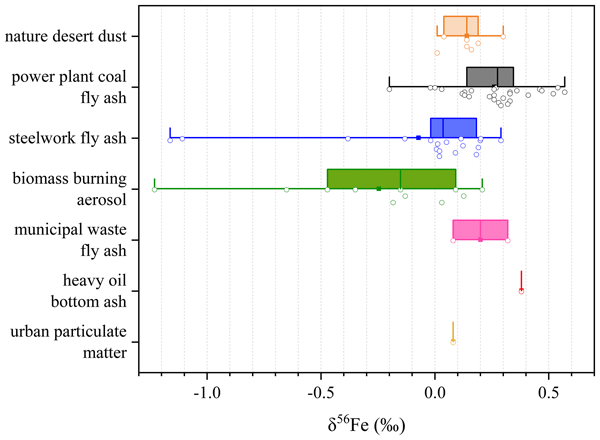
Abstract. Aerosol iron (Fe) significantly impacts human health, atmospheric chemistry and marine biogeochemistry. The stable isotope ratio of Fe, typically reported as δ56Fe, has emerged as a promising method for source apportionment of total and soluble aerosol Fe. However, the δ56Fe endmember values remain poorly constrained for aerosol Fe from various non-dust sources, impeding the application of Fe isotopes in atmospheric research. This work measured isotopic compositions for aerosol Fe from desert dust and several anthropogenic sources. The average δ56Fe was determined to be +0.14 ± 0.10 ‰ for the seven dust samples we examined, in good agreement with previous work. We found that different anthropogenic aerosols exhibit a wide range of Fe isotopic composition. Compared to desert dust, the average δ56Fe was found to be higher for power plant coal fly ash (+0.26 ± 0.18 ‰, n = 28), slightly lower for steelwork fly ash (−0.07 ± 0.41 ‰, n = 18), and considerably lower for biofuel burning aerosol (−0.28 ± 0.39 ‰, n = 11). In addition, the average δ56Fe was determined to be +0.20 ± 0.12 ‰ (n = 2) for municipal incineration fly ash, +0.38 ± 0.13 ‰ (n = 1) for heavy oil bottom ash, and +0.08 ± 0.13 ‰ for certificated urban particulate matter sample (n = 1). We suggest that not all the anthropogenic aerosol Fe is isotopically lighter than natural dust Fe, in contrast to what is conventionally assumed. Our findings also imply that Fe isotope-based source apportionment must account for the δ56Fe endmember variability both among and within different anthropogenic aerosols. Overall, our work substantially improves our ability to constrain δ56Fe endmember values from various anthropogenic sources.
Competing interests: At least one of the (co-)authors is a member of the editorial board of Atmospheric Chemistry and Physics. The peer-review process was guided by an independent editor, and the authors also have no other competing interests to declare.
Publisher's note: Copernicus Publications remains neutral with regard to jurisdictional claims made in the text, published maps, institutional affiliations, or any other geographical representation in this paper. While Copernicus Publications makes every effort to include appropriate place names, the final responsibility lies with the authors. Views expressed in the text are those of the authors and do not necessarily reflect the views of the publisher.-
Notice on discussion status
The requested preprint has a corresponding peer-reviewed final revised paper. You are encouraged to refer to the final revised version.
-
Preprint
(995 KB)
-
Supplement
(436 KB)
-
The requested preprint has a corresponding peer-reviewed final revised paper. You are encouraged to refer to the final revised version.
- Preprint
(995 KB) - Metadata XML
-
Supplement
(436 KB) - BibTeX
- EndNote
- Final revised paper


Journal article(s) based on this preprint
Interactive discussion
Status: closed
-
RC1: 'Comment on egusphere-2026-3780', Anonymous Referee #1, 31 Jul 2026
- AC1: 'Reply on RC1', Mingjin Tang, 11 Sep 2026
-
RC2: 'Comment on egusphere-2026-3780', Anonymous Referee #2, 20 Aug 2026
General comments
The stable isotope ratio of Fe has been used for source apportionment of total and soluble aerosol Fe. However, there are still large uncertainties in the δ56Fe endmember values for aerosol Fe from various sources. The authors collected and measured δ56Fe for fly and bottom ash samples. The measurements conducted in this study might contribute to a better understanding of the mechanisms of isotopic fractionation. However, the misuse of the heavy δ56Fe endmember values for fly ash samples would contradict observational facts. Moreover, the caveats in recommendations for future work and conclusion should be carefully considered for the interpretation in the main text. Major revisions are needed before this manuscript can be considered for publication in ACP.
Major comment
- Please clarify that the heavy δ56Fe samples are captured as large particles before the emission into the ambient atmosphere. Additionally, please measure δ56Fe for the raw materials (except biofuel burning) and for actual aerosols in the ambient atmosphere to suggest the use of δ56Fe endmember values for the ambient aerosols, and discuss the mechanisms of isotopic fractionation. Since these isotopically heavy Fe aerosols (except biofuel burning) are captured or retained before being emitted to the atmosphere, the actual aerosols in the ambient atmosphere could be lighter, as the volume mean diameters of fly ash samples are mostly a few tens of μm, which are considerably larger than those for submicron aerosols with light δ56Fe. Please reconsider the interpretation throughout the manuscript.
- Please separate the discussion of δ56Fe between biofuel burning and open biomass burning, as aerosol Fe during open biomass burning is mainly derived from soil-suspended particles.
Specific comments
l.122, l.128, and l.168: Please explain the size and collection method of the particles.
l.334: Even though domestic biofuel burning may not be representative of wildfires, why did you compare it with open biomass burning? Please reconsider the interpretation to explain the meaning of the comparison throughout the manuscript.
l.385: Please separate the discussion between biofuel burning and open biomass burning.
l.404: Previous studies used δ56Fe for the aerosols in the ambient atmosphere, not assumed δ56Fe captured before being emitted into the atmosphere. Since these isotopically heavy Fe aerosols as large particles cannot be emitted to the atmosphere owing to the emission control devices, the actual aerosols in the ambient atmosphere can be lighter. Please discuss the mechanisms of isotopic fractionation.
l.433: The earlier study does not contradict the mechanisms of isotopic fractionation during the evaporation-condensation process in combustion. Industrial particles (< 50 µm) were collected prior to emission, so that the actual aerosols emitted into the ambient atmosphere can be smaller particles with lighter δ56Fe. The aerosol particles collected on impaction plates can include mineral dust aerosols, so that the average δ56Fe of total Fe is similar to that for desert dust Fe. Please provide more precise information and reconsider the interpretation.
Technical comments
l.238: Please correct this to Figure 2.
Citation: https://doi.org/10.5194/egusphere-2026-3780-RC2 - AC2: 'Reply on RC2', Mingjin Tang, 11 Sep 2026
Peer review completion


Interactive discussion
Status: closed
-
RC1: 'Comment on egusphere-2026-3780', Anonymous Referee #1, 31 Jul 2026
General comments:
The submitted MS egusphere-2026-3780 highlights new iron isotopes measurements in anthropogenic aerosol samples. This research work highlights “Isotopic composition of aerosol iron from anthropogenic source”. This study has high scientific significance, improving our current understanding of iron isotopic source signatures. There are very few studies discussing Fe isotope signature in anthropogenic aerosol, which makes this MS special. This manuscript perfectly fits with journal criteria. The scientific quality and presentation quality of the paper are excellent and need minimal improvement. The new Fe isotope data on anthropogenic aerosol will improve source apportionment capability by enhancing end member criteria. Before the publication of this manuscript, the author should address few minor corrections, which will improve the manuscript quality. Those corrections are listed below
Specific comments:
Line 106-108: “In contrast to what is conventionally assumed, we found….” this is the result/ conclusion of the paper, it will be ideal if you include in the conclusion section not in the introduction section.
Line-188-189: Author conducted sequential protocol at 120 oC, using 1) HNO3-HF, 2) H2O2-HNO3, 3) Aqua Regia, and 4) HCl, respectively. Is it necessary to conduct step-2, in general H2O2-HNO3 used for removing organic matter and volatiles as a predigestion step. Authors were also followed the same for their fly ash samples (line-193-195). If they followed two different methods, it should be justified with proper descriptions as well as references.
Section-2.2.2 (line-199-209) references for the purification steps should be included.
Citation: https://doi.org/10.5194/egusphere-2026-3780-RC1 - AC1: 'Reply on RC1', Mingjin Tang, 11 Sep 2026
-
RC2: 'Comment on egusphere-2026-3780', Anonymous Referee #2, 20 Aug 2026
General comments
The stable isotope ratio of Fe has been used for source apportionment of total and soluble aerosol Fe. However, there are still large uncertainties in the δ56Fe endmember values for aerosol Fe from various sources. The authors collected and measured δ56Fe for fly and bottom ash samples. The measurements conducted in this study might contribute to a better understanding of the mechanisms of isotopic fractionation. However, the misuse of the heavy δ56Fe endmember values for fly ash samples would contradict observational facts. Moreover, the caveats in recommendations for future work and conclusion should be carefully considered for the interpretation in the main text. Major revisions are needed before this manuscript can be considered for publication in ACP.
Major comment
- Please clarify that the heavy δ56Fe samples are captured as large particles before the emission into the ambient atmosphere. Additionally, please measure δ56Fe for the raw materials (except biofuel burning) and for actual aerosols in the ambient atmosphere to suggest the use of δ56Fe endmember values for the ambient aerosols, and discuss the mechanisms of isotopic fractionation. Since these isotopically heavy Fe aerosols (except biofuel burning) are captured or retained before being emitted to the atmosphere, the actual aerosols in the ambient atmosphere could be lighter, as the volume mean diameters of fly ash samples are mostly a few tens of μm, which are considerably larger than those for submicron aerosols with light δ56Fe. Please reconsider the interpretation throughout the manuscript.
- Please separate the discussion of δ56Fe between biofuel burning and open biomass burning, as aerosol Fe during open biomass burning is mainly derived from soil-suspended particles.
Specific comments
l.122, l.128, and l.168: Please explain the size and collection method of the particles.
l.334: Even though domestic biofuel burning may not be representative of wildfires, why did you compare it with open biomass burning? Please reconsider the interpretation to explain the meaning of the comparison throughout the manuscript.
l.385: Please separate the discussion between biofuel burning and open biomass burning.
l.404: Previous studies used δ56Fe for the aerosols in the ambient atmosphere, not assumed δ56Fe captured before being emitted into the atmosphere. Since these isotopically heavy Fe aerosols as large particles cannot be emitted to the atmosphere owing to the emission control devices, the actual aerosols in the ambient atmosphere can be lighter. Please discuss the mechanisms of isotopic fractionation.
l.433: The earlier study does not contradict the mechanisms of isotopic fractionation during the evaporation-condensation process in combustion. Industrial particles (< 50 µm) were collected prior to emission, so that the actual aerosols emitted into the ambient atmosphere can be smaller particles with lighter δ56Fe. The aerosol particles collected on impaction plates can include mineral dust aerosols, so that the average δ56Fe of total Fe is similar to that for desert dust Fe. Please provide more precise information and reconsider the interpretation.
Technical comments
l.238: Please correct this to Figure 2.
Citation: https://doi.org/10.5194/egusphere-2026-3780-RC2 - AC2: 'Reply on RC2', Mingjin Tang, 11 Sep 2026
Peer review completion
Journal article(s) based on this preprint
Viewed
| HTML | XML | Total | Supplement | BibTeX | EndNote | |
|---|---|---|---|---|---|---|
| 312 | 146 | 45 | 503 | 73 | 42 | 47 |
- HTML: 312
- PDF: 146
- XML: 45
- Total: 503
- Supplement: 73
- BibTeX: 42
- EndNote: 47
Viewed (geographical distribution)
| Country | # | Views | % |
|---|
| Total: | 0 |
| HTML: | 0 |
| PDF: | 0 |
| XML: | 0 |
- 1
Yifan Zhang
Guanhong Zhu
Mingyuan Liu
Yi Yang
Tianyu Zhang
Yizhu Chen
Jinlong Ma

Xinming Wang
The requested preprint has a corresponding peer-reviewed final revised paper. You are encouraged to refer to the final revised version.
- Preprint
(995 KB) - Metadata XML
-
Supplement
(436 KB) - BibTeX
- EndNote
- Final revised paper
General comments:
The submitted MS egusphere-2026-3780 highlights new iron isotopes measurements in anthropogenic aerosol samples. This research work highlights “Isotopic composition of aerosol iron from anthropogenic source”. This study has high scientific significance, improving our current understanding of iron isotopic source signatures. There are very few studies discussing Fe isotope signature in anthropogenic aerosol, which makes this MS special. This manuscript perfectly fits with journal criteria. The scientific quality and presentation quality of the paper are excellent and need minimal improvement. The new Fe isotope data on anthropogenic aerosol will improve source apportionment capability by enhancing end member criteria. Before the publication of this manuscript, the author should address few minor corrections, which will improve the manuscript quality. Those corrections are listed below
Specific comments:
Line 106-108: “In contrast to what is conventionally assumed, we found….” this is the result/ conclusion of the paper, it will be ideal if you include in the conclusion section not in the introduction section.
Line-188-189: Author conducted sequential protocol at 120 oC, using 1) HNO3-HF, 2) H2O2-HNO3, 3) Aqua Regia, and 4) HCl, respectively. Is it necessary to conduct step-2, in general H2O2-HNO3 used for removing organic matter and volatiles as a predigestion step. Authors were also followed the same for their fly ash samples (line-193-195). If they followed two different methods, it should be justified with proper descriptions as well as references.
Section-2.2.2 (line-199-209) references for the purification steps should be included.