
the Creative Commons Attribution 4.0 License.
the Creative Commons Attribution 4.0 License.
 | 06 Feb 2026
Human-Centred Design Approaches to Tsunami Mitigation under Sea Level Rise in Kesennuma, Japan
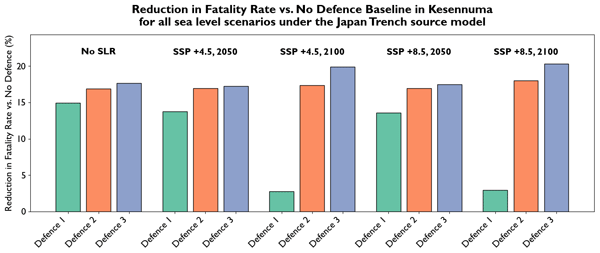
Abstract. Human-centred design (HCD) is increasingly prioritised as studies show human experience is critical in infrastructure use, and recent policies call for more socially responsive design. Tsunami impacts intensify as sea level rise (SLR) raises baseline water levels and reduces existing defence effectiveness, yet HCD informed approaches are rarely tested under projected SLR. Based on identified infrastructure preferences in Kesennuma City, Japan, we develop three multi-layered defence configurations: an environmentally integrated eco hybrid system (Design 1), a discreet open feeling barrier system (Design 2), and a reinforced high-performance system (Design 3). Using TUNAMI-N2 numerical modelling, 150 simulations combine three tsunami sources, five SLR conditions, and five defence states. Results for inundation extent, fatality rates, and economic loss show a consistent hierarchy: Design 3 achieves the strongest containment, while Design 2, which more closely aligns with residents’ preferences for openness and access, delivers near equivalent reductions typically within 10–15 percent. Design 1 provides only limited hazard reduction and is unsuitable as a standalone mitigation system. We show that HCD informed configurations can deliver strong technical performance and support a shift toward socially integrated, multi-layered tsunami protection under rising sea levels.
-
Notice on discussion status
The requested preprint has a corresponding peer-reviewed final revised paper. You are encouraged to refer to the final revised version.
-
Preprint
(2789 KB)
-
The requested preprint has a corresponding peer-reviewed final revised paper. You are encouraged to refer to the final revised version.
- Preprint
(2789 KB) - Metadata XML
- BibTeX
- EndNote
- Final revised paper


Journal article(s) based on this preprint
Interactive discussion
Status: closed
-
RC1: 'Comment on egusphere-2026-365', Anonymous Referee #1, 24 Feb 2026
-
AC1: 'Reply on RC1', Hayley Leggett, 11 May 2026
We thank the reviewer for their thorough and constructive review. Please find our responses to each comment below.
Comment 1: Loss Estimation and Uncertainty:
"The loss estimation part embeds very large uncertainties that are hidden in the analysis. The analysis includes deterministic loss estimation in Tables 2 and 3 for fatalities and economic loss in particular. These can somehow be interpreted as deterministic vulnerability functions, and mimics an engineering approach. However, our understanding of tsunami vulnerability, and tsunami fatalities in particular, is very limited. The experience from Japan provides only one datapoint, but it will depend on many factors such as time of the day, status of early warning, change in situation since 2011 etc. Hence, presenting the loss analysis without any uncertainty treatment can be greatly misleading. In particular, the fatality is not well understood, and the fatality estimations can be misleading or misinterpreted. Therefore, the methodology description and related results section need a major overhaul. The main comment is that fatality quantification is suggested to be removed. For the remaining part, the discussion related to the losses should have a much greater emphasis on the large uncertainties involved, and should be rewritten to make the uncertainty aspect clearer both in the methods, results, and discussions."
Response to Comment 1: Loss Estimation and Uncertainty
We thank the reviewer for this detailed and constructive comment. We agree that the current framing of the fatality section does not sufficiently emphasise its comparative rather than predictive nature, and we acknowledge that this could lead to misinterpretation. We will revise the methodology, results, and discussion sections to make this framing explicit and unambiguous.
We respectfully wish to clarify the intended purpose of this metric. The fatality rates presented in this study are not intended as realistic predictions of casualties under plausible future scenarios. Rather, they function as normalised comparative performance indicators within a controlled and internally consistent modelling framework, in the same way that inundation extent and economic loss are used. Comparing these outputs across identical source and SLR conditions isolates the influence of defence configuration, allowing the relative protective performance of each design to be assessed in human terms. The absolute values are therefore less meaningful than the relative differences between configurations.
We agree that this distinction is not made clearly enough in the current manuscript. We will revise Section 3.4.2 to explicitly state that the fatality model is applied as a comparative indicator under a controlled scenario framework, and that outputs should not be interpreted as predictions of real-world casualties. We will also add explicit uncertainty discussion to the methods, results, and discussion sections, acknowledging the sensitivity of fatality estimates to factors such as time of day, evacuation behaviour, and warning status, and clearly stating that these factors are not represented in the current framework. We fully commit to reframing the section in a way that makes its limitations and intended use transparent to the reader.Comment 2: Earthquake Scenarios
"The analysed earthquake scenarios are too few and quite limited in spanning the wealth of potential sources that is needed to fully understand the variable response of the mitigation measures. I would suggest that the authors provide a short discussion on how other sources, for example larger megathrust sources from PTHA (e.g. Behrens et al., 2021) would be expected to influence the results. In particular, an analysis of how differences in wavelengths and offshore amplitudes (and potentially their link to focal mechanisms) affects the effectiveness of the mitigation."
Response to Comment 2: Earthquake Scenarios
The three tsunami source models implemented in this study, the Kuril Trench, Japan Trench, and 2011 GEJE, correspond directly to the official three-fault framework used in Kesennuma City's hazard mapping and national Cabinet Office tsunami assessments (Cabinet Office, 2020). These represent the primary regional subduction zone sources considered relevant to Kesennuma under Japan's national DRR framework, and their selection therefore reflects established practice in hazard assessment for this location specifically.
We acknowledge that the study does not span the full range of potential source variability that a probabilistic framework would capture, and we agree that a short discussion of how alternative or larger magnitude sources might influence the results would strengthen the manuscript. We will add a discussion in Section 3.3.2 acknowledging the limitations of the deterministic scenario approach and briefly considering how differences in source characteristics such as wavelength, offshore amplitude, and focal mechanism could affect the relative performance of the defence configurations, with reference to relevant PTHA literature including Behrens et al. (2021), Grezio et al. (2017), and Davies et al. (2018) as suggested. We do not consider additional simulations necessary given the explicitly comparative and conceptual nature of the study, but we agree this discussion will provide important context for interpreting the results.Comment 3: No Countermeasure Baseline
"Further, it is difficult to assess the effectiveness of all the physical countermeasures without testing them against model results without any physical protection. This would make the results much more transparent, and illustrate better the effectiveness of Designs 1, 2, and 3, as it would constitute a sort of normalization. So, I would strongly recommend adding this to the study if possible."
Response to Comment 3: No Countermeasure Baseline
We agree that including a no countermeasure baseline would improve the transparency and interpretability of the results. We note that simulations without any physical protection were already conducted as part of the study design (Section 3.4), and we will update Figures 10, 11, 12, 13, and 15 to include this baseline explicitly. We will also include the current defence configuration as an additional reference point, as this allows the proposed designs to be evaluated not only against the undefended case but also against the existing protection level in Kesennuma. Together these two baselines provide a more complete picture of relative performance and strengthen the comparative framework of the study.Comment 4: Repetition and Scope
"Reading the manuscript I found many repetitions, in particular related to the HCD procedure in the introductory sections. These repetitions make the scope of the paper more difficult to follow. Hence, the manuscript could benefit from being tightened up. Moreover, it seems like the scope is mostly related to testing numerically how three different design methods influence physical protection rather than the HCD itself, which serves more as a background. Hence, I would recommend to shorten the introduction related to this background and have a stronger focus on the numerical testing."
Response to Comment 4: Repetition and Scope
We agree that there is repetition across the introductory sections of the manuscript, particularly in relation to HCD, and we will revise and tighten these sections accordingly. The three defence configurations were explicitly derived from HCD principles identified through community research in Kesennuma, forming the conceptual foundation of the study rather than contextual framing alone. We acknowledge that this relationship between HCD principles and design development is not currently communicated as clearly as it should be, and we will consolidate and sharpen this framing in the revised manuscript to ensure the contribution is more precisely articulated without unnecessary repetition.Comment 5: Laboratory Testing
"An open question is finally if such defense structures also can be tested in the laboratory. A short discussion related to this would be valuable."
Response to Comment 5: Laboratory Testing
We agree that physical laboratory testing of the proposed defence configurations would be a valuable next step. The conceptual designs presented in this study are well suited to flume or wave tank testing, which could provide empirical validation of the hydraulic performance modelled here and help refine material specifications and structural behaviour under realistic wave conditions. We will add a short discussion of this opportunity to the discussion and conclusion sections of the revised manuscript.Line by line comments
L25
"Please add references to SRL studies such as Li et al. (2018), Dura et al. (2021), Sepulveda et al., (2021)."
Response
Thank you for these suggestions. We will review and add the relevant references to the manuscript.L30
"Unclear what is meant by this statement 'have shown limited adaptability to changing environmental baselines', please rephrase."
Response
We will rephrase this sentence in the revised manuscript to improve clarity.L34
"The reference to 'empathy' sounds subjective in a science setting, is it possible to elaborate more what this would concretely imply for the HCD?"
Response
We will add a brief clarification at this point to make the concrete meaning of empathy within HCD methodology explicit, with reference to Giacomin (2014).L37
"meaningful --> effective"
Response
We will make this change in the revised manuscript.L40-45
"Lots of focus on the local perception here, but the physical protection context is lacking."
Response
We agree and will revise this section to better balance the discussion of local perception within the context of physical protection.L45
"The term 'user experience and local values' is vague, what does it mean concretely?"
Response
We will revise this phrase to provide a more concrete definition.L56
"Please define the concept 'multi-layered design' as it used throughout the manuscript."
Response
We will add a clear definition of 'multi-layered design' at its first use in the manuscript.L65
"The wave energy is not changed, only the focussing of it. Please rephrase."
Response
We will rephrase this sentence accordingly.L69
"revise 'most catastrophic' to 'most catastrophic event in history'. Please specify that you are talking exclusively about its impact on Kesennuma."
Response
We will make this change.L72-73
"Was the design also done towards more moderate local earthquakes (e.g. the M8.4 discussion) in addition to 1960 etc?"
Response
We will add clarification at this point to note that pre-2011 coastal defence design along the Sanriku coast considered multiple historical events, including the 1933 Showa Sanriku earthquake (M8.4), alongside the 1960 Chile tsunami.L76
"On what PTHA design basis? Please give reference. I would suggest a short review of PTHA methods here (e.g. Grezio et al., 2017, Davies et al., 2018, Behrens et al., 2021) and outline limitations of the scenario approach chosen here (see discussion above). The derivation or relationship of the scenarios from the PTHA should also be outlined."
Response
This has been addressed in our response to Comment 2.L106
"The meaning of the sentence is not completely clear. Does this imply that the countermeasures were considered less effective than in comparable locations along the Tohoku coast?"
Response
We will clarify this sentence to make clear that the criticism referred to the perceived compromise of originally proposed safety specifications through local negotiation, rather than a comparison of effectiveness with other locations along the Tohoku coast.L107
"Please add a reference after 'safety standards'"
Response
We will add Imakawa (2021), a detailed account of Kesennuma's reconstruction debates published in Nippon.com, and Ueda and Shaw (2014) to support the claim.L135
"Looks like this is partly discussed above. Since it is mainly background information, please consider shortening."
Response
This has been addressed in our response to Comment 4.L146
"differing --> different"
Response
We will make the change.L154
"You say these barriers are effective, but no reference or quantitative measure is given, please add a reference."
Response
We will add Nateghi et al. (2016), which demonstrates that seawalls reduced death and damage rates during moderate tsunami events along the Tohoku coast, and Strusinska-Correia (2017) to support this claim.L159
"Sentences starting with 'The rationale' seems essential to the study and might be moved up front."
Response
We agree and will move this content to a more prominent position.L176
"the research --> this research"
Response
We will correct this.
L187
"Sentence starting with 'Consequently…' should be in the introduction, but this motivation it is also partly duplicated elsewhere."
Response
This has been addressed in our response to Comment 4.L250
"Why discuss the time step when describing the general model? It will depend on the grid size and CFL number."
Response
We agree and will move the discussion of the time step to Section 3.4.
L255
"Are the structures rather embedded into the topography / DEM?"
Response
We will clarify that coastal defences, river embankments, and terrain features were incorporated directly into the DEM.
L259
"The offset of the model towards real events will really depend on the source and event itself. Perhaps it is better to report on the validated benchmark cases?"
Response
We agree and will replace the generic error statistics with the validated benchmark cases for TUNAMI-N2, including Oishi et al. (2015), Suppasri et al. (2013), and Dao and Tkalich (2007).
L290
"As mentioned in the general comments, I found the set of sources very limited to thoroughly test countermeasures. This limitation should be discussed better."
Response
This has been addressed in our response to Comment 2.
L300
"Here you discuss general properties of TUNAMI-N2, but this should not enter here, but rather in the general model description above."
Response
We agree and will move this content to Section 3.3.
L374
"The fatality model gives the impression that a deterministic analysis can be made for estimating the mortality losses, but it is given without proper scientific backing. There is also no uncertainty discussion here. Mortality will depend on many factors such as event time, experience etc, early warning. Hence, I cannot recommend keeping this section in the manuscript, and think it should be entirely removed."
Response
This has been addressed in our response to Comment 1.
L410
"Uncertainties should be discussed."
Response
This has been addressed in our response to Comment 1.
L415
"Reference missing"
Response
We will correct the cross-reference error.
L450
"Sentence 'This approach yields…' please delete, it is not really backed up anywhere (how can it be reproducible for instance?)."
Response
We will remove this sentence.
L481
"Please fix cross references"
Response
We will correct the cross-reference error.
Figure 9
"Technically speaking the lon-lats should be 'easting - northings' as they are in meters and not in degrees. It is unclear what current defenses refer to, please add this to the caption."
Response
We will correct the axis labels to easting and northing and clarify what current defences refer to in the caption.
L483
"conditions intensified" --> "intensities were increased"
Response
We will make the change.
Fig 10
"Hard to interpret really how good and cost effective these measures are without a 'no-countermeasure' reference model."
Response
This has been addressed in our response to Comment 3.
Section 4.3
"I strongly recommend removing this from the paper without a much better uncertainty analysis."
Response
This has been addressed in our response to Comment 1.
Figure 12, 13, 15
"Unclear which scenarios that are used here."
Response
We will clarify the scenarios used in the captions of Figures 12, 13, and 15.
L578
"The lack of sensitivity to the fatalities indicates that the uncertainties are suppressed in this analysis, which is another reason why I suggest to take it out of the study."
Response
This has been addressed in our response to Comment 1.Citation: https://doi.org/10.5194/egusphere-2026-365-AC1
-
AC1: 'Reply on RC1', Hayley Leggett, 11 May 2026
-
RC2: 'Comment on egusphere-2026-365', Anonymous Referee #2, 03 Apr 2026
The proposed study aims to show the effect of Human Centered approach in the design of tsunami protection countermeasures while taking into consideration of sea level rise in different levels until 2100. They proposed that the human centered design enables to construct a balance between engineering performance with the lived experiences and values of coastal communities for tsunami mitigation infrastructures. This study developed three different multi-layered tsunami defence configurations prepared including the outcomes of municipalities gathering with the public to let them participate in reconstruction planning and to express concerns about the visual and spatial effects of new seawalls and the potential loss of connection to the sea in the pilot area Kesennuma. It is clearly understood that they evaluates the technical performance of alternative multi-layered defence configurations that integrate community-derived principles through numerical simulation of combined tsunami and SLR scenarios. They used scientific approaches to identify economic loss and fatality rates and applied tsunami numerical modeling for the calculation of inundation extent. The comparison of results reveal that there is a need for policy and design approaches to integrate social, environmental, and structural priorities to achieve resilient coastal protection.
This manuscript has good scientific quality and significance and can be accepted for publication after some technical corrections. The comments for corrections are listed below:
- The abstract needs to be improved. The aim of the study need to be specified.
- Page 1 Line 20: The expression “HCD informed configurations” needs to be reviewed. “HCD integrated configurations” may be used.
- Page 4 Line 40: The sentence starts with “This relationship” which seems not appropriate for a start of new paragraph. There needs to be a link with the previously mentioned topic.
- Page 14 Line 292: There is an empty paranthesis after “source”.
- Page 20 Line 415: Error note occurred.
- Page 21 Line 446: The sentence “The combined use of total-building and key-building losses therefore provides both a system-level estimate of financial impact and a focused indicator of critical infrastructure vulnerability” needs to be rephrased.
- Page 23 Figure 9: The colors are not identified. The difference between (a), (b) and (c) are not clearly noticable. Color scale needs to be improved.
- Page 24 Line 481: Error note occurred.
- Page 25 Figure 11: Blue and green colors are not visible. It is difficult to identify the regional with blue. Color scale needs to be modified.
- Page 29 Figure 14: The economic loss distribution is not visible. It is possible to Zoom-in Kesennuma city and make it clearer.
- Page 30 Line 564: The sentence is not clear. It may be reviewed as “The results demonstrate a clear structural hierarchy across all evaluated indicators, yet the magnitude of difference between the two stronger configurations was smaller than expected, given their contrasting design philosophies.”
There are two other comments given below, which are not related with technical corrections but conceptual improvement:
- In Section 3.3.2, it is stated that three different tsunami sources were implemented in this study as Kuril Trench, the Japan Trench, and the 2011 GEJE (Tohoku) source. However, only the results of Japan trench were presented in the rest of the manuscript. This point should be clarified. Either the other results can be shown or the other two sources may be removed.
- It is understood that tsunami numerical simulations were conducted using TUNAMI-N2, which is realiable and validated-verified model in the worldwide.On page 14 line 303, it is stated that “Reflective boundary conditions were imposed along impermeable coastal structures to simulate wave impact and overtopping processes,….”. However, Table 1 on Page 17 shows the Manning’s value of concrete seawall as 0.015-0.030. It is not clear how reflective boundary conditions are used for the impermeable coastal structures, such as concrete seawalls, in the numerical modeling.
I appreciate the hard work of authors for this study and the concept of having public-participatory design of coastal protection countermeasures to increase community resilience.
-
AC2: 'Reply on RC2', Hayley Leggett, 11 May 2026
We thank the reviewer for their positive assessment and constructive suggestions. Please find our responses to each comment below.
Technical Comments
Comment 1: Abstract
"The abstract needs to be improved. The aim of the study need to be specified."
Response
We will revise the abstract to include an explicit aim statement, ensuring the study's objectives are easily identified.
Comment 2
"Page 1 Line 20: The expression 'HCD informed configurations' needs to be reviewed. 'HCD integrated configurations' may be used."
Response
We will update this expression to 'HCD-integrated configurations' throughout the manuscript.
Comment 3
"Page 4 Line 40: The sentence starts with 'This relationship' which seems not appropriate for a start of new paragraph. There needs to be a link with the previously mentioned topic."
Response
We will revise the opening of this paragraph to provide a clearer link to the preceding discussion.
Comment 4
"Page 14 Line 292: There is an empty parenthesis after 'source'."
Response
We will correct this formatting error.
Comment 5
"Page 20 Line 415: Error note occurred."
Response
We will correct the cross-reference error.
Comment 6
"Page 21 Line 446: The sentence 'The combined use of total-building and key-building losses therefore provides both a system-level estimate of financial impact and a focused indicator of critical infrastructure vulnerability' needs to be rephrased."
Response
We will rephrase this sentence to improve clarity.
Comment 7
"Page 23 Figure 9: The colors are not identified. The difference between (a), (b) and (c) are not clearly noticable. Color scale needs to be improved."
Response
We will improve the colour scale to enhance differentiation in inundation depths.
Comment 8
"Page 24 Line 481: Error note occurred."
Response
We will correct the cross-reference error.
Comment 9
"Page 25 Figure 11: Blue and green colors are not visible. It is difficult to identify the regional with blue. Color scale needs to be modified."
Response
We will revise the colour scheme to improve visibility and distinguish between the defence configurations more clearly.
Comment 10
"Page 29 Figure 14: The economic loss distribution is not visible. It is possible to Zoom-in Kesennuma city and make it clearer."
Response
We will add a zoomed-in panel of Kesennuma city to improve the visibility of the economic loss distribution.
Comment 11
"Page 30 Line 564: The sentence is not clear. It may be reviewed as 'The results demonstrate a clear structural hierarchy across all evaluated indicators, yet the magnitude of difference between the two stronger configurations was smaller than expected, given their contrasting design philosophies.'"
Response
We will adopt the reviewer's suggested rephrasing.Conceptual Comments
Comment 12
"In Section 3.3.2, it is stated that three different tsunami sources were implemented in this study as Kuril Trench, the Japan Trench, and the 2011 GEJE (Tohoku) source. However, only the results of Japan trench were presented in the rest of the manuscript. This point should be clarified. Either the other results can be shown or the other two sources may be removed."
Response
We will make it clearer in the manuscript that the Japan Trench is used as the representative case for all figures, as all three sources produced the same relative performance hierarchy among the defence configurations. The Japan Trench results are therefore presented for comparison purposes and due to space limitations, rather than implying the other sources were not modelled.
Comment 13
"It is understood that tsunami numerical simulations were conducted using TUNAMI-N2, which is reliable and validated-verified model in the worldwide. On page 14 line 303, it is stated that 'Reflective boundary conditions were imposed along impermeable coastal structures to simulate wave impact and overtopping processes,….'. However, Table 1 on Page 17 shows the Manning's value of concrete seawall as 0.015-0.030. It is not clear how reflective boundary conditions are used for the impermeable coastal structures, such as concrete seawalls, in the numerical modeling."
Response
We acknowledge that this sentence is ambiguous. Reflective boundary conditions and Manning's roughness coefficients serve distinct purposes within the model: the former are applied at the computational domain boundaries to prevent wave energy from exiting the domain, while the latter control frictional resistance within the domain. Coastal structures such as seawalls are represented through their incorporation into the DEM and assigned Manning's coefficients accordingly. We will revise this sentence to make this distinction clear.Citation: https://doi.org/10.5194/egusphere-2026-365-AC2
Peer review completion


Interactive discussion
Status: closed
-
RC1: 'Comment on egusphere-2026-365', Anonymous Referee #1, 24 Feb 2026
Review of the paper entitled “Human-Centred Design approaches to Tsunami Mitigation under Sea Level Rise in Kesennuma, Japan” by Hayley Leggett and co-authors.
General comments:
This paper outlines a review of a numerical study to test the sensitivity of physical countermeasures for combined tsunami and SRL impact in Kesennuma. It takes into account possibilities of softer measures through to so-called Human-Centered Design (HCD) approaches. Based on my reading of the paper, the focus is more on testing different technical solutions than on the HCD itself. It might be that a change in the title could be worthwhile to reflect better the scope of the work. I found that the topic and work may provide a valuable addition to the tsunami community, but my conclusion is also that major revisions are needed before the paper can be considered for publication. The main comments are connected to limited uncertainty treatment for the vulnerability, implying that some parts needs to be entirely re-written. Below, I outline the main suggestions for improvement points. Because several sections needs large revisions, I refrained from commenting in detail the later section of the manuscript.
The loss estimation part embeds very large uncertainties that are hidden in the analysis. The analysis includes deterministic loss estimation in Tables 2 and 3 for fatalities and economic loss in particular. These can somehow be interpreted as deterministic vulnerability functions, and mimics an engineering approach. However, our understanding of tsunami vulnerability, and tsunami fatalities in particular, is very limited. The experience from Japan provides only one datapoint, but it will depend on many factors such as time of the day, status of early warning, change in situation since 2011 etc. Hence, presenting the loss analysis without any uncertainty treatment can be greatly misleading. In particular, the fatality is not well understood, and the fatality estimations can be misleading or misinterpreted. Therefore, the methodology description and related results section need a major overhaul. The main comment is that fatality quantification is suggested to be removed. For the remaining part, the discussion related to the losses should have a much greater emphasis on the large uncertainties involved, and should be rewritten to make the uncertainty aspect clearer both in the methods, results, and discussions.
The analysed earthquake scenarios are too few and quite limited in spanning the wealth of potential sources that is needed to fully understand the variable response of the mitigation measures. I would suggest that the authors provide a short discussion on how other sources, for example larger megathrust sources from PTHA (e.g. Behrens et al., 2021) would be expected to influence the results. In particular, an analysis of how differences in wavelengths and offshore amplitudes (and potentially their link to focal mechanisms) affects the effectiveness of the mitigation.
Further, it is difficult to assess the effectiveness of all the physical countermeasures without testing them against model results without any physical protection. This would make the results much more transparent, and illustrate better the effectiveness of Designs 1,2, and 3, as it would constitute a sort of normalization. So, I would strongly recommend adding this to the study if possible.
Reading the manuscript I found many repetitions, in particular related to the HCD procedure in the introductory sections. These repetitions make the scope of the paper more difficult to follow. Hence, the manuscript could benefit from being tightened up. Moreover, it seems like the scope is mostly related to testing numerically how three different design methods influence physical protection rather than the HCD itself, which serves more as a background. Hence, I would recommend to shorten the introduction related to this background and have a stronger focus on the numerical testing.
An open question is finally if such defense structures also can be tested in the laboratory. A short discussion related to this would be valuable.
Line by line comments:
L25: Please add references to SRL studies such as Li et al. (2018), Dura et al. (2021), Sepulveda et al., (2021).
L30: Unclear what is meant by this statement “have shown limited adaptability to changing environmental baselines”, please rephrase.
L34: The reference to “empathy” sounds subjective in a science setting, is it possible to elaborate more what this would concretely imply for the HCD?
L37: meaningful --> effective
L40-45: Lots of focus on the local perception here, but the physical protection context is lacking.
L45: The term “user experience and local values” is vague, what does it mean concretely?
L56: Please define the concept “multi-layered design” as it used throughout the manuscript.
L65: The wave energy is not changed, only the focussing of it. Please rephrase.
L69: revise “most catastrophic” to “most catastrophic event in history”. Please specify that you are talking exclusively about its impact on Kesennuma.
L72-73: Was the design also done towards more moderate local earthquakes (e.g. the M8.4 discussion) in addition to 1960 etc?
L76 and onwards: On what PTHA design basis? Please give reference. I would suggest a short review of PTHA methods here (e.g. Grezio et al., 2017, Davies et al., 2018, Behrens et al., 2021) and outline limitations of the scenario approach chosen here (see discussion above). The derivation or relationship of the scenarios from the PTHA should also be outlined.
L106: The meaning of the sentence is not completely clear. Does this imply that the countermeasures were considered less effective than in comparable locations along the Tohoku coast?
L107: Please add a reference after “safety standards”
L135 and onwards: Looks like this is partly discussed above. Since it is mainly background information, please consider shortening.
L146: differing --> different
154: You say these barriers are effective, but no reference or quantitative measure is given, please add a reference.
L159 and onwards: Sentences starting with “The rationale” seems essential to the study and might be moved up front.
L176: the research --> this research
L187: Sentence starting with “Consequently…” should be in the introduction, but this motivation it is also partly duplicated elsewhere.
L250: Why discuss the time step when describing the general model? It will depend on the grid size and CFL number.
L255: Are the structures rather embedded into the topography / DEM?
L259: The offset of the model towards real events will really depend on the source and event itself. Perhaps it is better to report on the validated benchmark cases?
L290: As mentioned in the general comments, I found the set of sources very limited to thoroughly test countermeasures. This limitation should be discussed better.
L292: Missing reference
L300 and onwards: Here you discuss general properties of TUNAMI-N2, but this should not enter here, but rather in the general model description above.
L374: The fatality model gives the impression that a deterministic analysis can be made for estimating the mortality losses, but it is given without proper scientific backing. There is also no uncertainty discussion here. Mortality will depend on many factors such as event time, experience etc, early warning. Hence, I cannot recommend keeping this section in the manuscript, and think it should be entirely removed.
L410: Uncertainties should be discussed.
L415: Reference missing
L450: Sentence “This approach yields…” please delete, it is not really backed up anywhere (how can it be reproducible for instance?).
Figure 9: Technically speaking the lon-lats should be “easting - northings” as they are in meters and not in degrees. It is unclear what current defenses refer to, please add this to the caption.
L481: Please fix cross references
L483: “conditions intensified” --> “intensities were increased”
Fig10: Hard to interpret really how good and cost effective these measures are without a “no-countermeasure” reference model.
Section 4.3: I strongly recommend removing this from the paper without a much better uncertainty analysis.
Figure 12, 13, 15: Unclear which scenarios that are used here.
L578: The lack of sensitivity to the fatalities indicates that the uncertainties are supressed in this analysis, which is another reason why I suggest to take it out of the study.
References:
Behrens, J., Løvholt, F., Jalayer, F., Lorito, S., Salgado-Gálvez, M. A., Sørensen, M. et al. (2021). Probabilistic tsunami hazard and risk analysis: A review of research gaps. Frontiers in Earth Science, 9, 628772.
Davies, G., Griffin, J., Løvholt, F., Glimsdal, S., Harbitz, C., Thio, H. K., et al. (2018). A global probabilistic tsunami hazard assessment from earthquake sources.
Dura, T., Garner, A. J., Weiss, R., Kopp, R. E., Engelhart, S. E., Witter, R. C., et al., (2021). Changing impacts of Alaska-Aleutian subduction zone tsunamis in California under future sea-level rise. Nature communications, 12(1), 7119.
Grezio, A., Babeyko, A., Baptista, M. A., Behrens, J., Costa, A., Davies, G., et al., (2017). Probabilistic tsunami hazard analysis: multiple sources and global applications. Reviews of Geophysics, 55(4), 1158-1198.
Li, L., Switzer, A. D., Wang, Y., Chan, C. H., Qiu, Q., & Weiss, R. (2018). A modest 0.5-m rise in sea level will double the tsunami hazard in Macau. Science advances, 4(8), eaat1180.
Sepúlveda, I., Haase, J. S., Liu, P. L. F., Grigoriu, M., & Winckler, P. (2021). Non‐stationary probabilistic tsunami hazard assessments incorporating climate‐change‐driven sea level rise. Earth's Future, 9(6), e2021EF002007.
Citation: https://doi.org/10.5194/egusphere-2026-365-RC1 -
AC1: 'Reply on RC1', Hayley Leggett, 11 May 2026
We thank the reviewer for their thorough and constructive review. Please find our responses to each comment below.
Comment 1: Loss Estimation and Uncertainty:
"The loss estimation part embeds very large uncertainties that are hidden in the analysis. The analysis includes deterministic loss estimation in Tables 2 and 3 for fatalities and economic loss in particular. These can somehow be interpreted as deterministic vulnerability functions, and mimics an engineering approach. However, our understanding of tsunami vulnerability, and tsunami fatalities in particular, is very limited. The experience from Japan provides only one datapoint, but it will depend on many factors such as time of the day, status of early warning, change in situation since 2011 etc. Hence, presenting the loss analysis without any uncertainty treatment can be greatly misleading. In particular, the fatality is not well understood, and the fatality estimations can be misleading or misinterpreted. Therefore, the methodology description and related results section need a major overhaul. The main comment is that fatality quantification is suggested to be removed. For the remaining part, the discussion related to the losses should have a much greater emphasis on the large uncertainties involved, and should be rewritten to make the uncertainty aspect clearer both in the methods, results, and discussions."
Response to Comment 1: Loss Estimation and Uncertainty
We thank the reviewer for this detailed and constructive comment. We agree that the current framing of the fatality section does not sufficiently emphasise its comparative rather than predictive nature, and we acknowledge that this could lead to misinterpretation. We will revise the methodology, results, and discussion sections to make this framing explicit and unambiguous.
We respectfully wish to clarify the intended purpose of this metric. The fatality rates presented in this study are not intended as realistic predictions of casualties under plausible future scenarios. Rather, they function as normalised comparative performance indicators within a controlled and internally consistent modelling framework, in the same way that inundation extent and economic loss are used. Comparing these outputs across identical source and SLR conditions isolates the influence of defence configuration, allowing the relative protective performance of each design to be assessed in human terms. The absolute values are therefore less meaningful than the relative differences between configurations.
We agree that this distinction is not made clearly enough in the current manuscript. We will revise Section 3.4.2 to explicitly state that the fatality model is applied as a comparative indicator under a controlled scenario framework, and that outputs should not be interpreted as predictions of real-world casualties. We will also add explicit uncertainty discussion to the methods, results, and discussion sections, acknowledging the sensitivity of fatality estimates to factors such as time of day, evacuation behaviour, and warning status, and clearly stating that these factors are not represented in the current framework. We fully commit to reframing the section in a way that makes its limitations and intended use transparent to the reader.Comment 2: Earthquake Scenarios
"The analysed earthquake scenarios are too few and quite limited in spanning the wealth of potential sources that is needed to fully understand the variable response of the mitigation measures. I would suggest that the authors provide a short discussion on how other sources, for example larger megathrust sources from PTHA (e.g. Behrens et al., 2021) would be expected to influence the results. In particular, an analysis of how differences in wavelengths and offshore amplitudes (and potentially their link to focal mechanisms) affects the effectiveness of the mitigation."
Response to Comment 2: Earthquake Scenarios
The three tsunami source models implemented in this study, the Kuril Trench, Japan Trench, and 2011 GEJE, correspond directly to the official three-fault framework used in Kesennuma City's hazard mapping and national Cabinet Office tsunami assessments (Cabinet Office, 2020). These represent the primary regional subduction zone sources considered relevant to Kesennuma under Japan's national DRR framework, and their selection therefore reflects established practice in hazard assessment for this location specifically.
We acknowledge that the study does not span the full range of potential source variability that a probabilistic framework would capture, and we agree that a short discussion of how alternative or larger magnitude sources might influence the results would strengthen the manuscript. We will add a discussion in Section 3.3.2 acknowledging the limitations of the deterministic scenario approach and briefly considering how differences in source characteristics such as wavelength, offshore amplitude, and focal mechanism could affect the relative performance of the defence configurations, with reference to relevant PTHA literature including Behrens et al. (2021), Grezio et al. (2017), and Davies et al. (2018) as suggested. We do not consider additional simulations necessary given the explicitly comparative and conceptual nature of the study, but we agree this discussion will provide important context for interpreting the results.Comment 3: No Countermeasure Baseline
"Further, it is difficult to assess the effectiveness of all the physical countermeasures without testing them against model results without any physical protection. This would make the results much more transparent, and illustrate better the effectiveness of Designs 1, 2, and 3, as it would constitute a sort of normalization. So, I would strongly recommend adding this to the study if possible."
Response to Comment 3: No Countermeasure Baseline
We agree that including a no countermeasure baseline would improve the transparency and interpretability of the results. We note that simulations without any physical protection were already conducted as part of the study design (Section 3.4), and we will update Figures 10, 11, 12, 13, and 15 to include this baseline explicitly. We will also include the current defence configuration as an additional reference point, as this allows the proposed designs to be evaluated not only against the undefended case but also against the existing protection level in Kesennuma. Together these two baselines provide a more complete picture of relative performance and strengthen the comparative framework of the study.Comment 4: Repetition and Scope
"Reading the manuscript I found many repetitions, in particular related to the HCD procedure in the introductory sections. These repetitions make the scope of the paper more difficult to follow. Hence, the manuscript could benefit from being tightened up. Moreover, it seems like the scope is mostly related to testing numerically how three different design methods influence physical protection rather than the HCD itself, which serves more as a background. Hence, I would recommend to shorten the introduction related to this background and have a stronger focus on the numerical testing."
Response to Comment 4: Repetition and Scope
We agree that there is repetition across the introductory sections of the manuscript, particularly in relation to HCD, and we will revise and tighten these sections accordingly. The three defence configurations were explicitly derived from HCD principles identified through community research in Kesennuma, forming the conceptual foundation of the study rather than contextual framing alone. We acknowledge that this relationship between HCD principles and design development is not currently communicated as clearly as it should be, and we will consolidate and sharpen this framing in the revised manuscript to ensure the contribution is more precisely articulated without unnecessary repetition.Comment 5: Laboratory Testing
"An open question is finally if such defense structures also can be tested in the laboratory. A short discussion related to this would be valuable."
Response to Comment 5: Laboratory Testing
We agree that physical laboratory testing of the proposed defence configurations would be a valuable next step. The conceptual designs presented in this study are well suited to flume or wave tank testing, which could provide empirical validation of the hydraulic performance modelled here and help refine material specifications and structural behaviour under realistic wave conditions. We will add a short discussion of this opportunity to the discussion and conclusion sections of the revised manuscript.Line by line comments
L25
"Please add references to SRL studies such as Li et al. (2018), Dura et al. (2021), Sepulveda et al., (2021)."
Response
Thank you for these suggestions. We will review and add the relevant references to the manuscript.L30
"Unclear what is meant by this statement 'have shown limited adaptability to changing environmental baselines', please rephrase."
Response
We will rephrase this sentence in the revised manuscript to improve clarity.L34
"The reference to 'empathy' sounds subjective in a science setting, is it possible to elaborate more what this would concretely imply for the HCD?"
Response
We will add a brief clarification at this point to make the concrete meaning of empathy within HCD methodology explicit, with reference to Giacomin (2014).L37
"meaningful --> effective"
Response
We will make this change in the revised manuscript.L40-45
"Lots of focus on the local perception here, but the physical protection context is lacking."
Response
We agree and will revise this section to better balance the discussion of local perception within the context of physical protection.L45
"The term 'user experience and local values' is vague, what does it mean concretely?"
Response
We will revise this phrase to provide a more concrete definition.L56
"Please define the concept 'multi-layered design' as it used throughout the manuscript."
Response
We will add a clear definition of 'multi-layered design' at its first use in the manuscript.L65
"The wave energy is not changed, only the focussing of it. Please rephrase."
Response
We will rephrase this sentence accordingly.L69
"revise 'most catastrophic' to 'most catastrophic event in history'. Please specify that you are talking exclusively about its impact on Kesennuma."
Response
We will make this change.L72-73
"Was the design also done towards more moderate local earthquakes (e.g. the M8.4 discussion) in addition to 1960 etc?"
Response
We will add clarification at this point to note that pre-2011 coastal defence design along the Sanriku coast considered multiple historical events, including the 1933 Showa Sanriku earthquake (M8.4), alongside the 1960 Chile tsunami.L76
"On what PTHA design basis? Please give reference. I would suggest a short review of PTHA methods here (e.g. Grezio et al., 2017, Davies et al., 2018, Behrens et al., 2021) and outline limitations of the scenario approach chosen here (see discussion above). The derivation or relationship of the scenarios from the PTHA should also be outlined."
Response
This has been addressed in our response to Comment 2.L106
"The meaning of the sentence is not completely clear. Does this imply that the countermeasures were considered less effective than in comparable locations along the Tohoku coast?"
Response
We will clarify this sentence to make clear that the criticism referred to the perceived compromise of originally proposed safety specifications through local negotiation, rather than a comparison of effectiveness with other locations along the Tohoku coast.L107
"Please add a reference after 'safety standards'"
Response
We will add Imakawa (2021), a detailed account of Kesennuma's reconstruction debates published in Nippon.com, and Ueda and Shaw (2014) to support the claim.L135
"Looks like this is partly discussed above. Since it is mainly background information, please consider shortening."
Response
This has been addressed in our response to Comment 4.L146
"differing --> different"
Response
We will make the change.L154
"You say these barriers are effective, but no reference or quantitative measure is given, please add a reference."
Response
We will add Nateghi et al. (2016), which demonstrates that seawalls reduced death and damage rates during moderate tsunami events along the Tohoku coast, and Strusinska-Correia (2017) to support this claim.L159
"Sentences starting with 'The rationale' seems essential to the study and might be moved up front."
Response
We agree and will move this content to a more prominent position.L176
"the research --> this research"
Response
We will correct this.
L187
"Sentence starting with 'Consequently…' should be in the introduction, but this motivation it is also partly duplicated elsewhere."
Response
This has been addressed in our response to Comment 4.L250
"Why discuss the time step when describing the general model? It will depend on the grid size and CFL number."
Response
We agree and will move the discussion of the time step to Section 3.4.
L255
"Are the structures rather embedded into the topography / DEM?"
Response
We will clarify that coastal defences, river embankments, and terrain features were incorporated directly into the DEM.
L259
"The offset of the model towards real events will really depend on the source and event itself. Perhaps it is better to report on the validated benchmark cases?"
Response
We agree and will replace the generic error statistics with the validated benchmark cases for TUNAMI-N2, including Oishi et al. (2015), Suppasri et al. (2013), and Dao and Tkalich (2007).
L290
"As mentioned in the general comments, I found the set of sources very limited to thoroughly test countermeasures. This limitation should be discussed better."
Response
This has been addressed in our response to Comment 2.
L300
"Here you discuss general properties of TUNAMI-N2, but this should not enter here, but rather in the general model description above."
Response
We agree and will move this content to Section 3.3.
L374
"The fatality model gives the impression that a deterministic analysis can be made for estimating the mortality losses, but it is given without proper scientific backing. There is also no uncertainty discussion here. Mortality will depend on many factors such as event time, experience etc, early warning. Hence, I cannot recommend keeping this section in the manuscript, and think it should be entirely removed."
Response
This has been addressed in our response to Comment 1.
L410
"Uncertainties should be discussed."
Response
This has been addressed in our response to Comment 1.
L415
"Reference missing"
Response
We will correct the cross-reference error.
L450
"Sentence 'This approach yields…' please delete, it is not really backed up anywhere (how can it be reproducible for instance?)."
Response
We will remove this sentence.
L481
"Please fix cross references"
Response
We will correct the cross-reference error.
Figure 9
"Technically speaking the lon-lats should be 'easting - northings' as they are in meters and not in degrees. It is unclear what current defenses refer to, please add this to the caption."
Response
We will correct the axis labels to easting and northing and clarify what current defences refer to in the caption.
L483
"conditions intensified" --> "intensities were increased"
Response
We will make the change.
Fig 10
"Hard to interpret really how good and cost effective these measures are without a 'no-countermeasure' reference model."
Response
This has been addressed in our response to Comment 3.
Section 4.3
"I strongly recommend removing this from the paper without a much better uncertainty analysis."
Response
This has been addressed in our response to Comment 1.
Figure 12, 13, 15
"Unclear which scenarios that are used here."
Response
We will clarify the scenarios used in the captions of Figures 12, 13, and 15.
L578
"The lack of sensitivity to the fatalities indicates that the uncertainties are suppressed in this analysis, which is another reason why I suggest to take it out of the study."
Response
This has been addressed in our response to Comment 1.Citation: https://doi.org/10.5194/egusphere-2026-365-AC1
-
AC1: 'Reply on RC1', Hayley Leggett, 11 May 2026
-
RC2: 'Comment on egusphere-2026-365', Anonymous Referee #2, 03 Apr 2026
The proposed study aims to show the effect of Human Centered approach in the design of tsunami protection countermeasures while taking into consideration of sea level rise in different levels until 2100. They proposed that the human centered design enables to construct a balance between engineering performance with the lived experiences and values of coastal communities for tsunami mitigation infrastructures. This study developed three different multi-layered tsunami defence configurations prepared including the outcomes of municipalities gathering with the public to let them participate in reconstruction planning and to express concerns about the visual and spatial effects of new seawalls and the potential loss of connection to the sea in the pilot area Kesennuma. It is clearly understood that they evaluates the technical performance of alternative multi-layered defence configurations that integrate community-derived principles through numerical simulation of combined tsunami and SLR scenarios. They used scientific approaches to identify economic loss and fatality rates and applied tsunami numerical modeling for the calculation of inundation extent. The comparison of results reveal that there is a need for policy and design approaches to integrate social, environmental, and structural priorities to achieve resilient coastal protection.
This manuscript has good scientific quality and significance and can be accepted for publication after some technical corrections. The comments for corrections are listed below:
- The abstract needs to be improved. The aim of the study need to be specified.
- Page 1 Line 20: The expression “HCD informed configurations” needs to be reviewed. “HCD integrated configurations” may be used.
- Page 4 Line 40: The sentence starts with “This relationship” which seems not appropriate for a start of new paragraph. There needs to be a link with the previously mentioned topic.
- Page 14 Line 292: There is an empty paranthesis after “source”.
- Page 20 Line 415: Error note occurred.
- Page 21 Line 446: The sentence “The combined use of total-building and key-building losses therefore provides both a system-level estimate of financial impact and a focused indicator of critical infrastructure vulnerability” needs to be rephrased.
- Page 23 Figure 9: The colors are not identified. The difference between (a), (b) and (c) are not clearly noticable. Color scale needs to be improved.
- Page 24 Line 481: Error note occurred.
- Page 25 Figure 11: Blue and green colors are not visible. It is difficult to identify the regional with blue. Color scale needs to be modified.
- Page 29 Figure 14: The economic loss distribution is not visible. It is possible to Zoom-in Kesennuma city and make it clearer.
- Page 30 Line 564: The sentence is not clear. It may be reviewed as “The results demonstrate a clear structural hierarchy across all evaluated indicators, yet the magnitude of difference between the two stronger configurations was smaller than expected, given their contrasting design philosophies.”
There are two other comments given below, which are not related with technical corrections but conceptual improvement:
- In Section 3.3.2, it is stated that three different tsunami sources were implemented in this study as Kuril Trench, the Japan Trench, and the 2011 GEJE (Tohoku) source. However, only the results of Japan trench were presented in the rest of the manuscript. This point should be clarified. Either the other results can be shown or the other two sources may be removed.
- It is understood that tsunami numerical simulations were conducted using TUNAMI-N2, which is realiable and validated-verified model in the worldwide.On page 14 line 303, it is stated that “Reflective boundary conditions were imposed along impermeable coastal structures to simulate wave impact and overtopping processes,….”. However, Table 1 on Page 17 shows the Manning’s value of concrete seawall as 0.015-0.030. It is not clear how reflective boundary conditions are used for the impermeable coastal structures, such as concrete seawalls, in the numerical modeling.
I appreciate the hard work of authors for this study and the concept of having public-participatory design of coastal protection countermeasures to increase community resilience.
-
AC2: 'Reply on RC2', Hayley Leggett, 11 May 2026
We thank the reviewer for their positive assessment and constructive suggestions. Please find our responses to each comment below.
Technical Comments
Comment 1: Abstract
"The abstract needs to be improved. The aim of the study need to be specified."
Response
We will revise the abstract to include an explicit aim statement, ensuring the study's objectives are easily identified.
Comment 2
"Page 1 Line 20: The expression 'HCD informed configurations' needs to be reviewed. 'HCD integrated configurations' may be used."
Response
We will update this expression to 'HCD-integrated configurations' throughout the manuscript.
Comment 3
"Page 4 Line 40: The sentence starts with 'This relationship' which seems not appropriate for a start of new paragraph. There needs to be a link with the previously mentioned topic."
Response
We will revise the opening of this paragraph to provide a clearer link to the preceding discussion.
Comment 4
"Page 14 Line 292: There is an empty parenthesis after 'source'."
Response
We will correct this formatting error.
Comment 5
"Page 20 Line 415: Error note occurred."
Response
We will correct the cross-reference error.
Comment 6
"Page 21 Line 446: The sentence 'The combined use of total-building and key-building losses therefore provides both a system-level estimate of financial impact and a focused indicator of critical infrastructure vulnerability' needs to be rephrased."
Response
We will rephrase this sentence to improve clarity.
Comment 7
"Page 23 Figure 9: The colors are not identified. The difference between (a), (b) and (c) are not clearly noticable. Color scale needs to be improved."
Response
We will improve the colour scale to enhance differentiation in inundation depths.
Comment 8
"Page 24 Line 481: Error note occurred."
Response
We will correct the cross-reference error.
Comment 9
"Page 25 Figure 11: Blue and green colors are not visible. It is difficult to identify the regional with blue. Color scale needs to be modified."
Response
We will revise the colour scheme to improve visibility and distinguish between the defence configurations more clearly.
Comment 10
"Page 29 Figure 14: The economic loss distribution is not visible. It is possible to Zoom-in Kesennuma city and make it clearer."
Response
We will add a zoomed-in panel of Kesennuma city to improve the visibility of the economic loss distribution.
Comment 11
"Page 30 Line 564: The sentence is not clear. It may be reviewed as 'The results demonstrate a clear structural hierarchy across all evaluated indicators, yet the magnitude of difference between the two stronger configurations was smaller than expected, given their contrasting design philosophies.'"
Response
We will adopt the reviewer's suggested rephrasing.Conceptual Comments
Comment 12
"In Section 3.3.2, it is stated that three different tsunami sources were implemented in this study as Kuril Trench, the Japan Trench, and the 2011 GEJE (Tohoku) source. However, only the results of Japan trench were presented in the rest of the manuscript. This point should be clarified. Either the other results can be shown or the other two sources may be removed."
Response
We will make it clearer in the manuscript that the Japan Trench is used as the representative case for all figures, as all three sources produced the same relative performance hierarchy among the defence configurations. The Japan Trench results are therefore presented for comparison purposes and due to space limitations, rather than implying the other sources were not modelled.
Comment 13
"It is understood that tsunami numerical simulations were conducted using TUNAMI-N2, which is reliable and validated-verified model in the worldwide. On page 14 line 303, it is stated that 'Reflective boundary conditions were imposed along impermeable coastal structures to simulate wave impact and overtopping processes,….'. However, Table 1 on Page 17 shows the Manning's value of concrete seawall as 0.015-0.030. It is not clear how reflective boundary conditions are used for the impermeable coastal structures, such as concrete seawalls, in the numerical modeling."
Response
We acknowledge that this sentence is ambiguous. Reflective boundary conditions and Manning's roughness coefficients serve distinct purposes within the model: the former are applied at the computational domain boundaries to prevent wave energy from exiting the domain, while the latter control frictional resistance within the domain. Coastal structures such as seawalls are represented through their incorporation into the DEM and assigned Manning's coefficients accordingly. We will revise this sentence to make this distinction clear.Citation: https://doi.org/10.5194/egusphere-2026-365-AC2
Peer review completion
Journal article(s) based on this preprint
Viewed
| HTML | XML | Total | BibTeX | EndNote | |
|---|---|---|---|---|---|
| 1,078 | 980 | 134 | 2,192 | 246 | 310 |
- HTML: 1,078
- PDF: 980
- XML: 134
- Total: 2,192
- BibTeX: 246
- EndNote: 310
Viewed (geographical distribution)
| Country | # | Views | % |
|---|
| Total: | 0 |
| HTML: | 0 |
| PDF: | 0 |
| XML: | 0 |
- 1
Hayley Leggett

Muhammad Daffa Al Farizi
Muhammad Rizki Purnama
Anawat Suppasri
Fumihiko Imamura
The requested preprint has a corresponding peer-reviewed final revised paper. You are encouraged to refer to the final revised version.
- Preprint
(2789 KB) - Metadata XML
Review of the paper entitled “Human-Centred Design approaches to Tsunami Mitigation under Sea Level Rise in Kesennuma, Japan” by Hayley Leggett and co-authors.
General comments:
This paper outlines a review of a numerical study to test the sensitivity of physical countermeasures for combined tsunami and SRL impact in Kesennuma. It takes into account possibilities of softer measures through to so-called Human-Centered Design (HCD) approaches. Based on my reading of the paper, the focus is more on testing different technical solutions than on the HCD itself. It might be that a change in the title could be worthwhile to reflect better the scope of the work. I found that the topic and work may provide a valuable addition to the tsunami community, but my conclusion is also that major revisions are needed before the paper can be considered for publication. The main comments are connected to limited uncertainty treatment for the vulnerability, implying that some parts needs to be entirely re-written. Below, I outline the main suggestions for improvement points. Because several sections needs large revisions, I refrained from commenting in detail the later section of the manuscript.
The loss estimation part embeds very large uncertainties that are hidden in the analysis. The analysis includes deterministic loss estimation in Tables 2 and 3 for fatalities and economic loss in particular. These can somehow be interpreted as deterministic vulnerability functions, and mimics an engineering approach. However, our understanding of tsunami vulnerability, and tsunami fatalities in particular, is very limited. The experience from Japan provides only one datapoint, but it will depend on many factors such as time of the day, status of early warning, change in situation since 2011 etc. Hence, presenting the loss analysis without any uncertainty treatment can be greatly misleading. In particular, the fatality is not well understood, and the fatality estimations can be misleading or misinterpreted. Therefore, the methodology description and related results section need a major overhaul. The main comment is that fatality quantification is suggested to be removed. For the remaining part, the discussion related to the losses should have a much greater emphasis on the large uncertainties involved, and should be rewritten to make the uncertainty aspect clearer both in the methods, results, and discussions.
The analysed earthquake scenarios are too few and quite limited in spanning the wealth of potential sources that is needed to fully understand the variable response of the mitigation measures. I would suggest that the authors provide a short discussion on how other sources, for example larger megathrust sources from PTHA (e.g. Behrens et al., 2021) would be expected to influence the results. In particular, an analysis of how differences in wavelengths and offshore amplitudes (and potentially their link to focal mechanisms) affects the effectiveness of the mitigation.
Further, it is difficult to assess the effectiveness of all the physical countermeasures without testing them against model results without any physical protection. This would make the results much more transparent, and illustrate better the effectiveness of Designs 1,2, and 3, as it would constitute a sort of normalization. So, I would strongly recommend adding this to the study if possible.
Reading the manuscript I found many repetitions, in particular related to the HCD procedure in the introductory sections. These repetitions make the scope of the paper more difficult to follow. Hence, the manuscript could benefit from being tightened up. Moreover, it seems like the scope is mostly related to testing numerically how three different design methods influence physical protection rather than the HCD itself, which serves more as a background. Hence, I would recommend to shorten the introduction related to this background and have a stronger focus on the numerical testing.
An open question is finally if such defense structures also can be tested in the laboratory. A short discussion related to this would be valuable.
Line by line comments:
L25: Please add references to SRL studies such as Li et al. (2018), Dura et al. (2021), Sepulveda et al., (2021).
L30: Unclear what is meant by this statement “have shown limited adaptability to changing environmental baselines”, please rephrase.
L34: The reference to “empathy” sounds subjective in a science setting, is it possible to elaborate more what this would concretely imply for the HCD?
L37: meaningful --> effective
L40-45: Lots of focus on the local perception here, but the physical protection context is lacking.
L45: The term “user experience and local values” is vague, what does it mean concretely?
L56: Please define the concept “multi-layered design” as it used throughout the manuscript.
L65: The wave energy is not changed, only the focussing of it. Please rephrase.
L69: revise “most catastrophic” to “most catastrophic event in history”. Please specify that you are talking exclusively about its impact on Kesennuma.
L72-73: Was the design also done towards more moderate local earthquakes (e.g. the M8.4 discussion) in addition to 1960 etc?
L76 and onwards: On what PTHA design basis? Please give reference. I would suggest a short review of PTHA methods here (e.g. Grezio et al., 2017, Davies et al., 2018, Behrens et al., 2021) and outline limitations of the scenario approach chosen here (see discussion above). The derivation or relationship of the scenarios from the PTHA should also be outlined.
L106: The meaning of the sentence is not completely clear. Does this imply that the countermeasures were considered less effective than in comparable locations along the Tohoku coast?
L107: Please add a reference after “safety standards”
L135 and onwards: Looks like this is partly discussed above. Since it is mainly background information, please consider shortening.
L146: differing --> different
154: You say these barriers are effective, but no reference or quantitative measure is given, please add a reference.
L159 and onwards: Sentences starting with “The rationale” seems essential to the study and might be moved up front.
L176: the research --> this research
L187: Sentence starting with “Consequently…” should be in the introduction, but this motivation it is also partly duplicated elsewhere.
L250: Why discuss the time step when describing the general model? It will depend on the grid size and CFL number.
L255: Are the structures rather embedded into the topography / DEM?
L259: The offset of the model towards real events will really depend on the source and event itself. Perhaps it is better to report on the validated benchmark cases?
L290: As mentioned in the general comments, I found the set of sources very limited to thoroughly test countermeasures. This limitation should be discussed better.
L292: Missing reference
L300 and onwards: Here you discuss general properties of TUNAMI-N2, but this should not enter here, but rather in the general model description above.
L374: The fatality model gives the impression that a deterministic analysis can be made for estimating the mortality losses, but it is given without proper scientific backing. There is also no uncertainty discussion here. Mortality will depend on many factors such as event time, experience etc, early warning. Hence, I cannot recommend keeping this section in the manuscript, and think it should be entirely removed.
L410: Uncertainties should be discussed.
L415: Reference missing
L450: Sentence “This approach yields…” please delete, it is not really backed up anywhere (how can it be reproducible for instance?).
Figure 9: Technically speaking the lon-lats should be “easting - northings” as they are in meters and not in degrees. It is unclear what current defenses refer to, please add this to the caption.
L481: Please fix cross references
L483: “conditions intensified” --> “intensities were increased”
Fig10: Hard to interpret really how good and cost effective these measures are without a “no-countermeasure” reference model.
Section 4.3: I strongly recommend removing this from the paper without a much better uncertainty analysis.
Figure 12, 13, 15: Unclear which scenarios that are used here.
L578: The lack of sensitivity to the fatalities indicates that the uncertainties are supressed in this analysis, which is another reason why I suggest to take it out of the study.
References:
Behrens, J., Løvholt, F., Jalayer, F., Lorito, S., Salgado-Gálvez, M. A., Sørensen, M. et al. (2021). Probabilistic tsunami hazard and risk analysis: A review of research gaps. Frontiers in Earth Science, 9, 628772.
Davies, G., Griffin, J., Løvholt, F., Glimsdal, S., Harbitz, C., Thio, H. K., et al. (2018). A global probabilistic tsunami hazard assessment from earthquake sources.
Dura, T., Garner, A. J., Weiss, R., Kopp, R. E., Engelhart, S. E., Witter, R. C., et al., (2021). Changing impacts of Alaska-Aleutian subduction zone tsunamis in California under future sea-level rise. Nature communications, 12(1), 7119.
Grezio, A., Babeyko, A., Baptista, M. A., Behrens, J., Costa, A., Davies, G., et al., (2017). Probabilistic tsunami hazard analysis: multiple sources and global applications. Reviews of Geophysics, 55(4), 1158-1198.
Li, L., Switzer, A. D., Wang, Y., Chan, C. H., Qiu, Q., & Weiss, R. (2018). A modest 0.5-m rise in sea level will double the tsunami hazard in Macau. Science advances, 4(8), eaat1180.
Sepúlveda, I., Haase, J. S., Liu, P. L. F., Grigoriu, M., & Winckler, P. (2021). Non‐stationary probabilistic tsunami hazard assessments incorporating climate‐change‐driven sea level rise. Earth's Future, 9(6), e2021EF002007.