
the Creative Commons Attribution 4.0 License.
the Creative Commons Attribution 4.0 License.
 | 24 Feb 2026
Microphysical evolution and column loading drive nonlinear regional contrast in black carbon top-of-atmosphere forcing
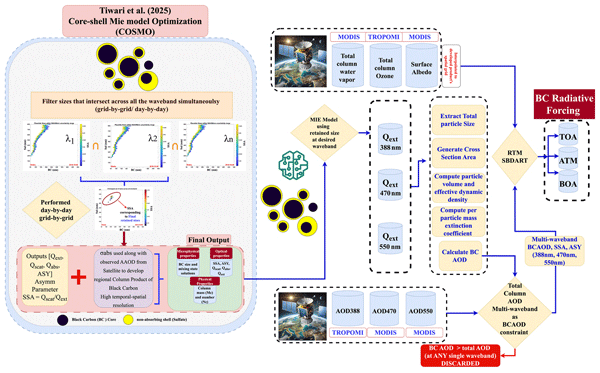
Abstract. Black carbon (BC) aerosols remain among the most uncertain contributors to anthropogenic climate forcing, as their radiative impact depends sensitively on microphysical evolution and atmospheric loading. This study presents a physics-informed, machine learning (ML) approach to estimate clear-sky BC top-of-atmosphere direct radiative forcing (BCTOA) at high spatial-temporal resolution while retaining physical interpretability. The study derives necessary optical properties for radiative transfer modeling (RTM), by constraining them with multi-platform, multi-waveband observations and their associated uncertainties. The RTM outputs are then used to train the ML surrogates and applied over two contrasting urban agglomerates-Xuzhou, China, and Dhaka, Bangladesh. The ML framework closely reproduces physics-based regional climatological mean (–17.6 ± 2.2 W m-2 versus –17.4 ± 2.6 W m-2 over Xuzhou; –14.9 ± 1.1 W m-2 versus –15.0 ± 1.2 W m-2 for Dhaka), while achieving high predictive fidelity R2 > 0.95; RMSE ~1.5–1.8 W m-2 and strong cross-regional consistency (r > 0.9). Predictor decomposition reveals BCTOA is primarily modulated by BC aerosol optical depth (BCAOD), column number density, and mixing state, with their relative importance and influence varying non-linearly across cooling-to-warming regimes. Crucially, similar BC loading can yield contrasting absorption-scattering dynamics across region, which are not captured by simplfied forcing parameterization. Together, the physics-informed ML framework and the multi-domain evaluation provide an efficient and transferable tool for constraining BC radiative impacts across real-world heterogeneity. The analysis also offers new mechanistic insight into how regional properties reshape BC regional radiative forcing.
Competing interests: At least one of the (co-)authors is a member of the editorial board of Atmospheric Chemistry and Physics. The peer-review process was guided by an independent editor, and the authors also have no other competing interests to declare.
Publisher's note: Copernicus Publications remains neutral with regard to jurisdictional claims made in the text, published maps, institutional affiliations, or any other geographical representation in this paper. While Copernicus Publications makes every effort to include appropriate place names, the final responsibility lies with the authors. Views expressed in the text are those of the authors and do not necessarily reflect the views of the publisher.-
Notice on discussion status
The requested preprint has a corresponding peer-reviewed final revised paper. You are encouraged to refer to the final revised version.
-
Preprint
(8040 KB)
-
Supplement
(4563 KB)
-
The requested preprint has a corresponding peer-reviewed final revised paper. You are encouraged to refer to the final revised version.
- Preprint
(8040 KB) - Metadata XML
-
Supplement
(4563 KB) - BibTeX
- EndNote
- Final revised paper


Journal article(s) based on this preprint
Interactive discussion
Status: closed
-
RC1: 'Comment on egusphere-2026-363', Anonymous Referee #1, 21 Apr 2026
-
AC2: 'Response to Reviewer 1 Comments', Pravash Tiwari, 13 Jun 2026
The comment was uploaded in the form of a supplement: https://egusphere.copernicus.org/preprints/2026/egusphere-2026-363/egusphere-2026-363-AC2-supplement.pdf
-
AC2: 'Response to Reviewer 1 Comments', Pravash Tiwari, 13 Jun 2026
-
RC2: 'Comment on egusphere-2026-363', Anonymous Referee #2, 22 Apr 2026
This manuscript presents a physics-informed machine learning (ML) framework to estimate clear-sky black carbon (BC) top-of-atmosphere (TOA) direct radiative forcing by combining observationally constrained microphysical retrievals (via a core–shell Mie framework) with radiative transfer modeling (SBDART), and subsequently training surrogate models for rapid prediction. The approach is applied to two contrasting urban regions (Xuzhou and Dhaka), and the authors further interpret controlling factors using SHAP analysis. While the study addresses an important issue, i.e., BC forcing uncertainty, it currently has several conceptual and methodological limitations that limit the robustness and general applicability of the conclusions, as detailed in my specific comments below.
Major comments:
- The COSMO model assumes the core-shell model for internal mixing. This will largely enhance the absorption of BC. But the actual mixing states may be different. I suggest the authors perform additional sensitivity experiments to test the effect of other mixing states, such as external mixing, partial internal mixing, uniform internal mixing, fractal aggregates, etc.
- The vertical distribution of BC also significantly affects its radiative effects, but is not discussed in the analysis. The authors should explicitly discuss what vertical profiles were assumed in SBDART, whether BC is assumed to be well mixed or prescribed, etc. How this profile assumption may lead to uncertainties in BC forcing.
- The study explicitly states that no observational product is available for direct validation and therefore uses COSMO–RTM output as the “reference truth.” This treatment will incorporate unceratinties in the COSMO model in the ML framework, and the results only represent emulation accuracy rather than physical correctness. I suggest the authors validate the model using CERES fluxes with high BC loading or AERONET derived forcing efficient under high AAOD conditions.
- Only two sites, Xuzhou and Dhaka, were selected to validate the model, which in my opinion, is not sufficient to justify the transferability of the model. Both sites are polluted urban regions, but BC can be extensive at biomass burning regimes, some of which are remote forest regions. Please consider adding more validation sites with different aerosol types.
- The interpretation of SHAP results may be over physical. SHAP only provides correlative behaviors in the model, not physical causality. Claims such as “BCAOD sign reversal”, “mixing state controls warming vs cooling” should be weakened.
Minor comments:
- Terminologies are not clear. “BCTOA”, “TOA forcing”, “BCTOA DRF” are used interchangeably; “mixing state” is sometimes defined, sometimes assumed; “Cooling-to-warming regimes” and “TOA regimes” are introduced informally and not rigorously defined.
- Typos: Missing spaces (e.g., “AOD550values”); Repeated words (“also also incorporate”); Inconsistent units formatting (e.g., W m-2 vs. W m⁻²).
- Several figures, such as Figures 3 and 4, are overcrowded and the fonts are too small.
- Please add 1:1 line, and statistics (Bias, RMSE) to Figure 4.
Citation: https://doi.org/10.5194/egusphere-2026-363-RC2 -
AC1: 'Response to Reviewer 2 Comments', Pravash Tiwari, 13 Jun 2026
The comment was uploaded in the form of a supplement: https://egusphere.copernicus.org/preprints/2026/egusphere-2026-363/egusphere-2026-363-AC1-supplement.pdf
Peer review completion


Interactive discussion
Status: closed
-
RC1: 'Comment on egusphere-2026-363', Anonymous Referee #1, 21 Apr 2026
Tiwari et al. derive the clear sky TOA direct radiative forcing due to black carbon (BCTOA DRF) using the outputs from the COSMO framework (their previous work) constrained by multi-spectral spaceborne AOD retrievals, and then employing SBDART model for BCTOA DRF calculation, for two geographical regions: Xuzhou and Dhaka. The BCTOA DRF estimated using SBDART is then used to train statistical ML model, whose efficacy is discussed in the manuscript for various microphysical properties (including amount) of BC. Shapley values were used to determine the contribution of different predictors in ML prediction of BCTOA DRF. The datasets used in this study, along with the methodology, are clearly described and well justified. The manuscript is well written and easy to follow. I have a few minor comments that aim to further improve the manuscript.
Minor comments:
Line 67: Are there any valid references which use linear AOD-flux relationship?
Line 95: How is the BCTOA DRF calculated from TOA fluxes? The values reported in the results are strongly negative compared to the global mean low positive values reported in previous studies, also stated in lines 44 and 45 of the manuscript.
Line 112: Can this framework be expanded to other regions with AERONET stations, or are there any other special requirements?
Line 210-220: Reference to your earlier work is missing here. Abbreviations MBE and MAE need to be defined. A brief note on the variables used to predict BCTOA, type of random forest model used along with the hyperparameters would be useful here.
Figure 3: Bottom panels are not correctly labelled. Also, the font size is too small for the last two panels in bottom row and should be increased.
Lines 280-335: While the values of the different BC-related parameters are taken from Figure 3, it would improve clarity if the corresponding panels (a–i) are explicitly referenced when these parameters are discussed.
Section 3.2: The rationale for comparing different statistical models for predicting BCTOA is not stated in the manuscript. If the authors wanted to show the benefit of using a random-forest model compared to multi-linear regression or linear regression, they could just state the additional information in the supplementary or appendix. Adding a separate section for this comparison seems unnecessary and I suggest moving this section to supplementary and briefly stating the benefit of using ML-based model in the main text.
Section 3.2: please refer to specific panels in Figure 4 appropriately while discussing them in the text.
Figures 4 and 6: Axis labels are hard to read. Please increase their font size.
Line 392: By “environmental” do you mean different source regions?
Lines 455-465: Please correct repeated information.
Line 536: Please include the number of years of data that was used in generating the “regional climatology” shown in Figure 7?
Figures 7 and 8: What geographical radius was used for estimating BC TOA DRF around each AERONET station? How were this radius chosen?
Citation: https://doi.org/10.5194/egusphere-2026-363-RC1 -
AC2: 'Response to Reviewer 1 Comments', Pravash Tiwari, 13 Jun 2026
The comment was uploaded in the form of a supplement: https://egusphere.copernicus.org/preprints/2026/egusphere-2026-363/egusphere-2026-363-AC2-supplement.pdf
-
AC2: 'Response to Reviewer 1 Comments', Pravash Tiwari, 13 Jun 2026
-
RC2: 'Comment on egusphere-2026-363', Anonymous Referee #2, 22 Apr 2026
This manuscript presents a physics-informed machine learning (ML) framework to estimate clear-sky black carbon (BC) top-of-atmosphere (TOA) direct radiative forcing by combining observationally constrained microphysical retrievals (via a core–shell Mie framework) with radiative transfer modeling (SBDART), and subsequently training surrogate models for rapid prediction. The approach is applied to two contrasting urban regions (Xuzhou and Dhaka), and the authors further interpret controlling factors using SHAP analysis. While the study addresses an important issue, i.e., BC forcing uncertainty, it currently has several conceptual and methodological limitations that limit the robustness and general applicability of the conclusions, as detailed in my specific comments below.
Major comments:
- The COSMO model assumes the core-shell model for internal mixing. This will largely enhance the absorption of BC. But the actual mixing states may be different. I suggest the authors perform additional sensitivity experiments to test the effect of other mixing states, such as external mixing, partial internal mixing, uniform internal mixing, fractal aggregates, etc.
- The vertical distribution of BC also significantly affects its radiative effects, but is not discussed in the analysis. The authors should explicitly discuss what vertical profiles were assumed in SBDART, whether BC is assumed to be well mixed or prescribed, etc. How this profile assumption may lead to uncertainties in BC forcing.
- The study explicitly states that no observational product is available for direct validation and therefore uses COSMO–RTM output as the “reference truth.” This treatment will incorporate unceratinties in the COSMO model in the ML framework, and the results only represent emulation accuracy rather than physical correctness. I suggest the authors validate the model using CERES fluxes with high BC loading or AERONET derived forcing efficient under high AAOD conditions.
- Only two sites, Xuzhou and Dhaka, were selected to validate the model, which in my opinion, is not sufficient to justify the transferability of the model. Both sites are polluted urban regions, but BC can be extensive at biomass burning regimes, some of which are remote forest regions. Please consider adding more validation sites with different aerosol types.
- The interpretation of SHAP results may be over physical. SHAP only provides correlative behaviors in the model, not physical causality. Claims such as “BCAOD sign reversal”, “mixing state controls warming vs cooling” should be weakened.
Minor comments:
- Terminologies are not clear. “BCTOA”, “TOA forcing”, “BCTOA DRF” are used interchangeably; “mixing state” is sometimes defined, sometimes assumed; “Cooling-to-warming regimes” and “TOA regimes” are introduced informally and not rigorously defined.
- Typos: Missing spaces (e.g., “AOD550values”); Repeated words (“also also incorporate”); Inconsistent units formatting (e.g., W m-2 vs. W m⁻²).
- Several figures, such as Figures 3 and 4, are overcrowded and the fonts are too small.
- Please add 1:1 line, and statistics (Bias, RMSE) to Figure 4.
Citation: https://doi.org/10.5194/egusphere-2026-363-RC2 -
AC1: 'Response to Reviewer 2 Comments', Pravash Tiwari, 13 Jun 2026
The comment was uploaded in the form of a supplement: https://egusphere.copernicus.org/preprints/2026/egusphere-2026-363/egusphere-2026-363-AC1-supplement.pdf
Peer review completion
Journal article(s) based on this preprint
Viewed
| HTML | XML | Total | Supplement | BibTeX | EndNote | |
|---|---|---|---|---|---|---|
| 1,593 | 804 | 95 | 2,492 | 224 | 131 | 197 |
- HTML: 1,593
- PDF: 804
- XML: 95
- Total: 2,492
- Supplement: 224
- BibTeX: 131
- EndNote: 197
Viewed (geographical distribution)
| Country | # | Views | % |
|---|
| Total: | 0 |
| HTML: | 0 |
| PDF: | 0 |
| XML: | 0 |
- 1
Pravash Tiwari

Hongrui Gao
Lingxiao Lu
Oleg Dubovik
The requested preprint has a corresponding peer-reviewed final revised paper. You are encouraged to refer to the final revised version.
- Preprint
(8040 KB) - Metadata XML
-
Supplement
(4563 KB) - BibTeX
- EndNote
- Final revised paper
Tiwari et al. derive the clear sky TOA direct radiative forcing due to black carbon (BCTOA DRF) using the outputs from the COSMO framework (their previous work) constrained by multi-spectral spaceborne AOD retrievals, and then employing SBDART model for BCTOA DRF calculation, for two geographical regions: Xuzhou and Dhaka. The BCTOA DRF estimated using SBDART is then used to train statistical ML model, whose efficacy is discussed in the manuscript for various microphysical properties (including amount) of BC. Shapley values were used to determine the contribution of different predictors in ML prediction of BCTOA DRF. The datasets used in this study, along with the methodology, are clearly described and well justified. The manuscript is well written and easy to follow. I have a few minor comments that aim to further improve the manuscript.
Minor comments:
Line 67: Are there any valid references which use linear AOD-flux relationship?
Line 95: How is the BCTOA DRF calculated from TOA fluxes? The values reported in the results are strongly negative compared to the global mean low positive values reported in previous studies, also stated in lines 44 and 45 of the manuscript.
Line 112: Can this framework be expanded to other regions with AERONET stations, or are there any other special requirements?
Line 210-220: Reference to your earlier work is missing here. Abbreviations MBE and MAE need to be defined. A brief note on the variables used to predict BCTOA, type of random forest model used along with the hyperparameters would be useful here.
Figure 3: Bottom panels are not correctly labelled. Also, the font size is too small for the last two panels in bottom row and should be increased.
Lines 280-335: While the values of the different BC-related parameters are taken from Figure 3, it would improve clarity if the corresponding panels (a–i) are explicitly referenced when these parameters are discussed.
Section 3.2: The rationale for comparing different statistical models for predicting BCTOA is not stated in the manuscript. If the authors wanted to show the benefit of using a random-forest model compared to multi-linear regression or linear regression, they could just state the additional information in the supplementary or appendix. Adding a separate section for this comparison seems unnecessary and I suggest moving this section to supplementary and briefly stating the benefit of using ML-based model in the main text.
Section 3.2: please refer to specific panels in Figure 4 appropriately while discussing them in the text.
Figures 4 and 6: Axis labels are hard to read. Please increase their font size.
Line 392: By “environmental” do you mean different source regions?
Lines 455-465: Please correct repeated information.
Line 536: Please include the number of years of data that was used in generating the “regional climatology” shown in Figure 7?
Figures 7 and 8: What geographical radius was used for estimating BC TOA DRF around each AERONET station? How were this radius chosen?