
the Creative Commons Attribution 4.0 License.
the Creative Commons Attribution 4.0 License.
 | 29 Jan 2026
Water mass modification of the warm Atlantic Inflow towards the Arctic across the Iceland-Faroe Ridge
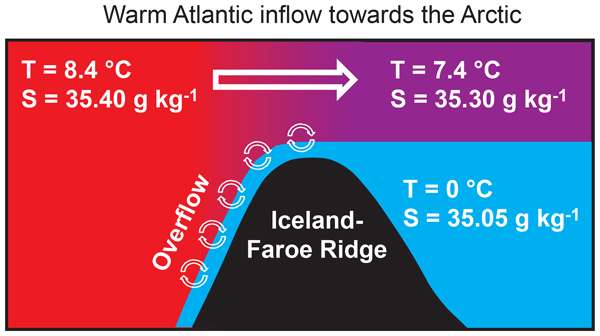
Abstract. The warm Atlantic inflow across the Iceland-Faroe Ridge (IFR) is the strongest of the three branches carrying warm water to the Nordic Seas and further into the Arctic. This branch (IF-inflow) carries almost 50 % of the total Atlantic water inflow. The Atlantic water crossing the IFR mainly flows through the Iceland Basin with no indication of a significant contribution from the Rockall Trough. The salinity variations of the Atlantic water approaching the IFR are well explained as a delayed response to the intrusion of the Subpolar Gyre into the Iceland Basin while the temperature variations may be seen as a combined response to the gyre and global warming. The flow corridor feeding the IFR with Atlantic Water gets narrower and migrates southeastward to the rim of the Iceland Basin when the Subpolar Gyre extends into the basin. As the Atlantic water crosses the IFR, it is cooled by at least 1 °C and freshened by at least 0.1 g kg-1. Satellite-tracked drifters that crossed the IFR exhibited prolonged residence times on the western flank of the IFR together with a high level of eddy kinetic energy. This indicates that transformation occurs in this area. We show that transformation of the water mainly is caused by mixing with Arctic water masses, rather than by air-sea-interactions, and that most of the modification takes place upstream of the ridge crest. The Atlantic water changes character from an almost barotropic to a much more baroclinic flow over and northeast of the ridge enabling water masses, otherwise constrained to follow isobaths, to cross the ridge. We find that the cooling and freshening of the Atlantic water across the IFR are relatively constant throughout the whole period from 1993 to 2023, except for the last few years. The associated freshening implies that the salinity difference between IF-inflow water and the deep waters northeast of the ridge has been reduced by roughly 20–30 % after crossing the ridge, which weakens the potential for dense-water formation. Updated transport estimates show a slight strengthening for this AMOC branch. From 1993 to 2023, the volume transport of the IF-inflow increased by (12±7) %, while the heat transport relative to 0 °C increased by (16±8) %.
-
Notice on discussion status
The requested preprint has a corresponding peer-reviewed final revised paper. You are encouraged to refer to the final revised version.
-
Preprint
(2805 KB)
-
Supplement
(942 KB)
-
The requested preprint has a corresponding peer-reviewed final revised paper. You are encouraged to refer to the final revised version.
- Preprint
(2805 KB) - Metadata XML
-
Supplement
(942 KB) - BibTeX
- EndNote
- Final revised paper


Journal article(s) based on this preprint
Interactive discussion
Status: closed
-
RC1: 'Comment on egusphere-2026-359', Anonymous Referee #1, 02 Mar 2026
-
AC1: 'Reply on RC1', Guðrið Eriksdóttir, 17 Apr 2026
We thank both referees for positive and constructive comments. We have tried to address them all. Below are all the reviewer comments and our responses. Major revisions in the updated manuscript are in red.
RC1:
This is an important analysis of a crucial portion of the AMOC of the upper limb. I am happy with much of this study, but have some points that should be addressed. They are outlined as follows:
Line 38: Reference for entrained ambient waters?
Response: Three references have been added
Line 124: Standard stations not marked in Fig. 1.
Response: The standard stations are now marked on both sections.
Lines 108-130: I think it’s important to mention how the reader can learn more about how each of these data products are collected and processed. I would encourage adding information to each of these three data sources specifically stating where that information can be found (even if it’s just the same website where you got the data).
Response: We have added more information on the data sets in Sect. 2.
Line 150: You should extend the x-axis slightly eastward to close the dashed-white contour south of Faroe.
Response: In the new Figure 2, the region has been extended both eastward and northward so that both contours are more continuous. For consistency, Figure 4c,d has been extended similarly.
Line 158: “From Fig. 2, ∆h is 10 cm.” Where? I’m guessing it is between the thick-dashed white contours, but you should specify.
Response: This should now be clear from the new figure.
174: Delete comma
Response: Has been done.
Lines 173-178: To be fair, only 3 drifters seem to originate in the Rockall Trough. I would delete the second half of the first sentence, or I would change it to something like “…and it also indicates a clear surface pathway from the IB through the FSC” and delete the last sentence of the paragraph. For the first part of the second sentence, I think you need to mention how many drifters were even in the western part of the RT.
Response: The text has been changed accordingly.
Line 184: Reference? Even if it’s the ones earlier in the paragraph, you should reference again for a statement like this.
Response: We now refer to Fig. 3a for justification.
Line 185: Word choice on “thus, point at”? Maybe use “suggest” instead?
Response: Has been changed.
186-187: Again, there is very little data to directly support this from the drifters. Actually, the data shows that this pathway never occurs, but it’s based on 3 drifters. Instead, there is plenty of data that shows that the water crossing the IFR comes from the IB, which essentially is the same point. I would re-word this concept in those terms.
Response: You are completely right. This statement is now deleted.
189: How many different transacts is that? The sentence could be strengthened by saying something like “…from approximately (# of transacts) transacts along 4 different routes between…” I’m guessing it’s hundreds.
Response: There are not that many transects. There are 54 at IFR (from Childers et al., 2014) and 10, 25 and 41 at the other transects further south. The number of transects has been written in the text.
223: Does low pc1 (high pc1) also mean that the PC is negative (positive)? If so, clarify. If not, wouldn’t it make more sense to do this analysis as positive or negative PC, rather than by year? (though you could mention that clearly the majority of pc1 will be pre-2008, and vice versa)
Response: The two periods have now been marked on Figure 4a.
223-230: I am just realizing that not all drifter deployment locations are included in the figures. This should be clarified earlier when you first introduce the drifter images. Maybe just in the captions, and it would help to be specific (e.g. the deployment locations of 17 drifters are outside the figure.)
Response: This has been added to the captions in figure 3 and 5.
241-249: Since you are using the water properties from I and V to determine what water is going over the ridge, it would be helpful to note the mooring locations on the float figures that show the WB and EB. It could be worth mentioning if all the floats cross the IV section before crossing WB and EB, or what percentage do.
Response: The locations of stations I and V have been added to Figure 3. We now mention that all of the drifters crossing the IFR passed between stations I and V or close to one of them (Fig. 3a).
296-301: There must be a better way to remove temperature trend than subtracting a constant value of global SST from the data set. At the very least, it would make more sense to subtract the global SST trend. It would be best to get a much more local trend, though using the trend from TIB would clearly be influenced by a positive trend in the EOF pc1. Perhaps you can find a longer local temperature data set where the EOF pc1 won’t play as much of a role since the gyre would’ve likely gone through a couple cycles? Or make the SST data have a greater spatial range without covering the entire globe (e.g., all SST data within a 10 degree lat and 20 degree lon box centered on the IFR)? Of course, using SST to represent temperature trends in the upper 500m will surely be biased as well. Maybe use the trend in mean Argo data from the top 500m in the northern North Atlantic, and then assume that trend for your entire record (since that data starts in 2004)? None of these are perfect, but I think there’s a better way. My suggestion is to use Argo.
Response: In response to the critique by both of the referees on this issue, we have made several changes to the manuscript: i) Instead of a global SST anomaly, we now consider more local temperature series represented by averages over the North Atlantic upstream (west) of our study area. ii) Since the depth of winter convection varies considerably over this region, we consider both surface temperature and a depth average over the uppermost 500 m. These series are illustrated in the revised Figure 8b. iii) Due to this ambiguity, we no longer subtract a global or regional temperature series from the observed temperature (TIB) and have removed the original Figure 8c. iv) Recognizing the critique by Referee 2, we have also removed the lagged correlation analysis and the original Figure 8d. In summary, we maintain our suggestion that the divergence between TIB and pc1 after 2015 is most likely due to warming of the upstream water masses, but in a more qualitative way.
304: I appreciate that this paragraph is trying to address my concerns in my previous comment, but I disagree with this reasoning unless you are referring to the EOF pc1 reinforcing the temperature trend. In that case, I agree, but you should try to find the balance between removing the local temperature trend while avoiding having too much of the EOF pc1 in the trend. Hence my suggestions above. You could even evaluate if your chosen method mostly isn’t being influenced by the gyre expansion/contraction by doing another EOF on it.
Response: With the revisions made in response to the previous referee comment, this should no longer be an issue.
358-9: Confusingly worded sentence. I suggest re-writing it.
Response: Has been re-written.
366: To what extent west does the upstream of the IFR region reach?
Response: Has been included
376-391: I am confused on this analysis. Is 10a the mean time spent in each grid cell of the drifters that entered? Clearly not all 101 drifters spent time in every grid cell, but also multiple surely spent time in the same grid cells. I think I understand 10b, but you still may want to clarify. Is it the number of drifters that spent time in each grid cell?
Response: 10a is now showing data points from all 101 drifters (these are 6-hourly data and the “day spent” was these numbers divided by 4). 10b are how many different floats has been in each cell. The text has been changed accordingly.
393: Wouldn’t EKE from altimetry be more robust? More samples and a different data source. You could do both with figures 11a and 11b.
Response: I have used SWOT data to calculate the EKE and it is included in figure 10d. Figure 10 and 11 are merged together as proposed by RC2.
433: Unbold “mean temperature”
Response: Has been done.
447: Why 1:3? Do we have evidence that the resulting water mass should have these properties? Otherwise, it looks like determining a mixing ratio to match a desired result; if this is the intent, then it would be better to analyse the two water masses and find the exact mixing ratio.
Response: There is no evidence (I rounded to a “nice” number because this is a first approximation). The mixing ratio for each year is added in supplementary Fig. S10. The mean mixing ratio for CT is 23.4% and for SA is 23.1% for the period from 1995 to 2015. For the last years this ratio is different for the two properties indicating, that this approximation no longer holds.
Figure 14 and the text have been updated accordingly.
480: Do you mean “more ocean” instead of “the ocean?”
Response: Yes. Has been change to “the ocean underneath the ice”.
Citation: https://doi.org/10.5194/egusphere-2026-359-AC1
-
AC1: 'Reply on RC1', Guðrið Eriksdóttir, 17 Apr 2026
-
RC2: 'Comment on egusphere-2026-359', Anonymous Referee #2, 05 Mar 2026
Review of “Water mass modification of the warm Atlantic Inflow towards the Arctic across the Iceland-Faroe Ridge” by Eriksdóttir et al.
Eriksdóttir et al. investigate how the Atlantic water inflow branch across the Iceland-Faroe Ridge (IFR) approaches the ridge and how the properties of the flow are modified during the crossing, using observations from drifter, CTD stations, and satellite data. They also present an updated time series of the Atlantic water transport at the standard section N north of the Faroe Islands. The authors focus mainly on the long-term variability and its causes.
This study fits well into the scope of Ocean Science and will be a useful addition to the literature for this area, and the findings have implications for the large-scale circulation. The authors have generally done a good job in addressing many aspects of the Atlantic water flow toward the IFR, but some of the analyses and arguments lack robustness to make the results more convincing. In particular, I’m missing uncertainties for many of the profiles and time series, which would help addressing how significant the observed changes are. While the manuscript reads well, the overall structure can be improved by linking sections better and making the text more concise, especially in the abstract. The figures are mainly clear and support the argumentation, but some can be improved to be more intuitive and help guide the interpretation. Overall, I think this manuscript would benefit from some moderate revision before it can be accepted for publication. Please see my specific comments below.
General comments:
- Regarding structure, I don’t quite see the difference between inter-annual and long-term variation. After Section 3.3. about “inter-annual variations”, I was wondering why you get these two periods from the EOF. You address the causes of both the changes in properties and flow later in Section 4.2 (now “long-term variations”), but it’d help a lot to get some “road map” information at the end or beginning of each section on where you will continue with the analysis. Some of this information is currently provided in the introduction (L82-105). I think that section can be shortened, i.e., you only provide a general outline of the content of the paper and refer to the actual section numbers in the introduction, while the details (and findings) should be reserved for when you get to the actual sections.
- Uncertainties: The profiles and time series are generally presented without uncertainties (e.g., Figs. 6, 9). Adding standard errors to your mean lines would help assessing whether the differences are significant (both for the figures and Table 1, where you report absolute differences).
Specific comments:
- The abstract is relatively long and reads like a summary, it could be more concise highlighting the main findings. It is unclear what belongs to the background/established knowledge and where the results of this paper start (typically: “Here we show …” or similar). The motivation for and implications of the study could be more explicit.
- Fig. 1: Please use a different color for land (green is part of the color map you use). Please mark the standard stations on the two sections.
- L83, 348, etc.: You introduce many abbreviations, but are not consistently using them throughout the manuscript. For readers not very familiar with the region, the manuscript becomes more difficult to read the more abbreviations you use. Please reduce the amount of abbreviations you use and be then consistent with their use for the rest of the manuscript.
- L139-141/Fig. 2: Perhaps this would be easier to see if you expanded the boundaries of Fig. 2.
- Fig. 2: Is the semi-transparent gray shading necessary? It is difficult to see (I was confused at first what to look for) and changes the perception of the colors. Also, perhaps use a discrete color map with increments every 1 cm, as it is very difficult to read off the Δh = 10 cm.
- L156-160: Why do you use the deepest point in the IFR and not the average depth for D? I also cannot follow the sentence in L159/160: You read 10 cm off Fig. 2 as a starting point for the calculation, so how can this provide support for Fig. 2?
- Fig. 3: This figure is not very clear, perhaps because the spaghetti lines overlap each other and do not show preferred pathways, if there are any. Have you tried to either plot the trajectories as semi-transparent lines or grid the drifter data on a fine grid (as in Fig. 10 or finer) and plot a heat map?
- Fig. 4: Panels c) and d) have very similar ranges of the color bars. For easier comparison, please use the same range on both panels.
- L201: Please explain why you subtract the spatial average of all grid points in the domain before computing the EOF. EOFs aim to capture the spatiotemporal variability; the spatial structure will not be conserved if you artificially force the field (with arbitrary domain boundaries) to have zero spatial mean at each time step. The anomaly for each grid point is normally computed by removing the temporal mean at each grid point before the EOF analysis. What difference to the result would that approach make?
- L223-230: A more common approach would be to use composites of the years with the highest and lowest pc1 for Fig. 5. This would help to exclude the years that are not extreme (such as 2003), while you still can state that these composites correspond to an early and late period.
- L245: For the properties upstream of the IFR, T_IB and S_IB, you could use profiles from Argo floats to supplement with data from the region south of the ridge, between stations I and V. If your argumentation holds, the time series from I and V should envelop the measurements in between.
- L257: Please add a reference for the large vertical and horizontal variability or show a plot of standard deviation for the mean properties in the supplementary.
- L260/Fig. 6: You’re (for good reasons) not comparing apples with apples here. For a closer comparison, you could consider also showing the T and S time series from the N-section as a 3-year running mean.
- L265: This is an example of where you could add some “road map” info, such as “We quantify this cooling and freshening in Section 5.1.” or similar.
- L296-301: The ocean is not as well mixed as the atmosphere. A global SST anomaly will likely not be representative for the upper 500m of the water column (what T_IB was constructed to be), nor will it have the correct timing for each region on Earth. Your current analysis simplifies these aspects too much, and a lag analysis does not seem trustworthy. Perhaps ocean heat content in the subpolar North Atlantic would be a better parameter to investigate. In any case, the time series of the global SST anomaly does not imply causality; other multidecadal variability, such as the Atlantic Multidecadal Variability, could also affect the long-term variability of T_IB and pc1.
- L337: It might not make much of a difference, but it is probably more appropriate to use the median instead of the mean crossing times, as the mean is more sensitive to extreme values for a potentially skewed distribution of crossing times.
- L340: To make it easier for readers who are not familiar with the method used by Larsen et al. (2012), please describe the method briefly (and keep the reference for details). For example, please specify what you mean by heat flux (sensible and latent heat fluxes, or also radiation?). Please also comment on the following: 1) The air-sea interaction only affects the mixed layer, but here you use the upper 500m for stations V and I, so you probably wouldn’t expect a high percentage anyway? 2) What are the seasonal differences in the flow during the IFR crossing? I expect that the result of the calculation is sensitive to the season of the crossing, with more air-sea interaction in winter than in summer.
- L345: “the only explanation” sounds a bit absolute, considering there is no estimate of the uncertainty associated with your estimates and method.
- L346: “well-established process” – I agree, but you could be explicit about the intermittency of the process (it is first alluded to later in Section 5.3.3).
- L354-356: Please state the period over which the observations were taken or refer to the methods section where you introduce the data. Is the distribution of profiles over time somewhat constant for the three regions, or would it be best to restrict the period to more recent years? Else your result may be biased considering the long-term changes in T_IB and S_IB (Fig. 8). Perhaps also consider to augment your data set of CTD profiles (at least for the upstream region, potentially also the flank region) by including profiles from Argo floats. This would reduce the uncertainties on your mean profile, as these profiles are usually not synoptic (10 days in between) compared to cruise sections.
- L361: Here you use the standard stations, as opposed to the transport-averaged T and S properties from before. With which station would a transport-averaged profile align most?
- Figs. 10 & 11: I suggest to combine these two figures into one. In panel 10a, do you mean “average” time spent in each grid cell? Please also mark the outline of the regions defined in Fig. 9 (upstream, flank, crest) to help the comparison and interpretation. Perhaps also just refer to the “flank” instead of the “western flank” (or consistently “western flank”, in all text and figures) – I was initially confused as the residence time appears higher on the central flank until I realized that you called the entire region “western flank” in L355, but only “flank” in Fig. 9.
- L400: Please add a reference for the Taylor-Proudman theorem.
- Supplementary Fig. 4: You refer to Fig. 3.7a in the caption – do you mean Fig. 9a?
- Supplementary Fig. 5: Please add isopycnals to the panels. To make the figure more intuitive and independent from the caption, you could also add titles/labels “I”, “V”, and “KR” to the panels.
- L447: Instead of assuming a fixed 1:3 ratio, you can compute it using the mixing line in a TS-diagram for each year.
- L458: This is the same formulation as in L23. Instead of saying that things have changed, please be explicit about what has changed (less cooling and more freshening, if I interpret Fig. 14 correctly?).
- L479: Bretones et al. (2022) may not be the most fitting reference here. They used a single model simulation and focused mainly on the far future, at the expense of details on the present or near future. Also, other models show a weakening in the Nordic Seas before a strengthening (e.g., Årthun et al., 2023, https://www.nature.com/articles/s41467-023-37846-6). In any case, I suggest tp reword to “some model simulations are consistent with our result” or similar – your observational results should provide the baseline, not the model simulations.
- L484: Please specify that the cooling refers to a reduction over space, not over time. Just before you were talking about temporal changes, which could lead to confusion.
- L511&513: Again, this sounds as if this is a recent change (in time, not space) for dense-water formation and freshening, so please reword.
Technical edits/suggestions:
- L10: There are many different definitions of the Arctic, many of them include the Nordic Seas. Perhaps best to be specific here and use “Arctic Ocean”.
- L14: Be consistent about the capitalization of “Atlantic water”/ “Atlantic Water” throughout the manuscript.
- L23: It is unclear whether the freshening refers to the “last few years” or the entire period.
- L25: Perhaps be explicit about the dense-water formation occurring “downstream”or “in the Nordic Seas”.
- L55: “deeper than 300m” → Do you mean “located below 300m depth”?
- L57: remove “A” before “high fishing activity”.
- L90: It is unclear why the citation is placed here, perhaps it should rather be at the end of the sentence or an indirect citation.
- L117-125: remove the sentence “The standard stations and sections are shown in Fig. 1” and add “(Fig. 1)” at the end of the sentences in L119 and L123 instead.
- L120: Perhaps use “Marine and Freshwater Research Institute (MFRI) in Iceland” as MFRI is the better known abbreviation.
- L125: The TEOS-10 standard suggests to capitalize Conservative Temperature and Absolute Salinity, which you have done sometimes, but not always.
- L135: “The background colours indicate the MDT” This sentence belongs into the caption (or remove it altogether).
- L142: “Subpolar Gyre”
- L147 (and similar captions): “a thicker 1000 m contour”
- L151: “south Icelandic slope”
- L173-174: You normally use “data” as plural, so change to “support” and “they also indicate”
- L181/182: Is there a reason for why you use “Ekman drift” instead of the more common “Ekman transport”?
- L199: You haven’t introduced the Rockall-Hatton Plateau yet, perhaps it could be marked on Fig. 1 or you explain what regions it encompasses.
- L204: move “(Fig. 4a)” to the end of the sentence, it interrupts the flow.
- L246 & L406: “overflow water”
- L256: You probably mean “Atlantic water core”.
- L276: Instead of “similarity between the cyan and black curves”, please name the properties you’re comparing to make the text easier to follow for the reader.
- L334: Either “Western Boundary” or “western boundary”
- L359: “time, this”
- L497: no comma between “find” and “that”
- L510: “to a projected”
Citation: https://doi.org/10.5194/egusphere-2026-359-RC2 -
AC2: 'Reply on RC2', Guðrið Eriksdóttir, 17 Apr 2026
We thank both referees for positive and constructive comments. We have tried to address them all. Below are all the reviewer comments and our responses. Major revisions in the updated manuscript are in red.
RC2: 'Comment on egusphere-2026-359', Anonymous Referee #2, 05 Mar 2026 reply
Review of “Water mass modification of the warm Atlantic Inflow towards the Arctic across the Iceland-Faroe Ridge” by Eriksdóttir et al.
Eriksdóttir et al. investigate how the Atlantic water inflow branch across the Iceland-Faroe Ridge (IFR) approaches the ridge and how the properties of the flow are modified during the crossing, using observations from drifter, CTD stations, and satellite data. They also present an updated time series of the Atlantic water transport at the standard section N north of the Faroe Islands. The authors focus mainly on the long-term variability and its causes.
This study fits well into the scope of Ocean Science and will be a useful addition to the literature for this area, and the findings have implications for the large-scale circulation. The authors have generally done a good job in addressing many aspects of the Atlantic water flow toward the IFR, but some of the analyses and arguments lack robustness to make the results more convincing. In particular, I’m missing uncertainties for many of the profiles and time series, which would help addressing how significant the observed changes are. While the manuscript reads well, the overall structure can be improved by linking sections better and making the text more concise, especially in the abstract. The figures are mainly clear and support the argumentation, but some can be improved to be more intuitive and help guide the interpretation. Overall, I think this manuscript would benefit from some moderate revision before it can be accepted for publication. Please see my specific comments below.
Response: In the revised manuscript, we have tried to follow these guidelines.
General comments:
- Regarding structure, I don’t quite see the difference between inter-annual and long-term variation. After Section 3.3. about “inter-annual variations”, I was wondering why you get these two periods from the EOF. You address the causes of both the changes in properties and flow later in Section 4.2 (now “long-term variations”), but it’d help a lot to get some “road map” information at the end or beginning of each section on where you will continue with the analysis. Some of this information is currently provided in the introduction (L82-105). I think that section can be shortened, i.e., you only provide a general outline of the content of the paper and refer to the actual section numbers in the introduction, while the details (and findings) should be reserved for when you get to the actual sections.
- Uncertainties: The profiles and time series are generally presented without uncertainties (e.g., Figs. 6, 9). Adding standard errors to your mean lines would help assessing whether the differences are significant (both for the figures and Table 1, where you report absolute differences).
Response: “inter-annual” as well as “low-frequency” have been changed to “long-term”. We have also tried to provide some text for a better road map. The introduction has been abbreviated with some of the text moved to Sect. 4.2. Uncertainties have been added where appropriate.
Specific comments:
- The abstract is relatively long and reads like a summary, it could be more concise highlighting the main findings. It is unclear what belongs to the background/established knowledge and where the results of this paper start (typically: “Here we show …” or similar). The motivation for and implications of the study could be more explicit.
Response: The abstract has been modified along these guidelines.
- Fig. 1: Please use a different color for land (green is part of the color map you use). Please mark the standard stations on the two sections.
Response: Land is now in grey and standard stations have been added to the two sections in the new Figure 2.
- L83, 348, etc.: You introduce many abbreviations, but are not consistently using them throughout the manuscript. For readers not very familiar with the region, the manuscript becomes more difficult to read the more abbreviations you use. Please reduce the amount of abbreviations you use and be then consistent with their use for the rest of the manuscript.
Response: Have tried to be more consistent and now use fewer abbreviations
- L139-141/Fig. 2: Perhaps this would be easier to see if you expanded the boundaries of Fig. 2.
Response: The boundaries of Figure 2 have been expanded both eastward and northward.
- Fig. 2: Is the semi-transparent gray shading necessary? It is difficult to see (I was confused at first what to look for) and changes the perception of the colors. Also, perhaps use a discrete color map with increments every 1 cm, as it is very difficult to read off the Δh = 10 cm.
Response: In the new Figure 2, the semi-transparent grey shading has been removed and SLH isolines for every 1 cm are shown.
- L156-160: Why do you use the deepest point in the IFR and not the average depth for D? I also cannot follow the sentence in L159/160: You read 10 cm off Fig. 2 as a starting point for the calculation, so how can this provide support for Fig. 2?
Response: This paragraph has been modified. The claim of support for Fig. 2 has been removed and the choice of depth for D motivated.
- Fig. 3: This figure is not very clear, perhaps because the spaghetti lines overlap each other and do not show preferred pathways, if there are any. Have you tried to either plot the trajectories as semi-transparent lines or grid the drifter data on a fine grid (as in Fig. 10 or finer) and plot a heat map?
Response: Semi-transparent lines have now been used
- Fig. 4: Panels c) and d) have very similar ranges of the color bars. For easier comparison, please use the same range on both panels.
Response: In the revised manuscript, the same range is used for panels c) and d) and now also for Figure 2.
- L201: Please explain why you subtract the spatial average of all grid points in the domain before computing the EOF. EOFs aim to capture the spatiotemporal variability; the spatial structure will not be conserved if you artificially force the field (with arbitrary domain boundaries) to have zero spatial mean at each time step. The anomaly for each grid point is normally computed by removing the temporal mean at each grid point before the EOF analysis. What difference to the result would that approach make?
Response: The text has now been modified to better explain the motivation for subtracting the spatial average of all grid points at each time step. By this modification, we escape the domination of overall sea level rise while still conserving the slope of the sea surface at every grid point and time step. Thus, the surface velocity field should also be conserved by this modification. To demonstrate the effect of this modification, an additional figure has been added to the Supplement (Figure S2), which shows the results of the EOF analysis without this modification. It should be noted that we (in addition to the modification) do follow the normal procedure of removing the temporal mean at each grid point before the EOF analysis, as suggested by the referee. This is also done in Figure S2, demonstrating that removing the temporal mean at each grid point by itself does not remove the confounding effect of sea level rise. To avoid more confusion on the results of the EOF analysis, panels c) and d) in Figure 4 have also been modified to show the observed Absolute Dynamic Topography for the extreme years 2005 and 2016 (originally presented in the Supplement) rather than the reconstructed topographies.
- L223-230: A more common approach would be to use composites of the years with the highest and lowest pc1 for Fig. 5. This would help to exclude the years that are not extreme (such as 2003), while you still can state that these composites correspond to an early and late period.
Response: That would be preferable, but we have too few data to do that.
- L245: For the properties upstream of the IFR, T_IB and S_IB, you could use profiles from Argo floats to supplement with data from the region south of the ridge, between stations I and V. If your argumentation holds, the time series from I and V should envelop the measurements in between.
Response: This discussion has been moved to Sect. 5.1 and has been modified. We have also, as suggested, looked at Argo data in this region, but there are only a limited number of floats and the timing of the observations do not give a representative distribution between periods with strong and weak SPG-intrusion. This makes it difficult to get statistically significant results. Our general conclusion is, however, that the Argo data support our claim.
- L257: Please add a reference for the large vertical and horizontal variability or show a plot of standard deviation for the mean properties in the supplementary.
Response: The standard deviation is shown in the supplementary.
- L260/Fig. 6: You’re (for good reasons) not comparing apples with apples here. For a closer comparison, you could consider also showing the T and S time series from the N-section as a 3-year running mean.
Response: The reason for using 3-year running means for the observations at stations I and V is that they are based on only a few cruises each year (typically 4). For section N, the transport-weighted values are based partly on 3-year running mean temperature observations from cruises and partly on daily observations from satellite altimetry. The text has been modified to present this more clearly.
- L265: This is an example of where you could add some “road map” info, such as “We quantify this cooling and freshening in Section 5.1.” or similar.
Response: Have been done
- L296-301: The ocean is not as well mixed as the atmosphere. A global SST anomaly will likely not be representative for the upper 500m of the water column (what T_IB was constructed to be), nor will it have the correct timing for each region on Earth. Your current analysis simplifies these aspects too much, and a lag analysis does not seem trustworthy. Perhaps ocean heat content in the subpolar North Atlantic would be a better parameter to investigate. In any case, the time series of the global SST anomaly does not imply causality; other multidecadal variability, such as the Atlantic Multidecadal Variability, could also affect the long-term variability of T_IB and pc1.
Response: In response to the critique by both of the referees on this issue, we have made several changes to the manuscript: i) Instead of a global SST anomaly, we now consider more local temperature series represented by averages over the North Atlantic upstream (west) of our study area. ii) Since the depth of winter convection varies considerably over this region, we consider both surface temperature and a depth average over the uppermost 500 m. These series are illustrated in the revised Figure 8b. iii) Due to this ambiguity, we no longer subtract a global or regional temperature series from the observed temperature (T_IB) and have removed the original Figure 8c. iv) Recognizing the critique by Referee 2, we have also removed the lagged correlation analysis and the original Figure 8d. In summary, we maintain our suggestion that the divergence between T_IB and pc1 after 2015 is most likely due to warming of the upstream water masses, but in a more qualitative way.
- L337: It might not make much of a difference, but it is probably more appropriate to use the median instead of the mean crossing times, as the mean is more sensitive to extreme values for a potentially skewed distribution of crossing times.
Response: Has been changed. The times are a bit shorter now.
- L340: To make it easier for readers who are not familiar with the method used by Larsen et al. (2012), please describe the method briefly (and keep the reference for details). For example, please specify what you mean by heat flux (sensible and latent heat fluxes, or also radiation?). Please also comment on the following: 1) The air-sea interaction only affects the mixed layer, but here you use the upper 500m for stations V and I, so you probably wouldn’t expect a high percentage anyway? 2) What are the seasonal differences in the flow during the IFR crossing? I expect that the result of the calculation is sensitive to the season of the crossing, with more air-sea interaction in winter than in summer.
Response: Have tried to explain the method more clearly. In the Iceland Basin, winter convection extends to at least 500 m as cited elsewhere in the manuscript. As to the question of the seasonal variation, we agree that this is an important issue, but we feel that this is beyond the scope of this already rather long manuscript.
- L345: “the only explanation” sounds a bit absolute, considering there is no estimate of the uncertainty associated with your estimates and method.
Response: Has been changed
- L346: “well-established process” – I agree, but you could be explicit about the intermittency of the process (it is first alluded to later in Section 5.3.3).
Response: Has been done.
- L354-356: Please state the period over which the observations were taken or refer to the methods section where you introduce the data. Is the distribution of profiles over time somewhat constant for the three regions, or would it be best to restrict the period to more recent years? Else your result may be biased considering the long-term changes in T_IB and S_IB (Fig. 8). Perhaps also consider to augment your data set of CTD profiles (at least for the upstream region, potentially also the flank region) by including profiles from Argo floats. This would reduce the uncertainties on your mean profile, as these profiles are usually not synoptic (10 days in between) compared to cruise sections.
Response: Timeline for the measurements are included in Fig. 9. Analyses of Argo data and of two subperiods with CTD data are included in supplementary.
- L361: Here you use the standard stations, as opposed to the transport-averaged T and S properties from before. With which station would a transport-averaged profile align most?
Response: With the baroclinic structure and temporal variations on the section, it is difficult to pick out one station as most representative, but somewhere between N03 and N05 ought to apply generally.
- Figs. 10 & 11: I suggest to combine these two figures into one. In panel 10a, do you mean “average” time spent in each grid cell? Please also mark the outline of the regions defined in Fig. 9 (upstream, flank, crest) to help the comparison and interpretation. Perhaps also just refer to the “flank” instead of the “western flank” (or consistently “western flank”, in all text and figures) – I was initially confused as the residence time appears higher on the central flank until I realized that you called the entire region “western flank” in L355, but only “flank” in Fig. 9.
Response: The changes has been made and we have changed “time spent in days” to observations (6-hourly data). “Time spent in days” was observations divided by 4. Have used “flank” and in order to know on which side of the ridge then “upstream” and “towards Iceland Basin” has been used.
- L400: Please add a reference for the Taylor-Proudman theorem.
Response: We have added a reference.
- Supplementary Fig. 4: You refer to Fig. 3.7a in the caption – do you mean Fig. 9a?
Response: Yes, is corrected.
- Supplementary Fig. 5: Please add isopycnals to the panels. To make the figure more intuitive and independent from the caption, you could also add titles/labels “I”, “V”, and “KR” to the panels.
Response: Has been done.
- L447: Instead of assuming a fixed 1:3 ratio, you can compute it using the mixing line in a TS-diagram for each year.
Response: The mixing ratio for each year is added in supplementary figure S11. The mean mixing ratio for CT is 23.4% and for SA is 23.1% for the period from 1995 to 2015. For the last years this ratio is different for the two properties indicating, that this approximation no longer holds.
Figure 14 has been updated and the text accordingly.
- L458: This is the same formulation as in L23. Instead of saying that things have changed, please be explicit about what has changed (less cooling and more freshening, if I interpret Fig. 14 correctly?).
Response: Have change the formulation.
- L479: Bretones et al. (2022) may not be the most fitting reference here. They used a single model simulation and focused mainly on the far future, at the expense of details on the present or near future. Also, other models show a weakening in the Nordic Seas before a strengthening (e.g., Årthun et al., 2023, https://www.nature.com/articles/s41467-023-37846-6). In any case, I suggest tp reword to “some model simulations are consistent with our result” or similar – your observational results should provide the baseline, not the model simulations.
Response: The model reference has been removed.
- L484: Please specify that the cooling refers to a reduction over space, not over time. Just before you were talking about temporal changes, which could lead to confusion.
Response: Have added “by crossing the IFR”.
- L511&513: Again, this sounds as if this is a recent change (in time, not space) for dense-water formation and freshening, so please reword.
Response: Have used “spatial (not temporal) freshening”
Technical edits/suggestions:
- L10: There are many different definitions of the Arctic, many of them include the Nordic Seas. Perhaps best to be specific here and use “Arctic Ocean”.
Response: Done
- L14: Be consistent about the capitalization of “Atlantic water”/ “Atlantic Water” throughout the manuscript.
Response: Have used “Atlantic water”
- L23: It is unclear whether the freshening refers to the “last few years” or the entire period.
Response: This text has been modified for better clarification.
- L25: Perhaps be explicit about the dense-water formation occurring “downstream” or “in the Nordic Seas”.
Response: Done
- L55: “deeper than 300m” → Do you mean “located below 300m depth”?
Response: Done
- L57: remove “A” before “high fishing activity”.
Response: Done
- L90: It is unclear why the citation is placed here, perhaps it should rather be at the end of the sentence or an indirect citation.
Response: This reference has been removed during the revision of the introduction.
- L117-125: remove the sentence “The standard stations and sections are shown in Fig. 1” and add “(Fig. 1)” at the end of the sentences in L119 and L123 instead.
Response: has been changed.
- L120: Perhaps use “Marine and Freshwater Research Institute (MFRI) in Iceland” as MFRI is the better known abbreviation.
Response: has been changed.
- L125: The TEOS-10 standard suggests to capitalize Conservative Temperature and Absolute Salinity, which you have done sometimes, but not always.
Response: Has been done
- L135: “The background colours indicate the MDT” This sentence belongs into the caption (or remove it altogether).
Response: The sentence has been removed.
- L142: “Subpolar Gyre”
Response: Has been done.
- L147 (and similar captions): “a thicker 1000 m contour”
Response: Has been done.
- L151: “south Icelandic slope”
Response: Has been done.
- L173-174: You normally use “data” as plural, so change to “support” and “they also indicate”
Response: Has been done.
- L181/182: Is there a reason for why you use “Ekman drift” instead of the more common “Ekman transport”?
Response: Here, we refer to individual drifters rather than the volume transport. This should hopefully be clearer in the text now.
- L199: You haven’t introduced the Rockall-Hatton Plateau yet, perhaps it could be marked on Fig. 1 or you explain what regions it encompasses.
Response: The revised text no longer refers to the Rockall-Hatton Plateau.
- L204: move “(Fig. 4a)” to the end of the sentence, it interrupts the flow.
Response: Has been done.
- L246 & L406: “overflow water”
Response: Has been done.
- L256: You probably mean “Atlantic water core”.
Response: Yes
- L276: Instead of “similarity between the cyan and black curves”, please name the properties you’re comparing to make the text easier to follow for the reader.
Response: Has been done.
- L334: Either “Western Boundary” or “western boundary”
Response: Have used “western boundary”.
- L359: “time, this”
Response: This sentence has been rewritten
- L497: no comma between “find” and “that”
Response: Has been done.
- L510: “to a projected”
Response: Has been done.
Citation: https://doi.org/10.5194/egusphere-2026-359-AC2
-
AC2: 'Reply on RC2', Guðrið Eriksdóttir, 17 Apr 2026
-
EC1: 'Comment on egusphere-2026-359', Sjoerd Groeskamp, 30 Mar 2026
Both reviewers consider this study to be a useful addition to the literature and are overall happy with the study. However, they both point out the need to improve some interpretation of the results, that there is potential to make the manuscript more concise and that there is a need to improve the error analyses. I therefore encourage the authors to consider the referee comments and provide a point-by-point response to authors comments and revised manuscript for consideration for Ocean Sciences.
Citation: https://doi.org/10.5194/egusphere-2026-359-EC1
Peer review completion


Interactive discussion
Status: closed
-
RC1: 'Comment on egusphere-2026-359', Anonymous Referee #1, 02 Mar 2026
This is an important analysis of a crucial portion of the AMOC of the upper limb. I am happy with much of this study, but have some points that should be addressed. They are outlined as follows:
Line 38: Reference for entrained ambient waters?
Line 124: Standard stations not marked in Fig. 1.
Lines 108-130: I think it’s important to mention how the reader can learn more about how each of these data products are collected and processed. I would encourage adding information to each of these three data sources specifically stating where that information can be found (even if it’s just the same website where you got the data).
Line 150: You should extend the x-axis slightly eastward to close the dashed-white contour south of Faroe.
Line 158: “From Fig. 2, ∆h is 10 cm.” Where? I’m guessing it is between the thick-dashed white contours, but you should specify.
174: Delete comma
Lines 173-178: To be fair, only 3 drifters seem to originate in the Rockall Trough. I would delete the second half of the first sentence, or I would change it to something like “…and it also indicates a clear surface pathway from the IB through the FSC” and delete the last sentence of the paragraph. For the first part of the second sentence, I think you need to mention how many drifters were even in the western part of the RT.
Line 184: Reference? Even if it’s the ones earlier in the paragraph, you should reference again for a statement like this.
Line 185: Word choice on “thus, point at”? Maybe use “suggest” instead?
186-187: Again, there is very little data to directly support this from the drifters. Actually, the data shows that this pathway never occurs, but it’s based on 3 drifters. Instead, there is plenty of data that shows that the water crossing the IFR comes from the IB, which essentially is the same point. I would re-word this concept in those terms.
189: How many different transacts is that? The sentence could be strengthened by saying something like “…from approximately (# of transacts) transacts along 4 different routes between…” I’m guessing it’s hundreds.
223: Does low pc1 (high pc1) also mean that the PC is negative (positive)? If so, clarify. If not, wouldn’t it make more sense to do this analysis as positive or negative PC, rather than by year? (though you could mention that clearly the majority of pc1 will be pre-2008, and vice versa)
223-230: I am just realizing that not all drifter deployment locations are included in the figures. This should be clarified earlier when you first introduce the drifter images. Maybe just in the captions, and it would help to be specific (e.g. the deployment locations of 17 drifters are outside the figure.)
241-249: Since you are using the water properties from I and V to determine what water is going over the ridge, it would be helpful to note the mooring locations on the float figures that show the WB and EB. It could be worth mentioning if all the floats cross the IV section before crossing WB and EB, or what percentage do.
296-301: There must be a better way to remove temperature trend than subtracting a constant value of global SST from the data set. At the very least, it would make more sense to subtract the global SST trend. It would be best to get a much more local trend, though using the trend from TIB would clearly be influenced by a positive trend in the EOF pc1. Perhaps you can find a longer local temperature data set where the EOF pc1 won’t play as much of a role since the gyre would’ve likely gone through a couple cycles? Or make the SST data have a greater spatial range without covering the entire globe (e.g., all SST data within a 10 degree lat and 20 degree lon box centered on the IFR)? Of course, using SST to represent temperature trends in the upper 500m will surely be biased as well. Maybe use the trend in mean Argo data from the top 500m in the northern North Atlantic, and then assume that trend for your entire record (since that data starts in 2004)? None of these are perfect, but I think there’s a better way. My suggestion is to use Argo.
304: I appreciate that this paragraph is trying to address my concerns in my previous comment, but I disagree with this reasoning unless you are referring to the EOF pc1 reinforcing the temperature trend. In that case, I agree, but you should try to find the balance between removing the local temperature trend while avoiding having too much of the EOF pc1 in the trend. Hence my suggestions above. You could even evaluate if your chosen method mostly isn’t being influenced by the gyre expansion/contraction by doing another EOF on it.
358-9: Confusingly worded sentence. I suggest re-writing it.
366: To what extent west does the upstream of the IFR region reach?
376-391: I am confused on this analysis. Is 10a the mean time spent in each grid cell of the drifters that entered? Clearly not all 101 drifters spent time in every grid cell, but also multiple surely spent time in the same grid cells. I think I understand 10b, but you still may want to clarify. Is it the number of drifters that spent time in each grid cell?
393: Wouldn’t EKE from altimetry be more robust? More samples and a different data source. You could do both with figures 11a and 11b.
433: Unbold “mean temperature”
447: Why 1:3? Do we have evidence that the resulting water mass should have these properties? Otherwise, it looks like determining a mixing ratio to match a desired result; if this is the intent, then it would be better to analyze the two water masses and find the exact mixing ratio.
480: Do you mean “more ocean” instead of “the ocean?”
Citation: https://doi.org/10.5194/egusphere-2026-359-RC1 -
AC1: 'Reply on RC1', Guðrið Eriksdóttir, 17 Apr 2026
We thank both referees for positive and constructive comments. We have tried to address them all. Below are all the reviewer comments and our responses. Major revisions in the updated manuscript are in red.
RC1:
This is an important analysis of a crucial portion of the AMOC of the upper limb. I am happy with much of this study, but have some points that should be addressed. They are outlined as follows:
Line 38: Reference for entrained ambient waters?
Response: Three references have been added
Line 124: Standard stations not marked in Fig. 1.
Response: The standard stations are now marked on both sections.
Lines 108-130: I think it’s important to mention how the reader can learn more about how each of these data products are collected and processed. I would encourage adding information to each of these three data sources specifically stating where that information can be found (even if it’s just the same website where you got the data).
Response: We have added more information on the data sets in Sect. 2.
Line 150: You should extend the x-axis slightly eastward to close the dashed-white contour south of Faroe.
Response: In the new Figure 2, the region has been extended both eastward and northward so that both contours are more continuous. For consistency, Figure 4c,d has been extended similarly.
Line 158: “From Fig. 2, ∆h is 10 cm.” Where? I’m guessing it is between the thick-dashed white contours, but you should specify.
Response: This should now be clear from the new figure.
174: Delete comma
Response: Has been done.
Lines 173-178: To be fair, only 3 drifters seem to originate in the Rockall Trough. I would delete the second half of the first sentence, or I would change it to something like “…and it also indicates a clear surface pathway from the IB through the FSC” and delete the last sentence of the paragraph. For the first part of the second sentence, I think you need to mention how many drifters were even in the western part of the RT.
Response: The text has been changed accordingly.
Line 184: Reference? Even if it’s the ones earlier in the paragraph, you should reference again for a statement like this.
Response: We now refer to Fig. 3a for justification.
Line 185: Word choice on “thus, point at”? Maybe use “suggest” instead?
Response: Has been changed.
186-187: Again, there is very little data to directly support this from the drifters. Actually, the data shows that this pathway never occurs, but it’s based on 3 drifters. Instead, there is plenty of data that shows that the water crossing the IFR comes from the IB, which essentially is the same point. I would re-word this concept in those terms.
Response: You are completely right. This statement is now deleted.
189: How many different transacts is that? The sentence could be strengthened by saying something like “…from approximately (# of transacts) transacts along 4 different routes between…” I’m guessing it’s hundreds.
Response: There are not that many transects. There are 54 at IFR (from Childers et al., 2014) and 10, 25 and 41 at the other transects further south. The number of transects has been written in the text.
223: Does low pc1 (high pc1) also mean that the PC is negative (positive)? If so, clarify. If not, wouldn’t it make more sense to do this analysis as positive or negative PC, rather than by year? (though you could mention that clearly the majority of pc1 will be pre-2008, and vice versa)
Response: The two periods have now been marked on Figure 4a.
223-230: I am just realizing that not all drifter deployment locations are included in the figures. This should be clarified earlier when you first introduce the drifter images. Maybe just in the captions, and it would help to be specific (e.g. the deployment locations of 17 drifters are outside the figure.)
Response: This has been added to the captions in figure 3 and 5.
241-249: Since you are using the water properties from I and V to determine what water is going over the ridge, it would be helpful to note the mooring locations on the float figures that show the WB and EB. It could be worth mentioning if all the floats cross the IV section before crossing WB and EB, or what percentage do.
Response: The locations of stations I and V have been added to Figure 3. We now mention that all of the drifters crossing the IFR passed between stations I and V or close to one of them (Fig. 3a).
296-301: There must be a better way to remove temperature trend than subtracting a constant value of global SST from the data set. At the very least, it would make more sense to subtract the global SST trend. It would be best to get a much more local trend, though using the trend from TIB would clearly be influenced by a positive trend in the EOF pc1. Perhaps you can find a longer local temperature data set where the EOF pc1 won’t play as much of a role since the gyre would’ve likely gone through a couple cycles? Or make the SST data have a greater spatial range without covering the entire globe (e.g., all SST data within a 10 degree lat and 20 degree lon box centered on the IFR)? Of course, using SST to represent temperature trends in the upper 500m will surely be biased as well. Maybe use the trend in mean Argo data from the top 500m in the northern North Atlantic, and then assume that trend for your entire record (since that data starts in 2004)? None of these are perfect, but I think there’s a better way. My suggestion is to use Argo.
Response: In response to the critique by both of the referees on this issue, we have made several changes to the manuscript: i) Instead of a global SST anomaly, we now consider more local temperature series represented by averages over the North Atlantic upstream (west) of our study area. ii) Since the depth of winter convection varies considerably over this region, we consider both surface temperature and a depth average over the uppermost 500 m. These series are illustrated in the revised Figure 8b. iii) Due to this ambiguity, we no longer subtract a global or regional temperature series from the observed temperature (TIB) and have removed the original Figure 8c. iv) Recognizing the critique by Referee 2, we have also removed the lagged correlation analysis and the original Figure 8d. In summary, we maintain our suggestion that the divergence between TIB and pc1 after 2015 is most likely due to warming of the upstream water masses, but in a more qualitative way.
304: I appreciate that this paragraph is trying to address my concerns in my previous comment, but I disagree with this reasoning unless you are referring to the EOF pc1 reinforcing the temperature trend. In that case, I agree, but you should try to find the balance between removing the local temperature trend while avoiding having too much of the EOF pc1 in the trend. Hence my suggestions above. You could even evaluate if your chosen method mostly isn’t being influenced by the gyre expansion/contraction by doing another EOF on it.
Response: With the revisions made in response to the previous referee comment, this should no longer be an issue.
358-9: Confusingly worded sentence. I suggest re-writing it.
Response: Has been re-written.
366: To what extent west does the upstream of the IFR region reach?
Response: Has been included
376-391: I am confused on this analysis. Is 10a the mean time spent in each grid cell of the drifters that entered? Clearly not all 101 drifters spent time in every grid cell, but also multiple surely spent time in the same grid cells. I think I understand 10b, but you still may want to clarify. Is it the number of drifters that spent time in each grid cell?
Response: 10a is now showing data points from all 101 drifters (these are 6-hourly data and the “day spent” was these numbers divided by 4). 10b are how many different floats has been in each cell. The text has been changed accordingly.
393: Wouldn’t EKE from altimetry be more robust? More samples and a different data source. You could do both with figures 11a and 11b.
Response: I have used SWOT data to calculate the EKE and it is included in figure 10d. Figure 10 and 11 are merged together as proposed by RC2.
433: Unbold “mean temperature”
Response: Has been done.
447: Why 1:3? Do we have evidence that the resulting water mass should have these properties? Otherwise, it looks like determining a mixing ratio to match a desired result; if this is the intent, then it would be better to analyse the two water masses and find the exact mixing ratio.
Response: There is no evidence (I rounded to a “nice” number because this is a first approximation). The mixing ratio for each year is added in supplementary Fig. S10. The mean mixing ratio for CT is 23.4% and for SA is 23.1% for the period from 1995 to 2015. For the last years this ratio is different for the two properties indicating, that this approximation no longer holds.
Figure 14 and the text have been updated accordingly.
480: Do you mean “more ocean” instead of “the ocean?”
Response: Yes. Has been change to “the ocean underneath the ice”.
Citation: https://doi.org/10.5194/egusphere-2026-359-AC1
-
AC1: 'Reply on RC1', Guðrið Eriksdóttir, 17 Apr 2026
-
RC2: 'Comment on egusphere-2026-359', Anonymous Referee #2, 05 Mar 2026
Review of “Water mass modification of the warm Atlantic Inflow towards the Arctic across the Iceland-Faroe Ridge” by Eriksdóttir et al.
Eriksdóttir et al. investigate how the Atlantic water inflow branch across the Iceland-Faroe Ridge (IFR) approaches the ridge and how the properties of the flow are modified during the crossing, using observations from drifter, CTD stations, and satellite data. They also present an updated time series of the Atlantic water transport at the standard section N north of the Faroe Islands. The authors focus mainly on the long-term variability and its causes.
This study fits well into the scope of Ocean Science and will be a useful addition to the literature for this area, and the findings have implications for the large-scale circulation. The authors have generally done a good job in addressing many aspects of the Atlantic water flow toward the IFR, but some of the analyses and arguments lack robustness to make the results more convincing. In particular, I’m missing uncertainties for many of the profiles and time series, which would help addressing how significant the observed changes are. While the manuscript reads well, the overall structure can be improved by linking sections better and making the text more concise, especially in the abstract. The figures are mainly clear and support the argumentation, but some can be improved to be more intuitive and help guide the interpretation. Overall, I think this manuscript would benefit from some moderate revision before it can be accepted for publication. Please see my specific comments below.
General comments:
- Regarding structure, I don’t quite see the difference between inter-annual and long-term variation. After Section 3.3. about “inter-annual variations”, I was wondering why you get these two periods from the EOF. You address the causes of both the changes in properties and flow later in Section 4.2 (now “long-term variations”), but it’d help a lot to get some “road map” information at the end or beginning of each section on where you will continue with the analysis. Some of this information is currently provided in the introduction (L82-105). I think that section can be shortened, i.e., you only provide a general outline of the content of the paper and refer to the actual section numbers in the introduction, while the details (and findings) should be reserved for when you get to the actual sections.
- Uncertainties: The profiles and time series are generally presented without uncertainties (e.g., Figs. 6, 9). Adding standard errors to your mean lines would help assessing whether the differences are significant (both for the figures and Table 1, where you report absolute differences).
Specific comments:
- The abstract is relatively long and reads like a summary, it could be more concise highlighting the main findings. It is unclear what belongs to the background/established knowledge and where the results of this paper start (typically: “Here we show …” or similar). The motivation for and implications of the study could be more explicit.
- Fig. 1: Please use a different color for land (green is part of the color map you use). Please mark the standard stations on the two sections.
- L83, 348, etc.: You introduce many abbreviations, but are not consistently using them throughout the manuscript. For readers not very familiar with the region, the manuscript becomes more difficult to read the more abbreviations you use. Please reduce the amount of abbreviations you use and be then consistent with their use for the rest of the manuscript.
- L139-141/Fig. 2: Perhaps this would be easier to see if you expanded the boundaries of Fig. 2.
- Fig. 2: Is the semi-transparent gray shading necessary? It is difficult to see (I was confused at first what to look for) and changes the perception of the colors. Also, perhaps use a discrete color map with increments every 1 cm, as it is very difficult to read off the Δh = 10 cm.
- L156-160: Why do you use the deepest point in the IFR and not the average depth for D? I also cannot follow the sentence in L159/160: You read 10 cm off Fig. 2 as a starting point for the calculation, so how can this provide support for Fig. 2?
- Fig. 3: This figure is not very clear, perhaps because the spaghetti lines overlap each other and do not show preferred pathways, if there are any. Have you tried to either plot the trajectories as semi-transparent lines or grid the drifter data on a fine grid (as in Fig. 10 or finer) and plot a heat map?
- Fig. 4: Panels c) and d) have very similar ranges of the color bars. For easier comparison, please use the same range on both panels.
- L201: Please explain why you subtract the spatial average of all grid points in the domain before computing the EOF. EOFs aim to capture the spatiotemporal variability; the spatial structure will not be conserved if you artificially force the field (with arbitrary domain boundaries) to have zero spatial mean at each time step. The anomaly for each grid point is normally computed by removing the temporal mean at each grid point before the EOF analysis. What difference to the result would that approach make?
- L223-230: A more common approach would be to use composites of the years with the highest and lowest pc1 for Fig. 5. This would help to exclude the years that are not extreme (such as 2003), while you still can state that these composites correspond to an early and late period.
- L245: For the properties upstream of the IFR, T_IB and S_IB, you could use profiles from Argo floats to supplement with data from the region south of the ridge, between stations I and V. If your argumentation holds, the time series from I and V should envelop the measurements in between.
- L257: Please add a reference for the large vertical and horizontal variability or show a plot of standard deviation for the mean properties in the supplementary.
- L260/Fig. 6: You’re (for good reasons) not comparing apples with apples here. For a closer comparison, you could consider also showing the T and S time series from the N-section as a 3-year running mean.
- L265: This is an example of where you could add some “road map” info, such as “We quantify this cooling and freshening in Section 5.1.” or similar.
- L296-301: The ocean is not as well mixed as the atmosphere. A global SST anomaly will likely not be representative for the upper 500m of the water column (what T_IB was constructed to be), nor will it have the correct timing for each region on Earth. Your current analysis simplifies these aspects too much, and a lag analysis does not seem trustworthy. Perhaps ocean heat content in the subpolar North Atlantic would be a better parameter to investigate. In any case, the time series of the global SST anomaly does not imply causality; other multidecadal variability, such as the Atlantic Multidecadal Variability, could also affect the long-term variability of T_IB and pc1.
- L337: It might not make much of a difference, but it is probably more appropriate to use the median instead of the mean crossing times, as the mean is more sensitive to extreme values for a potentially skewed distribution of crossing times.
- L340: To make it easier for readers who are not familiar with the method used by Larsen et al. (2012), please describe the method briefly (and keep the reference for details). For example, please specify what you mean by heat flux (sensible and latent heat fluxes, or also radiation?). Please also comment on the following: 1) The air-sea interaction only affects the mixed layer, but here you use the upper 500m for stations V and I, so you probably wouldn’t expect a high percentage anyway? 2) What are the seasonal differences in the flow during the IFR crossing? I expect that the result of the calculation is sensitive to the season of the crossing, with more air-sea interaction in winter than in summer.
- L345: “the only explanation” sounds a bit absolute, considering there is no estimate of the uncertainty associated with your estimates and method.
- L346: “well-established process” – I agree, but you could be explicit about the intermittency of the process (it is first alluded to later in Section 5.3.3).
- L354-356: Please state the period over which the observations were taken or refer to the methods section where you introduce the data. Is the distribution of profiles over time somewhat constant for the three regions, or would it be best to restrict the period to more recent years? Else your result may be biased considering the long-term changes in T_IB and S_IB (Fig. 8). Perhaps also consider to augment your data set of CTD profiles (at least for the upstream region, potentially also the flank region) by including profiles from Argo floats. This would reduce the uncertainties on your mean profile, as these profiles are usually not synoptic (10 days in between) compared to cruise sections.
- L361: Here you use the standard stations, as opposed to the transport-averaged T and S properties from before. With which station would a transport-averaged profile align most?
- Figs. 10 & 11: I suggest to combine these two figures into one. In panel 10a, do you mean “average” time spent in each grid cell? Please also mark the outline of the regions defined in Fig. 9 (upstream, flank, crest) to help the comparison and interpretation. Perhaps also just refer to the “flank” instead of the “western flank” (or consistently “western flank”, in all text and figures) – I was initially confused as the residence time appears higher on the central flank until I realized that you called the entire region “western flank” in L355, but only “flank” in Fig. 9.
- L400: Please add a reference for the Taylor-Proudman theorem.
- Supplementary Fig. 4: You refer to Fig. 3.7a in the caption – do you mean Fig. 9a?
- Supplementary Fig. 5: Please add isopycnals to the panels. To make the figure more intuitive and independent from the caption, you could also add titles/labels “I”, “V”, and “KR” to the panels.
- L447: Instead of assuming a fixed 1:3 ratio, you can compute it using the mixing line in a TS-diagram for each year.
- L458: This is the same formulation as in L23. Instead of saying that things have changed, please be explicit about what has changed (less cooling and more freshening, if I interpret Fig. 14 correctly?).
- L479: Bretones et al. (2022) may not be the most fitting reference here. They used a single model simulation and focused mainly on the far future, at the expense of details on the present or near future. Also, other models show a weakening in the Nordic Seas before a strengthening (e.g., Årthun et al., 2023, https://www.nature.com/articles/s41467-023-37846-6). In any case, I suggest tp reword to “some model simulations are consistent with our result” or similar – your observational results should provide the baseline, not the model simulations.
- L484: Please specify that the cooling refers to a reduction over space, not over time. Just before you were talking about temporal changes, which could lead to confusion.
- L511&513: Again, this sounds as if this is a recent change (in time, not space) for dense-water formation and freshening, so please reword.
Technical edits/suggestions:
- L10: There are many different definitions of the Arctic, many of them include the Nordic Seas. Perhaps best to be specific here and use “Arctic Ocean”.
- L14: Be consistent about the capitalization of “Atlantic water”/ “Atlantic Water” throughout the manuscript.
- L23: It is unclear whether the freshening refers to the “last few years” or the entire period.
- L25: Perhaps be explicit about the dense-water formation occurring “downstream”or “in the Nordic Seas”.
- L55: “deeper than 300m” → Do you mean “located below 300m depth”?
- L57: remove “A” before “high fishing activity”.
- L90: It is unclear why the citation is placed here, perhaps it should rather be at the end of the sentence or an indirect citation.
- L117-125: remove the sentence “The standard stations and sections are shown in Fig. 1” and add “(Fig. 1)” at the end of the sentences in L119 and L123 instead.
- L120: Perhaps use “Marine and Freshwater Research Institute (MFRI) in Iceland” as MFRI is the better known abbreviation.
- L125: The TEOS-10 standard suggests to capitalize Conservative Temperature and Absolute Salinity, which you have done sometimes, but not always.
- L135: “The background colours indicate the MDT” This sentence belongs into the caption (or remove it altogether).
- L142: “Subpolar Gyre”
- L147 (and similar captions): “a thicker 1000 m contour”
- L151: “south Icelandic slope”
- L173-174: You normally use “data” as plural, so change to “support” and “they also indicate”
- L181/182: Is there a reason for why you use “Ekman drift” instead of the more common “Ekman transport”?
- L199: You haven’t introduced the Rockall-Hatton Plateau yet, perhaps it could be marked on Fig. 1 or you explain what regions it encompasses.
- L204: move “(Fig. 4a)” to the end of the sentence, it interrupts the flow.
- L246 & L406: “overflow water”
- L256: You probably mean “Atlantic water core”.
- L276: Instead of “similarity between the cyan and black curves”, please name the properties you’re comparing to make the text easier to follow for the reader.
- L334: Either “Western Boundary” or “western boundary”
- L359: “time, this”
- L497: no comma between “find” and “that”
- L510: “to a projected”
Citation: https://doi.org/10.5194/egusphere-2026-359-RC2 -
AC2: 'Reply on RC2', Guðrið Eriksdóttir, 17 Apr 2026
We thank both referees for positive and constructive comments. We have tried to address them all. Below are all the reviewer comments and our responses. Major revisions in the updated manuscript are in red.
RC2: 'Comment on egusphere-2026-359', Anonymous Referee #2, 05 Mar 2026 reply
Review of “Water mass modification of the warm Atlantic Inflow towards the Arctic across the Iceland-Faroe Ridge” by Eriksdóttir et al.
Eriksdóttir et al. investigate how the Atlantic water inflow branch across the Iceland-Faroe Ridge (IFR) approaches the ridge and how the properties of the flow are modified during the crossing, using observations from drifter, CTD stations, and satellite data. They also present an updated time series of the Atlantic water transport at the standard section N north of the Faroe Islands. The authors focus mainly on the long-term variability and its causes.
This study fits well into the scope of Ocean Science and will be a useful addition to the literature for this area, and the findings have implications for the large-scale circulation. The authors have generally done a good job in addressing many aspects of the Atlantic water flow toward the IFR, but some of the analyses and arguments lack robustness to make the results more convincing. In particular, I’m missing uncertainties for many of the profiles and time series, which would help addressing how significant the observed changes are. While the manuscript reads well, the overall structure can be improved by linking sections better and making the text more concise, especially in the abstract. The figures are mainly clear and support the argumentation, but some can be improved to be more intuitive and help guide the interpretation. Overall, I think this manuscript would benefit from some moderate revision before it can be accepted for publication. Please see my specific comments below.
Response: In the revised manuscript, we have tried to follow these guidelines.
General comments:
- Regarding structure, I don’t quite see the difference between inter-annual and long-term variation. After Section 3.3. about “inter-annual variations”, I was wondering why you get these two periods from the EOF. You address the causes of both the changes in properties and flow later in Section 4.2 (now “long-term variations”), but it’d help a lot to get some “road map” information at the end or beginning of each section on where you will continue with the analysis. Some of this information is currently provided in the introduction (L82-105). I think that section can be shortened, i.e., you only provide a general outline of the content of the paper and refer to the actual section numbers in the introduction, while the details (and findings) should be reserved for when you get to the actual sections.
- Uncertainties: The profiles and time series are generally presented without uncertainties (e.g., Figs. 6, 9). Adding standard errors to your mean lines would help assessing whether the differences are significant (both for the figures and Table 1, where you report absolute differences).
Response: “inter-annual” as well as “low-frequency” have been changed to “long-term”. We have also tried to provide some text for a better road map. The introduction has been abbreviated with some of the text moved to Sect. 4.2. Uncertainties have been added where appropriate.
Specific comments:
- The abstract is relatively long and reads like a summary, it could be more concise highlighting the main findings. It is unclear what belongs to the background/established knowledge and where the results of this paper start (typically: “Here we show …” or similar). The motivation for and implications of the study could be more explicit.
Response: The abstract has been modified along these guidelines.
- Fig. 1: Please use a different color for land (green is part of the color map you use). Please mark the standard stations on the two sections.
Response: Land is now in grey and standard stations have been added to the two sections in the new Figure 2.
- L83, 348, etc.: You introduce many abbreviations, but are not consistently using them throughout the manuscript. For readers not very familiar with the region, the manuscript becomes more difficult to read the more abbreviations you use. Please reduce the amount of abbreviations you use and be then consistent with their use for the rest of the manuscript.
Response: Have tried to be more consistent and now use fewer abbreviations
- L139-141/Fig. 2: Perhaps this would be easier to see if you expanded the boundaries of Fig. 2.
Response: The boundaries of Figure 2 have been expanded both eastward and northward.
- Fig. 2: Is the semi-transparent gray shading necessary? It is difficult to see (I was confused at first what to look for) and changes the perception of the colors. Also, perhaps use a discrete color map with increments every 1 cm, as it is very difficult to read off the Δh = 10 cm.
Response: In the new Figure 2, the semi-transparent grey shading has been removed and SLH isolines for every 1 cm are shown.
- L156-160: Why do you use the deepest point in the IFR and not the average depth for D? I also cannot follow the sentence in L159/160: You read 10 cm off Fig. 2 as a starting point for the calculation, so how can this provide support for Fig. 2?
Response: This paragraph has been modified. The claim of support for Fig. 2 has been removed and the choice of depth for D motivated.
- Fig. 3: This figure is not very clear, perhaps because the spaghetti lines overlap each other and do not show preferred pathways, if there are any. Have you tried to either plot the trajectories as semi-transparent lines or grid the drifter data on a fine grid (as in Fig. 10 or finer) and plot a heat map?
Response: Semi-transparent lines have now been used
- Fig. 4: Panels c) and d) have very similar ranges of the color bars. For easier comparison, please use the same range on both panels.
Response: In the revised manuscript, the same range is used for panels c) and d) and now also for Figure 2.
- L201: Please explain why you subtract the spatial average of all grid points in the domain before computing the EOF. EOFs aim to capture the spatiotemporal variability; the spatial structure will not be conserved if you artificially force the field (with arbitrary domain boundaries) to have zero spatial mean at each time step. The anomaly for each grid point is normally computed by removing the temporal mean at each grid point before the EOF analysis. What difference to the result would that approach make?
Response: The text has now been modified to better explain the motivation for subtracting the spatial average of all grid points at each time step. By this modification, we escape the domination of overall sea level rise while still conserving the slope of the sea surface at every grid point and time step. Thus, the surface velocity field should also be conserved by this modification. To demonstrate the effect of this modification, an additional figure has been added to the Supplement (Figure S2), which shows the results of the EOF analysis without this modification. It should be noted that we (in addition to the modification) do follow the normal procedure of removing the temporal mean at each grid point before the EOF analysis, as suggested by the referee. This is also done in Figure S2, demonstrating that removing the temporal mean at each grid point by itself does not remove the confounding effect of sea level rise. To avoid more confusion on the results of the EOF analysis, panels c) and d) in Figure 4 have also been modified to show the observed Absolute Dynamic Topography for the extreme years 2005 and 2016 (originally presented in the Supplement) rather than the reconstructed topographies.
- L223-230: A more common approach would be to use composites of the years with the highest and lowest pc1 for Fig. 5. This would help to exclude the years that are not extreme (such as 2003), while you still can state that these composites correspond to an early and late period.
Response: That would be preferable, but we have too few data to do that.
- L245: For the properties upstream of the IFR, T_IB and S_IB, you could use profiles from Argo floats to supplement with data from the region south of the ridge, between stations I and V. If your argumentation holds, the time series from I and V should envelop the measurements in between.
Response: This discussion has been moved to Sect. 5.1 and has been modified. We have also, as suggested, looked at Argo data in this region, but there are only a limited number of floats and the timing of the observations do not give a representative distribution between periods with strong and weak SPG-intrusion. This makes it difficult to get statistically significant results. Our general conclusion is, however, that the Argo data support our claim.
- L257: Please add a reference for the large vertical and horizontal variability or show a plot of standard deviation for the mean properties in the supplementary.
Response: The standard deviation is shown in the supplementary.
- L260/Fig. 6: You’re (for good reasons) not comparing apples with apples here. For a closer comparison, you could consider also showing the T and S time series from the N-section as a 3-year running mean.
Response: The reason for using 3-year running means for the observations at stations I and V is that they are based on only a few cruises each year (typically 4). For section N, the transport-weighted values are based partly on 3-year running mean temperature observations from cruises and partly on daily observations from satellite altimetry. The text has been modified to present this more clearly.
- L265: This is an example of where you could add some “road map” info, such as “We quantify this cooling and freshening in Section 5.1.” or similar.
Response: Have been done
- L296-301: The ocean is not as well mixed as the atmosphere. A global SST anomaly will likely not be representative for the upper 500m of the water column (what T_IB was constructed to be), nor will it have the correct timing for each region on Earth. Your current analysis simplifies these aspects too much, and a lag analysis does not seem trustworthy. Perhaps ocean heat content in the subpolar North Atlantic would be a better parameter to investigate. In any case, the time series of the global SST anomaly does not imply causality; other multidecadal variability, such as the Atlantic Multidecadal Variability, could also affect the long-term variability of T_IB and pc1.
Response: In response to the critique by both of the referees on this issue, we have made several changes to the manuscript: i) Instead of a global SST anomaly, we now consider more local temperature series represented by averages over the North Atlantic upstream (west) of our study area. ii) Since the depth of winter convection varies considerably over this region, we consider both surface temperature and a depth average over the uppermost 500 m. These series are illustrated in the revised Figure 8b. iii) Due to this ambiguity, we no longer subtract a global or regional temperature series from the observed temperature (T_IB) and have removed the original Figure 8c. iv) Recognizing the critique by Referee 2, we have also removed the lagged correlation analysis and the original Figure 8d. In summary, we maintain our suggestion that the divergence between T_IB and pc1 after 2015 is most likely due to warming of the upstream water masses, but in a more qualitative way.
- L337: It might not make much of a difference, but it is probably more appropriate to use the median instead of the mean crossing times, as the mean is more sensitive to extreme values for a potentially skewed distribution of crossing times.
Response: Has been changed. The times are a bit shorter now.
- L340: To make it easier for readers who are not familiar with the method used by Larsen et al. (2012), please describe the method briefly (and keep the reference for details). For example, please specify what you mean by heat flux (sensible and latent heat fluxes, or also radiation?). Please also comment on the following: 1) The air-sea interaction only affects the mixed layer, but here you use the upper 500m for stations V and I, so you probably wouldn’t expect a high percentage anyway? 2) What are the seasonal differences in the flow during the IFR crossing? I expect that the result of the calculation is sensitive to the season of the crossing, with more air-sea interaction in winter than in summer.
Response: Have tried to explain the method more clearly. In the Iceland Basin, winter convection extends to at least 500 m as cited elsewhere in the manuscript. As to the question of the seasonal variation, we agree that this is an important issue, but we feel that this is beyond the scope of this already rather long manuscript.
- L345: “the only explanation” sounds a bit absolute, considering there is no estimate of the uncertainty associated with your estimates and method.
Response: Has been changed
- L346: “well-established process” – I agree, but you could be explicit about the intermittency of the process (it is first alluded to later in Section 5.3.3).
Response: Has been done.
- L354-356: Please state the period over which the observations were taken or refer to the methods section where you introduce the data. Is the distribution of profiles over time somewhat constant for the three regions, or would it be best to restrict the period to more recent years? Else your result may be biased considering the long-term changes in T_IB and S_IB (Fig. 8). Perhaps also consider to augment your data set of CTD profiles (at least for the upstream region, potentially also the flank region) by including profiles from Argo floats. This would reduce the uncertainties on your mean profile, as these profiles are usually not synoptic (10 days in between) compared to cruise sections.
Response: Timeline for the measurements are included in Fig. 9. Analyses of Argo data and of two subperiods with CTD data are included in supplementary.
- L361: Here you use the standard stations, as opposed to the transport-averaged T and S properties from before. With which station would a transport-averaged profile align most?
Response: With the baroclinic structure and temporal variations on the section, it is difficult to pick out one station as most representative, but somewhere between N03 and N05 ought to apply generally.
- Figs. 10 & 11: I suggest to combine these two figures into one. In panel 10a, do you mean “average” time spent in each grid cell? Please also mark the outline of the regions defined in Fig. 9 (upstream, flank, crest) to help the comparison and interpretation. Perhaps also just refer to the “flank” instead of the “western flank” (or consistently “western flank”, in all text and figures) – I was initially confused as the residence time appears higher on the central flank until I realized that you called the entire region “western flank” in L355, but only “flank” in Fig. 9.
Response: The changes has been made and we have changed “time spent in days” to observations (6-hourly data). “Time spent in days” was observations divided by 4. Have used “flank” and in order to know on which side of the ridge then “upstream” and “towards Iceland Basin” has been used.
- L400: Please add a reference for the Taylor-Proudman theorem.
Response: We have added a reference.
- Supplementary Fig. 4: You refer to Fig. 3.7a in the caption – do you mean Fig. 9a?
Response: Yes, is corrected.
- Supplementary Fig. 5: Please add isopycnals to the panels. To make the figure more intuitive and independent from the caption, you could also add titles/labels “I”, “V”, and “KR” to the panels.
Response: Has been done.
- L447: Instead of assuming a fixed 1:3 ratio, you can compute it using the mixing line in a TS-diagram for each year.
Response: The mixing ratio for each year is added in supplementary figure S11. The mean mixing ratio for CT is 23.4% and for SA is 23.1% for the period from 1995 to 2015. For the last years this ratio is different for the two properties indicating, that this approximation no longer holds.
Figure 14 has been updated and the text accordingly.
- L458: This is the same formulation as in L23. Instead of saying that things have changed, please be explicit about what has changed (less cooling and more freshening, if I interpret Fig. 14 correctly?).
Response: Have change the formulation.
- L479: Bretones et al. (2022) may not be the most fitting reference here. They used a single model simulation and focused mainly on the far future, at the expense of details on the present or near future. Also, other models show a weakening in the Nordic Seas before a strengthening (e.g., Årthun et al., 2023, https://www.nature.com/articles/s41467-023-37846-6). In any case, I suggest tp reword to “some model simulations are consistent with our result” or similar – your observational results should provide the baseline, not the model simulations.
Response: The model reference has been removed.
- L484: Please specify that the cooling refers to a reduction over space, not over time. Just before you were talking about temporal changes, which could lead to confusion.
Response: Have added “by crossing the IFR”.
- L511&513: Again, this sounds as if this is a recent change (in time, not space) for dense-water formation and freshening, so please reword.
Response: Have used “spatial (not temporal) freshening”
Technical edits/suggestions:
- L10: There are many different definitions of the Arctic, many of them include the Nordic Seas. Perhaps best to be specific here and use “Arctic Ocean”.
Response: Done
- L14: Be consistent about the capitalization of “Atlantic water”/ “Atlantic Water” throughout the manuscript.
Response: Have used “Atlantic water”
- L23: It is unclear whether the freshening refers to the “last few years” or the entire period.
Response: This text has been modified for better clarification.
- L25: Perhaps be explicit about the dense-water formation occurring “downstream” or “in the Nordic Seas”.
Response: Done
- L55: “deeper than 300m” → Do you mean “located below 300m depth”?
Response: Done
- L57: remove “A” before “high fishing activity”.
Response: Done
- L90: It is unclear why the citation is placed here, perhaps it should rather be at the end of the sentence or an indirect citation.
Response: This reference has been removed during the revision of the introduction.
- L117-125: remove the sentence “The standard stations and sections are shown in Fig. 1” and add “(Fig. 1)” at the end of the sentences in L119 and L123 instead.
Response: has been changed.
- L120: Perhaps use “Marine and Freshwater Research Institute (MFRI) in Iceland” as MFRI is the better known abbreviation.
Response: has been changed.
- L125: The TEOS-10 standard suggests to capitalize Conservative Temperature and Absolute Salinity, which you have done sometimes, but not always.
Response: Has been done
- L135: “The background colours indicate the MDT” This sentence belongs into the caption (or remove it altogether).
Response: The sentence has been removed.
- L142: “Subpolar Gyre”
Response: Has been done.
- L147 (and similar captions): “a thicker 1000 m contour”
Response: Has been done.
- L151: “south Icelandic slope”
Response: Has been done.
- L173-174: You normally use “data” as plural, so change to “support” and “they also indicate”
Response: Has been done.
- L181/182: Is there a reason for why you use “Ekman drift” instead of the more common “Ekman transport”?
Response: Here, we refer to individual drifters rather than the volume transport. This should hopefully be clearer in the text now.
- L199: You haven’t introduced the Rockall-Hatton Plateau yet, perhaps it could be marked on Fig. 1 or you explain what regions it encompasses.
Response: The revised text no longer refers to the Rockall-Hatton Plateau.
- L204: move “(Fig. 4a)” to the end of the sentence, it interrupts the flow.
Response: Has been done.
- L246 & L406: “overflow water”
Response: Has been done.
- L256: You probably mean “Atlantic water core”.
Response: Yes
- L276: Instead of “similarity between the cyan and black curves”, please name the properties you’re comparing to make the text easier to follow for the reader.
Response: Has been done.
- L334: Either “Western Boundary” or “western boundary”
Response: Have used “western boundary”.
- L359: “time, this”
Response: This sentence has been rewritten
- L497: no comma between “find” and “that”
Response: Has been done.
- L510: “to a projected”
Response: Has been done.
Citation: https://doi.org/10.5194/egusphere-2026-359-AC2
-
AC2: 'Reply on RC2', Guðrið Eriksdóttir, 17 Apr 2026
-
EC1: 'Comment on egusphere-2026-359', Sjoerd Groeskamp, 30 Mar 2026
Both reviewers consider this study to be a useful addition to the literature and are overall happy with the study. However, they both point out the need to improve some interpretation of the results, that there is potential to make the manuscript more concise and that there is a need to improve the error analyses. I therefore encourage the authors to consider the referee comments and provide a point-by-point response to authors comments and revised manuscript for consideration for Ocean Sciences.
Citation: https://doi.org/10.5194/egusphere-2026-359-EC1
Peer review completion
Journal article(s) based on this preprint
Viewed
| HTML | XML | Total | Supplement | BibTeX | EndNote | |
|---|---|---|---|---|---|---|
| 1,245 | 723 | 126 | 2,094 | 251 | 96 | 197 |
- HTML: 1,245
- PDF: 723
- XML: 126
- Total: 2,094
- Supplement: 251
- BibTeX: 96
- EndNote: 197
Viewed (geographical distribution)
| Country | # | Views | % |
|---|
| Total: | 0 |
| HTML: | 0 |
| PDF: | 0 |
| XML: | 0 |
- 1
Guðrið Eriksdóttir

Bogi Hansen
Karin Margretha H. Larsen
Steffen M. Olsen
Andrea M. U. Glerisch
Sólveig R. Ólafsdóttir
The requested preprint has a corresponding peer-reviewed final revised paper. You are encouraged to refer to the final revised version.
- Preprint
(2805 KB) - Metadata XML
-
Supplement
(942 KB) - BibTeX
- EndNote
- Final revised paper
This is an important analysis of a crucial portion of the AMOC of the upper limb. I am happy with much of this study, but have some points that should be addressed. They are outlined as follows:
Line 38: Reference for entrained ambient waters?
Line 124: Standard stations not marked in Fig. 1.
Lines 108-130: I think it’s important to mention how the reader can learn more about how each of these data products are collected and processed. I would encourage adding information to each of these three data sources specifically stating where that information can be found (even if it’s just the same website where you got the data).
Line 150: You should extend the x-axis slightly eastward to close the dashed-white contour south of Faroe.
Line 158: “From Fig. 2, ∆h is 10 cm.” Where? I’m guessing it is between the thick-dashed white contours, but you should specify.
174: Delete comma
Lines 173-178: To be fair, only 3 drifters seem to originate in the Rockall Trough. I would delete the second half of the first sentence, or I would change it to something like “…and it also indicates a clear surface pathway from the IB through the FSC” and delete the last sentence of the paragraph. For the first part of the second sentence, I think you need to mention how many drifters were even in the western part of the RT.
Line 184: Reference? Even if it’s the ones earlier in the paragraph, you should reference again for a statement like this.
Line 185: Word choice on “thus, point at”? Maybe use “suggest” instead?
186-187: Again, there is very little data to directly support this from the drifters. Actually, the data shows that this pathway never occurs, but it’s based on 3 drifters. Instead, there is plenty of data that shows that the water crossing the IFR comes from the IB, which essentially is the same point. I would re-word this concept in those terms.
189: How many different transacts is that? The sentence could be strengthened by saying something like “…from approximately (# of transacts) transacts along 4 different routes between…” I’m guessing it’s hundreds.
223: Does low pc1 (high pc1) also mean that the PC is negative (positive)? If so, clarify. If not, wouldn’t it make more sense to do this analysis as positive or negative PC, rather than by year? (though you could mention that clearly the majority of pc1 will be pre-2008, and vice versa)
223-230: I am just realizing that not all drifter deployment locations are included in the figures. This should be clarified earlier when you first introduce the drifter images. Maybe just in the captions, and it would help to be specific (e.g. the deployment locations of 17 drifters are outside the figure.)
241-249: Since you are using the water properties from I and V to determine what water is going over the ridge, it would be helpful to note the mooring locations on the float figures that show the WB and EB. It could be worth mentioning if all the floats cross the IV section before crossing WB and EB, or what percentage do.
296-301: There must be a better way to remove temperature trend than subtracting a constant value of global SST from the data set. At the very least, it would make more sense to subtract the global SST trend. It would be best to get a much more local trend, though using the trend from TIB would clearly be influenced by a positive trend in the EOF pc1. Perhaps you can find a longer local temperature data set where the EOF pc1 won’t play as much of a role since the gyre would’ve likely gone through a couple cycles? Or make the SST data have a greater spatial range without covering the entire globe (e.g., all SST data within a 10 degree lat and 20 degree lon box centered on the IFR)? Of course, using SST to represent temperature trends in the upper 500m will surely be biased as well. Maybe use the trend in mean Argo data from the top 500m in the northern North Atlantic, and then assume that trend for your entire record (since that data starts in 2004)? None of these are perfect, but I think there’s a better way. My suggestion is to use Argo.
304: I appreciate that this paragraph is trying to address my concerns in my previous comment, but I disagree with this reasoning unless you are referring to the EOF pc1 reinforcing the temperature trend. In that case, I agree, but you should try to find the balance between removing the local temperature trend while avoiding having too much of the EOF pc1 in the trend. Hence my suggestions above. You could even evaluate if your chosen method mostly isn’t being influenced by the gyre expansion/contraction by doing another EOF on it.
358-9: Confusingly worded sentence. I suggest re-writing it.
366: To what extent west does the upstream of the IFR region reach?
376-391: I am confused on this analysis. Is 10a the mean time spent in each grid cell of the drifters that entered? Clearly not all 101 drifters spent time in every grid cell, but also multiple surely spent time in the same grid cells. I think I understand 10b, but you still may want to clarify. Is it the number of drifters that spent time in each grid cell?
393: Wouldn’t EKE from altimetry be more robust? More samples and a different data source. You could do both with figures 11a and 11b.
433: Unbold “mean temperature”
447: Why 1:3? Do we have evidence that the resulting water mass should have these properties? Otherwise, it looks like determining a mixing ratio to match a desired result; if this is the intent, then it would be better to analyze the two water masses and find the exact mixing ratio.
480: Do you mean “more ocean” instead of “the ocean?”