
the Creative Commons Attribution 4.0 License.
the Creative Commons Attribution 4.0 License.
 | 07 Jul 2026
Contrasting physical drivers of chlorophyll-a responses to marine heatwaves in the South China Sea
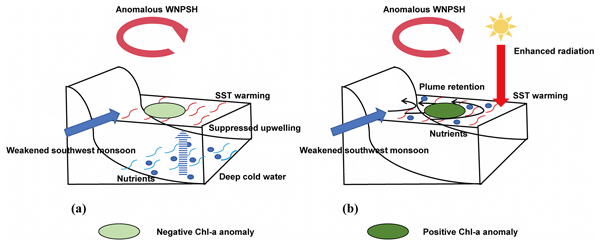
Abstract. In recent years, more frequent marine heatwaves (MHWs) in the South China Sea (SCS) have affected surface chlorophyll-a (Chl-a). Traditional linear statistical methods have limited capacity to identify the contributions of multiple highly interrelated physical drivers in complex oceanic systems. To address this limitation, we applied the Synergistic–Unique–Redundant Decomposition (SURD) method to investigate MHW-related Chl-a anomalies from 1998 to 2024. Analyses reveal a marked regional contrast during summer MHWs, with positive Chl-a anomalies in the northern SCS and negative anomalies in the western SCS. Although summer thermal extremes in both regions were linked to similar anomalous atmospheric circulations associated with the western North Pacific subtropical high, the local physical mechanisms controlling Chl-a responses differed. In the South Vietnam upwelling region, weakened wind forcing reduced Ekman pumping and vertical transport, limiting surface cooling and nutrient replenishment to the euphotic zone, thereby contributing to negative Chl-a anomalies. In the Pearl River Estuary, enhanced incident shortwave radiation promoted rapid surface warming, while weakened wind-driven export favoured the nearshore retention of low-salinity plume water. The SURD results indicate that retained plume water enhanced surface layer stratification and likely increased nutrient supply, allowing plume retention to act synergistically with cumulative heat stress and supporting positive Chl-a anomalies. However, unresolved optical and biological processes in the Pearl River Estuary introduce uncertainty into the inferred nutrient pathway. These results suggest that besides thermal forcing, Chl-a responses to MHWs in marginal seas are also significantly affected by regional physical pathways.
-
Notice on discussion status
The requested preprint has a corresponding peer-reviewed final revised paper. You are encouraged to refer to the final revised version.
-
Preprint
(3613 KB)
-
Supplement
(144 KB)
-
The requested preprint has a corresponding peer-reviewed final revised paper. You are encouraged to refer to the final revised version.
- Preprint
(3613 KB) - Metadata XML
-
Supplement
(144 KB) - BibTeX
- EndNote
- Final revised paper


Journal article(s) based on this preprint
Interactive discussion
Status: closed
-
RC1: 'Comment on egusphere-2026-3353', Anonymous Referee #1, 20 Jul 2026
The comment was uploaded in the form of a supplement: https://egusphere.copernicus.org/preprints/2026/egusphere-2026-3353/egusphere-2026-3353-RC1-supplement.pdfCitation: https://doi.org/
10.5194/egusphere-2026-3353-RC1 - AC1: 'Reply on RC1', Yunlu Fang, 15 Sep 2026
-
RC2: 'Comment on egusphere-2026-3353', Anonymous Referee #2, 03 Aug 2026
Recommendation: Major revision
The manuscript addresses an important topic and introduces an interesting analytical framework. The VUA results are compelling and the paper is clearly written. However, stronger justification is needed for the PRE interpretation, particularly regarding the inferred nutrient pathway, and the use of satellite derived surface chlorophyll observations as a biological indicator. Addressing these issues would substantially strengthen the manuscript.
- AC2: 'Reply on RC2', Yunlu Fang, 15 Sep 2026
-
RC3: 'Comment on egusphere-2026-3353', Anonymous Referee #3, 13 Aug 2026
General comments:
The paper focuses on determining the physical mechanisms of the impact of Marine heatwaves (MHW) on chlorophyll-a in the South China Sea using a statistical method that quantifies causality and suited for complex interactions, instead of simpler linear approaches. The results show that in addition to heats tress, the chlorophyll-a is also forced by regional physical pathways rather a dominant independent driver. This approach could be applied to other marginal seas affected by MHWs. The paper is well-written, and the methods are sound overall. I recommend minor revision. My main concern with the study is about addressing why the Chl-a responses to MHW were only looked at seasonally (see line by line comments for details). It is also unclear why some large-scale driver (like the WNPSH) connects to the summer MHWs. These points need to be addressed. My specific comments are below:
Specific comments:
Line 74: Do you mean two representative ecosystem regions?
Line 57: Was SURF method applied before to understand MHW or marine extremes drivers? Was it applied more widely in oceanography studies. Please provide references.
Line 95: What is the method used to determine MLD, using a temperature or density threshold? What’s the threshold?
Line 125: Add the definition for each MHW metric: frequence, duration ….
Line 129: Change analysi to analysis.
Section 2.3.2: Add what function package and programming language does the SURD method could be implemented from
Figure 2. Add boxes to indicate both regions PRE and VUA
Section 3.2: Why the Chl-a responses to MHW were only looked at seasonally while the MHW are computed on an annual basis. It’d interesting to examine the Chl-a anomalies for the whole period and not just per season.
Line 212-233: From “Cumulative SST .. .” To move to Methods.
Line 347: Please give a brief definition for the western Northern Pacific subtropical high and a justification / rationale on why it was thought to impact the summer MHWs (for example, is this a commonly reported driver for these events in the region?)
Sections 3 and 4: These sections should be merged and renamed Results & Discussion as the authors are presenting results in section but also comparing and discussing them relative to previous findings. Additionally former subsection 4.3 is mainly about the limitation of the SURD method (which fits for a discussion)
Citation: https://doi.org/10.5194/egusphere-2026-3353-RC3 - AC3: 'Reply on RC3', Yunlu Fang, 15 Sep 2026
Peer review completion


Interactive discussion
Status: closed
-
RC1: 'Comment on egusphere-2026-3353', Anonymous Referee #1, 20 Jul 2026
The comment was uploaded in the form of a supplement: https://egusphere.copernicus.org/preprints/2026/egusphere-2026-3353/egusphere-2026-3353-RC1-supplement.pdf
- AC1: 'Reply on RC1', Yunlu Fang, 15 Sep 2026
-
RC2: 'Comment on egusphere-2026-3353', Anonymous Referee #2, 03 Aug 2026
Recommendation: Major revision
The manuscript addresses an important topic and introduces an interesting analytical framework. The VUA results are compelling and the paper is clearly written. However, stronger justification is needed for the PRE interpretation, particularly regarding the inferred nutrient pathway, and the use of satellite derived surface chlorophyll observations as a biological indicator. Addressing these issues would substantially strengthen the manuscript.
- AC2: 'Reply on RC2', Yunlu Fang, 15 Sep 2026
-
RC3: 'Comment on egusphere-2026-3353', Anonymous Referee #3, 13 Aug 2026
General comments:
The paper focuses on determining the physical mechanisms of the impact of Marine heatwaves (MHW) on chlorophyll-a in the South China Sea using a statistical method that quantifies causality and suited for complex interactions, instead of simpler linear approaches. The results show that in addition to heats tress, the chlorophyll-a is also forced by regional physical pathways rather a dominant independent driver. This approach could be applied to other marginal seas affected by MHWs. The paper is well-written, and the methods are sound overall. I recommend minor revision. My main concern with the study is about addressing why the Chl-a responses to MHW were only looked at seasonally (see line by line comments for details). It is also unclear why some large-scale driver (like the WNPSH) connects to the summer MHWs. These points need to be addressed. My specific comments are below:
Specific comments:
Line 74: Do you mean two representative ecosystem regions?
Line 57: Was SURF method applied before to understand MHW or marine extremes drivers? Was it applied more widely in oceanography studies. Please provide references.
Line 95: What is the method used to determine MLD, using a temperature or density threshold? What’s the threshold?
Line 125: Add the definition for each MHW metric: frequence, duration ….
Line 129: Change analysi to analysis.
Section 2.3.2: Add what function package and programming language does the SURD method could be implemented from
Figure 2. Add boxes to indicate both regions PRE and VUA
Section 3.2: Why the Chl-a responses to MHW were only looked at seasonally while the MHW are computed on an annual basis. It’d interesting to examine the Chl-a anomalies for the whole period and not just per season.
Line 212-233: From “Cumulative SST .. .” To move to Methods.
Line 347: Please give a brief definition for the western Northern Pacific subtropical high and a justification / rationale on why it was thought to impact the summer MHWs (for example, is this a commonly reported driver for these events in the region?)
Sections 3 and 4: These sections should be merged and renamed Results & Discussion as the authors are presenting results in section but also comparing and discussing them relative to previous findings. Additionally former subsection 4.3 is mainly about the limitation of the SURD method (which fits for a discussion)
Citation: https://doi.org/10.5194/egusphere-2026-3353-RC3 - AC3: 'Reply on RC3', Yunlu Fang, 15 Sep 2026
Peer review completion
Journal article(s) based on this preprint
Viewed
| HTML | XML | Total | Supplement | BibTeX | EndNote | |
|---|---|---|---|---|---|---|
| 243 | 97 | 38 | 378 | 59 | 26 | 22 |
- HTML: 243
- PDF: 97
- XML: 38
- Total: 378
- Supplement: 59
- BibTeX: 26
- EndNote: 22
Viewed (geographical distribution)
| Country | # | Views | % |
|---|
| Total: | 0 |
| HTML: | 0 |
| PDF: | 0 |
| XML: | 0 |
- 1
Yunlu Fang

Yicheng Chen
Peiliang Li
Mingyang Li
The requested preprint has a corresponding peer-reviewed final revised paper. You are encouraged to refer to the final revised version.
- Preprint
(3613 KB) - Metadata XML
-
Supplement
(144 KB) - BibTeX
- EndNote
- Final revised paper