
the Creative Commons Attribution 4.0 License.
the Creative Commons Attribution 4.0 License.
 | 19 Jun 2026
Muted orbital-scale Monsoon Variability over the Korean Peninsula
Abstract. A recent study identified an east-west dipole pattern in East Asian Summer Monsoon (EASM) variability in response to precessional-scale forcing (Wen et al., 2024). The Korean Peninsula (KP) is situated near the nodal line of this dipole. It should therefore exhibit muted precessional variability in precipitation and its oxygen isotope composition (δ18Op). So far, this conjecture has not been tested using paleoclimatic data. Here, we present speleothem δ18O (δ18Osp) records from the KP, which support the notion of suppressed orbital-scale hydroclimate variability. Conducting a transient model simulation with the isotope-enabled Community Earth System Model (iCESM) covering the past 130,000 years, along with tagging experiments for low and high insolation conditions, we show that, on precessional scales, isotopic contributions from oceanic and continental moisture sources compensate each other over the KP, resulting in only a weak regional signal in δ18Op. Based on iCESM1.2 simulations, we further demonstrate that deuterium excess (d-excess) variability over the KP would still capture the moisture source region’s zonal seesaw response to precessional forcing, indicating that the reconstruction of paleo water d-excess values from eastern Asian speleothem fluid inclusions could provide new valuable insights into the drivers of regional monsoon systems. This study provides new insights into the spatiotemporal variability of Pan-Asian hydroclimates and its links to changes in moisture source.
-
Notice on discussion status
The requested preprint has a corresponding peer-reviewed final revised paper. You are encouraged to refer to the final revised version.
-
Preprint
(4646 KB)
-
Supplement
(6593 KB)
-
The requested preprint has a corresponding peer-reviewed final revised paper. You are encouraged to refer to the final revised version.
- Preprint
(4646 KB) - Metadata XML
-
Supplement
(6593 KB) - BibTeX
- EndNote
- Final revised paper


Journal article(s) based on this preprint
Interactive discussion
Status: closed
-
RC1: 'Comment on egusphere-2026-3348', Anonymous Referee #1, 11 Jul 2026
-
AC1: 'Reply on RC1', Nitesh Sinha, 19 Aug 2026
The comment was uploaded in the form of a supplement: https://egusphere.copernicus.org/preprints/2026/egusphere-2026-3348/egusphere-2026-3348-AC1-supplement.pdf
-
AC1: 'Reply on RC1', Nitesh Sinha, 19 Aug 2026
-
RC2: 'Comment on egusphere-2026-3348', Anonymous Referee #2, 14 Jul 2026
The authors have completed a modeling study to look at the response of rainfall, rainfall d18O, deuterium excess, and relative humidity over orbital (precessional) time scales, to test the hypothesis that there should be muted precessional-scale variability over the Korean Peninsula.
Overall, the modeling data are important and provide nice targets for future work, including a look at d-excess in speleothem fluid inclusions.
Where I think the manuscript could be improved is in better making the case that there truly is a dampened precessional-scale d18O response in the calcite speleothems. As written, this is not yet clear and unambiguous. I don't think this is a fatal flaw, however, because most of the paper relies on the model results.
Detailed comments:
Abstract: not only d-excess, but cap17O, which could be reconstructed from speleothem carbonate in the absence of usable fluid inclusions.
L35: I would state this as “near equilibrium”, because we really don’t know exactly what is isotopic equilibrium in carbonate isotopes. You get different answers from really slow-growing calcite (Daëron et al., 2019) than you do from shallow vadose-zone caves (Mickler et al., 2004).
L35: I don’t like the nomenclature “d18Osp”. Speleothems are cave deposits that could be comprised of different minerals (gypsum, aragonite, calcite, etc.). What you are referring to is δ18O in calcite, so δ18Oc makes more sense, particularly because each mineral has a different temperature-dependent fractionation factor (alluded to in L35).
L74: I think you need to be more specific here: what about “recorded changes in the EASM”? Monsoon intensity, moisture source, changes in δ18O without changes in rainfal amount, local rainfall amount, upstream rainout, etc? Many of the debates about the EASM arise from the specific interpretations of controlling factors, and you can be more precise when describing the meaning of the δ18Op. I think it would be helpful to clearly state the authors’ interpretation of the records and where they do and do not align (e.g., EASM δ18O in calcite versus the loess plateau records).
L100: I think the writing style is really good, but more specifics will help the reader understand the issues at hand. What did the authors specifically elucidate about the mechanisms?
L108: “…determined by moisture sources” in what way, and how does δ18Op respond? The way this paragraph is written suggests that changes in moisture source control δ18Op. But how can that be? Isn’t it the differences in rainout history (i.e., the fraction remaining after rainout in Rayleigh distillation) that controls δ18Op? Each air mass has a history, and the differences in δ18Op do not arise from their geographic sources, but rather from their histories prior to reaching the cave site.
L111: what processes control d-excess? Again, it isn’t geographic origin that is the control, it is a climatic control through some combination of relative humidity at the evaporation source, condensation temperature, rain drop evaporation, etc. Try to go beyond simple associations (e.g, moisture source and d-excess) and focus instead on climate drivers so that the reader can understand the mechanisms controlling isotopes in rainfall and speleothem calcite.
L125: the water tagging and modeling experiments are useful, particularly when supporting modern observations. But models are not reality. Are there δ18O records in precipitation that can reveal these changes?
L207: Define “Eastern Asia” as (22-45°N, 100-150°E) in the caption.
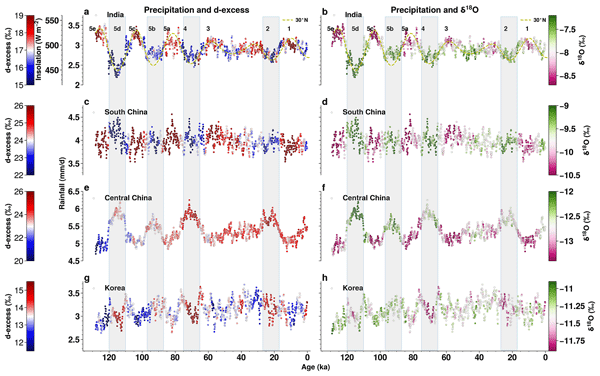
L239-41: Can you show the antiphase δ18Op response in a time series? And the “suppressed” δ18Op signal over the KP? Only a snapshot is shown in the geographic plot in Figure 1c. The figures show substantial precessional scale variability, but line 241 states it is absent over the KP. This is going to be a source of confusion for a lot of readers.
In Figure 1d, it is stated that δ18Op are anomalies. With respect to what? A zero mean? Detrended? Or are they δ18O ‰ VSMOW values? Aslo, are we really to believe that δ18Op varies by up to 24‰ VSMOW over a precessional cycle, as is seemingly the case for MIS5e to 5d? How realistic are these anomalies?
L255 caption for Figure 2. Describe how the isotopes were normalized. It is hard to read the data with the large symbols on the Korean data. A solid line or smaller symbols would be easier.
Regarding the KP speleothem isotope records (L513 and elsewhere): Are the modern measured δ18Oc values anywhere near isotopic equilibrium as would be predicted based on drip water δ18O and measured cave temperature? Do any of the samples replicate the isotope signal over coeval periods? Are the samples well-dated in terms of precision? Do the caves have stable cave-climates? Are any samples recrystallized or suffer from poor dating? These are all lines of evidence that can establish whether the material is robust as a paleoclimate proxy or close to isotopic equilibrium.
I recognize that some of these data have already been published, but the authors haven’t demonstrated that the speleothems are trustworthy proxies of drip water δ18O, hence the interpretation of dampened orbital signals is not convincing yet, but it could be made so with this information. An alternative hypothesis is that the KP δ18Oc records reflect isotopic disequilibrium between drip waters and calcite, and therefore do not reflect climate changes.
L344: Should read “… enriched in heavy isotopes during Pmin”, as it is not possible to enrich Pmin. It is accurate to state that (paraphrasing) “δ18O values are 0.22‰ higher during Pmin”, but it is not correct that δ18O (which contains both 18O and 16O in its definition) can be “enriched” or “depleted” unless you are referring to the isotope of interest (e.g., enriched in 18O, enriched in 16O). See Zach Sharp’s free online textbook for recommendations on correct stable isotopic terminology.
L406: Important distinction: in *some* speleothems, not all. This is important because the paper has implications for future work to test their model-based results. I would broaden the discussion here, and later, to include Δ17O, which co-varies with d-excess in precipitation but is not sensitive to temperature variations, and could, in principle, be measured in speleothem carbonate.
References
Daëron, M., Drysdale, R. N., Peral, M., Huyghe, D., Blamart, D., Coplen, T. B., Lartaud, F., and Zanchetta, G., 2019, Most Earth-surface calcites precipitate out of isotopic equilibrium: Nature Communications, v. 10, no. 1, p. 429.
Mickler, P. J., Banner, J. L., Stern, L., Asmerom, Y., Edwards, R. L., and Ito, E., 2004, Stable isotope variations in modern tropical speleothems: Evaluating equilibrium vs. kinetic isotope effects: Geochimica et Cosmochimica Acta, v. 68, no. 21, p. 4381.
Citation: https://doi.org/10.5194/egusphere-2026-3348-RC2 -
AC2: 'Reply on RC2', Nitesh Sinha, 19 Aug 2026
The comment was uploaded in the form of a supplement: https://egusphere.copernicus.org/preprints/2026/egusphere-2026-3348/egusphere-2026-3348-AC2-supplement.pdf
-
AC2: 'Reply on RC2', Nitesh Sinha, 19 Aug 2026
Peer review completion


Interactive discussion
Status: closed
-
RC1: 'Comment on egusphere-2026-3348', Anonymous Referee #1, 11 Jul 2026
This manuscript presents a comprehensive and insightful investigation into the orbital-scale hydroclimate variability over the Korean Peninsula, integrating new speleothem δ¹⁸O records with a series of isotope-enabled transient and time-slice model simulations. The authors convincingly demonstrate that the precessional signal in both precipitation and δ¹⁸Op is muted over the Korean Peninsula due to compensating effects between oceanic and continental moisture sources, a finding that aligns with the recently proposed grand dipole pattern of the Asian summer monsoon. The study further highlights the potential utility of deuterium excess (d-excess) as a complementary proxy for capturing precessional moisture-source dynamics in this nodal region.
Overall, I find the analyses to be thorough, the model–data comparison carefully executed, and the interpretation physically coherent. The manuscript is rich in content, well-structured, and makes a valuable contribution to our understanding of pan-Asian monsoon dynamics on orbital timescales. I only have some minor comments.
Abstract: please add 1.2 in the first iCESM.
Please consistently use the “precession timescales”, “precession scales” or “precession scale”
“To this end, we consider new and previously published δ18Osp records from two Korean stalagmites: ED1 (Eden Cave, (Jo et al., 2014)) and GE1 (Gwaneum Cave, (Jo et al., 2010)).’ This sentence is ambiguous, please clarify which one is new?
Line 171: realistic ice-sheet forcings. I don’t think it is realistic, as there is no realistic reconstructions before LGM.
Section S1; Figure S7 is not the source region.
Line 314: please check the Fig. S3a, d. It’s not WNPSH.
Fig. 6: coastal line should be black.
Citation: https://doi.org/10.5194/egusphere-2026-3348-RC1 -
AC1: 'Reply on RC1', Nitesh Sinha, 19 Aug 2026
The comment was uploaded in the form of a supplement: https://egusphere.copernicus.org/preprints/2026/egusphere-2026-3348/egusphere-2026-3348-AC1-supplement.pdf
-
AC1: 'Reply on RC1', Nitesh Sinha, 19 Aug 2026
-
RC2: 'Comment on egusphere-2026-3348', Anonymous Referee #2, 14 Jul 2026
The authors have completed a modeling study to look at the response of rainfall, rainfall d18O, deuterium excess, and relative humidity over orbital (precessional) time scales, to test the hypothesis that there should be muted precessional-scale variability over the Korean Peninsula.
Overall, the modeling data are important and provide nice targets for future work, including a look at d-excess in speleothem fluid inclusions.
Where I think the manuscript could be improved is in better making the case that there truly is a dampened precessional-scale d18O response in the calcite speleothems. As written, this is not yet clear and unambiguous. I don't think this is a fatal flaw, however, because most of the paper relies on the model results.
Detailed comments:
Abstract: not only d-excess, but cap17O, which could be reconstructed from speleothem carbonate in the absence of usable fluid inclusions.
L35: I would state this as “near equilibrium”, because we really don’t know exactly what is isotopic equilibrium in carbonate isotopes. You get different answers from really slow-growing calcite (Daëron et al., 2019) than you do from shallow vadose-zone caves (Mickler et al., 2004).
L35: I don’t like the nomenclature “d18Osp”. Speleothems are cave deposits that could be comprised of different minerals (gypsum, aragonite, calcite, etc.). What you are referring to is δ18O in calcite, so δ18Oc makes more sense, particularly because each mineral has a different temperature-dependent fractionation factor (alluded to in L35).
L74: I think you need to be more specific here: what about “recorded changes in the EASM”? Monsoon intensity, moisture source, changes in δ18O without changes in rainfal amount, local rainfall amount, upstream rainout, etc? Many of the debates about the EASM arise from the specific interpretations of controlling factors, and you can be more precise when describing the meaning of the δ18Op. I think it would be helpful to clearly state the authors’ interpretation of the records and where they do and do not align (e.g., EASM δ18O in calcite versus the loess plateau records).
L100: I think the writing style is really good, but more specifics will help the reader understand the issues at hand. What did the authors specifically elucidate about the mechanisms?
L108: “…determined by moisture sources” in what way, and how does δ18Op respond? The way this paragraph is written suggests that changes in moisture source control δ18Op. But how can that be? Isn’t it the differences in rainout history (i.e., the fraction remaining after rainout in Rayleigh distillation) that controls δ18Op? Each air mass has a history, and the differences in δ18Op do not arise from their geographic sources, but rather from their histories prior to reaching the cave site.
L111: what processes control d-excess? Again, it isn’t geographic origin that is the control, it is a climatic control through some combination of relative humidity at the evaporation source, condensation temperature, rain drop evaporation, etc. Try to go beyond simple associations (e.g, moisture source and d-excess) and focus instead on climate drivers so that the reader can understand the mechanisms controlling isotopes in rainfall and speleothem calcite.
L125: the water tagging and modeling experiments are useful, particularly when supporting modern observations. But models are not reality. Are there δ18O records in precipitation that can reveal these changes?
L207: Define “Eastern Asia” as (22-45°N, 100-150°E) in the caption.
L239-41: Can you show the antiphase δ18Op response in a time series? And the “suppressed” δ18Op signal over the KP? Only a snapshot is shown in the geographic plot in Figure 1c. The figures show substantial precessional scale variability, but line 241 states it is absent over the KP. This is going to be a source of confusion for a lot of readers.
In Figure 1d, it is stated that δ18Op are anomalies. With respect to what? A zero mean? Detrended? Or are they δ18O ‰ VSMOW values? Aslo, are we really to believe that δ18Op varies by up to 24‰ VSMOW over a precessional cycle, as is seemingly the case for MIS5e to 5d? How realistic are these anomalies?
L255 caption for Figure 2. Describe how the isotopes were normalized. It is hard to read the data with the large symbols on the Korean data. A solid line or smaller symbols would be easier.
Regarding the KP speleothem isotope records (L513 and elsewhere): Are the modern measured δ18Oc values anywhere near isotopic equilibrium as would be predicted based on drip water δ18O and measured cave temperature? Do any of the samples replicate the isotope signal over coeval periods? Are the samples well-dated in terms of precision? Do the caves have stable cave-climates? Are any samples recrystallized or suffer from poor dating? These are all lines of evidence that can establish whether the material is robust as a paleoclimate proxy or close to isotopic equilibrium.
I recognize that some of these data have already been published, but the authors haven’t demonstrated that the speleothems are trustworthy proxies of drip water δ18O, hence the interpretation of dampened orbital signals is not convincing yet, but it could be made so with this information. An alternative hypothesis is that the KP δ18Oc records reflect isotopic disequilibrium between drip waters and calcite, and therefore do not reflect climate changes.
L344: Should read “… enriched in heavy isotopes during Pmin”, as it is not possible to enrich Pmin. It is accurate to state that (paraphrasing) “δ18O values are 0.22‰ higher during Pmin”, but it is not correct that δ18O (which contains both 18O and 16O in its definition) can be “enriched” or “depleted” unless you are referring to the isotope of interest (e.g., enriched in 18O, enriched in 16O). See Zach Sharp’s free online textbook for recommendations on correct stable isotopic terminology.
L406: Important distinction: in *some* speleothems, not all. This is important because the paper has implications for future work to test their model-based results. I would broaden the discussion here, and later, to include Δ17O, which co-varies with d-excess in precipitation but is not sensitive to temperature variations, and could, in principle, be measured in speleothem carbonate.
References
Daëron, M., Drysdale, R. N., Peral, M., Huyghe, D., Blamart, D., Coplen, T. B., Lartaud, F., and Zanchetta, G., 2019, Most Earth-surface calcites precipitate out of isotopic equilibrium: Nature Communications, v. 10, no. 1, p. 429.
Mickler, P. J., Banner, J. L., Stern, L., Asmerom, Y., Edwards, R. L., and Ito, E., 2004, Stable isotope variations in modern tropical speleothems: Evaluating equilibrium vs. kinetic isotope effects: Geochimica et Cosmochimica Acta, v. 68, no. 21, p. 4381.
Citation: https://doi.org/10.5194/egusphere-2026-3348-RC2 -
AC2: 'Reply on RC2', Nitesh Sinha, 19 Aug 2026
The comment was uploaded in the form of a supplement: https://egusphere.copernicus.org/preprints/2026/egusphere-2026-3348/egusphere-2026-3348-AC2-supplement.pdf
-
AC2: 'Reply on RC2', Nitesh Sinha, 19 Aug 2026
Peer review completion
Journal article(s) based on this preprint
Viewed
| HTML | XML | Total | Supplement | BibTeX | EndNote | |
|---|---|---|---|---|---|---|
| 231 | 76 | 35 | 342 | 47 | 21 | 26 |
- HTML: 231
- PDF: 76
- XML: 35
- Total: 342
- Supplement: 47
- BibTeX: 21
- EndNote: 26
Viewed (geographical distribution)
| Country | # | Views | % |
|---|
| Total: | 0 |
| HTML: | 0 |
| PDF: | 0 |
| XML: | 0 |
- 1
Nitesh Sinha

Axel Timmermann
Sun-Seon Lee
Kyoung-Nam Jo
Jasper A. Wassenburg
Daniel M. Cleary
Kyung-Sook Yun
The requested preprint has a corresponding peer-reviewed final revised paper. You are encouraged to refer to the final revised version.
- Preprint
(4646 KB) - Metadata XML
-
Supplement
(6593 KB) - BibTeX
- EndNote
- Final revised paper
This manuscript presents a comprehensive and insightful investigation into the orbital-scale hydroclimate variability over the Korean Peninsula, integrating new speleothem δ¹⁸O records with a series of isotope-enabled transient and time-slice model simulations. The authors convincingly demonstrate that the precessional signal in both precipitation and δ¹⁸Op is muted over the Korean Peninsula due to compensating effects between oceanic and continental moisture sources, a finding that aligns with the recently proposed grand dipole pattern of the Asian summer monsoon. The study further highlights the potential utility of deuterium excess (d-excess) as a complementary proxy for capturing precessional moisture-source dynamics in this nodal region.
Overall, I find the analyses to be thorough, the model–data comparison carefully executed, and the interpretation physically coherent. The manuscript is rich in content, well-structured, and makes a valuable contribution to our understanding of pan-Asian monsoon dynamics on orbital timescales. I only have some minor comments.
Abstract: please add 1.2 in the first iCESM.
Please consistently use the “precession timescales”, “precession scales” or “precession scale”
“To this end, we consider new and previously published δ18Osp records from two Korean stalagmites: ED1 (Eden Cave, (Jo et al., 2014)) and GE1 (Gwaneum Cave, (Jo et al., 2010)).’ This sentence is ambiguous, please clarify which one is new?
Line 171: realistic ice-sheet forcings. I don’t think it is realistic, as there is no realistic reconstructions before LGM.
Section S1; Figure S7 is not the source region.
Line 314: please check the Fig. S3a, d. It’s not WNPSH.
Fig. 6: coastal line should be black.