
the Creative Commons Attribution 4.0 License.
the Creative Commons Attribution 4.0 License.
 | 19 Jun 2026
Divergent responses of streamflow reanalysis errors to precipitation reanalysis errors modulated by catchment heterogeneity
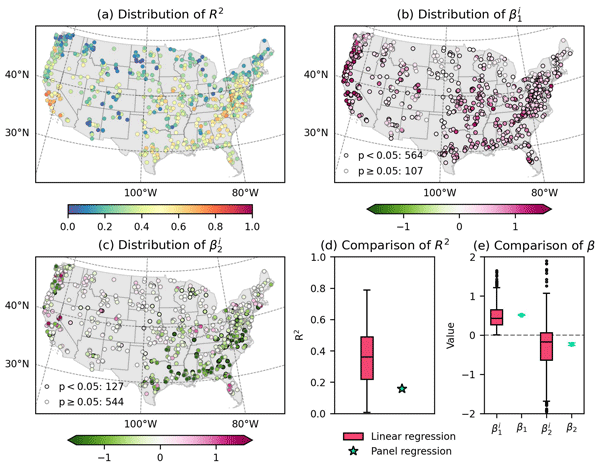
Abstract. Streamflow reanalysis is vital for water resources management and climate impact assessment; however, the extent to which it is affected by precipitation forcing errors remains poorly understood. Focusing on the reanalysis dataset of Global Flood Awareness System driven by the European Centre for Medium-Range Weather Forecasts Reanalysis v5 (GloFAS-ERA5), this paper details how streamflow reanalysis errors respond to precipitation errors. Specifically, the root mean square errors (RMSEs) are calculated by hydrological year for reanalysis products across 671 catchments in the Catchment Attributes and Meteorology for Large-sample Studies (CAMELS) dataset; and by combining catchment-specific linear regression with global panel regression, the effects of precipitation errors on streamflow errors are quantified. The results demonstrate an improved performance from GloFAS-ERA5 v2.1 to v4.0, with the median RMSE decreasing from 2.16 mm to 1.81 mm. For GloFAS-ERA5 v4.0, the panel regression indicates that for every 1 mm increase in precipitation RMSE, the corresponding streamflow RMSE increases by an average of 0.51 mm–reflecting the buffering capacity of catchment storage. In the meantime, the corresponding catchment-specific increase of streamflow RMSE reaches up to 2.5 mm in humid catchments but remains below 0.7 mm in arid catchments. These divergent responses reflect that the saturation-excess mechanism makes the precipitation errors immediately affect the streamflow error while soil moisture deficits dampen their effects. Furthermore, incorporating interaction terms into panel regression increases the coefficient of determination (R2) from 0.16 to 0.36, indicating that error responses are modulated by catchment heterogeneity. This modulation is further confirmed by targeted case studies, indicating that the temperature controls the storage and release of snow water, thereby dampening and delaying the responses of streamflow errors to precipitation errors in snow-dominated catchments. These findings provide a valuable diagnostic method and practical guidance for applications of global streamflow reanalysis to complex, heterogeneous catchments.
-
Notice on discussion status
The requested preprint has a corresponding peer-reviewed final revised paper. You are encouraged to refer to the final revised version.
-
Preprint
(3443 KB)
-
The requested preprint has a corresponding peer-reviewed final revised paper. You are encouraged to refer to the final revised version.
- Preprint
(3443 KB) - Metadata XML
- BibTeX
- EndNote
- Final revised paper


Journal article(s) based on this preprint
Interactive discussion
Status: closed
-
RC1: 'Comment on egusphere-2026-3321', Anonymous Referee #1, 01 Jul 2026
-
AC1: 'Reply on RC1', Tongtiegang Zhao, 29 Jul 2026
We sincerely appreciate your insightful and constructive comments. Our point-by-point responses to each comment are provided below.
This paper precisely addresses a long-standing issue that has been ambiguously treated in the field of global hydrological reanalysis, namely, whether precipitation input errors are amplified or attenuated during the runoff concentration process. It does not merely provide a global average number; rather, for the first time, it systematically quantifies the distinctly different patterns of this error propagation in humid, arid, and snow-covered regions. Using two specific case studies, which include a rain-fed basin and a snow-fed basin, the paper interprets statistical regression coefficients into two physical processes, namely saturation-excess runoff and snowmelt delay, making the conclusions highly convincing.
Response: Thank you for the positive comments. We hope that this work can provide a valuable diagnostic method and practical guidance for applications of global streamflow reanalysis to complex, heterogeneous catchments.
Nevertheless, the paper still has the following areas that require improvement:
Response: Thank you very much for the insightful and detailed comments. Accordingly, we will thoroughly revise this paper. Below please find the point-to-point responses.
(1) Lines 18-19: The physical interpretation of the buffering coefficient of 0.51 is somewhat thin. Although it is mentioned as "the buffering capacity of catchment storage," the storage capacities of the 671 basins (e.g., baseflow index, groundwater recharge rate) vary considerably. The paper does not further cross-validate the average coefficient of 0.51 with basin-specific storage capacity curves or soil moisture memory. Does this 0.51 predominantly reflect soil infiltration, or is it dominated by evapotranspiration (ET) consumption? The current explanation is somewhat vague.
Response: Thank you for raising this important point. The value 0.51 is a cross-catchment average statistical response estimated from the panel regression for 671 catchments. Instead of a direct quantitative estimate of any single hydrological process, it may collectively reflect soil-water storage, groundwater and baseflow dynamics, evapotranspiration, snow storage, channel routing, model structure and other unresolved processes. The catchment-specific coefficients range from near zero to approximately 2.5, showing that the average cannot represent each catchment.
We will analyze this coefficient heterogeneity more explicitly in the Results and replace “catchment storage buffering” with “attenuation associated with multiple hydrological processes”.
(2) The paper does not address the issue of water balance closure. The explanation that the error in arid regions is <0.7 is attributed to soil moisture deficit buffering, but this implies a premise—that the runoff error caused by precipitation error is absorbed. Where does the absorbed error go? Does this imply that the evapotranspiration (ET) error in arid regions is amplified?
Response: We agree that weaker responses of streamflow reanalysis errors in arid catchments do not mean that precipitation errors disappear or are fully “absorbed.” Such discrepancies may instead appear in evapotranspiration, soil water, groundwater, snow storage, delayed runoff or combinations of these components.
We will provide additional diagnostic evidence on how hydrological states may mediate error propagation by examining the snow depth water equivalent, soil wetness index and runoff water equivalent variables from the GloFAS-ERA5 dataset using the SNOW-17/SAC-SMA simulations from the CAMELS dataset. Also, we will avoid wording that implies complete water-balance attribution and will add this limitation explicitly.
(3) Although the paper states that VIF < 5, indicating weak collinearity between precipitation and temperature, in snow seasons, higher precipitation is often accompanied by lower temperatures, and the actual impacts of the two are highly temporally coupled. While the panel regression passes statistical tests, the physical simultaneity (i.e., winter low temperatures cause snowfall, and the quality of both low-temperature and precipitation data often deteriorates simultaneously) has not been sufficiently disentangled and discussed.
Response: We agree. The VIF values below 5 indicate only that the annual RMSE predictors do not exhibit severe linear multicollinearity. They do not demonstrate that the physical effects of precipitation and temperature are separated. In snow-dominated catchments, temperature influences precipitation phase, snow accumulation and melt timing, while annual RMSE can conceal seasonal coupling and lagged responses.
In our revision, we will add analysis of relationships among precipitation error, temperature error and snow-storage error using the snow depth water equivalent from the GloFAS-ERA5 dataset and the SNOW-17/SAC-SMA outputs from the CAMELS dataset. Also, we will revise the interpretation accordingly and discuss d seasonal, event-scale and lagged analyses.
(4) Logical confusion: Section 4.2 indicates that basin-specific regressions perform better than panel regression. Why then continue to stubbornly focus on improving the panel regression? Although the authors explain that panel regression provides a stable average, they do not explicitly answer: given the substantial individual differences (ranging from 0 to 2.5), does the forced use of a global panel regression (even with interaction terms) statistically obscure the extreme physical mechanisms of the extremes? The logic would be clearer if a sentence were added, such as: "Panel regression is primarily used to reveal cross-basin universal laws, rather than to precisely predict specific values for a given basin."
Response: Thank you for this clarification request. The two approaches address different questions: catchment-specific linear regressions reveal local heterogeneity, whereas the panel regression estimates an average relationship using spatial and temporal information across the 671 catchments. Higher catchment-level R² values therefore do not make the panel model unnecessary, but the panel model is not intended for precise prediction of individual catchments and may obscure extreme mechanisms.
We will state explicitly: “The panel regression is intended to identify cross-catchment average relationships rather than to provide precise predictions for individual catchments.” We will also clarify that interaction terms represent only part of the heterogeneity and that panel regression, catchment-specific regression, and case studies are complementary rather than competing methods.
(5) The limitation of the temporal scale is not discussed: all error calculations are based on annual RMSE. The annual-scale RMSE smooths out intra-seasonal phase errors.
Response: We agree that annual RMSE supports consistent cross-catchment comparison and panel analysis but sacrifices temporal detail. It can smooth seasonal contrasts, flood-peak timing errors, snowmelt delays, extreme events and the structure of positive versus negative biases.
In our revision, we will add a focused discussion stating that seasonal, monthly and event-based analyses are needed to test mechanisms that cannot be resolved by annual aggregation. We will also avoid using annual-scale agreement as evidence of event-scale fidelity.
Citation: https://doi.org/10.5194/egusphere-2026-3321-AC1 - AC3: 'Reply on RC1', Tongtiegang Zhao, 12 Aug 2026
-
AC1: 'Reply on RC1', Tongtiegang Zhao, 29 Jul 2026
-
RC2: 'Comment on egusphere-2026-3321', Anonymous Referee #2, 28 Jul 2026
This manuscript investigates the responses of GloFAS-ERA5 streamflow reanalysis errors to ERA5 precipitation reanalysis errors and further explores the moderating effects of catchment climatic and physiographic heterogeneity. By combining catchment-specific linear regression, panel regression and case studies of representative catchments, the study analyzes 671 CAMELS catchments and provides insights into both overall relationships and catchment heterogeneity. The research topic is novel to some extent and the results have practical implications for understanding and applying global streamflow reanalysis products.
Several issues related to the physical interpretation of the results, regression modeling, and study limitations should be addressed.
Major comments
- The attenuation of precipitation errors by catchments may involve multiple hydrological processes, including soil infiltration, soil water storage, groundwater recharge, evapotranspiration consumption, snow storage, and river channel routing. Since the 671 catchments exhibit substantial differences in baseflow index, soil water storage capacity, and hydrological memory, the average response coefficient of 0.51 should not be interpreted as a direct quantification of a single physical process. The authors are encouraged to provide further discussion on the specific hydrological mechanisms underlying this coefficient.
- The sources of unexplained errors should be discussed more explicitly. Although interaction terms involving precipitation seasonality and snow fraction are incorporated, the coefficient of determination of the panel regression remains 0.36, indicating that a considerable proportion of streamflow reanalysis errors is still not explained by the current predictors. The authors should discuss other potential factors contributing to the remaining uncertainty, such as soil properties, groundwater processes, model structure, or other catchment characteristics.
- The manuscript attributes the weaker influence of precipitation errors on streamflow errors in arid catchments to soil moisture deficits absorbing part of the precipitation errors. However, further explanation is needed regarding where the “absorbed” errors are ultimately reflected in the water balance. For example, do these errors mainly contribute to changes in evapotranspiration, soil water storage or other hydrological components? A more cautious discussion of this mechanism is recommended.
- This study mainly investigates error responses through regression relationships between annual RMSE values. Therefore, the results provide evidence of statistical associations rather than strict causal effects. The authors should avoid using overly strong causal language and consider reducing expressions such as “control”, “confirm”, and “entirely dependent on”. For example, in Line 287, the statement “almost entirely dependent on precipitation accuracy” appears too strong and could be revised to “predominantly associated with precipitation accuracy during the examined period”.
Minor comments
- The GloFAS streamflow data are generally provided in discharge units, whereas streamflow errors in this study are expressed in millimeters. The authors should clarify in the Methods section whether streamflow values were converted from discharge to runoff depth.
- Daymet is a high-resolution gridded dataset generated through interpolation based on station observations. The authors are encouraged to briefly acknowledge the uncertainties associated with Daymet in the Discussion section.
- Please check the formulation of the R2 equation. In Equation (4), the numerator and denominator appear to lack squared terms.
- Please provide a clearer definition of precipitation seasonality. The calculation method and the physical meaning of positive and negative values should be explicitly described.
- Line 163: The word “diversifies” should be used instead of “diversify” in the phrase “how catchment heterogeneity diversify the error responses”.
- Line 246: There is an extra word “the” in the phrase “the the saturation-excess mechanism”. Please remove the redundant word.
Citation: https://doi.org/10.5194/egusphere-2026-3321-RC2 -
AC2: 'Reply on RC2', Tongtiegang Zhao, 29 Jul 2026
We sincerely appreciate your insightful and constructive comments. Our point-by-point responses to each comment are provided below.
This manuscript investigates the responses of GloFAS-ERA5 streamflow reanalysis errors to ERA5 precipitation reanalysis errors and further explores the moderating effects of catchment climatic and physiographic heterogeneity. By combining catchment-specific linear regression, panel regression and case studies of representative catchments, the study analyzes 671 CAMELS catchments and provides insights into both overall relationships and catchment heterogeneity. The research topic is novel to some extent and the results have practical implications for understanding and applying global streamflow reanalysis products.
Response: Thank you for the positive comments.
Several issues related to the physical interpretation of the results, regression modeling, and study limitations should be addressed.
Response: Thank you very much for the insightful and detailed comments. Accordingly, we will thoroughly revise this paper. Below please find the point-to-point responses.
Major comments
- The attenuation of precipitation errors by catchments may involve multiple hydrological processes, including soil infiltration, soil water storage, groundwater recharge, evapotranspiration consumption, snow storage, and river channel routing. Since the 671 catchments exhibit substantial differences in baseflow index, soil water storage capacity, and hydrological memory, the average response coefficient of 0.51 should not be interpreted as a direct quantification of a single physical process. The authors are encouraged to provide further discussion on the specific hydrological mechanisms underlying this coefficient.
Response: We agree. The coefficient value of 0.51 represents an average statistical association between annual precipitation RMSE and annual streamflow RMSE across 671 catchments, not a process-specific partition of precipitation error. Its magnitude may be consistent with the combined effects of soil storage, groundwater and baseflow dynamics, evapotranspiration, snow accumulation and melt, river routing, model parameterization and structural error. The local coefficients, ranging from near zero to about 2.5, further show that no single interpretation is valid across all catchments.
We will therefore expand the analysis of catchment-level coefficient heterogeneity, use the phrase “attenuation associated with multiple hydrological processes” and distinguish direct empirical results from plausible but unquantified hydrological explanations.
- The sources of unexplained errors should be discussed more explicitly. Although interaction terms involving precipitation seasonality and snow fraction are incorporated, the coefficient of determination of the panel regression remains 0.36, indicating that a considerable proportion of streamflow reanalysis errors is still not explained by the current predictors. The authors should discuss other potential factors contributing to the remaining uncertainty, such as soil properties, groundwater processes, model structure, or other catchment characteristics.
Response: Thank you for this important point. The increase of R² from 0.16 to 0.36 indicates that the precipitation seasonality and snow fraction explain part of the systematic cross-catchment heterogeneity, but it is not a complete explanation of streamflow error variability. The remaining variance may relate to soil properties, groundwater and baseflow processes, hydrological memory, vegetation, topography, river routing, model structure and parameterization, spatial-scale mismatch and uncertainty in the reference datasets. We will distinguish “substantial improvement in explanatory power” from “complete explanation” and discuss these uncertainty sources.
- The manuscript attributes the weaker influence of precipitation errors on streamflow errors in arid catchments to soil moisture deficits absorbing part of the precipitation errors. However, further explanation is needed regarding where the “absorbed” errors are ultimately reflected in the water balance. For example, do these errors mainly contribute to changes in evapotranspiration, soil water storage or other hydrological components? A more cautious discussion of this mechanism is recommended.
Response: We agree. A weak streamflow-RMSE response in an arid catchment does not imply that the precipitation discrepancy vanishes. We will investigate where the absorbed errors go by examining the snow depth water equivalent, soil wetness index and runoff water equivalent variables from the GloFAS-ERA5 dataset using the SNOW-17/SAC-SMA simulations from the CAMELS dataset. Also, we will avoid wording that implies complete water-balance attribution and will add this limitation explicitly.
- This study mainly investigates error responses through regression relationships between annual RMSE values. Therefore, the results provide evidence of statistical associations rather than strict causal effects. The authors should avoid using overly strong causal language and consider reducing expressions such as “control”, “confirm”, and “entirely dependent on”. For example, in Line 287, the statement “almost entirely dependent on precipitation accuracy” appears too strong and could be revised to “predominantly associated with precipitation accuracy during the examined period”.
Response: We agree that annual RMSE regression does not provide a formal causal identification. We will systematically replace expressions such as “control”, “cause”, “confirm” and “entirely dependent on” where they exceed the evidence, using formulations including “is associated with”, “is consistent with”, “suggests”, “may reflect” and “provides process-based support.” In particular, “almost entirely dependent on precipitation accuracy” will be revised to “predominantly associated with precipitation accuracy during the examined period.” We will also clarify that the case studies support process-consistent interpretation but do not isolate causal pathways from other co-varying hydrological and model factors.
Minor comments
- The GloFAS streamflow data are generally provided in discharge units, whereas streamflow errors in this study are expressed in millimeters. The authors should clarify in the Methods section whether streamflow values were converted from discharge to runoff depth.
Response: Thank you for the instructive comment. We will add the exact process used to convert GloFAS-ERA5 discharge to catchment runoff depth into the Method section.
- Daymet is a high-resolution gridded dataset generated through interpolation based on station observations. The authors are encouraged to briefly acknowledge the uncertainties associated with Daymet in the Discussion section.
Response: We agree. We will clarify that “ERA5 error” denotes the discrepancy between ERA5 and Daymet, not error relative to ground truth. We will add this limitation into the Discussion section.
- Please check the formulation of the R2 equation. In Equation (4), the numerator and denominator appear to lack squared terms.
Response: We now recognize that this is a typo and shall correct it.
- Please provide a clearer definition of precipitation seasonality. The calculation method and the physical meaning of positive and negative values should be explicitly described.
Response: We will state that the metric is taken from the CAMELS dataset, provide its exact definition, explain the physical meaning and clarify why it is used as a moderator of precipitation-error responses.
- Line 163: The word “diversifies” should be used instead of “diversify” in the phrase “how catchment heterogeneity diversify the error responses”.
Response: We shall correct this typo.
- Line 246: There is an extra word “the” in the phrase “the the saturation-excess mechanism”. Please remove the redundant word.
Response: We shall correct this typo.
Citation: https://doi.org/10.5194/egusphere-2026-3321-AC2 - AC4: 'Reply on RC2', Tongtiegang Zhao, 12 Aug 2026
Peer review completion


Interactive discussion
Status: closed
-
RC1: 'Comment on egusphere-2026-3321', Anonymous Referee #1, 01 Jul 2026
This paper precisely addresses a long-standing issue that has been ambiguously treated in the field of global hydrological reanalysis, namely, whether precipitation input errors are amplified or attenuated during the runoff concentration process. It does not merely provide a global average number; rather, for the first time, it systematically quantifies the distinctly different patterns of this error propagation in humid, arid, and snow-covered regions. Using two specific case studies, which include a rain-fed basin and a snow-fed basin, the paper interprets statistical regression coefficients into two physical processes, namely saturation-excess runoff and snowmelt delay, making the conclusions highly convincing.
Nevertheless, the paper still has the following areas that require improvement:
(1) Lines 18-19: The physical interpretation of the buffering coefficient of 0.51 is somewhat thin. Although it is mentioned as "the buffering capacity of catchment storage," the storage capacities of the 671 basins (e.g., baseflow index, groundwater recharge rate) vary considerably. The paper does not further cross-validate the average coefficient of 0.51 with basin-specific storage capacity curves or soil moisture memory. Does this 0.51 predominantly reflect soil infiltration, or is it dominated by evapotranspiration (ET) consumption? The current explanation is somewhat vague.
(2) The paper does not address the issue of water balance closure. The explanation that the error in arid regions is <0.7 is attributed to soil moisture deficit buffering, but this implies a premise—that the runoff error caused by precipitation error is absorbed. Where does the absorbed error go? Does this imply that the evapotranspiration (ET) error in arid regions is amplified?
(3) Although the paper states that VIF < 5, indicating weak collinearity between precipitation and temperature, in snow seasons, higher precipitation is often accompanied by lower temperatures, and the actual impacts of the two are highly temporally coupled. While the panel regression passes statistical tests, the physical simultaneity (i.e., winter low temperatures cause snowfall, and the quality of both low-temperature and precipitation data often deteriorates simultaneously) has not been sufficiently disentangled and discussed.
(4) Logical confusion: Section 4.2 indicates that basin-specific regressions perform better than panel regression. Why then continue to stubbornly focus on improving the panel regression? Although the authors explain that panel regression provides a stable average, they do not explicitly answer: given the substantial individual differences (ranging from 0 to 2.5), does the forced use of a global panel regression (even with interaction terms) statistically obscure the extreme physical mechanisms of the extremes? The logic would be clearer if a sentence were added, such as: "Panel regression is primarily used to reveal cross-basin universal laws, rather than to precisely predict specific values for a given basin."
(5) The limitation of the temporal scale is not discussed: all error calculations are based on annual RMSE. The annual-scale RMSE smooths out intra-seasonal phase errors.
Citation: https://doi.org/10.5194/egusphere-2026-3321-RC1 -
AC1: 'Reply on RC1', Tongtiegang Zhao, 29 Jul 2026
We sincerely appreciate your insightful and constructive comments. Our point-by-point responses to each comment are provided below.
This paper precisely addresses a long-standing issue that has been ambiguously treated in the field of global hydrological reanalysis, namely, whether precipitation input errors are amplified or attenuated during the runoff concentration process. It does not merely provide a global average number; rather, for the first time, it systematically quantifies the distinctly different patterns of this error propagation in humid, arid, and snow-covered regions. Using two specific case studies, which include a rain-fed basin and a snow-fed basin, the paper interprets statistical regression coefficients into two physical processes, namely saturation-excess runoff and snowmelt delay, making the conclusions highly convincing.
Response: Thank you for the positive comments. We hope that this work can provide a valuable diagnostic method and practical guidance for applications of global streamflow reanalysis to complex, heterogeneous catchments.
Nevertheless, the paper still has the following areas that require improvement:
Response: Thank you very much for the insightful and detailed comments. Accordingly, we will thoroughly revise this paper. Below please find the point-to-point responses.
(1) Lines 18-19: The physical interpretation of the buffering coefficient of 0.51 is somewhat thin. Although it is mentioned as "the buffering capacity of catchment storage," the storage capacities of the 671 basins (e.g., baseflow index, groundwater recharge rate) vary considerably. The paper does not further cross-validate the average coefficient of 0.51 with basin-specific storage capacity curves or soil moisture memory. Does this 0.51 predominantly reflect soil infiltration, or is it dominated by evapotranspiration (ET) consumption? The current explanation is somewhat vague.
Response: Thank you for raising this important point. The value 0.51 is a cross-catchment average statistical response estimated from the panel regression for 671 catchments. Instead of a direct quantitative estimate of any single hydrological process, it may collectively reflect soil-water storage, groundwater and baseflow dynamics, evapotranspiration, snow storage, channel routing, model structure and other unresolved processes. The catchment-specific coefficients range from near zero to approximately 2.5, showing that the average cannot represent each catchment.
We will analyze this coefficient heterogeneity more explicitly in the Results and replace “catchment storage buffering” with “attenuation associated with multiple hydrological processes”.
(2) The paper does not address the issue of water balance closure. The explanation that the error in arid regions is <0.7 is attributed to soil moisture deficit buffering, but this implies a premise—that the runoff error caused by precipitation error is absorbed. Where does the absorbed error go? Does this imply that the evapotranspiration (ET) error in arid regions is amplified?
Response: We agree that weaker responses of streamflow reanalysis errors in arid catchments do not mean that precipitation errors disappear or are fully “absorbed.” Such discrepancies may instead appear in evapotranspiration, soil water, groundwater, snow storage, delayed runoff or combinations of these components.
We will provide additional diagnostic evidence on how hydrological states may mediate error propagation by examining the snow depth water equivalent, soil wetness index and runoff water equivalent variables from the GloFAS-ERA5 dataset using the SNOW-17/SAC-SMA simulations from the CAMELS dataset. Also, we will avoid wording that implies complete water-balance attribution and will add this limitation explicitly.
(3) Although the paper states that VIF < 5, indicating weak collinearity between precipitation and temperature, in snow seasons, higher precipitation is often accompanied by lower temperatures, and the actual impacts of the two are highly temporally coupled. While the panel regression passes statistical tests, the physical simultaneity (i.e., winter low temperatures cause snowfall, and the quality of both low-temperature and precipitation data often deteriorates simultaneously) has not been sufficiently disentangled and discussed.
Response: We agree. The VIF values below 5 indicate only that the annual RMSE predictors do not exhibit severe linear multicollinearity. They do not demonstrate that the physical effects of precipitation and temperature are separated. In snow-dominated catchments, temperature influences precipitation phase, snow accumulation and melt timing, while annual RMSE can conceal seasonal coupling and lagged responses.
In our revision, we will add analysis of relationships among precipitation error, temperature error and snow-storage error using the snow depth water equivalent from the GloFAS-ERA5 dataset and the SNOW-17/SAC-SMA outputs from the CAMELS dataset. Also, we will revise the interpretation accordingly and discuss d seasonal, event-scale and lagged analyses.
(4) Logical confusion: Section 4.2 indicates that basin-specific regressions perform better than panel regression. Why then continue to stubbornly focus on improving the panel regression? Although the authors explain that panel regression provides a stable average, they do not explicitly answer: given the substantial individual differences (ranging from 0 to 2.5), does the forced use of a global panel regression (even with interaction terms) statistically obscure the extreme physical mechanisms of the extremes? The logic would be clearer if a sentence were added, such as: "Panel regression is primarily used to reveal cross-basin universal laws, rather than to precisely predict specific values for a given basin."
Response: Thank you for this clarification request. The two approaches address different questions: catchment-specific linear regressions reveal local heterogeneity, whereas the panel regression estimates an average relationship using spatial and temporal information across the 671 catchments. Higher catchment-level R² values therefore do not make the panel model unnecessary, but the panel model is not intended for precise prediction of individual catchments and may obscure extreme mechanisms.
We will state explicitly: “The panel regression is intended to identify cross-catchment average relationships rather than to provide precise predictions for individual catchments.” We will also clarify that interaction terms represent only part of the heterogeneity and that panel regression, catchment-specific regression, and case studies are complementary rather than competing methods.
(5) The limitation of the temporal scale is not discussed: all error calculations are based on annual RMSE. The annual-scale RMSE smooths out intra-seasonal phase errors.
Response: We agree that annual RMSE supports consistent cross-catchment comparison and panel analysis but sacrifices temporal detail. It can smooth seasonal contrasts, flood-peak timing errors, snowmelt delays, extreme events and the structure of positive versus negative biases.
In our revision, we will add a focused discussion stating that seasonal, monthly and event-based analyses are needed to test mechanisms that cannot be resolved by annual aggregation. We will also avoid using annual-scale agreement as evidence of event-scale fidelity.
Citation: https://doi.org/10.5194/egusphere-2026-3321-AC1 - AC3: 'Reply on RC1', Tongtiegang Zhao, 12 Aug 2026
-
AC1: 'Reply on RC1', Tongtiegang Zhao, 29 Jul 2026
-
RC2: 'Comment on egusphere-2026-3321', Anonymous Referee #2, 28 Jul 2026
This manuscript investigates the responses of GloFAS-ERA5 streamflow reanalysis errors to ERA5 precipitation reanalysis errors and further explores the moderating effects of catchment climatic and physiographic heterogeneity. By combining catchment-specific linear regression, panel regression and case studies of representative catchments, the study analyzes 671 CAMELS catchments and provides insights into both overall relationships and catchment heterogeneity. The research topic is novel to some extent and the results have practical implications for understanding and applying global streamflow reanalysis products.
Several issues related to the physical interpretation of the results, regression modeling, and study limitations should be addressed.
Major comments
- The attenuation of precipitation errors by catchments may involve multiple hydrological processes, including soil infiltration, soil water storage, groundwater recharge, evapotranspiration consumption, snow storage, and river channel routing. Since the 671 catchments exhibit substantial differences in baseflow index, soil water storage capacity, and hydrological memory, the average response coefficient of 0.51 should not be interpreted as a direct quantification of a single physical process. The authors are encouraged to provide further discussion on the specific hydrological mechanisms underlying this coefficient.
- The sources of unexplained errors should be discussed more explicitly. Although interaction terms involving precipitation seasonality and snow fraction are incorporated, the coefficient of determination of the panel regression remains 0.36, indicating that a considerable proportion of streamflow reanalysis errors is still not explained by the current predictors. The authors should discuss other potential factors contributing to the remaining uncertainty, such as soil properties, groundwater processes, model structure, or other catchment characteristics.
- The manuscript attributes the weaker influence of precipitation errors on streamflow errors in arid catchments to soil moisture deficits absorbing part of the precipitation errors. However, further explanation is needed regarding where the “absorbed” errors are ultimately reflected in the water balance. For example, do these errors mainly contribute to changes in evapotranspiration, soil water storage or other hydrological components? A more cautious discussion of this mechanism is recommended.
- This study mainly investigates error responses through regression relationships between annual RMSE values. Therefore, the results provide evidence of statistical associations rather than strict causal effects. The authors should avoid using overly strong causal language and consider reducing expressions such as “control”, “confirm”, and “entirely dependent on”. For example, in Line 287, the statement “almost entirely dependent on precipitation accuracy” appears too strong and could be revised to “predominantly associated with precipitation accuracy during the examined period”.
Minor comments
- The GloFAS streamflow data are generally provided in discharge units, whereas streamflow errors in this study are expressed in millimeters. The authors should clarify in the Methods section whether streamflow values were converted from discharge to runoff depth.
- Daymet is a high-resolution gridded dataset generated through interpolation based on station observations. The authors are encouraged to briefly acknowledge the uncertainties associated with Daymet in the Discussion section.
- Please check the formulation of the R2 equation. In Equation (4), the numerator and denominator appear to lack squared terms.
- Please provide a clearer definition of precipitation seasonality. The calculation method and the physical meaning of positive and negative values should be explicitly described.
- Line 163: The word “diversifies” should be used instead of “diversify” in the phrase “how catchment heterogeneity diversify the error responses”.
- Line 246: There is an extra word “the” in the phrase “the the saturation-excess mechanism”. Please remove the redundant word.
Citation: https://doi.org/10.5194/egusphere-2026-3321-RC2 -
AC2: 'Reply on RC2', Tongtiegang Zhao, 29 Jul 2026
We sincerely appreciate your insightful and constructive comments. Our point-by-point responses to each comment are provided below.
This manuscript investigates the responses of GloFAS-ERA5 streamflow reanalysis errors to ERA5 precipitation reanalysis errors and further explores the moderating effects of catchment climatic and physiographic heterogeneity. By combining catchment-specific linear regression, panel regression and case studies of representative catchments, the study analyzes 671 CAMELS catchments and provides insights into both overall relationships and catchment heterogeneity. The research topic is novel to some extent and the results have practical implications for understanding and applying global streamflow reanalysis products.
Response: Thank you for the positive comments.
Several issues related to the physical interpretation of the results, regression modeling, and study limitations should be addressed.
Response: Thank you very much for the insightful and detailed comments. Accordingly, we will thoroughly revise this paper. Below please find the point-to-point responses.
Major comments
- The attenuation of precipitation errors by catchments may involve multiple hydrological processes, including soil infiltration, soil water storage, groundwater recharge, evapotranspiration consumption, snow storage, and river channel routing. Since the 671 catchments exhibit substantial differences in baseflow index, soil water storage capacity, and hydrological memory, the average response coefficient of 0.51 should not be interpreted as a direct quantification of a single physical process. The authors are encouraged to provide further discussion on the specific hydrological mechanisms underlying this coefficient.
Response: We agree. The coefficient value of 0.51 represents an average statistical association between annual precipitation RMSE and annual streamflow RMSE across 671 catchments, not a process-specific partition of precipitation error. Its magnitude may be consistent with the combined effects of soil storage, groundwater and baseflow dynamics, evapotranspiration, snow accumulation and melt, river routing, model parameterization and structural error. The local coefficients, ranging from near zero to about 2.5, further show that no single interpretation is valid across all catchments.
We will therefore expand the analysis of catchment-level coefficient heterogeneity, use the phrase “attenuation associated with multiple hydrological processes” and distinguish direct empirical results from plausible but unquantified hydrological explanations.
- The sources of unexplained errors should be discussed more explicitly. Although interaction terms involving precipitation seasonality and snow fraction are incorporated, the coefficient of determination of the panel regression remains 0.36, indicating that a considerable proportion of streamflow reanalysis errors is still not explained by the current predictors. The authors should discuss other potential factors contributing to the remaining uncertainty, such as soil properties, groundwater processes, model structure, or other catchment characteristics.
Response: Thank you for this important point. The increase of R² from 0.16 to 0.36 indicates that the precipitation seasonality and snow fraction explain part of the systematic cross-catchment heterogeneity, but it is not a complete explanation of streamflow error variability. The remaining variance may relate to soil properties, groundwater and baseflow processes, hydrological memory, vegetation, topography, river routing, model structure and parameterization, spatial-scale mismatch and uncertainty in the reference datasets. We will distinguish “substantial improvement in explanatory power” from “complete explanation” and discuss these uncertainty sources.
- The manuscript attributes the weaker influence of precipitation errors on streamflow errors in arid catchments to soil moisture deficits absorbing part of the precipitation errors. However, further explanation is needed regarding where the “absorbed” errors are ultimately reflected in the water balance. For example, do these errors mainly contribute to changes in evapotranspiration, soil water storage or other hydrological components? A more cautious discussion of this mechanism is recommended.
Response: We agree. A weak streamflow-RMSE response in an arid catchment does not imply that the precipitation discrepancy vanishes. We will investigate where the absorbed errors go by examining the snow depth water equivalent, soil wetness index and runoff water equivalent variables from the GloFAS-ERA5 dataset using the SNOW-17/SAC-SMA simulations from the CAMELS dataset. Also, we will avoid wording that implies complete water-balance attribution and will add this limitation explicitly.
- This study mainly investigates error responses through regression relationships between annual RMSE values. Therefore, the results provide evidence of statistical associations rather than strict causal effects. The authors should avoid using overly strong causal language and consider reducing expressions such as “control”, “confirm”, and “entirely dependent on”. For example, in Line 287, the statement “almost entirely dependent on precipitation accuracy” appears too strong and could be revised to “predominantly associated with precipitation accuracy during the examined period”.
Response: We agree that annual RMSE regression does not provide a formal causal identification. We will systematically replace expressions such as “control”, “cause”, “confirm” and “entirely dependent on” where they exceed the evidence, using formulations including “is associated with”, “is consistent with”, “suggests”, “may reflect” and “provides process-based support.” In particular, “almost entirely dependent on precipitation accuracy” will be revised to “predominantly associated with precipitation accuracy during the examined period.” We will also clarify that the case studies support process-consistent interpretation but do not isolate causal pathways from other co-varying hydrological and model factors.
Minor comments
- The GloFAS streamflow data are generally provided in discharge units, whereas streamflow errors in this study are expressed in millimeters. The authors should clarify in the Methods section whether streamflow values were converted from discharge to runoff depth.
Response: Thank you for the instructive comment. We will add the exact process used to convert GloFAS-ERA5 discharge to catchment runoff depth into the Method section.
- Daymet is a high-resolution gridded dataset generated through interpolation based on station observations. The authors are encouraged to briefly acknowledge the uncertainties associated with Daymet in the Discussion section.
Response: We agree. We will clarify that “ERA5 error” denotes the discrepancy between ERA5 and Daymet, not error relative to ground truth. We will add this limitation into the Discussion section.
- Please check the formulation of the R2 equation. In Equation (4), the numerator and denominator appear to lack squared terms.
Response: We now recognize that this is a typo and shall correct it.
- Please provide a clearer definition of precipitation seasonality. The calculation method and the physical meaning of positive and negative values should be explicitly described.
Response: We will state that the metric is taken from the CAMELS dataset, provide its exact definition, explain the physical meaning and clarify why it is used as a moderator of precipitation-error responses.
- Line 163: The word “diversifies” should be used instead of “diversify” in the phrase “how catchment heterogeneity diversify the error responses”.
Response: We shall correct this typo.
- Line 246: There is an extra word “the” in the phrase “the the saturation-excess mechanism”. Please remove the redundant word.
Response: We shall correct this typo.
Citation: https://doi.org/10.5194/egusphere-2026-3321-AC2 - AC4: 'Reply on RC2', Tongtiegang Zhao, 12 Aug 2026
Peer review completion
Journal article(s) based on this preprint
Viewed
| HTML | XML | Total | BibTeX | EndNote | |
|---|---|---|---|---|---|
| 158 | 71 | 26 | 255 | 17 | 21 |
- HTML: 158
- PDF: 71
- XML: 26
- Total: 255
- BibTeX: 17
- EndNote: 21
Viewed (geographical distribution)
| Country | # | Views | % |
|---|
| Total: | 0 |
| HTML: | 0 |
| PDF: | 0 |
| XML: | 0 |
- 1
Tongtiegang Zhao

Zexin Chen
Zeqing Huang
The requested preprint has a corresponding peer-reviewed final revised paper. You are encouraged to refer to the final revised version.
- Preprint
(3443 KB) - Metadata XML
This paper precisely addresses a long-standing issue that has been ambiguously treated in the field of global hydrological reanalysis, namely, whether precipitation input errors are amplified or attenuated during the runoff concentration process. It does not merely provide a global average number; rather, for the first time, it systematically quantifies the distinctly different patterns of this error propagation in humid, arid, and snow-covered regions. Using two specific case studies, which include a rain-fed basin and a snow-fed basin, the paper interprets statistical regression coefficients into two physical processes, namely saturation-excess runoff and snowmelt delay, making the conclusions highly convincing.
Nevertheless, the paper still has the following areas that require improvement:
(1) Lines 18-19: The physical interpretation of the buffering coefficient of 0.51 is somewhat thin. Although it is mentioned as "the buffering capacity of catchment storage," the storage capacities of the 671 basins (e.g., baseflow index, groundwater recharge rate) vary considerably. The paper does not further cross-validate the average coefficient of 0.51 with basin-specific storage capacity curves or soil moisture memory. Does this 0.51 predominantly reflect soil infiltration, or is it dominated by evapotranspiration (ET) consumption? The current explanation is somewhat vague.
(2) The paper does not address the issue of water balance closure. The explanation that the error in arid regions is <0.7 is attributed to soil moisture deficit buffering, but this implies a premise—that the runoff error caused by precipitation error is absorbed. Where does the absorbed error go? Does this imply that the evapotranspiration (ET) error in arid regions is amplified?
(3) Although the paper states that VIF < 5, indicating weak collinearity between precipitation and temperature, in snow seasons, higher precipitation is often accompanied by lower temperatures, and the actual impacts of the two are highly temporally coupled. While the panel regression passes statistical tests, the physical simultaneity (i.e., winter low temperatures cause snowfall, and the quality of both low-temperature and precipitation data often deteriorates simultaneously) has not been sufficiently disentangled and discussed.
(4) Logical confusion: Section 4.2 indicates that basin-specific regressions perform better than panel regression. Why then continue to stubbornly focus on improving the panel regression? Although the authors explain that panel regression provides a stable average, they do not explicitly answer: given the substantial individual differences (ranging from 0 to 2.5), does the forced use of a global panel regression (even with interaction terms) statistically obscure the extreme physical mechanisms of the extremes? The logic would be clearer if a sentence were added, such as: "Panel regression is primarily used to reveal cross-basin universal laws, rather than to precisely predict specific values for a given basin."
(5) The limitation of the temporal scale is not discussed: all error calculations are based on annual RMSE. The annual-scale RMSE smooths out intra-seasonal phase errors.