
the Creative Commons Attribution 4.0 License.
the Creative Commons Attribution 4.0 License.
 | 02 Mar 2026
Atmospheric river trajectories organise along a global transport network
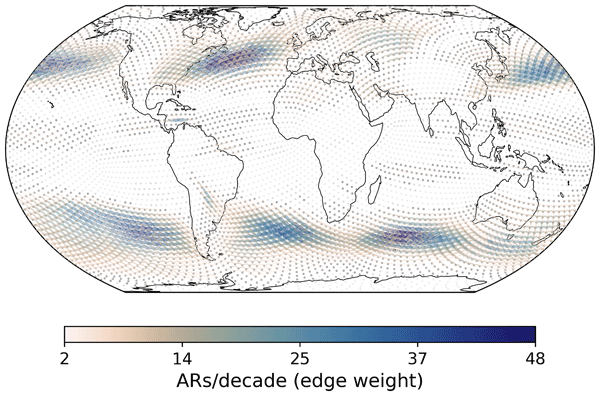
Abstract. Atmospheric rivers (ARs) transport vast amounts of water vapor and cause weather extremes. However, they have typically been studied as isolated events rather than as components of a global transport system. By mapping ARs worldwide, we reveal that their transport is organized along a sparse set of preferred pathways forming a global network. Recognizing ARs as a globally interconnected system is highly relevant, not only for advancing atmospheric science but also for improving forecasts of extreme precipitation, droughts, and polar ice melt under climate change. Beyond the familiar storm tracks, we identify hubs of pronounced vapor transport changes and demonstrate that polar regions act as structural accumulation regions for persistent ARs. ARs preferentially travel along circumglobal atmospheric highways shaped by teleconnection patterns and circulation regimes, providing new opportunities for AR prediction. While previous research recognized only five AR basins, we uncover a larger, hierarchically organized set of interconnected basins that provides a more comprehensive understanding of how regional AR hotspots are embedded within large-scale flow. The global AR transport network links synoptic storms to planetary circulation, illuminating hidden pathways in the global water cycle.
-
Notice on discussion status
The requested preprint has a corresponding peer-reviewed final revised paper. You are encouraged to refer to the final revised version.
-
Preprint
(0 KB)
-
The requested preprint has a corresponding peer-reviewed final revised paper. You are encouraged to refer to the final revised version.


Journal article(s) based on this preprint
Interactive discussion
Status: closed
-
RC1: 'Comment on egusphere-2026-332', Anonymous Referee #1, 01 Apr 2026
Referee Report for "Atmospheric river trajectories organise along a global transport network" by Tobias Braun et al.
The manuscript presents a network-based representation of atmospheric river (AR) trajectories to identify large-scale transport pathways, hubs, and basins. The idea of organizing AR dynamics within a global transport network is clear and well-motivated, and provides a coherent link between regional behavior and planetary-scale structure. In particular, extending the analysis to a global perspective is important, as AR transport is inherently non-local: moisture pathways span ocean basins and connect distant regions, such that regional impacts depend on large-scale circulation patterns and upstream conditions. The proposed framework captures this connectivity in a unified way.
The work is structured around three relevant questions on transport changes, pathways, and basin organization. The contribution is primarily conceptual and methodological: several identified structures align with known circulation features, while the novelty lies in their systematic extraction within a unified network framework, particularly in the identification of hierarchical basin organization.
From a methodological standpoint, the framework is well formulated and constitutes a major strength. The use of multiple AR catalogs, Lagrangian trajectory-based construction, and null models provides a solid foundation. At the same time, the approach relies on several modeling choices—such as centroid-based representation, edge definition, thresholding, and consensus construction—that may influence the resulting topology.
The results are clearly presented and internally consistent. The framework successfully recovers known large-scale transport structures and provides a useful representation of AR dynamics. The extraction of a global “highway” structure using edge betweenness centrality is a particularly strong result, supported by statistical validation. The identification of basins and their hierarchical organization is also convincing and represents a meaningful extension beyond previous classifications.
At the same time, several interpretations would benefit from more cautious framing. In particular, some findings (e.g., hubs, IVT changes) largely reflect known physical processes expressed in the network representation. Interpretations based on PageRank or shortest-path structures appear to reflect topological properties of the constructed network rather than independently demonstrated dynamical mechanisms. Similarly, claims regarding predictability are based on moderate correlations and structural arguments, and could be stated more conservatively.
I have a few points that would help strengthen the manuscript:
1) The results depend on the underlying AR catalogs and trajectory definitions. It would be useful to more explicitly quantify how robust the main structures are across detection methods, and how differences between catalogs and the chosen consensus construction propagate into the network.
2) The connection between network structures and atmospheric dynamics could be clarified. Some interpretations (e.g., “highways” or accumulation regions) appear to reflect known circulation features or topological properties of the network, rather than independent mechanisms.
3) The analysis depends on several methodological choices (e.g., AR representation, thresholding, spatial resolution, and consensus construction). A brief discussion of the sensitivity of the results to these choices would strengthen confidence in the conclusions.
4) The predictability perspective is interesting but currently limited. A more cautious framing or clearer statement of limitations would improve the discussion.
Overall, the manuscript presents a clear and useful framework with relevant insights for the community. The study is well executed and suitable for publication after minor clarifications and a more careful framing of interpretation and predictability claims.
Citation: https://doi.org/10.5194/egusphere-2026-332-RC1 -
AC1: 'Reply on RC1', Tobias Braun, 28 Apr 2026
The comments of the reviewer are repeated here in bold font; our answers are given in italics.
From a methodological standpoint, the framework is well formulated and constitutes a major strength. The use of multiple AR catalogs, Lagrangian trajectory-based construction, and
null models provides a solid foundation. At the same time, the approach relies on several modeling choices—such as centroid-based representation, edge definition, thresholding, and consensus construction—that may influence the resulting topology.
We thank the reviewer for their helpful and detailed feedback. We really appreciate their constructive suggestions and think they will help us to make the manuscript ready for publication. We respond to all comments, including the raised matter of modelling choices, in a point-by-point manner below.[...] At the same time, several interpretations would benefit from more cautious framing. In particular, some findings (e.g., hubs, IVT changes) largely reflect known physical processes expressed in the network representation. Interpretations based on PageRank or shortest-path structures appear to reflect topological properties of the constructed network rather than independently demonstrated dynamical mechanisms. Similarly, claims regarding predictability are based on moderate correlations and structural arguments, and could be stated more conservatively.
We agree that the proposed framework does not discover independent dynamical mechanisms and that predictability claims should be stated more cautiously, as further described below.1) The results depend on the underlying AR catalogs and trajectory definitions. It would be useful to more explicitly quantify how robust the main structures are across detection methods, and how differences between catalogs and the chosen consensus construction propagate into the network.
We thank the reviewer for this comment. We agree that the choice of AR catalog and AR locator constitute the main sources of uncertainty in the proposed approach.- In the current version of the manuscript, we investigate the catalog-sensitivity of key network properties only in one of the main figures (Fig.4a) but more extensively in seven supplementary figures (Fig. S4, S5, S7, S8, S10, S11, S19). In the revised version of the manuscript, we will extend the catalog-sensitivity analysis by constructing AR networks from two additional mid-latitudinal AR catalogs compiled from algorithms with tracking capabilities: the ARCONNECT and IPART 1.0 algorithms.
- We do consider that the choice of the AR locator is investigated comprehensively in the current manuscript, as we present how results differ with respect to distinct trajectory definitions (we consider the AR centroid, core and head) in five figures in the supplement (Fig. S5, S7, S9, S10, S13).
- We currently do not consider alternative consensus construction approaches. Thus, we will extend the analysis to systematically test the sensitivity of a few alternative consensus definitions in the revised manuscript.
To not extend the already long manuscript, we will present the new results in the supplement.
2) The connection between network structures and atmospheric dynamics could be clarified. Some interpretations (e.g., “highways” or accumulation regions) appear to reflect known circulation features or topological properties of the network, rather than independent mechanisms.
We agree with the reviewer that the observed topological properties do not reveal entirely novel atmospheric mechanisms. In the revised manuscript, we will further elucidate how the identified network features map to known circulation features.3) The analysis depends on several methodological choices (e.g., AR representation, thresholding, spatial resolution, and consensus construction). A brief discussion of the sensitivity of the results to these choices would strengthen confidence in the conclusions.
As described in our response to point 1), we will deepen the sensitivity analysis with respect to AR catalog choice and consensus formation. The effect of thresholding is currently showcased through AR network visualization in Fig. S4. The impact of different spatial resolutions is not analyzed as of now. For the revised manuscript, we will add two supplementary figures: i) one that shows how several network properties change when the threshold is varied continuously to clarify the role of this important parameter, and (ii) one that demonstrates how increasing/decreasing the spatial resolution alters network topology.4) The predictability perspective is interesting but currently limited. A more cautious framing or clearer statement of limitations would improve the discussion.
We agree with the reviewer that this should be phrased more carefully, given the limited evidence at this stage. We will rephrase accordingly.Overall, the manuscript presents a clear and useful framework with relevant insights for the community. The study is well executed and suitable for publication after minor clarifications and a more careful framing of interpretation and predictability claims.
We thank the reviewer again for their thoughtful review.Citation: https://doi.org/10.5194/egusphere-2026-332-AC1
-
AC1: 'Reply on RC1', Tobias Braun, 28 Apr 2026
-
RC2: 'Comment on egusphere-2026-332', Anonymous Referee #2, 13 Apr 2026
The authors put forward a framework that identifies the major Atmospheric River (AR) basins on a global scale, speculate on the respective AR drivers, and explore how they change in response to seasonality and the El Nino Southern Oscillation (ENSO) climate mode. The paper is well written and insightful, with the figures conveying the results concisely. However, a justification of some of the choices made is required and a stronger link to meteorology is also needed. I believe that after a major revision the manuscript will be in a suitable form to be published in this journal.
Major Comments:
1. The ARs used to construct the global atmospheric river transport network (ARTN) are extracted from the Potsdam Institute for Climate Impact Research (PIK) Atmospheric River Trajectories version 1 (PIKART-1) and the Tracking Rivers Globally as Elongated Targets Version 4 (tARget-4) catalogues. Why are these catalogues selected? How sensitive are the results to the choice of the AR catalogues and hence to the way ARs are diagnosed? The authors should also provide in the text further information on how the ARs are identified in these two products, this is not clear from lines 76-79.
2. The AR basins displayed in Fig. 5a may not be always active during the full study period. For example, ARs in the northern Arabian Peninsula are more prominent in El Nino winters and following spring season (Dasari et al., 2017; Esfandiari and Rezaei, 2022) when the mid-latitude storm track is also shifted equatorwards (as seen Fig. 4h). In summer following El Nino winters, ARs are less frequent in the subtropics over southeast Asia (Liang and Yong, 2021). Can the authors identify the meteorological conditions under which each AR basin is more prominent? This would allow for predictability: if a similar environmental set up is forecasted, we have an idea of the regions more likely to be impacted by ARs.
3. Have the authors explored trends in the AR features and basins? For example, are some AR basins becoming less relevant in detriment of others? What about the AR IVT changes? Can these trends be linked to changes in the background state as given by ERA-5 that is used to extract the ARs? The long study period allows for a statistically robust trend analysis to be performed.
4. From a meteorological perspective, are all the AR communities in Fig. 5a independent from each other? For example, take the one over western Greenland. The ARs that occur here develop locally or originate from those that occur in the communities around it? In lines 465-467 it is stated "Physically, AR communities can be understood as enclosed geographical regions whose boundaries are determined by persistent steering flows, topography, coastal moisture gradients and thermodynamic limits on AR life cycles (depending on the rates of evaporation and precipitation over an AR’s life cycle)." Have the authors considered adding a table with the major features of each AR basin? Can the authors quantify the relative contribution of local vs. remote moisture sources for the ARs in each basin? This may help justify some of the considered AR communities.
5. For the ENSO results displayed in Fig. 4, and based on what is shown in Fig. S18, I believe the authors took all El Nino and La Nina months in the period 1950-2023 irrespective of the season. Given the seasonal contrast in AR highways that is more prominent in the Northern Hemisphere (Figs. 4e-f), it would be better to generate seasonal maps for El Nino and La Nina as well. There are also different flavours of ENSO (Newman et al., 2011), which can also be considered.
Minor Comments:
1. Line 17: "narrow and long channels of anomalously high water vapor transport"
2. Lines 341-343: This is in line with the findings of Ramos et al. (2019), which also stresses the role of moisture from South America in driving cold-season ARs over the western CAPE.
3. Lines 438-440: This should go into the Methods section
4. Line 445: "Washington state" or "northwestern North America"
5. Lines 571-573: What is meant by "dangerous impacts" here? Aren't ARs also impactful outside of the polar regions?
6. Lines 604-606: The methodology used here can also be applied to aerosol atmospheric rivers (AARs; Lapere et al., 2024), in which aerosols such as dust, black carbon, organic carbon, and sea salt and transported polewards within a dry or moist air mass.
References:
Dasari, H. P., Langodan, S., Viswanadhapalli, Y., Vadlamudi, B. R., Papadopoulos, V. P. and Hoteit, I. (2018) ENSO influence on the interannual variability of the Red Sea convergence zone and associated rainfall. International Journal of Climatology, 38, 761-775. https://doi.org/10.1002/joc.5208
Esfandiari, N., Rezaei, M. (2022) Automatic detection, classification, and long-term investigation of temporal–spatial changes of atmospheric rivers in the Middle East. International Journal of Climatology, 42, 7730–7750. https://doi.org/10.1002/joc.7674
Lapere, R., Thomas, J. L., Favier, V., Angot, H., Asplund, J., Ekman, A. M. L., Marelle, L., Raut, J.-C., Da Silva, A., Wille, J. D., Zieger, P. (2024) Polar aerosol atmospheric rivers: Detection, characteristics, and potential applications. Journal of Geophysical Research: Atmospheres, 129, e2023JD039606. https://doi.org/10.1029/2023JD039606
Liang, J., and Yong, Y. (2021) Climatology of atmospheric rivers in the Asian monsoon region. International Journal of Climatology, 41, E801–E818. https://doi.org/10.1002/joc.6729
Newman, M., Shin, S.-I., Alexander, M. A. (2011) Natural variation in ENSO flavors. Geophysical Research Letters, 38, L14705. https://doi.org/10.1029/2011GL047658
Ramos, A. M., Blamey, R. C., Algarra, I., Nieto, R., Gimeno, L., Tomé, R., Reason, C. J. C.,Trigo, R.M. (2019) From Amazonia to southern Africa: atmospheric moisture transport through low-level jets and atmospheric rivers. Annals of the New York Academy of Sciences, 1436, 217-230. https://doi.org/10.1111/nyas.13960
Citation: https://doi.org/10.5194/egusphere-2026-332-RC2 -
AC2: 'Reply on RC2', Tobias Braun, 28 Apr 2026
The comments of the reviewer are repeated here in bold font; our answers are given in italics.
The authors put forward a framework that identifies the major Atmospheric River (AR) basins on a global scale, speculate on the respective AR drivers, and explore how they change in response to seasonality and the El Nino Southern Oscillation (ENSO) climate mode. The paper is well written and insightful, with the figures conveying the results concisely. However, a justification of some of the choices made is required and a stronger link to meteorology is also needed. I believe that after a major revision the manuscript will be in a suitable form to be published in this journal.
We thank the reviewer for their detailed revision of our manuscript. We agree that their main concern—justifying some parameter choices and linking the identified topological features to meteorological features more closely—will further improve the manuscript. We also greatly appreciate their constructive and creative suggestions, pointing towards the potential of our framework to answer many additional research questions (e.g., long-term AR transport changes, local vs. remote moisture sources for specific AR basins, interactions between seasonality and ENSO in modulating AR highways). We address their concerns point-by-point below. With our response, we hope to convince the editor and reviewers that, given the current length of the manuscript, investigating all of the suggested additional research questions is unfortunately beyond the scope of our manuscript. In this regard, we are looking forward to future applications and further developments for which we are very happy to collaborate as well.1. The ARs used to construct the global atmospheric river transport network (ARTN) are extracted from the Potsdam Institute for Climate Impact Research (PIK) Atmospheric River Trajectories version 1 (PIKART-1) and the Tracking Rivers Globally as Elongated Targets Version 4 (tARget-4) catalogues. Why are these catalogues selected? How sensitive are the results to the choice of the AR catalogues and hence to the way ARs are diagnosed? The authors should also provide in the text further information on how the ARs are identified in these two products, this is not clear from lines 76-79.
We thank the reviewer for this important remark. We agree that the choice of the AR catalog is indeed one of the main sources of uncertainty in the proposed approach. In the current version of the manuscript, we investigate the catalog-sensitivity of key network properties only in one of the main figures (Fig.4a) but more extensively in seven supplementary figures (Fig. S4, S5, S7, S8, S10, S11, S19). An exhaustive analysis that could integrate all available AR identification algorithms that have tracking capabilities (e.g., as they are collected in the ARTMIP project) is unfortunately beyond the scope of this manuscript. However, in the revised version of the manuscript we will extend the analysis of catalog-sensitivity by constructing AR networks from two additional mid-latitudinal AR catalogs compiled from algorithms with tracking capabilities: the ARCONNECT and IPART 1.0 algorithms. We will comment on how some central choices in the type of AR detector may affect AR network topology. To not extend the already long manuscript, we will present these results in the supplement. While the precise detection and tracking algorithms used to compile these AR catalogs is not the topic of this manuscript, we will provide some elaborations on their identification approaches in the methods.2. The AR basins displayed in Fig. 5a may not be always active during the full study period. For example, ARs in the northern Arabian Peninsula are more prominent in El Nino winters and following spring season (Dasari et al., 2017; Esfandiari and Rezaei, 2022) when the mid-latitude storm track is also shifted equatorwards (as seen Fig. 4h). In summer following El Nino winters, ARs are less frequent in the subtropics over southeast Asia (Liang and Yong, 2021). Can the authors identify the meteorological conditions under which each AR basin is more prominent? This would allow for predictability: if a similar environmental set up is forecasted, we have an idea of the regions more likely to be impacted by ARs.
The reviewer raises an important and interesting point: it is true that the identified AR basins are long-term aggregates and may exhibit varying activity at seasonal and interannual time scales. We believe that this nonstationarity and its meteorological drivers are worthwhile to be investigated in depth in a future study (see 3). Allowing for deformations and spatial shifts in the structure of AR basins introduces several complexities: we would have to determine when a basin is still the same basin or when it has to be considered a distinct one. The plethora of community detection methods from network theory allows to define such margins and account for transient communities (see e.g., Aslak et al. (2018)). This community detection task in an evolving network is, however, highly non-trivial. In this regard, considering additional climate data to elucidate which climate states (e.g., circulation regimes) preferentially give rise to which community appears very interesting, albeit challenging.
As we would prefer to not add to the already long manuscript with additional method development and extensive climate data, we will identify the season/ENSO state of highest AR activity for each (spatially fixed) AR basin. With this, we directly respond to one of the reviewer’s interesting questions, i.e., if certain communities are more active during a given season (and ENSO state).3. Have the authors explored trends in the AR features and basins? For example, are some AR basins becoming less relevant in detriment of others? What about the AR IVT changes? Can these trends be linked to changes in the background state as given by ERA-5 that is used to extract the ARs? The long study period allows for a statistically robust trend analysis to be performed.
We thank the reviewer for this question as it reassures us that this is one of the most natural and promising next steps for the introduced framework. As briefly described in 2, tracking AR basins across time is a challenging task. Quantifying trends in the other network properties is more straight-forward. I am currently supervising a bachelor's thesis about this topic, so we hope to expand on this intriguing question in a follow-up manuscript soon. We consider the question on changing baseline IVT also as very interesting. Especially the PIKART algorithm is well-suited for appropriately detecting and tracking ARs on a drifting IVT background as it extracts ARs from endogenous anomalies in IVT variability. We explored some trends in our previous study (Vallejo-Bernal & Braun et al (2025)). We will try to study the direct impacts of drifting IVT on basin structures in the above-mentioned follow-up study.
4. From a meteorological perspective, are all the AR communities in Fig. 5a independent from each other? For example, take the one over western Greenland. The ARs that occur here develop locally or originate from those that occur in the communities around it? In lines 465-467 it is stated "Physically, AR communities can be understood as enclosed geographical regions whose boundaries are determined by persistent steering flows, topography, coastal moisture gradients and thermodynamic limits on AR life cycles (depending on the rates of evaporation and precipitation over an AR’s life cycle)." Have the authors considered adding a table with the major features of each AR basin? Can the authors quantify the relative contribution of local vs. remote moisture sources for the ARs in each basin? This may help justify some of the considered AR communities.
We are glad about the reviewer’s overall interest in the AR basin approach. AR basins are not fully independent. For any pair of neighbouring basins, one can still expect a certain degree of inter-community traffic. The intra- versus inter-community transport frequencies are visually indicated by the edges in Fig. 6e-h. Here, we can see that communities are coupled weakly at the highest hierarchical level (Fig.6 a/e) and become more tightly linked the further we “zoom in”. Meteorologically, the AR basins represent emergent transport regions shaped by atmospheric dynamics, but they are not strictly closed systems. Their physical meaning lies in preferred pathways and residence regions, not strict source–sink separation.
Detailed analyses of AR lifecycles within their main transport regions have been the focus of previous studies (e.g., Guan & Waliser (2019)). A detailed investigation of how these should be revisited given the basins identified here is beyond the scope of our study. However, in the revised version of the manuscript, we will explain the interpretation of the defined basins more clearly and add a small table to the supplement that lists central lifecycle attributes for each AR basin. An analysis of local versus remote moisture sources, e.g. using FLEXPART, is a great direction for future work but currently beyond the scope of this study.5. For the ENSO results displayed in Fig. 4, and based on what is shown in Fig. S18, I believe the authors took all El Nino and La Nina months in the period 1950-2023 irrespective of the season. Given the seasonal contrast in AR highways that is more prominent in the Northern Hemisphere (Figs. 4e-f), it would be better to generate seasonal maps for El Nino and La Nina as well. There are also different flavours of ENSO (Newman et al., 2011), which can also be considered.
We agree with the reviewer that seasonal contrast between the identified AR highways is more pronounced in the northern hemisphere. Considering ENSO flavours and combinations between ENSO regimes and seasons will likely lead to interesting insights in how ARs are modulated by multi-scale climate oscillations but would lead away from the main objective of our study, that is, introducing the general methodological framework and demonstrating how it offers a unified representation of global AR transport. We will overall emphasize this objective more clearly in the revised version.Minor Comments:
- Line 17: "narrow and long channels of anomalously high water vapor transport"
We will amend the definition accordingly. - Lines 341-343: This is in line with the findings of Ramos et al. (2019), which also stresses the role of moisture from South America in driving cold-season ARs over the western CAPE.
We thank the reviewer for providing this reference and will add it here. - Lines 438-440: This should go into the Methods section
It is not entirely clear to us why the respective sentence would be better placed in the Methods section as it does not touch on an aspect of the AR network method. To us, its content is descriptive/interpretative rather than methodological. We paste it here for further discussion: “The Western Hemisphere Warm Pool represents one of the main NH evaporative regions and has been previously identified as a global hub of AR moisture uptake (Algarra et al., 2020), but Fig. 2a additionally reveals that the LLJs can be distinguished from a background of overall high moisture uptake.” - Line 445: "Washington state" or "northwestern North America"
We will change it to “northwestern North America”. - Lines 571-573: What is meant by "dangerous impacts" here? Aren't ARs also impactful outside of the polar regions?
We will clarify that ARs can of course also be impactful outside the polar regions as our current phrasing implies otherwise. - Lines 604-606: The methodology used here can also be applied to aerosol atmospheric rivers (AARs; Lapere et al., 2024), in which aerosols such as dust, black carbon, organic carbon, and sea salt and transported polewards within a dry or moist air mass.
We will add this very interesting application to the outlook and thank the reviewer for sharing this good idea.
References:
Aslak, U., Rosvall, M., & Lehmann, S. (2018). Constrained information flows in temporal networks reveal intermittent communities. Physical Review E, 97(6), 062312.
Guan, B., & Waliser, D. E. (2019). Tracking atmospheric rivers globally: Spatial distributions and temporal evolution of life cycle characteristics. Journal of Geophysical Research: Atmospheres, 124(23), 12523-12552.
Vallejo‐Bernal, S. M., Braun, T., Marwan, N., & Kurths, J. (2025). PIKART: A comprehensive global catalog of atmospheric rivers. Journal of Geophysical Research: Atmospheres, 130(15), e2024JD041869.Citation: https://doi.org/10.5194/egusphere-2026-332-AC2 - Line 17: "narrow and long channels of anomalously high water vapor transport"
-
AC2: 'Reply on RC2', Tobias Braun, 28 Apr 2026
Peer review completion


Interactive discussion
Status: closed
-
RC1: 'Comment on egusphere-2026-332', Anonymous Referee #1, 01 Apr 2026
Referee Report for "Atmospheric river trajectories organise along a global transport network" by Tobias Braun et al.
The manuscript presents a network-based representation of atmospheric river (AR) trajectories to identify large-scale transport pathways, hubs, and basins. The idea of organizing AR dynamics within a global transport network is clear and well-motivated, and provides a coherent link between regional behavior and planetary-scale structure. In particular, extending the analysis to a global perspective is important, as AR transport is inherently non-local: moisture pathways span ocean basins and connect distant regions, such that regional impacts depend on large-scale circulation patterns and upstream conditions. The proposed framework captures this connectivity in a unified way.
The work is structured around three relevant questions on transport changes, pathways, and basin organization. The contribution is primarily conceptual and methodological: several identified structures align with known circulation features, while the novelty lies in their systematic extraction within a unified network framework, particularly in the identification of hierarchical basin organization.
From a methodological standpoint, the framework is well formulated and constitutes a major strength. The use of multiple AR catalogs, Lagrangian trajectory-based construction, and null models provides a solid foundation. At the same time, the approach relies on several modeling choices—such as centroid-based representation, edge definition, thresholding, and consensus construction—that may influence the resulting topology.
The results are clearly presented and internally consistent. The framework successfully recovers known large-scale transport structures and provides a useful representation of AR dynamics. The extraction of a global “highway” structure using edge betweenness centrality is a particularly strong result, supported by statistical validation. The identification of basins and their hierarchical organization is also convincing and represents a meaningful extension beyond previous classifications.
At the same time, several interpretations would benefit from more cautious framing. In particular, some findings (e.g., hubs, IVT changes) largely reflect known physical processes expressed in the network representation. Interpretations based on PageRank or shortest-path structures appear to reflect topological properties of the constructed network rather than independently demonstrated dynamical mechanisms. Similarly, claims regarding predictability are based on moderate correlations and structural arguments, and could be stated more conservatively.
I have a few points that would help strengthen the manuscript:
1) The results depend on the underlying AR catalogs and trajectory definitions. It would be useful to more explicitly quantify how robust the main structures are across detection methods, and how differences between catalogs and the chosen consensus construction propagate into the network.
2) The connection between network structures and atmospheric dynamics could be clarified. Some interpretations (e.g., “highways” or accumulation regions) appear to reflect known circulation features or topological properties of the network, rather than independent mechanisms.
3) The analysis depends on several methodological choices (e.g., AR representation, thresholding, spatial resolution, and consensus construction). A brief discussion of the sensitivity of the results to these choices would strengthen confidence in the conclusions.
4) The predictability perspective is interesting but currently limited. A more cautious framing or clearer statement of limitations would improve the discussion.
Overall, the manuscript presents a clear and useful framework with relevant insights for the community. The study is well executed and suitable for publication after minor clarifications and a more careful framing of interpretation and predictability claims.
Citation: https://doi.org/10.5194/egusphere-2026-332-RC1 -
AC1: 'Reply on RC1', Tobias Braun, 28 Apr 2026
The comments of the reviewer are repeated here in bold font; our answers are given in italics.
From a methodological standpoint, the framework is well formulated and constitutes a major strength. The use of multiple AR catalogs, Lagrangian trajectory-based construction, and
null models provides a solid foundation. At the same time, the approach relies on several modeling choices—such as centroid-based representation, edge definition, thresholding, and consensus construction—that may influence the resulting topology.
We thank the reviewer for their helpful and detailed feedback. We really appreciate their constructive suggestions and think they will help us to make the manuscript ready for publication. We respond to all comments, including the raised matter of modelling choices, in a point-by-point manner below.[...] At the same time, several interpretations would benefit from more cautious framing. In particular, some findings (e.g., hubs, IVT changes) largely reflect known physical processes expressed in the network representation. Interpretations based on PageRank or shortest-path structures appear to reflect topological properties of the constructed network rather than independently demonstrated dynamical mechanisms. Similarly, claims regarding predictability are based on moderate correlations and structural arguments, and could be stated more conservatively.
We agree that the proposed framework does not discover independent dynamical mechanisms and that predictability claims should be stated more cautiously, as further described below.1) The results depend on the underlying AR catalogs and trajectory definitions. It would be useful to more explicitly quantify how robust the main structures are across detection methods, and how differences between catalogs and the chosen consensus construction propagate into the network.
We thank the reviewer for this comment. We agree that the choice of AR catalog and AR locator constitute the main sources of uncertainty in the proposed approach.- In the current version of the manuscript, we investigate the catalog-sensitivity of key network properties only in one of the main figures (Fig.4a) but more extensively in seven supplementary figures (Fig. S4, S5, S7, S8, S10, S11, S19). In the revised version of the manuscript, we will extend the catalog-sensitivity analysis by constructing AR networks from two additional mid-latitudinal AR catalogs compiled from algorithms with tracking capabilities: the ARCONNECT and IPART 1.0 algorithms.
- We do consider that the choice of the AR locator is investigated comprehensively in the current manuscript, as we present how results differ with respect to distinct trajectory definitions (we consider the AR centroid, core and head) in five figures in the supplement (Fig. S5, S7, S9, S10, S13).
- We currently do not consider alternative consensus construction approaches. Thus, we will extend the analysis to systematically test the sensitivity of a few alternative consensus definitions in the revised manuscript.
To not extend the already long manuscript, we will present the new results in the supplement.
2) The connection between network structures and atmospheric dynamics could be clarified. Some interpretations (e.g., “highways” or accumulation regions) appear to reflect known circulation features or topological properties of the network, rather than independent mechanisms.
We agree with the reviewer that the observed topological properties do not reveal entirely novel atmospheric mechanisms. In the revised manuscript, we will further elucidate how the identified network features map to known circulation features.3) The analysis depends on several methodological choices (e.g., AR representation, thresholding, spatial resolution, and consensus construction). A brief discussion of the sensitivity of the results to these choices would strengthen confidence in the conclusions.
As described in our response to point 1), we will deepen the sensitivity analysis with respect to AR catalog choice and consensus formation. The effect of thresholding is currently showcased through AR network visualization in Fig. S4. The impact of different spatial resolutions is not analyzed as of now. For the revised manuscript, we will add two supplementary figures: i) one that shows how several network properties change when the threshold is varied continuously to clarify the role of this important parameter, and (ii) one that demonstrates how increasing/decreasing the spatial resolution alters network topology.4) The predictability perspective is interesting but currently limited. A more cautious framing or clearer statement of limitations would improve the discussion.
We agree with the reviewer that this should be phrased more carefully, given the limited evidence at this stage. We will rephrase accordingly.Overall, the manuscript presents a clear and useful framework with relevant insights for the community. The study is well executed and suitable for publication after minor clarifications and a more careful framing of interpretation and predictability claims.
We thank the reviewer again for their thoughtful review.Citation: https://doi.org/10.5194/egusphere-2026-332-AC1
-
AC1: 'Reply on RC1', Tobias Braun, 28 Apr 2026
-
RC2: 'Comment on egusphere-2026-332', Anonymous Referee #2, 13 Apr 2026
The authors put forward a framework that identifies the major Atmospheric River (AR) basins on a global scale, speculate on the respective AR drivers, and explore how they change in response to seasonality and the El Nino Southern Oscillation (ENSO) climate mode. The paper is well written and insightful, with the figures conveying the results concisely. However, a justification of some of the choices made is required and a stronger link to meteorology is also needed. I believe that after a major revision the manuscript will be in a suitable form to be published in this journal.
Major Comments:
1. The ARs used to construct the global atmospheric river transport network (ARTN) are extracted from the Potsdam Institute for Climate Impact Research (PIK) Atmospheric River Trajectories version 1 (PIKART-1) and the Tracking Rivers Globally as Elongated Targets Version 4 (tARget-4) catalogues. Why are these catalogues selected? How sensitive are the results to the choice of the AR catalogues and hence to the way ARs are diagnosed? The authors should also provide in the text further information on how the ARs are identified in these two products, this is not clear from lines 76-79.
2. The AR basins displayed in Fig. 5a may not be always active during the full study period. For example, ARs in the northern Arabian Peninsula are more prominent in El Nino winters and following spring season (Dasari et al., 2017; Esfandiari and Rezaei, 2022) when the mid-latitude storm track is also shifted equatorwards (as seen Fig. 4h). In summer following El Nino winters, ARs are less frequent in the subtropics over southeast Asia (Liang and Yong, 2021). Can the authors identify the meteorological conditions under which each AR basin is more prominent? This would allow for predictability: if a similar environmental set up is forecasted, we have an idea of the regions more likely to be impacted by ARs.
3. Have the authors explored trends in the AR features and basins? For example, are some AR basins becoming less relevant in detriment of others? What about the AR IVT changes? Can these trends be linked to changes in the background state as given by ERA-5 that is used to extract the ARs? The long study period allows for a statistically robust trend analysis to be performed.
4. From a meteorological perspective, are all the AR communities in Fig. 5a independent from each other? For example, take the one over western Greenland. The ARs that occur here develop locally or originate from those that occur in the communities around it? In lines 465-467 it is stated "Physically, AR communities can be understood as enclosed geographical regions whose boundaries are determined by persistent steering flows, topography, coastal moisture gradients and thermodynamic limits on AR life cycles (depending on the rates of evaporation and precipitation over an AR’s life cycle)." Have the authors considered adding a table with the major features of each AR basin? Can the authors quantify the relative contribution of local vs. remote moisture sources for the ARs in each basin? This may help justify some of the considered AR communities.
5. For the ENSO results displayed in Fig. 4, and based on what is shown in Fig. S18, I believe the authors took all El Nino and La Nina months in the period 1950-2023 irrespective of the season. Given the seasonal contrast in AR highways that is more prominent in the Northern Hemisphere (Figs. 4e-f), it would be better to generate seasonal maps for El Nino and La Nina as well. There are also different flavours of ENSO (Newman et al., 2011), which can also be considered.
Minor Comments:
1. Line 17: "narrow and long channels of anomalously high water vapor transport"
2. Lines 341-343: This is in line with the findings of Ramos et al. (2019), which also stresses the role of moisture from South America in driving cold-season ARs over the western CAPE.
3. Lines 438-440: This should go into the Methods section
4. Line 445: "Washington state" or "northwestern North America"
5. Lines 571-573: What is meant by "dangerous impacts" here? Aren't ARs also impactful outside of the polar regions?
6. Lines 604-606: The methodology used here can also be applied to aerosol atmospheric rivers (AARs; Lapere et al., 2024), in which aerosols such as dust, black carbon, organic carbon, and sea salt and transported polewards within a dry or moist air mass.
References:
Dasari, H. P., Langodan, S., Viswanadhapalli, Y., Vadlamudi, B. R., Papadopoulos, V. P. and Hoteit, I. (2018) ENSO influence on the interannual variability of the Red Sea convergence zone and associated rainfall. International Journal of Climatology, 38, 761-775. https://doi.org/10.1002/joc.5208
Esfandiari, N., Rezaei, M. (2022) Automatic detection, classification, and long-term investigation of temporal–spatial changes of atmospheric rivers in the Middle East. International Journal of Climatology, 42, 7730–7750. https://doi.org/10.1002/joc.7674
Lapere, R., Thomas, J. L., Favier, V., Angot, H., Asplund, J., Ekman, A. M. L., Marelle, L., Raut, J.-C., Da Silva, A., Wille, J. D., Zieger, P. (2024) Polar aerosol atmospheric rivers: Detection, characteristics, and potential applications. Journal of Geophysical Research: Atmospheres, 129, e2023JD039606. https://doi.org/10.1029/2023JD039606
Liang, J., and Yong, Y. (2021) Climatology of atmospheric rivers in the Asian monsoon region. International Journal of Climatology, 41, E801–E818. https://doi.org/10.1002/joc.6729
Newman, M., Shin, S.-I., Alexander, M. A. (2011) Natural variation in ENSO flavors. Geophysical Research Letters, 38, L14705. https://doi.org/10.1029/2011GL047658
Ramos, A. M., Blamey, R. C., Algarra, I., Nieto, R., Gimeno, L., Tomé, R., Reason, C. J. C.,Trigo, R.M. (2019) From Amazonia to southern Africa: atmospheric moisture transport through low-level jets and atmospheric rivers. Annals of the New York Academy of Sciences, 1436, 217-230. https://doi.org/10.1111/nyas.13960
Citation: https://doi.org/10.5194/egusphere-2026-332-RC2 -
AC2: 'Reply on RC2', Tobias Braun, 28 Apr 2026
The comments of the reviewer are repeated here in bold font; our answers are given in italics.
The authors put forward a framework that identifies the major Atmospheric River (AR) basins on a global scale, speculate on the respective AR drivers, and explore how they change in response to seasonality and the El Nino Southern Oscillation (ENSO) climate mode. The paper is well written and insightful, with the figures conveying the results concisely. However, a justification of some of the choices made is required and a stronger link to meteorology is also needed. I believe that after a major revision the manuscript will be in a suitable form to be published in this journal.
We thank the reviewer for their detailed revision of our manuscript. We agree that their main concern—justifying some parameter choices and linking the identified topological features to meteorological features more closely—will further improve the manuscript. We also greatly appreciate their constructive and creative suggestions, pointing towards the potential of our framework to answer many additional research questions (e.g., long-term AR transport changes, local vs. remote moisture sources for specific AR basins, interactions between seasonality and ENSO in modulating AR highways). We address their concerns point-by-point below. With our response, we hope to convince the editor and reviewers that, given the current length of the manuscript, investigating all of the suggested additional research questions is unfortunately beyond the scope of our manuscript. In this regard, we are looking forward to future applications and further developments for which we are very happy to collaborate as well.1. The ARs used to construct the global atmospheric river transport network (ARTN) are extracted from the Potsdam Institute for Climate Impact Research (PIK) Atmospheric River Trajectories version 1 (PIKART-1) and the Tracking Rivers Globally as Elongated Targets Version 4 (tARget-4) catalogues. Why are these catalogues selected? How sensitive are the results to the choice of the AR catalogues and hence to the way ARs are diagnosed? The authors should also provide in the text further information on how the ARs are identified in these two products, this is not clear from lines 76-79.
We thank the reviewer for this important remark. We agree that the choice of the AR catalog is indeed one of the main sources of uncertainty in the proposed approach. In the current version of the manuscript, we investigate the catalog-sensitivity of key network properties only in one of the main figures (Fig.4a) but more extensively in seven supplementary figures (Fig. S4, S5, S7, S8, S10, S11, S19). An exhaustive analysis that could integrate all available AR identification algorithms that have tracking capabilities (e.g., as they are collected in the ARTMIP project) is unfortunately beyond the scope of this manuscript. However, in the revised version of the manuscript we will extend the analysis of catalog-sensitivity by constructing AR networks from two additional mid-latitudinal AR catalogs compiled from algorithms with tracking capabilities: the ARCONNECT and IPART 1.0 algorithms. We will comment on how some central choices in the type of AR detector may affect AR network topology. To not extend the already long manuscript, we will present these results in the supplement. While the precise detection and tracking algorithms used to compile these AR catalogs is not the topic of this manuscript, we will provide some elaborations on their identification approaches in the methods.2. The AR basins displayed in Fig. 5a may not be always active during the full study period. For example, ARs in the northern Arabian Peninsula are more prominent in El Nino winters and following spring season (Dasari et al., 2017; Esfandiari and Rezaei, 2022) when the mid-latitude storm track is also shifted equatorwards (as seen Fig. 4h). In summer following El Nino winters, ARs are less frequent in the subtropics over southeast Asia (Liang and Yong, 2021). Can the authors identify the meteorological conditions under which each AR basin is more prominent? This would allow for predictability: if a similar environmental set up is forecasted, we have an idea of the regions more likely to be impacted by ARs.
The reviewer raises an important and interesting point: it is true that the identified AR basins are long-term aggregates and may exhibit varying activity at seasonal and interannual time scales. We believe that this nonstationarity and its meteorological drivers are worthwhile to be investigated in depth in a future study (see 3). Allowing for deformations and spatial shifts in the structure of AR basins introduces several complexities: we would have to determine when a basin is still the same basin or when it has to be considered a distinct one. The plethora of community detection methods from network theory allows to define such margins and account for transient communities (see e.g., Aslak et al. (2018)). This community detection task in an evolving network is, however, highly non-trivial. In this regard, considering additional climate data to elucidate which climate states (e.g., circulation regimes) preferentially give rise to which community appears very interesting, albeit challenging.
As we would prefer to not add to the already long manuscript with additional method development and extensive climate data, we will identify the season/ENSO state of highest AR activity for each (spatially fixed) AR basin. With this, we directly respond to one of the reviewer’s interesting questions, i.e., if certain communities are more active during a given season (and ENSO state).3. Have the authors explored trends in the AR features and basins? For example, are some AR basins becoming less relevant in detriment of others? What about the AR IVT changes? Can these trends be linked to changes in the background state as given by ERA-5 that is used to extract the ARs? The long study period allows for a statistically robust trend analysis to be performed.
We thank the reviewer for this question as it reassures us that this is one of the most natural and promising next steps for the introduced framework. As briefly described in 2, tracking AR basins across time is a challenging task. Quantifying trends in the other network properties is more straight-forward. I am currently supervising a bachelor's thesis about this topic, so we hope to expand on this intriguing question in a follow-up manuscript soon. We consider the question on changing baseline IVT also as very interesting. Especially the PIKART algorithm is well-suited for appropriately detecting and tracking ARs on a drifting IVT background as it extracts ARs from endogenous anomalies in IVT variability. We explored some trends in our previous study (Vallejo-Bernal & Braun et al (2025)). We will try to study the direct impacts of drifting IVT on basin structures in the above-mentioned follow-up study.
4. From a meteorological perspective, are all the AR communities in Fig. 5a independent from each other? For example, take the one over western Greenland. The ARs that occur here develop locally or originate from those that occur in the communities around it? In lines 465-467 it is stated "Physically, AR communities can be understood as enclosed geographical regions whose boundaries are determined by persistent steering flows, topography, coastal moisture gradients and thermodynamic limits on AR life cycles (depending on the rates of evaporation and precipitation over an AR’s life cycle)." Have the authors considered adding a table with the major features of each AR basin? Can the authors quantify the relative contribution of local vs. remote moisture sources for the ARs in each basin? This may help justify some of the considered AR communities.
We are glad about the reviewer’s overall interest in the AR basin approach. AR basins are not fully independent. For any pair of neighbouring basins, one can still expect a certain degree of inter-community traffic. The intra- versus inter-community transport frequencies are visually indicated by the edges in Fig. 6e-h. Here, we can see that communities are coupled weakly at the highest hierarchical level (Fig.6 a/e) and become more tightly linked the further we “zoom in”. Meteorologically, the AR basins represent emergent transport regions shaped by atmospheric dynamics, but they are not strictly closed systems. Their physical meaning lies in preferred pathways and residence regions, not strict source–sink separation.
Detailed analyses of AR lifecycles within their main transport regions have been the focus of previous studies (e.g., Guan & Waliser (2019)). A detailed investigation of how these should be revisited given the basins identified here is beyond the scope of our study. However, in the revised version of the manuscript, we will explain the interpretation of the defined basins more clearly and add a small table to the supplement that lists central lifecycle attributes for each AR basin. An analysis of local versus remote moisture sources, e.g. using FLEXPART, is a great direction for future work but currently beyond the scope of this study.5. For the ENSO results displayed in Fig. 4, and based on what is shown in Fig. S18, I believe the authors took all El Nino and La Nina months in the period 1950-2023 irrespective of the season. Given the seasonal contrast in AR highways that is more prominent in the Northern Hemisphere (Figs. 4e-f), it would be better to generate seasonal maps for El Nino and La Nina as well. There are also different flavours of ENSO (Newman et al., 2011), which can also be considered.
We agree with the reviewer that seasonal contrast between the identified AR highways is more pronounced in the northern hemisphere. Considering ENSO flavours and combinations between ENSO regimes and seasons will likely lead to interesting insights in how ARs are modulated by multi-scale climate oscillations but would lead away from the main objective of our study, that is, introducing the general methodological framework and demonstrating how it offers a unified representation of global AR transport. We will overall emphasize this objective more clearly in the revised version.Minor Comments:
- Line 17: "narrow and long channels of anomalously high water vapor transport"
We will amend the definition accordingly. - Lines 341-343: This is in line with the findings of Ramos et al. (2019), which also stresses the role of moisture from South America in driving cold-season ARs over the western CAPE.
We thank the reviewer for providing this reference and will add it here. - Lines 438-440: This should go into the Methods section
It is not entirely clear to us why the respective sentence would be better placed in the Methods section as it does not touch on an aspect of the AR network method. To us, its content is descriptive/interpretative rather than methodological. We paste it here for further discussion: “The Western Hemisphere Warm Pool represents one of the main NH evaporative regions and has been previously identified as a global hub of AR moisture uptake (Algarra et al., 2020), but Fig. 2a additionally reveals that the LLJs can be distinguished from a background of overall high moisture uptake.” - Line 445: "Washington state" or "northwestern North America"
We will change it to “northwestern North America”. - Lines 571-573: What is meant by "dangerous impacts" here? Aren't ARs also impactful outside of the polar regions?
We will clarify that ARs can of course also be impactful outside the polar regions as our current phrasing implies otherwise. - Lines 604-606: The methodology used here can also be applied to aerosol atmospheric rivers (AARs; Lapere et al., 2024), in which aerosols such as dust, black carbon, organic carbon, and sea salt and transported polewards within a dry or moist air mass.
We will add this very interesting application to the outlook and thank the reviewer for sharing this good idea.
References:
Aslak, U., Rosvall, M., & Lehmann, S. (2018). Constrained information flows in temporal networks reveal intermittent communities. Physical Review E, 97(6), 062312.
Guan, B., & Waliser, D. E. (2019). Tracking atmospheric rivers globally: Spatial distributions and temporal evolution of life cycle characteristics. Journal of Geophysical Research: Atmospheres, 124(23), 12523-12552.
Vallejo‐Bernal, S. M., Braun, T., Marwan, N., & Kurths, J. (2025). PIKART: A comprehensive global catalog of atmospheric rivers. Journal of Geophysical Research: Atmospheres, 130(15), e2024JD041869.Citation: https://doi.org/10.5194/egusphere-2026-332-AC2 - Line 17: "narrow and long channels of anomalously high water vapor transport"
-
AC2: 'Reply on RC2', Tobias Braun, 28 Apr 2026
Peer review completion
Journal article(s) based on this preprint
Viewed
Since the preprint corresponding to this journal article was posted outside of Copernicus Publications, the preprint-related metrics are limited to HTML views.
| HTML | XML | Total | BibTeX | EndNote | |
|---|---|---|---|---|---|
| 779 | 0 | 9 | 788 | 0 | 0 |
- HTML: 779
- PDF: 0
- XML: 9
- Total: 788
- BibTeX: 0
- EndNote: 0
Viewed (geographical distribution)
Since the preprint corresponding to this journal article was posted outside of Copernicus Publications, the preprint-related metrics are limited to HTML views.
| Country | # | Views | % |
|---|
| Total: | 0 |
| HTML: | 0 |
| PDF: | 0 |
| XML: | 0 |
- 1
Tobias Braun
Sara M. Vallejo-Bernal
Norbert Marwan
Juergen Kurths
Johannes Quaas
Albert Díaz-Guilera
Luis Gimeno
Miguel D. Mahecha
The requested preprint has a corresponding peer-reviewed final revised paper. You are encouraged to refer to the final revised version.