
the Creative Commons Attribution 4.0 License.
the Creative Commons Attribution 4.0 License.
 | 16 Jun 2026
Observation-based analysis of horizontally oriented ice crystals using dual-angle polarization lidar and cloud Doppler radar in Beijing
Abstract. Ice crystal orientation strongly influences cloud radiative properties and remote sensing retrievals, but long-term, high-resolution quantitative observations remain scarce. This study presents comprehensive case studies and statistical analyses of horizontally oriented ice crystals (HOICs) based on full-year (2022) synergistic observations in Beijing, China, combining a zenith-pointing micropulse lidar, a collocated 15° off-zenith polarization lidar, and a Ka-band cloud Doppler radar. Applying a novel height-resolved classification method based on dual-angle polarization lidars, HOICs are identified with high spatiotemporal resolution. HOICs are found to be common, accounting for 15.0 % of all ice-containing cloud data points annually and peaking at 24.6 % in summer, with maximum occurrence at temperatures from −20 °C to −10 °C. Macroscopically, typical HOIC layers exhibit horizontal extents of 10–100 km and durations of several hours within their optimal formation temperature ranges. Furthermore, the Euclidean-distance analysis between HOICs and past overlying cloud layers revealed a strong linkage of HOIC occurrence to supercooled liquid water clouds (SWCs), being much closer to HOIC events than randomly oriented ice crystals (ROICs). Dynamically, cloud radar observations further reveal that HOICs preferentially occur in stable environments with turbulent eddy dissipation rates below 10⁻² m² s⁻³ and exhibit lower fall velocities than ROICs. Estimates based on radar-observed vertical velocity indicate typical HOIC equivalent diameters of approximately 1200 μm with Reynolds numbers predominantly below 100. The findings provide key observational constraints for improving ice cloud microphysics and orientation parameterizations in numerical models.
-
Notice on discussion status
The requested preprint has a corresponding peer-reviewed final revised paper. You are encouraged to refer to the final revised version.
-
Preprint
(13411 KB)
-
The requested preprint has a corresponding peer-reviewed final revised paper. You are encouraged to refer to the final revised version.
- Preprint
(13411 KB) - Metadata XML
- BibTeX
- EndNote
- Final revised paper


Journal article(s) based on this preprint
Interactive discussion
Status: closed
-
RC1: 'Comment on egusphere-2026-3314', Anonymous Referee #1, 03 Jul 2026
-
AC1: 'Reply on RC1', Zhaolong Wu, 06 Aug 2026
Dear Editor,
Please find attached our detailed response to the referee’s comments. We have addressed all comments carefully and made the necessary revisions.
We sincerely thank the referees for their constructive feedback, which helped improve the quality of our manuscript.
Kind regards,
Zhaolong Wu
-
AC1: 'Reply on RC1', Zhaolong Wu, 06 Aug 2026
-
RC2: 'Comment on egusphere-2026-3314', Anonymous Referee #2, 23 Jul 2026
Comment on “Observation-based analysis of horizontally oriented ice crystals using dual-angle polarization lidar and cloud Doppler radar in Beijing” by Wu et al.
This study presents comprehensive case studies and statistical analyses of horizontally oriented ice crystals (HOICs) using a full year (2022) of synergistic observations in Beijing, China, combining a zenith-pointing micropulse lidar, a collocated 15° off-zenith polarization lidar, and a Ka-band cloud Doppler radar. Applying a novel height-resolved classification method based on dual-angle polarization lidars, HOICs are identified with high spatiotemporal resolution. Many novel findings have been found in this study, making it highly worthy for prompt publication. For example, HOICs are found to be common, accounting for 15.0 % of all ice-containing cloud data points annually and peaking at 24.6 % in summer, with maximum occurrence at temperatures from −20 °C to −10 °C. Also, HOICs preferentially occur in stable environments with turbulent eddy dissipation rates below 10⁻² m² s⁻³ and exhibit lower fall velocities than ROICs. The manuscript is generally well written, logically organized, and addresses an important source of uncertainty in cloud remote sensing and radiative-transfer parameterizations. Minor comments have been provided as follows.
General comment
- The retrieval of particle diameter and Reynolds number follows the method introduced in the authors’ previous study. However, these calculations are presented only for HOICs and not for randomly oriented ice crystals (ROICs). Is it possible to calculate those for ROICs?
- The retrieved median equivalent diameter of HOICs is 1187 μm, which is larger than the sizes commonly reported for pristine plates and dendrites in previous in-situ studies. The authors acknowledge that cloud-radar measurements are strongly weighted toward larger particles and may not detect smaller HOICs in optically thin cirrus. To avoid possible overinterpretation of Table 1 and Figure 14, please state explicitly in the main text or figure/table captions that the retrieved diameters and Reynolds numbers represent radar-reflectivity-weighted estimates for the radar-detectable HOIC population, rather than an unbiased size distribution of all HOICs.
- The HOIC classification and the resulting cloud-phase fractions depend on a fixed combination of thresholds, including a zenith-to-off-zenith attenuated-backscatter ratio of 2 and a depolarization-ratio threshold of 0.6. How will the conclusion of cloud phase fraction change with varying the thresholds? Is the distribution sensitive to the fixed thresholds?
Minor comments:
Line 71, Actually, the authors did not provide detailed descriptions of previous studies, while they provide descriptions regarding the limitations of observations to HOICs. Thus, I would like to suggest the authors remove “these” in the sentence to say “Most of previous studies did not”
Line 78-80, I would suggest the authors do not need to emphasize their previous study. Instead, they can simply say “Wu et al. (2025) introduced a range-bin-resolved method for …”.
Line 144-145, To introduce the method proposed by other studies which the authors select to compare with, I would suggest changing the description as “Griesche et al. (2020) retrieved turbulent dissipation rates from cloud radar observations, which has been validated using tethered-balloon in situ measurements”.
Line 148, Similar as earlier comment, the authors can simply say “in the Appendix of Wu et al. (2025)”.
Line 171, please keep the citation format the same and correct, such as Wu et al. (2025).
Line 173, please indicate the time zone for this study, local time or UTC?
Line 182, “It is highly convincing that HOICs exist above our lidar station” is not necessary to mention, which is a repeat to other information, and I would like to suggest removing it.
Line 205, The authors may add “unless an inversion layer exists within clouds”.
Line 259, No need to explain the median “diamonds” and interquartile range “horizontal lines”, since they have been explained in the figure caption.
Line 305, “introduced in” should be better as “introduced by”
Line 314-315, I would suggest removing “finally”.
Line 319-320, Note that temperature threshold -40 degree C is used earlier, different from the value -38 degree C used here. I would suggest the authors keep using the same value in this study.
Line 502, “generally stronger than that at night”
Line 520-521, I would suggest combining this sentence into the last paragraph.
Line 687-689, “Consistent with our estimates” and “which is in good agreement with the findings in our study” are redundant to each other, please only keep one of them.
Line 756, I would suggest changing “:” to “,”
Line 813-814, Do the authors mean “it would be desirable if such data sets are available at different sites over several years and to further examine the sensitivity of the inferred HOIC properties to cloud classification strategy, ice-crystal habit assumptions, and environmental variability”?
Citation: https://doi.org/10.5194/egusphere-2026-3314-RC2 -
AC2: 'Reply on RC2', Zhaolong Wu, 06 Aug 2026
Dear Editor,
Please find attached our detailed response to the referee’s comments. We have addressed all comments carefully and made the necessary revisions.
We sincerely thank the referees for their constructive feedback, which helped improve the quality of our manuscript.
Kind regards,
Zhaolong Wu
-
RC3: 'Comment on egusphere-2026-3314', Anonymous Referee #3, 29 Jul 2026
This manuscript presents a valuable and comprehensive investigation of horizontally oriented ice crystals (HOICs) using a near-year-long dataset covering 354 observation days with dual-angle polarization lidars and a cloud Doppler radar. Given the scarcity of long-term, range-resolved observations of HOIC occurrence at high spatial and temporal resolutions, the dataset presented in this study is particularly valuable. The authors combine statistical analyses with representative case studies, providing useful insights into the macrophysical and microphysical characteristics of HOICs.
The methodology is generally appropriate, the observational dataset is substantial, and the manuscript is well structured and clearly written. The topic falls within the scope of Atmospheric Chemistry and Physics. I recommend publication after the authors address the following minor comments and technical corrections.
Specific Comments:
Please moderate definitive expressions such as “fully demonstrates.” For example, Section 3.2, line 234 states, “This case fully demonstrates that…”. Because evidence from a single case can illustrate or support an interpretation but cannot fully demonstrate a general mechanism, I suggest replacing “fully demonstrates” with “illustrates,” “suggests,” or “provides evidence that.”
The caption of Figure 11 states, “To ensure a causal relationship…”. This wording is too strong. Requiring the selected SWCs to occur earlier in time and above the ice-crystal observations makes the analysis physically consistent with the sedimentation process, but it does not establish a causal relationship. I suggest revising this sentence to: “To make the analysis physically consistent with ice-crystal sedimentation, the selected SWCs must temporally precede and be located above the observed ice crystals.” Related causal statements in the main text should also be moderated where appropriate.
The manuscript identifies an EDR of approximately (10⁻² m² s⁻³) as a dynamical threshold for maintaining the horizontal orientation of ice crystals. Because this value is derived from observations at a single site during one year and may depend on the retrieval and classification methods, “threshold” could imply a universal and sharply defined physical limit. Please consider describing it as an “approximate empirical threshold,” “characteristic transition value,” or “observed transition range,” and clarify that its broader applicability requires further evaluation.
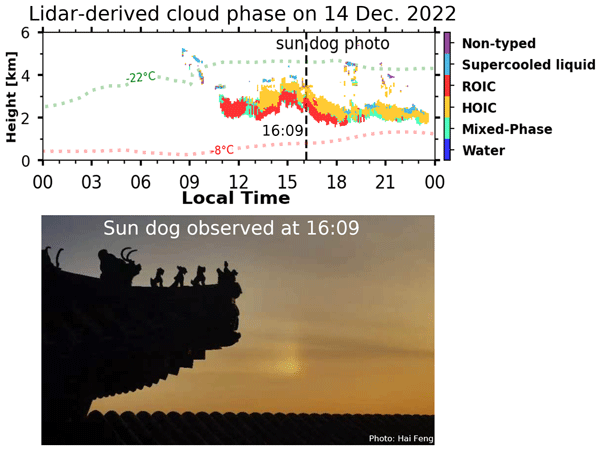
Figures 1, 8, and 9 use local time. Please specify the corresponding time zone and UTC offset in the figure captions and, where appropriate, for example, “China Standard Time (UTC+8)” if this is the time standard used throughout the study.
Citation: https://doi.org/10.5194/egusphere-2026-3314-RC3 -
AC3: 'Reply on RC3', Zhaolong Wu, 06 Aug 2026
Dear Editor,
Please find attached our detailed response to the referee’s comments. We have addressed all comments carefully and made the necessary revisions.
We sincerely thank the referees for their constructive feedback, which helped improve the quality of our manuscript.
Kind regards,
Zhaolong Wu
-
AC3: 'Reply on RC3', Zhaolong Wu, 06 Aug 2026
Peer review completion


Interactive discussion
Status: closed
-
RC1: 'Comment on egusphere-2026-3314', Anonymous Referee #1, 03 Jul 2026
This is a very solid and scientifically valuable piece of work. The authors conducted a systematic, year‑long observational analysis of horizontally oriented ice crystals (HOICs) using a unique ground‑based combination of dual‑angle polarization lidars and a cloud radar in Beijing. For the first time, the study provides long‑term statistical constraints on the occurrence frequency, macrophysical characteristics, environmental conditions, and relationships of HOICs with supercooled liquid water clouds (SWCs) and turbulence, filling a critical gap in this field. The data are of high quality, the analysis methodology is rigorous, and the results are of significant reference value for improving ice‑cloud microphysics parameterization schemes in climate models. The paper is well structured and the arguments are well supported, but some details still need improvement. Therefore, a minor revision is recommended before acceptance.
Is Figure 5(a) based on statistics over all temperatures? The fraction of water clouds in 2022 is only 5.2% – could this be double‑checked?
For Figure 6 (rigorous cloud mask) and Figure 7 (relaxed cloud mask), the numbers of statistical cases are 735 and 693 respectively, with a difference of more than 5%. Could the corresponding reasons be provided?
The paper cites previous studies multiple times, but as an independent paper for publication, it should appropriately explain those previous studies. For example, in the sentence "Moreover, HOICs produce much stronger backscatter in the zenith‑pointing lidar than in the off‑zenith‑pointing lidar, making cloud‑layer detection more easily triggered in the zenith observations (Zhao et al., 2014; Wu et al., 2025)," the physical mechanism should be articulated within this paper.
The paper states: "both confirming a statistically significant difference in their overall EDR distributions (p ≪ 0.001). Interestingly, the calculated Cliff’s Delta yields a small overall effect size (d = −0.060)." The formulas for p and d should be provided.
Citation: https://doi.org/10.5194/egusphere-2026-3314-RC1 -
AC1: 'Reply on RC1', Zhaolong Wu, 06 Aug 2026
Dear Editor,
Please find attached our detailed response to the referee’s comments. We have addressed all comments carefully and made the necessary revisions.
We sincerely thank the referees for their constructive feedback, which helped improve the quality of our manuscript.
Kind regards,
Zhaolong Wu
-
AC1: 'Reply on RC1', Zhaolong Wu, 06 Aug 2026
-
RC2: 'Comment on egusphere-2026-3314', Anonymous Referee #2, 23 Jul 2026
Comment on “Observation-based analysis of horizontally oriented ice crystals using dual-angle polarization lidar and cloud Doppler radar in Beijing” by Wu et al.
This study presents comprehensive case studies and statistical analyses of horizontally oriented ice crystals (HOICs) using a full year (2022) of synergistic observations in Beijing, China, combining a zenith-pointing micropulse lidar, a collocated 15° off-zenith polarization lidar, and a Ka-band cloud Doppler radar. Applying a novel height-resolved classification method based on dual-angle polarization lidars, HOICs are identified with high spatiotemporal resolution. Many novel findings have been found in this study, making it highly worthy for prompt publication. For example, HOICs are found to be common, accounting for 15.0 % of all ice-containing cloud data points annually and peaking at 24.6 % in summer, with maximum occurrence at temperatures from −20 °C to −10 °C. Also, HOICs preferentially occur in stable environments with turbulent eddy dissipation rates below 10⁻² m² s⁻³ and exhibit lower fall velocities than ROICs. The manuscript is generally well written, logically organized, and addresses an important source of uncertainty in cloud remote sensing and radiative-transfer parameterizations. Minor comments have been provided as follows.
General comment
- The retrieval of particle diameter and Reynolds number follows the method introduced in the authors’ previous study. However, these calculations are presented only for HOICs and not for randomly oriented ice crystals (ROICs). Is it possible to calculate those for ROICs?
- The retrieved median equivalent diameter of HOICs is 1187 μm, which is larger than the sizes commonly reported for pristine plates and dendrites in previous in-situ studies. The authors acknowledge that cloud-radar measurements are strongly weighted toward larger particles and may not detect smaller HOICs in optically thin cirrus. To avoid possible overinterpretation of Table 1 and Figure 14, please state explicitly in the main text or figure/table captions that the retrieved diameters and Reynolds numbers represent radar-reflectivity-weighted estimates for the radar-detectable HOIC population, rather than an unbiased size distribution of all HOICs.
- The HOIC classification and the resulting cloud-phase fractions depend on a fixed combination of thresholds, including a zenith-to-off-zenith attenuated-backscatter ratio of 2 and a depolarization-ratio threshold of 0.6. How will the conclusion of cloud phase fraction change with varying the thresholds? Is the distribution sensitive to the fixed thresholds?
Minor comments:
Line 71, Actually, the authors did not provide detailed descriptions of previous studies, while they provide descriptions regarding the limitations of observations to HOICs. Thus, I would like to suggest the authors remove “these” in the sentence to say “Most of previous studies did not”
Line 78-80, I would suggest the authors do not need to emphasize their previous study. Instead, they can simply say “Wu et al. (2025) introduced a range-bin-resolved method for …”.
Line 144-145, To introduce the method proposed by other studies which the authors select to compare with, I would suggest changing the description as “Griesche et al. (2020) retrieved turbulent dissipation rates from cloud radar observations, which has been validated using tethered-balloon in situ measurements”.
Line 148, Similar as earlier comment, the authors can simply say “in the Appendix of Wu et al. (2025)”.
Line 171, please keep the citation format the same and correct, such as Wu et al. (2025).
Line 173, please indicate the time zone for this study, local time or UTC?
Line 182, “It is highly convincing that HOICs exist above our lidar station” is not necessary to mention, which is a repeat to other information, and I would like to suggest removing it.
Line 205, The authors may add “unless an inversion layer exists within clouds”.
Line 259, No need to explain the median “diamonds” and interquartile range “horizontal lines”, since they have been explained in the figure caption.
Line 305, “introduced in” should be better as “introduced by”
Line 314-315, I would suggest removing “finally”.
Line 319-320, Note that temperature threshold -40 degree C is used earlier, different from the value -38 degree C used here. I would suggest the authors keep using the same value in this study.
Line 502, “generally stronger than that at night”
Line 520-521, I would suggest combining this sentence into the last paragraph.
Line 687-689, “Consistent with our estimates” and “which is in good agreement with the findings in our study” are redundant to each other, please only keep one of them.
Line 756, I would suggest changing “:” to “,”
Line 813-814, Do the authors mean “it would be desirable if such data sets are available at different sites over several years and to further examine the sensitivity of the inferred HOIC properties to cloud classification strategy, ice-crystal habit assumptions, and environmental variability”?
Citation: https://doi.org/10.5194/egusphere-2026-3314-RC2 -
AC2: 'Reply on RC2', Zhaolong Wu, 06 Aug 2026
Dear Editor,
Please find attached our detailed response to the referee’s comments. We have addressed all comments carefully and made the necessary revisions.
We sincerely thank the referees for their constructive feedback, which helped improve the quality of our manuscript.
Kind regards,
Zhaolong Wu
-
RC3: 'Comment on egusphere-2026-3314', Anonymous Referee #3, 29 Jul 2026
This manuscript presents a valuable and comprehensive investigation of horizontally oriented ice crystals (HOICs) using a near-year-long dataset covering 354 observation days with dual-angle polarization lidars and a cloud Doppler radar. Given the scarcity of long-term, range-resolved observations of HOIC occurrence at high spatial and temporal resolutions, the dataset presented in this study is particularly valuable. The authors combine statistical analyses with representative case studies, providing useful insights into the macrophysical and microphysical characteristics of HOICs.
The methodology is generally appropriate, the observational dataset is substantial, and the manuscript is well structured and clearly written. The topic falls within the scope of Atmospheric Chemistry and Physics. I recommend publication after the authors address the following minor comments and technical corrections.
Specific Comments:
Please moderate definitive expressions such as “fully demonstrates.” For example, Section 3.2, line 234 states, “This case fully demonstrates that…”. Because evidence from a single case can illustrate or support an interpretation but cannot fully demonstrate a general mechanism, I suggest replacing “fully demonstrates” with “illustrates,” “suggests,” or “provides evidence that.”
The caption of Figure 11 states, “To ensure a causal relationship…”. This wording is too strong. Requiring the selected SWCs to occur earlier in time and above the ice-crystal observations makes the analysis physically consistent with the sedimentation process, but it does not establish a causal relationship. I suggest revising this sentence to: “To make the analysis physically consistent with ice-crystal sedimentation, the selected SWCs must temporally precede and be located above the observed ice crystals.” Related causal statements in the main text should also be moderated where appropriate.
The manuscript identifies an EDR of approximately (10⁻² m² s⁻³) as a dynamical threshold for maintaining the horizontal orientation of ice crystals. Because this value is derived from observations at a single site during one year and may depend on the retrieval and classification methods, “threshold” could imply a universal and sharply defined physical limit. Please consider describing it as an “approximate empirical threshold,” “characteristic transition value,” or “observed transition range,” and clarify that its broader applicability requires further evaluation.
Figures 1, 8, and 9 use local time. Please specify the corresponding time zone and UTC offset in the figure captions and, where appropriate, for example, “China Standard Time (UTC+8)” if this is the time standard used throughout the study.
Citation: https://doi.org/10.5194/egusphere-2026-3314-RC3 -
AC3: 'Reply on RC3', Zhaolong Wu, 06 Aug 2026
Dear Editor,
Please find attached our detailed response to the referee’s comments. We have addressed all comments carefully and made the necessary revisions.
We sincerely thank the referees for their constructive feedback, which helped improve the quality of our manuscript.
Kind regards,
Zhaolong Wu
-
AC3: 'Reply on RC3', Zhaolong Wu, 06 Aug 2026
Peer review completion
Journal article(s) based on this preprint
Viewed
| HTML | XML | Total | BibTeX | EndNote | |
|---|---|---|---|---|---|
| 142 | 98 | 36 | 276 | 28 | 32 |
- HTML: 142
- PDF: 98
- XML: 36
- Total: 276
- BibTeX: 28
- EndNote: 32
Viewed (geographical distribution)
| Country | # | Views | % |
|---|
| Total: | 0 |
| HTML: | 0 |
| PDF: | 0 |
| XML: | 0 |
- 1
Zhaolong Wu
Patric Seifert
Holger Baars
Cristofer Jimenez
Chengcai Li
Albert Ansmann

The requested preprint has a corresponding peer-reviewed final revised paper. You are encouraged to refer to the final revised version.
- Preprint
(13411 KB) - Metadata XML
This is a very solid and scientifically valuable piece of work. The authors conducted a systematic, year‑long observational analysis of horizontally oriented ice crystals (HOICs) using a unique ground‑based combination of dual‑angle polarization lidars and a cloud radar in Beijing. For the first time, the study provides long‑term statistical constraints on the occurrence frequency, macrophysical characteristics, environmental conditions, and relationships of HOICs with supercooled liquid water clouds (SWCs) and turbulence, filling a critical gap in this field. The data are of high quality, the analysis methodology is rigorous, and the results are of significant reference value for improving ice‑cloud microphysics parameterization schemes in climate models. The paper is well structured and the arguments are well supported, but some details still need improvement. Therefore, a minor revision is recommended before acceptance.
Is Figure 5(a) based on statistics over all temperatures? The fraction of water clouds in 2022 is only 5.2% – could this be double‑checked?
For Figure 6 (rigorous cloud mask) and Figure 7 (relaxed cloud mask), the numbers of statistical cases are 735 and 693 respectively, with a difference of more than 5%. Could the corresponding reasons be provided?
The paper cites previous studies multiple times, but as an independent paper for publication, it should appropriately explain those previous studies. For example, in the sentence "Moreover, HOICs produce much stronger backscatter in the zenith‑pointing lidar than in the off‑zenith‑pointing lidar, making cloud‑layer detection more easily triggered in the zenith observations (Zhao et al., 2014; Wu et al., 2025)," the physical mechanism should be articulated within this paper.
The paper states: "both confirming a statistically significant difference in their overall EDR distributions (p ≪ 0.001). Interestingly, the calculated Cliff’s Delta yields a small overall effect size (d = −0.060)." The formulas for p and d should be provided.