
the Creative Commons Attribution 4.0 License.
the Creative Commons Attribution 4.0 License.
 | 12 Jun 2026
Estimating Beam Pointing of Vertically Pointing Cloud Radars Using Radiosonde Measurements
Abstract. Accurate beam pointing is essential for vertically pointing cloud radars, as even small tilting off zenith introduces projections of horizontal wind into Doppler velocity measurements. These effects can bias the interpretation of vertical air motion and hydrometeor fall speeds, leading to systematic errors in cloud and precipitation retrievals.
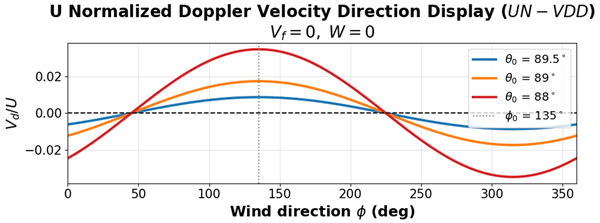
We present a method to estimate and validate radar beam pointing angle using collocated radiosonde observations. When the radar beam is tilted, the observed Doppler velocity exhibits a cosine dependence on wind direction due to projection of horizontal wind onto the beam, with an amplitude proportional to wind speed. By normalizing Doppler velocity with horizontal wind speed, this geometric dependence can be isolated, enabling quantitative retrieval of off-zenith beam pointing estimation.
The method is applied to the Ka-band ARM Zenith Radar (KAZR) and the Marine W-band ARM Cloud Radar (MWACR) during the Cloud and Precipitation Experiment at kennaook (CAPE-k). Results show a clear wind-direction dependence consistent with small but measurable beam pointing offsets. Differences in Doppler velocity between KAZR and MWACR further reduce the influence of hydrometeor fall velocity and vertical air motion, providing an independent constraint on relative pointing errors. Application to KAZR observations at ARM fixed sites and recent field campaigns further demonstrates that the method is robust across a range of atmospheric conditions. This approach provides a practical and scalable tool for evaluating radar beam pointing using routinely available radiosonde data, with direct implications for improving the accuracy of ARM cloud and precipitation products.
-
Notice on discussion status
The requested preprint has a corresponding peer-reviewed final revised paper. You are encouraged to refer to the final revised version.
-
Preprint
(1582 KB)
-
The requested preprint has a corresponding peer-reviewed final revised paper. You are encouraged to refer to the final revised version.
- Preprint
(1582 KB) - Metadata XML
- BibTeX
- EndNote
- Final revised paper


Journal article(s) based on this preprint
Interactive discussion
Status: closed
-
RC1: 'Comment on egusphere-2026-3304', Anonymous Referee #1, 15 Jul 2026
-
AC1: 'Reply on RC1', Min Deng, 14 Aug 2026
We sincerely thank the reviewer for the positive assessment of our study and for recommending its publication in Atmospheric Measurement Techniques. We wish this U wind Normalized Velocity Direction Display (UN-VDD) techinique would be helpful for all vertically pointing radars observations.
Citation: https://doi.org/10.5194/egusphere-2026-3304-AC1
-
AC1: 'Reply on RC1', Min Deng, 14 Aug 2026
-
RC2: 'Comment on egusphere-2026-3304', Anonymous Referee #2, 16 Jul 2026
The comment was uploaded in the form of a supplement: https://egusphere.copernicus.org/preprints/2026/egusphere-2026-3304/egusphere-2026-3304-RC2-supplement.pdf
-
AC2: 'Reply on RC2', Min Deng, 14 Aug 2026
Thank you for your careful and detailed review of our manuscript. We have addressed your comments concerning the literature review, methodological description, uncertainty analysis, and practical application of the proposed method. Changes in the revised manuscript are shown in blue.
We also added a new Fig. 4 to illustrate the U-normalized velocity–direction display (UN-VDD) beam-pointing retrieval. In addition, we expanded the Discussion and Conclusions to address operational monitoring and correction of Doppler-velocity contamination caused by off-vertical pointing. More details can be found in the attached file.
-
AC2: 'Reply on RC2', Min Deng, 14 Aug 2026
Peer review completion


Interactive discussion
Status: closed
-
RC1: 'Comment on egusphere-2026-3304', Anonymous Referee #1, 15 Jul 2026
This is an interesting study that uses radiosonde wind measurements to estimate how well a “vertically pointing beam” is actually pointed vertically. This manuscript is well written and should be published in the Journal of Atmospheric Measurement Techniques.
Citation: https://doi.org/10.5194/egusphere-2026-3304-RC1 -
AC1: 'Reply on RC1', Min Deng, 14 Aug 2026
We sincerely thank the reviewer for the positive assessment of our study and for recommending its publication in Atmospheric Measurement Techniques. We wish this U wind Normalized Velocity Direction Display (UN-VDD) techinique would be helpful for all vertically pointing radars observations.
Citation: https://doi.org/10.5194/egusphere-2026-3304-AC1
-
AC1: 'Reply on RC1', Min Deng, 14 Aug 2026
-
RC2: 'Comment on egusphere-2026-3304', Anonymous Referee #2, 16 Jul 2026
The comment was uploaded in the form of a supplement: https://egusphere.copernicus.org/preprints/2026/egusphere-2026-3304/egusphere-2026-3304-RC2-supplement.pdf
-
AC2: 'Reply on RC2', Min Deng, 14 Aug 2026
Thank you for your careful and detailed review of our manuscript. We have addressed your comments concerning the literature review, methodological description, uncertainty analysis, and practical application of the proposed method. Changes in the revised manuscript are shown in blue.
We also added a new Fig. 4 to illustrate the U-normalized velocity–direction display (UN-VDD) beam-pointing retrieval. In addition, we expanded the Discussion and Conclusions to address operational monitoring and correction of Doppler-velocity contamination caused by off-vertical pointing. More details can be found in the attached file.
-
AC2: 'Reply on RC2', Min Deng, 14 Aug 2026
Peer review completion
Journal article(s) based on this preprint
Viewed
| HTML | XML | Total | BibTeX | EndNote | |
|---|---|---|---|---|---|
| 174 | 77 | 34 | 285 | 24 | 32 |
- HTML: 174
- PDF: 77
- XML: 34
- Total: 285
- BibTeX: 24
- EndNote: 32
Viewed (geographical distribution)
| Country | # | Views | % |
|---|
| Total: | 0 |
| HTML: | 0 |
| PDF: | 0 |
| XML: | 0 |
- 1

Scott Giangrande
Adam K. Theisen
Karen Johnson
Iosif A. Lindenmaier
Timothy G. Wendler
Jennifer Comstock
Marquette Rocque
Alyssa Matthews
The requested preprint has a corresponding peer-reviewed final revised paper. You are encouraged to refer to the final revised version.
- Preprint
(1582 KB) - Metadata XML
This is an interesting study that uses radiosonde wind measurements to estimate how well a “vertically pointing beam” is actually pointed vertically. This manuscript is well written and should be published in the Journal of Atmospheric Measurement Techniques.