
the Creative Commons Attribution 4.0 License.
the Creative Commons Attribution 4.0 License.
 | 04 Feb 2026
Technical note: Kinetically resolved volatile and redox fingerprints of geologic materials by TGA/DSC-MicroGC
Abstract. The biogeochemical cycles of carbon, oxygen and sulfur are fundamental interlinked, yet quantifying their speciation and reactivity within complex geological matrices remains a major analytical challenge. We present a novel integrated TGA/DSC-MicroGC system that simultaneously monitors mass loss, heat flow, and evolved gas composition during controlled heating. This approach kinetically resolves and quantifies distinct carbon and sulfur species through their unique thermal decomposition profiles. Furthermore, continuous monitoring of oxygen consumption provides a direct measure of a material’s absolute redox capacity, yielding a kinetic fingerprint of its reducible components. Validation against geochemical standards and application to sediments from the Congo Basin and Lake Cadagno, reveal diagenetic transitions and paleoenvironmental fluxes that are invisible to conventional bulk methods. This integrated methodology provides a mechanistic, high-resolution view of electron-transfer processes in natural materials, providing a transformative tool for probing biogeochemical cycling, redox evolution and environmental reactivity across Earth systems.
-
Notice on discussion status
The requested preprint has a corresponding peer-reviewed final revised paper. You are encouraged to refer to the final revised version.
-
Preprint
(1423 KB)
-
The requested preprint has a corresponding peer-reviewed final revised paper. You are encouraged to refer to the final revised version.
- Preprint
(1423 KB) - Metadata XML
- BibTeX
- EndNote
- Final revised paper


Journal article(s) based on this preprint
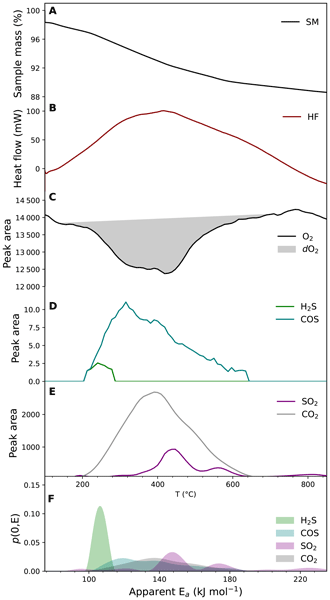
We present a novel analytical system that simultaneously measures mass loss, heat flow, gas emissions, and oxygen consumption during controlled heating. The method reveals how carbon, oxygen, and sulfur are stored, transformed, and recycled in geological materials. By providing high-resolution insights into thermal reactivity and redox processes, it helps identify hidden environmental changes and offers a powerful new tool for studying biogeochemical cycles and Earth’s environmental evolution.
Interactive discussion
Status: closed
-
RC1: 'Comment on egusphere-2026-321', Anonymous Referee #1, 18 Feb 2026
- AC1: 'Reply on RC1', Shuzhuang Wu, 30 Apr 2026
-
RC2: 'Comment on egusphere-2026-321', Małgorzata Labus, 25 Feb 2026
The article presents an interesting and technically relevant approach to kinetically resolved analysis, and its main conceptual framework is clearly articulated. The authors outline the experimental setup and provide a logical progression from theoretical background to practical implementation. The overall structure of the paper supports readability, and the figures and equations help contextualize the proposed method.
Regarding the methodology, it is described in a generally coherent manner; the experimental conditions, measurement procedures, and analytical framework are outlined. However, while the core experimental steps are presented, certain aspects could benefit from greater detail to ensure full reproducibility. For example, although the authors explain the type of kinetic model applied and reference the governing equations, the description of parameter estimation is somewhat concise. It is not always entirely clear how raw experimental data were processed prior to fitting, whether nonlinear regression was performed using a specific algorithm, or what statistical criteria were used to assess goodness of fit.
Concerning the calculation of kinetic parameters, the paper indicates that these were derived from fitting the experimental data to the proposed kinetic model, but the computational procedure is not exhaustively described. The reader can infer that parameters such as rate constants were obtained through model-based regression; however, the manuscript does not fully specify the fitting protocol (e.g., software used, optimization method, weighting strategy, treatment of uncertainty). As a result, while the conceptual basis for parameter calculation is understandable, the practical implementation lacks some transparency.
Additionally, it is unclear how many samples were tested. It is known that the samples came from two locations, but was only one sample from each site tested? Are they representative? After all, the sediment composition will depend on the sampling location, depth, and many other parameters. The sampling methodology needs to be clarified.
The attached PDF file highlights some shortcomings and ambiguities. Furthermore, the conclusions were described very briefly; they should be expanded.
In summary, the article is scientifically sound and clearly structured, but the methodological section could be expanded to provide a more detailed and reproducible description of how kinetic parameters were calculated. Greater clarity in the data analysis workflow and parameter estimation procedure would strengthen the technical rigor of the manuscript.
- AC2: 'Reply on RC2', Shuzhuang Wu, 30 Apr 2026
Peer review completion


Interactive discussion
Status: closed
-
RC1: 'Comment on egusphere-2026-321', Anonymous Referee #1, 18 Feb 2026
overall well structured. detailed revisions in the supplement
- AC1: 'Reply on RC1', Shuzhuang Wu, 30 Apr 2026
-
RC2: 'Comment on egusphere-2026-321', Małgorzata Labus, 25 Feb 2026
The article presents an interesting and technically relevant approach to kinetically resolved analysis, and its main conceptual framework is clearly articulated. The authors outline the experimental setup and provide a logical progression from theoretical background to practical implementation. The overall structure of the paper supports readability, and the figures and equations help contextualize the proposed method.
Regarding the methodology, it is described in a generally coherent manner; the experimental conditions, measurement procedures, and analytical framework are outlined. However, while the core experimental steps are presented, certain aspects could benefit from greater detail to ensure full reproducibility. For example, although the authors explain the type of kinetic model applied and reference the governing equations, the description of parameter estimation is somewhat concise. It is not always entirely clear how raw experimental data were processed prior to fitting, whether nonlinear regression was performed using a specific algorithm, or what statistical criteria were used to assess goodness of fit.
Concerning the calculation of kinetic parameters, the paper indicates that these were derived from fitting the experimental data to the proposed kinetic model, but the computational procedure is not exhaustively described. The reader can infer that parameters such as rate constants were obtained through model-based regression; however, the manuscript does not fully specify the fitting protocol (e.g., software used, optimization method, weighting strategy, treatment of uncertainty). As a result, while the conceptual basis for parameter calculation is understandable, the practical implementation lacks some transparency.
Additionally, it is unclear how many samples were tested. It is known that the samples came from two locations, but was only one sample from each site tested? Are they representative? After all, the sediment composition will depend on the sampling location, depth, and many other parameters. The sampling methodology needs to be clarified.
The attached PDF file highlights some shortcomings and ambiguities. Furthermore, the conclusions were described very briefly; they should be expanded.
In summary, the article is scientifically sound and clearly structured, but the methodological section could be expanded to provide a more detailed and reproducible description of how kinetic parameters were calculated. Greater clarity in the data analysis workflow and parameter estimation procedure would strengthen the technical rigor of the manuscript.
- AC2: 'Reply on RC2', Shuzhuang Wu, 30 Apr 2026
Peer review completion
Journal article(s) based on this preprint
We present a novel analytical system that simultaneously measures mass loss, heat flow, gas emissions, and oxygen consumption during controlled heating. The method reveals how carbon, oxygen, and sulfur are stored, transformed, and recycled in geological materials. By providing high-resolution insights into thermal reactivity and redox processes, it helps identify hidden environmental changes and offers a powerful new tool for studying biogeochemical cycles and Earth’s environmental evolution.
Viewed
| HTML | XML | Total | BibTeX | EndNote | |
|---|---|---|---|---|---|
| 1,107 | 461 | 108 | 1,676 | 170 | 252 |
- HTML: 1,107
- PDF: 461
- XML: 108
- Total: 1,676
- BibTeX: 170
- EndNote: 252
Viewed (geographical distribution)
| Country | # | Views | % |
|---|
| Total: | 0 |
| HTML: | 0 |
| PDF: | 0 |
| XML: | 0 |
- 1
Shuzhuang Wu
Samuel L. Jaccard
Matthieu E. Galvez
The requested preprint has a corresponding peer-reviewed final revised paper. You are encouraged to refer to the final revised version.
- Preprint
(1423 KB) - Metadata XML
overall well structured. detailed revisions in the supplement