
the Creative Commons Attribution 4.0 License.
the Creative Commons Attribution 4.0 License.
 | 16 Jun 2026
Simultaneous ground-based observations of a large quasi 26-day wave from three different measurement sites in northern mid-latitudes
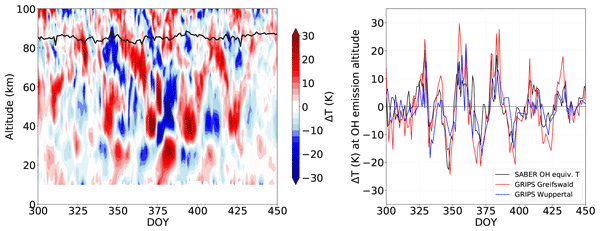
Abstract. We present simultaneous observations of a remarkable planetary wave event in mesospheric temperature observed by three different ground-based mid-latitude OH spectrometers at stations in Germany (Greifswald (54° N, 13° E), Wuppertal (51° N, 7° E), and Hohenpeißenberg (48° N, 11° E)) during boreal winter 2016/2017. Additionally, temperature profile observations with the satellite instruments SABER/TIMED and MLS/Aura are used for supporting information on the global distribution of the wave event.
The observed wave had a period of about 26 days and an amplitude of partly up to about 20 K. The satellite temperature observations confirmed that the wave signature exhibited all the characteristics of the well known Rossby (1,4) normal mode oscillation. To the best of our knowledge this is the first study reporting on such a strong Rossby (1,4) wave in the middle atmosphere of the Northern Hemisphere. The wave signature was also identified in atomic oxygen mixing ratios in the mesopause region and lower thermosphere observed with SABER illustrating the importance of such wave events not only for the temperature distribution but also for the temporal variation of trace-gas distributions.
-
Notice on discussion status
The requested preprint has a corresponding peer-reviewed final revised paper. You are encouraged to refer to the final revised version.
-
Preprint
(4802 KB)
-
The requested preprint has a corresponding peer-reviewed final revised paper. You are encouraged to refer to the final revised version.
- Preprint
(4802 KB) - Metadata XML
- BibTeX
- EndNote
- Final revised paper


Journal article(s) based on this preprint
Interactive discussion
Status: closed
-
RC1: 'Comment on egusphere-2026-3209', Anonymous Referee #1, 15 Jul 2026
The comment was uploaded in the form of a supplement: https://egusphere.copernicus.org/preprints/2026/egusphere-2026-3209/egusphere-2026-3209-RC1-supplement.pdfCitation: https://doi.org/
10.5194/egusphere-2026-3209-RC1 -
AC1: 'Reply on RC1', Christoph Kalicinsky, 22 Sep 2026
The comment was uploaded in the form of a supplement: https://egusphere.copernicus.org/preprints/2026/egusphere-2026-3209/egusphere-2026-3209-AC1-supplement.pdf
-
AC1: 'Reply on RC1', Christoph Kalicinsky, 22 Sep 2026
-
RC2: 'Comment on egusphere-2026-3209', Anonymous Referee #2, 09 Aug 2026
General comment:
This manuscript describes a quasi-periodic temperature perturbation (a quasi 26-day oscillation) in the mesosphere during the Northern Hemisphere winter 2016/2017. The combination of simultaneous ground-based OH*(3,1) rotational temperature observations at three mid-latitude stations with SABER and MLS observations provides a convincing observational basis for the analysis.
The authors present evidence supporting the interpretation of this observed quasi 26-day (or 25–27-day) oscillation as a Rossby (1,4) normal mode.
I also find interesting the discussion concerning the possible implications for the identification of solar 27-day signatures.
I consider the manuscript is an interesting contribution. It is clear and well written, in my opinion. I have, only one minor comment, which follows.
Specific comment:
How specific is the quasi 26-day amplitude event observed in 2016/2017?
This study uses data from 1 July 2016 to 30 June 2017, and the pronounced quasi-periodic signal appears only during a relatively limited interval within this period, approximately from DOY 320 to 440, corresponding to a few months around the winter. Since the authors have access to longer ground-based records, I wonder whether it would be possible to investigate whether comparable quasi-26-day events occur during other winters. For example, using Greifswald and Wuppertal observations. I understand that the third station only has observations until mid 2017.
I think that the SABER and MLS datasets also provide the possibility of examining additional winters.
Citation: https://doi.org/10.5194/egusphere-2026-3209-RC2 -
AC2: 'Reply on RC2', Christoph Kalicinsky, 22 Sep 2026
The comment was uploaded in the form of a supplement: https://egusphere.copernicus.org/preprints/2026/egusphere-2026-3209/egusphere-2026-3209-AC2-supplement.pdf
-
AC2: 'Reply on RC2', Christoph Kalicinsky, 22 Sep 2026
Peer review completion


Interactive discussion
Status: closed
-
RC1: 'Comment on egusphere-2026-3209', Anonymous Referee #1, 15 Jul 2026
The comment was uploaded in the form of a supplement: https://egusphere.copernicus.org/preprints/2026/egusphere-2026-3209/egusphere-2026-3209-RC1-supplement.pdf
-
AC1: 'Reply on RC1', Christoph Kalicinsky, 22 Sep 2026
The comment was uploaded in the form of a supplement: https://egusphere.copernicus.org/preprints/2026/egusphere-2026-3209/egusphere-2026-3209-AC1-supplement.pdf
-
AC1: 'Reply on RC1', Christoph Kalicinsky, 22 Sep 2026
-
RC2: 'Comment on egusphere-2026-3209', Anonymous Referee #2, 09 Aug 2026
General comment:
This manuscript describes a quasi-periodic temperature perturbation (a quasi 26-day oscillation) in the mesosphere during the Northern Hemisphere winter 2016/2017. The combination of simultaneous ground-based OH*(3,1) rotational temperature observations at three mid-latitude stations with SABER and MLS observations provides a convincing observational basis for the analysis.
The authors present evidence supporting the interpretation of this observed quasi 26-day (or 25–27-day) oscillation as a Rossby (1,4) normal mode.
I also find interesting the discussion concerning the possible implications for the identification of solar 27-day signatures.
I consider the manuscript is an interesting contribution. It is clear and well written, in my opinion. I have, only one minor comment, which follows.
Specific comment:
How specific is the quasi 26-day amplitude event observed in 2016/2017?
This study uses data from 1 July 2016 to 30 June 2017, and the pronounced quasi-periodic signal appears only during a relatively limited interval within this period, approximately from DOY 320 to 440, corresponding to a few months around the winter. Since the authors have access to longer ground-based records, I wonder whether it would be possible to investigate whether comparable quasi-26-day events occur during other winters. For example, using Greifswald and Wuppertal observations. I understand that the third station only has observations until mid 2017.
I think that the SABER and MLS datasets also provide the possibility of examining additional winters.
Citation: https://doi.org/10.5194/egusphere-2026-3209-RC2 -
AC2: 'Reply on RC2', Christoph Kalicinsky, 22 Sep 2026
The comment was uploaded in the form of a supplement: https://egusphere.copernicus.org/preprints/2026/egusphere-2026-3209/egusphere-2026-3209-AC2-supplement.pdf
-
AC2: 'Reply on RC2', Christoph Kalicinsky, 22 Sep 2026
Peer review completion
Journal article(s) based on this preprint
Viewed
| HTML | XML | Total | BibTeX | EndNote | |
|---|---|---|---|---|---|
| 136 | 63 | 38 | 237 | 38 | 39 |
- HTML: 136
- PDF: 63
- XML: 38
- Total: 237
- BibTeX: 38
- EndNote: 39
Viewed (geographical distribution)
| Country | # | Views | % |
|---|
| Total: | 0 |
| HTML: | 0 |
| PDF: | 0 |
| XML: | 0 |
- 1
Christoph Kalicinsky

Sandra Wallis
Lukas Depenthal
Christoph G. Hoffmann
Anna Lange
Christian von Savigny
The requested preprint has a corresponding peer-reviewed final revised paper. You are encouraged to refer to the final revised version.
- Preprint
(4802 KB) - Metadata XML