
the Creative Commons Attribution 4.0 License.
the Creative Commons Attribution 4.0 License.
 | 05 Mar 2026
Top-Down Benchmark of U.S. Methane Inventories Reveals Regional Discrepancies in Activity-Based Estimates
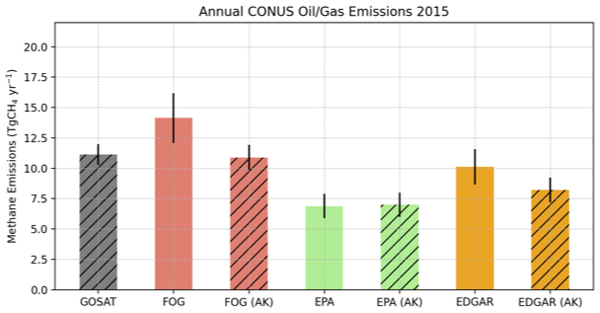
Abstract. Robust estimates of methane emissions are critical for understanding their impacts on atmospheric warming and air quality, and for assessing methane mitigation strategies. Gridded inventories, such as the U.S. Environmental Protection Agency’s Greenhouse Gas Inventory (EPA GHGI), the Emissions Database for Global Atmospheric Research (EDGAR 2024), and the National Oceanic and Atmospheric Administration’s Fossil Fuel Oil and Gas inventory (NOAA FOG), are constructed to evaluate large-scale emission patterns and support identifying emission mitigation priorities and prioritizing future measurements. However, substantial differences across inventories complicate such assessments. We benchmark EPA GHGI, EDGAR 2024, and NOAA FOG against flux estimates from an atmospheric inversion of Greenhouse Gases Observing Satellite (GOSAT) data from 2012 to 2020 over the Contiguous United States (CONUS). A key technical challenge is the heterogeneous sensitivity of satellite-derived fluxes, which depends on measurement uncertainty, coverage, and inversion model configuration. We account for this heterogeneity by applying an inversion operator to each inventory prior to comparison with the GOSAT-based estimates. The GOSAT estimates are most sensitive to oil&gas and livestock emissions; oil and gas emissions are consistent with NOAA FOG (14.1 Tg CH4 yr⁻¹ in 2015), but exceed EPA GHGI and EDGAR, particularly across Texas, Oklahoma, and Louisiana. GOSAT-based livestock emissions exceed EPA GHGI and EDGAR by 1–2 Tg CH4 yr⁻¹, with the largest differences in the Midwest and California. Despite these discrepancies, both activity and satellite based estimates show no observable trends from 2012 to 2020 in fossil and livestock emissions.
-
Notice on discussion status
The requested preprint has a corresponding peer-reviewed final revised paper. You are encouraged to refer to the final revised version.
-
Preprint
(6657 KB)
-
The requested preprint has a corresponding peer-reviewed final revised paper. You are encouraged to refer to the final revised version.
- Preprint
(6657 KB) - Metadata XML
- BibTeX
- EndNote
- Final revised paper


Journal article(s) based on this preprint
Interactive discussion
Status: closed
- RC1: 'Comment on egusphere-2026-313', Anonymous Referee #1, 16 Apr 2026
-
RC2: 'Comment on egusphere-2026-313', Anonymous Referee #2, 02 May 2026
The manuscript describes a comparison of three inventories with satellite data over the US. Differences between measurements and inventories are discussed for total emissions and three major sectors both spatially and temporally. The methods for comparing data and inventory are described with more details found in the appendix. Thorough discussion of two important sectors, oil&gas and livestock, give a good idea on the comparability and include pinpointing areas that could benefit from research. This will be valuable for scientists and inventory users, and I would recommend publishing the manuscript with only few minor corrections.
Lines 46-49: These links are repeated several times throughout the paper and seem to be superfluous in this place
Line 112: Is there a typo in equation (1)?
Lines 206-224: Description and caption of table 2 seem to be mixed.
Lines 367-377: Section 2.3 is much shorter than the previous ones. Is there a specific reason why the timeline is not included for waste?
Citation: https://doi.org/10.5194/egusphere-2026-313-RC2 -
AC1: 'Comment on egusphere-2026-313', John Worden, 09 May 2026
Response to Reviewer Comments
Reviewer 1
Comment: This manuscript evaluates the total and spatial distribution of methane emissions by sector for three different gridded emission inventories, which were modified with inversion operators prior to comparison with GOSAT inversion based estimates. The methods and results will be highly valuable to the atmospheric scientists and other stakeholders using satellite-based inversions with a priori gridded inventories to assess the spatial distribution and trends in sectoral methane emissions. I believe this version of the manuscript is acceptable for publication but have suggested a few minor revisions to improve clarity:
Response: We thank the reviewer for their time! Below are our responses.
Comment: Line 55: What do you mean by "economic safety risks" of leaking natural gas? I would say that emissions have both safety risks (from fires and explosions) and economic impacts (lower revenue due to product loss).
Response: the word “Economic” was from a previous version but somehow got to the submitted manuscript. Deleted.
Comment: Line 155: Describe the spatially gridded U.S. EPA GHG Inventory as the "gridded U.S. EPA GHG inventory" since you are citing Maasakkers et al rather than EPA.
Response: Changed
Comment: Lines 609 - 627: I recommend mentioning the U.S. is withdrawing from UNFCCC and EPA no longer plans to develop, submit, or publish an annual GHG Inventory. The University of Maryland recently released a report equivalent to the EPA 2026 GHGI which theoretically could be gridded using the Maasakkers et al approach. https://cgs.umd.edu/news/new-us-greenhouse-gas-emissions-inventory-and-analysis-published-cgs
Response: We thank the reviewer for pointing us to the Desai et al. (2026) Greenhouse Gas Inventory and Analysis for the United States. We agree that this product is relevant to future benchmarking efforts because it provides updated national-scale inventory estimates for 1990–2024 using methods that are consistent with the EPA GHGI. However, we are not comfortable stating that EPA will no longer produce, submit, or publish annual GHG inventories, since future inventory reporting practices may change. Instead, we have added the following sentence to acknowledge the Desai et al. inventory while keeping the focus on the inventory products evaluated in this study:
Desai et al. (2026) provides updated national-scale inventory estimates for 1990–2024 that are methodologically consistent with the EPA GHGI, allowing a comparable gridded product to be developed and evaluated against satellite-based inversions using the benchmark framework applied here.
Reviewer 2
Comment: The manuscript describes a comparison of three inventories with satellite data over the US. Differences between measurements and inventories are discussed for total emissions and three major sectors both spatially and temporally. The methods for comparing data and inventory are described with more details found in the appendix. Thorough discussion of two important sectors, oil&gas and livestock, give a good idea on the comparability and include pinpointing areas that could benefit from research. This will be valuable for scientists and inventory users, and I would recommend publishing the manuscript with only few minor corrections.
Response: Thank you for your time in reviewing this manuscript!
Comment: Lines 46-49: These links are repeated several times throughout the paper and seem to be superfluous in this place
Response: I think you are likely referring to the Zenodo links. Our objective is to immediately point an incoming researcher to the location where they can download / use our code. For that reason we kept the statement before the introduction showing the Zenodo link but have referenced the data availability section in the subsequent reference around line 169.
Comment: Line 112: Is there a typo in equation (1)?
Response: I think you are referring to the need for an extra bracket line? If so, fixed.
Comment: Lines 206-224: Description and caption of table 2 seem to be mixed.
Response: We thank the reviewer for pointing this out. We agree that the table description and caption were mixed together and somewhat redundant. We revised the paragraph so that it now focuses on the main comparison and interpretation, and moved the descriptive information about the table scope, units, source exclusions, and references into the caption.
Comment: Lines 367-377: Section 2.3 is much shorter than the previous ones. Is there a specific reason why the timeline is not included for waste?
Response: We have added this statement at the end of the section to address this comment: “Because of this limited sensitivity we do not compare temporal changes in the waste emissions.”
Citation: https://doi.org/10.5194/egusphere-2026-313-AC1
Peer review completion


Interactive discussion
Status: closed
-
RC1: 'Comment on egusphere-2026-313', Anonymous Referee #1, 16 Apr 2026
This manuscript evaluates the total and spatial distribution of methane emissions by sector for three different gridded emission inventories, which were modified with inversion operators prior to comparison with GOSAT inversion based estimates. The methods and results will be highly valuable to the atmospheric scientists and other stakeholders using satellite-based inversions with a priori gridded inventories to assess the spatial distribution and trends in sectoral methane emissions. I believe this version of the manuscript is acceptable for publication but have suggested a few minor revisions to improve clarity:
Line 55: What do you mean by "economic safety risks" of leaking natural gas? I would say that emissions have both safety risks (from fires and explosions) and economic impacts (lower revenue due to product loss).
Line 155: Describe the spatially gridded U.S. EPA GHG Inventory as the "gridded U.S. EPA GHG inventory" since you are citing Maasakkers et al rather than EPA.
Lines 609 - 627: I recommend mentioning the the U.S. is withdrawing from UNFCCC and EPA no longer plans to develop, submit, or publish an annual GHG Inventory. The University of Maryland recently released a report equivalent to the EPA 2026 GHGI which theoretically could be gridded using the Maasakkers et al approach. https://cgs.umd.edu/news/new-us-greenhouse-gas-emissions-inventory-and-analysis-published-cgs
Citation: https://doi.org/10.5194/egusphere-2026-313-RC1 -
RC2: 'Comment on egusphere-2026-313', Anonymous Referee #2, 02 May 2026
The manuscript describes a comparison of three inventories with satellite data over the US. Differences between measurements and inventories are discussed for total emissions and three major sectors both spatially and temporally. The methods for comparing data and inventory are described with more details found in the appendix. Thorough discussion of two important sectors, oil&gas and livestock, give a good idea on the comparability and include pinpointing areas that could benefit from research. This will be valuable for scientists and inventory users, and I would recommend publishing the manuscript with only few minor corrections.
Lines 46-49: These links are repeated several times throughout the paper and seem to be superfluous in this place
Line 112: Is there a typo in equation (1)?
Lines 206-224: Description and caption of table 2 seem to be mixed.
Lines 367-377: Section 2.3 is much shorter than the previous ones. Is there a specific reason why the timeline is not included for waste?
Citation: https://doi.org/10.5194/egusphere-2026-313-RC2 -
AC1: 'Comment on egusphere-2026-313', John Worden, 09 May 2026
Response to Reviewer Comments
Reviewer 1
Comment: This manuscript evaluates the total and spatial distribution of methane emissions by sector for three different gridded emission inventories, which were modified with inversion operators prior to comparison with GOSAT inversion based estimates. The methods and results will be highly valuable to the atmospheric scientists and other stakeholders using satellite-based inversions with a priori gridded inventories to assess the spatial distribution and trends in sectoral methane emissions. I believe this version of the manuscript is acceptable for publication but have suggested a few minor revisions to improve clarity:
Response: We thank the reviewer for their time! Below are our responses.
Comment: Line 55: What do you mean by "economic safety risks" of leaking natural gas? I would say that emissions have both safety risks (from fires and explosions) and economic impacts (lower revenue due to product loss).
Response: the word “Economic” was from a previous version but somehow got to the submitted manuscript. Deleted.
Comment: Line 155: Describe the spatially gridded U.S. EPA GHG Inventory as the "gridded U.S. EPA GHG inventory" since you are citing Maasakkers et al rather than EPA.
Response: Changed
Comment: Lines 609 - 627: I recommend mentioning the U.S. is withdrawing from UNFCCC and EPA no longer plans to develop, submit, or publish an annual GHG Inventory. The University of Maryland recently released a report equivalent to the EPA 2026 GHGI which theoretically could be gridded using the Maasakkers et al approach. https://cgs.umd.edu/news/new-us-greenhouse-gas-emissions-inventory-and-analysis-published-cgs
Response: We thank the reviewer for pointing us to the Desai et al. (2026) Greenhouse Gas Inventory and Analysis for the United States. We agree that this product is relevant to future benchmarking efforts because it provides updated national-scale inventory estimates for 1990–2024 using methods that are consistent with the EPA GHGI. However, we are not comfortable stating that EPA will no longer produce, submit, or publish annual GHG inventories, since future inventory reporting practices may change. Instead, we have added the following sentence to acknowledge the Desai et al. inventory while keeping the focus on the inventory products evaluated in this study:
Desai et al. (2026) provides updated national-scale inventory estimates for 1990–2024 that are methodologically consistent with the EPA GHGI, allowing a comparable gridded product to be developed and evaluated against satellite-based inversions using the benchmark framework applied here.
Reviewer 2
Comment: The manuscript describes a comparison of three inventories with satellite data over the US. Differences between measurements and inventories are discussed for total emissions and three major sectors both spatially and temporally. The methods for comparing data and inventory are described with more details found in the appendix. Thorough discussion of two important sectors, oil&gas and livestock, give a good idea on the comparability and include pinpointing areas that could benefit from research. This will be valuable for scientists and inventory users, and I would recommend publishing the manuscript with only few minor corrections.
Response: Thank you for your time in reviewing this manuscript!
Comment: Lines 46-49: These links are repeated several times throughout the paper and seem to be superfluous in this place
Response: I think you are likely referring to the Zenodo links. Our objective is to immediately point an incoming researcher to the location where they can download / use our code. For that reason we kept the statement before the introduction showing the Zenodo link but have referenced the data availability section in the subsequent reference around line 169.
Comment: Line 112: Is there a typo in equation (1)?
Response: I think you are referring to the need for an extra bracket line? If so, fixed.
Comment: Lines 206-224: Description and caption of table 2 seem to be mixed.
Response: We thank the reviewer for pointing this out. We agree that the table description and caption were mixed together and somewhat redundant. We revised the paragraph so that it now focuses on the main comparison and interpretation, and moved the descriptive information about the table scope, units, source exclusions, and references into the caption.
Comment: Lines 367-377: Section 2.3 is much shorter than the previous ones. Is there a specific reason why the timeline is not included for waste?
Response: We have added this statement at the end of the section to address this comment: “Because of this limited sensitivity we do not compare temporal changes in the waste emissions.”
Citation: https://doi.org/10.5194/egusphere-2026-313-AC1
Peer review completion
Journal article(s) based on this preprint
Viewed
| HTML | XML | Total | BibTeX | EndNote | |
|---|---|---|---|---|---|
| 1,183 | 707 | 97 | 1,987 | 99 | 150 |
- HTML: 1,183
- PDF: 707
- XML: 97
- Total: 1,987
- BibTeX: 99
- EndNote: 150
Viewed (geographical distribution)
| Country | # | Views | % |
|---|
| Total: | 0 |
| HTML: | 0 |
| PDF: | 0 |
| XML: | 0 |
- 1

Sudhanshu Pandey
Hannah Nesser
Kevin Bowman
Colin Harkins
Congmeng Lyu
Joannes D. Maasakkers
Deborah Gordon
Daniel Jacob
Lucas Estrada
Daniel J. Varon
James D. East
Lauren Schmeisser
The requested preprint has a corresponding peer-reviewed final revised paper. You are encouraged to refer to the final revised version.
- Preprint
(6657 KB) - Metadata XML
This manuscript evaluates the total and spatial distribution of methane emissions by sector for three different gridded emission inventories, which were modified with inversion operators prior to comparison with GOSAT inversion based estimates. The methods and results will be highly valuable to the atmospheric scientists and other stakeholders using satellite-based inversions with a priori gridded inventories to assess the spatial distribution and trends in sectoral methane emissions. I believe this version of the manuscript is acceptable for publication but have suggested a few minor revisions to improve clarity:
Line 55: What do you mean by "economic safety risks" of leaking natural gas? I would say that emissions have both safety risks (from fires and explosions) and economic impacts (lower revenue due to product loss).
Line 155: Describe the spatially gridded U.S. EPA GHG Inventory as the "gridded U.S. EPA GHG inventory" since you are citing Maasakkers et al rather than EPA.
Lines 609 - 627: I recommend mentioning the the U.S. is withdrawing from UNFCCC and EPA no longer plans to develop, submit, or publish an annual GHG Inventory. The University of Maryland recently released a report equivalent to the EPA 2026 GHGI which theoretically could be gridded using the Maasakkers et al approach. https://cgs.umd.edu/news/new-us-greenhouse-gas-emissions-inventory-and-analysis-published-cgs