
the Creative Commons Attribution 4.0 License.
the Creative Commons Attribution 4.0 License.
 | 11 Jun 2026
Urban surface-atmosphere fluxes of pptv-level oxygenated organic molecules (OOMs) from eddy covariance observations
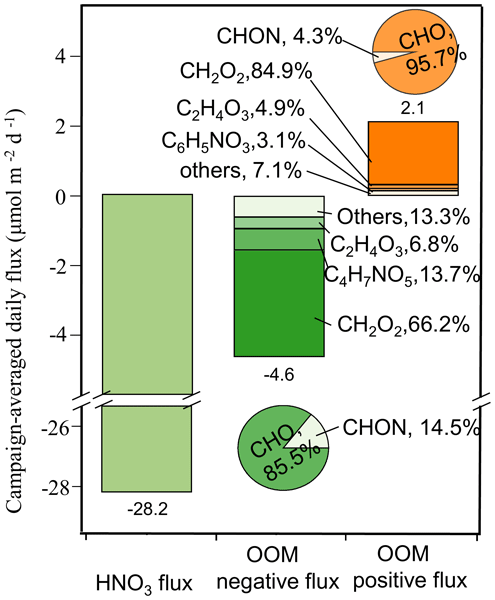
Abstract. Oxygenated Organic Molecules (OOMs) represent a substantial fraction of ambient reactive carbon and are potential precursors of secondary organic aerosols (SOA). Surface-atmosphere exchange flux modulates OOM budgets and subsequent SOA formation. This study presents the first urban eddy covariance measurements of pptv-level OOM surface-atmosphere fluxes, using an iodide-adduct chemical ionization mass spectrometer during the hottest month of the year in a central China megacity. We addressed the challenges of retrieving reliable fluxes for OOM species with low concentration signal-to-noise-ratios. Effects of data block averaging and water vapor dilution were investigated. We retrieved the fluxes of 16 OOMs, which displayed highly variable exchange behavior and fell into three categories: deposition-dominated, emission-dominated, and bidirectional exchange. Campaign-averaged total daily OOM deposition flux 1.64 μmol m-2 d-1 was 16.3% of HNO3 deposition flux, but 4 times larger than the total daily OOM emission flux. Isoprene-derived organonitrate C4H7NO5, IEPOX+ISOPOOH (C5H10O3), formic acid, and nitrophenol C6H5NO3 are identified as the dominant contributors to the total OOM fluxes. OOM fluxes at this urban site, however, were one to two orders of magnitude lower than previous flux observations above forest canopy. This work provides key methodological guidance and observational constraints for surface-atmosphere exchange of underrepresented reactive carbons.
-
Notice on discussion status
The requested preprint has a corresponding peer-reviewed final revised paper. You are encouraged to refer to the final revised version.
-
Preprint
(2013 KB)
-
Supplement
(4346 KB)
-
The requested preprint has a corresponding peer-reviewed final revised paper. You are encouraged to refer to the final revised version.
- Preprint
(2013 KB) - Metadata XML
-
Supplement
(4346 KB) - BibTeX
- EndNote
- Final revised paper


Journal article(s) based on this preprint
Interactive discussion
Status: closed
-
CC1: 'Data Provider Acknowledgements', Glenn Wolfe, 11 Jun 2026
-
CC2: 'Reply on CC1', Glenn Wolfe, 11 Jun 2026
Sorry...wrong paper.
Citation: https://doi.org/10.5194/egusphere-2026-3089-CC2
-
CC2: 'Reply on CC1', Glenn Wolfe, 11 Jun 2026
-
RC1: 'Comment on egusphere-2026-3089', I. Pérez, 18 Jun 2026
This paper presents eddy-covariance measurements for fluxes of oxygenated organic molecules, OOM. The measurement site was placed in the surroundings of Wuhan and the campaign extended nearly one month during summer 2025. The experimental setup is described together with the flux obtaining. The study presents daily cycles of micrometeorological variables, OOM fluxes, concentrations and meteorological variables such as temperature and total sun radiation. In consequence, the manuscript is quite complete and some minor remarks could be introduced.
The measurement site is in the urban-rural interface, in the Wuhan surroundings. Since the horizontal homogeneity could not be guaranteed, the authors could indicate if the experimental response depends on the wind direction.
Moreover, the paper indicates that the measurements were obtained above the zero-plane displacement. Since the surface roughness depends on the wind direction, the authors could explain the determination of the zero-plane displacement.
Since the measurement extended during one month, a comment about the measurement representativeness should be included. Moreover, the possible annual evolution of these measurements could be introduced.
Potential readers could wonder if varied atmospheric circulations are represented. In addition, the response against specific events, such as front passages or precipitation events would be acknowledged.
The authors indicate that daily calibrations were made. They should explain if measurements are steady and if the calibration frequency is necessary. In addition, the measurement corrections after the calibrations should be introduced.
The authors could comment if a comparison with measurements from similar or other devices was made in similar or different environments.
Finally, limitations of this study should be noted.
Minor remarks.
Figure S10. “temparature” should be “temperature”.
Citation: https://doi.org/10.5194/egusphere-2026-3089-RC1 - AC1: 'Reply on RC1', Huan Yu, 11 Sep 2026
-
RC2: 'Comment on egusphere-2026-3089', Runlong Cai, 23 Jun 2026
Sun et al. reported measurements of the fluxes of trace oxygenated organic molecules (OOMs) in an urban environment. According to their statement, this is the first OOM flux measurements in urban environments, in which the OOM fluxes are found to be significantly lower than those previously reported for forest environments. They hence discussed the methods to retrieve the OOM fluxes with low signal-to-noise ratios, and then reported the fluxes of 16 OOMs and their characteristics. This study has a major contribution to the methods of flux measurements and also provides observational constraints for understanding surface-atmosphere exchange. The topic fits the scope of Atmospheric Chemistry and Physics, and I recommend acceptance after major revisions.
Major comments:
- My main concern is whether the significantly lower flux compared to previously reported values for clean environments represents certain urban environments or only this specific observational site? Such a difference was attributed to the fact that the measurement in this study was conducted away from emission sources. Could there be data, e.g., a comparison of OOM concentrations between different environments, supporting this argument? Are the OOM concentrations reported in Fig. 3 comparable to previous studies? Could the low flux be associated with measurement biases (e.g., insufficient correction for sampling losses)? I encourage the authors to expand the discussion of potential limitations on this topic.
- I do not understand section 3.2.2. Since water vapor has only a minor volume fraction (0.5-2 %), why is it hypothesized to have a significant influence on flux measurement? The authors conclude that the water vapor-induced bias is within 2%, consistent with my understanding. If I did not miss something important, please consider moving this section to the SI.
Minor comments:
- Line 62. “Full spectrum OOM flux measurements”. It is better to avoid this discussion, as this challenge is not addressed in this study. Iodide CIMS detects only a subset of OOMs, and only 16 OOM fluxes are reported herein.
- Line 160. The same tube transport delay was applied to all analyzed species. This approximation is understandable, yet it would be interesting to see the delay for other species.
- Figure S4. Although the results are not used, the transmission of species determined using the LSM spans 3-4 orders of magnitude. This seems to be different from previous studies (e.g., Heinritzi et al. 2016). What could be the reason, e.g., dataset or methods? Also, applying LSM to Eq. S2 may not be a good choice, as the matrix can sometimes be ill-conditioned. It may be better to use other inversion methods with constraints on smoothness. Nevertheless, this does not seem to affect the results and findings.
Technical comments:
- Line 103. Remove “s” after the period.
- Line 360. “Line 3.2.2” -> “Line 3.3.2”
Citation: https://doi.org/10.5194/egusphere-2026-3089-RC2 - AC2: 'Reply on RC2', Huan Yu, 11 Sep 2026
-
RC3: 'Comment on egusphere-2026-3089', Anonymous Referee #3, 26 Jun 2026
Sun et al. reported the OOMs flux measurements using the eddy covariance method and ICIMS. In this manuscript, the authors discussed the spectral analysis and flux loss correction, the influence of sampling frequency and water vapor, and the analysis of OOMs flux. The author claimed that they addressed the challenges of retrieving reliable fluxes for reported 16 OOM species, and the measured fluxes of 16 OOMs were significantly lower than those previously reported for forest environments. This manuscript presents an important contribution to OOM flux measurement methods and helps us understand surface–atmosphere exchange of OOMs. Based on this version, I think this topic is more relevant to the scope of Atmospheric Measurement Techniques rather than Atmospheric Chemistry and Physics. No matter what, I recommend that the manuscript be considered for publication after major revisions addressing the comments and concerns raised below.
Major comments:
- The author reported that the significant lower flux of 16 OOMs comparted to the forest region. My main concern was that these results was possible not realistic due to following details:
- the accurate calibration of 16 OOMs: in this study, the indirect calibrations would introduce much uncertainty.
- the error of the peak fitting of ICIMS using high time resolution of 1 HZ or 10 HZ: in fact, ICIMS could provide 1 HZ or 10 HZ data, but during high time resolution, the mass spectrum fluctuate more serious, it would cause the fitting errors of target species.
- the interference of 20.8 m inlet tube: the Teflon tube could adsorb particles, and the residual time was evaluated to about 5 s based on the sampling flowrate, thus it would cause uptake and heterogenous reaction of OOMs in summer (with relative high temperature and relative humidity), resulting in concentration changes in OOMs rather than flux variation. Meanwhile, wall loss of the OOMs itself in long sampling tube induced the changes of fluxes.
- The influence of lag time: the author evaluated it based on HNO3. My concern was that the reactivity of HNO3 in the Telflon tube was different with OOMs, which would introduce inconsistence of concentration fluctuation.
- The interference of relative humidity: the author claimed a minor volume fraction (0.5-2 %) of water was hypothesized to have a significant influence on flux measurement. And the results showed that water vapor-induced bias is within 2%. This seems contradictory? How the author gets this result? Is it similar for CH2O2 and HNO3, which were very sensitive to water?
Minor comments:
- The title using OOMs may be not accuracy. In the whole manuscript, it just discussed 16 OOMs.
- Line 125, the author mentioned 21 OOMs, but 16 OOMs was discussed, please check.
- Section 2.2.2, it should provide the detailed calibration results of CH2O2 and HNO3, and consider the effects of RH on calibration coefficient.
- Section 3.1, the author conducted flux loss correction using 1 or 10 Hz. The time resolution of ICIMS could be 10 Hz? In Figure S6, what is the time resolution of OOMs and how to differentiate the noise of flux for C4H7NO5, CH2O2, C3H4O4?
- Section 3.3, the author just mentioned the trends of OOM flux. No more detailed discussion was explored to clarify the variation reason, the influence of surface–atmosphere exchange for OOMs on their source or sinks, NPF, SOA formation, and etc. Based on this version, I think this topic is more relevant to the scope of Atmospheric Measurement Techniques rather than Atmospheric Chemistry and Physics
Citation: https://doi.org/10.5194/egusphere-2026-3089-RC3 - AC3: 'Reply on RC3', Huan Yu, 11 Sep 2026
Peer review completion


Interactive discussion
Status: closed
-
CC1: 'Data Provider Acknowledgements', Glenn Wolfe, 11 Jun 2026
I am disappointed to not see a thank you to the ATom instrument teams in the acknowledgements. Though this data is publicly available, someone worked hard to provide it for your use.
Citation: https://doi.org/10.5194/egusphere-2026-3089-CC1 -
CC2: 'Reply on CC1', Glenn Wolfe, 11 Jun 2026
Sorry...wrong paper.
Citation: https://doi.org/10.5194/egusphere-2026-3089-CC2
-
CC2: 'Reply on CC1', Glenn Wolfe, 11 Jun 2026
-
RC1: 'Comment on egusphere-2026-3089', I. Pérez, 18 Jun 2026
This paper presents eddy-covariance measurements for fluxes of oxygenated organic molecules, OOM. The measurement site was placed in the surroundings of Wuhan and the campaign extended nearly one month during summer 2025. The experimental setup is described together with the flux obtaining. The study presents daily cycles of micrometeorological variables, OOM fluxes, concentrations and meteorological variables such as temperature and total sun radiation. In consequence, the manuscript is quite complete and some minor remarks could be introduced.
The measurement site is in the urban-rural interface, in the Wuhan surroundings. Since the horizontal homogeneity could not be guaranteed, the authors could indicate if the experimental response depends on the wind direction.
Moreover, the paper indicates that the measurements were obtained above the zero-plane displacement. Since the surface roughness depends on the wind direction, the authors could explain the determination of the zero-plane displacement.
Since the measurement extended during one month, a comment about the measurement representativeness should be included. Moreover, the possible annual evolution of these measurements could be introduced.
Potential readers could wonder if varied atmospheric circulations are represented. In addition, the response against specific events, such as front passages or precipitation events would be acknowledged.
The authors indicate that daily calibrations were made. They should explain if measurements are steady and if the calibration frequency is necessary. In addition, the measurement corrections after the calibrations should be introduced.
The authors could comment if a comparison with measurements from similar or other devices was made in similar or different environments.
Finally, limitations of this study should be noted.
Minor remarks.
Figure S10. “temparature” should be “temperature”.
Citation: https://doi.org/10.5194/egusphere-2026-3089-RC1 - AC1: 'Reply on RC1', Huan Yu, 11 Sep 2026
-
RC2: 'Comment on egusphere-2026-3089', Runlong Cai, 23 Jun 2026
Sun et al. reported measurements of the fluxes of trace oxygenated organic molecules (OOMs) in an urban environment. According to their statement, this is the first OOM flux measurements in urban environments, in which the OOM fluxes are found to be significantly lower than those previously reported for forest environments. They hence discussed the methods to retrieve the OOM fluxes with low signal-to-noise ratios, and then reported the fluxes of 16 OOMs and their characteristics. This study has a major contribution to the methods of flux measurements and also provides observational constraints for understanding surface-atmosphere exchange. The topic fits the scope of Atmospheric Chemistry and Physics, and I recommend acceptance after major revisions.
Major comments:
- My main concern is whether the significantly lower flux compared to previously reported values for clean environments represents certain urban environments or only this specific observational site? Such a difference was attributed to the fact that the measurement in this study was conducted away from emission sources. Could there be data, e.g., a comparison of OOM concentrations between different environments, supporting this argument? Are the OOM concentrations reported in Fig. 3 comparable to previous studies? Could the low flux be associated with measurement biases (e.g., insufficient correction for sampling losses)? I encourage the authors to expand the discussion of potential limitations on this topic.
- I do not understand section 3.2.2. Since water vapor has only a minor volume fraction (0.5-2 %), why is it hypothesized to have a significant influence on flux measurement? The authors conclude that the water vapor-induced bias is within 2%, consistent with my understanding. If I did not miss something important, please consider moving this section to the SI.
Minor comments:
- Line 62. “Full spectrum OOM flux measurements”. It is better to avoid this discussion, as this challenge is not addressed in this study. Iodide CIMS detects only a subset of OOMs, and only 16 OOM fluxes are reported herein.
- Line 160. The same tube transport delay was applied to all analyzed species. This approximation is understandable, yet it would be interesting to see the delay for other species.
- Figure S4. Although the results are not used, the transmission of species determined using the LSM spans 3-4 orders of magnitude. This seems to be different from previous studies (e.g., Heinritzi et al. 2016). What could be the reason, e.g., dataset or methods? Also, applying LSM to Eq. S2 may not be a good choice, as the matrix can sometimes be ill-conditioned. It may be better to use other inversion methods with constraints on smoothness. Nevertheless, this does not seem to affect the results and findings.
Technical comments:
- Line 103. Remove “s” after the period.
- Line 360. “Line 3.2.2” -> “Line 3.3.2”
Citation: https://doi.org/10.5194/egusphere-2026-3089-RC2 - AC2: 'Reply on RC2', Huan Yu, 11 Sep 2026
-
RC3: 'Comment on egusphere-2026-3089', Anonymous Referee #3, 26 Jun 2026
Sun et al. reported the OOMs flux measurements using the eddy covariance method and ICIMS. In this manuscript, the authors discussed the spectral analysis and flux loss correction, the influence of sampling frequency and water vapor, and the analysis of OOMs flux. The author claimed that they addressed the challenges of retrieving reliable fluxes for reported 16 OOM species, and the measured fluxes of 16 OOMs were significantly lower than those previously reported for forest environments. This manuscript presents an important contribution to OOM flux measurement methods and helps us understand surface–atmosphere exchange of OOMs. Based on this version, I think this topic is more relevant to the scope of Atmospheric Measurement Techniques rather than Atmospheric Chemistry and Physics. No matter what, I recommend that the manuscript be considered for publication after major revisions addressing the comments and concerns raised below.
Major comments:
- The author reported that the significant lower flux of 16 OOMs comparted to the forest region. My main concern was that these results was possible not realistic due to following details:
- the accurate calibration of 16 OOMs: in this study, the indirect calibrations would introduce much uncertainty.
- the error of the peak fitting of ICIMS using high time resolution of 1 HZ or 10 HZ: in fact, ICIMS could provide 1 HZ or 10 HZ data, but during high time resolution, the mass spectrum fluctuate more serious, it would cause the fitting errors of target species.
- the interference of 20.8 m inlet tube: the Teflon tube could adsorb particles, and the residual time was evaluated to about 5 s based on the sampling flowrate, thus it would cause uptake and heterogenous reaction of OOMs in summer (with relative high temperature and relative humidity), resulting in concentration changes in OOMs rather than flux variation. Meanwhile, wall loss of the OOMs itself in long sampling tube induced the changes of fluxes.
- The influence of lag time: the author evaluated it based on HNO3. My concern was that the reactivity of HNO3 in the Telflon tube was different with OOMs, which would introduce inconsistence of concentration fluctuation.
- The interference of relative humidity: the author claimed a minor volume fraction (0.5-2 %) of water was hypothesized to have a significant influence on flux measurement. And the results showed that water vapor-induced bias is within 2%. This seems contradictory? How the author gets this result? Is it similar for CH2O2 and HNO3, which were very sensitive to water?
Minor comments:
- The title using OOMs may be not accuracy. In the whole manuscript, it just discussed 16 OOMs.
- Line 125, the author mentioned 21 OOMs, but 16 OOMs was discussed, please check.
- Section 2.2.2, it should provide the detailed calibration results of CH2O2 and HNO3, and consider the effects of RH on calibration coefficient.
- Section 3.1, the author conducted flux loss correction using 1 or 10 Hz. The time resolution of ICIMS could be 10 Hz? In Figure S6, what is the time resolution of OOMs and how to differentiate the noise of flux for C4H7NO5, CH2O2, C3H4O4?
- Section 3.3, the author just mentioned the trends of OOM flux. No more detailed discussion was explored to clarify the variation reason, the influence of surface–atmosphere exchange for OOMs on their source or sinks, NPF, SOA formation, and etc. Based on this version, I think this topic is more relevant to the scope of Atmospheric Measurement Techniques rather than Atmospheric Chemistry and Physics
Citation: https://doi.org/10.5194/egusphere-2026-3089-RC3 - AC3: 'Reply on RC3', Huan Yu, 11 Sep 2026
Peer review completion
Journal article(s) based on this preprint
Viewed
| HTML | XML | Total | Supplement | BibTeX | EndNote | |
|---|---|---|---|---|---|---|
| 249 | 95 | 37 | 381 | 65 | 27 | 22 |
- HTML: 249
- PDF: 95
- XML: 37
- Total: 381
- Supplement: 65
- BibTeX: 27
- EndNote: 22
Viewed (geographical distribution)
| Country | # | Views | % |
|---|
| Total: | 0 |
| HTML: | 0 |
| PDF: | 0 |
| XML: | 0 |
- 1
Jieya Sun
Xinyu Wang
Jingya Hua
Bo Zhu
Nan Chen

The requested preprint has a corresponding peer-reviewed final revised paper. You are encouraged to refer to the final revised version.
- Preprint
(2013 KB) - Metadata XML
-
Supplement
(4346 KB) - BibTeX
- EndNote
- Final revised paper
I am disappointed to not see a thank you to the ATom instrument teams in the acknowledgements. Though this data is publicly available, someone worked hard to provide it for your use.