
the Creative Commons Attribution 4.0 License.
the Creative Commons Attribution 4.0 License.
 | 02 Feb 2026
Impact of Spectral Aerosol Radiative Forcing at the Izaña Observatory during the August 2023 Extreme Wildfires
Abstract. Extreme wildfires represent a highly variable source of atmospheric aerosols with potentially strong impacts on surface solar radiation. In August 2023, an exceptional wildfire on Tenerife (Canary Islands, Spain) reached the neighbourhoods of the Izana Observatory (IZO, 2400 m a.s.l.). This near-source configuration enabled a rare observational characterisation of the spectral radiative effects of biomass-burning aerosols. During the most intense phases of the event (17–18 August), aerosol optical depth (AOD) at 500 nm reached extreme values of 3.63 and 2.25, respectively, with Angstrom Exponent (AE) above, indicating a strong dominance of fine-mode smoke particles. Spectral measurements of global-horizontal, direct-normal and diffuse-horizontal solar irradiance (300–1100 nm) show a pronounced attenuation of direct and global irradiances, particularly in the visible range, together with a strong enhancement of diffuse radiation. Relative to clean-sky conditions, daily global irradiance decreased by 21–27 %, while direct-normal irradiance was reduced by 72–99 %. Spectral aerosol radiative forcing and radiative forcing efficiency at the surface were quantified using radiative transfer simulations under pristine atmospheric conditions as a reference. The integrated spectral radiative forcing (300–1100 nm) for global irradiance reached -395 and -299 W m−2 on 17 and 18 August, respectively, indicating strong surface cooling dominated by scattering processes. Maximum forcing and efficiency occurred in the visible spectral range, consistent with the optical properties of freshly emitted smoke aerosols. At the same time, increases in the amount of present particles, equivalent black carbon (eBC) and greenhouse gases (CO2, CH4 and CO) confirm the direct influence of the wildfire plume on atmospheric composition at IZO. These observations provide one of the few detailed spectral assessments of surface radiative forcing by extreme biomass-burning aerosols at a high-altitude site and highlight the need to accurately represent fine-mode smoke aerosols in radiative transfer and climate models.
-
Notice on discussion status
The requested preprint has a corresponding peer-reviewed final revised paper. You are encouraged to refer to the final revised version.
-
Preprint
(9041 KB)
-
The requested preprint has a corresponding peer-reviewed final revised paper. You are encouraged to refer to the final revised version.
- Preprint
(9041 KB) - Metadata XML
- BibTeX
- EndNote
- Final revised paper


Journal article(s) based on this preprint
Interactive discussion
Status: closed
-
RC1: 'Comment on egusphere-2026-306', Anonymous Referee #1, 23 Feb 2026
Reviewer comment on egusphere-2026-306 “Impact of Spectral Aerosol Radiative Forcing at the Izaña Observatory during the August 2023 Extreme Wildfires” by Garcia et a.
Reviewer recommendation: Accept with minor revisions
General comment:
The study by Garcia et al. captures a rare near-source wildfire event at a well-instrumented high-altitude observatory, providing valuable spectral radiative forcing data that is scarce in the literature. Du to the wide range of columnar, vertical, is situ aerosol and trace gas instrument at the Izaña Observatory (IZO) it is a comprehensive multi-instrument approach with rigorous methodology and significant results.
Specific comments
Missing aerosol absorption properties: The authors note (line 122) that AERONET inversion products (SSA, asymmetry parameter) were unavailable. This is a significant limitation since: SSA is crucial for distinguishing scattering vs. absorption effects. Without SSA, the conclusion that "scattering processes" dominate relies primarily on the positive diffuse forcing rather than direct measurement. Recommendation: Discuss this limitation more explicitly and consider whether MAAP absorption data could partially compensate
Limited temporal coverage: Analysis mostly focuses on two specific times (11:56 and 15:46 UTC). While understandable for detailed spectral analysis, a diurnal evolution of radiative forcing would strengthen the analysis. Recommendation: Consider adding a figure showing temporal evolution of integrated radiative forcing throughout the two days
The comparison between 17 and 18 August would probably benefit from an analysis of measurement variability during each event.
Minor comments:
- Date/Time format: format of date/time varies between figures (e.g. Fig. 3 and 4), consider aligning the format
- Add one or two more wildfire studies and the values mentioned therein?
- Line 100: “at the 4th position the shadow band stops at +5° after the solar disk" - Should this be "beyond" rather than "after"?
- Line 222 and 232 – reference to Masoom seems somewhat repetitive, maybe add FMF value of Masoom to increase information value of second mention.
- Table 1 and lines 259/260: The PM2.5/PM10 ratio shows 0.81 for 17/08 and 0.66 for 18/08, but text (line 260) states "0.83 and 0.69", why is that?
- Reference list: several times doi link wrong format: “https://doi.org/https://doi.org..” (remove one https://doi.org)
Overall Assessment:
This is a valuable contribution documenting an extreme biomass burning event with rare spectral detail. The main scientific conclusions are sound, but the paper would benefit from a clearer discussion of limitations, particularly regarding missing SSA data. The multi-instrument approach is a major strength that validates the findings across independent measurement techniques. With the revisions outlined above the manuscript should be suitable for publication.
Citation: https://doi.org/10.5194/egusphere-2026-306-RC1 - AC1: 'Reply on RC1', García Cabrera Rosa Delia, 18 Mar 2026
-
RC2: 'Comment on egusphere-2026-306', Anonymous Referee #2, 06 Mar 2026
The manuscript “Impact of Spectral Aerosol Radiative Forcing at the Izaña Observatory during the August 2023 Extreme Wildfires” is clearly within the scope of the AMT/ACP inter-journal Special Issue “Sun-photometric measurements of aerosols: harmonization, comparisons, synergies, effects, and applications”. The study makes extensive and appropriate use of sun-photometric observations (AERONET), complemented by high-quality spectral irradiance measurements and multi-instrumental aerosol and trace-gas observations.The scientific objective is well defined and addresses a timely and relevant topic: the spectral radiative effects of extreme biomass-burning aerosols under near-source conditions. The dataset is unique, the methodology is sound, and the analysis is thorough. The use of spectral irradiance measurements combined with radiative transfer simulations to quantify spectral radiative forcing and efficiency represents a valuable contribution to the existing literature, particularly given the scarcity of such detailed spectral studies. The structure is clear, the instrumentation and methods are well described, and the results are supported by comprehensive observational evidence. Studies of this kind are valuable as we are trying to demystify the radiative effect of wildfires on climate processes, and it is very rare to be able to have such extensive data of different types and instruments so close to the source of emmissions.
I suggest to accept the manuscript for publication after the following minor revisions:1. Meteorological and Plume Characterization
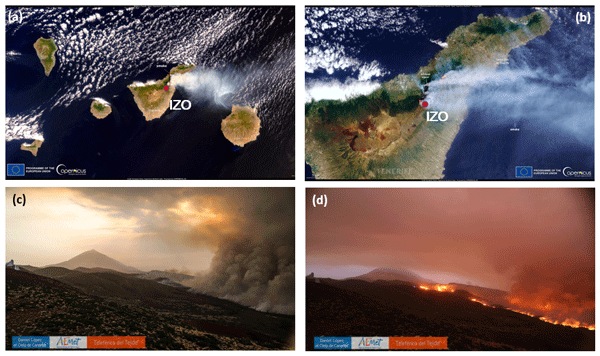
While Figure 1 provides a visual overview, more quantitative detail is needed regarding the meteorological conditions and the spatial relationship between the fire and the instruments.Meteorological Context: Please provide more specific synoptic or local meteorological data during the wildfire peaks. While the text mentions a heatwave and low humidity, a brief discussion or a supplementary panel showing wind direction/speed at the observatory level would better contextualize the plume's arrival.
Plume Proximity: The manuscript states the fire occurred "only a few metres" from the spectroradiometer. Please provide a more precise estimate of the distance to the active fire front during the 17–18 August peak to support the "near-source" characterization.
Plume Height: You mention that the fresh smoke layer extended up to 4 km a.s.l. based on lidar observations. Given that the Izaña Observatory is located at 2400 m a.s.l., please explicitly discuss the fact that the observatory was effectively immersed within the smoke plume. This is crucial for interpreting the extremely high surface concentrations.2. Clarification of Measurement Levels (Sections 2.3.3, 2.3.4, and 2.3.5)
It should be explicitly stated in the headings or introductory sentences of these sections that the TEOM , MAAP , and Integrating Nephelometer measurements represent ground-level (in-situ) concentrations at the observatory.
These surface-level observations should be discussed in direct relation to the plume height mentioned earlier (4 km a.s.l.) to clarify that these are not column-integrated values but point measurements within the plume layer.
3. AERONET Data and Retrieval Limitations (Lines 116–121)
Data Levels: The manuscript clarifies that Level 2.0 data was used for 17 August, but Level 1.0 was required for 18 August because the extreme aerosol load was misclassified as clouds by the AERONET algorithm. This has been done to other studies as well, when we "know" that the cloud flaggin is off. But some discussion on the uncertainties introduced by this choice should be provided.Methodological Limitations: Please expand the discussion on the limitations of AERONET retrievals during such extreme events. Specifically, how does the use of Level 1.0 data (without final calibration or full quality control) impact the uncertainty of the AOD and AE values presented in Table 1?
Cloud Flagging: Could you specify if the Level 1.0 data points used were those specifically flagged as "cloudy" in the standard Version 3 algorithm? Confirming that these "clouds" were actually the dense wildfire plume would strengthen the justification for using Level 1.0 data.
4. Inversion Products and SSA Hypothesis
The authors state that inversion products (SSA and asymmetry parameter) were unavailable due to insufficient data , which is very reasonable given the non homogenity of the skies during the event.
Since spectral Single Scattering Albedo (SSA) significantly influences the final radiative effect, please discuss in detail the specific hypotheses or fixed values used for these parameters in your radiative transfer simulations.
A sensitivity analysis or a comparison with literature-based SSA values for fresh biomass-burning smoke (e.g., from the referenced 2021 Greece fires ) would add robustness to the radiative forcing calculations.
Citation: https://doi.org/10.5194/egusphere-2026-306-RC2 - AC2: 'Reply on RC2', García Cabrera Rosa Delia, 18 Mar 2026
Peer review completion


Interactive discussion
Status: closed
-
RC1: 'Comment on egusphere-2026-306', Anonymous Referee #1, 23 Feb 2026
Reviewer comment on egusphere-2026-306 “Impact of Spectral Aerosol Radiative Forcing at the Izaña Observatory during the August 2023 Extreme Wildfires” by Garcia et a.
Reviewer recommendation: Accept with minor revisions
General comment:
The study by Garcia et al. captures a rare near-source wildfire event at a well-instrumented high-altitude observatory, providing valuable spectral radiative forcing data that is scarce in the literature. Du to the wide range of columnar, vertical, is situ aerosol and trace gas instrument at the Izaña Observatory (IZO) it is a comprehensive multi-instrument approach with rigorous methodology and significant results.
Specific comments
Missing aerosol absorption properties: The authors note (line 122) that AERONET inversion products (SSA, asymmetry parameter) were unavailable. This is a significant limitation since: SSA is crucial for distinguishing scattering vs. absorption effects. Without SSA, the conclusion that "scattering processes" dominate relies primarily on the positive diffuse forcing rather than direct measurement. Recommendation: Discuss this limitation more explicitly and consider whether MAAP absorption data could partially compensate
Limited temporal coverage: Analysis mostly focuses on two specific times (11:56 and 15:46 UTC). While understandable for detailed spectral analysis, a diurnal evolution of radiative forcing would strengthen the analysis. Recommendation: Consider adding a figure showing temporal evolution of integrated radiative forcing throughout the two days
The comparison between 17 and 18 August would probably benefit from an analysis of measurement variability during each event.
Minor comments:
- Date/Time format: format of date/time varies between figures (e.g. Fig. 3 and 4), consider aligning the format
- Add one or two more wildfire studies and the values mentioned therein?
- Line 100: “at the 4th position the shadow band stops at +5° after the solar disk" - Should this be "beyond" rather than "after"?
- Line 222 and 232 – reference to Masoom seems somewhat repetitive, maybe add FMF value of Masoom to increase information value of second mention.
- Table 1 and lines 259/260: The PM2.5/PM10 ratio shows 0.81 for 17/08 and 0.66 for 18/08, but text (line 260) states "0.83 and 0.69", why is that?
- Reference list: several times doi link wrong format: “https://doi.org/https://doi.org..” (remove one https://doi.org)
Overall Assessment:
This is a valuable contribution documenting an extreme biomass burning event with rare spectral detail. The main scientific conclusions are sound, but the paper would benefit from a clearer discussion of limitations, particularly regarding missing SSA data. The multi-instrument approach is a major strength that validates the findings across independent measurement techniques. With the revisions outlined above the manuscript should be suitable for publication.
Citation: https://doi.org/10.5194/egusphere-2026-306-RC1 - AC1: 'Reply on RC1', García Cabrera Rosa Delia, 18 Mar 2026
-
RC2: 'Comment on egusphere-2026-306', Anonymous Referee #2, 06 Mar 2026
The manuscript “Impact of Spectral Aerosol Radiative Forcing at the Izaña Observatory during the August 2023 Extreme Wildfires” is clearly within the scope of the AMT/ACP inter-journal Special Issue “Sun-photometric measurements of aerosols: harmonization, comparisons, synergies, effects, and applications”. The study makes extensive and appropriate use of sun-photometric observations (AERONET), complemented by high-quality spectral irradiance measurements and multi-instrumental aerosol and trace-gas observations.The scientific objective is well defined and addresses a timely and relevant topic: the spectral radiative effects of extreme biomass-burning aerosols under near-source conditions. The dataset is unique, the methodology is sound, and the analysis is thorough. The use of spectral irradiance measurements combined with radiative transfer simulations to quantify spectral radiative forcing and efficiency represents a valuable contribution to the existing literature, particularly given the scarcity of such detailed spectral studies. The structure is clear, the instrumentation and methods are well described, and the results are supported by comprehensive observational evidence. Studies of this kind are valuable as we are trying to demystify the radiative effect of wildfires on climate processes, and it is very rare to be able to have such extensive data of different types and instruments so close to the source of emmissions.
I suggest to accept the manuscript for publication after the following minor revisions:1. Meteorological and Plume Characterization
While Figure 1 provides a visual overview, more quantitative detail is needed regarding the meteorological conditions and the spatial relationship between the fire and the instruments.Meteorological Context: Please provide more specific synoptic or local meteorological data during the wildfire peaks. While the text mentions a heatwave and low humidity, a brief discussion or a supplementary panel showing wind direction/speed at the observatory level would better contextualize the plume's arrival.
Plume Proximity: The manuscript states the fire occurred "only a few metres" from the spectroradiometer. Please provide a more precise estimate of the distance to the active fire front during the 17–18 August peak to support the "near-source" characterization.
Plume Height: You mention that the fresh smoke layer extended up to 4 km a.s.l. based on lidar observations. Given that the Izaña Observatory is located at 2400 m a.s.l., please explicitly discuss the fact that the observatory was effectively immersed within the smoke plume. This is crucial for interpreting the extremely high surface concentrations.2. Clarification of Measurement Levels (Sections 2.3.3, 2.3.4, and 2.3.5)
It should be explicitly stated in the headings or introductory sentences of these sections that the TEOM , MAAP , and Integrating Nephelometer measurements represent ground-level (in-situ) concentrations at the observatory.
These surface-level observations should be discussed in direct relation to the plume height mentioned earlier (4 km a.s.l.) to clarify that these are not column-integrated values but point measurements within the plume layer.
3. AERONET Data and Retrieval Limitations (Lines 116–121)
Data Levels: The manuscript clarifies that Level 2.0 data was used for 17 August, but Level 1.0 was required for 18 August because the extreme aerosol load was misclassified as clouds by the AERONET algorithm. This has been done to other studies as well, when we "know" that the cloud flaggin is off. But some discussion on the uncertainties introduced by this choice should be provided.Methodological Limitations: Please expand the discussion on the limitations of AERONET retrievals during such extreme events. Specifically, how does the use of Level 1.0 data (without final calibration or full quality control) impact the uncertainty of the AOD and AE values presented in Table 1?
Cloud Flagging: Could you specify if the Level 1.0 data points used were those specifically flagged as "cloudy" in the standard Version 3 algorithm? Confirming that these "clouds" were actually the dense wildfire plume would strengthen the justification for using Level 1.0 data.
4. Inversion Products and SSA Hypothesis
The authors state that inversion products (SSA and asymmetry parameter) were unavailable due to insufficient data , which is very reasonable given the non homogenity of the skies during the event.
Since spectral Single Scattering Albedo (SSA) significantly influences the final radiative effect, please discuss in detail the specific hypotheses or fixed values used for these parameters in your radiative transfer simulations.
A sensitivity analysis or a comparison with literature-based SSA values for fresh biomass-burning smoke (e.g., from the referenced 2021 Greece fires ) would add robustness to the radiative forcing calculations.
Citation: https://doi.org/10.5194/egusphere-2026-306-RC2 - AC2: 'Reply on RC2', García Cabrera Rosa Delia, 18 Mar 2026
Peer review completion
Journal article(s) based on this preprint
Viewed
| HTML | XML | Total | BibTeX | EndNote | |
|---|---|---|---|---|---|
| 1,407 | 701 | 159 | 2,267 | 162 | 220 |
- HTML: 1,407
- PDF: 701
- XML: 159
- Total: 2,267
- BibTeX: 162
- EndNote: 220
Viewed (geographical distribution)
| Country | # | Views | % |
|---|
| Total: | 0 |
| HTML: | 0 |
| PDF: | 0 |
| XML: | 0 |
- 1
Rosa D. García
África Barreto

Victoria E. Cachorro
Pablo González-Sicilia
Sergio León-Luis
Ayoze Alvárez-Hernández
Juan José Bustos
Ramón Ramos
Fernando Almansa
Óscar Álvarez-Losada
Yenny González
Pedro Pablo Rivas
Carlos Javier Torres
The requested preprint has a corresponding peer-reviewed final revised paper. You are encouraged to refer to the final revised version.
- Preprint
(9041 KB) - Metadata XML