
the Creative Commons Attribution 4.0 License.
the Creative Commons Attribution 4.0 License.
 | 16 Jun 2026
Polythermal conditions in small glaciers in the Swiss Alps
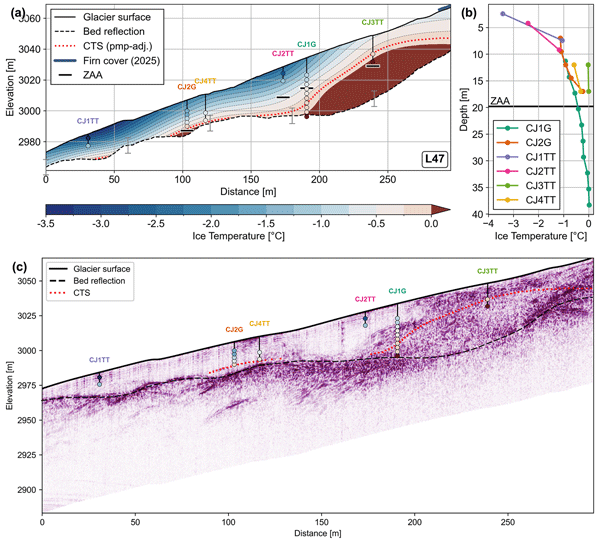
Abstract. Englacial temperature measurements in the Alps remain sparse and biased toward high-elevation accumulation areas, leaving the thermal state of ablation zones poorly constrained. Here, we present borehole thermometry and ground-penetrating radar surveys from six small Swiss glaciers (< 0.5 km², 2700–3800 m a.s.l.). Polythermal conditions are confirmed in three glaciers, with the cold-temperate transition surface at depths of 17–38 m and ice temperatures ranging from temperate to −2.1 °C. A fourth site, Glacier du Sex Rouge, likely retains its historically documented polythermal structure, but borehole measurements were limited to the near-surface cold layer and do not reach the temperate ice below. A consistent spatial pattern emerges, with temperate ice at higher elevations transitioning into fully or partially cold-based glacier termini. Ground-penetrating radar retrievals are generally consistent with borehole-derived thermal conditions, with low scattering in cold ice and enhanced scattering in temperate zones. The observed thermal structures are closely linked to the history of firn cover loss, reconstructed from long-term mass balance records, with sites that lost their firn cover earliest showing the most advanced cooling. Our findings suggest that polythermal conditions among small Alpine glaciers may be more widespread than previously recognised, with important implications for glacial hazard assessments and highlighting the need for systematic regional-scale thermal observations and modelling.
Competing interests: At least one of the (co-)authors is a member of the editorial board of The Cryosphere. The peer-review process was guided by an independent editor, and the authors also have no other competing interests to declare.
Publisher's note: Copernicus Publications remains neutral with regard to jurisdictional claims made in the text, published maps, institutional affiliations, or any other geographical representation in this paper. While Copernicus Publications makes every effort to include appropriate place names, the final responsibility lies with the authors. Views expressed in the text are those of the authors and do not necessarily reflect the views of the publisher.-
Notice on discussion status
The requested preprint has a corresponding peer-reviewed final revised paper. You are encouraged to refer to the final revised version.
-
Preprint
(10557 KB)
-
Supplement
(11745 KB)
-
The requested preprint has a corresponding peer-reviewed final revised paper. You are encouraged to refer to the final revised version.
- Preprint
(10557 KB) - Metadata XML
-
Supplement
(11745 KB) - BibTeX
- EndNote
- Final revised paper


Journal article(s) based on this preprint
Interactive discussion
Status: closed
-
RC1: 'Comment on egusphere-2026-3042', Marcus Gastaldello, 25 Jun 2026
The comment was uploaded in the form of a supplement: https://egusphere.copernicus.org/preprints/2026/egusphere-2026-3042/egusphere-2026-3042-RC1-supplement.zipCitation: https://doi.org/
10.5194/egusphere-2026-3042-RC1 -
AC1: 'Reply on RC1', Janosch Beer, 27 Aug 2026
Dear Dr. Caroline Clason & reviewer 1,We thank you for the detailed and constructive review. We believe the revisions prompted by your comments have substantially strengthened our manuscript. Our point-by-point response is provided in the attached document, giving our reply to each comment together with the corresponding change made in the manuscript. The revised manuscript, supplement, and a marked-up (latexdiff) version will follow with the formal revision as soon as the discussion stage has closed.On behalf of all co-authors,Janosch Beer
-
AC1: 'Reply on RC1', Janosch Beer, 27 Aug 2026
-
RC2: 'Comment on egusphere-2026-3042', Anonymous Referee #2, 30 Jun 2026
-
AC2: 'Reply on RC2', Janosch Beer, 27 Aug 2026
Dear Dr. Caroline Clason & referee 2,We thank you for the thorough and constructive review. We believe the revisions prompted by your comments have substantially strengthened our manuscript. Our point-by-point response is provided in the attached document, giving our reply to each comment together with the corresponding change made in the manuscript. The revised manuscript, supplement, and a marked-up (latexdiff) version will follow with the formal revision once the discussion stage has closed.On behalf of all co-authors,Janosch Beer
-
AC2: 'Reply on RC2', Janosch Beer, 27 Aug 2026
Peer review completion


Interactive discussion
Status: closed
-
RC1: 'Comment on egusphere-2026-3042', Marcus Gastaldello, 25 Jun 2026
The comment was uploaded in the form of a supplement: https://egusphere.copernicus.org/preprints/2026/egusphere-2026-3042/egusphere-2026-3042-RC1-supplement.zip
-
AC1: 'Reply on RC1', Janosch Beer, 27 Aug 2026
Dear Dr. Caroline Clason & reviewer 1,We thank you for the detailed and constructive review. We believe the revisions prompted by your comments have substantially strengthened our manuscript. Our point-by-point response is provided in the attached document, giving our reply to each comment together with the corresponding change made in the manuscript. The revised manuscript, supplement, and a marked-up (latexdiff) version will follow with the formal revision as soon as the discussion stage has closed.On behalf of all co-authors,Janosch Beer
-
AC1: 'Reply on RC1', Janosch Beer, 27 Aug 2026
-
RC2: 'Comment on egusphere-2026-3042', Anonymous Referee #2, 30 Jun 2026
-
AC2: 'Reply on RC2', Janosch Beer, 27 Aug 2026
Dear Dr. Caroline Clason & referee 2,We thank you for the thorough and constructive review. We believe the revisions prompted by your comments have substantially strengthened our manuscript. Our point-by-point response is provided in the attached document, giving our reply to each comment together with the corresponding change made in the manuscript. The revised manuscript, supplement, and a marked-up (latexdiff) version will follow with the formal revision once the discussion stage has closed.On behalf of all co-authors,Janosch Beer
-
AC2: 'Reply on RC2', Janosch Beer, 27 Aug 2026
Peer review completion
Journal article(s) based on this preprint
Viewed
| HTML | XML | Total | Supplement | BibTeX | EndNote | |
|---|---|---|---|---|---|---|
| 176 | 106 | 28 | 310 | 64 | 19 | 19 |
- HTML: 176
- PDF: 106
- XML: 28
- Total: 310
- Supplement: 64
- BibTeX: 19
- EndNote: 19
Viewed (geographical distribution)
| Country | # | Views | % |
|---|
| Total: | 0 |
| HTML: | 0 |
| PDF: | 0 |
| XML: | 0 |
- 1

Mylène Jacquemart
Matthias Huss
Ilaria Santin
Gabriela Clara Racz
Christophe Ogier
Saskia Gindraux
Leo Hösli
Raphael Moser
James Irving
Mauro Fischer
Daniel Farinotti
The requested preprint has a corresponding peer-reviewed final revised paper. You are encouraged to refer to the final revised version.
- Preprint
(10557 KB) - Metadata XML
-
Supplement
(11745 KB) - BibTeX
- EndNote
- Final revised paper