
the Creative Commons Attribution 4.0 License.
the Creative Commons Attribution 4.0 License.
 | 11 Jun 2026
Ionospheric currents and auroral signatures during successive earthward bursty bulk flows and dipolarization: a 7 December 2023 case study
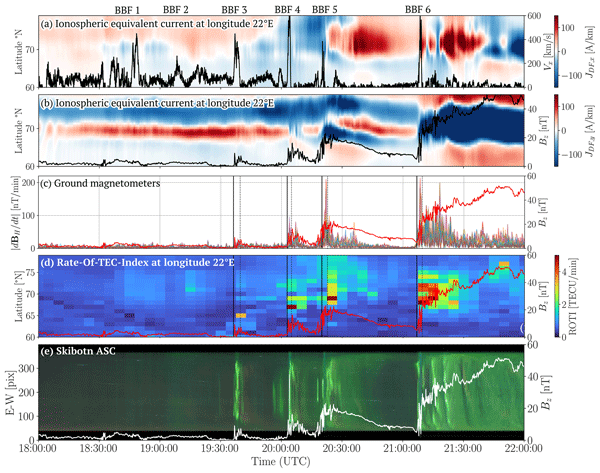
Abstract. The Sun continuously sends plasma and magnetic fields toward Earth, loading the nightside magnetosphere (the magnetotail) with energy and momentum in its stretched magnetic field lines. Under certain conditions this stored energy is suddenly released, producing fast streams of plasma that travel from the magnetotail toward Earth and interact with the ionized upper atmosphere (the ionosphere) through electric currents. On 7 December 2023, six such fast plasma flows were detected by a spacecraft in the magnetotail. By tracing the magnetic field lines, we estimated where each flow connected to the ionosphere. Using ground‑based magnetometers, auroral images, and satellite measurements, we examined how the ionosphere responded to each flow. We show that the repeated impacts of these flows gradually altered the ionospheric current system and auroral activity, ultimately leading to the onset of a substorm.
-
Notice on discussion status
The requested preprint has a corresponding peer-reviewed final revised paper. You are encouraged to refer to the final revised version.
-
Preprint
(42097 KB)
-
The requested preprint has a corresponding peer-reviewed final revised paper. You are encouraged to refer to the final revised version.
- Preprint
(42097 KB) - Metadata XML
- BibTeX
- EndNote
- Final revised paper


Journal article(s) based on this preprint
Interactive discussion
Status: closed
-
RC1: 'Comment on egusphere-2026-2997', Anonymous Referee #1, 25 Jun 2026
-
AC1: 'Reply on RC1', Vanina Lanabere, 20 Jul 2026
The comment was uploaded in the form of a supplement: https://egusphere.copernicus.org/preprints/2026/egusphere-2026-2997/egusphere-2026-2997-AC1-supplement.pdf
-
RC3: 'Reply on AC1', Anonymous Referee #1, 22 Jul 2026
The reviewer thanks the authors for their revisions to the manuscript. The reviewer recommends publication with these revisions.
Citation: https://doi.org/10.5194/egusphere-2026-2997-RC3 -
AC3: 'Reply on RC3', Vanina Lanabere, 27 Jul 2026
We thank the referee for this positive assessment. The corrections described in our response will be incorporated into the revised manuscript once we are asked to submit a revised version.
Citation: https://doi.org/10.5194/egusphere-2026-2997-AC3
-
AC3: 'Reply on RC3', Vanina Lanabere, 27 Jul 2026
-
RC3: 'Reply on AC1', Anonymous Referee #1, 22 Jul 2026
-
AC1: 'Reply on RC1', Vanina Lanabere, 20 Jul 2026
-
RC2: 'Comment on egusphere-2026-2997', Anonymous Referee #2, 10 Jul 2026
Review of ‘Ionospheric currents and auroral signatures during successive earthward bursty bulk flows and dipolarization: a 7 December 2023 case study’ by Vanina Lanabere et al.
The paper presents auroral and equivalent ionospheric current observations, which were conjugate to 6 sequential bursty bulk flows (BBFs), detected in the nightside magnetotail transition region by three THEMIS spacecraft. This interval is interesting as it allowed to see ionospheric feedback to magnetotail BBFs related to expansions of weak substorms. For one of the intervals, field-aligned currents from the three SWARM spacecraft were available (Fig. 9), which allowed to evaluate the impact for the space weather/induced currents. Overall, this is a nicely compiled report with illuminating auroral observations, which fits the scope of Annales Geophysicae, and could be published after minor revisions. Publishing such material is important, as despite there are many available ground auroral observations and many in situ BBF observations, the number of conjugate observations is still very far from a critical amount that is necessary to understand the coupling between the magnetotail processes and their ionospheric footprints. I list my minor comments below.
- The paper does not cite a number of original conjugate BBF-aurora observations. Particularly citations to
- Nakamura, , W. Baumjohann, R. Schödel, M. Brittnacher, V. A. Sergeev, M. Kubyshkina, T. Mukai, and K. Liou (2001), Earthward flow bursts, auroral streamers, and small expansions, J. Geophys. Res., 106(A6), 10791–10802, doi:10.1029/2000JA000306 and to
- Borodkova, N. L., Yahnin, A. G., Liou, K., Sauvaud, J.-A., Fedorov, A. O., Lutsenko, V. N., Nozdrachev, M. N., and Lyubchich, A. A.: Plasma sheet fast flows and auroral dynamics during substorm: a case study, Ann. Geophys., 20, 341–347, https://doi.org/10.5194/angeo-20-341-2002, 2002
are missing.
- Also, citing the review Kepko, L., McPherron, R.L., Amm, O. et al. Substorm Current Wedge Revisited. Space Sci Rev 190, 1–46 (2015). https://doi.org/10.1007/s11214-014-0124-9 would be very appropriate.
- Line 24: Please add the following citation after ‘dipolarization’: Baumjohann, W., Hesse, M., Kokubun, S., Mukai, T., Nagai, T., & Petrukovich, A. A. (1999). Substorm dipolarization and recovery. Journal of Geophysical Research, 104, 24,995–25,000. https://doi.org/10.1029/1999JA900282
- Line 24: Please add the following citation after ‘expansion phase’: Merkin, G., Panov, E. V., Sorathia, K., & Ukhorskiy, A. Y. (2019). Contribution of bursty bulk flows to the global dipolarization of the magnetotail during an isolated substorm. Journal of Geophysical Research: Space Physics, 124, 8647–8668. https://doi.org/10.1029/2019JA026872
- Lines 36-38: Lui et al, 2015 are not the ones who suggested this, but those who found evidence for this using magnetotail observations, following the original idea of Birn and Hesse 2013, 2014.
Birn, J., and M. Hesse (2013), The substorm current wedge in MHD simulations, J. Geophys. Res. Space Physics, 118, 3364–3376, doi:10.1002/jgra.50187.
Birn, J., & Hesse, M. (2014). The substorm current wedge: Further insights from MHD simulations. Journal of Geophysical Research: Space Physics, 119, 3503–3513. https://doi.org/10.1002/2014JA019863
Please correct.
- Line 44: Please add citation to
Panov, E. V., Baumjohann, W., Nakamura, R., Weygand, J. M., Giles, B. L., Russell, C. T., et al. (2019). Continent-wide R1/R2 current system and ohmic losses by broad dipolarization-injection fronts. Journal of Geophysical Research: Space Physics, 124, 4064–4082. https://doi.org/10.1029/2019JA026521
in the end of the sentence (after ‘single SCW’).
- Table 1 and the text below it: The present paper is not a statistical paper. It is not clear to me why this information is included in the paper. Table 1 and the corresponding text could easily be removed or minimized.
- Sections 2.2-2.4 look too detailed to me, and could be compressed to make the paper more elegant. I do not insist though.
- Lines 182 and 184: the text about two features repeats and looks confusing. Please rewrite.
- Lines 217-230: I do not see the need for this text, as the present paper is a case study paper.
- Figure 9: Times in panels b1-b10 are hardly visible. Please increase the font.
- Line 590: Though this paper may be the first presenting an auroral feedback to six sequential BBFs, there were previous reports with conjugate THEMIS-ASI-SECS data presented, during weak substorm intervals:
Keiling, A., et al. (2009), Substorm current wedge driven by plasma flow vortices: THEMIS observations, J. Geophys. Res., 114, A00C22, doi:10.1029/2009JA014114 and
Panov E. V., W. Baumjohann, R. Nakamura, O. Amm, M. V. Kubyshkina, K.-H. Glassmeier, J. M. Weygand, V. Angelopoulos, A. A. Petrukovich, and V. A. Sergeev (2013), Ionospheric response to oscillatory flow braking in the magnetotail, J. Geophys. Res. Space Physics, 118, 1529–1544, doi:10.1002/jgra.50190 reported on further peculiarities in connection between ionospheric auroral activations and magnetotail BBFs, where BBFs were related to the vortices in SECS.
In turn, Panov, E., Baumjohann, W., Wolf, R. et al. Magnetotail energy dissipation during an auroral substorm. Nature Phys 12, 1158–1163 (2016). https://doi.org/10.1038/nphys3879 , connected auroral northward expansion and subsequent equatorward retreat to the global magnetotail dipolarization and its subsequent restretching.
In the three above papers, consistently with the text in Line 578, auroral feedback of BBFs is not specifically associated with auroral streamers, but with a more complex auroral behavoiur. This is actually not surprising, as THEMIS were in the BBF breaking region:
Baumjohann, W., Hesse, M., Kokubun, S., Mukai, T., Nagai, T., & Petrukovich, A. A. (1999). Substorm dipolarization and recovery. Journal of Geophysical Research, 104, 24,995–25,000. https://doi.org/10.1029/1999JA900282
Shiokawa, K., Baumjohann, W., & Haerendel, G. (1997). Braking of high-speed flows in the near-Earth tail. Geophysical Research Letters, 24, 1179–1182. https://doi.org/10.1029/97GL01062 .
Please add this discussion to the paper using the above references.
Citation: https://doi.org/10.5194/egusphere-2026-2997-RC2 -
AC2: 'Reply on RC2', Vanina Lanabere, 20 Jul 2026
The comment was uploaded in the form of a supplement: https://egusphere.copernicus.org/preprints/2026/egusphere-2026-2997/egusphere-2026-2997-AC2-supplement.pdf
-
RC4: 'Reply on AC2', Anonymous Referee #2, 23 Jul 2026
I have read the proposed amendments and am fine with them. I thank the authors for the reply and recommend publication of the paper.
Citation: https://doi.org/10.5194/egusphere-2026-2997-RC4 -
AC4: 'Reply on RC4', Vanina Lanabere, 27 Jul 2026
We thank the referee for this positive assessment. The corrections described in our response will be incorporated into the revised manuscript once we are asked to submit a revised version.
Citation: https://doi.org/10.5194/egusphere-2026-2997-AC4
-
AC4: 'Reply on RC4', Vanina Lanabere, 27 Jul 2026
-
RC4: 'Reply on AC2', Anonymous Referee #2, 23 Jul 2026
Peer review completion


Post-review adjustments


Interactive discussion
Status: closed
-
RC1: 'Comment on egusphere-2026-2997', Anonymous Referee #1, 25 Jun 2026
General comments:
The manuscript provides detailed case studies of 4 bursty bulk flow events occurring on December 7, 2023 in order to determine the magnetotail-ionosphere coupling during these events and the space weather impacts of these events. The authors examine horizontal ionospheric currents, all-sky camera data, plasma measurements from THEMIS and Swarm, and ground magnetometer data from these intervals. They conclude that BBFs correspond to regions of counterclockwise vorticity and enhanced auroral activity in the ionosphere, highly localized alternating FAC structures, magnetotail dipolarizations, and ground magnetic disturbances that have the potential to drive GIC events. This manuscript is a valuable contribution to the field and this reviewer recommends publication following minor revisions to improve the clarity of the manuscript.
Figure corrections:
Figure 1: Since this figure is referred to later in the manuscript to discuss By during BBF intervals in line 242, the reviewer recommends labeling the dots in panel d with the number of the relevant BBF interval.
Figure 2: The authors may consider separating panel d into one panel for AU/AL and one panel for SYM-H, since the two sets of parameters are determined differently and measure different kinds of activity.
Figure 2 caption: “no time-shifted” → “no time-shift”
Figure 4: The inclusion of the BBF footpoints estimated from the Tsyganenko models make it difficult to identify the ground stations, centroid etc. and are already described in the text and included in later figures. The reviewer recommends removing these footpoints from this figure or including them as a separate figure in an appendix.
Figures 5-8, panels a: The BBF footpoint centroid is difficult to see in panels a in Figures 5-8 and could be made bigger. The Tsyganenko footpoints are not referred to in the text and not included in panels b in Figure 5. The reviewer recommends removing these footpoints from all Figures 5-8 or including the footpoints in Figure 5 panels b.
Figure 11, panels a-d: It is extremely hard to see the BBF centroid and footpoints in these figures and the reviewer recommends making these bigger.
Figure 12: It could be helpful to include reference lines for the BBF events discussed in the text.
Technical corrections:
Line 189: It looks like the IMF clock angle changes closer to 18:00 UT.
Line 226: Since the THEMIS-D BBF detection is not included in Figure 3 but is discussed in the text, it would be good to include in the figure or mention the time span of the BBF in the text.
Line 232: “throughout the interval” → “throughout the intervals”
Line 379: Do the authors mean to refer to panel a3?
Line 406: Do the authors mean to refer to panels c and d where THEMIS D Bz is labeled?
Line 445: The reviewer believes the authors should be referring to 20:03:28 instead of 20:23:28.
Table 2 caption: “SuperMag” → “SuperMAG”
Line 462: “SuperMag” → “SuperMAG”
Line 546: The reviewer believes the authors mean that the largest perturbation occurs during Interval 6, while Interval 5 produced a comparable peak.
Citation: https://doi.org/10.5194/egusphere-2026-2997-RC1 -
AC1: 'Reply on RC1', Vanina Lanabere, 20 Jul 2026
The comment was uploaded in the form of a supplement: https://egusphere.copernicus.org/preprints/2026/egusphere-2026-2997/egusphere-2026-2997-AC1-supplement.pdf
-
RC3: 'Reply on AC1', Anonymous Referee #1, 22 Jul 2026
The reviewer thanks the authors for their revisions to the manuscript. The reviewer recommends publication with these revisions.
Citation: https://doi.org/10.5194/egusphere-2026-2997-RC3 -
AC3: 'Reply on RC3', Vanina Lanabere, 27 Jul 2026
We thank the referee for this positive assessment. The corrections described in our response will be incorporated into the revised manuscript once we are asked to submit a revised version.
Citation: https://doi.org/10.5194/egusphere-2026-2997-AC3
-
AC3: 'Reply on RC3', Vanina Lanabere, 27 Jul 2026
-
RC3: 'Reply on AC1', Anonymous Referee #1, 22 Jul 2026
-
AC1: 'Reply on RC1', Vanina Lanabere, 20 Jul 2026
-
RC2: 'Comment on egusphere-2026-2997', Anonymous Referee #2, 10 Jul 2026
Review of ‘Ionospheric currents and auroral signatures during successive earthward bursty bulk flows and dipolarization: a 7 December 2023 case study’ by Vanina Lanabere et al.
The paper presents auroral and equivalent ionospheric current observations, which were conjugate to 6 sequential bursty bulk flows (BBFs), detected in the nightside magnetotail transition region by three THEMIS spacecraft. This interval is interesting as it allowed to see ionospheric feedback to magnetotail BBFs related to expansions of weak substorms. For one of the intervals, field-aligned currents from the three SWARM spacecraft were available (Fig. 9), which allowed to evaluate the impact for the space weather/induced currents. Overall, this is a nicely compiled report with illuminating auroral observations, which fits the scope of Annales Geophysicae, and could be published after minor revisions. Publishing such material is important, as despite there are many available ground auroral observations and many in situ BBF observations, the number of conjugate observations is still very far from a critical amount that is necessary to understand the coupling between the magnetotail processes and their ionospheric footprints. I list my minor comments below.
- The paper does not cite a number of original conjugate BBF-aurora observations. Particularly citations to
- Nakamura, , W. Baumjohann, R. Schödel, M. Brittnacher, V. A. Sergeev, M. Kubyshkina, T. Mukai, and K. Liou (2001), Earthward flow bursts, auroral streamers, and small expansions, J. Geophys. Res., 106(A6), 10791–10802, doi:10.1029/2000JA000306 and to
- Borodkova, N. L., Yahnin, A. G., Liou, K., Sauvaud, J.-A., Fedorov, A. O., Lutsenko, V. N., Nozdrachev, M. N., and Lyubchich, A. A.: Plasma sheet fast flows and auroral dynamics during substorm: a case study, Ann. Geophys., 20, 341–347, https://doi.org/10.5194/angeo-20-341-2002, 2002
are missing.
- Also, citing the review Kepko, L., McPherron, R.L., Amm, O. et al. Substorm Current Wedge Revisited. Space Sci Rev 190, 1–46 (2015). https://doi.org/10.1007/s11214-014-0124-9 would be very appropriate.
- Line 24: Please add the following citation after ‘dipolarization’: Baumjohann, W., Hesse, M., Kokubun, S., Mukai, T., Nagai, T., & Petrukovich, A. A. (1999). Substorm dipolarization and recovery. Journal of Geophysical Research, 104, 24,995–25,000. https://doi.org/10.1029/1999JA900282
- Line 24: Please add the following citation after ‘expansion phase’: Merkin, G., Panov, E. V., Sorathia, K., & Ukhorskiy, A. Y. (2019). Contribution of bursty bulk flows to the global dipolarization of the magnetotail during an isolated substorm. Journal of Geophysical Research: Space Physics, 124, 8647–8668. https://doi.org/10.1029/2019JA026872
- Lines 36-38: Lui et al, 2015 are not the ones who suggested this, but those who found evidence for this using magnetotail observations, following the original idea of Birn and Hesse 2013, 2014.
Birn, J., and M. Hesse (2013), The substorm current wedge in MHD simulations, J. Geophys. Res. Space Physics, 118, 3364–3376, doi:10.1002/jgra.50187.
Birn, J., & Hesse, M. (2014). The substorm current wedge: Further insights from MHD simulations. Journal of Geophysical Research: Space Physics, 119, 3503–3513. https://doi.org/10.1002/2014JA019863
Please correct.
- Line 44: Please add citation to
Panov, E. V., Baumjohann, W., Nakamura, R., Weygand, J. M., Giles, B. L., Russell, C. T., et al. (2019). Continent-wide R1/R2 current system and ohmic losses by broad dipolarization-injection fronts. Journal of Geophysical Research: Space Physics, 124, 4064–4082. https://doi.org/10.1029/2019JA026521
in the end of the sentence (after ‘single SCW’).
- Table 1 and the text below it: The present paper is not a statistical paper. It is not clear to me why this information is included in the paper. Table 1 and the corresponding text could easily be removed or minimized.
- Sections 2.2-2.4 look too detailed to me, and could be compressed to make the paper more elegant. I do not insist though.
- Lines 182 and 184: the text about two features repeats and looks confusing. Please rewrite.
- Lines 217-230: I do not see the need for this text, as the present paper is a case study paper.
- Figure 9: Times in panels b1-b10 are hardly visible. Please increase the font.
- Line 590: Though this paper may be the first presenting an auroral feedback to six sequential BBFs, there were previous reports with conjugate THEMIS-ASI-SECS data presented, during weak substorm intervals:
Keiling, A., et al. (2009), Substorm current wedge driven by plasma flow vortices: THEMIS observations, J. Geophys. Res., 114, A00C22, doi:10.1029/2009JA014114 and
Panov E. V., W. Baumjohann, R. Nakamura, O. Amm, M. V. Kubyshkina, K.-H. Glassmeier, J. M. Weygand, V. Angelopoulos, A. A. Petrukovich, and V. A. Sergeev (2013), Ionospheric response to oscillatory flow braking in the magnetotail, J. Geophys. Res. Space Physics, 118, 1529–1544, doi:10.1002/jgra.50190 reported on further peculiarities in connection between ionospheric auroral activations and magnetotail BBFs, where BBFs were related to the vortices in SECS.
In turn, Panov, E., Baumjohann, W., Wolf, R. et al. Magnetotail energy dissipation during an auroral substorm. Nature Phys 12, 1158–1163 (2016). https://doi.org/10.1038/nphys3879 , connected auroral northward expansion and subsequent equatorward retreat to the global magnetotail dipolarization and its subsequent restretching.
In the three above papers, consistently with the text in Line 578, auroral feedback of BBFs is not specifically associated with auroral streamers, but with a more complex auroral behavoiur. This is actually not surprising, as THEMIS were in the BBF breaking region:
Baumjohann, W., Hesse, M., Kokubun, S., Mukai, T., Nagai, T., & Petrukovich, A. A. (1999). Substorm dipolarization and recovery. Journal of Geophysical Research, 104, 24,995–25,000. https://doi.org/10.1029/1999JA900282
Shiokawa, K., Baumjohann, W., & Haerendel, G. (1997). Braking of high-speed flows in the near-Earth tail. Geophysical Research Letters, 24, 1179–1182. https://doi.org/10.1029/97GL01062 .
Please add this discussion to the paper using the above references.
Citation: https://doi.org/10.5194/egusphere-2026-2997-RC2 -
AC2: 'Reply on RC2', Vanina Lanabere, 20 Jul 2026
The comment was uploaded in the form of a supplement: https://egusphere.copernicus.org/preprints/2026/egusphere-2026-2997/egusphere-2026-2997-AC2-supplement.pdf
-
RC4: 'Reply on AC2', Anonymous Referee #2, 23 Jul 2026
I have read the proposed amendments and am fine with them. I thank the authors for the reply and recommend publication of the paper.
Citation: https://doi.org/10.5194/egusphere-2026-2997-RC4 -
AC4: 'Reply on RC4', Vanina Lanabere, 27 Jul 2026
We thank the referee for this positive assessment. The corrections described in our response will be incorporated into the revised manuscript once we are asked to submit a revised version.
Citation: https://doi.org/10.5194/egusphere-2026-2997-AC4
-
AC4: 'Reply on RC4', Vanina Lanabere, 27 Jul 2026
-
RC4: 'Reply on AC2', Anonymous Referee #2, 23 Jul 2026
Peer review completion
Post-review adjustments
Journal article(s) based on this preprint
Video supplement
Ionospheric currents and auroral signatures during successive earthward bursty bulk flows and dipolarization: a 7 December 2023 case study Lanabere, Vanina https://doi.org/10.5446/73085
Viewed
| HTML | XML | Total | BibTeX | EndNote | |
|---|---|---|---|---|---|
| 276 | 120 | 36 | 432 | 21 | 21 |
- HTML: 276
- PDF: 120
- XML: 36
- Total: 432
- BibTeX: 21
- EndNote: 21
Viewed (geographical distribution)
| Country | # | Views | % |
|---|
| Total: | 0 |
| HTML: | 0 |
| PDF: | 0 |
| XML: | 0 |
- 1
Vanina Lanabere

Stephan Buchert
Adrian Blagau
Harriet George
Sota Nanjo
Liisa Juusola
Andrew P. Dimmock
Samuel Wharton
Heikki Vanhamäki
Octav Marghitu
Louis Richard
Alice V. L. Wallner
Daria Kotova
Theresa Hoppe
Jennifer A. Carter
Anita Aikio
The requested preprint has a corresponding peer-reviewed final revised paper. You are encouraged to refer to the final revised version.
- Preprint
(42097 KB) - Metadata XML
General comments:
The manuscript provides detailed case studies of 4 bursty bulk flow events occurring on December 7, 2023 in order to determine the magnetotail-ionosphere coupling during these events and the space weather impacts of these events. The authors examine horizontal ionospheric currents, all-sky camera data, plasma measurements from THEMIS and Swarm, and ground magnetometer data from these intervals. They conclude that BBFs correspond to regions of counterclockwise vorticity and enhanced auroral activity in the ionosphere, highly localized alternating FAC structures, magnetotail dipolarizations, and ground magnetic disturbances that have the potential to drive GIC events. This manuscript is a valuable contribution to the field and this reviewer recommends publication following minor revisions to improve the clarity of the manuscript.
Figure corrections:
Figure 1: Since this figure is referred to later in the manuscript to discuss By during BBF intervals in line 242, the reviewer recommends labeling the dots in panel d with the number of the relevant BBF interval.
Figure 2: The authors may consider separating panel d into one panel for AU/AL and one panel for SYM-H, since the two sets of parameters are determined differently and measure different kinds of activity.
Figure 2 caption: “no time-shifted” → “no time-shift”
Figure 4: The inclusion of the BBF footpoints estimated from the Tsyganenko models make it difficult to identify the ground stations, centroid etc. and are already described in the text and included in later figures. The reviewer recommends removing these footpoints from this figure or including them as a separate figure in an appendix.
Figures 5-8, panels a: The BBF footpoint centroid is difficult to see in panels a in Figures 5-8 and could be made bigger. The Tsyganenko footpoints are not referred to in the text and not included in panels b in Figure 5. The reviewer recommends removing these footpoints from all Figures 5-8 or including the footpoints in Figure 5 panels b.
Figure 11, panels a-d: It is extremely hard to see the BBF centroid and footpoints in these figures and the reviewer recommends making these bigger.
Figure 12: It could be helpful to include reference lines for the BBF events discussed in the text.
Technical corrections:
Line 189: It looks like the IMF clock angle changes closer to 18:00 UT.
Line 226: Since the THEMIS-D BBF detection is not included in Figure 3 but is discussed in the text, it would be good to include in the figure or mention the time span of the BBF in the text.
Line 232: “throughout the interval” → “throughout the intervals”
Line 379: Do the authors mean to refer to panel a3?
Line 406: Do the authors mean to refer to panels c and d where THEMIS D Bz is labeled?
Line 445: The reviewer believes the authors should be referring to 20:03:28 instead of 20:23:28.
Table 2 caption: “SuperMag” → “SuperMAG”
Line 462: “SuperMag” → “SuperMAG”
Line 546: The reviewer believes the authors mean that the largest perturbation occurs during Interval 6, while Interval 5 produced a comparable peak.