
the Creative Commons Attribution 4.0 License.
the Creative Commons Attribution 4.0 License.
 | 02 Jun 2026
Aerosol–cloud interactions influence the climate response to AMOC weakening
Abstract. The Atlantic Meridional Overturning Circulation (AMOC) strongly influences regional climate, yet the response of atmospheric aerosols and aerosol-cloud interactions to its weakening remains largely unexplored. Using the ICON-HAM model, we investigate how a 60 % AMOC weakening affects aerosol distributions, cloud microphysics, and radiative budgets. The weakening of the AMOC drives a hemispheric aerosol redistribution through purely dynamical pathways, increasing the Northern Hemisphere aerosol burden by 5 % through enhanced Saharan dust emissions and extended aerosol lifetimes under suppressed wet deposition. Averaged over 40–90° N, these perturbations propagate into cloud properties via both liquid and ice-phase pathways. In-cloud droplet number concentrations increase by 8 % in warm clouds and 13 % in the mixed-phase regime. In the ice phase, enhanced dust ice-nucleating particles produce a 37 % increase in mixed-phase ice crystal number concentrations through multiple heterogeneous freezing pathways, promoting the Wegener-Bergeron-Findeisen process and reducing mixed-phase total water path by 8 %. The global-mean net cloud radiative effect (CRE) anomaly is +0.84 W m-2, acting as a negative feedback that partially offsets AMOC-induced cooling. A linear decomposition reveals that this positive CRE arises not from cloud loss, but from a reduction in the cooling efficiency of existing clouds, which more than offsets the enhanced cooling from increased cloud cover. Our findings demonstrate that aerosol-cloud interactions form an active component of the climate response to AMOC weakening, exposing a critical gap in simulations that rely on prescribed aerosol fields.
-
Notice on discussion status
The requested preprint has a corresponding peer-reviewed final revised paper. You are encouraged to refer to the final revised version.
-
Preprint
(7848 KB)
-
Supplement
(3464 KB)
-
The requested preprint has a corresponding peer-reviewed final revised paper. You are encouraged to refer to the final revised version.
- Preprint
(7848 KB) - Metadata XML
-
Supplement
(3464 KB) - BibTeX
- EndNote
- Final revised paper


Journal article(s) based on this preprint
Interactive discussion
Status: closed
-
RC1: 'Comment on egusphere-2026-2961', Anonymous Referee #1, 20 Jun 2026
-
AC1: 'Reply on RC1', Ryan Vella, 04 Sep 2026
The comment was uploaded in the form of a supplement: https://egusphere.copernicus.org/preprints/2026/egusphere-2026-2961/egusphere-2026-2961-AC1-supplement.pdf
-
AC1: 'Reply on RC1', Ryan Vella, 04 Sep 2026
-
RC2: 'Comment on egusphere-2026-2961', Anonymous Referee #2, 22 Jun 2026
This study identifies and addresses a compelling research gap: the role of aerosols for the cloud feedback response to AMOC weakening. In contrast to a positive shortwave cloud feedback response found in previous literature, this study finds a negative shortwave cloud feedback as a result of dust aerosol impacts on cloud optical depth. The writing and figures are generally clear, and the results are significant, particularly as they contrast with previous studies. My main concern is that the authors use CRE to evaluate the effect of cloud changes, which can alias in the effects of other changes like surface albedo and atmospheric water vapor and temperature. Below I suggest calculating cloud feedbacks instead, as well as clarifying some points of the experimental design, specifying why these results differ from the existing literature, and discussing the extent to which the results may change in a warmer, non-preindustrial background climate. Please find some additional suggestions below.
Main Comments
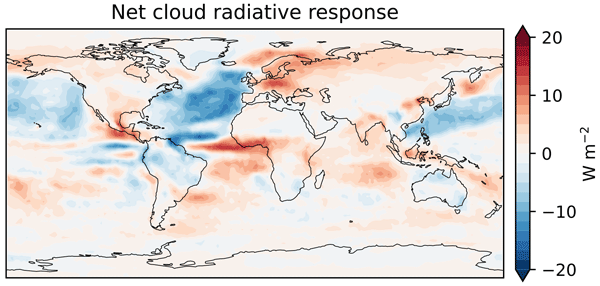
1. Cloud radiative effects (CRE; Fig. 8) do not isolate the radiative consequences of cloud changes (L337), assuming CRE is calculated as the difference between the all-sky and clear-sky top-of-atmosphere radiation anomalies. Calculating the actual cloud feedbacks rather than the CRE may significantly change the authors’ finding that cloud changes produce a negative cloud feedback in response to AMOC weakening. A positive SW CRE anomaly (Fig. 8) can occur even when there are no cloud changes, due to changes in other variables. For the experiments here, there is a large increase in sea-ice area (Figure 1, bottom left) that will increase the surface albedo. As a result, a cloud that has a large SW cooling CRE in the control experiment will have a much smaller SW cooling CRE when the ocean surface below is replaced with sea ice in the AMOC decline experiment, because even in clear-sky conditions the sea ice will reflect a large fraction of incoming SW radiation. This will produce a positive polar/subpolar SW CRE anomaly for the AMOC decline v. preindustrial control even in the absence of any cloud changes, solely due to surface albedo changes. These cloud masking effects are discussed further in Soden et al. (2008; https://doi.org/10.1175/2007JCLI2110.1), and can result not only from surface albedo changes, but also from changes in water vapor and atmospheric temperature.
- To isolate the cloud feedback that results from cloud changes alone, and not changes in other variables, I recommend using a cloud feedback analysis. Options here would be the radiative kernel approach from Soden et al. (2008), the cloud radiative kernel method from Zelinka et al. (2012; DOI: 10.1175/JCLI-D-11-00248.1), or the APRP method (although this one only calculates the SW cloud feedback). I think the best approach would be the cloud radiative kernel method, which directly calculates cloud feedbacks due to changes in cloud amount, altitude, and optical depth, but the authors would need to run their experiments with the COSP satellite simulator active to provide the necessary variables for this. There’s code for the cloud radiative kernel and APRP methods at Mark Zelinka’s Github (https://github.com/mzelinka), and code for the standard radiative kernel approach from Tyler Janoski (Janoski et al., 2025; https://github.com/tyfolino/climkern).
- One other note is that when taking the global-mean SW cloud feedback change, it might be worth also calculating this while excluding deep convective clouds, which have compensating LW cloud feedback changes.
2. It would be helpful to see a more specific discussion of why this study’s cloud feedback may differ from previous studies of the cloud response to the AMOC decline. Specifically, why is there a negative SW cloud feedback here (if this persists in the new feedback analysis), in contrast to a positive SW cloud feedback identified in previous literature (e.g., Zhang et al. (2010; https://doi.org/10.1175/2009JCLI3118.1), He et al. (2017; https://doi.org/10.1175/JCLI-D-16-0581.1), Trossman et al. (2016; https://doi.org/10.1002/2016GL067931), Lin et al. (2019; https://doi.org/10.1029/2019GL083084), and Hahn et al. (2025; https://doi.org/10.1175/JCLI-D-24-0752.1))? In what ways does this model represent aerosols differently from other models that have produced opposite results?
3. Can the authors discuss the extent to which the results may be state-dependent? This study’s experiments use preindustrial CO2 forcing and prescribe changes in SSTs and SICs from NAHosMIP experiments that impose an AMOC decline in a preindustrial climate. However, in reality the AMOC will decline in an environment with increasing CO2 concentrations. As an alternative to the NAHosMIP protocol, other studies have assessed the impact of the AMOC decline by comparing experiments with increased CO2 to experiments with both increased CO2 and freshwater removal that produces a constant AMOC strength (e.g. Liu et al., 2020; https://doi.org/10.1126/sciadv.aaz4876). Comparison of these future CO2 experiments with preindustrial NAHosMIP experiments has demonstrated state-dependent AMOC impacts (Bellomo and Mehling, 2024, also cited by the authors). I’m wondering how the AMOC-induced cloud response might differ when the background state has increased CO2 concentrations? Perhaps this would reduce the background cloud amount in the North Atlantic, so that there would be a smaller capacity for AMOC-induced dust changes to reduce cloud optical depth. On the other hand, there may be a larger reduction in North Atlantic precipitation for an AMOC decline in a future climate (Bellomo and Mehling, 2024), reducing wet deposition and increasing the impact of dust changes.
4. Can the authors please explain some points of the experimental design:
- Figure 1, bottom right suggests that the prescribed, AMOC-induced SST/SIC anomaly experiments have land surface temperatures fixed to the preindustrial control conditions, but large surface temperature changes over land in Figure 2 indicate that land temperatures are not prescribed. Please clarify whether land is interactive in the experimental design section and consider changing this schematic.
- Which two periods from the EC-Earth hosing experiment are taken to calculate and prescribe SIC and SST anomalies?
- Why not compare the hosing experiment with a preindustrial experiment (with no hosing) to calculate SIC and SST anomalies?
Other Comments:
Abstract: The authors state that the negative feedback from reduced cloud optical depth more than offsets the positive feedback from increased cloud amount. To highlight the significance of this result, I suggest adding somewhere in the abstract that previous studies have instead found a positive cloud feedback in response to AMOC weakening—this is a key difference of the present study.
Figure 1: Suggest adding color bars to these plots. Otherwise the sign of the SST and SIC changes is unclear.
L20: Recent literature has found that heat fluxes, rather than freshwater fluxes, are the main cause of projected AMOC weakening (e.g., Couldrey et al., 2022, Fig. 3; https://doi.org/10.1007/s00382-022-06386-y).
L40: When isolating the effect of the AMOC decline alone (rather than the combined effect of GHG warming and AMOC cooling), this surface cooling and positive low-cloud feedback is not limited to the warming hole in the subpolar North Atlantic; rather, it extends to the North Atlantic midlatitudes and subtropics. Other studies that show this positive shortwave cloud feedback include Zhang et al. (2010; https://doi.org/10.1175/2009JCLI3118.1), He et al. (2017; https://doi.org/10.1175/JCLI-D-16-0581.1), Lin et al. (2019; https://doi.org/10.1029/2019GL083084), and Hahn et al. (2025; https://doi.org/10.1175/JCLI-D-24-0752.1).
L106: To what extent do the authors expect differences between the simulations’ short, 10-year climatologies to result from differences in internal atmospheric variability, in addition to AMOC differences?
L251-253: It would be helpful for the reader to explicitly reference cloud cover vs. LWP here—like “triggers additional cloud formation, increasing mid- and high-cloud cover, but the reduced absolute moisture leaves less moisture available to condense within each cloud, reducing LWP and IWP.” This would tie things back better to the intro sentence for this paragraph.
L269: Why focus on 40-90N? It looks like there are large cloud changes to the south of this in the North Atlantic as well (Figures 5,6), and the dust changes are mainly in the tropics (Figure 4).
Page 16: The discussion of Figure 7 was quite detailed, and I got a bit lost in which of these features are most important when considering the TWP changes, which aren’t discussed until the very end of this section. Please consider streamlining this to make it clear how these features are relevant for the main points of the paper.
Citation: https://doi.org/10.5194/egusphere-2026-2961-RC2 -
AC2: 'Reply on RC2', Ryan Vella, 04 Sep 2026
The comment was uploaded in the form of a supplement: https://egusphere.copernicus.org/preprints/2026/egusphere-2026-2961/egusphere-2026-2961-AC2-supplement.pdf
Peer review completion


Interactive discussion
Status: closed
-
RC1: 'Comment on egusphere-2026-2961', Anonymous Referee #1, 20 Jun 2026
Summary
An interesting paper that provides a relatively comprehensive analysis of the effects of AMOC weakening on aerosol cloud interactions. The study finds a positive global mean cloud radiative effect anomaly, which is due to a reduction in the cooling efficiency of existing clouds overwhelming enhanced cooling from more cloud cover. I list some concerns below.
Comments
First Paragraph: “Anthropogenic climate change is driving rapid Arctic warming and ice melt, increasing the influx of freshwater into the North Atlantic (Bamber et al., 2018). This additional freshwater reduces the salinity and density of the upper ocean, weakening deep water formation (Sévellec et al., 2017). As a result, the sinking branch of the AMOC becomes progressively suppressed, and the overturning circulation loses strength (Bakker et al., 2016).” This seems to suggest that freshwater input into the subpolar North Atlantic is the only way the AMOC can weaken. What about direct thermal forcing? From not only GHGs, but anthropogenic aerosols as well (e.g., https://acp.copernicus.org/articles/21/5821/2021/). It might be worth connecting the loop somewhere (which is interesting) if possible à less anthropogenic aerosols (e.g., clean air policies) à AMOC weakening à changes in natural aerosols à positive forcing (as you find) à would potentially act to amplify the initial aerosol forcing and AMOC weakening. Although it appears you only find a dust response, and not a sea salt response (see below).
L44 “Most previous studies have focused primarily on thermodynamic and macrophysical cloud responses, leaving a critical gap in our understanding of how aerosol–cloud interactions shape the climate response to AMOC weakening. Changes in atmospheric circulation and surface wind patterns associated with a weakened AMOC inevitably alter natural aerosol emissions as well as their atmospheric transport and processing.” Yes. Probably can expand this and cite a couple of papers (either here or elsewhere, since your analysis is focused on the natural aerosol emissions response to AMOC weakening). For example, this paper: https://www.nature.com/articles/s41612-024-00602-8 isolates the AMOC feedback response and finds (for AMOC weakening): subpolar North Atlantic (SPNA) cooling, increased SPNA low level cloud cover (consistent with the SST cooling), increased SLP over Greenland/Iceland (i.e., weakened Icelandic low), weakened SPNA surface winds (consistent with the former) and decreases sea salt burden over the SPNA (consistent with weaker winds and SST cooling). These SST, SLP and wind responses to the AMOC also exist in CMIP6 models, as shown here: https://acp.copernicus.org/articles/21/5821/2021/ (and presumably the sea salt response). Although again, it appears you do not find a sea salt response (not even in the SPNA). Any ideas on why that might be? I assume it has to do with the large AMOC weakening here, and the corresponding increase in sea ice in the SPNA? Which effectively shuts of sea salt emissions here?
L110. “All anthropogenic and biomass-burning emissions were held fixed at perpetual 2015 levels throughout the integration, ensuring that any changes in aerosol distributions arise solely from dynamical adjustments rather than emission changes.” à I assume this whole sentence refers to anthropogenic and biomass burning emissions, since certainly dust emissions are changing in responses to e.g., meteorology. Might want to clarify. Yes, L120 confirms, but probably good to be more precise in the above sentence.
L182. “The enhanced Saharan dust export finds strong support in the palaeoclimate record. Speleothem and marine sediment reconstructions show that periods of weakened AMOC and increased latitudinal temperature gradients coincide with elevated Saharan dust fluxes..” à Is this due to AMOC weakening specifically, or just general cooling?
Near L340 and Figure 8. It might be worth showing the total CRE, to identify where it is positive versus negative? For example, this is not intuitive over the SPNA since SW effects are large and positive but LW effects oppose.
I’m also a bit confused on the use of CRE, since this does not isolate the aerosol effect. Does the model not have diagnostics (e.g., aerosol free radiation calls) that allow one to isolate the aerosol radiative effect directly? Or, perhaps, one could use an offline radiative transfer model? Not only the aerosol-cloud effect, but what about the aerosol direct radiative effects? Are they not important to also quantify?
L347, “Globally, the area-weighted SW cloud radiative effect anomaly is +1.16 W m−2, indicating a net reduction in cloud reflectivity” à Can you say this here? CRE will be related to both cloud reflectivity and cloud amount? Doesn’t the next paragraph isolate these components?
L418 (and L349). “The global-mean net cloud radiative effect anomaly of +0.84 W m−2 acts as a negative feedback that partially offsets AMOC-induced surface cooling.” More broadly, if this positive (global mean) forcing also exists over the North Atlantic, the implication is that it would feedback and further weaken the AMOC? I understand this cannot be quantified in this model setup, but nonetheless, it’s an interesting idea.
L437. “a pathway that models relying on prescribed aerosol fields cannot represent, and whose absence may contribute to the spread in projected climate responses to future AMOC change.” à is this referring to natural aerosols, anthropogenic aerosols, or both? Were there any CMIP6 models that used prescribed aerosol fields? In terms of dust (and even anthropogenic aerosol) emissions, I think that nearly all had interactive emissions? I also note that this point is also made at the end of the abstract. Perhaps a more important caveat to note (one that is in common to all single-model studies, in particular when based on aerosols) is that the results presented here may be model dependent.
Citation: https://doi.org/10.5194/egusphere-2026-2961-RC1 -
AC1: 'Reply on RC1', Ryan Vella, 04 Sep 2026
The comment was uploaded in the form of a supplement: https://egusphere.copernicus.org/preprints/2026/egusphere-2026-2961/egusphere-2026-2961-AC1-supplement.pdf
-
AC1: 'Reply on RC1', Ryan Vella, 04 Sep 2026
-
RC2: 'Comment on egusphere-2026-2961', Anonymous Referee #2, 22 Jun 2026
This study identifies and addresses a compelling research gap: the role of aerosols for the cloud feedback response to AMOC weakening. In contrast to a positive shortwave cloud feedback response found in previous literature, this study finds a negative shortwave cloud feedback as a result of dust aerosol impacts on cloud optical depth. The writing and figures are generally clear, and the results are significant, particularly as they contrast with previous studies. My main concern is that the authors use CRE to evaluate the effect of cloud changes, which can alias in the effects of other changes like surface albedo and atmospheric water vapor and temperature. Below I suggest calculating cloud feedbacks instead, as well as clarifying some points of the experimental design, specifying why these results differ from the existing literature, and discussing the extent to which the results may change in a warmer, non-preindustrial background climate. Please find some additional suggestions below.
Main Comments
1. Cloud radiative effects (CRE; Fig. 8) do not isolate the radiative consequences of cloud changes (L337), assuming CRE is calculated as the difference between the all-sky and clear-sky top-of-atmosphere radiation anomalies. Calculating the actual cloud feedbacks rather than the CRE may significantly change the authors’ finding that cloud changes produce a negative cloud feedback in response to AMOC weakening. A positive SW CRE anomaly (Fig. 8) can occur even when there are no cloud changes, due to changes in other variables. For the experiments here, there is a large increase in sea-ice area (Figure 1, bottom left) that will increase the surface albedo. As a result, a cloud that has a large SW cooling CRE in the control experiment will have a much smaller SW cooling CRE when the ocean surface below is replaced with sea ice in the AMOC decline experiment, because even in clear-sky conditions the sea ice will reflect a large fraction of incoming SW radiation. This will produce a positive polar/subpolar SW CRE anomaly for the AMOC decline v. preindustrial control even in the absence of any cloud changes, solely due to surface albedo changes. These cloud masking effects are discussed further in Soden et al. (2008; https://doi.org/10.1175/2007JCLI2110.1), and can result not only from surface albedo changes, but also from changes in water vapor and atmospheric temperature.
- To isolate the cloud feedback that results from cloud changes alone, and not changes in other variables, I recommend using a cloud feedback analysis. Options here would be the radiative kernel approach from Soden et al. (2008), the cloud radiative kernel method from Zelinka et al. (2012; DOI: 10.1175/JCLI-D-11-00248.1), or the APRP method (although this one only calculates the SW cloud feedback). I think the best approach would be the cloud radiative kernel method, which directly calculates cloud feedbacks due to changes in cloud amount, altitude, and optical depth, but the authors would need to run their experiments with the COSP satellite simulator active to provide the necessary variables for this. There’s code for the cloud radiative kernel and APRP methods at Mark Zelinka’s Github (https://github.com/mzelinka), and code for the standard radiative kernel approach from Tyler Janoski (Janoski et al., 2025; https://github.com/tyfolino/climkern).
- One other note is that when taking the global-mean SW cloud feedback change, it might be worth also calculating this while excluding deep convective clouds, which have compensating LW cloud feedback changes.
2. It would be helpful to see a more specific discussion of why this study’s cloud feedback may differ from previous studies of the cloud response to the AMOC decline. Specifically, why is there a negative SW cloud feedback here (if this persists in the new feedback analysis), in contrast to a positive SW cloud feedback identified in previous literature (e.g., Zhang et al. (2010; https://doi.org/10.1175/2009JCLI3118.1), He et al. (2017; https://doi.org/10.1175/JCLI-D-16-0581.1), Trossman et al. (2016; https://doi.org/10.1002/2016GL067931), Lin et al. (2019; https://doi.org/10.1029/2019GL083084), and Hahn et al. (2025; https://doi.org/10.1175/JCLI-D-24-0752.1))? In what ways does this model represent aerosols differently from other models that have produced opposite results?
3. Can the authors discuss the extent to which the results may be state-dependent? This study’s experiments use preindustrial CO2 forcing and prescribe changes in SSTs and SICs from NAHosMIP experiments that impose an AMOC decline in a preindustrial climate. However, in reality the AMOC will decline in an environment with increasing CO2 concentrations. As an alternative to the NAHosMIP protocol, other studies have assessed the impact of the AMOC decline by comparing experiments with increased CO2 to experiments with both increased CO2 and freshwater removal that produces a constant AMOC strength (e.g. Liu et al., 2020; https://doi.org/10.1126/sciadv.aaz4876). Comparison of these future CO2 experiments with preindustrial NAHosMIP experiments has demonstrated state-dependent AMOC impacts (Bellomo and Mehling, 2024, also cited by the authors). I’m wondering how the AMOC-induced cloud response might differ when the background state has increased CO2 concentrations? Perhaps this would reduce the background cloud amount in the North Atlantic, so that there would be a smaller capacity for AMOC-induced dust changes to reduce cloud optical depth. On the other hand, there may be a larger reduction in North Atlantic precipitation for an AMOC decline in a future climate (Bellomo and Mehling, 2024), reducing wet deposition and increasing the impact of dust changes.
4. Can the authors please explain some points of the experimental design:
- Figure 1, bottom right suggests that the prescribed, AMOC-induced SST/SIC anomaly experiments have land surface temperatures fixed to the preindustrial control conditions, but large surface temperature changes over land in Figure 2 indicate that land temperatures are not prescribed. Please clarify whether land is interactive in the experimental design section and consider changing this schematic.
- Which two periods from the EC-Earth hosing experiment are taken to calculate and prescribe SIC and SST anomalies?
- Why not compare the hosing experiment with a preindustrial experiment (with no hosing) to calculate SIC and SST anomalies?
Other Comments:
Abstract: The authors state that the negative feedback from reduced cloud optical depth more than offsets the positive feedback from increased cloud amount. To highlight the significance of this result, I suggest adding somewhere in the abstract that previous studies have instead found a positive cloud feedback in response to AMOC weakening—this is a key difference of the present study.
Figure 1: Suggest adding color bars to these plots. Otherwise the sign of the SST and SIC changes is unclear.
L20: Recent literature has found that heat fluxes, rather than freshwater fluxes, are the main cause of projected AMOC weakening (e.g., Couldrey et al., 2022, Fig. 3; https://doi.org/10.1007/s00382-022-06386-y).
L40: When isolating the effect of the AMOC decline alone (rather than the combined effect of GHG warming and AMOC cooling), this surface cooling and positive low-cloud feedback is not limited to the warming hole in the subpolar North Atlantic; rather, it extends to the North Atlantic midlatitudes and subtropics. Other studies that show this positive shortwave cloud feedback include Zhang et al. (2010; https://doi.org/10.1175/2009JCLI3118.1), He et al. (2017; https://doi.org/10.1175/JCLI-D-16-0581.1), Lin et al. (2019; https://doi.org/10.1029/2019GL083084), and Hahn et al. (2025; https://doi.org/10.1175/JCLI-D-24-0752.1).
L106: To what extent do the authors expect differences between the simulations’ short, 10-year climatologies to result from differences in internal atmospheric variability, in addition to AMOC differences?
L251-253: It would be helpful for the reader to explicitly reference cloud cover vs. LWP here—like “triggers additional cloud formation, increasing mid- and high-cloud cover, but the reduced absolute moisture leaves less moisture available to condense within each cloud, reducing LWP and IWP.” This would tie things back better to the intro sentence for this paragraph.
L269: Why focus on 40-90N? It looks like there are large cloud changes to the south of this in the North Atlantic as well (Figures 5,6), and the dust changes are mainly in the tropics (Figure 4).
Page 16: The discussion of Figure 7 was quite detailed, and I got a bit lost in which of these features are most important when considering the TWP changes, which aren’t discussed until the very end of this section. Please consider streamlining this to make it clear how these features are relevant for the main points of the paper.
Citation: https://doi.org/10.5194/egusphere-2026-2961-RC2 -
AC2: 'Reply on RC2', Ryan Vella, 04 Sep 2026
The comment was uploaded in the form of a supplement: https://egusphere.copernicus.org/preprints/2026/egusphere-2026-2961/egusphere-2026-2961-AC2-supplement.pdf
Peer review completion
Journal article(s) based on this preprint
Viewed
| HTML | XML | Total | Supplement | BibTeX | EndNote | |
|---|---|---|---|---|---|---|
| 275 | 171 | 49 | 495 | 59 | 41 | 38 |
- HTML: 275
- PDF: 171
- XML: 49
- Total: 495
- Supplement: 59
- BibTeX: 41
- EndNote: 38
Viewed (geographical distribution)
| Country | # | Views | % |
|---|
| Total: | 0 |
| HTML: | 0 |
| PDF: | 0 |
| XML: | 0 |
- 1

Ulrike Lohmann
The requested preprint has a corresponding peer-reviewed final revised paper. You are encouraged to refer to the final revised version.
- Preprint
(7848 KB) - Metadata XML
-
Supplement
(3464 KB) - BibTeX
- EndNote
- Final revised paper
Summary
An interesting paper that provides a relatively comprehensive analysis of the effects of AMOC weakening on aerosol cloud interactions. The study finds a positive global mean cloud radiative effect anomaly, which is due to a reduction in the cooling efficiency of existing clouds overwhelming enhanced cooling from more cloud cover. I list some concerns below.
Comments
First Paragraph: “Anthropogenic climate change is driving rapid Arctic warming and ice melt, increasing the influx of freshwater into the North Atlantic (Bamber et al., 2018). This additional freshwater reduces the salinity and density of the upper ocean, weakening deep water formation (Sévellec et al., 2017). As a result, the sinking branch of the AMOC becomes progressively suppressed, and the overturning circulation loses strength (Bakker et al., 2016).” This seems to suggest that freshwater input into the subpolar North Atlantic is the only way the AMOC can weaken. What about direct thermal forcing? From not only GHGs, but anthropogenic aerosols as well (e.g., https://acp.copernicus.org/articles/21/5821/2021/). It might be worth connecting the loop somewhere (which is interesting) if possible à less anthropogenic aerosols (e.g., clean air policies) à AMOC weakening à changes in natural aerosols à positive forcing (as you find) à would potentially act to amplify the initial aerosol forcing and AMOC weakening. Although it appears you only find a dust response, and not a sea salt response (see below).
L44 “Most previous studies have focused primarily on thermodynamic and macrophysical cloud responses, leaving a critical gap in our understanding of how aerosol–cloud interactions shape the climate response to AMOC weakening. Changes in atmospheric circulation and surface wind patterns associated with a weakened AMOC inevitably alter natural aerosol emissions as well as their atmospheric transport and processing.” Yes. Probably can expand this and cite a couple of papers (either here or elsewhere, since your analysis is focused on the natural aerosol emissions response to AMOC weakening). For example, this paper: https://www.nature.com/articles/s41612-024-00602-8 isolates the AMOC feedback response and finds (for AMOC weakening): subpolar North Atlantic (SPNA) cooling, increased SPNA low level cloud cover (consistent with the SST cooling), increased SLP over Greenland/Iceland (i.e., weakened Icelandic low), weakened SPNA surface winds (consistent with the former) and decreases sea salt burden over the SPNA (consistent with weaker winds and SST cooling). These SST, SLP and wind responses to the AMOC also exist in CMIP6 models, as shown here: https://acp.copernicus.org/articles/21/5821/2021/ (and presumably the sea salt response). Although again, it appears you do not find a sea salt response (not even in the SPNA). Any ideas on why that might be? I assume it has to do with the large AMOC weakening here, and the corresponding increase in sea ice in the SPNA? Which effectively shuts of sea salt emissions here?
L110. “All anthropogenic and biomass-burning emissions were held fixed at perpetual 2015 levels throughout the integration, ensuring that any changes in aerosol distributions arise solely from dynamical adjustments rather than emission changes.” à I assume this whole sentence refers to anthropogenic and biomass burning emissions, since certainly dust emissions are changing in responses to e.g., meteorology. Might want to clarify. Yes, L120 confirms, but probably good to be more precise in the above sentence.
L182. “The enhanced Saharan dust export finds strong support in the palaeoclimate record. Speleothem and marine sediment reconstructions show that periods of weakened AMOC and increased latitudinal temperature gradients coincide with elevated Saharan dust fluxes..” à Is this due to AMOC weakening specifically, or just general cooling?
Near L340 and Figure 8. It might be worth showing the total CRE, to identify where it is positive versus negative? For example, this is not intuitive over the SPNA since SW effects are large and positive but LW effects oppose.
I’m also a bit confused on the use of CRE, since this does not isolate the aerosol effect. Does the model not have diagnostics (e.g., aerosol free radiation calls) that allow one to isolate the aerosol radiative effect directly? Or, perhaps, one could use an offline radiative transfer model? Not only the aerosol-cloud effect, but what about the aerosol direct radiative effects? Are they not important to also quantify?
L347, “Globally, the area-weighted SW cloud radiative effect anomaly is +1.16 W m−2, indicating a net reduction in cloud reflectivity” à Can you say this here? CRE will be related to both cloud reflectivity and cloud amount? Doesn’t the next paragraph isolate these components?
L418 (and L349). “The global-mean net cloud radiative effect anomaly of +0.84 W m−2 acts as a negative feedback that partially offsets AMOC-induced surface cooling.” More broadly, if this positive (global mean) forcing also exists over the North Atlantic, the implication is that it would feedback and further weaken the AMOC? I understand this cannot be quantified in this model setup, but nonetheless, it’s an interesting idea.
L437. “a pathway that models relying on prescribed aerosol fields cannot represent, and whose absence may contribute to the spread in projected climate responses to future AMOC change.” à is this referring to natural aerosols, anthropogenic aerosols, or both? Were there any CMIP6 models that used prescribed aerosol fields? In terms of dust (and even anthropogenic aerosol) emissions, I think that nearly all had interactive emissions? I also note that this point is also made at the end of the abstract. Perhaps a more important caveat to note (one that is in common to all single-model studies, in particular when based on aerosols) is that the results presented here may be model dependent.