
the Creative Commons Attribution 4.0 License.
the Creative Commons Attribution 4.0 License.
 | 11 Jun 2026
Detectability of solid particle injections into the stratosphere with satellite solar occultation instruments
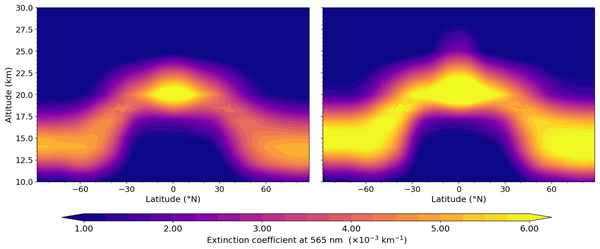
Abstract. Stratospheric aerosol injections (SAI) have been proposed as a potential climate intervention to mitigate some effects of global warming. This method involves the idea of injecting sulphur dioxide into the stratosphere. Other ideas include the injection of solid particles, like alumina and calcite, as these particles absorb less terrestrial infrared radiation and scatter solar radiation more efficiently. The aim of the study is to investigate the detectability of the continuous injection of 5 Tg yr-1 of alumina and calcite with typical satellite solar occultation instruments using SOCOL-AERv2 (SOlar Climate Ozone Links-Atmospheric and Environmental Research Incorporation version 2) model simulation results and the SCIATRAN radiative transfer model. The results demonstrate that, under the assumptions made, it is possible to detect the injection of solid particles into the stratosphere and that the corresponding SAI signals can be distinguished from natural variability under near-background conditions, which is essential for the observational verification of potential SAI perturbations.
-
Notice on discussion status
The requested preprint has a corresponding peer-reviewed final revised paper. You are encouraged to refer to the final revised version.
-
Preprint
(5282 KB)
-
The requested preprint has a corresponding peer-reviewed final revised paper. You are encouraged to refer to the final revised version.
- Preprint
(5282 KB) - Metadata XML
- BibTeX
- EndNote
- Final revised paper


Journal article(s) based on this preprint
Interactive discussion
Status: closed
-
RC1: 'Comment on egusphere-2026-2957', Filip Vanhellemont, 24 Jul 2026
-
AC1: 'Reply RC1', Anna Lange, 22 Aug 2026
The comment was uploaded in the form of a supplement: https://egusphere.copernicus.org/preprints/2026/egusphere-2026-2957/egusphere-2026-2957-AC1-supplement.pdf
-
AC1: 'Reply RC1', Anna Lange, 22 Aug 2026
-
RC2: 'Comment on egusphere-2026-2957', Anonymous Referee #2, 04 Aug 2026
This paper shows the results of a study on the detection of geoengineering with solid particles at a rate of 5 Tg per year using a simulation of satellite solar occultation measurements and aerosol extinction retrievals on SOCOL-AERv2 model output. The detection criteria considers both measurement uncertainty and natural variability during a “near-background” period. The study is interesting and relevant, and fits well within the scope of AMT. However, there are a few shortcomings in the design of the study and the assumptions in the simulations that need to be addressed:
- Line 2.2.2: What is the rational for a 30% a priori variance? Are the covariance terms (off-diagonal) assumed to be zero? How sensitive are the results to this assumption? Similarly, the assumed instrument SNR seems to be a critical element of this study, and the sensitivity to this assumption needs to be addressed. For example, how similar is this value to the current standard satellite occultation measurements, for example from SAGE II, or SAGE III/ISS, or even SCIAMACHY? The authors also need to compare their retrieval uncertainty to the uncertainties reported by a typical (real) occultation instrument.
- Section 3.1: At several points, the authors mention the “relevant altitude range”. This needs to be more thoroughly supported with at least some discussion of a tropopause definition with justification. It is mentioned later in the discussion around Fig 3, that SAGE II tropopause altitudes were used for the optical depth calculation but that this limits the analysis to 55 S to 55 N. This seems to be an unneeded limitation – tropopause altitudes are readily available from a large number of sources, including almost certainly from the SOCOL-AERv2 model output.
- Section 3.3: What is the justification for using only “near-background” levels of stratospheric aerosol to characterize natural variability? Stratospheric aerosol levels have been highly variable over the last two decades with perturbations from both minor to moderately sized volcanic eruptions and increasingly frequent forest fire smoke.
- Section 4: The conclusions from this study are somewhat limited due to the small scope of the study: only one injection scenario (5 Tg per year) and one set of instrument/retrieval parameters. It would be much for useful if the authors could identify a limit of detection in terms of both injection rate and instrument SNR (for example).
Technical corrections:
- Line 71: Are these really “Mie” calculations? Better to say something like “Scattering cross-section calculations…”
- Lines 82=85: At this point the discussion shifts from discussing Vattioni et al., 2025, to the current work and it’s somewhat confusing. For example, what does “Based on” and “are analysed” mean in this context?
- Line 97: Does the vertical field of view, quoted in Table 1, account for the forward scattering of the aerosol into the “instrument” line of sight? If not, how is this relevant?
- Figs 2,3,5,6: The “total error” is potentially confusing. The plot actually shows the range of uncertainty about the retrieved profile, not the total error. Please consider changing to shading on the plot and a different terminology.
Citation: https://doi.org/10.5194/egusphere-2026-2957-RC2 -
AC2: 'Reply RC2', Anna Lange, 22 Aug 2026
The comment was uploaded in the form of a supplement: https://egusphere.copernicus.org/preprints/2026/egusphere-2026-2957/egusphere-2026-2957-AC2-supplement.pdf
Peer review completion


Interactive discussion
Status: closed
-
RC1: 'Comment on egusphere-2026-2957', Filip Vanhellemont, 24 Jul 2026
Review: Detectability of solid particle injections into the stratosphere with satellite solar occultation instruments
By Anna Lange et al.
In this paper, the authors investigate the possibility to detect the presence of artificially injected solid particles (5 Tg per year) into the stratosphere by using the standard satellite solar occultation measurement technique. The injection of these particles is at present debated in the (still controversial) framework of geoengineering. Usually, SO2-induced sulphate aerosols are considered; here, solid alumina and calcite particles are discussed, due to their increased scattering efficiency and reduced infrared absorption. Using the SOCOL-AERv2 circulation/chemistry/microphysics model and the SCIATRAN Radiative Transfer model, synthetic retrievals of 565 nm aerosol extinction were obtained, taking into account a number of error sources. The results clearly show that for injections of 5 Tg per year, the presence of these particles is clearly observed in solar occultation retrievals, and can be distinguished from the mean background stratospheric aerosol loading, even when natural variability is considered.
General comments
This paper forms a substantial contribution to the scientific research related to the mitigation of global warming by geoengineering, since it clearly shows that the effects of stratospheric injections (here, in particular, alumina and calcite) can be measured by standard occultation techniques. Since geoengineering is quite a hot topic, I consider ACP to be an appropriate journal. Overall, the assumptions, methods and conclusions are valid, although one aspect of the retrieval mathematics should be clarified (see below). I’ve suggested some additional references, but in general, ample credit is given to other authors in the field. The structure of the paper is well organized. Use of English is also good, but I did include a list of suggestions to improve the clarity of the text. Furthermore, mathematical notation should be improved. If the comments below are properly addressed, I see no objection to the publication of the paper. I therefore advise to publish with minor revisions.
Specific comments
- Is there a specific reason why the paper deals with solar occultation instruments only? It is fair to assume that similar conclusions can be drawn for ground-based observations, or limb scatter and nadir instruments. If there is a reason, a short explanation would be good.
- Line 14: please also add the more recent paper by Kremser et al, Stratospheric aerosols - Observations, processes, and impact on climate, Reviews of Geophysics 54, 278-335.
- Line 26: please cite the ALTIUS paper: Fussen et al., The ALTIUS atmospheric limb sounder, JQSRT vol 238, 2019.
- Line 38: Please explain from where the number of 5 Tg per year originates. If it comes from Vattioni et al (2025), it would be a good idea to briefly repeat the reason for this number here. The entire conclusion of the paper (detectability or not) depends on it.
- Line 78: Briefly explain here why the tropical latitudes from 30°N to 30°S are chosen as injection site. It may seem obvious to the authors, but it would improve the text for readers that are non-specialists.
- Line 85: What is the spin-up period? Is it the period necessary to reach steady-state?
- Section 2.2.2 (Retrieval): it is not clear from the text if random simulated noise was added to the transmittance, before converting to the logarithm (measurement vector y) for every individual retrieval. Please specify.
- Again, Section 2.2.2: the measurement vector y contains the logarithm of the transmittance. Therefore, the Beer-Lambert law says that y is linearly related to the aerosol extinction coefficients: y=K x, with K the matrix containing the path segment lengths in the atmosphere. In Eqn. 1, the terms F(xa) and -K*xa disappear. The merit function (Eqn. 2) is then simply || Kx-y||2 + ||x-xa||2, which is the standard expression for optimal estimation. Can you clarify why the equations are unnecessarily complicated? (perhaps I’m missing something).
- Eqn. 5: is it valid to add the variances due to T and P (constant air density) to the variances due to T only and again P only? Isn’t this overestimating the error?
- Figs. 2 and 5: I think the figure would be clearer to interpret if you would plot the altitude of the tropopause on every plot as a horizontal line. It really is the stratosphere that is of interest in this paper.
- Figs. 3 and 8: how was the stratospheric optical depth obtained? Integration from the tropopause up to the maximum available altitude in the data? Please specify.
- Line 202: It is stated that at 75°S, detectable SAI signals are present above about 20 km. In Fig. 5, I observe detection (background outside the retrieval error) from 10 km to 24 km, which does not correspond with the text. Please correct.
Technical comments, corrections and suggestions
- It would be good to specify in the abstract that conclusions were obtained for stratospheric aerosol extinction at the specific wavelength of 565 nm. For example, Line 7: “Retrievals of 565 nm aerosol extinction demonstrate that, under the assumptions made, …”
- Line 26: change ‘probably’ -> ‘potentially’, and ‘…above a certain size …’ -> ‘…above a certain particle size …’’
- Line 36: change ‘…start-ups may see an option to earn money with SAI (e. g. “Make sunsets” company)’ -> ‘…start-ups may find SAI to be profitable (e. g. the “Make sunsets” company)’.
- The entire paragraph from line 76 to 81 contains some redundancy (aluminia or calcite, radius of 240 nm are mentioned several times). Could you remove this redundancy?
- It is important to make a distinction in mathematical notation between scalars and vectors/matrices/multidimensional objects in general. One possibility is to write multidimensional objects in boldface, and scalars in plain roman. Eqn. 1 then is: y = F(xa) + K(x-xa). Please do this everywhere in the text.
- Line 109: change text to: “… the logarithms of the transmission values at 565 nm for all tangent heights, …”
- Line 122: change text to “… and T(TH) as the transmission value …”, in order for the notation to be conform with Eqn. 4.
- Line 128: change text to “… the error estimation on the extinction was …”
- Eqn. 6: This is a scalar equation; it can be written in a better way as ri = (xi-xref,i)/xref,i, with i the index indicating the tangent heigh index.
- Table 4, second row, first column: change to “A priori”.
- Table 4, 4th row, second column: change to “Extinction coefficient profile with SAI (alumina or calcite), retrieved with SCIATRAN.”
- Fig. 3, Fig.6, caption: change to “… optical depth (565 nm) as function of latitude ….”. Similar for Fig. 8.
- Line 201: change to “… the corresponding profiles deviate more distinctly …”
- Line 205: change “pannel” to “panel” (twice)
- Fig. 5, caption: change “apriori” to “a priori”
- Line 247: change to “For both injection scenarios (compare Figs. 3, 6), this is the case.”
Citation: https://doi.org/10.5194/egusphere-2026-2957-RC1 -
AC1: 'Reply RC1', Anna Lange, 22 Aug 2026
The comment was uploaded in the form of a supplement: https://egusphere.copernicus.org/preprints/2026/egusphere-2026-2957/egusphere-2026-2957-AC1-supplement.pdf
-
RC2: 'Comment on egusphere-2026-2957', Anonymous Referee #2, 04 Aug 2026
This paper shows the results of a study on the detection of geoengineering with solid particles at a rate of 5 Tg per year using a simulation of satellite solar occultation measurements and aerosol extinction retrievals on SOCOL-AERv2 model output. The detection criteria considers both measurement uncertainty and natural variability during a “near-background” period. The study is interesting and relevant, and fits well within the scope of AMT. However, there are a few shortcomings in the design of the study and the assumptions in the simulations that need to be addressed:
- Line 2.2.2: What is the rational for a 30% a priori variance? Are the covariance terms (off-diagonal) assumed to be zero? How sensitive are the results to this assumption? Similarly, the assumed instrument SNR seems to be a critical element of this study, and the sensitivity to this assumption needs to be addressed. For example, how similar is this value to the current standard satellite occultation measurements, for example from SAGE II, or SAGE III/ISS, or even SCIAMACHY? The authors also need to compare their retrieval uncertainty to the uncertainties reported by a typical (real) occultation instrument.
- Section 3.1: At several points, the authors mention the “relevant altitude range”. This needs to be more thoroughly supported with at least some discussion of a tropopause definition with justification. It is mentioned later in the discussion around Fig 3, that SAGE II tropopause altitudes were used for the optical depth calculation but that this limits the analysis to 55 S to 55 N. This seems to be an unneeded limitation – tropopause altitudes are readily available from a large number of sources, including almost certainly from the SOCOL-AERv2 model output.
- Section 3.3: What is the justification for using only “near-background” levels of stratospheric aerosol to characterize natural variability? Stratospheric aerosol levels have been highly variable over the last two decades with perturbations from both minor to moderately sized volcanic eruptions and increasingly frequent forest fire smoke.
- Section 4: The conclusions from this study are somewhat limited due to the small scope of the study: only one injection scenario (5 Tg per year) and one set of instrument/retrieval parameters. It would be much for useful if the authors could identify a limit of detection in terms of both injection rate and instrument SNR (for example).
Technical corrections:
- Line 71: Are these really “Mie” calculations? Better to say something like “Scattering cross-section calculations…”
- Lines 82=85: At this point the discussion shifts from discussing Vattioni et al., 2025, to the current work and it’s somewhat confusing. For example, what does “Based on” and “are analysed” mean in this context?
- Line 97: Does the vertical field of view, quoted in Table 1, account for the forward scattering of the aerosol into the “instrument” line of sight? If not, how is this relevant?
- Figs 2,3,5,6: The “total error” is potentially confusing. The plot actually shows the range of uncertainty about the retrieved profile, not the total error. Please consider changing to shading on the plot and a different terminology.
Citation: https://doi.org/10.5194/egusphere-2026-2957-RC2 -
AC2: 'Reply RC2', Anna Lange, 22 Aug 2026
The comment was uploaded in the form of a supplement: https://egusphere.copernicus.org/preprints/2026/egusphere-2026-2957/egusphere-2026-2957-AC2-supplement.pdf
Peer review completion
Journal article(s) based on this preprint
Viewed
| HTML | XML | Total | BibTeX | EndNote | |
|---|---|---|---|---|---|
| 269 | 142 | 40 | 451 | 34 | 30 |
- HTML: 269
- PDF: 142
- XML: 40
- Total: 451
- BibTeX: 34
- EndNote: 30
Viewed (geographical distribution)
| Country | # | Views | % |
|---|
| Total: | 0 |
| HTML: | 0 |
| PDF: | 0 |
| XML: | 0 |
- 1

John Andrew Dykema
Sandro Vattioni
Ulrike Niemeier
Alexei Rozanov
Christian von Savigny
The requested preprint has a corresponding peer-reviewed final revised paper. You are encouraged to refer to the final revised version.
- Preprint
(5282 KB) - Metadata XML
Review: Detectability of solid particle injections into the stratosphere with satellite solar occultation instruments
By Anna Lange et al.
In this paper, the authors investigate the possibility to detect the presence of artificially injected solid particles (5 Tg per year) into the stratosphere by using the standard satellite solar occultation measurement technique. The injection of these particles is at present debated in the (still controversial) framework of geoengineering. Usually, SO2-induced sulphate aerosols are considered; here, solid alumina and calcite particles are discussed, due to their increased scattering efficiency and reduced infrared absorption. Using the SOCOL-AERv2 circulation/chemistry/microphysics model and the SCIATRAN Radiative Transfer model, synthetic retrievals of 565 nm aerosol extinction were obtained, taking into account a number of error sources. The results clearly show that for injections of 5 Tg per year, the presence of these particles is clearly observed in solar occultation retrievals, and can be distinguished from the mean background stratospheric aerosol loading, even when natural variability is considered.
General comments
This paper forms a substantial contribution to the scientific research related to the mitigation of global warming by geoengineering, since it clearly shows that the effects of stratospheric injections (here, in particular, alumina and calcite) can be measured by standard occultation techniques. Since geoengineering is quite a hot topic, I consider ACP to be an appropriate journal. Overall, the assumptions, methods and conclusions are valid, although one aspect of the retrieval mathematics should be clarified (see below). I’ve suggested some additional references, but in general, ample credit is given to other authors in the field. The structure of the paper is well organized. Use of English is also good, but I did include a list of suggestions to improve the clarity of the text. Furthermore, mathematical notation should be improved. If the comments below are properly addressed, I see no objection to the publication of the paper. I therefore advise to publish with minor revisions.
Specific comments
Technical comments, corrections and suggestions