
the Creative Commons Attribution 4.0 License.
the Creative Commons Attribution 4.0 License.
 | 23 Jun 2026
Spectral Signatures of Zenith Sky Radiances from Surface-Based Sky Radiometers: Implications for Clear- and Cloudy-Sky Detection
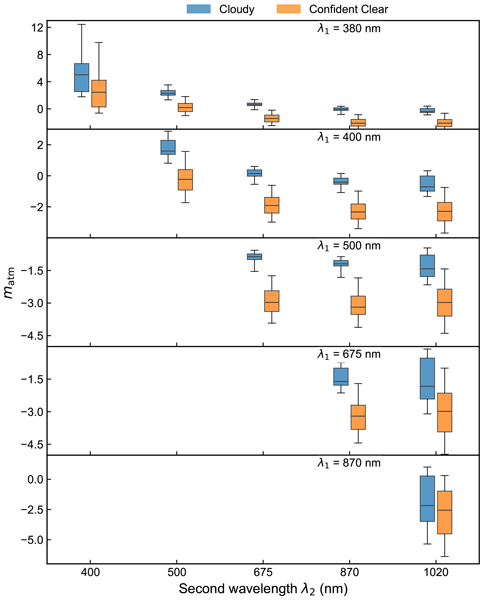
Abstract. Accurate identification of clear- and cloudy-sky conditions is essential for reliable aerosol and cloud retrievals from ground-based remote sensing observations. This study investigates the spectral characteristics of zenith radiances measured by SKYNET sky radiometers and evaluates their potential for distinguishing clear- and cloudy-sky conditions based on wavelength dependence. Analyses of normalized spectral zenith radiances at multiple sites representing diverse atmospheric environments, including urban, maritime, tropical continental, and polar regions, revealed systematic differences between clear- and cloudy-sky conditions identified using quality-controlled MODIS cloud mask products. The spectral slope derived from the logarithmic contrast between zenith radiances at 0.400 and 0.675 µm showed strong sensitivity to cloudy-sky conditions but limited capability for detecting clear-sky conditions. In contrast, slopes based on the 0.500 and 0.675 µm and 0.400 and 0.675 µm wavelength pairs exhibited more balanced detection performance for both clear- and cloudy-sky conditions. Based on detailed analyses of the dependence of these slope values on solar geometry, aerosol properties, and cloud properties, together with classification scores evaluated against MODIS cloud mask data, this study proposes a simple, efficient, and easy-to-use sky-state detection criterion that classifies observations into clear, cloudy, and undetermined categories. Independent validation using collocated direct normal irradiance measurements confirmed the physical consistency of the slope-based classification. Further comparison with the standard cloud-screening procedure showed very good agreement in clear-sky aerosol data extracted using the newly developed criterion across diverse atmospheric environments. Overall, these results demonstrate that spectral zenith radiances provide a simple and physically interpretable basis for clear- and cloudy-sky detection. Incorporating such spectral diagnostics into ground-based radiometric networks can improve cloud screening and enhance the reliability of long-term aerosol and cloud climatological analyses.
-
Notice on discussion status
The requested preprint has a corresponding peer-reviewed final revised paper. You are encouraged to refer to the final revised version.
-
Preprint
(1390 KB)
-
The requested preprint has a corresponding peer-reviewed final revised paper. You are encouraged to refer to the final revised version.
- Preprint
(1390 KB) - Metadata XML
- BibTeX
- EndNote
- Final revised paper


Journal article(s) based on this preprint
Interactive discussion
Status: closed
-
RC1: 'Comment on egusphere-2026-2943', Anonymous Referee #1, 14 Jul 2026
- AC1: 'Reply on RC1', Pradeep Khatri, 20 Aug 2026
-
RC2: 'Comment on egusphere-2026-2943', Anonymous Referee #2, 18 Jul 2026
The proposed cloud-screening approach appears physically consistent with the different spectral behavior of aerosols and clouds. Author found that the spectral slope derived from the logarithmic contrast between zenith radiances at 0.400 and 0.675 µm has strong sensitivity to cloudy-sky conditions but limited capability for detecting clear-sky conditions, whereas slopes based on the 0.500 and 0.675 µm and 0.400 and 0.675 µm wavelength pairs exhibits more balanced detection performance for both clear and cloudy-sky conditions. The proposed method cannot be considered a fundamentally new concept, but represents a useful and practical cloud-screening technique to apply to sun-sky radiometers.
There are some points that the authors should address:
1) In line 138, it is stated that the SKYNET archive is available at atmos3.cr.chiba-u.jp/skynet. However, this is not the official SKYNET website, which is www.skynet-isdc.org. The latter provides two processing modes, namely CERES and ESR-MRI. Are the products downloaded from the former website exactly the same as those available from the official SKYNET portal? If not, it would not be accurate to state that the database is obtained from SKYNET without further clarification.
2) To what extent does the value of the epsilon parameter (line 406) depend on the measurement site? Please discuss its site dependence and whether a site-specific tuning is required.
3) Instead of the qualitative comparison presented in Figure 9, I recommend providing a quantitative assessment of the different cloud-screening methods. For example, the authors could report the percentage or number of data points rejected by each method.
4) The proposed method should be evaluated under a wider range of atmospheric conditions. In particular, it would be useful to compare the performance of the different cloud-screening approaches during representative case studies, such as desert dust outbreaks, wildfire smoke events, and cirrus cloud conditions, in order to demonstrate any improvement achieved by the proposed method.
5) The title should clearly specify that the proposed cloud-screening method applies only to direct-sun measurements.
Citation: https://doi.org/10.5194/egusphere-2026-2943-RC2 - AC2: 'Reply on RC2', Pradeep Khatri, 20 Aug 2026
-
EC1: 'Comment on egusphere-2026-2943', Teruyuki Nakajima, 29 Jul 2026
Editor's comments in the discussion section of Khatri et al. (2026-2943)
Dear Dr. Khatri and co-authors,
The open discussion period has been over and we have two referees' comments, in which the present editor identifies several important comments/questions to improve the manuscript before paper's qualification for publication. So, please answer to these comments each by each carefully. The editor specifically has the following comments to understand the method:
(1) Please present a theoretical figure of the slope Eq. (1) against wavelengths and/or SZA to indicate the method is consistent with the principle of the atmospheric radiative transfer theory. It is OK to make a simple radiative transfer calculation with plane parallel models of aerosol and cloud laden atmospheres. Such a theoretical computation will contribute to answering some reviewers' comments.
(2) What is the unit of 𝑇𝑁, 𝐹𝑃, 𝑇𝑃 in Eqs. (3), (4), and (5)?
(3) Please explain the cloud screening method of SR-CERES. As the referees commented, in addition to the comparison with the SR-CERES method, it will be useful for the research community to see some quantitative comparison of the present cloud screening performance and those of other methods such as Khatri and Takamura (2009).
Teruyuki Nakajima, Editor
Citation: https://doi.org/10.5194/egusphere-2026-2943-EC1 - AC3: 'Reply on EC1', Pradeep Khatri, 20 Aug 2026
Peer review completion


Interactive discussion
Status: closed
-
RC1: 'Comment on egusphere-2026-2943', Anonymous Referee #1, 14 Jul 2026
General comment
The authors develop the identification method of clear- and cloudy-sky conditions from the zenith radiances measured by the sky radiometer for reliable retrievals of aerosols and clouds. The characteristics of zenith radiances are investigated in detail. The process of developing the new method is easy to understand, and it is a reasonable technique. However, the results for aerosol retrieval are similar to those of the previous method. Although the authors suggest that the new method is easy-to-use and effective, I believe it does not contribute significantly to scientific progress and, in its current form, is insufficient for journal publication. Most of the cloud retrieval methods using zenith radiances are based on one-dimensional radiative transfer model. For this reason, it is necessary to select cases of overcast skies where the parallel-plate approximation holds. Since the new method distinguishes overcast conditions, I am more interested in its usefulness for cloud analysis than for aerosol analysis. I recommend adding an assessment of its impact on cloud retrieval.
Specific comments
- L30: Is the standard cloud-screening procedure of the SKYNET?
- L62: The definition of clear-sky is ambiguous. The clear-sky is used to describe both completely cloudless skies and skies with just a few clouds.
- L87-89: The authors mention that the zenith radiance measurements are more useful than the irradiance-based screening methods or purely statistical approaches. However, there is insufficient evidence. Why don’t you compare those with the new method in this study?
- L101: If it is possible to compare the new method with that of AERONET, the authors would be able to demonstrate the advantages of this study.
- L127: The more detailed information or references regarding sky radiometer is required. The sky radiometer measures not only the zenith irradiances but also the direct irradiance, and the distribution of sky irradiances.
- L173-174: The nine MODIS pixels are used for the references of cloudy sky. Can this be interpreted as an extraction of overcast conditions?
- L185-186: Since the radiometric calibration constants vary by instruments, the ratios of radiance spectrum are different from instruments. Is it necessary to determine a threshold for each instrument? The sky radiometer has a self-calibration method. Shouldn’t the calibrated radiances be used? The authors determined the threshold using the long-term observation data, but did the changes in the calibration constants over time have any influences to the threshold?
- L205: DNI is sensitive to only the presence of clouds near the sun.
- L273-274: Isn’t the wavelength pair of 0.500 and .0675 um the most distinct pair?
- Figure 3 and 4: The authors discuss the characteristics of spectral slope using only their mean values. Can we assume that the variability is small?
- L499: The more information of the standard SR-CEReS package is required. How does the standard method discriminate the clear- and cloud-sky conditions?
Citation: https://doi.org/10.5194/egusphere-2026-2943-RC1 - AC1: 'Reply on RC1', Pradeep Khatri, 20 Aug 2026
-
RC2: 'Comment on egusphere-2026-2943', Anonymous Referee #2, 18 Jul 2026
The proposed cloud-screening approach appears physically consistent with the different spectral behavior of aerosols and clouds. Author found that the spectral slope derived from the logarithmic contrast between zenith radiances at 0.400 and 0.675 µm has strong sensitivity to cloudy-sky conditions but limited capability for detecting clear-sky conditions, whereas slopes based on the 0.500 and 0.675 µm and 0.400 and 0.675 µm wavelength pairs exhibits more balanced detection performance for both clear and cloudy-sky conditions. The proposed method cannot be considered a fundamentally new concept, but represents a useful and practical cloud-screening technique to apply to sun-sky radiometers.
There are some points that the authors should address:
1) In line 138, it is stated that the SKYNET archive is available at atmos3.cr.chiba-u.jp/skynet. However, this is not the official SKYNET website, which is www.skynet-isdc.org. The latter provides two processing modes, namely CERES and ESR-MRI. Are the products downloaded from the former website exactly the same as those available from the official SKYNET portal? If not, it would not be accurate to state that the database is obtained from SKYNET without further clarification.
2) To what extent does the value of the epsilon parameter (line 406) depend on the measurement site? Please discuss its site dependence and whether a site-specific tuning is required.
3) Instead of the qualitative comparison presented in Figure 9, I recommend providing a quantitative assessment of the different cloud-screening methods. For example, the authors could report the percentage or number of data points rejected by each method.
4) The proposed method should be evaluated under a wider range of atmospheric conditions. In particular, it would be useful to compare the performance of the different cloud-screening approaches during representative case studies, such as desert dust outbreaks, wildfire smoke events, and cirrus cloud conditions, in order to demonstrate any improvement achieved by the proposed method.
5) The title should clearly specify that the proposed cloud-screening method applies only to direct-sun measurements.
Citation: https://doi.org/10.5194/egusphere-2026-2943-RC2 - AC2: 'Reply on RC2', Pradeep Khatri, 20 Aug 2026
-
EC1: 'Comment on egusphere-2026-2943', Teruyuki Nakajima, 29 Jul 2026
Editor's comments in the discussion section of Khatri et al. (2026-2943)
Dear Dr. Khatri and co-authors,
The open discussion period has been over and we have two referees' comments, in which the present editor identifies several important comments/questions to improve the manuscript before paper's qualification for publication. So, please answer to these comments each by each carefully. The editor specifically has the following comments to understand the method:
(1) Please present a theoretical figure of the slope Eq. (1) against wavelengths and/or SZA to indicate the method is consistent with the principle of the atmospheric radiative transfer theory. It is OK to make a simple radiative transfer calculation with plane parallel models of aerosol and cloud laden atmospheres. Such a theoretical computation will contribute to answering some reviewers' comments.
(2) What is the unit of 𝑇𝑁, 𝐹𝑃, 𝑇𝑃 in Eqs. (3), (4), and (5)?
(3) Please explain the cloud screening method of SR-CERES. As the referees commented, in addition to the comparison with the SR-CERES method, it will be useful for the research community to see some quantitative comparison of the present cloud screening performance and those of other methods such as Khatri and Takamura (2009).
Teruyuki Nakajima, Editor
Citation: https://doi.org/10.5194/egusphere-2026-2943-EC1 - AC3: 'Reply on EC1', Pradeep Khatri, 20 Aug 2026
Peer review completion
Journal article(s) based on this preprint
Viewed
| HTML | XML | Total | BibTeX | EndNote | |
|---|---|---|---|---|---|
| 186 | 97 | 27 | 310 | 26 | 30 |
- HTML: 186
- PDF: 97
- XML: 27
- Total: 310
- BibTeX: 26
- EndNote: 30
Viewed (geographical distribution)
| Country | # | Views | % |
|---|
| Total: | 0 |
| HTML: | 0 |
| PDF: | 0 |
| XML: | 0 |
- 1

Hitoshi Irie
Hiroshi Kobayashi
Isamu Morino
Yoshitaka Jin
Tadahiro Hayasaka
Hironobu Iwabuchi
Tamio Takamura
Yoshiki Takayama
The requested preprint has a corresponding peer-reviewed final revised paper. You are encouraged to refer to the final revised version.
- Preprint
(1390 KB) - Metadata XML
General comment
The authors develop the identification method of clear- and cloudy-sky conditions from the zenith radiances measured by the sky radiometer for reliable retrievals of aerosols and clouds. The characteristics of zenith radiances are investigated in detail. The process of developing the new method is easy to understand, and it is a reasonable technique. However, the results for aerosol retrieval are similar to those of the previous method. Although the authors suggest that the new method is easy-to-use and effective, I believe it does not contribute significantly to scientific progress and, in its current form, is insufficient for journal publication. Most of the cloud retrieval methods using zenith radiances are based on one-dimensional radiative transfer model. For this reason, it is necessary to select cases of overcast skies where the parallel-plate approximation holds. Since the new method distinguishes overcast conditions, I am more interested in its usefulness for cloud analysis than for aerosol analysis. I recommend adding an assessment of its impact on cloud retrieval.
Specific comments