
the Creative Commons Attribution 4.0 License.
the Creative Commons Attribution 4.0 License.
 | 04 Jun 2026
Electrostatics and Collision Dynamics of Ice and Anthropogenic Smoke Particles in the Mesosphere/Lower Thermosphere
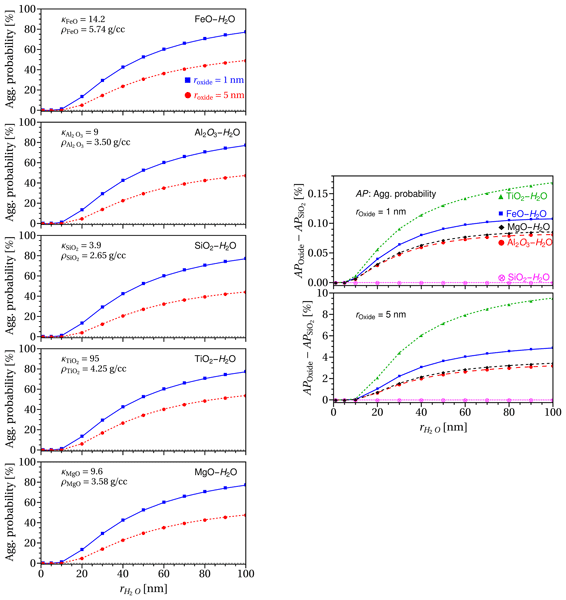
Abstract. The increase in satellite launches raises the anthropogenic influx of various elements into the Mesosphere and Lower Thermosphere (MLT), comparable to the natural influx caused by meteoric ablation. This study investigates the electrostatic interactions between ice particles and remnants of space debris using a classical electrostatic framework. Aside from the Coulomb interaction, the attractive force between two particles at short distances, arising from polarization, is taken into account. Collision outcomes, the effective velocity regime for collisions, and the subsequent aggregation probability are estimated. Aggregation is limited to a specific range of collision velocities between minimum and maximum values. This range varies depending on factors such as particle size, mass density, and dielectric constant. For most particles, the aggregation velocities range from a few m s-1 to several tens of m s-1, where smaller particles may need significantly higher velocities to form stable aggregates. When considering the collisions of particles in thermal motion, it is found that Al2O3 (due to its greater abundance) and TiO2 (due to its higher dielectric constant), both originating from anthropogenic sources, may dominate in the formation of ice-anthropogenic particle aggregates. In the MLT region, the formation of stable aggregates from the collision of ice with particles from space debris, which one may denote as anthropogenic smoke particles (ASPs), is similar to that from collisions with meteoric smoke particles (MSPs).
-
Notice on discussion status
The requested preprint has a corresponding peer-reviewed final revised paper. You are encouraged to refer to the final revised version.
-
Preprint
(3495 KB)
-
The requested preprint has a corresponding peer-reviewed final revised paper. You are encouraged to refer to the final revised version.
- Preprint
(3495 KB) - Metadata XML
- BibTeX
- EndNote
- Final revised paper


Journal article(s) based on this preprint
Interactive discussion
Status: closed
-
RC1: 'Comment on egusphere-2026-2931', Anonymous Referee #1, 26 Jun 2026
- AC1: 'Reply on RC1', Trinesh Sana, 11 Sep 2026
-
RC2: 'Comment on egusphere-2026-2931', Lorin S. Matthews, 28 Jul 2026
This study considers the effect of charging on the aggregation of ice and several types of metal oxides in the mesosphere/lower thermosphere region of earth’s atmosphere. The oxides are chosen to be the primary oxides expected to be injected into earth’s atmosphere from debris from orbiting satellites re-entering the atmosphere. The study focuses on the probability of collisions of two spherical particles leading to sticking, based on the polarization induced as a charged particle approaches a neutral particle, or when two like-charged particles approach each other. The authors find that the type of oxide has a small effect on the collision results (due to the variation in the dielectric constants of the materials), but there is a significant size selection effect. These results are interesting and serve as the basis for further analysis of the effects of the increased injection of anthropogenic meteoric particles in the atmosphere. The manuscript’s utility could be improved by considering additional charging cases and suggesting possible implications for the size selectivity.
A few considerations for improvement are detailed below.
Scientific questions
1. “For the case of fixed singly negative charge ice and oxides with (rH2O = 1 nm, rOxide = 1 nm) and (rH2O =5 nm, rOxide =5 nm), we observed that ECoul ≈E0 for all the metal oxides. For these cases, the polarization effect is not strong enough to create the attractive energy well. Aggregation is not possible in these cases.” Polarization can’t create an attractive energy well, but might there be another mechanism for creating the binding energy if the collision energy is sufficient to overcome the coulomb repulsion barrier? When do van der Waals forces start to kick in? Some of this is taken into account by the coefficient of restitution. Can you elaborate on this further? What about contact electrification resulting from the collision, even if it doesn’t result in a bound aggregate?
2. This study only considers collisions between two spheres. In this case, the aggregates formed are dimers –further growth of the aggregate particles is not examined. Even considering the dimers as new spherical particles, is there a way to estimate the continued growth or maximum size of aggregate particles? Of course, the polarization of an aggregate dimer will be more difficult to calculate and the aggregation resulting in a trimer will be direction-dependent.
3. How does the growth of anthropogenic space debris particles compare with the growth of MSPs? Does the incorporation of a metal oxide in the aggregate increase the likelihood of further growth of the ice particle?
4. Given the aggregation probability reported, how will this affect processes in the mesosphere/lower thermosphere region? How will it affect charge balance, transport and growth, and ice particle formation, compared with current conditions associated with MSPs? What is the significance for preferentially large particles being aggregated (in the case of like charged particles) or for preferentially small particles aggregating (in the case of a charged particle and a neutral particle)?
5. The results were presented for a charge on the ice particles of 1e-. Since the charging is a stochastic process, there is a significant probably for either particle to have a charge of 2e-. or e+. How will this change the results?
Technical comments:
- “The framework presented in Bichoutskaia et al. (2010) has been utilized to derive the electrostatic interaction energy between charged ice and various oxides. The basic equations to derive ECoul and E0 have been solved using the method explained in Brazil Lindgren (2017).” Can you give a one-sentence description of the method? I was unfamiliar with these works and had to read the articles to figure out what was being done.
- Figure 2 – authors note that FeO has lowest values of u_min and u_max while SiO2 has highest values of u_min and u_max. It is very difficult to distinguish the differences on the five panels in Figure 2 – is there another way to show the variation in the data? Perhaps show the data for for FeO or SiO2, then in a separate panel show the data for the other oxides normalized by u_min and u_max for FeO or SiO2. This scheme could also be used for Figs. 3 – 5 and would better illustrate the differences between the data presented in the tables in the Appendices. (It would be helpful to give the dielectric constant on each subplot (along with the name of the oxide) and to arrange the subplots and the data in Table I in ascending or descending order in the dielectric constant.)
This study brought to mind other papers I read on size-segregation and increased collision probability due to triboelectric charging. These papers might be applicable to this study:
Aerodynamic generation of electric fields in turbulence laden with charged inertial particles, Nature communication, vol 9, 1676 (2018)
D.R. Johnson, A. Bocanski, E.M. Diorio, J. Chen, & H. Meng, Amplification of particle collision through contact electrification in isotropic turbulence, Proc. Natl. Acad. Sci. U.S.A. 122 (38) e2507580122, https://doi.org/10.1073/pnas.2507580122 (2025).
Citation: https://doi.org/10.5194/egusphere-2026-2931-RC2 - AC2: 'Reply on RC2', Trinesh Sana, 11 Sep 2026
Peer review completion


Interactive discussion
Status: closed
-
RC1: 'Comment on egusphere-2026-2931', Anonymous Referee #1, 26 Jun 2026
This manuscript applies a classical electrostatic theory to the collision and aggregation of charged mesospheric ice particles with anthropogenic smoke particles (ASPs) originating from re-entering space debris, deriving the minimum and maximum relative velocities that permit stable aggregate formation. The authors then use this to show that abundant or high-dielectric anthropogenic oxides such as Al₂O₃ and TiO₂ are likely to dominate aggregate formation, an interesting finding that can tell experimentalists what to look for. The study is timely and clearly written, and I recommend publication after consideration of the following minor comments.
Minor comments
- Abstract (line 4): Add a note of caution about the extent to which classical electrostatic theory can be applied to such small particles.
- Abstract (line 8): Clarify what is meant by "aggregation velocities." The meaning becomes clear after reading the article, but it is unclear in the abstract.
- Lines 67–69: The statement that particles with charges of the same sign can experience a strong attractive interaction is confusing on first reading. Make clearer that this arises from polarisation, and that it concerns composed particles. Consider phrasing it as "two uncharged particles, or even two particles of the same charge."
- Lines 84–86: Explain and justify this assumption better.
- Line 90: Change "usually" to "is believed to," or add a reference.
- Line 123: Briefly explain what the coefficient of restitution is.
- Figure 1: Consider labelling the x-axis "separation distance" rather than just "s."
- Figure 2: Consider adding a panel for the colors; show the minimum-to-maximum velocity range as a band rather than two differently coloured lines.
- Figure 2 (caption, lines 95–96): State clearly that we do not know what sizes ASPs may have, so 1 and 5 nm are assumptions. Some limits might be obtained from the sedimentation velocity and the amount of incoming material, so these values are reasonable — but it should still be made clear that the actual sizes are unknown.
Citation: https://doi.org/10.5194/egusphere-2026-2931-RC1 - AC1: 'Reply on RC1', Trinesh Sana, 11 Sep 2026
-
RC2: 'Comment on egusphere-2026-2931', Lorin S. Matthews, 28 Jul 2026
This study considers the effect of charging on the aggregation of ice and several types of metal oxides in the mesosphere/lower thermosphere region of earth’s atmosphere. The oxides are chosen to be the primary oxides expected to be injected into earth’s atmosphere from debris from orbiting satellites re-entering the atmosphere. The study focuses on the probability of collisions of two spherical particles leading to sticking, based on the polarization induced as a charged particle approaches a neutral particle, or when two like-charged particles approach each other. The authors find that the type of oxide has a small effect on the collision results (due to the variation in the dielectric constants of the materials), but there is a significant size selection effect. These results are interesting and serve as the basis for further analysis of the effects of the increased injection of anthropogenic meteoric particles in the atmosphere. The manuscript’s utility could be improved by considering additional charging cases and suggesting possible implications for the size selectivity.
A few considerations for improvement are detailed below.
Scientific questions
1. “For the case of fixed singly negative charge ice and oxides with (rH2O = 1 nm, rOxide = 1 nm) and (rH2O =5 nm, rOxide =5 nm), we observed that ECoul ≈E0 for all the metal oxides. For these cases, the polarization effect is not strong enough to create the attractive energy well. Aggregation is not possible in these cases.” Polarization can’t create an attractive energy well, but might there be another mechanism for creating the binding energy if the collision energy is sufficient to overcome the coulomb repulsion barrier? When do van der Waals forces start to kick in? Some of this is taken into account by the coefficient of restitution. Can you elaborate on this further? What about contact electrification resulting from the collision, even if it doesn’t result in a bound aggregate?
2. This study only considers collisions between two spheres. In this case, the aggregates formed are dimers –further growth of the aggregate particles is not examined. Even considering the dimers as new spherical particles, is there a way to estimate the continued growth or maximum size of aggregate particles? Of course, the polarization of an aggregate dimer will be more difficult to calculate and the aggregation resulting in a trimer will be direction-dependent.
3. How does the growth of anthropogenic space debris particles compare with the growth of MSPs? Does the incorporation of a metal oxide in the aggregate increase the likelihood of further growth of the ice particle?
4. Given the aggregation probability reported, how will this affect processes in the mesosphere/lower thermosphere region? How will it affect charge balance, transport and growth, and ice particle formation, compared with current conditions associated with MSPs? What is the significance for preferentially large particles being aggregated (in the case of like charged particles) or for preferentially small particles aggregating (in the case of a charged particle and a neutral particle)?
5. The results were presented for a charge on the ice particles of 1e-. Since the charging is a stochastic process, there is a significant probably for either particle to have a charge of 2e-. or e+. How will this change the results?
Technical comments:
- “The framework presented in Bichoutskaia et al. (2010) has been utilized to derive the electrostatic interaction energy between charged ice and various oxides. The basic equations to derive ECoul and E0 have been solved using the method explained in Brazil Lindgren (2017).” Can you give a one-sentence description of the method? I was unfamiliar with these works and had to read the articles to figure out what was being done.
- Figure 2 – authors note that FeO has lowest values of u_min and u_max while SiO2 has highest values of u_min and u_max. It is very difficult to distinguish the differences on the five panels in Figure 2 – is there another way to show the variation in the data? Perhaps show the data for for FeO or SiO2, then in a separate panel show the data for the other oxides normalized by u_min and u_max for FeO or SiO2. This scheme could also be used for Figs. 3 – 5 and would better illustrate the differences between the data presented in the tables in the Appendices. (It would be helpful to give the dielectric constant on each subplot (along with the name of the oxide) and to arrange the subplots and the data in Table I in ascending or descending order in the dielectric constant.)
This study brought to mind other papers I read on size-segregation and increased collision probability due to triboelectric charging. These papers might be applicable to this study:
Aerodynamic generation of electric fields in turbulence laden with charged inertial particles, Nature communication, vol 9, 1676 (2018)
D.R. Johnson, A. Bocanski, E.M. Diorio, J. Chen, & H. Meng, Amplification of particle collision through contact electrification in isotropic turbulence, Proc. Natl. Acad. Sci. U.S.A. 122 (38) e2507580122, https://doi.org/10.1073/pnas.2507580122 (2025).
Citation: https://doi.org/10.5194/egusphere-2026-2931-RC2 - AC2: 'Reply on RC2', Trinesh Sana, 11 Sep 2026
Peer review completion
Journal article(s) based on this preprint
Viewed
| HTML | XML | Total | BibTeX | EndNote | |
|---|---|---|---|---|---|
| 144 | 100 | 35 | 279 | 25 | 35 |
- HTML: 144
- PDF: 100
- XML: 35
- Total: 279
- BibTeX: 25
- EndNote: 35
Viewed (geographical distribution)
| Country | # | Views | % |
|---|
| Total: | 0 |
| HTML: | 0 |
| PDF: | 0 |
| XML: | 0 |
- 1

Sanjay K. Mishra
The requested preprint has a corresponding peer-reviewed final revised paper. You are encouraged to refer to the final revised version.
- Preprint
(3495 KB) - Metadata XML
This manuscript applies a classical electrostatic theory to the collision and aggregation of charged mesospheric ice particles with anthropogenic smoke particles (ASPs) originating from re-entering space debris, deriving the minimum and maximum relative velocities that permit stable aggregate formation. The authors then use this to show that abundant or high-dielectric anthropogenic oxides such as Al₂O₃ and TiO₂ are likely to dominate aggregate formation, an interesting finding that can tell experimentalists what to look for. The study is timely and clearly written, and I recommend publication after consideration of the following minor comments.
Minor comments