
the Creative Commons Attribution 4.0 License.
the Creative Commons Attribution 4.0 License.
 | 04 Feb 2026
Parameter estimation of river incision models of soft sedimentary rocks – a case study on the Kamikita Coastal Plain, northeast Japan
Abstract. To predict long-term future landscape evolution, understanding of the river incision model, which is the main driver of continental erosion, is especially important. For the bedrock channel incision model (detachment-limited (DL) model: erosion rate E = KAmSn where A is drainage area, S is channel gradient, and K, m, n are parameters), parameters can be estimated by the slope-area analysis if E is known. Based on the worldwide basin-averaged denudation rates of 10Be concentrations, previous studies compiled the parameter values for variable lithology. However, the scarcity of data for the soft sedimentary rock limits the applicability of global scale compilation. In addition, measuring the 10Be concentration in sedimentary rock is difficult in humid and tectonically active regions like Japan. To address this, slope-area analysis was conducted in the Kamikita Coastal Plain, Japan, where bedrock lithology (sedimentary rocks of Miocene to Pleistocene) and uplift rate (~ 0.2 mm y−1 for the past 300 ka) are assumed to be uniform. Parameter values were estimated based on river incision rates approximately derived from marine terraces (MIS 5e, 7, 9, and 11) which are widely distributed in the area. For six target rivers, DL-like behaviour was confirmed in the limited upstream and midstream areas located upstream of the alluvium distribution. Except for small rivers of A < 25 km2, the concavity index m/n was between 0.35 and 0.6, which is the typical range for steady-state channels. The estimated exponent n was nonlinear, ranging between 1 and 2, which is consistent with the previous global compilations. This nonlinearity can be explained by past sea-level changes causing knickpoints at similar elevations. Finally, the erosion coefficient K was estimated to be 10−5~−6 m0.1 y−1. For the main lithology of late Pliocene and early Pleistocene sedimentary rock, the estimated K almost agreed with the global relationship between K and unconfined compressive strength qu (K ∝ 1/qu2), supporting the significant influences of bedrock lithology on K.
-
Notice on discussion status
The requested preprint has a corresponding peer-reviewed final revised paper. You are encouraged to refer to the final revised version.
-
Preprint
(2499 KB)
-
The requested preprint has a corresponding peer-reviewed final revised paper. You are encouraged to refer to the final revised version.
- Preprint
(2499 KB) - Metadata XML
- BibTeX
- EndNote
- Final revised paper


Journal article(s) based on this preprint
Interactive discussion
Status: closed
- RC1: 'Comment on egusphere-2026-290', Anonymous Referee #1, 05 Mar 2026
-
RC2: 'Comment on egusphere-2026-290', Carole Petit, 06 Mar 2026
Paper Summary
The authors combine morphometric analyses with independent estimates of river incision rates (from marine terrace dating) to infer long-term erosion rates in the Kamikita peninsula in Japan.
From these analyses, they infer Stream Power Law (SPL) parameters such as the concavity index and the slope exponent n, which appears to be different from 1, implying a non-linear dependency of erosion rate on channel slope. Moreover, this study allows them to quantify bedrock erodibility, and hence to constrain all parameters that can be used to model long-term landscape erosion with the SPL.
Remarks
The approach combining independent morphometric analyses and river incision rate estimates from ¹⁰Be dating of marine terraces is interesting. The paper is well written and well illustrated; however, it lacks some discussion on the impact of the chosen methodology on the results. I think it can be accepted after a round of moderate to major revisions. Here are my comments:
- I don't understand why the paper opens with a statement on the importance of erosion estimates for nuclear waste disposal. I am well aware that erosion can be a threat to the safety of waste disposal sites, but over time periods of 100 ka to 1 Ma, there can be many other parameters that will modulate erosion rates, such as climate and sea-level changes. I think that such erodibility estimates are valid only for a short period of time, corresponding to the present-day situation. It should not be forgotten that the K parameter in the SPL includes both bedrock erodibility and external factors such as precipitation rates.
- Why did you choose to examine only the east-draining rivers, which seem to have a short detachment-limited portion, and not the west-draining ones, which are shorter and presumably steeper? The lithology appears to be similar and marine terraces are also present on the western side.
- The R coefficient of the chi-plot seems almost insensitive to variations in the concavity index theta (Figure 5), varying only between 0.95 and 1 for theta between 0 and 1. In my opinion, this reveals that the theta value is poorly constrained. Furthermore, if slope-break knickpoints are present in the channel profiles, a more sophisticated method should be used, with several line segments in the chi plot to infer the theta value while accounting for the different segments (https://lsdtopotools.github.io/LSDTT_documentation/LSDTT_chi_analysis.html). Ideally, the regional theta value should not be the average of individual estimates, but should instead be inferred by inversion from all channels together.
- I would like to see a comparison of ksn estimates between the values computed with the average theta and those computed with the individual theta values from each river.
Minor Comments
It is difficult to distinguish between vertical-step and slope-break knickpoints in Figure 3a.
Figure 7: please explain what the dashed curve represents.
Citation: https://doi.org/10.5194/egusphere-2026-290-RC2 -
AC1: 'Author responses to the referee comments', Shizuka Takai, 24 Apr 2026
Thank you very much for your thoughtful and constructive comments on our manuscript.
We have carefully considered all the reviewers' comments and have revised the manuscript accordingly.
This letter serves as a general response to all reviewers. In addition, we have prepared detailed response letters addressing the comments from each reviewer individually.We kindly ask you to review these responses at your convenience.
Peer review completion


Interactive discussion
Status: closed
-
RC1: 'Comment on egusphere-2026-290', Anonymous Referee #1, 05 Mar 2026
# Review Summary
This manuscript provides valuable estimates of the river incision parameters n and K for soft sedimentary rocks, a lithology that is often underrepresented in global geomorphological datasets. The use of marine terrace ages as a proxy for long-term river incision rates (E) is an interesting alternative to the cosmogenic-radionuclide-based approaches used in previous studies to contruct ksn-erosion relationships. However, the manuscript requires major revisions to address a lack of methodological detail, unproven assumptions regarding knickpoint morphology, and insufficient clarity regarding the role of sea-level fluctuations.
---
## Major Comments
### 1. Transparency of the ksn–Erosion Derivation
The methodology for relating ksn to erosion rates (Sect. 4.2) is central to the parameter estimation, yet it lacks necessary detail.
- Location for sampling sites: In Figure 7, multiple data points of the same color represent different sections/reaches of a single river. The authors must explicitly describe and map the individual sites where these reach-scale incision rates were measured (e.g., following the format of Figure 1 in Leonard et al., 2023).
Leonard, J.S., Whipple, K.X., and Heimsath, A.M., 2023, Controls on topography and erosion of the north-central Andes: Geology, doi:10.1130/G51618.1.
- Uncertainty consideration: Since incision rates (E) are derived from marine terrace heights (zt - zr - d) over time (Tt), any variation in tephra thickness (d) or terrace degradation introduces significant error. A formal uncertainty analysis for the regression in Figure 7 is required to assess the reliability of the resulting n and K values.
### 2. Evidence for "Slope-Break" Knickpoints
The authors categorize the extracted knickpoints as "slope-break" type to argue for persistent incision driven by base-level fall.
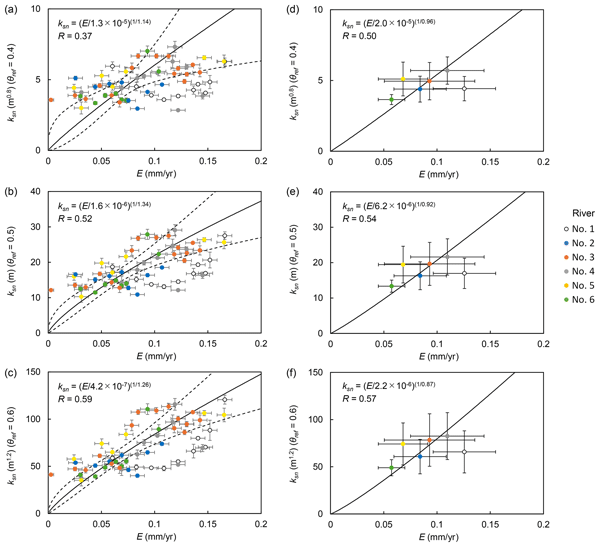
- Missing analysis: Theoretically, slope-break knickpoints manifest as distinct changes in the slope of the slope-area curve (Figure 3b). However, no such shifts are clearly visible or quantitatively analyzed in the provided plots (Figure 4b).
- Extraction method: The current method of using local minimums of ksn with respect to chi can locate knickpoints but does not differentiate morphology-based knickpoint types, i.e. slope-break vs vertical step knickpoints. Without statistical or graphical proof of a slope change, these features could be vertical-step knickpoints highly relevant to simple lithological transitions.
### 3. Mechanism of Nonlinearity (n)
The authors suggest that sea-level fluctuations account for the nonlinear relationship (n = 1.54) between ksn and E.
Conceptual gap: The authors must explain the physical mechanism by which transient knickpoints from sea-level change result in a higher n value. Specifically, they should clarify if n > 1 is a result from the sea-level signal itself rather than an intrinsic physics of river incision process.
## Minor Comments
Line 28-29: Provide a citation for river incision as a primary driver of vertical erosion.
Line 43-45: Provide a citation for the statement regarding parameter estimation from field data and the DL model.
Line 63-65: The connection between "safe waste transportation" and geological disposal is unclear. Clarify if the motivation is assessing the geological stability of the disposal site against future erosion, and specify the timeframe (e.g., "since the Late Quaternary").
Line 123-128: In the context of Figure 3, the motivation for focusing exclusively on slope-break knickpoints should be described in a separate paragraph.
Line 144-147: Clarify if the same analytical steps from previous research were followed. Additional details on how DEM-generated errors were avoided are necessary.
Line 147-148: Clarify how the specific measurement errors for DEM5A/B/C were derived.
Line 158-159: The regression ln(E) = a ln(ksn) + b is a standard derivation of the stream power law but requires a citation (e.g., Leonard et al., 2023). Detailed equations should be introduced in the Methods section.
Line 196: The statement that "θ is approximately 0.4" is contradicted by River No. 2, which has a reported concavity of θ = 0.59.
Line 211-213: The authors attribute knickpoints to base-level fall. They should specify if this is related to eustatic sea-level changes or accelerated incision. Eustatic changes do not necessarily lead to upstream-propagating transient knickpoints; the authors should add explicit evidence of slope-break changes.
Line 306-308: Elaborate on the "benefits" for radioactive waste disposal. For instance, explain how confining K and n allows for the prediction of maximum erosion depth over a 100,000-year safety assessment period.
Citation: https://doi.org/10.5194/egusphere-2026-290-RC1 -
RC2: 'Comment on egusphere-2026-290', Carole Petit, 06 Mar 2026
Paper Summary
The authors combine morphometric analyses with independent estimates of river incision rates (from marine terrace dating) to infer long-term erosion rates in the Kamikita peninsula in Japan.
From these analyses, they infer Stream Power Law (SPL) parameters such as the concavity index and the slope exponent n, which appears to be different from 1, implying a non-linear dependency of erosion rate on channel slope. Moreover, this study allows them to quantify bedrock erodibility, and hence to constrain all parameters that can be used to model long-term landscape erosion with the SPL.
Remarks
The approach combining independent morphometric analyses and river incision rate estimates from ¹⁰Be dating of marine terraces is interesting. The paper is well written and well illustrated; however, it lacks some discussion on the impact of the chosen methodology on the results. I think it can be accepted after a round of moderate to major revisions. Here are my comments:
- I don't understand why the paper opens with a statement on the importance of erosion estimates for nuclear waste disposal. I am well aware that erosion can be a threat to the safety of waste disposal sites, but over time periods of 100 ka to 1 Ma, there can be many other parameters that will modulate erosion rates, such as climate and sea-level changes. I think that such erodibility estimates are valid only for a short period of time, corresponding to the present-day situation. It should not be forgotten that the K parameter in the SPL includes both bedrock erodibility and external factors such as precipitation rates.
- Why did you choose to examine only the east-draining rivers, which seem to have a short detachment-limited portion, and not the west-draining ones, which are shorter and presumably steeper? The lithology appears to be similar and marine terraces are also present on the western side.
- The R coefficient of the chi-plot seems almost insensitive to variations in the concavity index theta (Figure 5), varying only between 0.95 and 1 for theta between 0 and 1. In my opinion, this reveals that the theta value is poorly constrained. Furthermore, if slope-break knickpoints are present in the channel profiles, a more sophisticated method should be used, with several line segments in the chi plot to infer the theta value while accounting for the different segments (https://lsdtopotools.github.io/LSDTT_documentation/LSDTT_chi_analysis.html). Ideally, the regional theta value should not be the average of individual estimates, but should instead be inferred by inversion from all channels together.
- I would like to see a comparison of ksn estimates between the values computed with the average theta and those computed with the individual theta values from each river.
Minor Comments
It is difficult to distinguish between vertical-step and slope-break knickpoints in Figure 3a.
Figure 7: please explain what the dashed curve represents.
Citation: https://doi.org/10.5194/egusphere-2026-290-RC2 -
AC1: 'Author responses to the referee comments', Shizuka Takai, 24 Apr 2026
Thank you very much for your thoughtful and constructive comments on our manuscript.
We have carefully considered all the reviewers' comments and have revised the manuscript accordingly.
This letter serves as a general response to all reviewers. In addition, we have prepared detailed response letters addressing the comments from each reviewer individually.We kindly ask you to review these responses at your convenience.
Peer review completion
Journal article(s) based on this preprint
Viewed
| HTML | XML | Total | BibTeX | EndNote | |
|---|---|---|---|---|---|
| 1,119 | 503 | 85 | 1,707 | 307 | 252 |
- HTML: 1,119
- PDF: 503
- XML: 85
- Total: 1,707
- BibTeX: 307
- EndNote: 252
Viewed (geographical distribution)
| Country | # | Views | % |
|---|
| Total: | 0 |
| HTML: | 0 |
| PDF: | 0 |
| XML: | 0 |
- 1
Tomoji Sanga
Taro Shimada
Seiji Takeda
The requested preprint has a corresponding peer-reviewed final revised paper. You are encouraged to refer to the final revised version.
- Preprint
(2499 KB) - Metadata XML
# Review Summary
This manuscript provides valuable estimates of the river incision parameters n and K for soft sedimentary rocks, a lithology that is often underrepresented in global geomorphological datasets. The use of marine terrace ages as a proxy for long-term river incision rates (E) is an interesting alternative to the cosmogenic-radionuclide-based approaches used in previous studies to contruct ksn-erosion relationships. However, the manuscript requires major revisions to address a lack of methodological detail, unproven assumptions regarding knickpoint morphology, and insufficient clarity regarding the role of sea-level fluctuations.
---
## Major Comments
### 1. Transparency of the ksn–Erosion Derivation
The methodology for relating ksn to erosion rates (Sect. 4.2) is central to the parameter estimation, yet it lacks necessary detail.
- Location for sampling sites: In Figure 7, multiple data points of the same color represent different sections/reaches of a single river. The authors must explicitly describe and map the individual sites where these reach-scale incision rates were measured (e.g., following the format of Figure 1 in Leonard et al., 2023).
Leonard, J.S., Whipple, K.X., and Heimsath, A.M., 2023, Controls on topography and erosion of the north-central Andes: Geology, doi:10.1130/G51618.1.
- Uncertainty consideration: Since incision rates (E) are derived from marine terrace heights (zt - zr - d) over time (Tt), any variation in tephra thickness (d) or terrace degradation introduces significant error. A formal uncertainty analysis for the regression in Figure 7 is required to assess the reliability of the resulting n and K values.
### 2. Evidence for "Slope-Break" Knickpoints
The authors categorize the extracted knickpoints as "slope-break" type to argue for persistent incision driven by base-level fall.
- Missing analysis: Theoretically, slope-break knickpoints manifest as distinct changes in the slope of the slope-area curve (Figure 3b). However, no such shifts are clearly visible or quantitatively analyzed in the provided plots (Figure 4b).
- Extraction method: The current method of using local minimums of ksn with respect to chi can locate knickpoints but does not differentiate morphology-based knickpoint types, i.e. slope-break vs vertical step knickpoints. Without statistical or graphical proof of a slope change, these features could be vertical-step knickpoints highly relevant to simple lithological transitions.
### 3. Mechanism of Nonlinearity (n)
The authors suggest that sea-level fluctuations account for the nonlinear relationship (n = 1.54) between ksn and E.
Conceptual gap: The authors must explain the physical mechanism by which transient knickpoints from sea-level change result in a higher n value. Specifically, they should clarify if n > 1 is a result from the sea-level signal itself rather than an intrinsic physics of river incision process.
## Minor Comments
Line 28-29: Provide a citation for river incision as a primary driver of vertical erosion.
Line 43-45: Provide a citation for the statement regarding parameter estimation from field data and the DL model.
Line 63-65: The connection between "safe waste transportation" and geological disposal is unclear. Clarify if the motivation is assessing the geological stability of the disposal site against future erosion, and specify the timeframe (e.g., "since the Late Quaternary").
Line 123-128: In the context of Figure 3, the motivation for focusing exclusively on slope-break knickpoints should be described in a separate paragraph.
Line 144-147: Clarify if the same analytical steps from previous research were followed. Additional details on how DEM-generated errors were avoided are necessary.
Line 147-148: Clarify how the specific measurement errors for DEM5A/B/C were derived.
Line 158-159: The regression ln(E) = a ln(ksn) + b is a standard derivation of the stream power law but requires a citation (e.g., Leonard et al., 2023). Detailed equations should be introduced in the Methods section.
Line 196: The statement that "θ is approximately 0.4" is contradicted by River No. 2, which has a reported concavity of θ = 0.59.
Line 211-213: The authors attribute knickpoints to base-level fall. They should specify if this is related to eustatic sea-level changes or accelerated incision. Eustatic changes do not necessarily lead to upstream-propagating transient knickpoints; the authors should add explicit evidence of slope-break changes.
Line 306-308: Elaborate on the "benefits" for radioactive waste disposal. For instance, explain how confining K and n allows for the prediction of maximum erosion depth over a 100,000-year safety assessment period.