
the Creative Commons Attribution 4.0 License.
the Creative Commons Attribution 4.0 License.
 | 04 Jun 2026
Storm-Modulated Submesoscale Dynamics over Sloping Topography in a Wind-Driven, Non-Tidal Basin
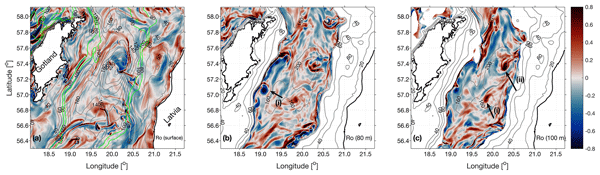
Abstract. While ocean surface submesoscales have been extensively studied, their counterparts in the bottom boundary layer (BBL) remain little explored. These subsurface features, however, appear to play a key role in (i) boundary-interior exchange, (ii) forward energy cascade, and (iii) turbulent boundary mixing, which is an important driver of the overturning circulation. Since submesoscales primarily arise through flow-topography interactions, recent studies have focused on their genesis in the open ocean, particularly in regions where strong, relatively steady currents flow over steep slopes. Here, we use the Baltic Sea as a natural laboratory to show that submesoscales are widespread even in semi-enclosed basins, far from major current systems, in regions where tides are virtually absent, and ephemeral wind-driven currents typically dominate. Using high-resolution numerical simulations, we demonstrate that surface and subsurface submesoscales can coexist, with the latter being especially prominent near the lateral boundaries. Strong ageostrophic features emanate from the boundaries and are accompanied by potential vorticity anomalies, indicating regions prone to instabilities. Oppositely signed vorticity is typically found at either side of the basin, intensifying locally during strong winds. By analyzing a series of sequential storm events with opposing winds, we show that variability in wind direction is important in determining the submesoscale generation sites and mixing hotspots. Wind reversals reverse the regional circulation and lead to alternating vorticity signals within the BBL, suggesting that the submesoscale generation sites and mixing hotspots exhibit transient behavior. Our findings highlight the previously unrecognized, broader significance of storm-modulated submesoscales in wind-driven marine and limnic systems, extending their relevance beyond the Baltic Sea.
-
Notice on discussion status
The requested preprint has a corresponding peer-reviewed final revised paper. You are encouraged to refer to the final revised version.
-
Preprint
(9494 KB)
-
The requested preprint has a corresponding peer-reviewed final revised paper. You are encouraged to refer to the final revised version.
- Preprint
(9494 KB) - Metadata XML
- BibTeX
- EndNote
- Final revised paper


Journal article(s) based on this preprint
Interactive discussion
Status: closed
-
RC1: 'Comment on egusphere-2026-2878', Anonymous Referee #1, 12 Jun 2026
-
AC1: 'Reply on RC1 and RC2', Evridiki Chrysagi, 03 Sep 2026
The comment was uploaded in the form of a supplement: https://egusphere.copernicus.org/preprints/2026/egusphere-2026-2878/egusphere-2026-2878-AC1-supplement.pdf
-
AC1: 'Reply on RC1 and RC2', Evridiki Chrysagi, 03 Sep 2026
-
RC2: 'Comment on egusphere-2026-2878', Anonymous Referee #2, 29 Jul 2026
The comment was uploaded in the form of a supplement: https://egusphere.copernicus.org/preprints/2026/egusphere-2026-2878/egusphere-2026-2878-RC2-supplement.pdf
-
AC2: 'Reply on RC1 and RC2', Evridiki Chrysagi, 03 Sep 2026
The comment was uploaded in the form of a supplement: https://egusphere.copernicus.org/preprints/2026/egusphere-2026-2878/egusphere-2026-2878-AC2-supplement.pdf
-
AC2: 'Reply on RC1 and RC2', Evridiki Chrysagi, 03 Sep 2026
Peer review completion


Interactive discussion
Status: closed
-
RC1: 'Comment on egusphere-2026-2878', Anonymous Referee #1, 12 Jun 2026
-
AC1: 'Reply on RC1 and RC2', Evridiki Chrysagi, 03 Sep 2026
The comment was uploaded in the form of a supplement: https://egusphere.copernicus.org/preprints/2026/egusphere-2026-2878/egusphere-2026-2878-AC1-supplement.pdf
-
AC1: 'Reply on RC1 and RC2', Evridiki Chrysagi, 03 Sep 2026
-
RC2: 'Comment on egusphere-2026-2878', Anonymous Referee #2, 29 Jul 2026
The comment was uploaded in the form of a supplement: https://egusphere.copernicus.org/preprints/2026/egusphere-2026-2878/egusphere-2026-2878-RC2-supplement.pdf
-
AC2: 'Reply on RC1 and RC2', Evridiki Chrysagi, 03 Sep 2026
The comment was uploaded in the form of a supplement: https://egusphere.copernicus.org/preprints/2026/egusphere-2026-2878/egusphere-2026-2878-AC2-supplement.pdf
-
AC2: 'Reply on RC1 and RC2', Evridiki Chrysagi, 03 Sep 2026
Peer review completion
Journal article(s) based on this preprint
Viewed
| HTML | XML | Total | BibTeX | EndNote | |
|---|---|---|---|---|---|
| 155 | 110 | 34 | 299 | 25 | 24 |
- HTML: 155
- PDF: 110
- XML: 34
- Total: 299
- BibTeX: 25
- EndNote: 24
Viewed (geographical distribution)
| Country | # | Views | % |
|---|
| Total: | 0 |
| HTML: | 0 |
| PDF: | 0 |
| XML: | 0 |
- 1
Evridiki Chrysagi

Lars Umlauf
Ulf Gräwe
Hans Burchard
Alberto C. Naveira Garabato
The requested preprint has a corresponding peer-reviewed final revised paper. You are encouraged to refer to the final revised version.
- Preprint
(9494 KB) - Metadata XML
see attached pdf