
the Creative Commons Attribution 4.0 License.
the Creative Commons Attribution 4.0 License.
 | 11 Jun 2026
Planetary Albedo Change Exacerbates Surface Warming: A Perspective From Cloud Transition
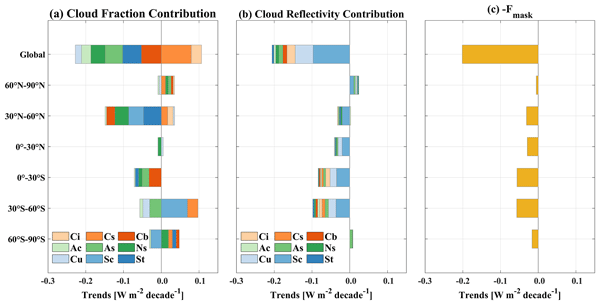
Abstract. Persistent global warming is modulated by cloud changes, yet the specific contributions and mechanisms remain inadequately quantified. Using CERES radiation data with a surface energy-balance framework, we quantify the contribution of cloud radiative changes to decadal surface temperature trends over 2002–2023. Cloud changes exert a weak net effect on global mean warming due to near-cancellation between shortwave warming and longwave cooling, but strongly modulate its spatial pattern. Specifically, clouds enhance warming in low- and mid-latitudes while mitigating warming at high latitudes. This pattern is driven by systematic transitions from low-/mid- to high-level optically thin clouds, which reduce planetary albedo and weaken cloud longwave emission. These changes exhibit hemispheric difference. In 30–60°N, the region contributing most to global warming, the decline in the cloud-reflected solar radiation is mainly driven by decreased cloud fraction, linked to elevated sea surface temperatures, aerosol reductions, and mid‑tropospheric drying. In 30–60°S, reduced cloud reflectivity resulting from decreased cloud optical thickness and increased liquid droplet radius dominates, partly offset by shifts from cumulus to stratocumulus. However, at high latitudes in both hemispheres, increased mid-/high-clouds and enhanced cloud reflectivity, driven by enhanced moisture, upper-tropospheric static stability and increased cloud optical thickness, lead to greater reflected solar radiation and reduced downwelling longwave radiation, thereby attenuating local warming. Our results establish a direct observational link between cloud transitions, planetary albedo decline, and spatially heterogeneous warming, providing a constraint on cloud feedbacks in recent climate change.
-
Notice on discussion status
The requested preprint has a corresponding peer-reviewed final revised paper. You are encouraged to refer to the final revised version.
-
Preprint
(1777 KB)
-
Supplement
(850 KB)
-
The requested preprint has a corresponding peer-reviewed final revised paper. You are encouraged to refer to the final revised version.
- Preprint
(1777 KB) - Metadata XML
-
Supplement
(850 KB) - BibTeX
- EndNote
- Final revised paper


Journal article(s) based on this preprint
Interactive discussion
Status: closed
-
RC1: 'Comment on egusphere-2026-2875', Anonymous Referee #1, 08 Jul 2026
- AC1: 'Reply on RC1', Ruixue Li, 18 Jul 2026
-
RC2: 'Comment on egusphere-2026-2875', Anonymous Referee #2, 26 Jul 2026
In this paper, Li et al. quantify the contribution of cloud radiative changes to decadal surface temperature trends over 2002–2023 using CERES radiation data with a surface energy-balance framework, and aim to establish a direct observational link between cloud transitions, planetary albedo decline, and spatially heterogeneous warming. The authors suggest that cloud changes strongly modulate the spatial pattern of surface warming by enhancing warming in low- and mid-latitudes while mitigating warming at high latitudes. The abstract claims that the work provides a constraint on cloud feedbacks in recent climate change.
However, the work fails to attribute cloud radiative changes during 2002–2023 to different forcing and feedback processes, and the work could not be used to constrain cloud feedbacks in recent climate change, as is claimed in the last sentence of the abstract. Therefore, substantial revisions are required before the paper be accepted for publication.
Specific comments:
- The trend of cloud radiative effect is not affected by cloud feedback alone, so the trend analyses in work could not provide a constraint on cloud feedbacks in recent climate change. The trend of CRE is affected by: (1) Cloud-aerosol interactions. (2) Rapid adjustment to changes in the concentration of greenhouse gases. (3) Effect of decadal and interdecadal oscillations. (4) Cloud feedback on global warming. Most of the meteorological factors listed in Fig. 6 are affected by all of these four factors, so the current trend analyses are not sufficient to constrain cloud feedback.
- The longwave component of the masking effect has not been removed, although the shortwave component of the masking effect has been removed according to Eq. (15). Under global warming, the masking effect have an important impact on LWCRE trends.
- The spatial pattern of cloud-induced warming is emphasized in the abstract. However, there is no figure showing the spatial pattern of cloud-induced warming in the paper. All figures show the trends in 6 zonal belts, but the phrase “spatial pattern” usually include information in both zonal and meridional directions.
- The systematic transitions from low-/mid- to high-level clouds, which have already been identified in previous studies, was not quantitatively linked to the trend of LW cloud radiative changes in this study.
Citation: https://doi.org/10.5194/egusphere-2026-2875-RC2 - AC2: 'Reply on RC2', Ruixue Li, 02 Aug 2026
Peer review completion


Interactive discussion
Status: closed
-
RC1: 'Comment on egusphere-2026-2875', Anonymous Referee #1, 08 Jul 2026
Review of: “Planetary Albedo Change Exacerbates Surface Warming: A Perspective From Cloud Transition”, Li et al.
This study focuses on observed changes in surface and top-of-atmosphere radiation budgets over the observational record provided by CERES EBAF, focusing on cloud-driven changes. The authors use a surface energy balance framework to decompose contributions to surface warming by cloud properties (fraction and reflectivity, SW and LW cloud radiative effects) and clear-sky radiative fluxes. ERA5 reanalyses were used to assess the impact of cloud-controlling factors (CCFs), including thermodynamic and dynamic meteorological variables and one microphysical factor (AOD), on these cloud-driven radiation changes. They conclude that changes in the frequencies of occurrence for specific cloud types drive the SW component to trends in cloud radiative forcing, with reductions in albedo contributions by low- and mid-level clouds, as well as increases in high cloud cover, amplifying warming. The authors focus on a meridionally resolved regions of zonal bands and find that cloud-driven changes to polar albedo partially offset local warming at high latitudes. They identify tropospheric drying and decreasing lower tropospheric stability as primary causes of positive cloud feedbacks at lower latitudes.
The manuscript provides a very informative breakdown of cloud contributions to warming in a succinct framework, and the results comprise a valuable estimation of recent observed trends that provides further evidence and detail on the recent evolution climate feedbacks. While the results are not novel, they will have value for the fields of Earth’s energy budget and albedo studies and contribute to a growing body of literature detailing meteorological drivers of global warming. In general, the manuscript is very well written, using clear, easily read language. However, I feel that two weaknesses compromise the manuscript’s efficacy in communicating these results: one, the analysis is at times overly simplistic and lacking physical rigor in explaining results using arguments from dynamical and general circulation changes under global warming, and; two, the results and conclusions on changes in radiation balances are not discussed in the context of other publications that have either discovered or arrived at the same results. Therefore, I suggest that minor revisions be made before considering the manuscript for publication. For these concerns, reframing and more thoroughly referencing and relating the findings to the existing literature about dynamical/circulation, emissions, and aerosol evolution, which is mostly in agreement with the study’s findings, would help. Please see my comments below for suggestions to address these.
Major comments
Especially since the manuscript utilizes a combined Results and Discussion section format, the body requires more referencing to remain fair to the existing body of literature. Without this, the study risks framing the findings as new and unknown rather than complementary evidence confirming or clarifying previous findings. In the following subitems for this comment, I refer to specific parts of the manuscript where I felt this applies:
- L331: This is a very good thing to point out but I think it requires more references, as it is not a new finding and has been shown in previous studies. For example, it aligns nicely with conclusions of Sledd and L’ecuyer (2020).
- L355-356: The supplementary figure only shows the trends in downwelling SW flux at the surface, but no causal evidence for aerosol- and water vapor-driven extinction are shown in the manuscript. The authors could say that it offsets a reduction in downwelling SW radiation at the surface, but provide more references in addition to Li et al. (2024b). Also, Fig. S3a should be referenced before and separately from the references supporting the explanation for drivers.
- L386-389: This needs some further references to other studies explaining the effect. If speculative explanations are discussed, these should be placed in the context of current literature, and formulated clearly framing them as possible explanations.
- L475-476: The authors are implicating CF-AOD coupling and show neat results clearly substantiating the importance of aerosol impacts on cloud lifetime. This should be explicitly stated and referred to other studies (e.g. Twomey, 1974, 1977 and more recent; perhaps also the SLCF chapter of IPCC AR6, Szopa et al., 2023).
- L509-512: This is perhaps one of the most critical instances where discussion and referencing previous literature is needed. Why is this not discussed in the context of Hadley circulation and the large amount of literature from research into ITCZ dynamics and cloud adjustments? Neither the ITCZ or Hadley circulation are mentioned anywhere in the text. This is essentially phrasing the shift of the ITCZ as a result of dynamical CCF changes in a very disconnected way, not providing any link to the very clear general circulation argument that we know has a strong control on clouds in this region. Citations are needed to show that this result is in agreement with many others showing the migration of the ITCZ northward (e.g., Guo et al., 2026; Shrestha, Soden & He, 2026; Loeb et al., 2025), which explains the changes in dynamical CCFs shown here.
- L525-527: Again, since potential explanations are given without any new evidence, this needs citation directly after the claim. The discussion in the rest of the paragraph is good.
- L606-613: Hadas et al. (2023) showed this as well. The compensation here is not clear in the formulation; I am not sure whether the authors are talking about compensation for PA reductions, or to spatial distributions in PA, as in maintaining the hemispheric albedo symmetry (on which there is a whole body of work). Could the authors rephrase to clarify what compensations they are referring to, and refer to previous literature on compensation pathways?
- L620-621: There is a large amount of literature on the declining PA beyond Li et al. (2015). Please cite additional references from this body of work.
Minor comments
- L35: Grammar: “while also” → “and”
- L42-43: This makes it seem like the paper is framed for identifying causes rather than feedbacks, the focus of the study and manuscript.
- L90: While it is true that surface fluxes are computed, I would use “modeled” instead, as computed may imply a lack of assumptions. This would better reflect that they must be taken with respective considerations in mind.
- Table 1: I think this table could be organized better for readability, and more comprehensive to prevent the need for the reader to dig in the manuscript in order to proceed and understand the text – it might benefit from including some of the information from Table A1 here instead. The listing of variables in sentence form also makes it difficult to read, and I would suggest giving each variable a row. The name might benefit from being split into two columns, one column for the short/variable and one for the long name/brief description. Furthermore, an extra column with an example reference citing a study on the use of this variable, or review, could be really useful and make this table a more pedagogically developed tool for the purposes of the study. If this makes it too cumbersome, it may also be better to list some of the variables in the methods text with their brief descriptions and citations (where applicable), as their appearance without naming in the text is a bit jarring.
- L277: Typeset “k” in “k-th” in math mode
- Figure 1: There are a few spacing issues in subplot and axis labels; make sure there is a space after the subplot label“(a)”, “K” in the x axis label of (a), and “Trend” in the x axis label of (d).
- L392-393: “TOA longwave cloud radiation effect: use the previously defined acronym/variable for ease of reading and consistency.
- L394-396: I do not think that sufficient detail and evidence has been given up to this point for claiming that cloud vertical distribution is clearly linked to the observed trends; this comes in the next section. Thus, this appears rather out of nowhere.
- L420-423: Here comes the root and substantiation for the observed LW CRE changes mentioned before. I would also be careful to call this a regime change; the processes driving low-, mid-, and high-level clouds of the typologies included in the study are very different from those driving intra-cloud type variation, thus the regime shift is more of an entire circulation regime change rather than a cloud regime change. This may be important to differentiate since it is possible to talk about e.g. Sc-Cu regime changes, but not Sc-Ci changes, and the reader must be aware that the authors mean climate/atmospheric circulation regimes
- L443-446: I would not describe or refer to figure elements in the main text by their appearance; the circle key explanation should be left to the figure caption, and any references in the text should be to the physical quantity, not the markers. That is, try to reformulate to something like, “the close agreement between observed CF trend and the sum of all CCF contributions indicates …”
- Figure 6: The label text is rather small for the large size of this figure.
- L479-480: Here a citation is needed. I am also not sure if it isn’t warranted to regress against CR as well, because now we have nothing to compare to here. Is it not interesting to have a directly comparable metric, so we can judge if your results indicate whether aerosol impacts on cloud lifetime are more important than on cloud albedo?
- L479-480: Less important than before, but here some citation is also needed. I am also not sure if it isn’t warranted to regress against CR as well, because now we have nothing to compare to here. Would it be interesting to have a directly comparable metric, so we can judge if the authors’ results indicate whether aerosol impacts on cloud lifetime are more important than (non-lifetime) on cloud albedo?
- L492-494: “... implying cloud reductions”: it would be more correct to say that reduced storm track activity does not imply cloud reductions, it directly causes them.
- L503-506: Can this spatial correlation map be included in the supplement to substantiate the claim? One like Fig. S5 would be sufficient.
- L512-514: Which cloud types’ contributions to CF are smaller in the SH than NH, and in which direction? There are opposing signs of contributions; the contributions by cloud type need to be specified here, otherwise it is difficult to interpret the claim. While the logic is hard to follow because of the opposite total signs of contributions in each hemisphere, the claim seems to be focused on Sc contributions, but I am not sure. It is also difficult to differentiate between e.g. Sc and Cu in Fig. 4 due to the very small contribution bars.
- L544-545: Missing specification about where the rise in RSR_cloud occurs in contrast to low and midlatitudes; do the authors mean in the high latitudes?
- L547-548: I do not think that the claim that physical processes are captured can be made, because the study focuses on statistical modeling. I advise to omit this sentence or reformulate to a more physically sound description of what the statistical model is yielding.
- L596: “Driven by the ongoing climate crisis, …”: This is a bit odd wording; the study is driven by the ongoing climate crisis? Perhaps it needs to be rephrased as motivation.
- L597: “surface energy balance equation”: I would describe this as a model or framework, rather than an equation.
- L606: As in before, the term “the mechanisms” implies physical and mechanistic explanations, but the study is focused on statistical modeling and relationships between quantities. I would suggest replacing these words with “cloud behaviors/changes” or similar.
- Table A1: Typesetting/kerning issues in right column of table
- Eq. A2: STadv is sometimes written as a text and at other times in math mode, with subscript “adv”. Please ensure all variables are consistent throughout the manuscript.
- L699-702: These are not very clear/standard descriptions of tasks/roles. What is the difference between organizing and writing? What does "modifying the paper” mean compared to reviewing and revising? I suggest using something more standardized, transparent, and easily understood, like the widely used CREdiT system (https://credit.niso.org/).
References
Sledd, A., & L’Ecuyer, T. S. (2021). A cloudier picture of ice-albedo feedback in CMIP6 models. Frontiers in Earth Science, 9, 769844. DOI: 10.3389/feart.2021.769844
Twomey, S. J. A. E. (1974). Pollution and the planetary albedo. Atmospheric Environment (1967), 8(12), 1251-1256. DOI: 10.1016/0004-6981(74)90004-3
Twomey, S. (1977). The influence of pollution on the shortwave albedo of clouds. J. atmos. Sci, 34, 1149-1152. DOI: 10.1175/1520-0469(1977)034<1149:TIOPOT>2.0.CO;2
Szopa, S. et al. (2023). Short-Lived Climate Forcers (Chapter 6). IPCC 2021: Climate Change 2021: The Physical Science Basis. Contribution of Working Group I to the Sixth Assessment Report of the Intergovernmental Panel on Climate Change, 817-922.
Guo, Y., Hu, A., Meehl, G. A., Molina, M. J., Li, H., Bellomo, K., & Rosenbloom, N. (2026). Migration of the intertropical convergence zone driven by ocean circulation changes. Nature Communications. DOI: 10.1038/s41467-026-73200-2
Shrestha, S., Soden, B. J., & He, H. (2026). Reversal of the ITCZ shift during the satellite era. Geophysical Research Letters, 53(12), e2026GL123402. DOI: 10.1029/2026GL123402
Loeb, N. G., Thorsen, T. J., Kato, S., Rose, F. G., Hodnebrog, Ø., & Myhre, G. (2025). Emerging hemispheric asymmetry of Earth’s radiation. Proceedings of the National Academy of Sciences, 122(40), e2511595122. DOI: 10.1073/pnas.2511595122
Citation: https://doi.org/10.5194/egusphere-2026-2875-RC1 - AC1: 'Reply on RC1', Ruixue Li, 18 Jul 2026
-
RC2: 'Comment on egusphere-2026-2875', Anonymous Referee #2, 26 Jul 2026
In this paper, Li et al. quantify the contribution of cloud radiative changes to decadal surface temperature trends over 2002–2023 using CERES radiation data with a surface energy-balance framework, and aim to establish a direct observational link between cloud transitions, planetary albedo decline, and spatially heterogeneous warming. The authors suggest that cloud changes strongly modulate the spatial pattern of surface warming by enhancing warming in low- and mid-latitudes while mitigating warming at high latitudes. The abstract claims that the work provides a constraint on cloud feedbacks in recent climate change.
However, the work fails to attribute cloud radiative changes during 2002–2023 to different forcing and feedback processes, and the work could not be used to constrain cloud feedbacks in recent climate change, as is claimed in the last sentence of the abstract. Therefore, substantial revisions are required before the paper be accepted for publication.
Specific comments:
- The trend of cloud radiative effect is not affected by cloud feedback alone, so the trend analyses in work could not provide a constraint on cloud feedbacks in recent climate change. The trend of CRE is affected by: (1) Cloud-aerosol interactions. (2) Rapid adjustment to changes in the concentration of greenhouse gases. (3) Effect of decadal and interdecadal oscillations. (4) Cloud feedback on global warming. Most of the meteorological factors listed in Fig. 6 are affected by all of these four factors, so the current trend analyses are not sufficient to constrain cloud feedback.
- The longwave component of the masking effect has not been removed, although the shortwave component of the masking effect has been removed according to Eq. (15). Under global warming, the masking effect have an important impact on LWCRE trends.
- The spatial pattern of cloud-induced warming is emphasized in the abstract. However, there is no figure showing the spatial pattern of cloud-induced warming in the paper. All figures show the trends in 6 zonal belts, but the phrase “spatial pattern” usually include information in both zonal and meridional directions.
- The systematic transitions from low-/mid- to high-level clouds, which have already been identified in previous studies, was not quantitatively linked to the trend of LW cloud radiative changes in this study.
Citation: https://doi.org/10.5194/egusphere-2026-2875-RC2 - AC2: 'Reply on RC2', Ruixue Li, 02 Aug 2026
Peer review completion
Journal article(s) based on this preprint
Viewed
| HTML | XML | Total | Supplement | BibTeX | EndNote | |
|---|---|---|---|---|---|---|
| 470 | 259 | 36 | 765 | 48 | 33 | 35 |
- HTML: 470
- PDF: 259
- XML: 36
- Total: 765
- Supplement: 48
- BibTeX: 33
- EndNote: 35
Viewed (geographical distribution)
| Country | # | Views | % |
|---|
| Total: | 0 |
| HTML: | 0 |
| PDF: | 0 |
| XML: | 0 |
- 1
Ruixue Li
Jiming Li

Bida Jian
Lijie Zhang
The requested preprint has a corresponding peer-reviewed final revised paper. You are encouraged to refer to the final revised version.
- Preprint
(1777 KB) - Metadata XML
-
Supplement
(850 KB) - BibTeX
- EndNote
- Final revised paper
Review of: “Planetary Albedo Change Exacerbates Surface Warming: A Perspective From Cloud Transition”, Li et al.
This study focuses on observed changes in surface and top-of-atmosphere radiation budgets over the observational record provided by CERES EBAF, focusing on cloud-driven changes. The authors use a surface energy balance framework to decompose contributions to surface warming by cloud properties (fraction and reflectivity, SW and LW cloud radiative effects) and clear-sky radiative fluxes. ERA5 reanalyses were used to assess the impact of cloud-controlling factors (CCFs), including thermodynamic and dynamic meteorological variables and one microphysical factor (AOD), on these cloud-driven radiation changes. They conclude that changes in the frequencies of occurrence for specific cloud types drive the SW component to trends in cloud radiative forcing, with reductions in albedo contributions by low- and mid-level clouds, as well as increases in high cloud cover, amplifying warming. The authors focus on a meridionally resolved regions of zonal bands and find that cloud-driven changes to polar albedo partially offset local warming at high latitudes. They identify tropospheric drying and decreasing lower tropospheric stability as primary causes of positive cloud feedbacks at lower latitudes.
The manuscript provides a very informative breakdown of cloud contributions to warming in a succinct framework, and the results comprise a valuable estimation of recent observed trends that provides further evidence and detail on the recent evolution climate feedbacks. While the results are not novel, they will have value for the fields of Earth’s energy budget and albedo studies and contribute to a growing body of literature detailing meteorological drivers of global warming. In general, the manuscript is very well written, using clear, easily read language. However, I feel that two weaknesses compromise the manuscript’s efficacy in communicating these results: one, the analysis is at times overly simplistic and lacking physical rigor in explaining results using arguments from dynamical and general circulation changes under global warming, and; two, the results and conclusions on changes in radiation balances are not discussed in the context of other publications that have either discovered or arrived at the same results. Therefore, I suggest that minor revisions be made before considering the manuscript for publication. For these concerns, reframing and more thoroughly referencing and relating the findings to the existing literature about dynamical/circulation, emissions, and aerosol evolution, which is mostly in agreement with the study’s findings, would help. Please see my comments below for suggestions to address these.
Major comments
Especially since the manuscript utilizes a combined Results and Discussion section format, the body requires more referencing to remain fair to the existing body of literature. Without this, the study risks framing the findings as new and unknown rather than complementary evidence confirming or clarifying previous findings. In the following subitems for this comment, I refer to specific parts of the manuscript where I felt this applies:
Minor comments
References
Sledd, A., & L’Ecuyer, T. S. (2021). A cloudier picture of ice-albedo feedback in CMIP6 models. Frontiers in Earth Science, 9, 769844. DOI: 10.3389/feart.2021.769844
Twomey, S. J. A. E. (1974). Pollution and the planetary albedo. Atmospheric Environment (1967), 8(12), 1251-1256. DOI: 10.1016/0004-6981(74)90004-3
Twomey, S. (1977). The influence of pollution on the shortwave albedo of clouds. J. atmos. Sci, 34, 1149-1152. DOI: 10.1175/1520-0469(1977)034<1149:TIOPOT>2.0.CO;2
Szopa, S. et al. (2023). Short-Lived Climate Forcers (Chapter 6). IPCC 2021: Climate Change 2021: The Physical Science Basis. Contribution of Working Group I to the Sixth Assessment Report of the Intergovernmental Panel on Climate Change, 817-922.
Guo, Y., Hu, A., Meehl, G. A., Molina, M. J., Li, H., Bellomo, K., & Rosenbloom, N. (2026). Migration of the intertropical convergence zone driven by ocean circulation changes. Nature Communications. DOI: 10.1038/s41467-026-73200-2
Shrestha, S., Soden, B. J., & He, H. (2026). Reversal of the ITCZ shift during the satellite era. Geophysical Research Letters, 53(12), e2026GL123402. DOI: 10.1029/2026GL123402
Loeb, N. G., Thorsen, T. J., Kato, S., Rose, F. G., Hodnebrog, Ø., & Myhre, G. (2025). Emerging hemispheric asymmetry of Earth’s radiation. Proceedings of the National Academy of Sciences, 122(40), e2511595122. DOI: 10.1073/pnas.2511595122