
the Creative Commons Attribution 4.0 License.
the Creative Commons Attribution 4.0 License.
 | 01 Jun 2026
Estimates of carbonyl sulfide and methane stratospheric lifetimes based on AirCore profiles
Abstract. Stratospheric loss is a major sink for both carbonyl sulfide (COS) and methane (CH4), but their stratospheric lifetimes and sinks remain poorly constrained because high-resolution observations of their vertical distributions in the lower stratosphere are sparse. Here, we estimate the mean stratospheric lifetime and sink of COS and CH4 from their correlations with N2O using two distinct methods applied to AirCore vertical profile measurements from three Northern Hemisphere summer campaigns. From these profiles, we derive a COS stratospheric lifetime of 69–90 years, corresponding to a sink of 30–41 GgS yr-1. For CH4, we find a stratospheric lifetime of 149–168 years, corresponding to a sink of 23–26 TgC yr-1. These values are in good agreement with previous estimates (39–76 years for COS, 152–160 years for CH4) and with estimates based on ACE-FTS observations (75–76 years for COS, 146–172 years for CH4). As has been noted previously, we also find a decline in the COS tropospheric burden between 2016 and 2020 in our AirCore samples, in contrast to the continued growth of CH4 and N2O. In addition, we found that tracer-tracer correlations vary among flights, and even within the same campaign, pointing to variability in lower-stratospheric composition. Although this variability may reflect differences in stratospheric transport, its origin remains unclear and requires further investigation. These results provide observational constraints on the stratospheric budgets of COS and CH4 and help refine their representation in atmospheric chemistry and transport models.
Competing interests: At least one of the (co-)authors is a member of the editorial board of Atmospheric Chemistry and Physics. The peer-review process was guided by an independent editor, and the authors also have no other competing interests to declare.
Publisher's note: Copernicus Publications remains neutral with regard to jurisdictional claims made in the text, published maps, institutional affiliations, or any other geographical representation in this paper. While Copernicus Publications makes every effort to include appropriate place names, the final responsibility lies with the authors. Views expressed in the text are those of the authors and do not necessarily reflect the views of the publisher.-
Notice on discussion status
The requested preprint has a corresponding peer-reviewed final revised paper. You are encouraged to refer to the final revised version.
-
Preprint
(2494 KB)
-
Supplement
(2921 KB)
-
The requested preprint has a corresponding peer-reviewed final revised paper. You are encouraged to refer to the final revised version.
- Preprint
(2494 KB) - Metadata XML
-
Supplement
(2921 KB) - BibTeX
- EndNote
- Final revised paper


Journal article(s) based on this preprint
Interactive discussion
Status: closed
-
RC1: 'Comment on egusphere-2026-2799', Marc von Hobe, 11 Jun 2026
- AC1: 'Reply on RC1', Alessandro Zanchetta, 21 Jul 2026
-
RC2: 'Comment on egusphere-2026-2799', Anonymous Referee #2, 07 Jul 2026
Review of: Estimates of carbonyl sulfide and methane stratospheric lifetimes based on AirCore profiles
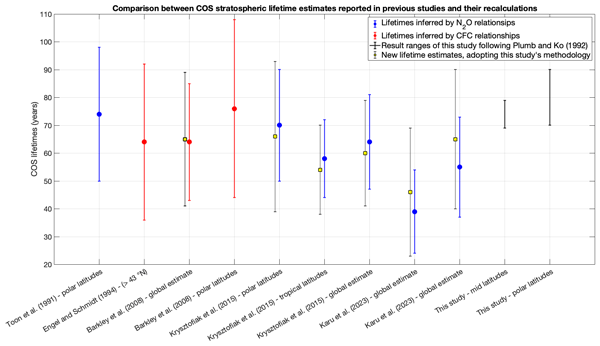
The authors estimate stratospheric lifetimes of OCS and CH₄ using ten AirCore profiles and an age-of-air analysis following a methodology similar to that presented by Karu et al. for the IAGOS-CARIBIC aircraft dataset. The resulting OCS and CH₄ lifetime estimates are generally consistent, within their uncertainties, with previous assessments. I particularly appreciated the historical comparisons with other datasets presented in Figures 1 and 13. However, I encourage the authors to also consider the more comprehensive historical analysis of OCS observations presented in:
Gurganus, C., Bednarz, E. M., Rollins, A., Waxman, E., Ray, E., Hintsa, E., et al. (2026). Constraining the stratospheric sulfate budget in global models: Insights from in situ OCS measurements during 2023 SABRE and comparison with satellite, balloon and surface data. Geophysical Research Letters, 53, e2025GL117405. https://doi.org/10.1029/2025GL117405
The AirCore dataset analyzed here was comprehensively described in the accompanying Zanchetta AMT publication, so I believe the concise methodology section in the present manuscript is appropriate. Overall, the manuscript presents a useful application of existing age-of-air techniques to a high-quality AirCore dataset. However, I recommend a substantial reduction in the number of figures and tables, many of which add little to the scientific discussion and could be consolidated or moved to the Supplement. The principal conclusions do not substantially alter the current understanding of stratospheric lifetimes or age of air for either species. Nevertheless, the manuscript provides a useful discussion of the uncertainties associated with estimating age of air from different assumptions regarding tropospheric boundary conditions, particularly for species such as CH₄ and N₂O with long-term increasing trends.
Major Comments
1. Comparison with ACE-FTS climatology
The manuscript compares a relatively small number of AirCore profiles with more than a decade of ACE-FTS observations. While the ACE-FTS climatology provides a reasonable representation of long-term, large-scale stratospheric transport, it is difficult to directly compare such a climatological average with individual AirCore profiles, which sample specific air masses. I encourage the authors to provide additional dynamical context for the AirCore observations. For example, trajectory analyses or plotting the measurements as a function of equivalent latitude would help determine whether differences arise from transport variability rather than methodological differences.
2. Comparison between the Volk and Plumb & Ko methodologies
The manuscript devotes considerable discussion to differences between the Volk and Plumb approaches for calculating age of air. However, both methods ultimately use the same Equation (2); the primary distinction lies in how the tropospheric "burden" (i.e., the representative mean tropospheric concentration) is calculated.
Based on the values presented in Section 3.1, the difference in the OCS/N₂O burden ratio for 2023 is less than approximately 3% (487/336.8 using Plumb & Ko versus 457/324 using Volk). This difference is comparable to, or smaller than, the measurement uncertainty of the AirCore OCS observations (approximately 4% assuming a 20 ppt precision for QCLS). Consequently, the small differences in derived age of air between the two methodologies are expected to remain well within the observational uncertainty, consistent with the overlap shown in Figures 11 and 12. I therefore recommend shortening this discussion and emphasizing that, for the present dataset, the methodological differences are small relative to the measurement uncertainties.
Specific Comments
- Table 3: This table primarily summarizes basic data analysis and does not appear to provide information that substantially advances the discussion. I recommend removing it or moving it to the Supplement.
- Figure 4: Presenting a "global average" ACE-FTS profile is potentially misleading because the ACE-FTS sampling is strongly biased toward middle and high latitudes, with relatively sparse tropical coverage. This limitation should be acknowledged more clearly, or the figure should be reconsidered.
- Figures 5–10: I do not see a strong scientific justification for including these figures in the main manuscript. They would be more appropriate in the Supplement, where readers can examine the individual profiles if desired.
- Tables 4–6: The OCS results would be much easier to interpret if they were consolidated into a single table, allowing readers to directly compare the results obtained using the Volk and Plumb & Ko methodologies.
- Tables 7–9: Similarly, the CH₄ results should be combined into a single summary table to facilitate direct comparison between the two age-of-air methods.
Overall, I believe this is a worthwhile contribution that demonstrates the application of established age-of-air methods to a valuable AirCore dataset. The principal conclusions are generally consistent with previous work, but the manuscript would benefit substantially from a more concise presentation, consolidation of figures and tables, and a more focused discussion of the practical significance of the differences between the two age-of-air methodologies.
Citation: https://doi.org/10.5194/egusphere-2026-2799-RC2 - AC2: 'Reply on RC2', Alessandro Zanchetta, 17 Aug 2026
Peer review completion


Interactive discussion
Status: closed
-
RC1: 'Comment on egusphere-2026-2799', Marc von Hobe, 11 Jun 2026
The study by Alessandro Zanchetta and coauthors deduces stratospheric lifetimes from vertical profiles of carbonyl sulfide and methane from AirCore measurements and ACE-FTS satellite observations. The analysis is sound and rather comprehensive, comparing slightly variant methodologies of estimating lifetimes and pointing out caveats with respect to, e.g., regional sampling and observation altitude. The manuscript is generally well presented and well written and fits into the scope of ACP.
One major aspect that, in my opinion, should be improved is the length of the paper and the amount of information presented. Specifically, I wonder if all 13 figures and 11 tables are needed. In that context, please consider the following:
- Table 2 contains important information, but it is not essential for the main message of the paper and could be shifted to a supplement.
- Table 3 also contains information that should be provided by all means, but the paper would not suffer from this being included in a supplement rather than the main body of the paper.
- Figure 4 could also be shifted to a supplement. It is important to have this information, but how these profiles lead to the actual burden numbers is not visible in the figure, so it is not essential for the main paper.
- Figures 5 – 7 and 8 – 10 take up a lot of space. I wonder if it is not possible to combine these into two figures (one for COS and one for CH4) without overloading them.
- It is good to show all results and important parameters for individual flights and analyses in Tables 4 – 6 for COS and 7 – 9 for CH4. But the important pieces of information are given and discussed in the text and these long and detailed tables would be better off in a supplement. Also, the information displayed in Figures 11 and 12 is already given in Tables 5/6 and 8/9 for COS and CH4 respectively.
- Does Figure 13 add new information compared to Table 10? In my opinion, the graphical representation of these data has limited added value, so showing just the table would be sufficient. But if you want to keep the figure, then the table with the more detailed information could be moved to a supplement.
Besides the number of figures and tables, there is quite a bit of redundancy in the test as well. Essentially the same numbers for COS and CH4 lifetime and stratospheric sink estimates from the two different methods (Plumb and Ko, 1992 vs. Volk et al., 1997) and for polar vs. mid latitudes are given in a similar way in Section 3 (lines 297 – 310 and 339 - 347), Section 4 (lines 380 - 382 + Section 4.1 and Section 4.2) and Section 5 (lines 506 - 516). While this information does fit into the flow in each individual Section, it may be worth avoiding some of this redundancy by cross referencing.
Note that these suggestions are not meant to push the paper below a certain page or word limit because shorter is always better. But I had the impression that the take-home messages of the study are somewhat hidden underneath the wealth on information shown.
Besides the general recommendations to make the paper more concise, I have a few specific suggestions and technical corrections:
Introduction:
The introduction almost exclusively focuses on COS, while in the title and the rest of the paper, CH4 is treated in parallel. I suggest adding one or two paragraphs on CH4 in the introduction as well.
Lines 39/40: an explicit reference for the COS tropospheric lifetime would be appropriate. And for COS being able to reach the stratosphere, a more original reference such as Crutzen (1976) would be more appropriate than the ones cited.
Lines 43 – 45: Again, the chosen references appear a bit arbitrary. For example, Vernier et al. (2011) don’t explicitly discuss the COS contribution but rather the effects of cumulative sulfate injection from volcanic eruptions. I suggest the Kremser et al. (2016) review paper, where the tropospheric budget and stratospheric sink of COS is discussed in detail and relevant literature is cited.
Methods:
Lines 100 – 105: It would be nice to show a comparison between the actual AirCore and ACE-FTS profiles. It’s not essential to actually show this in the paper, so such a figure could go into the supplemental material.
Line 114: I tend to agree that this is probably a fair assumption, but maybe you can add one sentence to explain why it is justified for the gases considered.
Line 132 – 134: I find this explanation a bit confusing. Did you use the Prather et al. estimate of 116 years for the full period, or did you apply a 2.1 % per year correction, even though you state that the trend is not significant? Please clarify!
Lines 163 – 170: In my opinion, limiting the analysis to reasonably low N2O mole fractions so that a tropospheric influence is minimized is important. This is a fundamental difference to the study by Karu et al., who analyzed only data with N2O > 317 ppb due to the altitude limitation. This may explain why that study compares least well to your analysis and other COS lifetime estimates in the literature, and it is worth highlighting that here or in one of the later sections.
Results:
Lines 287 – 288: Either here or in Section 2.3, please add the actual number of ACE-FTS profiles that were averaged.
Line 329: For CH4, why are the uncertainties for satellite data as large as for campaigns, different than for COS?
Discussion:
Lines 393 – 397: I think that the statement that Karu et al. (2023) “introduced” another point of uncertainty is misleading here. They did not introduce this but, due to the very limited altitude range of commercial aircraft, had to use data with a very limited altitude (and consequentially N2O, see my comment above) range. In my opinion, this warrants more discussion and explains why their lifetime estimate differs from your and other studies.
Lines 404 – 405 and Table 10: I suggest including stratospheric sink estimates from the important modeling studies by Brühl et al., (2012) of 35 Gg S/yr and Sheng et al. (2015) of 40.7 Gg S/yr. These papers do not explicitly state stratospheric lifetimes, but that also goes for some of the cited papers (e.g. Weisenstein, 1997).
Lines 439 – 440: Please discuss this in more detail (cf. my previous comments on the comparison with the Karu et al. estimate)!
Technical corrections:
Line 206: it should be “advocate” instead of “advocates”
Line 233: Please replace the term “evident criticalities” (e.g. by “atypical behavior” of “distinctive behavior”)!
Line 252: This reference is meant to be Figures 5 – 6 and 8 – 9, correct?
Line 290: Figures and tables should be referenced in order of appearance. So please refer to Table 5 prior to Table 6 or swap the numbering of these tables!
Lines 326 – 327: There seems to be a grammar issue. I suggest: “The application of the Plumb and Ko (1992) method leads to an average slope at mid latitudes of 0.2537 ± 0.0022, while at polar latitudes it is 0.2381 ± 0.0063.”
Line 492: It should be “applied in this study”.
Citation: https://doi.org/10.5194/egusphere-2026-2799-RC1 - AC1: 'Reply on RC1', Alessandro Zanchetta, 21 Jul 2026
-
RC2: 'Comment on egusphere-2026-2799', Anonymous Referee #2, 07 Jul 2026
Review of: Estimates of carbonyl sulfide and methane stratospheric lifetimes based on AirCore profiles
The authors estimate stratospheric lifetimes of OCS and CH₄ using ten AirCore profiles and an age-of-air analysis following a methodology similar to that presented by Karu et al. for the IAGOS-CARIBIC aircraft dataset. The resulting OCS and CH₄ lifetime estimates are generally consistent, within their uncertainties, with previous assessments. I particularly appreciated the historical comparisons with other datasets presented in Figures 1 and 13. However, I encourage the authors to also consider the more comprehensive historical analysis of OCS observations presented in:
Gurganus, C., Bednarz, E. M., Rollins, A., Waxman, E., Ray, E., Hintsa, E., et al. (2026). Constraining the stratospheric sulfate budget in global models: Insights from in situ OCS measurements during 2023 SABRE and comparison with satellite, balloon and surface data. Geophysical Research Letters, 53, e2025GL117405. https://doi.org/10.1029/2025GL117405
The AirCore dataset analyzed here was comprehensively described in the accompanying Zanchetta AMT publication, so I believe the concise methodology section in the present manuscript is appropriate. Overall, the manuscript presents a useful application of existing age-of-air techniques to a high-quality AirCore dataset. However, I recommend a substantial reduction in the number of figures and tables, many of which add little to the scientific discussion and could be consolidated or moved to the Supplement. The principal conclusions do not substantially alter the current understanding of stratospheric lifetimes or age of air for either species. Nevertheless, the manuscript provides a useful discussion of the uncertainties associated with estimating age of air from different assumptions regarding tropospheric boundary conditions, particularly for species such as CH₄ and N₂O with long-term increasing trends.
Major Comments
1. Comparison with ACE-FTS climatology
The manuscript compares a relatively small number of AirCore profiles with more than a decade of ACE-FTS observations. While the ACE-FTS climatology provides a reasonable representation of long-term, large-scale stratospheric transport, it is difficult to directly compare such a climatological average with individual AirCore profiles, which sample specific air masses. I encourage the authors to provide additional dynamical context for the AirCore observations. For example, trajectory analyses or plotting the measurements as a function of equivalent latitude would help determine whether differences arise from transport variability rather than methodological differences.
2. Comparison between the Volk and Plumb & Ko methodologies
The manuscript devotes considerable discussion to differences between the Volk and Plumb approaches for calculating age of air. However, both methods ultimately use the same Equation (2); the primary distinction lies in how the tropospheric "burden" (i.e., the representative mean tropospheric concentration) is calculated.
Based on the values presented in Section 3.1, the difference in the OCS/N₂O burden ratio for 2023 is less than approximately 3% (487/336.8 using Plumb & Ko versus 457/324 using Volk). This difference is comparable to, or smaller than, the measurement uncertainty of the AirCore OCS observations (approximately 4% assuming a 20 ppt precision for QCLS). Consequently, the small differences in derived age of air between the two methodologies are expected to remain well within the observational uncertainty, consistent with the overlap shown in Figures 11 and 12. I therefore recommend shortening this discussion and emphasizing that, for the present dataset, the methodological differences are small relative to the measurement uncertainties.
Specific Comments
- Table 3: This table primarily summarizes basic data analysis and does not appear to provide information that substantially advances the discussion. I recommend removing it or moving it to the Supplement.
- Figure 4: Presenting a "global average" ACE-FTS profile is potentially misleading because the ACE-FTS sampling is strongly biased toward middle and high latitudes, with relatively sparse tropical coverage. This limitation should be acknowledged more clearly, or the figure should be reconsidered.
- Figures 5–10: I do not see a strong scientific justification for including these figures in the main manuscript. They would be more appropriate in the Supplement, where readers can examine the individual profiles if desired.
- Tables 4–6: The OCS results would be much easier to interpret if they were consolidated into a single table, allowing readers to directly compare the results obtained using the Volk and Plumb & Ko methodologies.
- Tables 7–9: Similarly, the CH₄ results should be combined into a single summary table to facilitate direct comparison between the two age-of-air methods.
Overall, I believe this is a worthwhile contribution that demonstrates the application of established age-of-air methods to a valuable AirCore dataset. The principal conclusions are generally consistent with previous work, but the manuscript would benefit substantially from a more concise presentation, consolidation of figures and tables, and a more focused discussion of the practical significance of the differences between the two age-of-air methodologies.
Citation: https://doi.org/10.5194/egusphere-2026-2799-RC2 - AC2: 'Reply on RC2', Alessandro Zanchetta, 17 Aug 2026
Peer review completion
Journal article(s) based on this preprint
Viewed
| HTML | XML | Total | Supplement | BibTeX | EndNote | |
|---|---|---|---|---|---|---|
| 293 | 97 | 50 | 440 | 49 | 50 | 44 |
- HTML: 293
- PDF: 97
- XML: 50
- Total: 440
- Supplement: 49
- BibTeX: 50
- EndNote: 44
Viewed (geographical distribution)
| Country | # | Views | % |
|---|
| Total: | 0 |
| HTML: | 0 |
| PDF: | 0 |
| XML: | 0 |
- 1
Alessandro Zanchetta
Steven van Heuven
Rigel Kivi
Michel Ramonet
Andreas Engel
Maarten Krol

The requested preprint has a corresponding peer-reviewed final revised paper. You are encouraged to refer to the final revised version.
- Preprint
(2494 KB) - Metadata XML
-
Supplement
(2921 KB) - BibTeX
- EndNote
- Final revised paper
The study by Alessandro Zanchetta and coauthors deduces stratospheric lifetimes from vertical profiles of carbonyl sulfide and methane from AirCore measurements and ACE-FTS satellite observations. The analysis is sound and rather comprehensive, comparing slightly variant methodologies of estimating lifetimes and pointing out caveats with respect to, e.g., regional sampling and observation altitude. The manuscript is generally well presented and well written and fits into the scope of ACP.
One major aspect that, in my opinion, should be improved is the length of the paper and the amount of information presented. Specifically, I wonder if all 13 figures and 11 tables are needed. In that context, please consider the following:
Besides the number of figures and tables, there is quite a bit of redundancy in the test as well. Essentially the same numbers for COS and CH4 lifetime and stratospheric sink estimates from the two different methods (Plumb and Ko, 1992 vs. Volk et al., 1997) and for polar vs. mid latitudes are given in a similar way in Section 3 (lines 297 – 310 and 339 - 347), Section 4 (lines 380 - 382 + Section 4.1 and Section 4.2) and Section 5 (lines 506 - 516). While this information does fit into the flow in each individual Section, it may be worth avoiding some of this redundancy by cross referencing.
Note that these suggestions are not meant to push the paper below a certain page or word limit because shorter is always better. But I had the impression that the take-home messages of the study are somewhat hidden underneath the wealth on information shown.
Besides the general recommendations to make the paper more concise, I have a few specific suggestions and technical corrections:
Introduction:
The introduction almost exclusively focuses on COS, while in the title and the rest of the paper, CH4 is treated in parallel. I suggest adding one or two paragraphs on CH4 in the introduction as well.
Lines 39/40: an explicit reference for the COS tropospheric lifetime would be appropriate. And for COS being able to reach the stratosphere, a more original reference such as Crutzen (1976) would be more appropriate than the ones cited.
Lines 43 – 45: Again, the chosen references appear a bit arbitrary. For example, Vernier et al. (2011) don’t explicitly discuss the COS contribution but rather the effects of cumulative sulfate injection from volcanic eruptions. I suggest the Kremser et al. (2016) review paper, where the tropospheric budget and stratospheric sink of COS is discussed in detail and relevant literature is cited.
Methods:
Lines 100 – 105: It would be nice to show a comparison between the actual AirCore and ACE-FTS profiles. It’s not essential to actually show this in the paper, so such a figure could go into the supplemental material.
Line 114: I tend to agree that this is probably a fair assumption, but maybe you can add one sentence to explain why it is justified for the gases considered.
Line 132 – 134: I find this explanation a bit confusing. Did you use the Prather et al. estimate of 116 years for the full period, or did you apply a 2.1 % per year correction, even though you state that the trend is not significant? Please clarify!
Lines 163 – 170: In my opinion, limiting the analysis to reasonably low N2O mole fractions so that a tropospheric influence is minimized is important. This is a fundamental difference to the study by Karu et al., who analyzed only data with N2O > 317 ppb due to the altitude limitation. This may explain why that study compares least well to your analysis and other COS lifetime estimates in the literature, and it is worth highlighting that here or in one of the later sections.
Results:
Lines 287 – 288: Either here or in Section 2.3, please add the actual number of ACE-FTS profiles that were averaged.
Line 329: For CH4, why are the uncertainties for satellite data as large as for campaigns, different than for COS?
Discussion:
Lines 393 – 397: I think that the statement that Karu et al. (2023) “introduced” another point of uncertainty is misleading here. They did not introduce this but, due to the very limited altitude range of commercial aircraft, had to use data with a very limited altitude (and consequentially N2O, see my comment above) range. In my opinion, this warrants more discussion and explains why their lifetime estimate differs from your and other studies.
Lines 404 – 405 and Table 10: I suggest including stratospheric sink estimates from the important modeling studies by Brühl et al., (2012) of 35 Gg S/yr and Sheng et al. (2015) of 40.7 Gg S/yr. These papers do not explicitly state stratospheric lifetimes, but that also goes for some of the cited papers (e.g. Weisenstein, 1997).
Lines 439 – 440: Please discuss this in more detail (cf. my previous comments on the comparison with the Karu et al. estimate)!
Technical corrections:
Line 206: it should be “advocate” instead of “advocates”
Line 233: Please replace the term “evident criticalities” (e.g. by “atypical behavior” of “distinctive behavior”)!
Line 252: This reference is meant to be Figures 5 – 6 and 8 – 9, correct?
Line 290: Figures and tables should be referenced in order of appearance. So please refer to Table 5 prior to Table 6 or swap the numbering of these tables!
Lines 326 – 327: There seems to be a grammar issue. I suggest: “The application of the Plumb and Ko (1992) method leads to an average slope at mid latitudes of 0.2537 ± 0.0022, while at polar latitudes it is 0.2381 ± 0.0063.”
Line 492: It should be “applied in this study”.