
the Creative Commons Attribution 4.0 License.
the Creative Commons Attribution 4.0 License.
 | 11 Jun 2026
Seasonal and Interannual Drivers of Sargassum Inundations in the Northern Gulf of Guinea
Abstract. Sargassum strandings have become recurrent along the northern Gulf of Guinea (n-GoG) and are reported in the literature as having significant societal impacts, particularly on fisheries. However, persistent cloud cover frequently hampers satellite detection in this region, complicating efforts to monitor and study the phenomenon. To overcome this limitation, we combine remote-sensing observations with process-oriented numerical simulations that represent Sargassum transport, growth, and stranding. This approach provides new insights into the seasonal cycle and the interannual variability of coastal arrivals since 2011. Both observations and the model reveal a semiannual cycle of arrivals along the n-GoG, with peaks in March-April-May and September-October-November. Our results suggest that arrivals in the n-GoG depend primarily on the advection of Sargassum from the eastern Tropical Atlantic (e-TA), whereas local growth appears to play only a minor role. Indeed, a prior build-up of biomass preconditions n-GoG Sargassum intrusion events: off Sierra Leone for spring events, and within the ITCZ for autumn events. In both seasons, transport toward West Africa occurs via the North Equatorial Counter Current (NECC) and the Guinea Current (GC), and is particularly strong in autumn, with an advection time of about three months between the e-TA and the n-GoG coasts. After crossing Cape Palmas, Sargassum is driven shoreward by the prevailing southerly winds, which both promote coastal accumulation and maintain Sargassum north of the Equator. Without this wind-driven transport, Sargassum would remain embedded in the GC, spread more broadly across the Gulf of Guinea (GoG), and could recirculate southward through the South Equatorial Current (SEC). Coastal stranding acts as an additional regulator of the regional distribution by removing biomass from the open ocean and limiting its persistence near the coast. At interannual timescales, variability is controlled first by the amount of Sargassum biomass in the e-TA and second by their latitudinal position and likelihood of crossing Cape Palmas, especially in autumn. Both factors appear to be linked to the Atlantic Meridional Mode (AMM), with negative phases favoring entry into the GoG.
-
Notice on discussion status
The requested preprint has a corresponding peer-reviewed final revised paper. You are encouraged to refer to the final revised version.
-
Preprint
(3648 KB)
-
The requested preprint has a corresponding peer-reviewed final revised paper. You are encouraged to refer to the final revised version.
- Preprint
(3648 KB) - Metadata XML
- BibTeX
- EndNote
- Final revised paper


Journal article(s) based on this preprint
Interactive discussion
Status: closed
-
RC1: 'Comment on egusphere-2026-2727', Anonymous Referee #1, 08 Jul 2026
-
AC1: 'Reply on RC1', Clovis Thouvenin masson, 03 Sep 2026
We thank Anonymous Reviewer 1 for the careful and constructive comments, which helped us improve the structure, methodological detail, and clarity of the manuscript. Our detailed point-by-point responses are provided in the attached PDF. The reviewer’s comments are shown in black, while our responses and excerpts from the revised manuscript are shown in blue. Line numbers refer to the revised manuscript submitted with this response.
-
AC1: 'Reply on RC1', Clovis Thouvenin masson, 03 Sep 2026
-
RC2: 'Comment on egusphere-2026-2727', R. Marsh, 23 Jul 2026
This manuscript provides a welcome focus on sargassum in the northern Gulf of Guinea, with predominant attention until now on sargassum in the western tropical Atlantic, as implicit in the Introduction. The authors use an established modelling system (NEMO-Sarg), complemented with the Parcels tracking software, to explore the drivers, pathways and (in some cases) coastal fate of sargassum biomass in the region. The experimental design explores the relative influences of stranding and windage on the large-scale seasonal dispersal of sargassum, demonstrating the importance of both processes in understanding and predicting biomass distribution in the GoG. Backward and forward Lagrangian tracking is appropriately used, to explore source regions for n-GoG sargassum and to determine how much sargassum reaches the GoG with and without wind/wave influence.
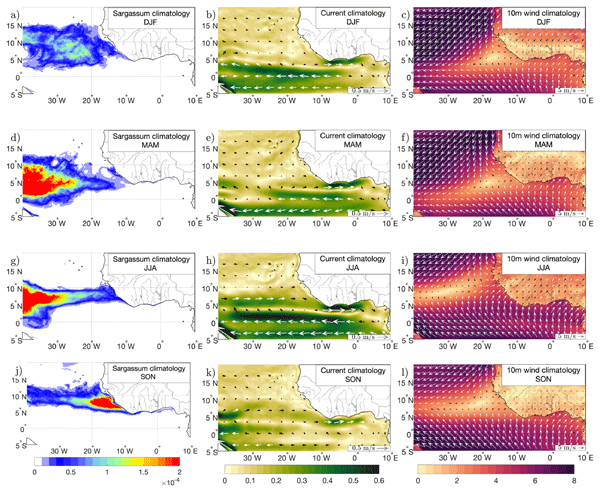
The data assembled in Fig. 2, and the evidence discussed in Sect. 3.1, is to my knowledge the first such synthesis and of particular value in itself. The difficult challenge of limited satellite coverage beneath the ITCZ is clearly evident in Fig. 3, although there is scope to further discuss how this compromises the simulations. Analysis of the seasonal cycle in currents, winds and hydrography well explains the spring and autumn stranding of sargassum along the n-GoG coast. Exploring interannual variability of sargassum FC in n-GoG, a high fraction of variance is correlated with the AMM in both spring and autumn, and upstream sargassum FC preceding autumn. These clear links are well explained.
Specific Comments:
- Line 17 (and elsewhere, in Abstract and main text): The statement ‘After crossing Cape Palmas, …’ would be better written ‘After passing south of Cape Palmas, …’ or ‘After crossing a transect south of Cape Palmas, …’
- Figure 1: this is a bit too schematic, regarding currents, winds and the GASB; choosing a representative year, I recommend showing example GLORYS currents (shaded for speed, with the additional annotated arrows), example ERA5 winds (vectors at coarse resolution), overlaid with stippled fractional area above a threshold to highlight the GASB; also, two panels could be shown, earlier and later in the summer to reflect the seasonally reversing winds and ocean currents, and corresponding GASB migration
- Introduction, last paragraph: ideally provide a more details and structured summary of the rest of the manuscript, explaining in particular the logical sequencing of your results section
- Sect 2.2: In briefly describing NEMO-Sarg, please specify the modelled variable the represents sargassum biomass – presumably the associated carbon?
- Line 107: Stokes drift should be capitalized here
- Line 119: In suppressing strandings, what then happens to the sargassum biomass? Is it shifted to the nearest ocean grid cell to ensure onward transport? It may be necessary to briefly explain the stranding algorithm.
- Lines 228-229: stating ‘Particles were seeded in areas where Sargassum was observed in the e-TA region’ – it seems more logical that you back-track from where Sargassum was observed in the n-GoG region; please correct or clarify
- Line 235: ‘are transported’ (not ‘is transported’)
- Figure 10: it would be further helpful to label the left column ‘MAM’ and the right column ‘SON’, rather than mention this detail only in the figure caption.
- Lines 461-465: It may be worth noting that sargassum is more directly (adversely) affected by low salinity (Hanisak and Samuel, 1987) although this dependence may not be included in NEMO-Sarg as used here; whether coastal salinity in the wet season falls low enough to impact sargassum along the n-GoG (Fig. 6b,e,h,k) is not clear but the authors could clarify and discuss.
- Line 750: Sowah et al. (2022) appears to be a repeated reference
Citation: https://doi.org/10.5194/egusphere-2026-2727-RC2 -
AC2: 'Reply on RC2', Clovis Thouvenin masson, 03 Sep 2026
We thank Reviewer 2 for the careful and constructive assessment of our manuscript. Our detailed point-by-point responses are provided in the attached PDF. The reviewer’s comments are shown in black, while our responses and excerpts from the revised manuscript are shown in blue. Line numbers refer to the revised manuscript submitted with this response.
Peer review completion


Interactive discussion
Status: closed
-
RC1: 'Comment on egusphere-2026-2727', Anonymous Referee #1, 08 Jul 2026
This work is very interesting and has value, contributing to the ongoing discussion and theories of where the sources of sargassum are in the region. It contributes to the knowledge gap of Sargassum in the Eastern Tropical Atlantic, where there are few studies compared to the Western side. It is clear that a lot of effort and thought has gone into applying this model, assessing the sensitivity, and gathering validation data. However, the authors need to consider their narrative more clearly and reconsider the structure of the paper. There needs to be inclusion of significantly more detail in their methods section, as well as reviewing the results and discussion to ensure the results are only the results. The authors should also add a conclusion section.
Please find below a more detailed review of the work by section/line number.Abstract:
The abstract is quite long and detailed, the highlight results get a bit lost, the authors should consider removing details, so the results found in the paper stand out strongly. The authors should also clearly state the impact or potential value of their work and what or who their results are useful for.
Introduction:
The introduction overall provides good context and research gaps of the problem, though the authors should review the section structure to take care that they are telling a linear story and not revisiting statements or themes already partially mentioned and returning to ideas later within the introduction.The following need to be addressed more closely:
The introduction is missing many references for reporting of large strandings in all noted regions, there are other central American publications and from the USA as well.
L28/29 Sentence needs rephrasing: “the floating species involved are...”
L37 Reference needed: “... while stranded Sargassum releases hydrogen sulfide and ammonia”
Around L50-56 or ~L70 consider including the newly published paper where the authors discuss source and movement pathways of sargassum particularly in GoG.: Beron-Vera, F.J., Olascoaga, M.J., Miron, P. and Bonner, G., 2026. Tracing the origin of tropical North Atlantic Sargassum blooms to West Africa. PNAS Nexus, 5(4), p.pgag085.
L55/6 The authors interpret from the literature that sargassum appears to or is suggested to reach West African coasts. It categorically does reach West African coasts as empirically observed in papers that are referenced in this study already, this shouldn’t be stated with speculation, sargassum is found on the beaches of West African nations but this is also made clear in the first sentences of the introduction and doesn’t need repeating.
L74/5 ‘and by’ does not make sense, sentence phrasing needs reviewing, suggest “...2011, and identify the...”
Methods:
L87-95
Section 2.1 is significantly lacking in detail.
The authors note the start year of data collection, but the end date of the data/study should also be included. Additionally, satellites should be named in full, not only acronyms. The authors should also add detail on how the satellite data was processed and not simply cite another paper, what cloud masking was employed? How was sun glint removed? What atmospheric processing was undertaken? What sargassum detection algorithms were used? How were they applied? What is the accuracy of the chosen detection algorithm? What is the temporal and spatial resolution of the input data? What output does the detection give; is it aerial extent or volume of biomass? These are essential information which are missing. The authors need to clarify if they undertook satellite detection of sargassum or are using data from another source.It is very unusual to discuss method limitations and discuss literature in this section, authors should say what they included/excluded and justify their approach, but limitations should be discussed in the discussion only to avoid repetition and increase clarity.
Section 2.3
The authors need to describe how the sargassum cover index is computed.
The authors need to describe their data sources where are the currents/winds/SST etc data from? What is their spatial and temporal resolution?
I think Table 3 doesn’t add much extra information, as this is described in text/Figure 1, the lat/lon can be added to Figure 1 caption.Section 2.4
The authors need to make it clearer how they identified where sargassum was present in their model and how they identified their particle starting points.
Please add justification for 1% windage; previous studies such as Putnam et al., (2018) and Marsh et al., (2021) have used this in the Caribbean, can 1% windage be justified in the GoG? It’s good to see you have explored no wind in section 2.5, but could the wind also be above 1%? In Section 2.3 0.1% windage is stated, please check this.The authors have not provided a description of how they have validated their model outputs. This needs to be included in the methods. In the results it appears authors have collated in situ measurements from other papers to validate their model, but this is not described in the methods. I am also not convinced this is enough to validate the model, the authors need to explain this very clearly.
Results:
The authors should consider restructuring the results, to present their time series and findings first and then present their literature-based validation afterwards. There is lots of discussion and some methods mixed in with the results. The results section should only state the results of the study. Further to this, the authors should consider what results are essential to the story and what is anecdotal/supporting and can be included in supplementary materials or appendices instead.Figure 2 please increase the font size, and check citation formatting. Please explain how Sargassum can be a measured as concentration and include the units (this should be in the methods), it is usually aerial coverage or biomass weight.
L195, an absence of in situ observation for an area does not make false detections likely, it makes it a possibility. Discussion of false detections should not be in the results section, but rather the discussion.
L204-214 is largely discussion not results. I have not continued to list lines which are discussion, but the whole section needs reviewing to separate results and discussion.
Figure 3 please write the months in full in the figure caption. The authors include in the figure caption that 2010-2024 is included but previously in the methods from 2002 was stated, please state clearly the dates of the study and data in the methods section.
Section 3.5.1 The composite definition and how high/low sargassum, seasons, application of time lags etc should be explained in the methods, not in the results.
Discussion:
Some of the discussion should be conclusions, there is an absence of conclusions. The authors need to review and rewrite this section alongside results. A conclusion must be added.General housekeeping:
In text citation lists should be listed alphabetically or in time-order.
Take care to only include last names in in-text citations ie L47, 58 should be Atiglo et al. 2024
L57/58 Take care to check where references got their information from and cite original sources as well; the statistic of 3% from Atiiglo et al. (2024) (not 3.5%) of studies comes from The Zotero ‘Sargassum Reference Repository’ database, which is available online at: Centre for Resource Management & Environmental Studies (CERMES) | The University of the West Indies at Cave Hill, Barbados – Reference-Repository (uwi.edu). This database is being updated and the proportion may have changed since you cited a paper from 2024.
Fidai et al 2023 (phd) thesis noted in Figure 2 for in situ data has a corresponding published paper and zenodo link with the in situ data (see Fidai, Y.A., Machado, C.B., Almela, V.D., Oxenford, H.A., Jayson-Quashigah, P.N., Tonon, T. and Dash, J., 2024. Innovative spectral characterisation of beached pelagic sargassum towards remote estimation of biochemical and phenotypic properties. Science of the Total Environment).
There are a lot of figures in this paper, the authors should consider what is essential to communicate, and what is anecdotal/supporting and can be included in supplementary materials or appendices instead.Citation: https://doi.org/10.5194/egusphere-2026-2727-RC1 -
AC1: 'Reply on RC1', Clovis Thouvenin masson, 03 Sep 2026
We thank Anonymous Reviewer 1 for the careful and constructive comments, which helped us improve the structure, methodological detail, and clarity of the manuscript. Our detailed point-by-point responses are provided in the attached PDF. The reviewer’s comments are shown in black, while our responses and excerpts from the revised manuscript are shown in blue. Line numbers refer to the revised manuscript submitted with this response.
-
AC1: 'Reply on RC1', Clovis Thouvenin masson, 03 Sep 2026
-
RC2: 'Comment on egusphere-2026-2727', R. Marsh, 23 Jul 2026
This manuscript provides a welcome focus on sargassum in the northern Gulf of Guinea, with predominant attention until now on sargassum in the western tropical Atlantic, as implicit in the Introduction. The authors use an established modelling system (NEMO-Sarg), complemented with the Parcels tracking software, to explore the drivers, pathways and (in some cases) coastal fate of sargassum biomass in the region. The experimental design explores the relative influences of stranding and windage on the large-scale seasonal dispersal of sargassum, demonstrating the importance of both processes in understanding and predicting biomass distribution in the GoG. Backward and forward Lagrangian tracking is appropriately used, to explore source regions for n-GoG sargassum and to determine how much sargassum reaches the GoG with and without wind/wave influence.
The data assembled in Fig. 2, and the evidence discussed in Sect. 3.1, is to my knowledge the first such synthesis and of particular value in itself. The difficult challenge of limited satellite coverage beneath the ITCZ is clearly evident in Fig. 3, although there is scope to further discuss how this compromises the simulations. Analysis of the seasonal cycle in currents, winds and hydrography well explains the spring and autumn stranding of sargassum along the n-GoG coast. Exploring interannual variability of sargassum FC in n-GoG, a high fraction of variance is correlated with the AMM in both spring and autumn, and upstream sargassum FC preceding autumn. These clear links are well explained.
Specific Comments:
- Line 17 (and elsewhere, in Abstract and main text): The statement ‘After crossing Cape Palmas, …’ would be better written ‘After passing south of Cape Palmas, …’ or ‘After crossing a transect south of Cape Palmas, …’
- Figure 1: this is a bit too schematic, regarding currents, winds and the GASB; choosing a representative year, I recommend showing example GLORYS currents (shaded for speed, with the additional annotated arrows), example ERA5 winds (vectors at coarse resolution), overlaid with stippled fractional area above a threshold to highlight the GASB; also, two panels could be shown, earlier and later in the summer to reflect the seasonally reversing winds and ocean currents, and corresponding GASB migration
- Introduction, last paragraph: ideally provide a more details and structured summary of the rest of the manuscript, explaining in particular the logical sequencing of your results section
- Sect 2.2: In briefly describing NEMO-Sarg, please specify the modelled variable the represents sargassum biomass – presumably the associated carbon?
- Line 107: Stokes drift should be capitalized here
- Line 119: In suppressing strandings, what then happens to the sargassum biomass? Is it shifted to the nearest ocean grid cell to ensure onward transport? It may be necessary to briefly explain the stranding algorithm.
- Lines 228-229: stating ‘Particles were seeded in areas where Sargassum was observed in the e-TA region’ – it seems more logical that you back-track from where Sargassum was observed in the n-GoG region; please correct or clarify
- Line 235: ‘are transported’ (not ‘is transported’)
- Figure 10: it would be further helpful to label the left column ‘MAM’ and the right column ‘SON’, rather than mention this detail only in the figure caption.
- Lines 461-465: It may be worth noting that sargassum is more directly (adversely) affected by low salinity (Hanisak and Samuel, 1987) although this dependence may not be included in NEMO-Sarg as used here; whether coastal salinity in the wet season falls low enough to impact sargassum along the n-GoG (Fig. 6b,e,h,k) is not clear but the authors could clarify and discuss.
- Line 750: Sowah et al. (2022) appears to be a repeated reference
Citation: https://doi.org/10.5194/egusphere-2026-2727-RC2 -
AC2: 'Reply on RC2', Clovis Thouvenin masson, 03 Sep 2026
We thank Reviewer 2 for the careful and constructive assessment of our manuscript. Our detailed point-by-point responses are provided in the attached PDF. The reviewer’s comments are shown in black, while our responses and excerpts from the revised manuscript are shown in blue. Line numbers refer to the revised manuscript submitted with this response.
Peer review completion
Journal article(s) based on this preprint
Viewed
| HTML | XML | Total | BibTeX | EndNote | |
|---|---|---|---|---|---|
| 203 | 127 | 41 | 371 | 29 | 29 |
- HTML: 203
- PDF: 127
- XML: 41
- Total: 371
- BibTeX: 29
- EndNote: 29
Viewed (geographical distribution)
| Country | # | Views | % |
|---|
| Total: | 0 |
| HTML: | 0 |
| PDF: | 0 |
| XML: | 0 |
- 1
Clovis Thouvenin-Masson

Julien Jouanno
The requested preprint has a corresponding peer-reviewed final revised paper. You are encouraged to refer to the final revised version.
- Preprint
(3648 KB) - Metadata XML
We studied why floating Sargassum seaweed repeatedly reaches the northern Gulf of Guinea, where it affects coastal activities such as fishing. By combining satellite observations with computer simulations, we found two main arrival seasons, in spring and autumn. Most events are driven by seaweed transported from the eastern tropical Atlantic, while winds push it toward the coast and beaching limits how long it persists. Year-to-year changes are linked to shifts in Atlantic climate.
We studied why floating Sargassum seaweed repeatedly reaches the northern Gulf...
This work is very interesting and has value, contributing to the ongoing discussion and theories of where the sources of sargassum are in the region. It contributes to the knowledge gap of Sargassum in the Eastern Tropical Atlantic, where there are few studies compared to the Western side. It is clear that a lot of effort and thought has gone into applying this model, assessing the sensitivity, and gathering validation data. However, the authors need to consider their narrative more clearly and reconsider the structure of the paper. There needs to be inclusion of significantly more detail in their methods section, as well as reviewing the results and discussion to ensure the results are only the results. The authors should also add a conclusion section.
Please find below a more detailed review of the work by section/line number.
Abstract:
The abstract is quite long and detailed, the highlight results get a bit lost, the authors should consider removing details, so the results found in the paper stand out strongly. The authors should also clearly state the impact or potential value of their work and what or who their results are useful for.
Introduction:
The introduction overall provides good context and research gaps of the problem, though the authors should review the section structure to take care that they are telling a linear story and not revisiting statements or themes already partially mentioned and returning to ideas later within the introduction.
The following need to be addressed more closely:
The introduction is missing many references for reporting of large strandings in all noted regions, there are other central American publications and from the USA as well.
L28/29 Sentence needs rephrasing: “the floating species involved are...”
L37 Reference needed: “... while stranded Sargassum releases hydrogen sulfide and ammonia”
Around L50-56 or ~L70 consider including the newly published paper where the authors discuss source and movement pathways of sargassum particularly in GoG.: Beron-Vera, F.J., Olascoaga, M.J., Miron, P. and Bonner, G., 2026. Tracing the origin of tropical North Atlantic Sargassum blooms to West Africa. PNAS Nexus, 5(4), p.pgag085.
L55/6 The authors interpret from the literature that sargassum appears to or is suggested to reach West African coasts. It categorically does reach West African coasts as empirically observed in papers that are referenced in this study already, this shouldn’t be stated with speculation, sargassum is found on the beaches of West African nations but this is also made clear in the first sentences of the introduction and doesn’t need repeating.
L74/5 ‘and by’ does not make sense, sentence phrasing needs reviewing, suggest “...2011, and identify the...”
Methods:
L87-95
Section 2.1 is significantly lacking in detail.
The authors note the start year of data collection, but the end date of the data/study should also be included. Additionally, satellites should be named in full, not only acronyms. The authors should also add detail on how the satellite data was processed and not simply cite another paper, what cloud masking was employed? How was sun glint removed? What atmospheric processing was undertaken? What sargassum detection algorithms were used? How were they applied? What is the accuracy of the chosen detection algorithm? What is the temporal and spatial resolution of the input data? What output does the detection give; is it aerial extent or volume of biomass? These are essential information which are missing. The authors need to clarify if they undertook satellite detection of sargassum or are using data from another source.
It is very unusual to discuss method limitations and discuss literature in this section, authors should say what they included/excluded and justify their approach, but limitations should be discussed in the discussion only to avoid repetition and increase clarity.
Section 2.3
The authors need to describe how the sargassum cover index is computed.
The authors need to describe their data sources where are the currents/winds/SST etc data from? What is their spatial and temporal resolution?
I think Table 3 doesn’t add much extra information, as this is described in text/Figure 1, the lat/lon can be added to Figure 1 caption.
Section 2.4
The authors need to make it clearer how they identified where sargassum was present in their model and how they identified their particle starting points.
Please add justification for 1% windage; previous studies such as Putnam et al., (2018) and Marsh et al., (2021) have used this in the Caribbean, can 1% windage be justified in the GoG? It’s good to see you have explored no wind in section 2.5, but could the wind also be above 1%? In Section 2.3 0.1% windage is stated, please check this.
The authors have not provided a description of how they have validated their model outputs. This needs to be included in the methods. In the results it appears authors have collated in situ measurements from other papers to validate their model, but this is not described in the methods. I am also not convinced this is enough to validate the model, the authors need to explain this very clearly.
Results:
The authors should consider restructuring the results, to present their time series and findings first and then present their literature-based validation afterwards. There is lots of discussion and some methods mixed in with the results. The results section should only state the results of the study. Further to this, the authors should consider what results are essential to the story and what is anecdotal/supporting and can be included in supplementary materials or appendices instead.
Figure 2 please increase the font size, and check citation formatting. Please explain how Sargassum can be a measured as concentration and include the units (this should be in the methods), it is usually aerial coverage or biomass weight.
L195, an absence of in situ observation for an area does not make false detections likely, it makes it a possibility. Discussion of false detections should not be in the results section, but rather the discussion.
L204-214 is largely discussion not results. I have not continued to list lines which are discussion, but the whole section needs reviewing to separate results and discussion.
Figure 3 please write the months in full in the figure caption. The authors include in the figure caption that 2010-2024 is included but previously in the methods from 2002 was stated, please state clearly the dates of the study and data in the methods section.
Section 3.5.1 The composite definition and how high/low sargassum, seasons, application of time lags etc should be explained in the methods, not in the results.
Discussion:
Some of the discussion should be conclusions, there is an absence of conclusions. The authors need to review and rewrite this section alongside results. A conclusion must be added.
General housekeeping:
In text citation lists should be listed alphabetically or in time-order.
Take care to only include last names in in-text citations ie L47, 58 should be Atiglo et al. 2024
L57/58 Take care to check where references got their information from and cite original sources as well; the statistic of 3% from Atiiglo et al. (2024) (not 3.5%) of studies comes from The Zotero ‘Sargassum Reference Repository’ database, which is available online at: Centre for Resource Management & Environmental Studies (CERMES) | The University of the West Indies at Cave Hill, Barbados – Reference-Repository (uwi.edu). This database is being updated and the proportion may have changed since you cited a paper from 2024.
Fidai et al 2023 (phd) thesis noted in Figure 2 for in situ data has a corresponding published paper and zenodo link with the in situ data (see Fidai, Y.A., Machado, C.B., Almela, V.D., Oxenford, H.A., Jayson-Quashigah, P.N., Tonon, T. and Dash, J., 2024. Innovative spectral characterisation of beached pelagic sargassum towards remote estimation of biochemical and phenotypic properties. Science of the Total Environment).
There are a lot of figures in this paper, the authors should consider what is essential to communicate, and what is anecdotal/supporting and can be included in supplementary materials or appendices instead.