
the Creative Commons Attribution 4.0 License.
the Creative Commons Attribution 4.0 License.
 | 21 May 2026
Cloud height mapping using multi simultaneous sky images from an all-sky camera network
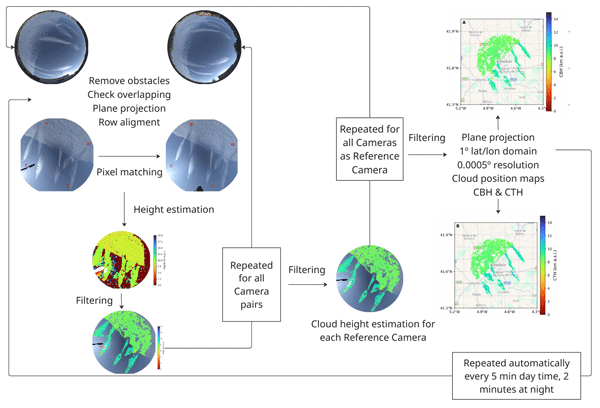
Abstract. This study presents a refined, automated in near-real time methodology to obtain cloud height maps using a network of 20 all-sky cameras. This low cost and easily manipulated instruments are distributed in the city of Valladolid, Spain, trying to cover uniformly an estimated area up to 200 km2, with the actual spatial coverage depending on cloud height. Camera distances vary from 16 km to less than 1 km, in order to have different viewing angles of the clouds above them. All this cameras are geometrically calibrated and maintained within GOA-SCAN (Group of Atmospheric Optics all-Sky CAmeras Network). The methodology utilizes a stereoscopic approach, pairing simultaneous images from all the cameras. Correlation between the image pixels is computed in order to find the same sky point in both images. Then knowing the baseline distance and the orientation of the cameras, the height of every pixel identified as cloudy is computed. This is repeated for all the camera pairs that have a significant overlapping field of view. Filtering criteria are applied to retain only the significant values. With this methodology, cloud base and top heights (CBH and CTH) maps with a 50 m spatial resolution are obtained every five minutes during daytime and every two minutes for nighttime. These maps are compared with the scene classification product from Sentinel-2 satellite images, finding significant agreement. Some discrepancies were found for high transparent clouds and cloud edges. In addition, all CBH and CTH data available during two and a half years are compared against the independent values measured by a ceilometer collocated with one of the cameras. The determination coefficient for the median CBH values within a circular 150 m distance is 0.93. The obtained CTH values tend to overestimate the ceilometer ones and have wider dispersion, with lower determination coefficient of 0.72. Illuminating conditions are crucial for the correct segmentation of cloudy pixels, limiting the performance of the algorithm at nighttime. Overall, the proposed methodology is promising for obtaining cloud spatial masks and cloud height maps, over different cloud types, layering and conditions.
-
Notice on discussion status
The requested preprint has a corresponding peer-reviewed final revised paper. You are encouraged to refer to the final revised version.
-
Preprint
(64064 KB)
-
Supplement
(22382 KB)
-
The requested preprint has a corresponding peer-reviewed final revised paper. You are encouraged to refer to the final revised version.
- Preprint
(64064 KB) - Metadata XML
-
Supplement
(22382 KB) - BibTeX
- EndNote
- Final revised paper


Journal article(s) based on this preprint
Interactive discussion
Status: closed
-
RC1: 'Comment on egusphere-2026-2694', Anonymous Referee #1, 26 Jun 2026
- AC1: 'Reply on RC1', Celia Herrero del Barrio, 23 Jul 2026
-
RC2: 'Comment on egusphere-2026-2694', Anonymous Referee #2, 13 Jul 2026
General comments
In this study, Herrero del Barrio et al. present an improved methodology that uses a network of all-sky cameras to derive cloud base height (CBH) and cloud top height (CTH) maps at high spatial resolution (50 m) in near real time, every 5 min during daytime and every 2 min during nighttime. A thorough comparison with Sentinel-2 products and ceilometer observations highlights the strengths and limitations of the method. The objectives of the study are clearly defined and are addressed through a thorough analysis, and the proposed methodology for deriving cloud masks and cloud height maps is of significance for the remote sensing of clouds. I consider the topic and results of this manuscript to fit the scope of AMT. However, I have some general comments that should be addressed prior to publication.
- I suggest stating at the very beginning of the Methodology section what is currently mentioned only in the Conclusions (lines 770–772): "It is important to remark that by using various camera pairs with different distances, the system captures parts of the vertical cloud structure, not only the cloud bases." This could also be reflected in Fig. 4. It would then be immediately clear to the reader why, for each grid bin, the minimum and maximum retrieved cloud heights are assigned to the CBH and CTH, respectively. In the same context, I would also suggest bringing forward what currently appears only in the Results section (lines 533–535): "cameras observe clouds from the surface, seeing mostly the cloud base and its sides; therefore, the CTH calculation is expected to be less accurate and precise, as the top part of the clouds is often obstructed by the cloud itself and only seen by a few viewing angles."
- I find the evaluation of the camera-derived CTH (which is expected to be underestimated, given the methodological limitations discussed above) against ceilometer observations problematic, since the ceilometer also underestimates the CTH. I would suggest presenting first, in the main text, the cases currently shown in the supplement (Fig. S5), in which the ceilometer detects an additional cloud layer above the current one, as these provide a more reliable ground truth for the CTH and would strengthen the evaluation of the presented methodology.
- I believe the study would benefit from a comparison of the results with those of previous studies mentioned in the introduction (where applicable), and from highlighting the novelty of the present study in the last paragraph of the introduction.
Specific comments
Line 32: It is not clear which short-term forecasting applications the authors are referring to here. Lines 32–34 should be refined. I suggest the authors focus on the fact that the detailed information on the cloud field provided by all-sky cameras (as their method provides) is important for capturing the spatio-temporal variability of cloudiness (supported by relevant publications). In general, more references, and more recent ones, should be cited in this paragraph.
Line 51: This statement needs explanation. Please either remove it or elaborate further.
Fig. 8 & 9: The white dots are difficult to see. Please consider using a different color or marker shape or increasing the figure size.
Line 482: Should this read "becomes more constrained" or "less constrained"? This part may need further elaboration.
Lines 545-546: "the grid bins within a 150 m radius of the ceilometer location (31 bins in total) have been considered to be a more representative area." — Is there any justification for this choice? Physical reasoning, previous studies, or a sensitivity analysis?
Lines 555-559: Is text missing here, or should this part be included in the discussion of Table 2, since it refers to the cases where the cameras indicate cloud-free conditions while the ceilometer detects clouds?
Lines 565-566: "This is likely due to the strong presence of the sun in these images, which produces significant saturation if not obstructed by clouds." — Perhaps refer here to Fig. 7 (Cam025)? Is that the case?
Line 568: Do these correlations correspond to cases where dirt is present on one camera only?
Technical corrections
Figure S2: White dots … instead of black. However, see me 3rd specific comment.
Figure 11. 1st line base instead of “bsae”
Figure S5: Section 4.2 instead of Section ??
Figure 14: two instead of three different days
Citation: https://doi.org/10.5194/egusphere-2026-2694-RC2 - AC2: 'Reply on RC2', Celia Herrero del Barrio, 23 Jul 2026
Peer review completion


Interactive discussion
Status: closed
-
RC1: 'Comment on egusphere-2026-2694', Anonymous Referee #1, 26 Jun 2026
Review of the Manuscript
Title: Cloud height mapping using multi simultaneous sky images from an all-sky camera networkGeneral comments
This manuscript presents a comprehensive and well developed methodology for retrieving cloud base height (CBH) and cloud top height (CTH) using a network of 20 all-sky cameras deployed around Valladolid (Spain). The approach combines stereoscopic reconstruction, advanced filtering, and multi-camera aggregation to produce near-real-time cloud height maps with spatial resolution of 50 m.The study is clearly motivated and addresses a relevant challenge in atmospheric remote sensing, as it fille the the gap between high-resolution but local ground-based instruments (e.g., ceilometers) and spatially extensive but temporally limited satellite measurements.
Validation against Sentinel-2 cloud masks and ceilometer observations spanning ~2.5 years strengthens the proposed method. The authors report good CBH performance, with R² ≈ 0.93 with low bias, demonstrating significant potential for operational applications such as solar nowcasting and cloud monitoring.
Overall, the manuscript represents a valuable contribution to atmospheric measurement techniques, but several aspects require clarification, and detailed discussion before publication.1. The main novelty of this work is to scale the existing stereographyc approach using all-sky cameras to a large network in automate and real time processing. However, more explicite explanation of this novelty to differenttiate respect to the key prior works would be desired. In particular, the authors should try to clarify wether the main innovations lies in network scale, agregation strategy or near real time implementations with improved accuracy.
2. The methodology is well detailed but frequently it is difficult to follow. Please improve the detail in the next aspects:
- The image rectifications and projection stage (Section 3.1.1) would be benefit of a clearrer mahtematical formulation, maye including an schematic diagram summarizing transformations and coordinate system.
- The derivation of the uncertainties propagation of the stereoscopic height equation (eq. 1) would be intereting, instead of the reported ±1 pixel shifts.
- How the thresholds criteria have been choosen? Please justify them quantitatively even from the empirical point of view. Are the ersults sensitive to this thresholds?3. The methodology strongly depends on a supervised segmentation model (U-Net), which is just trained for daytime conditions. Since nighttime and twilight performance are cleary degraded with respect to daytime performance, please discuss the potential bias induced by segmentation uncertainties on CBH and CTH retrieval. Could be the proposed method work without this segmentation process?
4. The validation for CTH and CBH against ceilometers and Satelite could be problematic, especially in case of thick clouds. Can you comment on that?
5. The authors identify some performance limitations (e.g., low clouds, high clouds at night, geometry constraints) but, did you quantify them more systematically? Are they in relation with uncertainties of the method or realted to previosu uncertainties (geometric calibration of the all-sky imager, segmentation, etc)
Minor comments:
The manuscript is generally well written, but some sentences are too long and could be simplified.
Please correct minor grammatical persintent issues (e.g., change “All this cameras” by “All these cameras”).Citation: https://doi.org/10.5194/egusphere-2026-2694-RC1 - AC1: 'Reply on RC1', Celia Herrero del Barrio, 23 Jul 2026
-
RC2: 'Comment on egusphere-2026-2694', Anonymous Referee #2, 13 Jul 2026
General comments
In this study, Herrero del Barrio et al. present an improved methodology that uses a network of all-sky cameras to derive cloud base height (CBH) and cloud top height (CTH) maps at high spatial resolution (50 m) in near real time, every 5 min during daytime and every 2 min during nighttime. A thorough comparison with Sentinel-2 products and ceilometer observations highlights the strengths and limitations of the method. The objectives of the study are clearly defined and are addressed through a thorough analysis, and the proposed methodology for deriving cloud masks and cloud height maps is of significance for the remote sensing of clouds. I consider the topic and results of this manuscript to fit the scope of AMT. However, I have some general comments that should be addressed prior to publication.
- I suggest stating at the very beginning of the Methodology section what is currently mentioned only in the Conclusions (lines 770–772): "It is important to remark that by using various camera pairs with different distances, the system captures parts of the vertical cloud structure, not only the cloud bases." This could also be reflected in Fig. 4. It would then be immediately clear to the reader why, for each grid bin, the minimum and maximum retrieved cloud heights are assigned to the CBH and CTH, respectively. In the same context, I would also suggest bringing forward what currently appears only in the Results section (lines 533–535): "cameras observe clouds from the surface, seeing mostly the cloud base and its sides; therefore, the CTH calculation is expected to be less accurate and precise, as the top part of the clouds is often obstructed by the cloud itself and only seen by a few viewing angles."
- I find the evaluation of the camera-derived CTH (which is expected to be underestimated, given the methodological limitations discussed above) against ceilometer observations problematic, since the ceilometer also underestimates the CTH. I would suggest presenting first, in the main text, the cases currently shown in the supplement (Fig. S5), in which the ceilometer detects an additional cloud layer above the current one, as these provide a more reliable ground truth for the CTH and would strengthen the evaluation of the presented methodology.
- I believe the study would benefit from a comparison of the results with those of previous studies mentioned in the introduction (where applicable), and from highlighting the novelty of the present study in the last paragraph of the introduction.
Specific comments
Line 32: It is not clear which short-term forecasting applications the authors are referring to here. Lines 32–34 should be refined. I suggest the authors focus on the fact that the detailed information on the cloud field provided by all-sky cameras (as their method provides) is important for capturing the spatio-temporal variability of cloudiness (supported by relevant publications). In general, more references, and more recent ones, should be cited in this paragraph.
Line 51: This statement needs explanation. Please either remove it or elaborate further.
Fig. 8 & 9: The white dots are difficult to see. Please consider using a different color or marker shape or increasing the figure size.
Line 482: Should this read "becomes more constrained" or "less constrained"? This part may need further elaboration.
Lines 545-546: "the grid bins within a 150 m radius of the ceilometer location (31 bins in total) have been considered to be a more representative area." — Is there any justification for this choice? Physical reasoning, previous studies, or a sensitivity analysis?
Lines 555-559: Is text missing here, or should this part be included in the discussion of Table 2, since it refers to the cases where the cameras indicate cloud-free conditions while the ceilometer detects clouds?
Lines 565-566: "This is likely due to the strong presence of the sun in these images, which produces significant saturation if not obstructed by clouds." — Perhaps refer here to Fig. 7 (Cam025)? Is that the case?
Line 568: Do these correlations correspond to cases where dirt is present on one camera only?
Technical corrections
Figure S2: White dots … instead of black. However, see me 3rd specific comment.
Figure 11. 1st line base instead of “bsae”
Figure S5: Section 4.2 instead of Section ??
Figure 14: two instead of three different days
Citation: https://doi.org/10.5194/egusphere-2026-2694-RC2 - AC2: 'Reply on RC2', Celia Herrero del Barrio, 23 Jul 2026
Peer review completion
Journal article(s) based on this preprint
Viewed
| HTML | XML | Total | Supplement | BibTeX | EndNote | |
|---|---|---|---|---|---|---|
| 349 | 252 | 50 | 651 | 111 | 46 | 30 |
- HTML: 349
- PDF: 252
- XML: 50
- Total: 651
- Supplement: 111
- BibTeX: 46
- EndNote: 30
Viewed (geographical distribution)
| Country | # | Views | % |
|---|
| Total: | 0 |
| HTML: | 0 |
| PDF: | 0 |
| XML: | 0 |
- 1
Celia Herrero del Barrio

Roberto Román
Sara Herrero-Anta
Daniel González-Fernández
Rogelio Carracedo
Ramiro González
Javier Gatón
Bruno Longarela
Juan Carlos Antuña-Sánchez
David Mateos
Carlos Toledano
Abel Calle
Victoria Cachorro
Ángel de Frutos
The requested preprint has a corresponding peer-reviewed final revised paper. You are encouraged to refer to the final revised version.
- Preprint
(64064 KB) - Metadata XML
-
Supplement
(22382 KB) - BibTeX
- EndNote
- Final revised paper
Review of the Manuscript
Title: Cloud height mapping using multi simultaneous sky images from an all-sky camera network
General comments
This manuscript presents a comprehensive and well developed methodology for retrieving cloud base height (CBH) and cloud top height (CTH) using a network of 20 all-sky cameras deployed around Valladolid (Spain). The approach combines stereoscopic reconstruction, advanced filtering, and multi-camera aggregation to produce near-real-time cloud height maps with spatial resolution of 50 m.
The study is clearly motivated and addresses a relevant challenge in atmospheric remote sensing, as it fille the the gap between high-resolution but local ground-based instruments (e.g., ceilometers) and spatially extensive but temporally limited satellite measurements.
Validation against Sentinel-2 cloud masks and ceilometer observations spanning ~2.5 years strengthens the proposed method. The authors report good CBH performance, with R² ≈ 0.93 with low bias, demonstrating significant potential for operational applications such as solar nowcasting and cloud monitoring.
Overall, the manuscript represents a valuable contribution to atmospheric measurement techniques, but several aspects require clarification, and detailed discussion before publication.
1. The main novelty of this work is to scale the existing stereographyc approach using all-sky cameras to a large network in automate and real time processing. However, more explicite explanation of this novelty to differenttiate respect to the key prior works would be desired. In particular, the authors should try to clarify wether the main innovations lies in network scale, agregation strategy or near real time implementations with improved accuracy.
2. The methodology is well detailed but frequently it is difficult to follow. Please improve the detail in the next aspects:
- The image rectifications and projection stage (Section 3.1.1) would be benefit of a clearrer mahtematical formulation, maye including an schematic diagram summarizing transformations and coordinate system.
- The derivation of the uncertainties propagation of the stereoscopic height equation (eq. 1) would be intereting, instead of the reported ±1 pixel shifts.
- How the thresholds criteria have been choosen? Please justify them quantitatively even from the empirical point of view. Are the ersults sensitive to this thresholds?
3. The methodology strongly depends on a supervised segmentation model (U-Net), which is just trained for daytime conditions. Since nighttime and twilight performance are cleary degraded with respect to daytime performance, please discuss the potential bias induced by segmentation uncertainties on CBH and CTH retrieval. Could be the proposed method work without this segmentation process?
4. The validation for CTH and CBH against ceilometers and Satelite could be problematic, especially in case of thick clouds. Can you comment on that?
5. The authors identify some performance limitations (e.g., low clouds, high clouds at night, geometry constraints) but, did you quantify them more systematically? Are they in relation with uncertainties of the method or realted to previosu uncertainties (geometric calibration of the all-sky imager, segmentation, etc)
Minor comments:
The manuscript is generally well written, but some sentences are too long and could be simplified.
Please correct minor grammatical persintent issues (e.g., change “All this cameras” by “All these cameras”).