
the Creative Commons Attribution 4.0 License.
the Creative Commons Attribution 4.0 License.
 | 11 Feb 2026
Radiocarbon in atmospheric CH4 and CO2 at Jungfraujoch in 2019–2024: influence of regional nuclear emissions and current global atmospheric 14CH4 signal
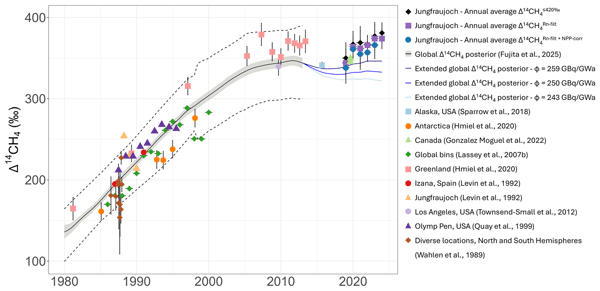
Abstract. Radiocarbon (14C) is a valuable tracer to determine the relative fossil fractions of emitted carbonaceous greenhouse gases, such as CO2 and CH4. While atmospheric ∆14CO2 measurements have been conducted at multiple sites for several decades, ∆14CH4 measurements remain more limited, mainly due to measurement challenges. In addition, nuclear power plant 14CH4 emissions can complicate data interpretation. In this study, biweekly ∆14CH4 and ∆14CO2 measurements at the Swiss High-Altitude Research Station Jungfraujoch (JFJ, about 3500 m a.s.l.) between 2019 and 2024 are presented. Over this period, ∆14CH4 values showed an increase from 350 ± 19 ‰ to 381 ± 13 ‰, while ∆14CO2 values decreased from -2.0 ± 3.8 ‰ to -12.7 ± 2.0 ‰, respectively. The former is related to the slight increase of 14CH4 emissions from the nuclear industry over the last years, while the latter is linked to the dilution of the 14CO2 signal due to the release of 14C-devoid CO2 from combustion of fossil fuels. Despite its high elevation, JFJ is still influenced by nuclear power plants (NPPs) operating in Europe. Considering a European-scale atmospheric dispersion model and 14CH4 and 14CO2 emissions from European NPPs, the mean nuclear 14C contribution to our individual measurements was estimated to be 7 ± 9 ‰ for ∆14CH4 and 0.2 ± 0.4 ‰ for ∆14CO2. Furthermore, our ∆14CH4 measurements reasonably agree with simulated atmospheric values of ∆14CH4 estimated by a global atmospheric one-box model and an estimation of global nuclear 14CH4 emissions.
-
Notice on discussion status
The requested preprint has a corresponding peer-reviewed final revised paper. You are encouraged to refer to the final revised version.
-
Preprint
(1918 KB)
-
Supplement
(505 KB)
-
The requested preprint has a corresponding peer-reviewed final revised paper. You are encouraged to refer to the final revised version.
- Preprint
(1918 KB) - Metadata XML
-
Supplement
(505 KB) - BibTeX
- EndNote
- Final revised paper


Journal article(s) based on this preprint
Interactive discussion
Status: closed
-
RC1: 'Comment on egusphere-2026-265', Anonymous Referee #1, 21 Mar 2026
The comment was uploaded in the form of a supplement: https://egusphere.copernicus.org/preprints/2026/egusphere-2026-265/egusphere-2026-265-RC1-supplement.pdfCitation: https://doi.org/
10.5194/egusphere-2026-265-RC1 -
AC1: 'Reply on RC1', Thomas Laemmel, 27 May 2026
The comment was uploaded in the form of a supplement: https://egusphere.copernicus.org/preprints/2026/egusphere-2026-265/egusphere-2026-265-AC1-supplement.pdf
-
AC1: 'Reply on RC1', Thomas Laemmel, 27 May 2026
-
RC2: 'Review of Laemmel et al Jungfraujoch 14CH4 record', Vasilii Petrenko, 07 Apr 2026
The authors present a new multiyear record of ∆14CH4 and ∆14CO2 from the high-altitude Jungfraujoch, Switzerland observatory that spans from 2019 - 2024. The ∆14CO2 record shows the expected trend (gradual decline), attributable to continuing fossil CO2 emissions. In my review, I focus on ∆14CH4, as this is the main focus of the paper and also more within my expertise.
∆14C of atmospheric CH4 is useful for constraining the fossil fraction of methane emissions; this fraction is uncertain on both the regional and global scales. While the interpretation of ∆14CH4 is complicated by direct nuclear emissions (something the authors discuss in detail), ∆14CH4 can be used in conjunction with methane stable isotope measurements for assessing regional and global CH4 budgets with higher confidence. The new record from Laemmel et al. fills a void in published recent direct atmospheric ∆14CH4 measurements. It also captures a recent gradual increase in ∆14CH4 in the free troposphere over Europe. This is novel and valuable; the measurements appear to be of high-quality. I therefore consider this study to be a good fit for ACP, and recommend its publication after some minor revisions.
Detailed comments:
Impressive precision (as evaluated by repeated measurements of two ambient air standards) of 8 ‰ is achieved for such small samples – well done!
The passive sampling into a large volume steel tank, and nighttime time-averaged sampling are nice innovations well suited for the purpose of getting high-quality background measurements of ∆14CH4 at this location.
How stable is CH4 in the large volume Tecobags, and was this tested for time intervals representative of sample storage? A brief mention / description of this would be useful.
Has simple “memory” (residual carbon from prior sample affecting the next sample) been tested for the laboratory extraction system? This would be useful to describe briefly as well.
What are the typical % yields of the extraction (i.e., what % of the CH4 carbon is in the end recovered as CO2, as compared to the expected amount based on CH4 mole fraction and air volume processed)? This would be useful to describe briefly as well.
The form of Equation 1 is not familiar to me, and I think the equation needs to be better explained / supported. What is C_obs? What is 14C_n? I don’t see this equation derived in the reference that is given to support it (Graven et al., 2019). Considering this, I recommend deriving the equation starting with the most basic quantities (number of 14CH4 molecules, number of total CH4 molecules) in the manuscript (perhaps in the supplement).
Line 324. note that Hmiel et al (2020) did not report any Antarctic ice core 14CH4; for Antarctica they only reported firn air measurements
Figure 2 caption. Please clarify what exactly the uncertainty bars on panel B represent. Is this the statistical uncertainty from individual AMS measurements? Or combined uncertainty from measurements and other aspects of processing?
Figure 3 caption – same comment as above regarding uncertainty bars.
I am not sure that trying to correct the ∆14CH4 results for regional nuclear power plant influence makes sense, for two reasons. First, as the authors themselves note in another part of the manuscript, ∆14CH4 releases are episodic rather than constant, so model-based corrections for individual samples are unlikely to be accurate. Second, I think the uncorrected measurements are overall more valuable, as they represent well – mixed tropospheric air at this location; this is what a global transport model would need for interpretation. That said, since the authors are comparing with predictions from a 1-box model, I can see the value of trying to remove the more regional nuclear influence. Perhaps some caveats along above lines could be added when discussing this correction and the corrected results.
Figure 4 legend: Hmiel et al (2020), not 2019
Citation: https://doi.org/10.5194/egusphere-2026-265-RC2 -
AC2: 'Reply on RC2', Thomas Laemmel, 27 May 2026
The comment was uploaded in the form of a supplement: https://egusphere.copernicus.org/preprints/2026/egusphere-2026-265/egusphere-2026-265-AC2-supplement.pdf
-
AC2: 'Reply on RC2', Thomas Laemmel, 27 May 2026
Peer review completion


Interactive discussion
Status: closed
-
RC1: 'Comment on egusphere-2026-265', Anonymous Referee #1, 21 Mar 2026
The comment was uploaded in the form of a supplement: https://egusphere.copernicus.org/preprints/2026/egusphere-2026-265/egusphere-2026-265-RC1-supplement.pdf
-
AC1: 'Reply on RC1', Thomas Laemmel, 27 May 2026
The comment was uploaded in the form of a supplement: https://egusphere.copernicus.org/preprints/2026/egusphere-2026-265/egusphere-2026-265-AC1-supplement.pdf
-
AC1: 'Reply on RC1', Thomas Laemmel, 27 May 2026
-
RC2: 'Review of Laemmel et al Jungfraujoch 14CH4 record', Vasilii Petrenko, 07 Apr 2026
The authors present a new multiyear record of ∆14CH4 and ∆14CO2 from the high-altitude Jungfraujoch, Switzerland observatory that spans from 2019 - 2024. The ∆14CO2 record shows the expected trend (gradual decline), attributable to continuing fossil CO2 emissions. In my review, I focus on ∆14CH4, as this is the main focus of the paper and also more within my expertise.
∆14C of atmospheric CH4 is useful for constraining the fossil fraction of methane emissions; this fraction is uncertain on both the regional and global scales. While the interpretation of ∆14CH4 is complicated by direct nuclear emissions (something the authors discuss in detail), ∆14CH4 can be used in conjunction with methane stable isotope measurements for assessing regional and global CH4 budgets with higher confidence. The new record from Laemmel et al. fills a void in published recent direct atmospheric ∆14CH4 measurements. It also captures a recent gradual increase in ∆14CH4 in the free troposphere over Europe. This is novel and valuable; the measurements appear to be of high-quality. I therefore consider this study to be a good fit for ACP, and recommend its publication after some minor revisions.
Detailed comments:
Impressive precision (as evaluated by repeated measurements of two ambient air standards) of 8 ‰ is achieved for such small samples – well done!
The passive sampling into a large volume steel tank, and nighttime time-averaged sampling are nice innovations well suited for the purpose of getting high-quality background measurements of ∆14CH4 at this location.
How stable is CH4 in the large volume Tecobags, and was this tested for time intervals representative of sample storage? A brief mention / description of this would be useful.
Has simple “memory” (residual carbon from prior sample affecting the next sample) been tested for the laboratory extraction system? This would be useful to describe briefly as well.
What are the typical % yields of the extraction (i.e., what % of the CH4 carbon is in the end recovered as CO2, as compared to the expected amount based on CH4 mole fraction and air volume processed)? This would be useful to describe briefly as well.
The form of Equation 1 is not familiar to me, and I think the equation needs to be better explained / supported. What is C_obs? What is 14C_n? I don’t see this equation derived in the reference that is given to support it (Graven et al., 2019). Considering this, I recommend deriving the equation starting with the most basic quantities (number of 14CH4 molecules, number of total CH4 molecules) in the manuscript (perhaps in the supplement).
Line 324. note that Hmiel et al (2020) did not report any Antarctic ice core 14CH4; for Antarctica they only reported firn air measurements
Figure 2 caption. Please clarify what exactly the uncertainty bars on panel B represent. Is this the statistical uncertainty from individual AMS measurements? Or combined uncertainty from measurements and other aspects of processing?
Figure 3 caption – same comment as above regarding uncertainty bars.
I am not sure that trying to correct the ∆14CH4 results for regional nuclear power plant influence makes sense, for two reasons. First, as the authors themselves note in another part of the manuscript, ∆14CH4 releases are episodic rather than constant, so model-based corrections for individual samples are unlikely to be accurate. Second, I think the uncorrected measurements are overall more valuable, as they represent well – mixed tropospheric air at this location; this is what a global transport model would need for interpretation. That said, since the authors are comparing with predictions from a 1-box model, I can see the value of trying to remove the more regional nuclear influence. Perhaps some caveats along above lines could be added when discussing this correction and the corrected results.
Figure 4 legend: Hmiel et al (2020), not 2019
Citation: https://doi.org/10.5194/egusphere-2026-265-RC2 -
AC2: 'Reply on RC2', Thomas Laemmel, 27 May 2026
The comment was uploaded in the form of a supplement: https://egusphere.copernicus.org/preprints/2026/egusphere-2026-265/egusphere-2026-265-AC2-supplement.pdf
-
AC2: 'Reply on RC2', Thomas Laemmel, 27 May 2026
Peer review completion
Journal article(s) based on this preprint
Viewed
| HTML | XML | Total | Supplement | BibTeX | EndNote | |
|---|---|---|---|---|---|---|
| 1,705 | 1,512 | 137 | 3,354 | 309 | 225 | 311 |
- HTML: 1,705
- PDF: 1,512
- XML: 137
- Total: 3,354
- Supplement: 309
- BibTeX: 225
- EndNote: 311
Viewed (geographical distribution)
| Country | # | Views | % |
|---|
| Total: | 0 |
| HTML: | 0 |
| PDF: | 0 |
| XML: | 0 |
- 1

Dylan Geissbühler
Stephan Henne
Ryo Fujita
Heather Graven
Christophe Espic
Matthias Bantle
Negar Haghipour
Franz Conen
Dominik Brunner
Martin Steinbacher
Giulia Zazzeri
Samuel Hammer
Markus Leuenberger
Sönke Szidat
The requested preprint has a corresponding peer-reviewed final revised paper. You are encouraged to refer to the final revised version.
- Preprint
(1918 KB) - Metadata XML
-
Supplement
(505 KB) - BibTeX
- EndNote
- Final revised paper