
the Creative Commons Attribution 4.0 License.
the Creative Commons Attribution 4.0 License.
 | 21 May 2026
Enhancing Urban Air Quality Mapping through Novel Measurement and Modelling approaches, and Citizen Science: Actionable Insights from the RI-URBANS Project
Abstract. Air Quality is among the most environmental issues impacting the urban populations. Traditional air quality networks can assess time trends and assess compliance to air quality regulations, but to understand sources and assess exposure. The RI-URBANS project is a European initiative aiming to develop new strategies and enhance the existing tools to address the air quality challenges and societal needs in European cities. This paper presents an overview of the pilots of the RI-URBANS project associated with air quality mapping and pollution hotspot identification using modelling, novel measuring methodologies and mapping techniques. Special focus is given on the discussion of the novel measuring methodologies introduced with the use of low-cost sensors, mobile measurements and citizen participation in the data collection process, with pilot projects undertaken in the core pilot cities in Europe and other projects from cities outside the pilot's core. The findings highlight the significance of participatory science, technological advancements in air quality measurement, and the potential for policy integration. The project's outcomes suggest that integrating stationary sensor networks, mobile monitoring platforms, and citizen engagement can significantly enhance urban air quality management, alongside traditional monitoring and modelling methodologies. This study highlights the important work undertaken by the participating cities and the novel approaches to disentangle the complicated air pollution patterns and improve the air quality for everyone, while making this crucial information easily obtainable.
Competing interests: At least one of the (co-)authors is a member of the editorial board of Atmospheric Measurement Techniques.
Publisher's note: Copernicus Publications remains neutral with regard to jurisdictional claims made in the text, published maps, institutional affiliations, or any other geographical representation in this paper. While Copernicus Publications makes every effort to include appropriate place names, the final responsibility lies with the authors. Views expressed in the text are those of the authors and do not necessarily reflect the views of the publisher.-
Notice on discussion status
The requested preprint has a corresponding peer-reviewed final revised paper. You are encouraged to refer to the final revised version.
-
Preprint
(8553 KB)
-
The requested preprint has a corresponding peer-reviewed final revised paper. You are encouraged to refer to the final revised version.


Journal article(s) based on this preprint
Interactive discussion
Status: closed
-
RC1: 'Comment on egusphere-2026-2592', Anonymous Referee #1, 24 Jun 2026
-
AC1: 'Reply on RC1', Francis Pope, 17 Jul 2026
We thank the reviewers for their positive reviews and useful critiques; we respond to all reviewer comments below, line by line.
Reviewer #1
Summary
This paper presents a summary of measurement and modelling approaches for urban air quality mapping and hotspot identification applied across the pilot studies from the RI-URBANS project. It describes the different methods used in each pilot, key insights and learnings from citizen science participation.
General comments
By summarising the methods and findings across the pilot studies, this paper provides practical guidelines for the development of future air monitoring networks and has the potential to make a valuable contribution to the field. However, major revisions are required before publication, particularly with respect to the paper's structure and organisation, to ensure that its key messages and contributions are clearly highlighted.
While currently structured thematically to some extent the authors still describe each pilot study as a separate paragraph including a lot of information, which gets lost in the results. Rather than discussing each pilot individually, the authors may consider comparing the measurement and modelling approaches used across the different pilots, highlighting what worked well for which research question/scale/pollutant, what challenges were encountered, and what lessons were learned. This would provide important insights to help design future air monitoring networks. A summary table presenting the different approaches, objectives, challenges, key findings, and actionable insights from each pilot study would help in this context.
RESPONSE: Following the reviewer's positive feedback, the Methodology section was substantially revised to provide greater detail on the pilot studies, including descriptions of the models evaluated and the low-cost sensors used for the measurements. In addition, an overview of the aims and achievements of the RI-URBANS project was included, together with two summary tables outlining the methodologies investigated. The Results section was also expanded to present the outcomes of the pilot studies and the performance of the approaches evaluated, drawing on the associated publications to provide an overview of their feasibility and practical applicability. Further details of the revisions are provided in the responses to the individual reviewer comments.
Specific comments
Methodology
It would be helpful to have further background about the RI-URBANs project and the pilots reviewed in this paper in this section. Also, this section may be used to introduce the different measurement and modelling approaches, which are currently listed separately for each pilot in the results section.
RESPONSE: Section 2.1 has been expanded to include an overview of the RI-URBANS project, describing its aims, scope, and key achievements. The added text explains the project's focus on monitoring emerging pollutants (including ultrafine particles and black carbon), the development of novel measurement protocols, modelling tools, and emission inventories, and its contribution to improved urban air quality monitoring and EU air quality policy.
Furthermore, Sections 2.2 and 2.3 were reordered to improve the overall structure and consistency of the manuscript. Both sections were revised to provide additional details on the models evaluated and the low-cost sensors used in each pilot study. Two summary tables were also added to present the measurement campaigns undertaken at each pilot site.
2.2 What is the novel part of the measurements? Is it the combination of approaches, pollutants measured or the involvement of citizen science? Currently the novelty of the measurements is not clear to me.
RESPONSE: We agree that the novelty of the measurement approach was not sufficiently clear in the original manuscript. The novelty of RI-URBANS lies not in a single measurement technique, but in the integration and evaluation of multiple complementary approaches. These include the deployment of traditional reference instrumentation in novel monitoring configurations, the extensive evaluation of low-cost sensors, the incorporation of citizen science into data collection, and the integration of remote sensing and satellite observations with ground-based measurements. Section 2.3 (previously Section 2.2) has been revised to clearly describe these novel aspects and their contribution to urban air quality monitoring.
“Novel measurement techniques involved the setup of stationary networks, mobile measurement approaches or remote sensing to complement the existing regulatory AQMN. Apart from novel setups of research grade instruments (e.g. on vans) low-cost sensors (LCS) were also extensively tested. These LCS can measure a variety of pollutants, including PM2.5, PM10, NO2, CO, O3, and in some cases black carbon (BC), ultrafine particles (UFP) and organic aerosols (OA). Table 2 lists the campaigns using novel data collection techniques from the RI-URBANS core and partner countries. The Alphasense OPC-N3 was the primary sensor used by the UK group for PM measurements. This is an optical particle counter sensor measuring PM in the range 0.35 to 40 μm, providing PNSD in 24 size bins and using that information to estimate PM1, PM2.5 and PM10concentrations. For UFP measurements the Testo DISCmini, a hand-held ultrafine particle counter measuring the number and average diameter of nanoparticles in the diameter range from 10 to 700 nm, was used. For BC measurements, several sensors were tested, for example the single wavelength microAeth AE51 and Observair and the more advanced MA200, MA350 capable of measuring in multiple wavelengths providing additional information about the carbon content of the samples (Elomaa et al., 2024). Finally, the Kunak Air Mobile, a modular mobile IoT sensor system measuring PM, NO2 and O3, was deployed by some of the campaigns.
Remote sensing approaches were also tested for air pollution mapping and hotspot identification in several RI-URBANS sub-projects, in particular the use of satellite and LIDAR data. These approaches are expected to play an increasingly important role in future AQ monitoring, providing data collection with greater spatial coverage.
The combination of all these novel approaches, in combination with the data obtained from the existing AQMN, can deliver valuable insights and help guide urban AQ policies. The combination of different methodologies as well as the use of LCS require robust QA/QC, which within RI-URBANS was achieved through campaign specific AQMN co-location campaigns, data cleaning, calibration, curation and normalisation procedures, assisting in the consistency and accuracy of the data collected. In most cases the data collected were openly available in data banks, such as the ARGOS platform (RI-URBANS, 2025b), further promoting transparency and increasing awareness.
Finally, the involvement of citizen scientists in the monitoring process was used in several pilot cities in the RI-URBANS project. Citizen science projects face several challenges. These, together with the measures adopted to overcome them and the lessons learned from the campaigns, are discussed in this study to inform future citizen science applications.”
2.3 This section needs strengthening – currently it just provides a broad overview of commonly used modelling approaches which do not necessary appear to reflect the models introduced in the results section.
RESPONSE: We agree with the reviewer that the focus should be put on the models used in the RI-URBANS project instead. Thus, a brief presentation of the models used from the pilot cities (which was previously in the Results) was added in section 2.2 (previously 2.3), removing unnecessary information from the Results. Also, a table was added summarising the works associated with each model for quick reference.
“The pilots in France mainly used the CHIMERE model, an open-source multi-scale chemistry transport model, which can forecast pollutant concentrations and make long-term simulations for emission control scenarios (LMD, 2025). The pilots in the UK focused on the ADMS (Atmospheric Dispersion Modelling System) model, an advanced dispersion model used to model the air quality impact of existing and proposed industrial installations. Specifically, the ADMS-Urban model can model the dispersion of particulate matter and chemical substances in the urban environment (CERC, 2026). The Environment – High Resolution Limited Area Model (Enviro-HIRLAM), used by the Finnish group, is developed as a fully online integrated numerical weather prediction and atmospheric chemical transport model for research and forecasting of joint meteorological, chemical and biological weather (Baklanov et al., 2017). The pilot cities in Greece used several models. The CAMS (Copernicus Atmosphere Monitoring Service) atmospheric model, an operational global forecasting system that tracks and predicts atmospheric composition, including air quality, greenhouse gases, and aerosols (ECMWF, 2026). Another model used was the Particulate Matter Comprehensive Air Quality Model with Extensions (PMCAMx), which is a state-of-the-art three-dimensional chemical transport model developed to simulate the atmospheric processing, mass concentration, and chemical composition of particulate matter over regional and urban scales (Gaydos et al., 2007). Finally, the group from Patras in Greece developed the SmartAQ system, which incorporates input from models including the PMCAMx, WRF (for meteorological data), MEGAN3 (for biogenic emissions), and outputs concentration forecasts for several gaseous pollutants and PM. The SmartAQ model (1x1 km2) provides advanced treatment of OA volatility chemistry, and uses an updated emission inventory, including biomass burning emissions and can forecast not only pollutant concentrations but also the source contributions for them (Siouti et al., 2022).”
Results and Discussion
As mentioned above, this appears to currently be a list of approaches and results from each pilot, instead it would be helpful to compare and contrast the methods across the pilots and highlight the actionable insights from these methods.
RESPONSE: We thank the reviewer for this helpful suggestion and carefully considered whether a direct comparison of the approaches across the pilot studies would strengthen the manuscript. However, the pilot studies addressed markedly different objectives, including source apportionment, air quality mapping at spatial scales ranging from neighbourhood to continental, evaluation of sensors and monitoring methodologies, measurement of different pollutants, and data harmonisation. As a result, a direct comparison of their methods or outcomes would not be meaningful. Instead, following the reviewers' comments, we have streamlined the presentation to improve consistency and clarity while maintaining the original aim of the manuscript: to present and evaluate the RI-URBANS pilot campaigns, drawing on the associated literature to highlight their feasibility, lessons learned, and the potential of these approaches to inform future urban air quality monitoring initiatives.
Reviewer #2
General comments
The manuscript aims to provide a summary and review of the broader RI-URBANS project. While the discussion and conclusion provide useful synthesis of the lessons learned across the project, the abstract, methods, and results are currently quite generalized and unstructured, making it difficult to gain a sense of the full scale of the program. With improved structure and a more explicit overview of each pilot, this manuscript will be a useful review of the important RI-URBANS project.
RESPONSE: We thank the reviewer for this helpful observation. We have made substantial revisions to the Methodology and Results sections to improve both their structure and readability. Information describing the models and technical approaches used in the different pilot studies has been significantly expanded, with several elements relocated from the Results to the Methodology section to provide a clearer overview of the project before presenting the findings. Consequently, the Results section now focuses on the outcomes of the pilot studies, including the performance, feasibility, and practical applicability of the approaches evaluated. Further details of these revisions are provided in the responses below and in our responses to Reviewer 1.Specific comments
The abstract is very generalized. The authors should add more specific project details and outcomes, drawing on what is written in the discussion and conclusion.
RESPONSE: The Abstract has been revised to provide a more specific overview of the aims, activities, and key outcomes of the RI-URBANS project while remaining within the journal's word limit. Additional text has been included to highlight two of the project's principal findings: (i) the importance of harmonising measurements obtained using different instruments and monitoring approaches to ensure comparable results across projects, and (ii) the key considerations for improving citizen science campaigns, particularly through careful study design and effective communication with participants.
Lines 133-138: I am confused on what the difference is between the two main approaches. The authors should add more details to clarify.
RESPONSE: One approach included the collection of data which were used directly for air pollution mapping and hotspot identification (in some cases this data was later used for modelling as well, which while mentioned in the text is outside the scope of the study). The other approach used pre-existing data (from data banks, e.g EBAS, or emission factors) which were analysed using advanced modelling (not plain mapping). A clarification on the use of pre-existing data was added - “Firstly, the use of previously tested and novel modelling methodologies was deployed on pre-existing data”. To clarify this distinction, the two approaches are studied separately with their own sections, both within the Methodology and Results sections.
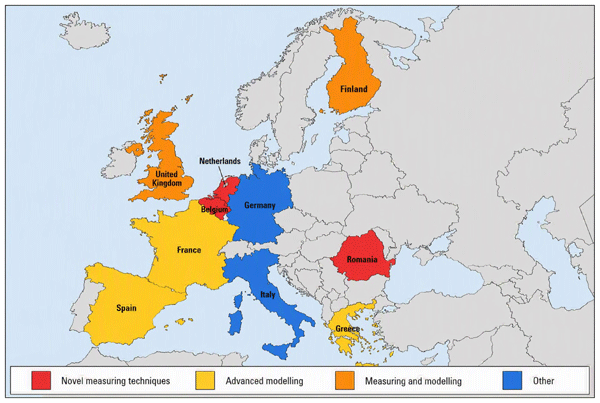
Section 2.1 should introduce each of the campaigns and give an overview of their goals, what equipment or approach they used, etc. This will improve the readability instead of introuding the campaigns in the results. A specific map of the pilot projects (not just the countries involved) with a visual representation of each focus (modelling? Citizen science? Etc.) would be very helpful.
RESPONSE: Thank you. The original text was too scattered within the manuscript, making it difficult for the reader to grasp it. Thus, several changes were made throughout the manuscript to improve the readability following the reviewer’s comment. Starting with section 2.1 an improved map was generated with the countries which participated and partnered on the RI-URBANS project with different colours according to their type of work. Furthermore, two tables (Table 1 and Table 2) were added (one in each section) summarising the modelling or measurement approach, the pollutants assessed, the collection method and citizen involvement (for the data collection campaigns) and their related publications. Furthermore, the models and sensors used are also presented in their corresponding section, removing unnecessary information from the Results chapter.
Section 2.2: This is a very generalized section. A table outlining each pilot and the data collection technique used (along with sensor type, calibration technique, etc.) would help provide a more specific, yet brief overview of the methods used across the RI-URBANS program.
RESPONSE: We thank the reviewer for this useful suggestion. An overview table was added in section 2.3 (previously section 2.2) presenting the campaigns in each pilot country of the RI-URBANS, the pollutants assessed, the collection method and citizen involvement, as well as the associated publications. We believe this addition improves the readability of the paper.
Section 2.3: Again, this section would be much easier to read if each of the campaigns had already been introduced, allowing for more specific details for each campaign. As it is now, the second paragraph reads more like an introduction section about air pollution modelling.
RESPONSE: Similar to the previous comment, a table summarising, the models used, the pollutants assessed and the associated publications was added in section 2.2 (previously 2.3) for the studies presented in the Results chapter.
Section 3: Right now, it is hard to follow the long list pilots without any big picture view of the broader project. See comment on section 2.1
RESPONSE: We agree with the reviewer. Following the changes on the Methodology chapter, several pieces of information which did not belong in the Results chapter (presentation of the models, sensors, and approaches) were removed, in most cases moved to the Methodology. The Results chapter is now focused on the presentation of the outcomes of the different projects, the information obtained and the assessment of the performance of the approaches tested. This was the main aim of the paper as well as of the RI-URBANS project in general. We believe that these changes along with the updated Methodology chapter and the tables added improve the flow, readability and presentation of the RI-URBANS projects.
Technical corrections:
Line 16: It seems like an adjective is missing in between “most” and “environmental”… One of the most importantenvironmental issues, perhaps?
RESPONSE: The reviewer is correct in pointing the missing word. The word pressing was added
Line 19: delete “assess” before exposure
RESPONSE: Deleted according to suggestion
Lines 23, 25, 61, : change “measuring” to measurement
RESPONSE: All instances were changed according to suggestion
Line 27: delete the second themes
RESPONSE: Deleted according to suggestion
Citation: https://doi.org/10.5194/egusphere-2026-2592-AC1
-
AC1: 'Reply on RC1', Francis Pope, 17 Jul 2026
-
RC2: 'Comment on egusphere-2026-2592', Anonymous Referee #2, 24 Jun 2026
General comments
The manuscript aims to provide a summary and review of the broader RI-URBANS project. While the discussion and conclusion provide useful synthesis of the lessons learned across the project, the abstract, methods, and results are currently quite generalized and unstructured, making it difficult to gain a sense of the full scale of the program. With improved structure and a more explicit overview of each pilot, this manuscript will be a useful review of the important RI-URBANS project.
Specific comments
The abstract is very generalized. The authors should add more specific project details and outcomes, drawing on what is written in the discussion and conclusion.
Lines 133-138: I am confused on what the difference is between the two main approaches. The authors should add more details to clarify.
Section 2.1 should introduce each of the campaigns and give an overview of their goals, what equipment or approach they used, etc. This will improve the readability instead of introuding the campaigns in the results. A specific map of the pilot projects (not just the countries involved) with a visual representation of each focus (modelling? Citizen science? Etc.) would be very helpful.
Section 2.2: This is a very generalized section. A table outlining each pilot and the data collection technique used (along with sensor type, calibration technique, etc.) would help provide a more specific, yet brief overview of the methods used across the RI-URBANS program.
Section 2.3: Again, this section would be much easier to read if each of the campaigns had already been introduced, allowing for more specific details for each campaign. As it is now, the second paragraph reads more like an introduction section about air pollution modelling.
Section 3: Right now, it is hard to follow the long list of pilots without any big picture view of the broader project. See comment on section 2.1
Technical corrections:
Line 16: It seems like an adjective is missing in between “most” and “environmental”… One of the most important environmental issues, perhaps?
Line 19: delete “assess” before exposure
Lines 23, 25, 61, : change “measuring” to measurement
Line 27: delete the second themes
Citation: https://doi.org/10.5194/egusphere-2026-2592-RC2 -
AC2: 'Reply on RC2', Francis Pope, 17 Jul 2026
We thank the reviewers for their positive reviews and useful critiques; we respond to all reviewer comments below, line by line.
Reviewer #1
Summary
This paper presents a summary of measurement and modelling approaches for urban air quality mapping and hotspot identification applied across the pilot studies from the RI-URBANS project. It describes the different methods used in each pilot, key insights and learnings from citizen science participation.
General comments
By summarising the methods and findings across the pilot studies, this paper provides practical guidelines for the development of future air monitoring networks and has the potential to make a valuable contribution to the field. However, major revisions are required before publication, particularly with respect to the paper's structure and organisation, to ensure that its key messages and contributions are clearly highlighted.
While currently structured thematically to some extent the authors still describe each pilot study as a separate paragraph including a lot of information, which gets lost in the results. Rather than discussing each pilot individually, the authors may consider comparing the measurement and modelling approaches used across the different pilots, highlighting what worked well for which research question/scale/pollutant, what challenges were encountered, and what lessons were learned. This would provide important insights to help design future air monitoring networks. A summary table presenting the different approaches, objectives, challenges, key findings, and actionable insights from each pilot study would help in this context.
RESPONSE: Following the reviewer's positive feedback, the Methodology section was substantially revised to provide greater detail on the pilot studies, including descriptions of the models evaluated and the low-cost sensors used for the measurements. In addition, an overview of the aims and achievements of the RI-URBANS project was included, together with two summary tables outlining the methodologies investigated. The Results section was also expanded to present the outcomes of the pilot studies and the performance of the approaches evaluated, drawing on the associated publications to provide an overview of their feasibility and practical applicability. Further details of the revisions are provided in the responses to the individual reviewer comments.
Specific comments
Methodology
It would be helpful to have further background about the RI-URBANs project and the pilots reviewed in this paper in this section. Also, this section may be used to introduce the different measurement and modelling approaches, which are currently listed separately for each pilot in the results section.
RESPONSE: Section 2.1 has been expanded to include an overview of the RI-URBANS project, describing its aims, scope, and key achievements. The added text explains the project's focus on monitoring emerging pollutants (including ultrafine particles and black carbon), the development of novel measurement protocols, modelling tools, and emission inventories, and its contribution to improved urban air quality monitoring and EU air quality policy.
Furthermore, Sections 2.2 and 2.3 were reordered to improve the overall structure and consistency of the manuscript. Both sections were revised to provide additional details on the models evaluated and the low-cost sensors used in each pilot study. Two summary tables were also added to present the measurement campaigns undertaken at each pilot site.
2.2 What is the novel part of the measurements? Is it the combination of approaches, pollutants measured or the involvement of citizen science? Currently the novelty of the measurements is not clear to me.
RESPONSE: We agree that the novelty of the measurement approach was not sufficiently clear in the original manuscript. The novelty of RI-URBANS lies not in a single measurement technique, but in the integration and evaluation of multiple complementary approaches. These include the deployment of traditional reference instrumentation in novel monitoring configurations, the extensive evaluation of low-cost sensors, the incorporation of citizen science into data collection, and the integration of remote sensing and satellite observations with ground-based measurements. Section 2.3 (previously Section 2.2) has been revised to clearly describe these novel aspects and their contribution to urban air quality monitoring.
“Novel measurement techniques involved the setup of stationary networks, mobile measurement approaches or remote sensing to complement the existing regulatory AQMN. Apart from novel setups of research grade instruments (e.g. on vans) low-cost sensors (LCS) were also extensively tested. These LCS can measure a variety of pollutants, including PM2.5, PM10, NO2, CO, O3, and in some cases black carbon (BC), ultrafine particles (UFP) and organic aerosols (OA). Table 2 lists the campaigns using novel data collection techniques from the RI-URBANS core and partner countries. The Alphasense OPC-N3 was the primary sensor used by the UK group for PM measurements. This is an optical particle counter sensor measuring PM in the range 0.35 to 40 μm, providing PNSD in 24 size bins and using that information to estimate PM1, PM2.5 and PM10concentrations. For UFP measurements the Testo DISCmini, a hand-held ultrafine particle counter measuring the number and average diameter of nanoparticles in the diameter range from 10 to 700 nm, was used. For BC measurements, several sensors were tested, for example the single wavelength microAeth AE51 and Observair and the more advanced MA200, MA350 capable of measuring in multiple wavelengths providing additional information about the carbon content of the samples (Elomaa et al., 2024). Finally, the Kunak Air Mobile, a modular mobile IoT sensor system measuring PM, NO2 and O3, was deployed by some of the campaigns.
Remote sensing approaches were also tested for air pollution mapping and hotspot identification in several RI-URBANS sub-projects, in particular the use of satellite and LIDAR data. These approaches are expected to play an increasingly important role in future AQ monitoring, providing data collection with greater spatial coverage.
The combination of all these novel approaches, in combination with the data obtained from the existing AQMN, can deliver valuable insights and help guide urban AQ policies. The combination of different methodologies as well as the use of LCS require robust QA/QC, which within RI-URBANS was achieved through campaign specific AQMN co-location campaigns, data cleaning, calibration, curation and normalisation procedures, assisting in the consistency and accuracy of the data collected. In most cases the data collected were openly available in data banks, such as the ARGOS platform (RI-URBANS, 2025b), further promoting transparency and increasing awareness.
Finally, the involvement of citizen scientists in the monitoring process was used in several pilot cities in the RI-URBANS project. Citizen science projects face several challenges. These, together with the measures adopted to overcome them and the lessons learned from the campaigns, are discussed in this study to inform future citizen science applications.”
2.3 This section needs strengthening – currently it just provides a broad overview of commonly used modelling approaches which do not necessary appear to reflect the models introduced in the results section.
RESPONSE: We agree with the reviewer that the focus should be put on the models used in the RI-URBANS project instead. Thus, a brief presentation of the models used from the pilot cities (which was previously in the Results) was added in section 2.2 (previously 2.3), removing unnecessary information from the Results. Also, a table was added summarising the works associated with each model for quick reference.
“The pilots in France mainly used the CHIMERE model, an open-source multi-scale chemistry transport model, which can forecast pollutant concentrations and make long-term simulations for emission control scenarios (LMD, 2025). The pilots in the UK focused on the ADMS (Atmospheric Dispersion Modelling System) model, an advanced dispersion model used to model the air quality impact of existing and proposed industrial installations. Specifically, the ADMS-Urban model can model the dispersion of particulate matter and chemical substances in the urban environment (CERC, 2026). The Environment – High Resolution Limited Area Model (Enviro-HIRLAM), used by the Finnish group, is developed as a fully online integrated numerical weather prediction and atmospheric chemical transport model for research and forecasting of joint meteorological, chemical and biological weather (Baklanov et al., 2017). The pilot cities in Greece used several models. The CAMS (Copernicus Atmosphere Monitoring Service) atmospheric model, an operational global forecasting system that tracks and predicts atmospheric composition, including air quality, greenhouse gases, and aerosols (ECMWF, 2026). Another model used was the Particulate Matter Comprehensive Air Quality Model with Extensions (PMCAMx), which is a state-of-the-art three-dimensional chemical transport model developed to simulate the atmospheric processing, mass concentration, and chemical composition of particulate matter over regional and urban scales (Gaydos et al., 2007). Finally, the group from Patras in Greece developed the SmartAQ system, which incorporates input from models including the PMCAMx, WRF (for meteorological data), MEGAN3 (for biogenic emissions), and outputs concentration forecasts for several gaseous pollutants and PM. The SmartAQ model (1x1 km2) provides advanced treatment of OA volatility chemistry, and uses an updated emission inventory, including biomass burning emissions and can forecast not only pollutant concentrations but also the source contributions for them (Siouti et al., 2022).”
Results and Discussion
As mentioned above, this appears to currently be a list of approaches and results from each pilot, instead it would be helpful to compare and contrast the methods across the pilots and highlight the actionable insights from these methods.
RESPONSE: We thank the reviewer for this helpful suggestion and carefully considered whether a direct comparison of the approaches across the pilot studies would strengthen the manuscript. However, the pilot studies addressed markedly different objectives, including source apportionment, air quality mapping at spatial scales ranging from neighbourhood to continental, evaluation of sensors and monitoring methodologies, measurement of different pollutants, and data harmonisation. As a result, a direct comparison of their methods or outcomes would not be meaningful. Instead, following the reviewers' comments, we have streamlined the presentation to improve consistency and clarity while maintaining the original aim of the manuscript: to present and evaluate the RI-URBANS pilot campaigns, drawing on the associated literature to highlight their feasibility, lessons learned, and the potential of these approaches to inform future urban air quality monitoring initiatives.
Reviewer #2
General comments
The manuscript aims to provide a summary and review of the broader RI-URBANS project. While the discussion and conclusion provide useful synthesis of the lessons learned across the project, the abstract, methods, and results are currently quite generalized and unstructured, making it difficult to gain a sense of the full scale of the program. With improved structure and a more explicit overview of each pilot, this manuscript will be a useful review of the important RI-URBANS project.
RESPONSE: We thank the reviewer for this helpful observation. We have made substantial revisions to the Methodology and Results sections to improve both their structure and readability. Information describing the models and technical approaches used in the different pilot studies has been significantly expanded, with several elements relocated from the Results to the Methodology section to provide a clearer overview of the project before presenting the findings. Consequently, the Results section now focuses on the outcomes of the pilot studies, including the performance, feasibility, and practical applicability of the approaches evaluated. Further details of these revisions are provided in the responses below and in our responses to Reviewer 1.Specific comments
The abstract is very generalized. The authors should add more specific project details and outcomes, drawing on what is written in the discussion and conclusion.
RESPONSE: The Abstract has been revised to provide a more specific overview of the aims, activities, and key outcomes of the RI-URBANS project while remaining within the journal's word limit. Additional text has been included to highlight two of the project's principal findings: (i) the importance of harmonising measurements obtained using different instruments and monitoring approaches to ensure comparable results across projects, and (ii) the key considerations for improving citizen science campaigns, particularly through careful study design and effective communication with participants.
Lines 133-138: I am confused on what the difference is between the two main approaches. The authors should add more details to clarify.
RESPONSE: One approach included the collection of data which were used directly for air pollution mapping and hotspot identification (in some cases this data was later used for modelling as well, which while mentioned in the text is outside the scope of the study). The other approach used pre-existing data (from data banks, e.g EBAS, or emission factors) which were analysed using advanced modelling (not plain mapping). A clarification on the use of pre-existing data was added - “Firstly, the use of previously tested and novel modelling methodologies was deployed on pre-existing data”. To clarify this distinction, the two approaches are studied separately with their own sections, both within the Methodology and Results sections.
Section 2.1 should introduce each of the campaigns and give an overview of their goals, what equipment or approach they used, etc. This will improve the readability instead of introuding the campaigns in the results. A specific map of the pilot projects (not just the countries involved) with a visual representation of each focus (modelling? Citizen science? Etc.) would be very helpful.
RESPONSE: Thank you. The original text was too scattered within the manuscript, making it difficult for the reader to grasp it. Thus, several changes were made throughout the manuscript to improve the readability following the reviewer’s comment. Starting with section 2.1 an improved map was generated with the countries which participated and partnered on the RI-URBANS project with different colours according to their type of work. Furthermore, two tables (Table 1 and Table 2) were added (one in each section) summarising the modelling or measurement approach, the pollutants assessed, the collection method and citizen involvement (for the data collection campaigns) and their related publications. Furthermore, the models and sensors used are also presented in their corresponding section, removing unnecessary information from the Results chapter.
Section 2.2: This is a very generalized section. A table outlining each pilot and the data collection technique used (along with sensor type, calibration technique, etc.) would help provide a more specific, yet brief overview of the methods used across the RI-URBANS program.
RESPONSE: We thank the reviewer for this useful suggestion. An overview table was added in section 2.3 (previously section 2.2) presenting the campaigns in each pilot country of the RI-URBANS, the pollutants assessed, the collection method and citizen involvement, as well as the associated publications. We believe this addition improves the readability of the paper.
Section 2.3: Again, this section would be much easier to read if each of the campaigns had already been introduced, allowing for more specific details for each campaign. As it is now, the second paragraph reads more like an introduction section about air pollution modelling.
RESPONSE: Similar to the previous comment, a table summarising, the models used, the pollutants assessed and the associated publications was added in section 2.2 (previously 2.3) for the studies presented in the Results chapter.
Section 3: Right now, it is hard to follow the long list pilots without any big picture view of the broader project. See comment on section 2.1
RESPONSE: We agree with the reviewer. Following the changes on the Methodology chapter, several pieces of information which did not belong in the Results chapter (presentation of the models, sensors, and approaches) were removed, in most cases moved to the Methodology. The Results chapter is now focused on the presentation of the outcomes of the different projects, the information obtained and the assessment of the performance of the approaches tested. This was the main aim of the paper as well as of the RI-URBANS project in general. We believe that these changes along with the updated Methodology chapter and the tables added improve the flow, readability and presentation of the RI-URBANS projects.
Technical corrections:
Line 16: It seems like an adjective is missing in between “most” and “environmental”… One of the most importantenvironmental issues, perhaps?
RESPONSE: The reviewer is correct in pointing the missing word. The word pressing was added
Line 19: delete “assess” before exposure
RESPONSE: Deleted according to suggestion
Lines 23, 25, 61, : change “measuring” to measurement
RESPONSE: All instances were changed according to suggestion
Line 27: delete the second themes
RESPONSE: Deleted according to suggestion
Citation: https://doi.org/10.5194/egusphere-2026-2592-AC2
-
AC2: 'Reply on RC2', Francis Pope, 17 Jul 2026
Peer review completion


Interactive discussion
Status: closed
-
RC1: 'Comment on egusphere-2026-2592', Anonymous Referee #1, 24 Jun 2026
Enhancing Urban Air Quality Mapping through Novel Measurement Modelling approaches and Citizen Science: Actionable Insights from the RI-URBANS Project
Summary
This paper presents a summary of measurement and modelling approaches for urban air quality mapping and hotspot identification applied across the pilot studies from the RI-URBANS project. It describes the different methods used in each pilot, key insights and learnings from citizen science participation.
General comments
By summarising the methods and findings across the pilot studies, this paper provides practical guidelines for the development of future air monitoring networks and has the potential to make a valuable contribution to the field. However, major revisions are required before publication, particularly with respect to the paper's structure and organisation, to ensure that its key messages and contributions are clearly highlighted.
While currently structured thematically to some extent the authors still describe each pilot study as a separate paragraph including a lot of information, which gets lost in the results. Rather than discussing each pilot individually, the authors may consider comparing the measurement and modelling approaches used across the different pilots, highlighting what worked well for which research question/scale/pollutant, what challenges were encountered, and what lessons were learned. This would provide important insights to help design future air monitoring networks. A summary table presenting the different approaches, objectives, challenges, key findings, and actionable insights from each pilot study would help in this context.
Specific comments
Methodology
It would be helpful to have further background about the RI-URBANs project and the pilots reviewed in this paper in this section. Also, this section may be used to introduce the different measurement and modelling approaches, which are currently listed separately for each pilot in the results section.
2.2 What is the novel part of the measurements? Is it the combination of approaches, pollutants measured or the involvement of citizen science? Currently the novelty of the measurements is not clear to me.
2.3 This section needs strengthening – currently it just provides a broad overview of commonly used modelling approaches which do not necessary appear to reflect the models introduced in the results section.
Results and Discussion
As mentioned above, this appears to currently be a list of approaches and results from each pilot, instead it would be helpful to compare and contrast the methods across the pilots and highlight the actionable insights from these methods.
Citation: https://doi.org/10.5194/egusphere-2026-2592-RC1 -
AC1: 'Reply on RC1', Francis Pope, 17 Jul 2026
We thank the reviewers for their positive reviews and useful critiques; we respond to all reviewer comments below, line by line.
Reviewer #1
Summary
This paper presents a summary of measurement and modelling approaches for urban air quality mapping and hotspot identification applied across the pilot studies from the RI-URBANS project. It describes the different methods used in each pilot, key insights and learnings from citizen science participation.
General comments
By summarising the methods and findings across the pilot studies, this paper provides practical guidelines for the development of future air monitoring networks and has the potential to make a valuable contribution to the field. However, major revisions are required before publication, particularly with respect to the paper's structure and organisation, to ensure that its key messages and contributions are clearly highlighted.
While currently structured thematically to some extent the authors still describe each pilot study as a separate paragraph including a lot of information, which gets lost in the results. Rather than discussing each pilot individually, the authors may consider comparing the measurement and modelling approaches used across the different pilots, highlighting what worked well for which research question/scale/pollutant, what challenges were encountered, and what lessons were learned. This would provide important insights to help design future air monitoring networks. A summary table presenting the different approaches, objectives, challenges, key findings, and actionable insights from each pilot study would help in this context.
RESPONSE: Following the reviewer's positive feedback, the Methodology section was substantially revised to provide greater detail on the pilot studies, including descriptions of the models evaluated and the low-cost sensors used for the measurements. In addition, an overview of the aims and achievements of the RI-URBANS project was included, together with two summary tables outlining the methodologies investigated. The Results section was also expanded to present the outcomes of the pilot studies and the performance of the approaches evaluated, drawing on the associated publications to provide an overview of their feasibility and practical applicability. Further details of the revisions are provided in the responses to the individual reviewer comments.
Specific comments
Methodology
It would be helpful to have further background about the RI-URBANs project and the pilots reviewed in this paper in this section. Also, this section may be used to introduce the different measurement and modelling approaches, which are currently listed separately for each pilot in the results section.
RESPONSE: Section 2.1 has been expanded to include an overview of the RI-URBANS project, describing its aims, scope, and key achievements. The added text explains the project's focus on monitoring emerging pollutants (including ultrafine particles and black carbon), the development of novel measurement protocols, modelling tools, and emission inventories, and its contribution to improved urban air quality monitoring and EU air quality policy.
Furthermore, Sections 2.2 and 2.3 were reordered to improve the overall structure and consistency of the manuscript. Both sections were revised to provide additional details on the models evaluated and the low-cost sensors used in each pilot study. Two summary tables were also added to present the measurement campaigns undertaken at each pilot site.
2.2 What is the novel part of the measurements? Is it the combination of approaches, pollutants measured or the involvement of citizen science? Currently the novelty of the measurements is not clear to me.
RESPONSE: We agree that the novelty of the measurement approach was not sufficiently clear in the original manuscript. The novelty of RI-URBANS lies not in a single measurement technique, but in the integration and evaluation of multiple complementary approaches. These include the deployment of traditional reference instrumentation in novel monitoring configurations, the extensive evaluation of low-cost sensors, the incorporation of citizen science into data collection, and the integration of remote sensing and satellite observations with ground-based measurements. Section 2.3 (previously Section 2.2) has been revised to clearly describe these novel aspects and their contribution to urban air quality monitoring.
“Novel measurement techniques involved the setup of stationary networks, mobile measurement approaches or remote sensing to complement the existing regulatory AQMN. Apart from novel setups of research grade instruments (e.g. on vans) low-cost sensors (LCS) were also extensively tested. These LCS can measure a variety of pollutants, including PM2.5, PM10, NO2, CO, O3, and in some cases black carbon (BC), ultrafine particles (UFP) and organic aerosols (OA). Table 2 lists the campaigns using novel data collection techniques from the RI-URBANS core and partner countries. The Alphasense OPC-N3 was the primary sensor used by the UK group for PM measurements. This is an optical particle counter sensor measuring PM in the range 0.35 to 40 μm, providing PNSD in 24 size bins and using that information to estimate PM1, PM2.5 and PM10concentrations. For UFP measurements the Testo DISCmini, a hand-held ultrafine particle counter measuring the number and average diameter of nanoparticles in the diameter range from 10 to 700 nm, was used. For BC measurements, several sensors were tested, for example the single wavelength microAeth AE51 and Observair and the more advanced MA200, MA350 capable of measuring in multiple wavelengths providing additional information about the carbon content of the samples (Elomaa et al., 2024). Finally, the Kunak Air Mobile, a modular mobile IoT sensor system measuring PM, NO2 and O3, was deployed by some of the campaigns.
Remote sensing approaches were also tested for air pollution mapping and hotspot identification in several RI-URBANS sub-projects, in particular the use of satellite and LIDAR data. These approaches are expected to play an increasingly important role in future AQ monitoring, providing data collection with greater spatial coverage.
The combination of all these novel approaches, in combination with the data obtained from the existing AQMN, can deliver valuable insights and help guide urban AQ policies. The combination of different methodologies as well as the use of LCS require robust QA/QC, which within RI-URBANS was achieved through campaign specific AQMN co-location campaigns, data cleaning, calibration, curation and normalisation procedures, assisting in the consistency and accuracy of the data collected. In most cases the data collected were openly available in data banks, such as the ARGOS platform (RI-URBANS, 2025b), further promoting transparency and increasing awareness.
Finally, the involvement of citizen scientists in the monitoring process was used in several pilot cities in the RI-URBANS project. Citizen science projects face several challenges. These, together with the measures adopted to overcome them and the lessons learned from the campaigns, are discussed in this study to inform future citizen science applications.”
2.3 This section needs strengthening – currently it just provides a broad overview of commonly used modelling approaches which do not necessary appear to reflect the models introduced in the results section.
RESPONSE: We agree with the reviewer that the focus should be put on the models used in the RI-URBANS project instead. Thus, a brief presentation of the models used from the pilot cities (which was previously in the Results) was added in section 2.2 (previously 2.3), removing unnecessary information from the Results. Also, a table was added summarising the works associated with each model for quick reference.
“The pilots in France mainly used the CHIMERE model, an open-source multi-scale chemistry transport model, which can forecast pollutant concentrations and make long-term simulations for emission control scenarios (LMD, 2025). The pilots in the UK focused on the ADMS (Atmospheric Dispersion Modelling System) model, an advanced dispersion model used to model the air quality impact of existing and proposed industrial installations. Specifically, the ADMS-Urban model can model the dispersion of particulate matter and chemical substances in the urban environment (CERC, 2026). The Environment – High Resolution Limited Area Model (Enviro-HIRLAM), used by the Finnish group, is developed as a fully online integrated numerical weather prediction and atmospheric chemical transport model for research and forecasting of joint meteorological, chemical and biological weather (Baklanov et al., 2017). The pilot cities in Greece used several models. The CAMS (Copernicus Atmosphere Monitoring Service) atmospheric model, an operational global forecasting system that tracks and predicts atmospheric composition, including air quality, greenhouse gases, and aerosols (ECMWF, 2026). Another model used was the Particulate Matter Comprehensive Air Quality Model with Extensions (PMCAMx), which is a state-of-the-art three-dimensional chemical transport model developed to simulate the atmospheric processing, mass concentration, and chemical composition of particulate matter over regional and urban scales (Gaydos et al., 2007). Finally, the group from Patras in Greece developed the SmartAQ system, which incorporates input from models including the PMCAMx, WRF (for meteorological data), MEGAN3 (for biogenic emissions), and outputs concentration forecasts for several gaseous pollutants and PM. The SmartAQ model (1x1 km2) provides advanced treatment of OA volatility chemistry, and uses an updated emission inventory, including biomass burning emissions and can forecast not only pollutant concentrations but also the source contributions for them (Siouti et al., 2022).”
Results and Discussion
As mentioned above, this appears to currently be a list of approaches and results from each pilot, instead it would be helpful to compare and contrast the methods across the pilots and highlight the actionable insights from these methods.
RESPONSE: We thank the reviewer for this helpful suggestion and carefully considered whether a direct comparison of the approaches across the pilot studies would strengthen the manuscript. However, the pilot studies addressed markedly different objectives, including source apportionment, air quality mapping at spatial scales ranging from neighbourhood to continental, evaluation of sensors and monitoring methodologies, measurement of different pollutants, and data harmonisation. As a result, a direct comparison of their methods or outcomes would not be meaningful. Instead, following the reviewers' comments, we have streamlined the presentation to improve consistency and clarity while maintaining the original aim of the manuscript: to present and evaluate the RI-URBANS pilot campaigns, drawing on the associated literature to highlight their feasibility, lessons learned, and the potential of these approaches to inform future urban air quality monitoring initiatives.
Reviewer #2
General comments
The manuscript aims to provide a summary and review of the broader RI-URBANS project. While the discussion and conclusion provide useful synthesis of the lessons learned across the project, the abstract, methods, and results are currently quite generalized and unstructured, making it difficult to gain a sense of the full scale of the program. With improved structure and a more explicit overview of each pilot, this manuscript will be a useful review of the important RI-URBANS project.
RESPONSE: We thank the reviewer for this helpful observation. We have made substantial revisions to the Methodology and Results sections to improve both their structure and readability. Information describing the models and technical approaches used in the different pilot studies has been significantly expanded, with several elements relocated from the Results to the Methodology section to provide a clearer overview of the project before presenting the findings. Consequently, the Results section now focuses on the outcomes of the pilot studies, including the performance, feasibility, and practical applicability of the approaches evaluated. Further details of these revisions are provided in the responses below and in our responses to Reviewer 1.Specific comments
The abstract is very generalized. The authors should add more specific project details and outcomes, drawing on what is written in the discussion and conclusion.
RESPONSE: The Abstract has been revised to provide a more specific overview of the aims, activities, and key outcomes of the RI-URBANS project while remaining within the journal's word limit. Additional text has been included to highlight two of the project's principal findings: (i) the importance of harmonising measurements obtained using different instruments and monitoring approaches to ensure comparable results across projects, and (ii) the key considerations for improving citizen science campaigns, particularly through careful study design and effective communication with participants.
Lines 133-138: I am confused on what the difference is between the two main approaches. The authors should add more details to clarify.
RESPONSE: One approach included the collection of data which were used directly for air pollution mapping and hotspot identification (in some cases this data was later used for modelling as well, which while mentioned in the text is outside the scope of the study). The other approach used pre-existing data (from data banks, e.g EBAS, or emission factors) which were analysed using advanced modelling (not plain mapping). A clarification on the use of pre-existing data was added - “Firstly, the use of previously tested and novel modelling methodologies was deployed on pre-existing data”. To clarify this distinction, the two approaches are studied separately with their own sections, both within the Methodology and Results sections.
Section 2.1 should introduce each of the campaigns and give an overview of their goals, what equipment or approach they used, etc. This will improve the readability instead of introuding the campaigns in the results. A specific map of the pilot projects (not just the countries involved) with a visual representation of each focus (modelling? Citizen science? Etc.) would be very helpful.
RESPONSE: Thank you. The original text was too scattered within the manuscript, making it difficult for the reader to grasp it. Thus, several changes were made throughout the manuscript to improve the readability following the reviewer’s comment. Starting with section 2.1 an improved map was generated with the countries which participated and partnered on the RI-URBANS project with different colours according to their type of work. Furthermore, two tables (Table 1 and Table 2) were added (one in each section) summarising the modelling or measurement approach, the pollutants assessed, the collection method and citizen involvement (for the data collection campaigns) and their related publications. Furthermore, the models and sensors used are also presented in their corresponding section, removing unnecessary information from the Results chapter.
Section 2.2: This is a very generalized section. A table outlining each pilot and the data collection technique used (along with sensor type, calibration technique, etc.) would help provide a more specific, yet brief overview of the methods used across the RI-URBANS program.
RESPONSE: We thank the reviewer for this useful suggestion. An overview table was added in section 2.3 (previously section 2.2) presenting the campaigns in each pilot country of the RI-URBANS, the pollutants assessed, the collection method and citizen involvement, as well as the associated publications. We believe this addition improves the readability of the paper.
Section 2.3: Again, this section would be much easier to read if each of the campaigns had already been introduced, allowing for more specific details for each campaign. As it is now, the second paragraph reads more like an introduction section about air pollution modelling.
RESPONSE: Similar to the previous comment, a table summarising, the models used, the pollutants assessed and the associated publications was added in section 2.2 (previously 2.3) for the studies presented in the Results chapter.
Section 3: Right now, it is hard to follow the long list pilots without any big picture view of the broader project. See comment on section 2.1
RESPONSE: We agree with the reviewer. Following the changes on the Methodology chapter, several pieces of information which did not belong in the Results chapter (presentation of the models, sensors, and approaches) were removed, in most cases moved to the Methodology. The Results chapter is now focused on the presentation of the outcomes of the different projects, the information obtained and the assessment of the performance of the approaches tested. This was the main aim of the paper as well as of the RI-URBANS project in general. We believe that these changes along with the updated Methodology chapter and the tables added improve the flow, readability and presentation of the RI-URBANS projects.
Technical corrections:
Line 16: It seems like an adjective is missing in between “most” and “environmental”… One of the most importantenvironmental issues, perhaps?
RESPONSE: The reviewer is correct in pointing the missing word. The word pressing was added
Line 19: delete “assess” before exposure
RESPONSE: Deleted according to suggestion
Lines 23, 25, 61, : change “measuring” to measurement
RESPONSE: All instances were changed according to suggestion
Line 27: delete the second themes
RESPONSE: Deleted according to suggestion
Citation: https://doi.org/10.5194/egusphere-2026-2592-AC1
-
AC1: 'Reply on RC1', Francis Pope, 17 Jul 2026
-
RC2: 'Comment on egusphere-2026-2592', Anonymous Referee #2, 24 Jun 2026
General comments
The manuscript aims to provide a summary and review of the broader RI-URBANS project. While the discussion and conclusion provide useful synthesis of the lessons learned across the project, the abstract, methods, and results are currently quite generalized and unstructured, making it difficult to gain a sense of the full scale of the program. With improved structure and a more explicit overview of each pilot, this manuscript will be a useful review of the important RI-URBANS project.
Specific comments
The abstract is very generalized. The authors should add more specific project details and outcomes, drawing on what is written in the discussion and conclusion.
Lines 133-138: I am confused on what the difference is between the two main approaches. The authors should add more details to clarify.
Section 2.1 should introduce each of the campaigns and give an overview of their goals, what equipment or approach they used, etc. This will improve the readability instead of introuding the campaigns in the results. A specific map of the pilot projects (not just the countries involved) with a visual representation of each focus (modelling? Citizen science? Etc.) would be very helpful.
Section 2.2: This is a very generalized section. A table outlining each pilot and the data collection technique used (along with sensor type, calibration technique, etc.) would help provide a more specific, yet brief overview of the methods used across the RI-URBANS program.
Section 2.3: Again, this section would be much easier to read if each of the campaigns had already been introduced, allowing for more specific details for each campaign. As it is now, the second paragraph reads more like an introduction section about air pollution modelling.
Section 3: Right now, it is hard to follow the long list of pilots without any big picture view of the broader project. See comment on section 2.1
Technical corrections:
Line 16: It seems like an adjective is missing in between “most” and “environmental”… One of the most important environmental issues, perhaps?
Line 19: delete “assess” before exposure
Lines 23, 25, 61, : change “measuring” to measurement
Line 27: delete the second themes
Citation: https://doi.org/10.5194/egusphere-2026-2592-RC2 -
AC2: 'Reply on RC2', Francis Pope, 17 Jul 2026
We thank the reviewers for their positive reviews and useful critiques; we respond to all reviewer comments below, line by line.
Reviewer #1
Summary
This paper presents a summary of measurement and modelling approaches for urban air quality mapping and hotspot identification applied across the pilot studies from the RI-URBANS project. It describes the different methods used in each pilot, key insights and learnings from citizen science participation.
General comments
By summarising the methods and findings across the pilot studies, this paper provides practical guidelines for the development of future air monitoring networks and has the potential to make a valuable contribution to the field. However, major revisions are required before publication, particularly with respect to the paper's structure and organisation, to ensure that its key messages and contributions are clearly highlighted.
While currently structured thematically to some extent the authors still describe each pilot study as a separate paragraph including a lot of information, which gets lost in the results. Rather than discussing each pilot individually, the authors may consider comparing the measurement and modelling approaches used across the different pilots, highlighting what worked well for which research question/scale/pollutant, what challenges were encountered, and what lessons were learned. This would provide important insights to help design future air monitoring networks. A summary table presenting the different approaches, objectives, challenges, key findings, and actionable insights from each pilot study would help in this context.
RESPONSE: Following the reviewer's positive feedback, the Methodology section was substantially revised to provide greater detail on the pilot studies, including descriptions of the models evaluated and the low-cost sensors used for the measurements. In addition, an overview of the aims and achievements of the RI-URBANS project was included, together with two summary tables outlining the methodologies investigated. The Results section was also expanded to present the outcomes of the pilot studies and the performance of the approaches evaluated, drawing on the associated publications to provide an overview of their feasibility and practical applicability. Further details of the revisions are provided in the responses to the individual reviewer comments.
Specific comments
Methodology
It would be helpful to have further background about the RI-URBANs project and the pilots reviewed in this paper in this section. Also, this section may be used to introduce the different measurement and modelling approaches, which are currently listed separately for each pilot in the results section.
RESPONSE: Section 2.1 has been expanded to include an overview of the RI-URBANS project, describing its aims, scope, and key achievements. The added text explains the project's focus on monitoring emerging pollutants (including ultrafine particles and black carbon), the development of novel measurement protocols, modelling tools, and emission inventories, and its contribution to improved urban air quality monitoring and EU air quality policy.
Furthermore, Sections 2.2 and 2.3 were reordered to improve the overall structure and consistency of the manuscript. Both sections were revised to provide additional details on the models evaluated and the low-cost sensors used in each pilot study. Two summary tables were also added to present the measurement campaigns undertaken at each pilot site.
2.2 What is the novel part of the measurements? Is it the combination of approaches, pollutants measured or the involvement of citizen science? Currently the novelty of the measurements is not clear to me.
RESPONSE: We agree that the novelty of the measurement approach was not sufficiently clear in the original manuscript. The novelty of RI-URBANS lies not in a single measurement technique, but in the integration and evaluation of multiple complementary approaches. These include the deployment of traditional reference instrumentation in novel monitoring configurations, the extensive evaluation of low-cost sensors, the incorporation of citizen science into data collection, and the integration of remote sensing and satellite observations with ground-based measurements. Section 2.3 (previously Section 2.2) has been revised to clearly describe these novel aspects and their contribution to urban air quality monitoring.
“Novel measurement techniques involved the setup of stationary networks, mobile measurement approaches or remote sensing to complement the existing regulatory AQMN. Apart from novel setups of research grade instruments (e.g. on vans) low-cost sensors (LCS) were also extensively tested. These LCS can measure a variety of pollutants, including PM2.5, PM10, NO2, CO, O3, and in some cases black carbon (BC), ultrafine particles (UFP) and organic aerosols (OA). Table 2 lists the campaigns using novel data collection techniques from the RI-URBANS core and partner countries. The Alphasense OPC-N3 was the primary sensor used by the UK group for PM measurements. This is an optical particle counter sensor measuring PM in the range 0.35 to 40 μm, providing PNSD in 24 size bins and using that information to estimate PM1, PM2.5 and PM10concentrations. For UFP measurements the Testo DISCmini, a hand-held ultrafine particle counter measuring the number and average diameter of nanoparticles in the diameter range from 10 to 700 nm, was used. For BC measurements, several sensors were tested, for example the single wavelength microAeth AE51 and Observair and the more advanced MA200, MA350 capable of measuring in multiple wavelengths providing additional information about the carbon content of the samples (Elomaa et al., 2024). Finally, the Kunak Air Mobile, a modular mobile IoT sensor system measuring PM, NO2 and O3, was deployed by some of the campaigns.
Remote sensing approaches were also tested for air pollution mapping and hotspot identification in several RI-URBANS sub-projects, in particular the use of satellite and LIDAR data. These approaches are expected to play an increasingly important role in future AQ monitoring, providing data collection with greater spatial coverage.
The combination of all these novel approaches, in combination with the data obtained from the existing AQMN, can deliver valuable insights and help guide urban AQ policies. The combination of different methodologies as well as the use of LCS require robust QA/QC, which within RI-URBANS was achieved through campaign specific AQMN co-location campaigns, data cleaning, calibration, curation and normalisation procedures, assisting in the consistency and accuracy of the data collected. In most cases the data collected were openly available in data banks, such as the ARGOS platform (RI-URBANS, 2025b), further promoting transparency and increasing awareness.
Finally, the involvement of citizen scientists in the monitoring process was used in several pilot cities in the RI-URBANS project. Citizen science projects face several challenges. These, together with the measures adopted to overcome them and the lessons learned from the campaigns, are discussed in this study to inform future citizen science applications.”
2.3 This section needs strengthening – currently it just provides a broad overview of commonly used modelling approaches which do not necessary appear to reflect the models introduced in the results section.
RESPONSE: We agree with the reviewer that the focus should be put on the models used in the RI-URBANS project instead. Thus, a brief presentation of the models used from the pilot cities (which was previously in the Results) was added in section 2.2 (previously 2.3), removing unnecessary information from the Results. Also, a table was added summarising the works associated with each model for quick reference.
“The pilots in France mainly used the CHIMERE model, an open-source multi-scale chemistry transport model, which can forecast pollutant concentrations and make long-term simulations for emission control scenarios (LMD, 2025). The pilots in the UK focused on the ADMS (Atmospheric Dispersion Modelling System) model, an advanced dispersion model used to model the air quality impact of existing and proposed industrial installations. Specifically, the ADMS-Urban model can model the dispersion of particulate matter and chemical substances in the urban environment (CERC, 2026). The Environment – High Resolution Limited Area Model (Enviro-HIRLAM), used by the Finnish group, is developed as a fully online integrated numerical weather prediction and atmospheric chemical transport model for research and forecasting of joint meteorological, chemical and biological weather (Baklanov et al., 2017). The pilot cities in Greece used several models. The CAMS (Copernicus Atmosphere Monitoring Service) atmospheric model, an operational global forecasting system that tracks and predicts atmospheric composition, including air quality, greenhouse gases, and aerosols (ECMWF, 2026). Another model used was the Particulate Matter Comprehensive Air Quality Model with Extensions (PMCAMx), which is a state-of-the-art three-dimensional chemical transport model developed to simulate the atmospheric processing, mass concentration, and chemical composition of particulate matter over regional and urban scales (Gaydos et al., 2007). Finally, the group from Patras in Greece developed the SmartAQ system, which incorporates input from models including the PMCAMx, WRF (for meteorological data), MEGAN3 (for biogenic emissions), and outputs concentration forecasts for several gaseous pollutants and PM. The SmartAQ model (1x1 km2) provides advanced treatment of OA volatility chemistry, and uses an updated emission inventory, including biomass burning emissions and can forecast not only pollutant concentrations but also the source contributions for them (Siouti et al., 2022).”
Results and Discussion
As mentioned above, this appears to currently be a list of approaches and results from each pilot, instead it would be helpful to compare and contrast the methods across the pilots and highlight the actionable insights from these methods.
RESPONSE: We thank the reviewer for this helpful suggestion and carefully considered whether a direct comparison of the approaches across the pilot studies would strengthen the manuscript. However, the pilot studies addressed markedly different objectives, including source apportionment, air quality mapping at spatial scales ranging from neighbourhood to continental, evaluation of sensors and monitoring methodologies, measurement of different pollutants, and data harmonisation. As a result, a direct comparison of their methods or outcomes would not be meaningful. Instead, following the reviewers' comments, we have streamlined the presentation to improve consistency and clarity while maintaining the original aim of the manuscript: to present and evaluate the RI-URBANS pilot campaigns, drawing on the associated literature to highlight their feasibility, lessons learned, and the potential of these approaches to inform future urban air quality monitoring initiatives.
Reviewer #2
General comments
The manuscript aims to provide a summary and review of the broader RI-URBANS project. While the discussion and conclusion provide useful synthesis of the lessons learned across the project, the abstract, methods, and results are currently quite generalized and unstructured, making it difficult to gain a sense of the full scale of the program. With improved structure and a more explicit overview of each pilot, this manuscript will be a useful review of the important RI-URBANS project.
RESPONSE: We thank the reviewer for this helpful observation. We have made substantial revisions to the Methodology and Results sections to improve both their structure and readability. Information describing the models and technical approaches used in the different pilot studies has been significantly expanded, with several elements relocated from the Results to the Methodology section to provide a clearer overview of the project before presenting the findings. Consequently, the Results section now focuses on the outcomes of the pilot studies, including the performance, feasibility, and practical applicability of the approaches evaluated. Further details of these revisions are provided in the responses below and in our responses to Reviewer 1.Specific comments
The abstract is very generalized. The authors should add more specific project details and outcomes, drawing on what is written in the discussion and conclusion.
RESPONSE: The Abstract has been revised to provide a more specific overview of the aims, activities, and key outcomes of the RI-URBANS project while remaining within the journal's word limit. Additional text has been included to highlight two of the project's principal findings: (i) the importance of harmonising measurements obtained using different instruments and monitoring approaches to ensure comparable results across projects, and (ii) the key considerations for improving citizen science campaigns, particularly through careful study design and effective communication with participants.
Lines 133-138: I am confused on what the difference is between the two main approaches. The authors should add more details to clarify.
RESPONSE: One approach included the collection of data which were used directly for air pollution mapping and hotspot identification (in some cases this data was later used for modelling as well, which while mentioned in the text is outside the scope of the study). The other approach used pre-existing data (from data banks, e.g EBAS, or emission factors) which were analysed using advanced modelling (not plain mapping). A clarification on the use of pre-existing data was added - “Firstly, the use of previously tested and novel modelling methodologies was deployed on pre-existing data”. To clarify this distinction, the two approaches are studied separately with their own sections, both within the Methodology and Results sections.
Section 2.1 should introduce each of the campaigns and give an overview of their goals, what equipment or approach they used, etc. This will improve the readability instead of introuding the campaigns in the results. A specific map of the pilot projects (not just the countries involved) with a visual representation of each focus (modelling? Citizen science? Etc.) would be very helpful.
RESPONSE: Thank you. The original text was too scattered within the manuscript, making it difficult for the reader to grasp it. Thus, several changes were made throughout the manuscript to improve the readability following the reviewer’s comment. Starting with section 2.1 an improved map was generated with the countries which participated and partnered on the RI-URBANS project with different colours according to their type of work. Furthermore, two tables (Table 1 and Table 2) were added (one in each section) summarising the modelling or measurement approach, the pollutants assessed, the collection method and citizen involvement (for the data collection campaigns) and their related publications. Furthermore, the models and sensors used are also presented in their corresponding section, removing unnecessary information from the Results chapter.
Section 2.2: This is a very generalized section. A table outlining each pilot and the data collection technique used (along with sensor type, calibration technique, etc.) would help provide a more specific, yet brief overview of the methods used across the RI-URBANS program.
RESPONSE: We thank the reviewer for this useful suggestion. An overview table was added in section 2.3 (previously section 2.2) presenting the campaigns in each pilot country of the RI-URBANS, the pollutants assessed, the collection method and citizen involvement, as well as the associated publications. We believe this addition improves the readability of the paper.
Section 2.3: Again, this section would be much easier to read if each of the campaigns had already been introduced, allowing for more specific details for each campaign. As it is now, the second paragraph reads more like an introduction section about air pollution modelling.
RESPONSE: Similar to the previous comment, a table summarising, the models used, the pollutants assessed and the associated publications was added in section 2.2 (previously 2.3) for the studies presented in the Results chapter.
Section 3: Right now, it is hard to follow the long list pilots without any big picture view of the broader project. See comment on section 2.1
RESPONSE: We agree with the reviewer. Following the changes on the Methodology chapter, several pieces of information which did not belong in the Results chapter (presentation of the models, sensors, and approaches) were removed, in most cases moved to the Methodology. The Results chapter is now focused on the presentation of the outcomes of the different projects, the information obtained and the assessment of the performance of the approaches tested. This was the main aim of the paper as well as of the RI-URBANS project in general. We believe that these changes along with the updated Methodology chapter and the tables added improve the flow, readability and presentation of the RI-URBANS projects.
Technical corrections:
Line 16: It seems like an adjective is missing in between “most” and “environmental”… One of the most importantenvironmental issues, perhaps?
RESPONSE: The reviewer is correct in pointing the missing word. The word pressing was added
Line 19: delete “assess” before exposure
RESPONSE: Deleted according to suggestion
Lines 23, 25, 61, : change “measuring” to measurement
RESPONSE: All instances were changed according to suggestion
Line 27: delete the second themes
RESPONSE: Deleted according to suggestion
Citation: https://doi.org/10.5194/egusphere-2026-2592-AC2
-
AC2: 'Reply on RC2', Francis Pope, 17 Jul 2026
Peer review completion
Journal article(s) based on this preprint
Viewed
| HTML | XML | Total | BibTeX | EndNote | |
|---|---|---|---|---|---|
| 378 | 181 | 38 | 597 | 43 | 50 |
- HTML: 378
- PDF: 181
- XML: 38
- Total: 597
- BibTeX: 43
- EndNote: 50
Viewed (geographical distribution)
| Country | # | Views | % |
|---|
| Total: | 0 |
| HTML: | 0 |
| PDF: | 0 |
| XML: | 0 |
- 1
Dimitrios Bousiotis

Jelle Hofman
Martine Van Poppel
Jules Kerckhoffs
Roy Harrison
The requested preprint has a corresponding peer-reviewed final revised paper. You are encouraged to refer to the final revised version.
- Preprint
(8553 KB) - Metadata XML
Enhancing Urban Air Quality Mapping through Novel Measurement Modelling approaches and Citizen Science: Actionable Insights from the RI-URBANS Project
Summary
This paper presents a summary of measurement and modelling approaches for urban air quality mapping and hotspot identification applied across the pilot studies from the RI-URBANS project. It describes the different methods used in each pilot, key insights and learnings from citizen science participation.
General comments
By summarising the methods and findings across the pilot studies, this paper provides practical guidelines for the development of future air monitoring networks and has the potential to make a valuable contribution to the field. However, major revisions are required before publication, particularly with respect to the paper's structure and organisation, to ensure that its key messages and contributions are clearly highlighted.
While currently structured thematically to some extent the authors still describe each pilot study as a separate paragraph including a lot of information, which gets lost in the results. Rather than discussing each pilot individually, the authors may consider comparing the measurement and modelling approaches used across the different pilots, highlighting what worked well for which research question/scale/pollutant, what challenges were encountered, and what lessons were learned. This would provide important insights to help design future air monitoring networks. A summary table presenting the different approaches, objectives, challenges, key findings, and actionable insights from each pilot study would help in this context.
Specific comments
Methodology
It would be helpful to have further background about the RI-URBANs project and the pilots reviewed in this paper in this section. Also, this section may be used to introduce the different measurement and modelling approaches, which are currently listed separately for each pilot in the results section.
2.2 What is the novel part of the measurements? Is it the combination of approaches, pollutants measured or the involvement of citizen science? Currently the novelty of the measurements is not clear to me.
2.3 This section needs strengthening – currently it just provides a broad overview of commonly used modelling approaches which do not necessary appear to reflect the models introduced in the results section.
Results and Discussion
As mentioned above, this appears to currently be a list of approaches and results from each pilot, instead it would be helpful to compare and contrast the methods across the pilots and highlight the actionable insights from these methods.